Experts now doubt that excess thyroid cancer in Fukushima children is due to “screening effect”
 Oshidori Mako Interviews Experts Regarding Excess Occurrence of Pediatric Thyroid Cancer in Fukushima, Fukushima Voice, English Version 6 Aug 15, “………Issue to be considered #2:
 Fraud, Corruption charges against SNC Lavalin (nuclear advisor to South Australia?)
 Is South Australia’s Royal Commission considering SNC Lavalin’s technology for South Australia? Did SNC Lavalin put in asubmission? (we won’t know, because commercial submissions are “in confidence”)
South Australia’s Nuclear Fuel Chain Commission visited Toronto on 14tth July and had discussions on
the CANDU reactor design and technology. That CANDU technology is owned and marketed by SNC Lavalin.

 RCMP charges SNC-Lavalin with fraud and corruption linked to Libyan projects Graeme Hamilton, Financial Post Staff | February
19, 2015MONTREAL – Once a jewel of the Quebec business establishment, SNC-Lavalin Group Inc. now stands criminally accused of fraud and corruption after the RCMP announced charges against the engineering giant Thursday.
The case against SNC and two of its subsidiaries stems from the company’s dealings in Libya between 2001 and 2011, when a senior executive established close ties with Saadi Gaddafi, son of dictator Muammar Gaddafi.
Court documents allege the company offered bribes worth $47.7 million “to one or several public officials of the ‘Great Socialist People’s Libyan Arab Jamahiriya,’” as Gaddafi called the nation he ruled until he was overthrown and killed in 2011.
SNC and its subsidiaries SNC-Lavalin Construction Inc. and SNC-Lavalin International Inc. are also alleged to have defrauded various Libyan public agencies of approximately $129.8 million.
“Corruption of foreign officials undermines good governance and sustainable economic development,” RCMP Assistant Commissioner Gilles Michaud said Thursday. “The charges laid today demonstrate how the RCMP continues to support Canada’s international commitments and safeguard its integrity and reputation.”
For SNC, the charges represent another black cloud in a storm the company has been trying to escape since a tip from Swiss authorities triggered the RCMP investigation, dubbed Project Assistance, in 2011……..
The RCMP investigation has already led to charges against former SNC executives Sami Bebawi and Stéphane Roy as well as Mr. Bebawi’s lawyer, Constantine Kyres. Riadh Ben Aissa, a former SNC vice-president, pleaded guilty in Switzerland last year to charges of corruption and money laundering related to SNC’s Libyan business. He has been extradited to Canada where he is facing fraud charges related to the awarding of the McGill University Health Centre contract to SNC. Former SNC CEO Pierre Duhaime is facing similar charges in connection with the MUHC project.
The charges, filed Thursday in Montreal, do not specify who received the bribes, but a previously released RCMP affidavit, containing unproven allegations, described Saadi Gaddafi as a major recipient of SNC’s largesse.
“Riadh Ben Aissa’s close relationship with Saadi Gaddafi was a major asset to SNC-Lavalin who was well aware of it and fostered the relationship,” the affidavit sworn in 2013 by Cpl. Alexandre Beaulieu said………
The contracts landed by SNC were grandiose projects with names to please the vanity of a dictator ……..
n Quebec, there was concern Thursday about the impact the new charges will have on a major economic player. The Federation of Quebec Chambers of Commerce issued a statement saying the charges cannot be allowed to harm SNC’s business. “We have to stop collectively knocking ourselves down and move to a reconstruction phase,” the federation said.
Karl Moore, a professor at McGill University’s Desautels Faculty of Management, said the charges come at a bad time for SNC. “They’ve actually really changed,” he said. “They’ve changed the culture and it’s squeaky clean. It’s one of the best engineering firms, from a compliance point of view, in the world.”
He does not think the company’s survival is at stake, but it will suffer. “This puts a bit of a cloud on them. When they’re out there seeing clients, there is some concern, and competitors will bring it up,” he said. “If I’m a competitor of SNC, I would take considerable delight in pointing out [its] weaknesses.”
The company has been ordered to appear in court in Montreal on April 14. http://business.financialpost.com/news/rcmp-charges-snc-lavalin-with-fraud-and-corruption-linked-to-libyan-projects
The Japanese Scientists’ Association joins strong public opinion against nuclear power

 Fukushima today: A first-person account from the field and the conference table, Bulletin of the Atomic Scientists, 26 Aug 15 Subrata Ghoshroy “…… It is hard to tell if the government’s promotional campaign is succeeding. The Abe government is continuing to push for the revival of nuclear power in Japan, as exemplified by the recent restart of the Sendai plant.
By doing so, it clearly sought to lay down a marker—and also perhaps to gauge public opinion before proceeding to restart other plants.
On the other hand, public opinion has been growing stronger in opposition—although the opinion polls have not been overwhelming. One of the significant aspects of the conference was the vigorous participation of women scientists like Miyake, who spoke out strongly against nuclear power and also challenged the male domination in the scientific community. Young mothers were participating in increasing numbers in anti-nuclear protests in Japan and also in Korea, we were told by Hye-Jeong Kim, a leader of the anti-nuclear movement in South Korea, who is also a member of the country’s Nuclear Safety and Security Commission, an equivalent of the NRC in the United States.
With these developments in mind, a scientific community that can speak with one voice and make a credible case against the government-industry publicity campaign is crucial. The Japanese Scientists’ Association envisioned its role as accurately communicating to people around the world the dangers of nuclear power and the seriousness of the damage suffered by the Japanese people. And the group hoped to use science to counter the forces that promote nuclear power in Japan, and demand that Japan give top priority to renewables……
…………Editor’s note: The conference was organized in collaboration with the International Network of Engineers and Scientists; other conference organizers included Keiiji Ujikawa, (an economics professor at Yokohama National University, Shinjiro Hagiwara (an emeritus professor of economics at the same institution), and Fujio Yamamoto, (an emeritus professor of mechanical engineering at Fukui University.)
The author had made a video presentation earlier about his visit to Fukushima at a meeting in Boston. http://thebulletin.org/fukushima-today-first-person-account-field-and-conference-table8683#.Vd6Rj7YbwEs.twitter
Fukushima: Excess Occurrence of children’s thyroid cancer not due to overdiagnosis
physicians actually involved with diagnosis during the thyroid examination unanimously agree that “it is not overdiagnosis.” These physicians include Dr. Akira Miyauchi from Kuma Hospital, one of nation’s top thyroid clinicians, as well as Dr. Shinichi Suzuki from Fukushima Medical University, director of thyroid examination in Fukushima Prefecture.
 Oshidori Mako Interviews Experts Regarding Excess Occurrence of Pediatric Thyroid Cancer in Fukushima, Fukushima Voice, English Version 6 Aug 15,
This is a translation of an article written by Oshidori Mako and published in the July issue of DAYS JAPAN, posted here with permission of Oshidori Mako. Pediatric Thyroid Cancer in Fukushima
The Thyroid Examination Assessment Subcommittee of
the Prefectural Oversight Committee Meeting for the Fukushima Health Management Survey
Admits Excess Occurrence of Pediatric Thyroid Cancer
In Full-Scale Screening or second round screening, 15 children were newly diagnosed similarly.
Frame By Frame Analysis Of Tianjin Explosion. Was Tianjin Nuked?

Update: Scintillation and white outs proof of nuclear explosion and temperatures over 4000 C°
Scintillation is based on the distance from the blast. The farther you get away from the blast the less neutron exposure you get. CCD Cameras will detect scintillation but only at high levels. They are not sensitive to far field radiation patterns. All CCD cameras were too far away to be sensitive enough to show scintillation properly.
So you have to look at the white out in the centre of the photo. This is where the brightness is so great that it overloads the ccd pickup chip causing a clipping effect. The fact that the fireball was whited out or clipped indicates that the colour temperature was over 4,000 degrees C. Only achievable in a nuclear blast. The cameras auto gain circuit clips the video level for being too bright so you get a white out…
View original post 74 more words
Top Scientist — Threat of Catastrophic Permafrost Thaw is “Real and Imminent”

There’s a lot of carbon stored in the Arctic’s thawing permafrost. According to our best estimates, it’s in the range of 1,300 billion tons (see Climate Change and the Permafrost Feedback). That’s more than twice the amount of carbon already emitted by fossil fuels globally since the 1880s. And the sad irony is that continuing to burn fossil fuels risks passing a tipping point beyond which rapid destabilization and release of those carbon stores becomes locked in.

(Global permafrost coverage as recorded by the World Meteorological Organization. A 2 C global warming threshold is generally thought to be the point at which enough of the Arctic permafrost will go into catastrophic destabilization, to result in a global warming amplifying feedback that then thaws all or most of the rest. The 2 C threshold was chosen because it is the bottom boundary of the Pliocene — a time when this…
View original post 659 more words
Twisting the nuclear story in the pro corporate direction
In Muller’s previous presentations on his YouTube show Veritasium, he has consistently confused the 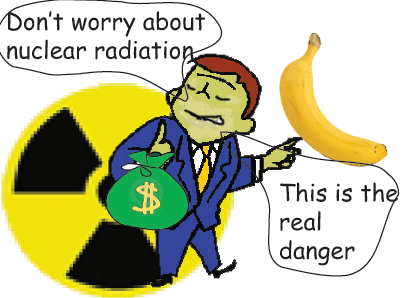
naturally occurring radioactive potassium K, with the nuclear fission produced radioactive isotopes…..Muller seems to have no understanding of the way in which bananas are used in the body
What Muller and Thomas are doing is following the script from the tobacco and asbestos industries.
This documentary “Uranium – twisting the Dragon’s Tail” is just Series One. I would love to know who helped to fund Gene Pool Productions for PBS and SBS to produce this. I’m betting that Series Two will follow before long, with a glossy and positive story about Generation IV nuclear reactors.
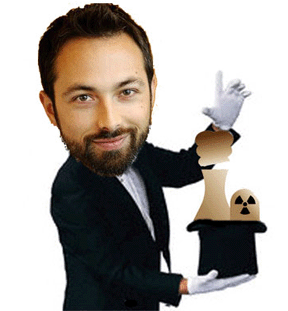 The half lie of the Dragon’s Tail. Online opinion, By Noel Wauchope Thursday, 27 August 2015 The documentary “Uranium – Twisting the Dragon’s Tail” is the latest glossy and highly sophisticated soft sell for the nuclear industry. It’s also, if you look at it closely, rather confusing.
I will start from the end, because that’s where the main message of this film comes out clearly “Just imagine a world where reactors can produce immense amounts of clean, safe, energy. There is no such thing as a future without uranium.” These final words are said against a background of soaring celestial choirs.
This seems to be the formula now, in nuclear promotion. The 2013 propaganda film “Pandora’s Promise” carried the same positive message – an ever rocketing energy demand to be met by ever increasing, indeed limitless, electrical energy provided by new nuclear reactors.
But, like ‘Pandora’s Promise’, this new documentary devotes the first two thirds of its series to discussing the negative aspects of the nuclear industry. Episode One covers its history, ill effects of radiation, the atomic bomb and its use. Episode Two continues this, with a sympathetic attitude to Australian Aboriginal concerns.
Unlike “Pandora’s Promise” this film does not denigrate anti-nuclear activists, and there is no attempt to ridicule Dr Helen Caldicott, as “Pandora’s Promise” did.
Indeed, the first two episodes are beautifully clear and accurate, as well as entertaining. Really, I couldn’t criticise them.
With the final episode – that’s when the message kicks in, and also when it gets confusing…….
Muller consistently mixes up “natural” radiation with ionising radiation from nuclear fission. He talks about background radiation as “natural”. There’s no mention of the increased ionising radiation in the biosphere as a result of the atomic bomb testing in the 1950s and 60s.
In Muller’s previous presentations on his YouTube show Veritasium, he has consistently confused the naturally occurring radioactive potassium K, with the nuclear fission produced radioactive isotopes, such as caesium 137 and strontium 90. As part of this confusion he constantly uses bananas as a comparison https://www.youtube.com/watch?v=TRL7o2kPqw0.
Cesium-137 is 12 million times more radioactive than potassium-40. Another highly-radioactive fission product, strontium-90, releases almost 20 million times more radiation per unit mass than does potassium-40. Muller seems to have no understanding of the way in which bananas are used in the body. The human species has had thousands of years of experience with bananas and other foods containing potassium 40 (K40). We have a natural trace level of K40 in our bodies. When we eat bananas, our bodies excrete the extra cesium, so by the natural process of homeostasis, our K40 level remains the same. This is not the case with the very recently created radioactive isotopes from nuclear fission; they remain….., there is absolutely no mention of the effects of internal emitters of radiation – that is, the radioactive isotopes breathed in or ingested, that can sit in a body’s organs for years, decades, emitting high dose gamma radiation..
Moving on to the Fukushima nuclear accident, we are told that the psychological effects are the serious ones. What a great piece of spin this is! Of course the psychological effects are extremely serious. Wouldn’t you be worried, if you were a pregnant woman, or if you feared that your child might later get leukaemia, because you decided to return to a radioactive environment? It is the reality of increased risk of fatal illness that accentuates the other disastrous consequences of that accident.
Prof Thomas assures us “The most important studies will be those on the mental effects”. In the context of this documentary, that just makes me envisage more documentaries like this one – with more spin about how we mustn’t worry about ionising radiation…….
The documentary appeared in Australia at a very convenient time for the South Australian Royal Commission. Dr Muller often covers his back with remarks about nuclear weapons “the most savage thing that man has ever built” and like his “feeling that renewables are going so fast – perhaps we can use alternatives”. But ultimately, his is a message of confidence in nuclear power. He says “Every year uranium saves more lives than it has ever destroyed” Really? Where are the facts to back up these kinds of statements? And all is spoken with guru like solemnity, and the backing of soaring holy choral music……..
What Muller and Thomas are doing is following the script from the tobacco and asbestos industries. They know full well that the toll of cancers, heart conditions, birth defects, from persistent exposure to ionising radiation will not become apparent for decades. They would have us believe that it will be impossible to establish ionising radiation as the cause of this toll of suffering and death…….
We are living in a strange time, where science is valued if it brings a benefit to corporations. Dr Derek Muller and Professor Geraldine Thomas are comfortably ensconced in that world. But there must be some scientists out there who are like Sir Richard Doll, and whose work is motivated by the public good.
And we desperately need those scientists.
This documentary “Uranium – Twisting the Dragon’s Tail” is just Series One. I would love to know who helped to fund Gene Pool Productions for PBS and SBS to produce this. I’m betting that Series Two will follow before long, with a glossy and positive story about Generation IV nuclear reactors. http://www.onlineopinion.com.au/view.asp?article=17624
Sendai nuclear plant operator set to plug leaks in 5 cooling system pipes
SATSUMA-SENDAI, Kagoshima Prefecture–The operator of the recently reactivated Sendai nuclear power plant here said it had pinpointed the sites of leaks that forced a postponement of full reactor operations.
Kyushu Electric Power Co. said it detected tiny cracks in five narrow pipes that carry seawater used to cool steam. The pipes are part of the steam condenser at the No. 1 reactor, which resumed operation on Aug. 11.
Output will be maintained at 75 percent of capacity, while the utility carries out checks for further holes.
Kyushu Electric was expected to release a final report on the glitch on Aug. 25. At the same time, it said fully restored reactor operations will be postponed from the scheduled date of Aug. 25.
The regional utility detected a tiny amount of seawater leaked into one of three condensers in the secondary cooling system of the reactor, which has an output of 890 megawatts, on Aug. 20.
The seawater was flowing in the condenser, a device that converts steam used in power generation to water by cooling it, and became mixed with the secondary cooling water that does not contain radioactive materials.
Kyushu Electric suspended operations of one of the two water circulation channels through the condenser at issue and inspected narrow pipes forming the system by passing an electric current through it.
Technicians found miniscule holes in five of 13,000 pipes they had inspected as of 10 a.m. on Aug. 24. After inspecting all the pipes, the workers will repair the faulty bits.
Kyushu Electric said the seawater was removed with a desalination device and operations at the No. 1 reactor were not hindered.
The reactor was restarted earlier this month for the first time since it was shut down for a periodic inspection in May 2011. Opponents of the plant have voiced safety concerns
Source: Asahi Shimbun
http://ajw.asahi.com/article/behind_news/social_affairs/AJ201508250046
Agreement reached on decontaminated water disposal
Fishers in Japan’s northeastern prefecture of Fukushima have formally allowed the release of decontaminated groundwater from around buildings of nuclear reactors into the sea.
The release is aimed at reducing production of heavily contaminated water in the basements of the buildings at the Fukushima Daiichi plant.
Groundwater flowing into the buildings is producing 300 tons of highly radioactive water daily, resulting in a huge number of storage tanks at the plant.
Plant operator Tokyo Electric Power Company, or TEPCO, and the government have been asking the fishers to allow the release to keep the water from flowing into the buildings and becoming heavily tainted.
TEPCO plans to use 41 wells already dug around the buildings to pump up the water and lower the levels of radioactive substances to between one-one-thousandth and one-ten-thousandth of their original amounts before releasing it.
The operator, the government and an independent institution plan to check so that only water below allowed levels is discharged.
On Tuesday, the local federation of fisheries cooperatives approved the plan on condition that the release rules are strictly followed and that compensation is paid for any damage due to harmful rumors.
Federation chairman Tetsu Nozaki said the approval was decided unanimously, but that some members were dissatisfied. He added that the plan is needed for steadily decommissioning the plant, and that he wants TEPCO and the government to keep their word.
The firm’s Fukushima headquarters chief Yoshiyuki Ishizaki said the plan is a big step forward in the decommissioning process as well as tackling the problem of contaminated water. He said fishermen told him that the plan could lead to rebuilding of Fukushima’s fishing industry, and that he will keep their remarks in mind.
TEPCO plans to start releasing the water soon.
Source: NHK
http://www3.nhk.or.jp/nhkworld/english/news/20150825_33.html
Fishermen OK TEPCO’s plan to dump Fukushima plant water into sea
FUKUSHIMA, Japan (Kyodo) — Fishermen in Fukushima Prefecture approved on Tuesday a plan by Tokyo Electric Power Co. to pump up contaminated groundwater continuously flowing into the stricken Fukushima Daiichi nuclear station and dump it into the ocean after removing almost all radioactive materials from it.
The plan is one of TEPCO’s key measures aimed at curbing the amount of toxic water buildup at the complex. Local fishermen had long opposed the plan amid concern over pollution of the ocean and marine products.
“I don’t know if it’s acceptable for all fishery operators, but stable work of decommissioning (of the Fukushima plant) is necessary for the revival of Fukushima’s fishery industry,” Tetsu Nozaki, chairman of the Fukushima Prefectural Federation of Fisheries Co-operative Associations, told reporters after a board meeting.
He also called on TEPCO to make sure it will only discharge water which does not contain radioactive materials exceeding the legally allowable limit.
The amount of toxic water is piling up every day, as untainted groundwater is seeping into the reactor buildings and mixing with radioactive water generated in the process of cooling the reactors that suffered meltdowns in the nuclear crisis triggered by a massive earthquake and tsunami in 2011.
By pumping up water through drainage wells and dumping it into the ocean after treatment, TEPCO said it will be able to halve some 300 tons of contaminated water being generated each day.
In exchange for approving the plan, the Fukushima fisherman’s association demanded on Aug. 11 that the government and TEPCO continue paying compensation for the fishermen as long as the nuclear plant causes damage to their business, among other requirements.
On Tuesday, the National Federation of Fisheries Cooperative Associations also gave the green light for the release of treated water into the sea.
TEPCO has been struggling to resolve the problem of toxic water buildup at the plant for more than four years after the nuclear crisis, with radiation leakages into the environment still occurring regularly at the complex.
The company is also behind schedule on a project to build a huge underground ice wall, another key measure to prevent radioactive water from further increasing at the site.
Source: Mainichi
http://mainichi.jp/english/english/newsselect/news/20150825p2g00m0dm075000c.html
Forest fires out of control around Lake Baikal in Siberia

 Massive wildfires transform Siberian paradise into disaster area Mashable, Andrew Freeman 25 Aug 15 Dozens of large wildfires are burning out of control around Lake Baikal in Siberia, which is the world’s largest freshwater lake by volume and the deepest lake, at more than 5,300 feet deep. The Lake Baikal area is a popular recreational area during the summer, with campgrounds and cottages surrounding the shoreline.
Because of the composition of the soil in this part of the world, these fires are spewing unusually high amounts of carbon into the atmosphere, thereby contributing to global warming.
The region has seen drier and milder than average weather this year, and a combination of natural and manmade fires have led to a cataclysmic scene, with thick smoke seen from space and orange-tinted skies on the ground.
In July, the Lake Baikal area was one of the most unusually mild areas on Earth, according to NASA data as well as information from the National Oceanic and Atmospheric Administration (NOAA).
Fires have been burning off and on in this area since April, when farmers traditionally burn dried grass to help fertilize the soil. However, this year, many agricultural fires in this region got out of control, killing at least two dozen people and destroying several villages.
The smoke even made it across the Pacific Ocean, making for red sunsets in the Pacific Northwest, which is now suffering through it’s own wildfire calamity………http://mashable.com/2015/08/24/massive-fires-are-surrounding-the-worlds-deepest-lake-in-siberia/
UK’s Hinkley Point C nuclear station is now officially mothballed
Hinkley C Mothballed – Is it in its Death Throes? http://www.no2nuclearpower.org.uk/news/comment/hinkley-c-mothballed-is-it-in-its-death-throws/ Two very recent articles in Click Green and Professional Engineer indicate that Hinkley Point C is now officially mothballed. Indeed the project seems to be in its death throes.

We already knew that site preparation work at Hinkley Point C was stopped in April 2015, up to 400 construction workers were laid off, and the Final Investment Decision was delayed until the autumn. (1) What wasn’t clear at the time was that NNB Genco – the consortium planning to build the reactors which consists of EDF Energy, China General Nuclear Corp and other investors – put a cap on future spending on the project. (2)
On 1st July the site entered Care and Maintenance which means that activity at the site is limited to the management of material stockpiles and water management zones, remediation of asbestos contaminated land and archaeological surveys. (3)
The budget cap seems to have been greater than the Office for Nuclear Regulation (ONR) was expecting. ONR, of course, charges NNB Genco for all the work it carries out to regulate its activities.
ONR says it has taken the decision to suspend the production of future inspection reports until a Final Investment Decision is made. It has also suspended attendance at the local liaison committee – the Cannington Forum. These suspensions are most likely because NNB Genco no longer has the budget to pay for them, so the consortium will have asked ONR to stop visiting the site to do inspections and stop attending the forum because it can’t afford to pay. In retaliation ONR says it is “monitoring the impact of the budget constraint upon NNB Genco’s competency and capability”. In other words NNB Genco had better watch out or it will lose its status as an organisation competent and capable of holding a nuclear license.
ONR says its inspectors “continue to engage with the programme of design and safety case activities” related to the start of nuclear safety related construction. Its August newsletter said that further submissions are expected in September this year and the Pre Construction Safety Case related to nuclear island construction was ready for ONR to begin initial engagement at the end of July this year. (4)
So while some desk work appears to be continuing all major work on-site appears to have stopped and NNB Genco is so uncertain that the final investment decision will be positive it has asked ONR to stop as much work as possible to save money – even to the point of threatening its own status as a nuclear capable organisation. The Click Green website says:
“Despite recently publishing a list of preferred suppliers for the £24 billion project, the French firm were in behind-the-scenes talks with the Office for Nuclear Regulation (ONR), during which they informed them of their decision to mothball the site.”
It looks as though it may be all over for Hinkley Point C bar the shouting.
(1) Gloucestershire Echo 2nd April 2015 http://www.gloucestershireecho.co.uk/400-jobs-lost-Barnwood-based-EDF-stops-site-work/story-26271600-detail/story.html
(2) Click Green 20th Aug 2015 http://www.clickgreen.org.uk/news/national-news/126381-exclusive-edf-mothballs-planned-hinkley-c-nuclear-power-site.html
(3) Professional Engineering 20th Aug 2015 http://www.power-eng.com/articles/2015/08/construction-halted-at-hinkley-point-c-nuclear-project-site.html
(4) See page 7 ONR Regulation Matters August 2015http://www.onr.org.uk/documents/2015/regulation-matters-issue-1.pdf
Lockheed Martin used government nuclear money to lobby for more government nuclear money
 Lockheed Martin fined for using government money to lobby for more government money, http://theweek.com/speedreads/573689/lockheed-martin-fined-using-government-money-lobby-more-government-money The Week, Bonnie Kristian, 25 Aug 15,
Defense contracting giant Lockheed Martin has agreed to pay a fine to settle charges that the company illegally lobbied for a major government contract using federal funds. Lockheed targeted members of Congress and the Obama administration from 2009 to 2014, using money that had been allocated for research in a previous federal contract.
This is not the first time the contractor has used tax dollars to lobby for additional income. The Energy Department investigation that exposed these lobbying habits suggested Lockheed “felt empowered [to lobby this way] because it had improperly directed federal funds to similar activities in the past.”
The contract Lockheed unethically sought was worth $2.4 billion annually, and the company’s 2014 revenues totaled $45.6 billion — but the settlement payment was just $4.7 million. It’s a “slap on the wrist for the world’s biggest defense contractor to pay,” according to Jay Coghlan of Nuclear Watch New Mexico, who argues that Lockheed “engaged in deep and systemic corruption” which should result in criminal prosecution.
St Louis suburb contaminated by radioactive thorium
 Nuclear Waste Taints St. Louis Suburb, Radioactive thorium found at residential properties is linked to nuclear-weapons work done decades ago ,WSJ, By JOHN R. EMSHWILLER Aug. 23, 2015
Radioactive contamination has been discovered at three residential properties in the St. Louis area, adding fuel to a long-running controversy about how much damage was done to the environment and possibly people’s health by nuclear-weapons work performed there decades ago.
The U.S. Army Corps of Engineers, which disclosed the finding last week, said it was the first time it found such contamination on residential properties while cleaning up waste related to weapons programs in the St. Louis area……….
For years, the Corps has been cleaning up largely industrial and commercial sections in the St. Louis area that were contaminated as part of the weapons-program work that began during World War II. The national legacy of radioactive and chemical contamination from the atomic-weapons program, including its impact on St. Louis, was examined in a 2013 Wall Street Journal series.
The contaminated residential properties are near Coldwater Creek, which, which has been at the center of ongoing tensions over the past few years runs through suburban areas northwest of downtown St. Louis and passes an area formerly used to store weapons-program waste.
Federal officials have long acknowledged contamination got into the creek, which feeds into the Missouri River, and included it in their cleanup work. How far the taint was carried has remained a question.
Current and former residents of nearby areas have argued that contamination from the creek had spread into their neighborhoods during periods of flooding and they have pushed for extensive sampling of houses and yards. They also contend residents have suffered from an unusually large number of cancer cases and other maladies possibly linked to radioactive contamination………
Last September, the Missouri Department of Health & Senior Services wrote a letter to federal authorities saying it had found a significantly higher incidence of leukemia in areas around Coldwater Creek though it hadn’t determined whether there was a link to weapons-program contaminants. It asked them to join in a health study.
Last week, a spokesman for the state health department said it is still in discussions about what steps to take next. The St. Louis County Department of Public Health is putting together its own health-study effort, said its director, Faisal Khan.
“The community around Coldwater Creek continues to have severe concerns about their own health and how much their health problems might be related to where they lived,” he said.
A spokeswoman for the federal Agency for Toxic Substances and Disease Registry, which was invited to participate in the study, didn’t have an immediate comment. In the past, the agency has said it was working with state officials and referred questions to them.
Write to John R. Emshwiller at john.emshwiller@wsj.com http://www.wsj.com/articles/nuclear-waste-taints-st-louis-suburb-1440361689
“Trojan horse’ – anti nuclear protest in Pretoria, South Africa
Green Peace activists protest against SA’s nuclear power plans http://citizen.co.za/652983/green-peace-activists-protest-against-sas-nuclear-power-plans/ Valeska Abreu , 25 Aug 15,
Green Peace activists have tied themselves to a four meter high Trojan horse which has been changed to a pillar at the entrance of the Department of Energy in Pretoria.

They are silently protesting against South Africa’s plans for nuclear power. Four activists are sitting on the cold cemented floor wearing white safety overalls and masks, holding up placards that read “no future in nuclear” and “solar is the solution”.
The activist group is calling for the department to focus its plans on renewable energy rather than nuclear. Melita Steele, senior climate and energy campaign manager, says nuclear energy is a trap and could bankrupt the country.
The lobby group wrote a letter of demands to the department seven days ago but say they have not received any response. “It’s indicative of how the department is engaging on the issue of nuclear,” said Steele.
She said they would remain outside the department until they received feedback.
Under pressure from banks, Japan pursuing unfeasible Fukushima nuclear cleanup
This Former Nuclear Industry Executive Claims the Fukushima Cleanup Plan Is Infeasible, VICE, August 12, 2015 by Thomas Marsh “………….Arnie Gundersen: I can’t reveal my sources, but they are very significant diplomats who have told me that the pressure on the Diet (Japanese parliament) from the electric companies is astronomical. The companies that own the plants want to get their money back, but these plants have been shut down for five years and the staff of approximately seven hundred people have been retained; and the taxes have been paid, and the towns that they are in haven’t seen any decline in their economy… even though these plants aren’t generating revenue. So where does the money come from?
The answer is that two or so billion dollars has been lent by banks to keep the utilities afloat, because utilities don’t have two billion dollars in cash sitting around. Now, it’s payback time for the bankers, and between the banks who want their two or three billion back, and the utilities that want their investment—which is probably in the order of $10 or $20 billion—back, then the pressure on the Diet is astronomical. Big money is pushing very hard to get these reactors started back up.
So you say they’ve proposed a 30-year cleanup, and you don’t think this is possible, correct?
No, I’m sure it’s not. A normal, clean power plant takes about ten years to decommission, and by “clean” I mean where literally the workers are working in street clothes most of the time. There are very few places in the plant where they’d have to put on what we call PCs—protective clothing. The white uniforms you see all over Fukushima… I’ve worked in nuclear power plants and only once or twice have had to wear those.
You can literally walk through most power plants in your street clothes, and the reason they have to wear them outside at Fukushima is because the radiation fields are so high. What’s happening now is that the ground is highly radioactive. In some areas where the radiation level is so high they’ve even put steel plates on top of the ground so that people could walk there. That’s not a normal decommissioning………
It’s a show. This is all about showing the Japanese that it’s not too bad, and we can run our other 40 or so plants fine, trust us. It’s definitely symbolic for the Japanese, but the real reason is the banks want their money back…….http://www.vice.com/read/japan-fukushima-clean-up
1 This Month
Chernobyl: The Lost Tapes – A good documentary on Chernobyl on SBS available On Demand for the next 3 weeks– https://www.sbs.com.au/ondemand/tv-program/chernobyl-the-lost-tapes/2352741955560

of the week–London Campaign for Nuclear Disarmament

Tell the Ukrainian Government to Drop Prosecution of Peace Activist Yurii Sheliazhenko
To see nuclear-related stories in greater depth and intensity – go to https://nuclearinformation.wordpress.com
-
Archives
- April 2026 (114)
- March 2026 (251)
- February 2026 (268)
- January 2026 (308)
- December 2025 (358)
- November 2025 (359)
- October 2025 (376)
- September 2025 (257)
- August 2025 (319)
- July 2025 (230)
- June 2025 (348)
- May 2025 (261)
-
Categories
- 1
- 1 NUCLEAR ISSUES
- business and costs
- climate change
- culture and arts
- ENERGY
- environment
- health
- history
- indigenous issues
- Legal
- marketing of nuclear
- media
- opposition to nuclear
- PERSONAL STORIES
- politics
- politics international
- Religion and ethics
- safety
- secrets,lies and civil liberties
- spinbuster
- technology
- Uranium
- wastes
- weapons and war
- Women
- 2 WORLD
- ACTION
- AFRICA
- Atrocities
- AUSTRALIA
- Christina's notes
- Christina's themes
- culture and arts
- Events
- Fuk 2022
- Fuk 2023
- Fukushima 2017
- Fukushima 2018
- fukushima 2019
- Fukushima 2020
- Fukushima 2021
- general
- global warming
- Humour (God we need it)
- Nuclear
- RARE EARTHS
- Reference
- resources – print
- Resources -audiovicual
- Weekly Newsletter
- World
- World Nuclear
- YouTube
-
RSS
Entries RSS
Comments RSS
 nuclear-news