More Wildfires Near Chernobyl; Europe Must Help with Firefighters & Prevention; Fires are Important Consideration for Chernobyl Spent Fuel Facility; Holtec’s History of Corruption Should Exclude Them from the Project


Plume of smoke from fire near Chernobyl from Terra MODIS (NASA) image of 10 August 2015 via Greenpeace Russia
Fires in the Chernobyl Exclusion Zone continue to be a major hazard, which can impact Europe depending on the wind direction and which, in a worst case scenario, could make Europe uninhabitable. Europe needs to be sending firefighting manpower and expertise, including forestry experts, no strings attached, to help the Ukraine prevent and stop these fires.
Fire should be foremost in everyone’s minds, when considering the Ukraine’s new nuclear waste facility. This should include consideration of use of German dry casks, which resist fire for one hour.[1] The US transportation casks are only required to be resistant for 30 minutes in fire, and the US licensed non-transportation dry casks (which includes French ones), are even less resistant. Innovation is desperately needed for safe nuclear fuel storage. Focus needs to be on…
View original post 699 more words
How the BBC distorted the story of Sellafield
The spectre of the new nuclear renaissance
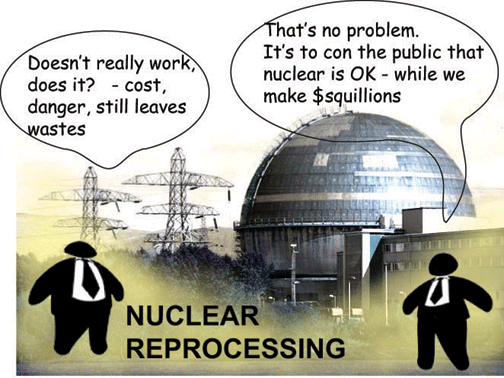
Al’Khalili then went on to give every impression that high level nuclear waste can be safely stored using the process of ‘vitrification’, that is, turning it in glass, and so binding the waste safely into a permanent, impermeable matrix.
What he failed to mention is that the glass is by no means permanent and durable storage medium for “thousands of generations” as the glass is liable to break down – and that the problem of long term disposal of these wastes remains unsolved. For example, asR C Ewing and colleagues wrote in 1995 in the journal Progress in Nuclear Energy,
“the post-disposal radiation damage to waste form glasses and crystalline ceramics is significant. The cumulative α-decay doses which are projected for nuclear waste glasses … are well within the range for which important changes in the physical and chemical properties may occur, e.g. the transition from the crystalline-to-aperiodic state in ceramics.”
 ‘Inside Sellafield’ and military plutonium – the BBC’s nuclear lies of omission http://www.
theecologist.org/reviews/2984689/inside_sellafield_and_military_plutonium_the_bbcs_nuclear_lies_
of_omission.html Dr David Lowry 12th August 2015
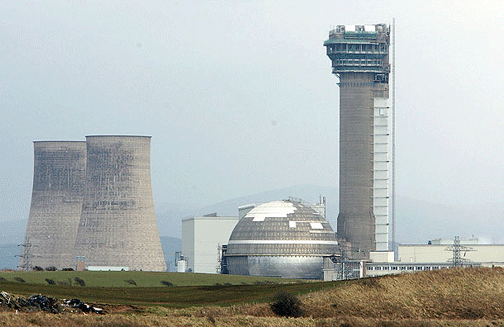 Lowry – understating the severity of accidents, concealing the role of the UK’s nuclear power stations in breeding military plutonium, and giving false reassurance over the unsolved problems of high level nuclear waste.
For one of these programmes the BBC commissioned Baghdad-born Professor Jameel ‘Jim’ Al-Khalili, theoretical physicist and Chair in the Public Engagement in Science from the University of Surrey, to research and present one programme called ‘Britain’s Nuclear Secrets: Inside Sellafield‘.
As a regular BBC broadcaster, hosting the long-running The Life Scientific on Radio 4, and maker of several science television programmes on television, including on quantum physics and the history of electricity, he was eminently qualified to make this programme.
However the programme was highly misleading thanks to major omissions, concealing the severity of accidents, and how the UK’s entire ‘civilian’ nuclear programme was subverted into producing military plutonium that fed into the Sellafield bomb factory. Continue reading
Sendai nuclear station restarted because economics are ‘more important’ than human life
The real reasons for the restart. The decision to restart the reactor at Sendai is probably based upon the “dismal science:” economics. It seems that financial considerations and worries about the health of the national and local economies triumphed over safety concerns.
 The prefecture and the nearest city are financially dependent on nuclear energy.
Satsumasendai city receives more than $12 million in grants annually from the nuclear industry, which it uses to pay for its public and educational facilities, receiving about $270 million over the years.
There are also questions of transparency in the dealings of local government authorities with Kyushu Electric Power.
Economics was considered more important than human life: That is why the Sendai nuclear power plant was able to restart.
Why was the Sendai nuclear power plant restarted? http://thebulletin.org/why-was-sendai-nuclear-power-plant-restarted8644 Tadahiro Katsuta 13 Aug 15 Two of Japan’s reactors—Units 1 and 2 of the Kyushu Electric Power Company’s Sendai nuclear power plant—have just restarted, and Unit 1 should begin generating electricity on August 14. Like all other Japanese nuclear power plants, Sendai was shut down after the events at Fukushima Daiichi in 2011, in which an earthquake, a tsunami, egregious design mistakes, and a poor safety culture combined to form “a cascade of stupid errors” that led to a triple meltdown.This is the first restart of any of Japan’s 43 operable commercial reactors since Fukushima, and it is happening despite many unresolved questions concerning nuclear safety regulations. When it comes to safety, the Sendai nuclear power plant is definitely not at the head of the class: The utility owning the power plant was given a pass despite a very problematic history. (At one point, a regulatory commissioner called the plan to restart Sendai “wishful thinking”.)
There is certainly no nationwide re-emergence of nuclear power in Japan. Indeed, there have been vocal public protests against the Sendai restart. One of the protestors even included a former prime minister of Japan.
So, why is it happening? What are the ostensible reasons for a restart? Were they valid?
A three-pointed rationalization. The justification for a restart was based upon three key points: the type of reactors to be used at Sendai were considered inherently “safer;” the chance of a similar natural disaster(s) was considered to be minimal; and the concerns of the local communities were dismissed as inconsequential.
Let us look at each of these items in turn. Continue reading
Hear Dr Helen Caldicott, on Japan’s nuclear power restart
 Q&A: Dr. Helen Caldicott on Japan’s nuclear power restart, Free Speech Radio News BY PRODUCER · AUGUST 12, 2015 DOWNLOAD AUDIO ………”The majority of Japanese people, 60 or 70 percent, are opposed to the reopening of reactors. There’ve been many, many demonstrations, but I’m afraid money counts over there. And Tepco and Toshiba are really the government, and when they decide it goes ahead. It is also being…it’s also happening because the nuclear industry in America is exerting a huge amount of pressure upon the Japanese industries to open again, for several reasons: a) It will increase the amount of
  uranium; b) [It will] encourage the nuclear industry in America; and c) Japan is a major producer of parts of nuclear reactors – the reactor vessel, etc. etc. – which they export all over the world, to Turkey and elsewhere. So there’s a huge amount of money involved and they don’t really care, let’s be frank, about people’s health. Although now, about a hundred and…over a hundred and nine children have developed thyroid cancer in the Fukushima prefecture, and the number of incidents in that population is one to two per million.”……
“There were three meltdowns – never before occurred in the history of the nuclear age – major meltdowns. So, I mean, everyone accepts there were three major meltdowns. That’s a fact. That’s a fact. That’s like me trying to substantiate that there’s a nose on your face. Um, it’s a fact, scientific fact. And it’s an absolute catastrophe. They’ll never clean it up. They won’t be able to get to those three melting cores, because if you stand next to them for a couple of minutes you’ll die. And no one’s ever thought about three major meltdowns that were in fact harder…hard to get those cores out. It will be impossible.”
CC: Some people appear to be taking comfort that this is not in fact the crippled Fukushima plant and it is not operated by Tepco. And they also believe that Sendai is not exposed to the same level of risk.
Dr. HC: It matters not who manages nuclear reactors. All meltdowns, and there have been quite a few, have been caused by human fallibility. They built six nuclear reactors just near an earthquake fault, at sea level, and they knew that they were doing that, and in fact the independent commission on Fukushima – set up by the Japanese government – said it was human fallibility and human faults. Sendai will be managed by humans with their fallibilities, number one, and number two, it’s near an active volcano. Japan is a very volcanic, earthquake-ridden area, and to build nuclear reactors on Japan, in the mainland or elsewhere, is pure foolishness.”……..
“Most doctors don’t really understand the medical effects of radiation; you have to study that. I’ve spoken to huge areas, or groups, of concerned parents who know nothing about it and are desperate for the truth, even if it’s bad. I’ve testified before a government commission in the parliament. I’ve spoken to various Japanese politicians, but the truth is, they have no power. It’s [Prime Minister Shinzō] Abe who’s determining the whole thing. And it’s money that’s determining it. And the Japanese government, really they give no heed to people’s suffering. And just to add another addition to this, the doctors have been told not to tell their patients that their symptoms are related to radiation. It’s a horrifying medical situation.”……..http://fsrn.org/2015/08/qa-dr-helen-caldicott-on-japans-nuclear-power-restart/
“Trillions of becquerels of radioactive material still flowing into sea” at Fukushima
 Officials: “Trillions of becquerels of radioactive material still flowing into sea” at Fukushima — Map shows nuclear waste coming up from bottom of ocean far offshore — Japan TV Journalist: “Contaminated seawater will circulate around globe… disaster like a huge cloth expanding everyday” (VIDEO) http://enenews.com/officials-trillions-becquerels-radioactive-material-flowing-sea-fukushima-map-shows-nuclear-waste-flowing-bottom-ocean-offshore-japan-tv-journalist-contaminated-seawater-will-circulate-around-gl?utm_source=feedburner&utm_medium=email&utm_campaign=Feed%3A+ENENews+%28Energy+News%29
Interview with NHK journalist Morley Robertson, by the Center for Remembering 3.11, published Jun 30, 2012 (emphasis added): I begin with the radiation leakage. Radiation leakage exerts a long term effect on the environment. It contaminates our food chain, the groundwaterand the ocean. And the contaminated seawater will circulate around the globe. We never know how much this will impact on the environment… We’ll never able to study such issues with empirical certainty… [Due to nuclear testing] we have already accumulated “hidden losses” of radiation damage… how much is the [Fukushima] cesium in relation to that?… I believe we should enjoy delicious food rather than worrying about the food. I enjoyed the town’s delicacy… I didn’t mind about how the beef was produced or where it came from. As long as it is tasty, it is no problem for me. With regard to radiation, I have become more optimistic. My hypothesis is that it’s no use worrying about radiation. For people in Fukushima, they have a lot to worry about their future, like damaged reputation… One reason why we have relied on nuclear plants is because we didn’t know about the facts… We need to face the facts… Rad-waste from the nuclear cycle is said to be unsolvable even after 2.5 million years.
Part II of Robertson’s Interview, published Jun 30, 2012: In 1974, then PM Tanaka declared, “Let ‘s go nuclear!”… we were issued credit cards to buy electric goods to consume the extra electricity… It is OK to say that everything was just a lie… and 3/11 happened. So we must study everything. It isno longer about what to do with Onagawa nuclear power plant, Miyagi or Tohoku. This is about what to do with Japan. This has been revealed by our vulnerability to the accident… So when we talk about “disaster“, it’s like a huge wrapping cloth expanding everyday.
- NHK: Morley is a journalist… working in the fields of television, radio, and lecture meetings… he studied at the University of Tokyo and Harvard University.
- Robertson’s Wikipedia entry (translated from Japanese by Microsoft): In 1968, because of father’s job moved to… Hiroshima [to work] on Atomic Bomb Casualty Commission [and] undertook study of atomic bomb patients.
TEPCO, updated Mar 10, 2015: Fukushima Daiichi Contaminated Water Issue FAQ — Q1Please explain the impact of the leaked radioactive materials on the sea. [Answer:] TEPCO announced that underground water including radioactive materials had leaked into the port… It has been implied that trillions of becquerels of radioactive materials are still flowing into the sea; however, the concentration of radioactive materials in the sea is at a level that meets the Guidelines for Drinking-water Quality, except for some areas…
TEPCO, Apr 28, 2015: Comprehensive risk review was implemented, considering all the possible risks that might have an impact outside the Fukushima Daiichi NPS site… Thepaths through which water could leak outside the site: …
- Sources of risk — Trenches… Pits… Tanks… Accumulated water inside reactor buildings… Contamination inside the port
- Leakage routes — Ground surface… Drainage channels… Underground (groundwater)
- Destination of the contaminated material… The Sea: Unit 1-4 water intake channel… Inside the port… Outside the port
Iran could not hide evidence of nuclear weapons work
 Why it’s impossible to hide nuclear work in 24 days – or 24 years, REUTERS, By Yousaf Butt August 13, 2015 One of the most misleading distortions being floated by political opponents of the Iran nuclear deal is the “24-day” loophole meme: Iran would be able to hide all evidence of any nefarious nuclear weapons work during the 24 days it may take inspectors to gain access to a suspicious site.
 For starters, International Atomic Energy Agency inspectors would have continuous daily access to all Iran’s declared nuclear facilities. If Iran does not allow anytime inspections of any declared site, it could result in the reimposition — or “snapback” — of sanctions.
The 24-day rule applies only to undeclared suspect sites anywhere in the country. Because inspections anywhere at any time can be complicated to work out, a procedure was devised to address the problem.
Why 24 days? Iran and the atomic energy agency first would have a maximum of 14 days to come to an understanding about how to carry out the new inspections. In the absence of an agreement, the members of the Joint Commission – the United States, Britain, France, Germany, China, Russia and Iran — must resolve the issue, by consensus or a vote, within seven days. Tehran would have three days to implement the decision. So, the 24 days is not a gift to Tehran that would allow it to hide potential nuclear malfeasance — it is just the maximum periodallowed to hammer out a way to inspect any undeclared suspicious facility in Iran.
More important, critics insist, Iran could use those 24 days to hide evidence of nuclear materials. This is not going to happen. It would be virtually impossible even in 240 days, let alone 24. Even a nanogram, or one-billionth of a gram, of leftover dust from nuclear-weapons related work — such as covert enrichment at a suspect site — could be detectable.
The main way the agency could find incriminating dust is with a “swipe sample” using a super-clean cotton cloth. The wipe would be applied to surfaces, especially where dust naturally collects, including corners of a room, cracks, bolt holes, equipment interiors and where walls meet the floor.
As the agency itself states: “Any nuclear process … will also produce particulate materials with particle dimensions in the 0.1 [to] 10 micrometer range. Such small particles are believed to be quite mobile and will travel several meters from their point of origin due to air currents or human activity. This mobility also makes it extremely difficult to clean up an area to such an extent that no particles remain available for swipe sampling.” [emphasis added]
The swipe samples from a suspect site would be taken to a laboratory, where the atomic energy agency can use a variety of highly sensitive methods to pick up any infinitesimal incriminating nuclear particles. Isotopic ratios, chemical forms or particle shapes can all provide clues about where the nuclear material came from and how it was produced.
One particularly powerful method is known as “fission track-secondary ion mass spectrometry.”Particles from a swipe sample are irradiated with neutrons on a Lexan (plastic) plate. If there are fissile materials in the sample, they would become unstable and split apart; heavy fission-product particles would be produced. In sufficient quantities, these particles would leave tracks in the plate that can be viewed by acid etching……….
The bottom line is that it is almost impossible to get away with messing around with nuclear materials. Nuclear fingerprints are not removable.
“You cannot get rid of them by cleaning,” Stephan Vogt, head of the atomic agency’sEnvironmental Sample Laboratory told Reuters in 2013. “You cannot dilute them to the extent that we will not be able to pick them up. It is just a matter of time,” he stated, before the atomic energy agency detects any incriminating residue………..
Twenty-nine top U.S. scientists — including Nobel Prize winners, senior experts in arms control and former White House science advisers – wrote to President Barack Obama this past weekend to praise the Iran deal. They called it “technically sound, stringent and innovative.” Instead of listening to the complaints about the 24-day meme, Congress should pay heed to these experts. http://blogs.reuters.com/great-debate/2015/08/13/why-its-impossible-to-hide-nuclear-work-in-24-days-or-24-years/
$4.1-million settlement to Hanford nuclear weapons site whistle-blower
Tamosaitis, who is well-known within the small community of experts in chemical mixing technology, had the largest national impact. The concerns he raised led the Energy Department to order a full-scale test of the mixing system, which has yet to be completed.
“The safety culture in the entire Energy Department complex is bad,” he said. “The Energy Department needs to clamp down on the contractors. It is systemwide.”
 Hanford nuclear weapons site whistle-blower wins $4.1-million settlement LA Times, By RALPH VARTABEDIAN contact the reporter Twitter: @rvartabedian When Walter Tamosaitis warned in 2011 that the Energy Department’s plans for a waste treatment plant at the former Hanford nuclear weapons complex were unsafe, he was demoted and put in a basement room with cardboard boxes and plywood for office furniture.
Tamosaitis had been leading a team of 100 scientists and engineers in designing a way to immobilize millions of gallons of highly toxic nuclear sludge as thick as peanut butter. The sludge, which could deliver a lethal dose of radiation to a nearby person within minutes, is stored in leaking underground tanks near the Columbia River in Washington state.
Two years later, Tamosaitis was fired after 44 years with San Francisco-based engineering firm URS, which was later acquired by Los Angeles-based AECOM. He filed a wrongful termination suit but encountered some initial legal setbacks, and it looked as if he had been blackballed from the industry.
But on Wednesday, Tamosaitis won a $4.1-million settlement from AECOM, among the largest known legal damages paid out to a whistle-blower in the Energy Department’s vast nuclear waste cleanup program. Continue reading
(?temporary) rejoicing in nuclear camp, over Sendai reactor restart
Japan’s nuclear restart is psychological boost, says Cameco CEO Gitzel, Star Phoenix,BY CHRISTOPHER DONVILLE, BLOOMBERG AUGUST 11, 2015 VANCOUVER — The first restart of a Japanese nuclear reactor since the 2011 Fukushima disaster will be “psychologically” important to the atomic industry, the world’s second-largest uranium producer said………http://www.thestarphoenix.com/technology/Japan+nuclear+restart+psychological+boost+says+Cameco+Gitzel/11282314/story.html
American Inventor of Failed Pebble Bed Nuclear Reactor Design Became Solar Expert by 1950s

Farrington Daniels (March 8, 1889 – June 23, 1972)
The Nuclear Pebble Bed Reactor concept was invented by an American in 1944, and considered by the US government but “encountered numerous design problems” and was dropped. While initially disappointed, the inventor, Farrington Daniels, moved quickly to solar energy before eventually dying of liver cancer. He apparently paid the price for his stint with the Manhattan Project, as plutonium has a half life in the liver of around 50 years. Remaining a lifetime in the liver and bones, it has plenty of opportunity to cause cancer. Jimmy Carter would have been exposed to plutonium during the Chalk River Nuclear Accident clean-up, and was just diagnosed with liver cancer.
Later the US taxpayer funded more study of the Pebble Bed, which still proved a failure. In the same period, the Germans decided to adopt the Pebble Bed, which failed dangerously in nuclear…
View original post 2,166 more words
August 13 Energy News

World:
¶ Egypt has invited bids for the development of 500 MW of renewable energy projects, including one solar PV, one concentrating solar power (CSP), and one wind power project. The Egyptian Electricity Transmission Company and the New and Renewable Energy Authority announced separate tenders for 250 MW of wind, 200 MW of PV and 50 MW of CSP capacity. [SeeNews Renewables]
 Kuraymat solar-natural gas power plant in Egypt. Author: Kuraymat. License: Creative Commons.
¶ Solar energy generation surged by around 153% over the last year in the UK, according to analyst company EnAppSys. The new report also notes that, while solar PV generation currently accounts for only 4% of the UK’s electricity supply, that growth in the industry was already causing “oversupply” to the grid, thus contributing to negative market prices during some periods. [CleanTechnica]
¶ French utility Engie, formerly GDF Suez, has started construction…
View original post 518 more words
BBC 4 “INSIDE SELLAFIELD” INFOMERCIAL – COMPLAINT

 Enthusiast for Moorside – Jim Al-Khalili
It is difficult to know where to begin with this but have submitted a complaint to the BBC …….you can do the same here
Your Complaint
Type of complaint:
Television
Choose channel:
BBC Four
Programme title:
Britain’s Nuclear Secrets: Inside Sellafield
Transmission date:
10/08/2015
Broadcast type:
Recorded/On demand
How long in to the show:
:
Complaint category:
Bias
Contacted us before:
No
Complaint title:
Biased Infomercial
Complaint description:
The programme purports to be investigative journalism when it is an infomercial for the nuclear industry and the government’s new build agenda.
“The real story” suggests impartiality. While the programme reiterates in a misleadingly superficial way the known dangers of nuclear power there was no attempt at all by the programme makers to speak to opponents of nuclear power or even whistleblowers from within the industry.
PR group Copper Consultancy have advised the nuclear industry/government bodies…
View original post 131 more words
Rise of the machines? The energy implications

 Figure 1: Will the machine’s rise up to overthrow us?
There’s been quite a lot of discussion on the internet recently on the topic of AI (Artificial Intelligence), prompted by several movies out on the topic (the latest Terminator one, Ex-Machina, Chappie, Interstellar, etc.), as well as the British TV series Humans (actually a remake of a Swedish TV series). We’ve also had dire warnings from Stephen Hawking and Bill Gates about how AI could spell the end for humanity (and this from the guy who came up with Windows?). Others worry that AI’s might steal all of our jobs. Anyway, I thought it would be useful to bring a engineering prospective to this topic and try to separate the plausible from the implausible.
 Figure 2: The trouble with robots….some strings attached!
For starters if you ever look at those walking robot brought out by the likes of…
View original post 2,655 more words
Obama’s Nuclear “Climate Change” Plan Proves Carter’s Unlimited Political Bribery Point
Candidate Obama said: “I don’t think there’s anything that we inevitably dislike about Nuclear Power. We just dislike the fact that it might blow up and irradiate and kill us“. (Keene Sentinel Interview, 2007)
Under President Obama’s EPA: “States will be able to get credit for nuclear energy plants that are under construction, as well as for upgrading plants and preserving those at risk of early retirement, the EPA said. Nuclear currently provides around 20 percent of the U.S. energy mix.” (Reuters, Sunday, 2 August 2015) [1] It is important to recall that nuclear energy creates a carbon footprint from mining to uranium processing to make the fuel to the cooling of nuclear waste for years and the guarding of nuclear waste for perpetuity. It also produces greenhouse gases, such as ozone, through radiolysis. It directly produces Krypton which is a greenhouse gas precursor.
President Jimmy…
View original post 1,657 more words
 Hajime Anbe says he cannot abide the reactivation of the Sendai Nuclear Power Plant’s No. 1 reactor as an evacuee of the ongoing Fukushima nuclear disaster, in Shimotsuke, Tochigi Prefecture.
The tone of Hajime Anbe’s voice, usually soft, becomes forceful when asked about the reactivation of the No. 1 reactor at Sendai Nuclear Power Plant in Kagoshima Prefecture.
“I cannot believe that a nuclear reactor has been restarted when the prospects of decommissioning the stricken Fukushima plant are still unclear,” he says. “It’s absurd, and rattles the nerves of those of us who have had to evacuate.” As a result of the Fukushima crisis, the 79-year-old Anbe has been forced to flee his home in the prefectural town of Namie and is temporarily living in Shimotsuke, Tochigi Prefecture. He is among the 110,000 people still evacuated, four years and five months since the disaster broke out.
Anbe has a bitter past. In the latter half of the 1960s, Tohoku Electric Power Co. announced the possibility of building a nuclear power plant in Namie and neighboring areas. The planned site was approximately one kilometer east of Anbe’s home. Convinced that such a plant would bring more jobs to his town, Anbe agreed to allow the road behind his home to be used as a route to the plant. He worked to obtain the support of other local residents and took care of the road, cutting the grass that grew on it.
Ultimately, due to residents’ objections and other factors, the plan fell through. Looking back, Anbe says, “I completely believed in nuclear power’s ‘safety myth.’ I should’ve done more research.”
His love for his hometown goes back 70 years, to the end of World War II. When his two older brothers returned from the battlefield, they expressed relief that even though Japan had lost the war, they had a hometown to return to. They told him that now that peace had arrived, they should work to make their hometown into a great place. With that ambition in his heart, Anbe took over the family’s farming business, expanded their farmland to six hectares, and devoted himself to growing rice.
His home in Namie is in a zone designated as preparing for the lifting of an evacuation directive. Because he believes his hometown will cease to exist unless its residents return, Anbe is planning to go back as soon as the evacuation order is lifted. An increasing number of residents are giving up any hopes of returning, however, disappointed that the crisis is far from being brought under control.
“Our hometown survived the war, but this time it might really disappear,” Anbe laments. And that fear is what pushes him to object to the reactivation of nuclear reactors, which feels to him like pretending the Fukushima disaster never happened.
Source: Mainichi
http://mainichi.jp/english/english/newsselect/news/20150812p2a00m0na007000c.html
Japan resumes nuclear reactor operation for 1st time in 2 years

Kyushu Electric Power Co. on Aug. 11 restarted the No. 1 reactor at its Sendai Nuclear Power Plant in Satsumasendai, Kagoshima Prefecture, making it the first reactor to be reactivated under new safety regulations established in the wake of the Fukushima nuclear disaster.
It was the first time in about two years for a nuclear reactor to operate in Japan, after the No. 3 and No. 4 reactors at the Oi Nuclear Power Plant in Fukui Prefecture were shut down in September 2013. The Kagoshima plant’s 890 megawatt No. 1 reactor had been inactive for around four years, three months.
At 10:30 a.m. on Aug. 11, a lever in the Sendai Nuclear Power Plant’s central control room was operated to remove rods controlling nuclear fission from the reactor. The reactor is expected to reach criticality at about 11 p.m. the same day.
After the reactor reaches criticality, Kyushu Electric Power Co. will check that it can be safely shut down, and if there are no problems, power generation and transmission will begin on Aug. 14. The power company will bring the reactor to full operating capacity in stages while checking the temperature and pressure inside the reactor.
If Japan’s Nuclear Regulation Authority (NRA) finds no problems with the reactor during an inspection, commercial operation will resume in early September.
Operation of the No. 1 reactor at the Sendai Nuclear Power Plant was suspended in May 2011 for a regular inspection. Since the reactor has been offline for a long time, possible trouble caused by deterioration of pipes and other equipment has been feared. It is rare globally for a reactor to be restarted after being offline for more than four years.
NRA Chairman Shunichi Tanaka has commented that various problems are envisaged, and the nuclear watchdog is therefore seeking solid safety precautions. The power company has said it will quickly release information if there is any trouble or if equipment malfunctions.
Kyushu Electric Power Co. has also had the nuclear plant’s No. 2 reactor undergo preoperational checks, and if there are no problems, the reactor is expected to be restarted in mid-October.
Japan has a total of 54 nuclear reactors. In the wake of the meltdowns at the Fukushima No. 1 Nuclear Power Plant triggered by a massive earthquake and tsunami in March 2011, reactors were gradually shut down, and in May 2012 no reactors were in operation. In July that year, the government restarted the No. 3 and 4 reactors at the Oi Nuclear Power Plant in Fukui Prefecture as a special measure, but they were shut down in September 2013 for regular inspections, again leaving Japan with no reactors in operation.
Applications have been filed with the NRA to screen 25 reactors at 15 nuclear power plants in Japan. In addition to the No. 1 and 2 reactors at the Sendai plant, other reactors to have received safety approval from the regulator are the No. 3 and 4 reactors at Kansai Electric Power Co.’s Takahama plant in Fukui Prefecture, and the No. 3 reactor at Shikoku Electric Power Co.’s Ikata plant in Ehime Prefecture. All of these reactors are pressurized water reactors, different from those at the Fukushima plant.
The Fukui District Court has issued a temporary injunction halting activation of reactors at the Takahama plant, and there are no immediate prospects of the plant’s reactors being restarted.
It is unclear whether local consent can be obtained for restarting the Ikata plant reactor, and it is unlikely that it will be reactivated this year.
Source: Mainichi
http://mainichi.jp/english/english/newsselect/news/20150811p2a00m0na017000c.html
1 This Month
Chernobyl: The Lost Tapes – A good documentary on Chernobyl on SBS available On Demand for the next 3 weeks– https://www.sbs.com.au/ondemand/tv-program/chernobyl-the-lost-tapes/2352741955560

of the week–London Campaign for Nuclear Disarmament

Tell the Ukrainian Government to Drop Prosecution of Peace Activist Yurii Sheliazhenko
To see nuclear-related stories in greater depth and intensity – go to https://nuclearinformation.wordpress.com
-
Archives
- April 2026 (152)
- March 2026 (251)
- February 2026 (268)
- January 2026 (308)
- December 2025 (358)
- November 2025 (359)
- October 2025 (376)
- September 2025 (257)
- August 2025 (319)
- July 2025 (230)
- June 2025 (348)
- May 2025 (261)
-
Categories
- 1
- 1 NUCLEAR ISSUES
- business and costs
- climate change
- culture and arts
- ENERGY
- environment
- health
- history
- indigenous issues
- Legal
- marketing of nuclear
- media
- opposition to nuclear
- PERSONAL STORIES
- politics
- politics international
- Religion and ethics
- safety
- secrets,lies and civil liberties
- spinbuster
- technology
- Uranium
- wastes
- weapons and war
- Women
- 2 WORLD
- ACTION
- AFRICA
- Atrocities
- AUSTRALIA
- Christina's notes
- Christina's themes
- culture and arts
- Events
- Fuk 2022
- Fuk 2023
- Fukushima 2017
- Fukushima 2018
- fukushima 2019
- Fukushima 2020
- Fukushima 2021
- general
- global warming
- Humour (God we need it)
- Nuclear
- RARE EARTHS
- Reference
- resources – print
- Resources -audiovicual
- Weekly Newsletter
- World
- World Nuclear
- YouTube
-
RSS
Entries RSS
Comments RSS
 nuclear-news