Japan exposing hundreds of young men to radiation – in the cause of promoting the nuclear industry
the level of radiation is so high that my biggest humanitarian concern is that – if the Japanese push to get these plants dismantled quickly – they will burn out hundreds and hundreds of young men. It’s usually young men because that’s how the construction trade is, needlessly. My point is, walk away for a hundred years, then come back in a hundred. By waiting a hundred years you’re reducing the radiation exposure to a significant, young virile gene pool that in my opinion doesn’t deserve to be exposed right now.
There’s a very real human cost to thousands of construction workers who are being exposed and will be exposed. But they have to show the Japanese that they’re dismantling that site because if the Japanese don’t believe it can be cleaned up they won’t let the other plants start back up.
It’s a show. This is all about showing the Japanese that it’s not too bad, and we can run our other forty or so plants fine, trust us. It’s definitely symbolic for the Japanese, but the real reason is the banks want their money back.
This Expert Claims the Japanese Government’s Fukushima Clean Up Is Just “a Show” http://linkis.com/www.vice.com/en_uk/r/5UnqS August 12, 2015 by Thomas Marsh The past couple of weeks have seen two stories draw our attention back to the Fukushima Daiichi nuclear disaster of March 2011, in which three nuclear reactors melted down after the plant was hit by a tsunami. Radioactive material was released in what was the biggest and most disastrous nuclear incident since Chernobyl in 1986.
One story concerned some pictures of deformed daisies near the Fukushima Daiichi site, which trended online for a while and got everyone all hot under the collar about radiation, until it was established that they occur all the time in nature. So no need to worry about that.
The other was a video released by Arnie Gundersen, a former nuclear industry executive and engineer who’s declared Fukushima “the biggest industrial catastrophe in the history of mankind”. In it, he claimed that 23,000-tankers of water contaminated with radioactive isotopes have leaked into the Pacific from the Fukushima Daiichi site since 2011 and will continue to do so for decades – at a rate of three hundred tonnes a day. So maybe start worrying again.
Sure enough, a recent report by the Tokyo Electric Power Company (TEPCO) claimed that concentrations of radioactive isotope Strontium-90 have reached record highs in certain areas of the Pacific Ocean around Fukushima, with levels spiking by about 1,000 percent in three months.
.What does this mean? Frustratingly, nobody seems to know for sure. Dr Paul Dorfmanof the Energy Institute of UCL says that views differ as to whether these enormous discharges will be diluted by the sea, and if not, where they will go. There are concerns over fishing in the area, as well the potential ways that this contamination can reach humankind – through the eating of those potentially contaminated fish, for example.
Any other reasons to be concerned? Well, if you’re Japanese, you’d do well to be at least suspicious. Because both Gundersen and Dorfman are adamant that the thirty-year decontamination operation of Fukushima Daiichi, which the government is allegedly aiming for, is unfeasible.
We talked to Gunderson to ask him why he thinks the Japanese government is so intent on a clean-up that seems impossible. Gundersen has stated previously that the answer “has nothing to do with science and everything to do with politics and money,” so we asked him about that, too.
VICE: Hi Arnie, thanks for talking to us. You’re saying that it’s the Japanese banks that are pushing for a quick clean-up. Why do you think this is?
Arnie Gundersen: I can’t reveal my sources, but they are very significant diplomats who have told me that the pressure on the Diet (Japanese parliament) from the electric companies is astronomical. The companies that own the plants want to get their money back, but these plants have been shut down for five years and the staff of approximately seven hundred people have been retained; and the taxes have been paid, and the towns that they are in haven’t seen any decline in their economy… even though these plants aren’t generating revenue. So where does the money come from?
The answer is that two or so billion dollars has been lent by banks to keep the utilities afloat, because utilities don’t have two billion dollars in cash sitting around. Now, it’s payback time for the bankers, and between the banks who want their two or three billion back, and the utilities that want their investment – which is probably in the order of ten or twenty billion – back, then the pressure on the Diet is astronomical. Big money is pushing very hard to get these reactors started back up.
So you say they’ve proposed a thirty-year clean up, and you don’t think this is possible, correct?
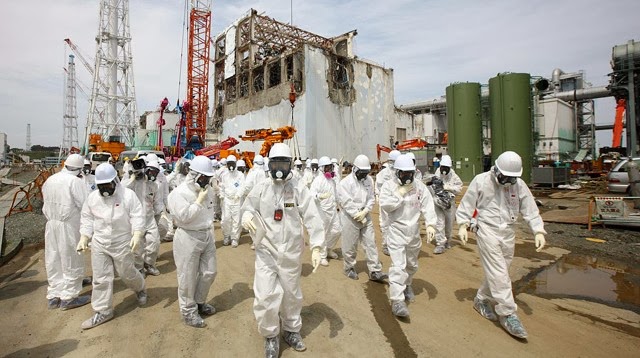
No, I’m sure it’s not. A normal, clean power plant takes about ten years to decommission, and by “clean” I mean where literally the workers are working in street clothes most of the time. There are very few places in the plant where they’d have to put on what we call PCs – protective clothing. The white uniforms you see all over Fukushima… I’ve worked in nuclear power plants and only once or twice have had to wear those.
You can literally walk through most power plants in your street clothes, and the reason they have to wear them outside at Fukushima is because the radiation fields are so high. What’s happening now is that the ground is highly radioactive. In some areas where the radiation level is so high they’ve even put steel plates on top of the ground so that people could walk there. That’s not a normal decommissioning.
What does this mean?
It means the level of radiation is so high that my biggest humanitarian concern is that – if the Japanese push to get these plants dismantled quickly – they will burn out hundreds and hundreds of young men. It’s usually young men because that’s how the construction trade is, needlessly. My point is, walk away for a hundred years, then come back in a hundred. By waiting a hundred years you’re reducing the radiation exposure to a significant, young virile gene pool that in my opinion doesn’t deserve to be exposed right now.
So you’re arguing there’s a human cost to the fact that this is being pushed through as fast as possible.
Yes, quite. There’s a very real human cost to thousands of construction workers who are being exposed and will be exposed. But they have to show the Japanese that they’re dismantling that site because if the Japanese don’t believe it can be cleaned up they won’t let the other plants start back up.
It’s a show. This is all about showing the Japanese that it’s not too bad, and we can run our other forty or so plants fine, trust us. It’s definitely symbolic for the Japanese, but the real reason is the banks want their money back.
5 Comments »
Leave a reply to damchodronma Cancel reply
1 This Month


18 March Webinar @ 1 PM EST: An Assessment of SMR Projects: The Case of Canada
register for the zoom:
https://us02web.zoom.us/webinar/register/WN_o8BIIOUvQ2ONJR1nta65DQ#/registration


of the week – STOP SMALL MODULAR REACTORS IN CANADA
To see nuclear-related stories in greater depth and intensity – go to https://nuclearinformation.wordpress.com
-
Archives
- March 2026 (146)
- February 2026 (268)
- January 2026 (308)
- December 2025 (358)
- November 2025 (359)
- October 2025 (376)
- September 2025 (258)
- August 2025 (319)
- July 2025 (230)
- June 2025 (348)
- May 2025 (261)
- April 2025 (305)
-
Categories
- 1
- 1 NUCLEAR ISSUES
- business and costs
- climate change
- culture and arts
- ENERGY
- environment
- health
- history
- indigenous issues
- Legal
- marketing of nuclear
- media
- opposition to nuclear
- PERSONAL STORIES
- politics
- politics international
- Religion and ethics
- safety
- secrets,lies and civil liberties
- spinbuster
- technology
- Uranium
- wastes
- weapons and war
- Women
- 2 WORLD
- ACTION
- AFRICA
- Atrocities
- AUSTRALIA
- Christina's notes
- Christina's themes
- culture and arts
- Events
- Fuk 2022
- Fuk 2023
- Fukushima 2017
- Fukushima 2018
- fukushima 2019
- Fukushima 2020
- Fukushima 2021
- general
- global warming
- Humour (God we need it)
- Nuclear
- RARE EARTHS
- Reference
- resources – print
- Resources -audiovicual
- Weekly Newsletter
- World
- World Nuclear
- YouTube
-
RSS
Entries RSS
Comments RSS
 nuclear-news
This is why the policy of nuclear nations is to raise ‘allowable’ limits for nuclear workers and the population generally when there are accidents… and since Atomic Age began. Contamination gets worse, it is worse for all life, but nothing about it is really safe or acceptable. It’s propaganda.
“The evidence from the Chernobyl affected territories reveals the real-world consequences of a simple and terrible new discovery: that the effects of low dose internal irradiation cause subtle changes in the genome that result in an increase in the general mutation rate. … first seen in cells in the laboratory. The Chernobyl evidence, shows that this seems to be true for all species, for plants and
animals and humans. It has profound implications that go beyond radiation protection and risk models.
“Krysanov …find that mice living in the high irradiation zone, 22 generations after the initial exposure, are MORE radiosensitive than mice living in lower exposure areas. The same effect is reported for plants by Grodzhinsky who wryly points out that plants cannot exhibit the ‘radiophobia’ that many of the Chernobyl effects have been blamed on. This flies in the face of current ideas about genetic selection.
“The effects of genomic instability are apparent in the evidence of massive harm to the organs and systems of living creatures at low doses of internal exposure, resulting in a kind of radiation ageing associated with random mutations in all cells. At the higher doses in the ‘liquidators’, after some years, their bodies seem to simply fall apart. In an astonishing statement we hear from Yablokov that in Moscow 100% of the liquidators are sick, in Leningrad 85%. These are men that ran like hares into the radiation fields with improvised lead waistcoats cut from roofs and who, by stabilising the situation at the reactor, saved Europe from a nuclear explosion equivalent to 50 Hiroshima Bombs – an outcome that would have made most of it uninhabitable. They are forgotten.
[THEY SIMPLY FALL APART]
“WHOLE BIOLOGICAL SYSTEMS COLLAPSE; at the cell level, at the tissue level and at the population level. Burlakova and Nazarov describe these subtle effects at lower doses of internal irradiation in laboratory cell systems and also people, Grodzhinsky shows the effects in plants, – higher for internal exposures than external, Krysanov shows the effects in wild animals and Yablokov and the Nesterenkos in the children and adults living and continuing to live in the contaminated territories. The effects clearly operate at what are presently thought to be vanishingly low doses.”
“ECRR Chernobyl: 20 Years On” (2006) pg 2
ECRR = European Committee on Radiation Risk
Dr. Chris Busby, Scientific Secretary wrote Introduction.
co-edited with Dr. Alexey Yablokov
Click to access chernobylebook.pdf
Spanish http://ciaramc.org/ciar/boletines/cr_bol226.htm
Thank you for this comment. It’s now featured as top post. Please continue to contribute your valuable ideas and information.
Applied Physic Art Nanotechnology
you are welcome to join my Facebook page Physic world meets the Fine Art World Applied Physic Art Nanotechnology
Thank you – I’m a bit Ludditey and not really usinng Facebook (though I think I am probably on it)