Worrying future for Fukushima’s nuclear refugees, induced to return home
 The woodlands of Iitate are “acting as a long lasting reservoir for radiocesium and as a large source for future recontamination in the environment beyond the forest,”
“You cannot work on a farm, you cannot grow rice, and you cannot pick wild plants either,”
Japan nuclear refugees face dilemma over returning home, Channel News Asia
Many residents have been unable to return to their home towns following the Fukushima nuclear disaster. Even what that changes, there will still be lingering concerns about safety. 21 Jul 2015 NARAHA, Japan: More than four years since Satoru Yamauchi abandoned his noodle restaurant to escape radiation spreading from the tsunami-wrecked Fukushima nuclear plant, the Japanese government is almost ready to declare it safe to go home.
But, like many of the displaced, he’s not sure if he wants to.
“I want my old life back, but I don’t think it’s possible here,” he told AFP on a recent visit to the dusty “soba” buckwheat noodle restaurant in Nahara that he ran for more than two decades………
UNFIT FOR HABITATION
Activists say despite government assurances, many areas still show highly-elevated levels of contamination, and many are unfit for habitation.
They say that for people who abandoned now-almost-worthless — but still mortgaged — homes, allowing TEPCO to stop payments amounts to forcing them to return.
Environmental campaign group Greenpeace has carried out a study of radiation contamination in Iitate, a heavily-forested 200-square-kilometre (75 square miles) district that sits around 40 kilometres northwest of the crippled plant also being eyed for resettlement. Continue reading
Machinations of the global nuclear lobby, and Australia’s Royal Commission on the Nuclear Fuel Chain

 Labor veers towards the nuclear idea https://independentaustralia.net/environment/environment-display/labor-veers-towards-the-nuclear-option,7965 21 July 15 The SA Nuclear Royal Commission, the ALP’s postponement of its National Conference nuclear debate and the machinations of the Nuclear For Climate Declaration could herald Australia’s deeper involvement in the nuclear industry, writes Noel Wauchope. “……….
Signing of the Nuclear For Climate Declaration This was done by Australia’s Rob Parker, President of the Australian Nuclear Association, in Paris.
Admittedly, this happened over a month earlier. However, the nuclear lobby is right now working hard on lobbying the United Nations Framework Convention on Climate Change (UNFCCC), with this Declaration.
Australia’s hard-working and poorly funded anti-nuclear movement is currently concentrating on the South Australian
Royal Commission. The Commission is looking increasingly like an arm of the global nuclear lobby. Because of its inadequacies, especially on nuclear wastes (set out very thoroughly here by South Australian Dennis Matthews) and its all too strong connections with the nuclear industry, this is a Royal Commission that might well sink without trace……
Rob Parker talked about the Nuclear For Climate Declaration.
The most important aim of this campaign is to get the UNFCCC to
“… recognise nuclear energy as a low-carbon energy option, and to include it in its climate funding
mechanisms, as is the case for all other low-carbon energy sources.”

Here we see how this ties in with the South Australian Royal Commission…..the global nuclear industry is hanging on the hope that nuclear power will receive government funding when and if it is recognised by the UNFCCC as a clean energy source, apparently essential for combatting global warming……
At this stage, Labor appears to be holding firm to its [anti-nuclear] policy
India’s Mayapuri residents concerned about ionising radiation in scrap machinery
Mayapuri haunted by radiation fears of 2010, Mohit Sharma, Hindustan Times, New Delhi Jul 21, 2015
Fear of a radiation leak is haunting businessmen and residents of Mayapuri, who claim that that authorities have failed to keep a check on the large scale dismantling of machines that go on in the area.

RK Gupta, the general secretary of the Mayapuri-Rewariline industrial welfare association says that while the content of scrap, vehicles and other items brought for dismantling are dubious and remain unverified, open dismantling of machines poses the danger of a repeat of radiation incident that occurred in the area five years ago………http://www.hindustantimes.com/newdelhi/mayapuri-haunted-by-radiation-fears-of-2010/article1-1371431.aspx
Jamaica passes Bill to regulate ionising radiation, prohibit building of nuclear reactor
Bill to regulate radiation and nuclear practice passed, Jamaica Star 21 July 15 A Bill seeking to create a legal framework for the regulation of activities, practices, apparatuses and facilities involving ionising radiation and nuclear technology was passed by the Senate on Friday.
The Bill entitled, the Nuclear Safety and Radiation Protection Act, 2015, was piloted by Minister of Justice, Senator Mark Golding.
The objectives of the Bill are to protect people and the environment from exposure to ionizing radiation to the maximum extent that is reasonably practicable, taking into account social and economic factors, and recognising the need for the use of ionizing radiation for beneficial purposes; and to protect radioactive sources from misuse that may result in harm to people or the environment. ……..
This Bill seeks to create a robust framework for the regulation of activities, practices, apparatus and facilities involving ionising radiation and nuclear technology, in keeping with international standards and best practices,” the Minister explained.
The Bill, which was approved by the House recently, also prohibits: building, importing, exporting or operating a research reactor………http://jamaica-star.com/latest/article.php?id=235
NPT non-signatory nuclear armed Israel is the global threat.
 International Nuclear Hypocrisy JULY 21, 2015 NPT non-signatory nuclear armed Israel is the global threat. Shouldn’t the world impose on Israel harsher financial and economic sanctions, boycott and political seclusion than they had imposed on the NPT signatory peaceful nuclear Iran??? By Dr. Elias Akleh, Intifada-Palestine.com The Nuclear Non-Proliferation Treaty (NPT) and the nuclear watchdog International Atomic Energy Agency (IAEA) have been turned into oppressive tools to limit the spread of safe nuclear technology and to prevent states other than the five nuclear states (the five permanent members of the United Nations Security Council; US, UK, France, Russia and China) from acquiring nuclear weapons. These nuclear states want to maintain its arms superiority and hegemony…….. .
In 1992 after the IAEA inspected all the Iranian sites they requested, the Director General Blixreported that all activities they observed were consistent with the peaceful use of atomic energy. In fact all the inspection reports by IAEA had stating the lack of any evidence that Iran is pursuing nuclear weapon program.
The American National Intelligence Estimate reported in 2007 that Iran had discontinued its nuclear weapon program in 2003. This was again confirmed by US Intelligence Agency officials, who were interviewed by The New York Times in March 2012 stating that Iran had not restarted its nuclear weapon program. Even the Israeli Mossad shared this findings contradicting their Prime Minister Netanyahu, who never got tired of warning of the alleged Iranian nuclear bomb.
The whole world knew that Iran did not have a nuclear weapon program. Yet the Western pressure continued due to the fact that Iran opposes the Zionist Israeli project in the Middle East, and has supported Hamas and Hezbollah in their struggle against Israeli occupation. ………..
The five major nuclear powers (US, Russia, UK, France and China), who seem to enthusiastically promote the NPT are themselves the biggest violators of the NPT. Overtly they pretended to reduce their own nuclear bombs by eliminating the bulky unstable old bombs, yet covertly they develop new smaller tactical and more devastating mini-nukes. These mini-nukes are part of the US-NATO arsenal and were cleared for use in the conventional war theater by the US Senate in 2002. The US, who had nuked Japan, has also used nuclear weapons, in the form of Depleted Uranium, to devastate Iraq in 2003, contaminating Iraqi soil and water, and causing all kinds of cancer and birth deformations in the children of both Iraqi citizens and of American veterans.
Recently we see a nuclear weapons arms race between the US and Russia. When the US declared its intent to deploy a major troop force near Russian borders, Russia countered, last month (June), by announcing plans to increase its nuclear arsenal with more than 40 new intercontinental ballistic missiles this year. This month (July) the US revealed that US military had successfully tested an upgraded nuclear gravity bomb; B51-12 that will replace four older versions of the bomb. Hippocratic Obama’s administration is upgrading its nuclear weapons while, at the same time, is using the NPT to limit Iran’s peaceful nuclear program.
The US and European nuclear states do not have the slightest genuine intention of enforcing the NPT unless when it serves them in controlling and punishing other developing countries. In 2010 the Obama administration cancelled the NPT conference that intended to discuss nuclear weapon-free zone in the Middle East. Last May 2015 Obama’s administration, again, stopped the UN’s effort to make the Middle East a nuclear free zone. The reason of course is nuclear Israel.
Most intelligence agencies, including CIA and FBI, know that Israel has been developing nuclear weapons as early as the 1960s confirming the reports of the Israeli whistleblower nuclear technician Mordechai Vanunu. ……………..
NPT non-signatory nuclear armed Israel is the global threat. Shouldn’t the world impose on Israel harsher financial and economic sanctions, boycott and political seclusion than they had imposed on the NPT signatory peaceful nuclear Iran??? http://www.intifada-palestine.com/2015/07/international-nuclear-hypocrisy/
Nuclear power won’t kill renewables – quite the reverse
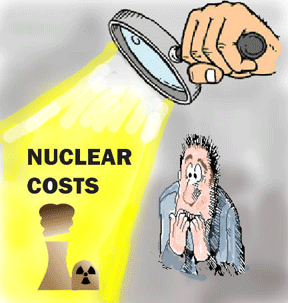 Roger Sowell , Sowell’s Law Blog 22 July 15 “……I would not anticipate the nuclear power industry being able to kill renewable energy, in fact, quite the opposite is very likely to occur. Most forms of renewable energy have a decreasing unit cost over time, most especially wind turbines over the past decade. Meanwhile, nuclear-based power has an increasing unit cost. The only examples I can find where nuclear power plants can be built for approximately $4,000 per kW are those countries where labor rates are still very cheap, such as China.
But, labor costs increase over time so that small advantage will disappear. Finally, the grid-storage problem has been solved technically, with under-sea storage and hydroelectric power as described by MIT. As offshore wind-turbines decline in installed cost, and the under-sea storage costs also decline with experience, truly sustainable and inexhaustible clean power on demand will finally exist. The electricity may not be too cheap to meter (the big lie of nuclear power), but it will be relatively cheap and not subject to price increases due to fuel availability. http://sowellslawblog.blogspot.com.au/
Concerns that Saudi Arabia would go for nuclear weapons, if Iran did
Saudi Arabia’s contest for power with Iran could turn nuclear, Business Insider ANGUS MCDOWALL,
Jul. 21, 2015, RIYADH (Reuters) – One likely Saudi Arabian response to the deal its biggest enemy Iran has struck with world powers is to accelerate its own nuclear power plans, creating an atomic infrastructure it could, one day, seek to weaponize.
But while it has recently made moves to advance its nuclear program, experts say it is uncertain whether it could realistically build an atomic bomb in secret or withstand the political pressure it would face if such plans were revealed.
“I think Saudi Arabia would seriously try to get the bomb if Iran did. It’s just like India and Pakistan. The Pakistanis said for years they didn’t want one, but when India got it, so did they,…….http://www.businessinsider.com/saudi-arabias-contest-for-power-with-iran-could-turn-nuclear-2015-7?IR=T
Not realistic to mine uranium in Quebec
Quebec uranium mining not realistic for several years – BAPE, 20TH JULY 2015 BY: HENRY LAZENBY CREAMER MEDIA DEPUTY EDITOR Toronto (miningweekly.com) – Uranium mining in Quebec is not feasible for several years still, owing to the exceedingly negative perception mining of the radio active element has among the province’s inhabitants, as a result of “numerous unanswered” questions regarding human health and ecosystem integrity, a committee tasked with holding public consultations on the subject has found. The public hearings office Bureau d’audiences publiques sur l’environnement (BAPE) committee reported that owing to scientific uncertainty and gaps in technological knowledge, uranium mining in the province was far from reaching social and political consensus. http://www.miningweekly.com/article/quebec-uranium-mining-not-realistic-for-several-years-bape-2015-07-20
Mysteriuese Évacuation complète d’un village au Kazakhstan à cause d’une « maladie du sommeil mysteriuese
Évacuation complète d’un village au Kazakhstan à cause d’une « maladie du sommeil » qui fait rage http://www.nouvelordremondial.cc/2015/07/21/evacuation-complete-dun-village-au-kazakhstan-a-cause-dune-maladie-du-sommeil-qui-fait-rage/ Un village au Kazakhstan est en train d’être évacué tandis que des scientifiques ne comprennent pas la cause d’une mystérieuse maladie du sommeil.
Des douzaines de gens du village éloigné de Kalachi ont été victimes de l’affliction, dont plusieurs se sont évanouis à l’école, chez eux ou même sur leurs motos.
Quelques victimes sont restées inconscientes durant des jours et ont aussi souffert d’hallucinations, de maux de tête et de fatigue.
Le Astana Times a rapporté que le Vice-Premier Ministre du pays a dit que la combinaison de monoxyde de carbone et de gaz d’hydrocarbure à proximité d’une mine d’uranium étaient la cause.
Mais un expert a déclaré à Wired que, tandis que les symptômes correspondent à la théorie, la mine a été abandonnée dans les années 1990, donc les causes du monoxyde de carbone ne sont pas avérées.
D’autres experts enquêtent actuellement sur le taux de gaz qui s’échappe de la mine et qui peuvent potentiellement être à l’origine du problème. Cependant, le mystère demeure.
Australia’s Cardinal George Pell criticises Pope Francis for his stand on climate change

Christina Macpherson’s websites & blogs
I thought we had enough to worry about with our government leader Tony Abbott. Now our religious heavy is out to dceny climate change. I’m ashamed to be Australian!
Cardinal George Pell criticises Pope Francis over climate change stance , SMH, July 19, 2015 Kerrie Armstrong Cardinal George Pell has publicly criticised Pope Francis’ decision to place climate change at the top of the Catholic Church’s agenda.
Cardinal Pell, a well-known climate change skeptic, told the Financial Times the church had “no particular expertise in science”.
“The church has got no mandate from the Lord to pronounce on scientific matters,” he said,
“We believe in the autonomy of science.”
Pope Francis and international Mayors get together to work on climate action
Francis is on to something by inviting mayors to the Vatican, rather than state-level leaders, such as prime ministers and presidents.
The Vatican summit this week comes ahead of a crucial round of United Nations climate talks scheduled for early December in Paris.
It’s a safe bet that Francis will nudge policymakers in the U.S. to push for climate action when he speaks at the U.N. in September, and becomes the first-ever pope to address a joint session of Congress.
 Pope Francis convenes world’s mayors to discuss global warming, Mashable Australia, Andrew Freeman 20 July 15 Anyone who thought that Pope Francis was going to issue his climate change manifesto, and then recede quietly into the background on the issue was sorely mistaken.
In fact, judging from his agenda this week, it’s clear that Francis intends to be a major player in spurring leaders to combat global warming, which he sees as inextricably linked to efforts to lift the plight of the world’s poor.
This week, the Vatican’s science committees will host two days of meetings with 50 mayors and governors from around the world; they will discuss ways to implement policies aimed at curbing greenhouse gas emissions, boosting resilience to climate extremes and eradicating poverty. Continue reading
Japan Accused of Coercing Fukushima Refugees to Return to Unsafe Homes
Greenpeace charges that pro-nuclear Prime Minister Shinzo Abe cares more about politics than public health
As the Japanese government moves to accelerate the return of Fukushima refugees to their homes, environmental advocacy organization Greenpeace warned Tuesday that radioactive contamination remains “so widespread and at such a high level that” that it will be impossible for people to safely go back.
Four years after an earthquake and tsunami touched off the nuclear meltdown, Japanese Prime Minister Shinzo Abe is pressing to lift evacuation orders by March 2017 and cut off compensation to victims of the disaster by 2018. The move would allow—and some say force—tens of thousands of refugees to go back to their homes.
The pro-nuclear prime minister says that the move, proposed in June, is aimed at speeding up Fukushima’s “reconstruction.”
Greenpeace, however, warns that such a development would be reckless and dangerous. The organization evaluated radiation contamination in Iitate, a forested 75-square-mile district in the Fukushima prefecture, and found that even after “decontamination,” the radiation level remains at 2uSv/h—or ten times the maximum deemed safe for the public.
“Prime Minister Abe would like the people of Japan to believe that they are decontaminating vast areas of Fukushima to levels safe enough for people to live in,” said Jan Vande Putte, radiation specialist with Greenpeace Belgium, in a press statement. “The reality is that this is a policy doomed to failure. The forests of Iitate are a vast stock of radioactivity that will remain both a direct hazard and source of potential recontamination for hundreds of years. It’s impossible to decontaminate.”
According to Greenpeace, the elimination of compensation would effectively force people back into an environment that is dangerous for their health.
“Stripping nuclear victims of their already inadequate compensation, which may force them to have to return to unsafe, highly radioactive areas for financial reasons, amounts to economic coercion,” said Putte. “Let’s be clear: this is a political decision by the Abe Government, not one based on science, data, or public health.”
Meanwhile, nuclear refugees from Iitate are fighting for adequate compensation through an Alternative Dispute Resolution process. Their lawyer, Yasushi Tadano, said: “The Iitate people’s fate is another of numerous cases in the past where Japan abandoned its people, as with the Ashio mining pollution and Minamata disease. We can not allow this to happen again.”
Residents across Japan have staged protests and filed lawsuits to block nuclear restarts, and polls show that, in the aftermath of the 2011 disaster, a clear majority of the Japanese public opposes nuclear power. In addition, surveys reveal low public confidence in the Japanese government and the Tokyo Electric Power Co.—the company behind the Fukushima Daiichi plant that continues to release radiation into the ecosystem.
Despite public opposition, Abe is aggressively pursuing a return to nuclear power. Earlier this month, Abe’s Liberal Democratic Party revealed that it aims to have 20 percent of the country’s electricity supplied by nuclear power by 2030.
Source: Common Deams
Sweaty work for Japan teams scrubbing away Fukushima radiation

IITATE, Japan – Sweating inside their plastic protection suits, thousands of men toil in Japan’s muggy early summer in a vast effort to scrub radiation from the villages around Fukushima.
The mission is to decontaminate hundreds of square kilometres (miles) that were polluted when reactors went into meltdown after a huge tsunami struck Fukushima Daiichi nuclear plant in March 2011.
No stone is left unturned: diggers scrape away the top layer of earth in fields, school courtyards and around the buildings of villages, while houses, buildings, roads and parking lots are scrubbed clean.
At least 20,000 people – all dressed in the special gloves, masks and boots required for workers in the nuclear industry – are involved in the clean-up, according to the environment ministry.
Some 2.5 million black bags filled with contaminated soil, plants and leaves wait at the sites or in one of the nearly 800 temporary outdoor storage facilities that have been set up across the disaster zone.
The mammoth effort comes as Japan’s government prepares to declare sections of the evacuation zone habitable again.
That will mean evacuees can return to the homes they abandoned more than four years ago. It will also mean, say campaigners, that some people will have no choice but to go back because it will trigger the ending of some compensation payments.
Government-run decontamination efforts are under way in 11 cities where Tokyo says that at present, anyone living there would be exposed to radiation levels of more than 20 millisieverts (mSv) a year.
The globally-accepted norm for radiation absorption is 1 mSv per year, although the International Atomic Energy Agency (IAEA) and others say anything up to 20 mSv per year poses no immediate danger to human health.
The settlement of Naraha, which lies just 20 kilometres (12 miles) from the plant, is expected to be declared safe in September.
The government intends to lift many evacuation orders by March 2017, if decontamination progresses as it hopes.
Still, the area immediately surrounding the plant remains uninhabitable, and storage sites meant to last 30 years are being built in the villages closest to the complex.
For now, only residential areas are being cleaned in the short-term, and the worst-hit parts of the countryside are being omitted, a recommendation made by the IAEA.
But that strategy has troubled environmentalists, who fear that could lead to re-contamination as woodlands will act as a radiation reservoir, with pollutants washed out by rains.
In a report on decontamination in Iitate, a heavily forested area that lies northwest of the plant, campaign group Greenpeace says these selective efforts will effectively confine returnees to a relatively small area of their old hometowns.
“The Japanese government plans, if implemented, will create an open-air prison of confinement to ‘cleaned’ houses and roads… and the vast untouched radioactive forests continue to pose a significant risk of recontamination of these ‘decontaminated’ areas to even higher levels,” the report, published Tuesday, says.
Some 39 other municipalities which were not evacuated after the accident, and which have radiation levels deemed safe for humans, are also being decontaminated by local authorities.
Source: Asia One
Fukushima No. 1 still has 7,000 tons of problematic toxic water to be removed
Some 7,000 tons of radioactive water at risk of leaking into the ground still has to be removed from underground tunnels and other locations at the Fukushima No. 1 nuclear plant.
Tokyo Electric Power Co. is trying to get rid of tainted water from the cable tunnels for reactors 2 and 3. That work is expected to be mostly completed by the end of this month.
As of Monday, such water could still be found in at least 16 such locations at the plant, where three reactors suffered a meltdown after being heavily damaged in the March 2011 earthquake and tsunami.
According to Tepco, numerous underground tunnels, ducts and pits hold radioactive water, in addition to the reactor and turbine buildings. Some of the water is more radioactive than the contaminated water already in storage tanks.
The highest levels of radioactive substances contained per liter were 990 becquerels of cesium-134 and 3,200 becquerels of cesium-137, more than 60 times higher than the provisional standards for water Tepco may discharge within the plant site.
The tunnels and ducts are not designed to hold water and therefore have a higher risk of leakage than storage tanks.
The Nuclear Regulation Authority has urged Tepco to immediately remove the water in the cable tunnels for reactors 2 and 3 due to extremely high levels of radioactive materials it contains and the high risk of the tainted water leaking into the ocean. These tunnels are located relatively close to the Pacific shoreline.
Levels of radioactive materials in the water in other tunnels and ducts are substantially lower, and such facilities are located away from the ocean. Still, due to the lack of sufficient monitoring, it would be hard to immediately detect a possible leak.
An official of the secretariat of the NRA said, “Tepco needs to tackle the problem of this tainted water, which it has so far failed to address.”
Source: Japan Times
http://www.japantimes.co.jp/news/2015/07/21/national/fukushima-1-still-7000-tons-problematic-toxic-water-removed/#.Va5V-xNViko
Tourism association turns to booze created with Fukushima buckwheat. Now on sale.

Buckwheat-based imitation beer hits shelves in nuclear disaster-affected village
KAWAUCHI, Fukushima Prefecture–A tourism association here has turned to booze created with buckwheat, a local specialty, to breathe life back into a village depleted by the nearby Fukushima nuclear disaster.
At the request of the Kawauchi tourism association, beer brewers in Fukushima Prefecture have developed two types of low-malt imitation beer using buckwheat, which is typically used to make soba noodles.
“I want to encourage residents of the village by developing new local specialty products,” said Shigeru Ide, who heads the tourism body.
The 330-milliliter beverages are each priced at 620 yen ($4.99), including tax, and became available at shops throughout Kawauchi earlier this month.
The Soba Garden imitation beer tastes strong, while Kyo has a light flavor.
Before the March 2011 Great East Japan Earthquake and tsunami triggered the accident at the Fukushima No. 1 nuclear power plant, Kawauchi was one of the largest producing centers of buckwheat in the prefecture.
Although evacuation orders have been lifted for most parts of Kawauchi, half of its 2,700 residents still live outside the village as evacuees.
Source: Asahi Shimbun
http://ajw.asahi.com/article/0311disaster/recovery/AJ201507200062
1 This Month
Chernobyl: The Lost Tapes – A good documentary on Chernobyl on SBS available On Demand for the next 3 weeks– https://www.sbs.com.au/ondemand/tv-program/chernobyl-the-lost-tapes/2352741955560

of the week–London Campaign for Nuclear Disarmament

Tell the Ukrainian Government to Drop Prosecution of Peace Activist Yurii Sheliazhenko
To see nuclear-related stories in greater depth and intensity – go to https://nuclearinformation.wordpress.com
-
Archives
- April 2026 (126)
- March 2026 (251)
- February 2026 (268)
- January 2026 (308)
- December 2025 (358)
- November 2025 (359)
- October 2025 (376)
- September 2025 (257)
- August 2025 (319)
- July 2025 (230)
- June 2025 (348)
- May 2025 (261)
-
Categories
- 1
- 1 NUCLEAR ISSUES
- business and costs
- climate change
- culture and arts
- ENERGY
- environment
- health
- history
- indigenous issues
- Legal
- marketing of nuclear
- media
- opposition to nuclear
- PERSONAL STORIES
- politics
- politics international
- Religion and ethics
- safety
- secrets,lies and civil liberties
- spinbuster
- technology
- Uranium
- wastes
- weapons and war
- Women
- 2 WORLD
- ACTION
- AFRICA
- Atrocities
- AUSTRALIA
- Christina's notes
- Christina's themes
- culture and arts
- Events
- Fuk 2022
- Fuk 2023
- Fukushima 2017
- Fukushima 2018
- fukushima 2019
- Fukushima 2020
- Fukushima 2021
- general
- global warming
- Humour (God we need it)
- Nuclear
- RARE EARTHS
- Reference
- resources – print
- Resources -audiovicual
- Weekly Newsletter
- World
- World Nuclear
- YouTube
-
RSS
Entries RSS
Comments RSS
 nuclear-news