Hayao Miyazaki Gives 300 Million Yen to Build Kids’ Area in Park
Retired Ghibli feature director also drew art for center for families after 2011 quake

Anime director and Studio Ghibli co-founder Hayao Miyazaki donated 300 million yen (around US$2.4 million) to the town of Kumejima, Okinawa for the construction of an “Interaction Center for Children” in the town’s Zenda Forest Park. The project’s supervisor and Miyazaki’s friend Tomohiro Horino expects the project to take around two years to complete.
The facility will include a two-story, 1,000-square-meter building. The town has allotted 10,000 square meters of the Zenda Forest Park for the project. The project will solicit opinions and suggestions for the project from the town’s citizens on a regular basis.
The project was revealed last year. Miyazaki drew the concept illustration above for the facility.
Miyazaki was also asked by a friend last year to draw a logo for the new facility on Kumejima. The facility is intended for families and children, who were displaced from Fukushima, to be outdoors; due to the Fukushima Daiichi Nuclear Power Station leak after the 2011 Great East Japan Earthquake, there are areas in Fukushima that are no longer safe for children to play.
Miyazaki has retired from making feature films, but continues to work on short films for the Ghibli Museum, as well as pet projects, including a samurai manga for Model Graphix magazine.
Source: Okinawa Times
S. Korea, Japan make no progress in fishery import ban talks
SEJONG, June 26 (Yonhap) — Talks between South Korea and Japan over Seoul’s ban on fishery imports from the neighboring country ended without any progress as they stuck to their guns, the government here said Friday.
Seoul imposed an import ban on 50 fishery products from Japan’s Fukushima Prefecture shortly after the major earthquake and tsunami caused a nuclear reactor there to melt down in March 2011.
The ban was expanded to cover all fishery products from Fukushima and seven adjacent prefectures in September 2013 following reports that massive amounts of radioactive materials and contaminated water from the Fukushima nuclear power plant were being dumped in waters surrounding Japan.
“The government held bilateral consultations with Japan on June 24-25 at the World Trade Organization (WTO) headquarters in Geneva over our country’s import restrictions on Japanese fishery products, but the talks ended after the countries confirmed their differences,” the Ministry of Trade, Industry and Energy said in a press release.
Japan argued South Korea’s import ban had no scientific justification, demanding Seoul remove all its import restrictions at the earliest date possible.
South Korea maintained its measures were still necessary to ensure the safety of its people and that they were in line with the WTO’s sanitary and phytosanitary measures.
This week’s talks came after Tokyo requested bilateral consultations with Seoul under a dispute settlement framework of the WTO.
Japan could ask the WTO to set up a dispute settlement panel if the countries fail to reach a deal within 60 days following Japan’s request for bilateral consultations.
Seoul’s trade ministry said it was not clear whether Tokyo will ask for additional consultations, but that it will be fully prepared to deal with any legal processes.
“Japan has expressed its position that it will decide its next step after reviewing the outcome of this week’s bilateral consultations,” the ministry said.
“The government will begin preparing for WTO’s dispute settlement process as Japan is expected to ask for the establishment of a dispute settlement panel.”
Source : Yonhap News
http://english.yonhapnews.co.kr/news/2015/06/26/0200000000AEN20150626001200320.html
Future of Britain’s Hinkley Point Nuclear Facility is increasingly uncertain
there is growing talk in the U.K. of whether the government should cut and run from nuclear.
In a speech to the House of Commons last week, Labour MP Paul Flynn questioned whether Whitehall would have made the same decision if it knew what it knows now about the cost of nuclear.
“Nuclear power was promised as an energy source that would be too cheap to meter. It is now too expensive to generate,”
While the European public has largely turned against nuclear since the Fukushima accident in Japan in 2011, the British have been shielded by a “skilled public relations operation,”
 Trouble ahead for UK’s nuclear hopes Britain’s push for new reactors is coming under fire. Politico Sara Stefanini 25/6/15, The next generation of reactors in the U.K. has been in the works for a decade, but now a looming challenge in the European Court of Justice attacking nuclear subsidies, growing technical problems and cost overruns are casting doubt on the idea of using nuclear to meet emissions reduction targets……..
the future of Hinkley Point C looks increasingly uncertain, as the first EPR projects in France and Finland have been hampered by delays, cost overruns and safety concerns, and as the Austrian government prepares to challenge the European Commission on its approval of the U.K.’s state aid. Continue reading
A new set of problems for Fukushima’s stricken nuclear facility
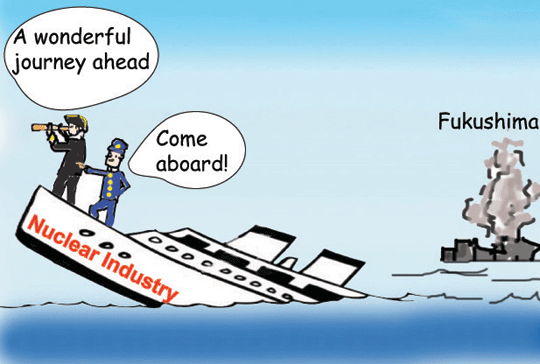 New Problems & Challenges Plague Fukushima, Simply Info June 23rd, 2015 As June wanes we find more delays, more problems and new admissions about the extent of the disaster.
TEPCO introduced a new roadmap plan. In this they declared they would now focus on safety over speed. At the same time they announced that spent fuel removal work for units 1-3 would be delayed again. Currently they are attempting to remove the cover on unit 1 but this process has not actually begun based on visual evidence at the plant. TEPCO has not been forthcoming what is delaying this work again. Work at unit 3 had been underway in early spring to remove parts of the crane that fell into the fuel pool. An oil leak was found as they attempted to remove a portion of the crane. This stopped the removal work as they cleaned the oil out of the pool water and investigated a cause. Around the same time they discovered damage to the metal gate that connects the spent fuel pool to the reactor well. After this discovery, removal work at unit 3 appeared to cease.
Newer reports also showed that the earlier concept of flooding the reactor containments to remove damaged fuel debris is being phased out. ……..http://www.fukuleaks.org/web/?p=14818
Many incidents and near misses in USA’s nuclear reactors

 The Truth About Nuclear Power – Part 16 Subtitle: Near Misses on Meltdowns Occur Every 3 Weeks Roger E. Sowell, Marina del Rey, California 25 June 15
This is the second of approximately one dozen articles on nuclear safety, these will (or do) include (1) the relationship between plant operators and the regulatory commission, NRC, and show that safety regulations are routinely relaxed to allow the plants to continue operating without spending the funds to bring them into compliance. (2) Also, the many, many near-misses each year in nuclear power plants will be discussed. (3) The safety issues with short term, and long-term, storage of spent fuel will be a topic. (4) Safety aspects of spent fuel reprocessing will be discussed. (5) The health effects on people and other living things will be discussed. The three major nuclear disasters (to date) will be discussed, (6) Chernobyl, (7) Three Mile Island, and (8) Fukushima. (9) The near-disaster at San Onofre will be discussed, and (10) the looming disaster at St. Lucie. (11) The inherent unsafe characteristics of nuclear power plants required government shielding from liability, or subsidy, for the costs of a nuclear accident via the Price-Anderson Act. (12) Finally, the serious public impacts of evacuation and relocation after a major incident, or “extraordinary nuclear occurrence” in the language used by the Price-Anderson Act, will be the topic of an article. Previous articles showing that nuclear power is not economic are linked at the end of this article.
In the four year period 2010-2013, inclusive, the US nuclear reactors had 70 near-misses. These occurred in 48 of the 103 reactors. Some, therefore, had multiple near-misses in the same year. One plant, Columbia, had 3 near-misses in the same year. Wolf Creek, and Ft. Calhoun each had one near-miss in three of the four years. On average, that is 17 near-misses per year, or roughly 17 percent of the reactor fleet. Put another way, every 3 weeks, another near-miss occurs. The frequency of near-misses is expected to increase over time, as the aging reactors have more equipment degrade and fail, and new systems are installed that are unfamiliar to the operators.
What is common in these incidents are old and degraded equipment that fails due to improper inspection, replacement equipment that either does not work as expected, or operators are improperly trained, and in one notable case, improperly trained workers left critical bolts improperly tightened on the reactor head.
The most serious incident, in my view, occurred at the Byron Station, Unit 2, in January, 2012, in Illinois. A complete loss of cooling water at Unit 2 was temporarily replaced with water from Unit 1. Had this been a single-reactor plant, with no operating reactor close at hand, the loss of cooling could have resulted in a partial or full core meltdown, exactly what happened at Fukushima, Japan. This is completely unacceptable.
Some, the nuclear proponents, will argue that the safety systems are adequate since no meltdowns occurred. However, the sheer number of serious incidents shows that eventually, another catastrophe will occur. The US has been lucky, but that luck is likely running out as the plants grow older and more mishaps occur.
Information in these incidents are taken from Union of Concerned Scientists’ series of annual reports, 2010 – 2013, inclusive. The commentary is my own. Links to the four (now five) reports are:
2010 see link
2011 see link
2012 see link
2013 see link
2014 see link (link added 5/10/2015)
Incidents in 2013 (Fourteen incidents)…………http://sowellslawblog.blogspot.com.au/2014/05/the-truth-about-nuclear-power-part-16.html
$1.8B in tax-payer loans for USA nuclear plant – as its costs soar
 Energy Department guarantees $1.8B in loans for GA nuclear plant, The Hill, By Devin Henry – 06/24/15 The Department of Energy (DOE) will guarantee $1.8 billion in loans for the operators of two new nuclear reactors under construction at a power plant in Georgia, the department announced on Wednesday.
The government had previously provided $6.5 billion in loan guarantees for the Vogtle Electric Generating Plant project, the country’s first new nuclear facility to be licensed and begin construction in more than 30 years. Wednesday’s step, officials said, will allow the project to be fully-financed………….
Construction at the Vogtle plant has been plagued by delays, and the Associated Press reportedWednesday that cost overruns have threatened the $2.7 billion in savings project executives have said they would secure since state regulators approved construction in 2009. Operators expect to spend at least $7.5 billion on the project. …http://thehill.com/policy/energy-environment/245975-energy-department-guarantees-18b-in-loans-for-ga-nuclear-plant
France keen to save AREVA, by selling nuclear reactors to Saudi Arabia
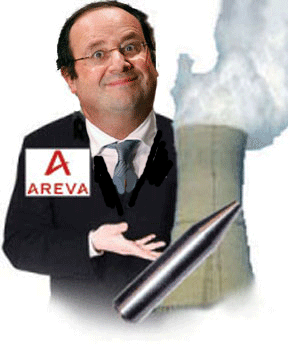 France plans new Saudi nuclear reactors, Sky News 25 June 2015 France has confirmed it is looking into building two nuclear reactors in Saudi Arabia, as part of 12 billion euro ($A17.31 billion) worth of deals struck between the nations.
Under one of the agreements Airbus will sell 23 H-145 multipurpose helicopters to Saudi Arabia for 500 million euros as well as launch a feasibility study into building the reactors, French Foreign Minister Laurent Fabius said on Wednesday……..
The study for two European Pressurised Reactors (EPR) – which France considers the safest and most advanced in the world – takes on added significance given the current efforts by Saudi Arabia’s rival, Iran, to develop its own nuclear capabilities.
In addition to the study, France will sign an agreement to train the Saudis on nuclear safety and the treatment of nuclear waste……
France has been reinforcing links with the conservative kingdom despite persistent criticism of its human rights record,…… http://www.skynews.com.au/news/world/mideast/2015/06/25/france-plans-new-saudi-nuclear-reactors.html#sthash.tI5czLBA.dpuf
Profiteering by nuclear weapons makers – world will not be free until this stops – Sr Megan Rice
 As long as any one nuclear weapon is still not dismantled nobody is free’ – 85yo nun jailed for protest Rt.com : June 24, 2015 85 year-old sister Megan Rice, who broke into a US nuclear facility, has been released after two years behind bars. The peace activist has given an interview to RT in order to “help to break the silence of secrecy”.
An 85-year-old nun Megan Rice and two Catholic peace activists 66-year-old Michael Walli, and 60-year-old Greg Boertje-Obed, were charged with vandalizing the outside of a Tennessee uranium bunker. Originally sentenced to three and nearly five years respectively, they are now likely to remain free following two years in prison after the government said on Monday that it will not appeal to reconsider the sabotage charge.
“I wouldn’t say we’re really free. We feel that as long as one nuclear weapon is still not dismantled nobody is free,” Rice told RT on Wednesday. “The real victims are all of humanity, and the one who is to be convicted is the government of the United States, which has, for nearly 70 years, manufactured or produced and designed, developed weapons of mass destruction.”…..
What we were trying to do was to protect the planet from sabotage, let alone every nuclear facility. We just want to convince everyone that $10 trillion, close to that, in 70 years has been spent building weapons of mass destruction in the facilities around this country. And certainly thousands of bombs are still in existence and stored, and also in readiness in various places. So, all of that must be ended,” Rice explained, pointing out the importance of developing life-enhancing alternatives.
The trio had no remorse for their actions, according to AP, and, in fact, they were even lucky to stay alive, as they managed to enter the area that allowed security guards to use deadly force.
“Most people feel that it’s absolutely atrocious and insane to continue this profiteering industry, which is what it is, because the profits of making the weapons are going into the hands of contractors and it’s not for anything that will ever be used or could ever be used – or should ever be used,” Rice concluded. http://rt.com/usa/269518-nun-anti-nuclear-activist/
New book on The Privatization of Nuclear War
 The Privatization of Nuclear War http://www.globalresearch.ca/the-privatization-of-nuclear-war/5458265 GRTV Report Produced by James Corbett, Featuring Michel Chossuodvsky By James Corbett and Prof Michel Chossudovsky Global Research, June 25, 2015 With tensions growing in Europe, Asia and the Middle East, a new generation of nuclear weapons technology is making nuclear warfare a very real prospect. And with very little fanfare, the US is embarking on the privatization of nuclear war under a first-strike doctrine.
“On August 6, 2003, on Hiroshima Day, commemorating when the first atomic bomb was dropped on Hiroshima (August 6 1945), a secret meeting was held behind closed doors at Strategic Command Headquarters at the Offutt Air Force Base in Nebraska. Senior executives from the nuclear industry and the military industrial complex were in attendance. This mingling of defense contractors, scientists and policy-makers was not intended to commemorate Hiroshima. The meeting was intended to set the stage for the development of a new generation of “smaller”, “safer” and “more usable” nuclear weapons, to be used in the “in-theater nuclear wars” of the 21st Century.
“Nuclear war has become a multibillion dollar undertaking, which fills the pockets of US defense contractors. What is at stake is the outright “privatization of nuclear war”.
US-NATO weapons of mass destruction are portrayed as instruments of peace. Mini-nukes are said to be “harmless to the surrounding civilian population”. Pre-emptive nuclear war is portrayed as a “humanitarian undertaking”.
Under the Obama administration, Islamic terrorists are said to be preparing to attack US cities. Proliferation is tacitly equated with “nuclear terrorism”. Obama’s nuclear doctrine puts particular emphasis on “nuclear terrorism” and on the alleged plans by Al Qaeda to develop and use nuclear weapons. …
While one can conceptualize the loss of life and destruction resulting from present-day wars including Iraq and Afghanistan, it is impossible to fully comprehend the devastation which might result from a Third World War, using “new technologies” and advanced weapons, until it occurs and becomes a reality. The international community has endorsed nuclear war in the name of world peace. “Making the world safer” is the justification for launching a military operation which could potentially result in a nuclear holocaust.”
(Excerpts from Michel Chossudovsky, Towards a World War III Scenario, The Dangers of Nuclear War, Global Research Montreal, 2011\
Speak out to prevent nuclear waste dumping close to Great Lakes
Environment Minister: don’t let Ontario Power Generation dump nuclear waste at Lake Huron. http://action.sumofus.org/a/lake-huron-nuclear-waste/ A federal review panel has just approved a ludicrous plan to dump nuclear waste on the shores of Lake Huron, key to the great lakes system supplying drinking water to 40 million people.
Ontario Power Generation wants to bury 7.1 million cubic feet of low level radioactive waste and discarded reactor core parts at the Bruce Power generating station near Kincardine — just 1.2 kilometres from Lake Huron.
Dumping nuclear waste next to the largest freshwater system on Earth is a short-sighted gamble, which will leave a poisonous legacy for future generations. Waste material stays radioactive for up to 100,000 years and there is no known way of storing it that ensures it will stay contained over that vast time scale.
We need to be protecting our invaluable natural resources like the Great Lakes, not letting corporations contaminate them. Dozens of communities, state legislators across the border, and environmental groups have been working to stop this dangerous plan before it becomes a reality. Let’s join them.
The federal government, through its environment minister, has just months to decide whether to approve the project. Let’s speak out now to stop this outrageous plan.
Tell Environment Minister Leona Aglukkaq not to approve Ontario Power Generation’s Lake Huron nuclear waste plan. The Great Lakes are part of our heritage and should not be put at risk of radioactive contamination. Whatever the nuclear industry claims, there is no known safe way to deal with nuclear waste. The nuclear industry has failed to come up with a way to guarantee that the waste store or surrounding rocks will contain radioactivity for hundreds of thousands of years. And examples from around the world — like Drigg in the UK and CSM in LeHague, France — show us that low level waste disposal sites are already leaking radiation into the environment, just decades after being built.
We can’t let energy companies gamble away the planet’s future.
Time and time again, SumOfUs members have called out governments who let corporations trash our shared natural resources. When over 130,000 of us signed a petition to the BC government demanding that it stop letting companies like Nestlé extract our precious groundwater for just $2.25 per million litres, political parties were forced to respond.
Now let’s protect Lake Huron — and our legacy to future generations.
Leona Aglukkaq: don’t let Ontario Power Generation dump nuclear waste at Lake Huron.
USA military know that nuclear radiation accumulates in biological organisms
 The Bioaccumulation of contamination in plankton, US Armed Forces, 1955 , Paul Langley’s Nuclear History Blog Quote (emphasis added) “Page 59. The problem of radioactive particles falling into the ocean raises the question of their availability to this portion of the biosphere. Plankton normally found in sea water are consumed in large quantities by fish.
These plankton concentrate mineral elements from the water, and it has been found that radioactivity may be concentrated(Page 60) in this manner by as much as a thousand fold. Thus, for example, one gram of plankton could contain a thousand times as much radioactivity as a gram of water adjacent to it. The radioactivity from these plankton which form a portion of fish diet tends to concentrate in the liver of the fish, and, if sufficiently high levels of contamination are encountered, could have a marked effect upon the ecology of an ocean area.
http://www.ncbi.nlm.nih.gov/pubmed/7752105
J Radiat Res. 1994 Dec;35(4):213-21.
Concentration factors for Cs-137 in marine algae from Japanese coastal waters.
Tateda Y, Koyanagi T.
Source
Abiko Research Laboratory, Central Research Institute of Electric Power Industry, Chiba, Japan.
Abstract
Concentration factors (CF: Bq.kg-1 in wet algae/Bq.kg-1 in filtered seawater) for Cs-137 in Japanese coastal algae, were investigated during 1984-1990. Cs-137/Cs(stable) atom ratios were also examined to clarify the distribution equilibrium of Cs-137 in marine algae and sea water. The CFs in marine algae were within the range of 5.4 approximately 92, and the geometric mean of CF was 28 +/- 2 (standard error) in Japanese coastal species. The CFs in edible species were within the range of 5.4 approximately 67, and the geometric mean of CF was 26 +/- 4 (standard error). The values of Cs-137/Cs atom ratios in marine algae and sea water indicated that Cs-137 reached an equilibrium state in partition between algae and sea water. Therefore, the CF value obtained in the present study can be regarded as an equilibrated value. Our results showed that the CF for Cs-137 in Japanese coastal algae were consistent with the Japanese guideline CFs, but were smaller than the recommended value by IAEA.
PMID: 7752105 [PubMed – indexed for MEDLINE] Free full text
end quote.
http://www.dutchdailynews.com/greenpeace-in-japan/………….https://nuclearhistory.wordpress.com/2013/03/16/the-bioaccumulation-of-contamination-in-plankton-us-armed-forces-1955/
Time to call off the costly Plant Vogtle Nuclear project – activists
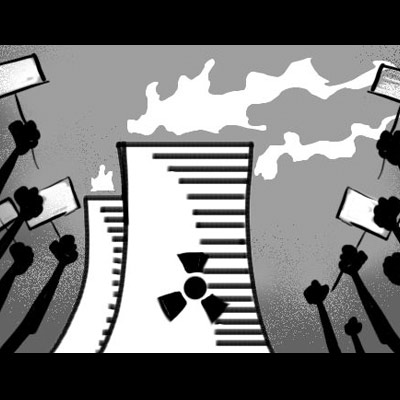 Activists Ask Regulators To Reconsider Nuclear Power Units
90.1 WABE, 23 Jun e15 vBy MOLLY SAMUEL Activists are asking Georgia’s energy regulators to reconsider building new nuclear power units at Plant Vogtle. The plant expansion is expected to be complete in 2020 – three years behind schedule.
Georgia Power has to go to the Public Service Commission every six months to get its expenses for construction at Vogtle approved. Right now, the last half of 2014 is under consideration. The PSC holds hearings to find out what’s going on at the plant, then lets Georgia Power pay its contractors.
Outside groups also get to weigh in. On Tuesday, Glenn Carroll, a coordinator for Nuclear Watch South, asked the PSC to consider stopping the process entirely.
“We think the public deserves to know what it would cost to cancel Plant Vogtle and compare that to the $12 billion we have left to spend,” she said.
That’s not a number that the PSC has investigated…….. http://wabe.org/post/activists-ask-regulators-reconsider-nuclear-power-units
Nuclear power a very poor deal for Saudi Arabia
Saudi Arabia must not focus on nuclear power THERE IS LITTLE DOUBT THAT NUCLEAR POWER WILL NOT BE ABLE TO COMPETE ECONOMICALLY WITH SOLAR PHOTOVOLTAIC AND WIND ENERGY BY ALI AHMAD AND M. V. RAMANA, SPECIAL TO GULF NEWS JUNE 25, 2015
Although Saudi Arabia has officially expressed interest in acquiring nuclear power since 2006, it is clear that this effort has gained momentum in the last few months, since the progress of negotiations between P5+1 (United States, Britain, France, Russia, China plus Germany) and Iran over the latter’s nuclear programme. Though some may find it understandable on strategic grounds, it is important to realise that nuclear power fares poorly if compared economically with fast-growing renewable technologies, especially solar photovoltaic energy.
Currently fossil fuel, oil and natural gas-based electricity generation constitutes essentially all of Saudi Arabia’s power production capacity. But it is desirable to develop alternative sources of electricity and both nuclear power and renewables have been held out as possibilities……
Nuclear reactors not only take long periods to construct, but are also prone to major construction delays and huge cost overruns. This is true in many countries, including industrialised economies with substantial nuclear capacity such as the US and France. Even without delays, establishing a nuclear power programme from scratch can take a minimum of 10 years. The UAE, for instance, started its programme in 2008 and expects to connect its first reactor to the grid in 2018. In comparison, solar projects typically have a one to two-year construction period.
If Saudi Arabia, for example, decides to build a nuclear reactor today, it will likely take a minimum of 10 years for it to start generating electricity. Therefore, any cost comparison must be based on what solar power may cost in 2025 rather than today’s costs. This time period is significant and if the dramatic decline in the cost of solar photovoltaic panels over the past decade (more than 75 per cent since 2009) continues till the end of this decade, the cost of generating nuclear power will exceed that of photovoltaic energy. There are good reasons to expect solar power costs to decline further in a similar fashion, including the relative lack of maturity of underlying technologies.
Even without such declines, there is evidence that renewable energy is already more economical than nuclear power. ……
Saudi Arabia is a natural location for investing in solar energy. It has one of the highest Direct Normal Irradiation resources in the world.
Likewise, wind energy too has significant potential in Saudi Arabia. Moreover, there is much greater scope with renewable energy for Saudi Arabia to ensure a higher degree of localisation and create a base of highly skilled workforce. Such localisation is certainly more difficult, if not impossible, to achieve with nuclear power.
Therefore, there is little doubt that nuclear power will not be able to compete economically with solar photovoltaic and wind energy. ….http://gulfnews.com/opinion/thinkers/saudi-arabia-must-not-focus-on-nuclear-power-1.1540888
Tax-payer backed loan guarantees for Vogtle nuclear reactors – still not enough to cover budget
 Feds Finalize $8.3 Billion in Taxpayer-Backed Loan Guarantees for Over Budget, Significantly Delayed Vogtle Nuclear Reactors as Alleged “Benefits” to Georgia Power’s Customers Have Eroded, Experts Say http://www.cleanenergy.org/2015/06/24/feds-finalize-8-3-billion-in-taxpayer-backed-loan-guarantees-for-over-budget-significantly-delayed-vogtle-nuclear-reactors-as-alleged-benefits-to-georgia-powers-customers/
Contact: Jennifer Rennicks, SACE, 865.235.1448, Jennifer@cleanenergy.org
Georgia Public Service Commissioners hear concerns from public on troubled project as Department of Energy issues remaining $1.8 billion to MEAG
Atlanta, Ga. (June 24, 2015) ///PRESS RELEASE/// On the heels of Tuesday’s all-day public hearing on the 12th semi-annual Vogtle Construction Monitoring (VCM) report (Docket 29849) at the Georgia Public Service Commission (PSC), which underscored more schedule delays and at least $1.4 billion in cost increases just for Georgia Power’s share of the two Toshiba-Westinghouse AP1000 nuclear reactors under construction at Plant Vogtle near Waynesboro along the Savannah River, the Department of Energy (DOE) issued the remaining $1.8 billion in federal loan guarantees to MEAG, a utility partner in the project. Despite testimony from the PSC Public Interest Advocacy (PIA) staff expert witnesses that identified at least an additional 3-month delay, constituting a 3 1/2 year overall project delay, and stressed that significant obstacles remain that could further derail the schedule, the DOE finalized the remaining portion of the $8.3 billion loan guarantee.
Since the controversial loan guarantee offers were made over five years ago, the Southern Alliance for Clean Energy (SACE) has questioned the risks posed to U.S. taxpayers if the more-than $15 billion nuclear project should default — a reality that plays a large role in the nuclear industry’s history. The loan guarantee terms, including the credit subsidy fees that represent the “price tag” a utility must pay to the federal government for the loan guarantee, were never made readily available to the public. The shocking information that the credit subsidy fee for utility giant Southern Company (subsidiary Georgia Power) and its utility partner, Oglethorpe Power, was nothing, $0, was only disclosed two months after the Department of Energy (DOE) finalized terms of $6.5 billion worth of loan guarantees despite the fact that taxpayers are on the hook should the project default. Now DOE has issued the third partner in the project, MEAG, the remaining $1.8 billion loan guarantee, without making the credit subsidy fee and loan documents public.
“The loan guarantee process has been shrouded in secrecy from Day One and the Vogtle project is a total mess,” said Sara Barczak, high risk energy choices program director with SACE. “We’re immensely frustrated that with all of this information on the problems plaguing this nuclear expansion project that the Department of Energy is still throwing taxpayer money after it.”
Not only are U.S. taxpayers shouldering risks from this project, but over $1.1 billion has already been collected from Georgia Power customers due to state legislation passed in 2009, the Georgia Nuclear Energy Financing Act or Georgia’s “nuclear tax,” which allows Georgia Power to charge customers in advance for financing costs associated with the Vogtle project. This is itemized on customers’ bills under the Nuclear Construction Cost Recovery rider. Expert testimony determined that the average household using 1000 kilowatt hours per month would pay an additional $319 during the delay period of April 2016 through June 2020 or $6.26 per month for additional financing costs and replacement fuel costs.
“During the hearing a shocking $30 billion price tag was revealed for Georgia Power customers over the course of the projected 60-year operating period for the two new Vogtle reactors. We learned that the $5 billion in benefits touted when the reactors were first approved during the certification process have completely evaporated. And the cost of $2 million per day of delay is actually closer to $3 million,” said Barczak. “What more information do the Georgia Public Service Commissioners and state lawmakers need to identify and implement measures to protect consumers from further hardship? The anti-consumer state legislation that allows Georgia Power to charge customers in advance for the project’s massive financing costs, which represent the largest share of the current cost overruns, was a bad experiment that must be corrected and prevented in the future.”
Originally Vogtle reactor Unit 3 was scheduled to come online April 1, 2016 and Unit 4 one year later but expert witnesses for the PSC have identified additional delays, now 42-months, as serious construction challenges remain. The current certified cost for Georgia Power’s share of the project is approximately $6.113 billion. The Company recently increased their cost estimate by 23%, to approximately $7.518 billion. At yesterday’s hearing experts provided even higher estimates: the current projected total cost for Georgia Power’s share, including litigation outcomes, has increased significantly since certification. Expert testimony provided a range from $7.884 billion to $8.578 billion.
“The Construction Monitor stated that original schedule projections had fuel loaded by now. But the reality is that less than 25% of the Vogtle project’s construction has been completed. The project is so delayed that financial benefits, especially the Production Tax Credits, may not even be realized,” said attorney Bobby Baker representing SACE, which has intervened in every VCM. “Only customers in the 2076 to 2080 time period will receive the fuel savings, which represents an enormous intergenerational subsidy benefitting customers 50 or 60 years down the road. Expert testimony confirmed that if a decision were made today, building new nuclear generation is uneconomic.”
SACE remains extremely concerned that decisions by the DOE and other federal agencies were made to put taxpayer money at risk in spite of all of this relevant information showing serious, ever-mounting problems facing the Vogtle project.
Additional information:
For additional background on the $8.3 billion in Vogtle loan guarantees, please view a report analyzing some of the loan guarantee documents SACE received from previous FOIA litigation here and the supplemental memo. Unlike DOE and OMB, the Southern Alliance for Clean Energy has made thousands of pages of documents received publicly available through an online library.
Georgia Power is 45.7% owner in the project (remaining utility partners are Oglethorpe Power (30%), MEAG (22.7%), and the City of Dalton (1.6%)). This means the original approximately $14.1 billion Vogtle project is now estimated to cost at least $16.5 billion, which does not include over $1.1 billion in possible litigation costs. Costs have increased by over $800 million just since the last review.
A Commission decision on whether to approve the $169 million in expenditures during the reporting period will be made by August 18, 2015. The public can submit comments by referencing “Docket 29849” either online via http://www.psc.state.ga.us/content.aspx?c=/commissioners/, by phone at (800) 282-5813 or by regular mail to: Georgia Public Service Commission, 244 Washington Street, SW, Atlanta, GA 30334-9052.
Nuclear plants remain costly even after they’re closed
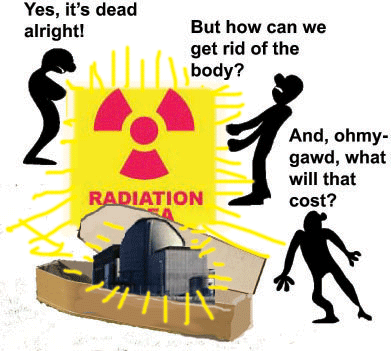 Nuke Plant Worker Admits That Plants Are At Their Life Expectancy and Bean Counters Short Change Maintenance http://nukeprofessional.blogspot.com.au/
http://www.chicagobusiness.com/article/20150220/OPINION/150219883?cachebust=BNYA#comment-2094841278 ——————————————————————–R Harden •
I worked at the Byron nuke plant for 29 years. The truth is, this plant, and others like it, have just about out lived their life expectancy. It’s going to close someday whether we like it or not. It has been modified, repaired, equipment replaced and systems up-dated. There is only so much you can do to preserve it’s existence and overall health. Like anything man made, it will have an end. The bean counters for Exelon figure cost verses income. Once the plant becomes more expense than profit, it will probably be shut down.
Technology has come along way since these old dinosaurs were built, and with the cost of nuclear power, they won’t survive. The Zion Nuclear Plant was closed many years ago because of this reason. It cost more to operate than it could make on paper.The real issue I see, is the cost of the spent nuclear fuel that is stored on site. Closing these sites does not get rid of that problem and the expense.
These sites will still require security, maintenance, insurance, taxes, and more, to a plant that has no income. These cost will be there for many, many years, until the fuel finds a new home somewhere else. They told us, spent nuclear fuel has a 2500 year, half life. No one else wants the spent fuel. That’s why it’s stored on site. Who will pay for this clean up is a good guess, but it will probably come down to the consumers and tax payers, as usual. Don’t get me wrong, Exelon is a very good company. They care much about the safety of these plants and the public. Because of government requirements, lack of government subsidies to the nuclear industry, high taxes, high insurance cost and high everything else, the nuclear industry has just about died. Just my opinion.
1 This Month

of the week – Shut Down Drone Warfare!


Tell the Ukrainian Government to Drop Prosecution of Peace Activist Yurii Sheliazhenko

Petition to revoke the licensing of the Near Surface Nuclear Disposal Facility (NSDF) at Chalk River. https://www.ourcommons.ca/petitions/en/Petition/Details?Petition=e-7247
To see nuclear-related stories in greater depth and intensity – go to https://nuclearinformation.wordpress.com
-
Archives
- April 2026 (103)
- March 2026 (251)
- February 2026 (268)
- January 2026 (308)
- December 2025 (358)
- November 2025 (359)
- October 2025 (376)
- September 2025 (257)
- August 2025 (319)
- July 2025 (230)
- June 2025 (348)
- May 2025 (261)
-
Categories
- 1
- 1 NUCLEAR ISSUES
- business and costs
- climate change
- culture and arts
- ENERGY
- environment
- health
- history
- indigenous issues
- Legal
- marketing of nuclear
- media
- opposition to nuclear
- PERSONAL STORIES
- politics
- politics international
- Religion and ethics
- safety
- secrets,lies and civil liberties
- spinbuster
- technology
- Uranium
- wastes
- weapons and war
- Women
- 2 WORLD
- ACTION
- AFRICA
- Atrocities
- AUSTRALIA
- Christina's notes
- Christina's themes
- culture and arts
- Events
- Fuk 2022
- Fuk 2023
- Fukushima 2017
- Fukushima 2018
- fukushima 2019
- Fukushima 2020
- Fukushima 2021
- general
- global warming
- Humour (God we need it)
- Nuclear
- RARE EARTHS
- Reference
- resources – print
- Resources -audiovicual
- Weekly Newsletter
- World
- World Nuclear
- YouTube
-
RSS
Entries RSS
Comments RSS
 nuclear-news