Fukushima may end free housing for voluntary nuclear evacuees in 2017

FUKUSHIMA – The Fukushima Prefectural Government may stop providing free accommodations at the end of March 2017 for people who voluntarily left areas in the prefecture not subject to nuclear evacuation advisories, sources said.
Officials hope to encourage people who evacuated on their own to return home, but the proposed end to the assistance will certainty draw objections from them.
There have been calls in some Fukushima municipalities that are worried about the lack of progress in the return home of evacuees for an end to the support program.
The prefecture will decide after listening to the opinions of local officials later this month, the sources said.
Of about 115,000 people who have taken refuge in and outside the prefecture, some 36,000 are believed to be from areas that are not covered by the central government’s evacuation advisories for radiation from the nuclear crisis that started in 2011.
Many voluntary evacuees are people with children as well as former residents of such areas as the town of Hirono, the village of Kawauchi and the city of Minamisoma, all geographically close to the government-designated evacuation zones.
They sought refuge outside their hometowns mainly due to concerns over exposure to radiation from the reactor meltdowns at Tokyo Electric Power Co.’s Fukushima No. 1 plant.
Under the Disaster Relief Act, the prefectural government provides prefabricated temporary housing for nuclear evacuees for free and fully finances their rent for private apartments.
The aid program was originally supposed to run two years, but it was extended by a year twice, with the current version set to expire at the end of next March. For voluntary evacuees, the prefecture hopes to terminate the assistance after another one-year extension, the sources said.
It is looking at continuing the free accommodations for people who fled the designated evacuation areas, the sources said.
http://www.japantimes.co.jp/news/2015/05/18/national/fukushima-may-end-free-accommodations-voluntary-nuclear-evacuees-2017/#.VVoO40ZZNBR
Crowdfunding and recuperation programs for Fukushima children
 Fukushima c’est eux Fukushima c’est nous
A group of parents who has been hosting children from Fukushima since summer 2012 are now organizing another round of crowd funding for summer 2015.
Details on their crown funding site.
http://fr.ulule.com/fukushima-nous/
Here is the information about the previous year’s achievement.
http://fr.ulule.com/fukushima/
JCSシドニーレインボープロジェクト JCS Sydney Rainbow Project
2015年夏、東北の震災孤児・遺児を10人、シドニーに保養に呼ぶ計画です
Summer camp 2015 for children who lost parents/family members
詳細はこちら For donation details https://readyfor.jp/projects/sydney
FUKUSHIMA KIDS DOLPHIN CAMP 2015 フクシマドルフィンキャンプ2015 御蔵島
“Dear eARThist family,
Oak to all relations Tokyo would like to present 2015 Fukushima Kids Dolphin Camp in Mikura Island this summer for children to release their stress from radiation fear caused by 2011 Tohoku earthquake and tsunami and give them an opportunity to play in the mother nature. And WE ARE COLLECTING DONATIONS!
See more at http://www.oak-to-all-relations.org/fukushima-kids-dolphin-camp2015/
Source: Save Children From Radiation
http://www.save-children-from-radiation.org/events/

Ma: Japanese food ban only for short term
Taiwanese President Ma Ying-jeou says Taiwan’s tightened controls on food imports from Japan will only be temporary.
Taiwanese health authorities had banned food imports from Fukushima and 4 nearby prefectures in the wake of the March 2011 nuclear accident.
But it was revealed in March that some food from the prefectures was being imported to Taiwan. This prompted calls by consumer groups for stricter regulations.
The authorities further tightened their rules on food imports from Japan last Friday. The measures include requiring that all Japanese food products bound for Taiwan carry certificates proving the prefecture of origin.
President Ma stressed to reporters on Monday that priority lies on dispelling consumer fears over the labeling of food products in Japan. He described the measure as being temporary, and added that health authorities are eager to resolve the issue.
Ma expressed his readiness to ease the restrictions after authorities determine how the banned products reached Taiwanese consumers and steps are taken to prevent similar reoccurrences.
The Japanese side has been urging Taiwan to lift the tougher regulations, calling the steps scientifically groundless. Japanese food exporters have expressed the fear that the revised regulations may increase export costs and make them less competitive in Taiwan.
Taiwanese supermarkets have also voiced concern over a possible decline in the volume of Japanese food they sell.
Source: NHK
http://www3.nhk.or.jp/nhkworld/english/news/20150518_29.html
UK Navy investigating Trident nuclear submatine whistle-blower William McNeilly

 Royal Navy investigates Trident whistle-blower William McNeilly who claims nuclear programme is a ‘disaster waiting to happen’ , The Independent 17 May 15 The Royal Navy is investigating claims by an apparent whistle-blower that there is a “complete lack of concern for security” that makes the Trident nuclear weapons programme vulnerable to terror attack.
The claims were made in an online post by 25-year-old William McNeilly, and included a photograph of his Navy ID card.
McNeilly said he had “sacrificed” his freedom and a well-paid career to make the claims in an 18-page report entitled “The Secret Nuclear Threat”, and that after posting it he had gone on the run.
The Ministry of Defence confirmed that McNeilly was a member of the naval service, and a source said the Navy was “concerned for the whereabouts and wellbeing of AB (able seaman) McNeilly and working closely with civilian police to locate him”.
In his report, McNeilly claimed he had witnessed a host of inadequate systems and checks while training with the Trident programme, from “things like food hygiene” to failed launch tests, flooding on board submarines, fires in the missile compartment and “a complete lack of security”.
“If airport security and nuclear weapon security were both compared to prisons,” McNeilly writes, “the airport would be Alcatraz and base security would be house arrest.”
McNeilly’s report: Key claims
• Missile launch tests failed on three occasions
• Collision with French nuclear sub covered up
• Failures to carry out security checks on bags
• Computer waste representing major fire risk
• Missile safety alarms muted and ignored
• Accidental flooding of torpedo compartment
• Failure to question recording of top-secret info
McNeilly described the state of Trident security as “the biggest threat the UK faces”, and said he was only releasing “selected information” in order to avoid damaging security further.
“I’m releasing this information in this way because it’s the only way I can to be sure it gets out,” he said, adding that he had “raised concerns through the chain of command on multiple occasions” and got nowhere……….http://www.independent.co.uk/news/uk/home-news/royal-navy-investigates-trident-whistleblower-william-mcneilly-who-claims-nuclear-programme-is-a-disaster-waiting-to-happen-10256148.html
Links between Alaskan seal deaths and Fukushima fallout
Scientists present links between unusual Alaska seal deaths and Fukushima fallout — Skin lesions, hair loss, lethargy — ‘Pulsed release’ when built-up radionuclides were set free as ice melted — “Wildlife health implications” due to radiation exposure discussed (PHOTOS & MAP) http://enenews.com/scientists-link-unusual-alaska-seal-deaths-fukushima-fallout-skin-lesions-hair-loss-lethargy-pulsed-release-built-radionuclides-set-free-ice-melted-discussion-wildlife-health-implications-due January 25th, 2014
Alaska Marine Science Symposium (pdf), Jan. 20-24, 2014 (emphasis added): 2011 Fukushima Fall Out: Aerial Deposition On To Sea Ice Scenario And Wildlife Health Implications To Ice-Associated Seals (Dr. Doug Dasher, John Kelley, Gay Sheffield, Raphaela Stimmelmayr) — On March 11, 2011 off Japan’s west coast, an earthquake-generated tsunami struck the Fukushima Daiichi nuclear power plant resulting in a major nuclear accident that included a large release of airborne radionuclides into the environment. Within five days of the accident atmospheric air masses carrying Fukushima radiation were transiting into the northern Bering and Chukchi seas.During summer 2011 it became evident to coastal communities and wildlife management agencies that there was a novel disease outbreak occurring in several species of Arctic ice-associated seals.
Gross symptoms associated with the disease included lethargy, no new hair growth, and skin lesions, with the majority of the outbreak reports occurring between the Nome and Barrow region. NOAA and USFWS declared an Alaska Northern Pinnipeds Usual Mortality Event (UME) in late winter of 2011. The ongoing Alaska 2011 Northern Pinnipeds UME investigation continues to explore a mix of potential etiologies (infectious, endocrine, toxins, nutritious etc.),including radioactivity. Currently, the underlying etiology remains undetermined. We present results on gamma analysis (cesium 134 and 137) of muscle tissue from control and diseased seals, anddiscuss wildlife health implications from different possible routes of exposure to Fukushima fallout to ice seals. Since the Fukushima fallout period occurred during the annual sea ice cover period from Nome to Barrow, a sea ice based fallout scenario in addition to amarine food web based one is of particular relevance for the Fukushima accident. Under a proposed sea ice fallout deposition scenario, radionuclides would have been settled onto sea ice. Sea ice and snow would have acted as a temporary refuge for deposited radionuclides; thus radionuclides would have only become available for migration during the melting season and would not have entered the regional food web in any appreciable manner until breakup (pulsed release). The cumulative on-ice exposure for ice seals would have occurred through external, inhalation, and non-equilibrium dietary pathwaysduring the ice-based seasonal spring haulout period for molting/pupping/breeding activities. Additionally, ice seals would have been under dietary/metabolic constraints and experiencing hormonal changes associated with reproduction and molting.
Radiation from Fukushima, APRN (Alaska Public Radio Network), Jan. 24, 2014: They’re having trouble sealing up the leaking nuclear power plants in Japan and they’re also having trouble disclosing what is going on there. Is this a reason to distrust Alaska seafood? […] GUESTS: Professor Doug Dasher, Environmental Oceanographer, University of Alaska Fairbanks School of Fisheries and Ocean Science — Dr. John Kelley, Professor Emeritus, University of Alaska Fairbanks, former Director, Naval Arctic Research Laboratory — Post your comment before, during or after the live broadcast (comments may be read on air). […] LIVE Broadcast: Tuesday, January 28, 2014 at 10:00 a.m. […]
Immediate release ordered for Sister Megan Rice and her compatriots
 Anti-nuclear activist nun Megan Rice to be freed from prison Convictions for the 85-year-old Catholic nun and two fellow activists who vandalized a uranium facility were overturned, Aljazeera
The order came a week after the 6th U.S. Circuit Court of Appeals in Cincinnati overturned the 2013 sabotage convictions of Sister Megan Rice, 66-year-old Michael Walli, and 59-year-old Greg Boertje-Obed, and ordered resentencing on their remaining conviction for injuring government property. The activists have spent two years in prison, and the court said they likely already have served more time than they will receive for the lesser charge.
On Thursday, their attorneys petitioned the court for an emergency release, saying that resentencing would take weeks if normal court procedures were followed. Prosecutors on Friday afternoon responded that they would not oppose the release, if certain conditions were met………..http://america.aljazeera.com/articles/2015/5/16/megan-rice-anti-nuclear-nun-activist-to-be-freed.html
Trident nuclear submarines plagued by security lapses: whistleblower claims “high risk”
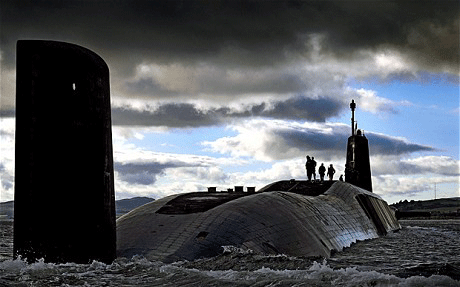 Trident whistleblower says nuclear subs are insecure, unsafe and ‘a disaster waiting to happen’, Herald Scotland Sunday 17 May 2015 TRIDENT submarines are plagued by serious security lapses, beset by multiple safety blunders and are “a disaster waiting to happen”, according to a nuclear weapons engineer turned whistleblower who is now being hunted by the police. William McNeilly, who says he was on patrol with HMS Victorious from January to April this year, alleges that the Trident missiles it carries are vulnerable to a terrorist attack that “would kill our people and destroy our land”. Infiltrators have “the perfect opportunity to send nuclear warheads crashing down on the UK”, he claims.
He has written a detailed 18-page report called The Nuclear Secrets, which claims to lift the lid on the alarming state of the UK’s ageing and short-staffed nuclear deterrent. He went absent without leave from the Royal Navy last week, is on the run and expects to be arrested. “This is bigger than me, it’s bigger than all of us,” he says. “We are so close to a nuclear disaster it is shocking, and yet everybody is accepting the risk to the public. If we don’t act now lives could be lost for generations.”
The risk was “extremely high”, he told the Sunday Herald. “My information comes from good sources and I have no reason to lie. If change isn’t made, a nuclear catastrophe almost certainly will happen.”
McNeilly’s report alleges 30 safety and security flaws on Trident submarines, based at Faslane on the Clyde. They include failures in testing whether missiles could be safely launched, burning toilet rolls starting a fire in a missile compartment, and security passes and bags going unchecked.
He also reports alarms being muted because they went off so often, missile safety procedures being ignored and top secret information left unguarded.
“It’s just a matter of time before we’re infiltrated by a psychopath or a terrorist,” he says. “There were some people that I served with on that patrol who showed clear psychopathic tendencies.”
The Royal Navy has launched an investigation into McNeilly’s report, and is working with the civilian police to find him. It describes his criticisms as “subjective and unsubstantiated”, stressing that submarines never go to sea unless they are completely safe.
The SNP’s Westminster leader, Angus Robertson MP, is demanding a full explanation and action to rectify all the failings. “These revelations, if true, are extremely concerning. It reads as a nightmare catalogue of serious safety breaches,” he said.
“They add to what appears to be a chaotic, shambolic safety culture on these aged subs. Broken or faulty equipment with no spares leading to slapdash patch-up jobs have no place in the Navy and just shows how utterly stretched it is.”
Robertson added: “Failure to follow standard safety procedures is unacceptable in any workplace but on a Trident submarine on patrol it could result in extreme tragedy, not just for those on board but indeed for the entire planet.”
McNeilly claims that there was a “massive cover-up” of what happened when HMS Vanguard collided with the French nuclear submarine, Le Triomphant, in the Atlantic in February 2009. He quotes a senior officer who was on Vanguard at the time as saying: “We thought, this is it, we’re all going to die.”
The crash dislodged high-pressure air (HPA) bottles, he says. “They had to return to base port slowly, because if one of HPA bottle groups exploded it would have created a chain reaction and sent the submarine plummeting to the bottom.”
McNeilly also outlines a litany of equipment problems, including a seawater leak, a flooded torpedo compartment and defective toilets. A missile compartment was used as an exercise gym, he alleges, and the submarine speaker system was difficult to understand.
He insists that he has been careful about what he has said publicly in order to avoid prejudicing security. He repeatedly raised concerns with his superiors but they were ignored, he says………….
“Most people know the Trident programme is a disaster waiting to happen, but they never tell the public. You’re guaranteed to lose everything, if you talk. Career, money, everything you own, your freedom, contact with family and friends.
I believe it’s in the Prime Minister’s best interest to pardon me. Prosecuting someone for alerting the people and the government to a major threat isn’t a good image for someone who serves the people.
I raised my concerns about the safety and security of the weapon system through the chain of command on multiple occasions. My concern couldn’t have been any clearer. Not once did someone even attempt to make a change.
I strongly believe that the Prime Minister and most people that defended Trident have no idea about how dire the situation is. This is not the time to judge on what they did when they didn’t know. It’s about what they do now that they know”. http://www.heraldscotland.com/news/home-news/trident-whistleblower-says-nuclear-submarimes-are-insecure-unsafe-and-a-disaster-wait.1431860917
Risks in Decision n to Dismantle Cover Over Damaged Fukushima Reactor
Decision to Dismantle Cover Over Damaged Fukushima Reactor ‘Questionable’ Sputnik News 16 May 15 A decision of the Tokyo Electric Power Company (TEPCO) to begin Friday preparatory work to dismantle the protective cover over the Reactor 1 building at the damaged Fukushima nuclear power plant raises questions, an expert in the nuclear energy told Sputnik.
“It [the cover] was … meant to protect the environment from the dispersion of radioactive particles. Of course, these risks continue beyond the taking off of the cover: rainwater washing out radioactivity that enters the ocean, heavy storms impacting water and nitrogen injection systems,” Mycle Schneider, an independent analyst on Energy and Nuclear Policy, said.
He cited the International Atomic Energy Agency, that has stated in its latest report that this decision may lead to “higher radiological and conventional safety risks to the work force.”……..http://sputniknews.com/analysis/20150516/1022209934.html
Claim that Saudi Arabia is to buy nuclear weapons from Pakistan
US officials: ‘Saudis set to buy nuclear weapons from Pakistan’, IBT By Yasmin Kaye May 17, 2015 Saudi Arabia is said to have taken the “strategic decision” to acquire “off-the-shelf” nuclear weapons from ally Pakistan, senior US officials told the Sunday Times.
Sunni Arab states are increasingly concerned of the repercussions of a deal currently being negotiated between world powers and Shi’ite rival Iran, which they fear may still be able to develop a nuclear bomb.
The deal being negotiated between Iran and the permanent members of the UN Security Council and Germany would see the Shi’ite nation curb its sensitive nuclear programme in exchange for sanctions relief.
“For the Saudis the moment has come,” a former US defence official told the Sunday Times last week.
“There has been a long-standing agreement in place with the Pakistanis and the House of Saud has now made the strategic decision to move forward.”
‘This stuff is available to them off the shelf’
Another US official working in intelligence told the paper that “hundreds of people at [CIA headquarters] Langley” were working to establish whether Islamabad had already supplied the Gulf nation with nuclear technology or weaponry………….
- Saudi Arabia has financed substantial amounts of Islamabad’s nuclear programme over the past three decades, providing Pakistan‘s government with billions of dollars of subsidised oil while taking delivery of Shaheen mobile ballistic missiles.
“Given their close relations and close military links, it’s long been assumed that if the Saudis wanted, they would call in a commitment, moral or otherwise, for Pakistan to supply them immediately with nuclear warheads,” former Foreign Secretary Lord David Owen told the Sunday Times.
A senior British military officer also told the paper that Western military leaders “all assume the Saudis have made the decision to go nuclear.”
“The fear is that other Middle Eastern powers — Turkey and Egypt — may feel compelled to do the same and we will see a new, even more dangerous, arms race.”
Lt.Gen. Khalid Kidwai, who helped develop Pakistan’s nuclear program, denied Islamabad had ever sent nuclear technology to Saudi Arabia or any other country in recent comments. http://www.ibtimes.co.uk/us-officials-saudis-set-buy-nuclear-weapons-pakistan-1501733
More research needed on earthquake risk at nuclear plants- Nuclear Regulatory Commission
Among commercial U.S. nuclear plants, the Diablo Canyon reactors near San Luis Obispo and the Columbia generating station in Richland, Washington, face “the highest … hazard” when potential strong shaking is evaluated against the plants’ designs, the Nuclear Regulatory Commission found…………..
Diablo Canyon, which sits within a web of earthquake faults on the California coast, one 650 yards away from the reactors, has faced questions for decades about its ability to withstand a strong earthquake. Last year, a former chief NRC inspector at the plant urged regulators to shut down the reactors until they can determine whether they can withstand shaking from nearby faults, a recommendation rejected by the NRC.
Last year, two Seattle-based groups, Heart of America Northwest and Washington Physicians for Social Responsibility, called for shutting down the Columbia plant, citing a report by a nuclear power critic on risk posed by a stockpile of spent nuclear fuel and a potential earthquake. Operator Energy Northwest said the report was marred by errors.
Anti-nuclear activists said the NRC directive confirms concerns that Diablo Canyon’s design might not account for the threat of nearby faults discovered after the twin-reactor plant was constructed decades ago.
“The order is yet more evidence that earthquakes surrounding Diablo Canyon are capable of more ground motion than the reactors were built to withstand,” Friends of the Earth said in a statement…………..http://www.sfgate.com/business/energy/article/NRC-orders-more-research-on-earthquake-risk-at-6261739.php
India seeking foreign funds in effort to get up nuclear insurance pool
 Nuclear insurance pool: Foreign firms interested to pitch in, says GIC, Economic Times 17 May 15NEW DELHI: With the Indian nuclear insurance pool falling short by Rs 600 crore towards becoming operational, some foreign companies have shown an interest in being a part of the initiative.
“We are also pursuing private sector companies… Six companies came with Rs 150 crore. Now, it has become 900 crore. We are putting all our efforts into raising the remaining Rs 600 crore for operationalising the pool,” said Y Ramulu, GM of General Insurance Corporation (GIC) of India.
Clauses in the Act which give the operator the Right to Recourse and allow it to sue the suppliers in case of any accident were seen as being a major hindrance to the growth of the nuclear industry. These concerns led to to the formation of the Indian nuclear insurance pool. ……
The government was also initially toying with the idea of a catastrophe bond, but Ramulu said that may not take off anytime soon. ……
“We are also hoping for government support in this case,” Ramulu said.
Sources said the government may throw in sovereign guarantee to address the concerns of foreign suppliers over the nuclear liability law.
Dubious reliability of Canada’s Paris Climate Pledge
Paris 2015: Canada aims to cut emissions by 30 per cent by 2030, SMH May 16, 2015 Josh Wingrove Canada pledged to cut greenhouse-gas emissions by about a third by 2030 in a move quickly dismissed by environmentalists and energy analysts as lacking detail and unrealistic without major policy changes.
Environment Minister Leona Aglukkaq announced the new target Friday in Winnipeg, ahead of a UN climate summit in December. In effect, Canada pledged to reduce its emissions to an estimated 515 metric megatons by 2030, partly by introducing new regulations on its oil and gas sector. The country isn’t on pace to meet its previous goal, and predicts emissions will grow — not shrink — over the next five years.
Emissions were 726 megatons in 2013, the most recent year for which data is available, and government figures show emissions are set to grow leading up to 2020. Canada now plans to cut emissions by 29 per cent between 2013 and 2030, based on Bloomberg calculations using public data.
To meet the new target, Canada “intends to develop” regulations to cut methane emissions from the oil and gas sector, in tandem with US regulations, Aglukkaq said. Canada will also introduce regulations on emissions from natural gas electrical plants, her department said in a news release without specifying what the rules would include.
The government offered no projections of what reduction in emissions the new measures would produce, or how soon the new initiatives would be introduced.
Australia is yet to reveal its post-2020 emissions plans with the Abbott government expect to reveal its goals next month.
Copenhagen pledge
Under the 2009 Copenhagen Accord, Canada pledged to cut emissions by 17 per cent from 2005 levels by 2020, or to 611 megatons, but is on pace to fall well short of its goal. Environment Canada figures show Canada’s emissions are projected to increase between 2015 and 2020, when they are projected to reach 727 megatons.
That means Canada’s Copenhagen pledge was to reduce emissions by 125 megatons between 2005 and 2020, whereas Canada is only on pace to cut them by nine megatons……
The US has pledged to cut emissions by at least 26 per cent from 2005 levels by 2025 — a lower target with a more aggressive timeframe. Mexico has pledged to cut emissions by 25 per cent by 2030, though its per-capita emissions are already 74 per cent lower than Canada’s, according to World Bank emissions data. http://www.smh.com.au/environment/climate-change/paris-2015-canada-aims-to-cut-emissions-by-30-per-cent-by-2030-20150515-gh311n.html
Green bonds – a powerful way to develope green energy?
Green bonds, a fast-growing money game with the clout to develop clean energy, await an umpire, EE News, Benjamin Hulac, E&E reporter ClimateWire: Thursday, May 14, 2015
When he chaired the Federal Communications Commission from 1993 to 1997, Reed Hundt studied the swift expansion of the nation’s telecommunications system that made the United States among the most advanced nations in the field and sparked investment overseas.
Between 1996 and 2013, broadband companies invested more than $1.3 trillion in telecom infrastructure domestically, according to the broadband industry’s trade group.
About 32 percent of the world’s population — 84 percent and 21 percent of residents in developed and developing nations, respectively — now has mobile broadband connections, according to the United Nations.
Hundt believes the same experience could be repeated in developing clean energy to cope with global climate change.
Borrowed money paid for the communications boom, Hundt explained, speaking yesterday at an energy efficiency conference in Washington, D.C. He added that world leaders should apply the same method to fund the renewable energy market.
“Everything in communications has been purchased with debt,” he said, holding up an iPhone and describing how rapidly mobile phones have spread internationally.
The portion of the business world devoted to renewable energy resembles the telecom industry in the 1980s, said Hundt, now the CEO of the Coalition for Green Capital, a nonprofit working to drive renewable investment by creating so-called green banks.
“I think that we’re in the really early days,” he said during a panel talk on green bonds, adding that a “total, radical, disrupting overhaul” of the energy sector must be accomplished with a massive lending market and robust debt securitization…………..http://www.eenews.net/stories/1060018552
Moving your investments way from banks that invest in fossil fuels

But can you be sure that your new banks don’t invest in uranium and nuclear power?
How to divest your bank account of fossil fuels, Guardian Patrick Collinson, 16 May 15
The big five UK banks are among the world’s biggest lenders to the coal, oil and gas industries. If you don’t want to help them support climate change, there are viable alternatives
Is your current account with one of the big five banks: Lloyds, Barclays, HSBC, RBS/NatWest or Santander? If so, you are helping to support the more than £66bn they have lent to companies around the world engaged in oil and gas extraction. But individuals- who are concerned about climate change can move their money to banks and financial institutions that offer fossil-free alternatives.
The scale of support provided by mainstream banks across the world for the coal, oil and gas industry is breathtaking – and it is British banks that are among the biggest lenders. An analysis of Europe’s 20 largest banks in 2014 found that Barclays had the highest volume of “high carbon” loans, as a proportion of its total lending, of any of the banks, while Lloyds had the highest amount invested in high-carbon equities.
“The five biggest banks in the UK are also the five biggest investors in climate change,” says campaign group MoveYourMoney.org.uk.
It also analysed how much the major banks are financing controversial fracking operations. HSBC provides services to Cuadrilla; Barclays handles banking for IGas Energy, the company with the most oil and gas exploration licences in the UK; while Lloyds loaned £10m to Alkane Energy.
But what can individuals concerned about climate change do? Are there fossil fuel-free alternatives? The good news is that switching is now easier than ever – and high-quality accounts are easily accessible.
MoveYourMoney has prepared an action plan. …….http://www.theguardian.com/environment/2015/may/16/how-to-divest-your-bank-account-of-fossil-fuels#comment-52338430
US Navy considers privatising disposal of old nuclear ships
Scrap War: US May Compete Nuclear Ship Disposal Deal, Defense News By Christopher P. CavasMay 17, 2015 WASHINGTON — All nuclear-powered US Navy ships go to die at Puget Sound Naval Shipyard in Bremerton, Washington. That’s been an immutable mantra since the early 1990s, when the shipyard developed a recycling plan to dispose of old submarines and cruisers that were piling up as they reached the end of their lives.
Under the shipyard’s direction, shipboard nuclear reactors are defueled, the reactor vessels and their compartments are removed, encased and barged to the federal government’s Hanford Nuclear Reservation in southern Washington State, and the ships’ remains are cut up for scrap and recycling. The program has successfully disposed of more than 100 nuclear submarines and eight nuclear cruisers.
As the only US-certified facility with experience recycling nuclear ships, the plan has long been that, sometime in early 2017, Puget Sound would take on its largest disposal job by far — that of the aircraft carrier Enterprise, one of the most famous ships of the Cold War era.
But now, the Navy is considering throwing open the job to commercial bidders — a clear break from prior practice that could open the nuclear ship-disposal world to more competition……….http://www.defensenews.com/story/defense/naval/ships/2015/05/17/aircraft-carrier-enterprise-newport-news-puget-sound-naval-shipyard-nuclear-shipbreaking-ship-scrapping-recycling-brownsville-disposal-navy-navsea/27321139/
1 This Month

of the week – Shut Down Drone Warfare!


Tell the Ukrainian Government to Drop Prosecution of Peace Activist Yurii Sheliazhenko

Petition to revoke the licensing of the Near Surface Nuclear Disposal Facility (NSDF) at Chalk River. https://www.ourcommons.ca/petitions/en/Petition/Details?Petition=e-7247
To see nuclear-related stories in greater depth and intensity – go to https://nuclearinformation.wordpress.com
-
Archives
- April 2026 (103)
- March 2026 (251)
- February 2026 (268)
- January 2026 (308)
- December 2025 (358)
- November 2025 (359)
- October 2025 (376)
- September 2025 (257)
- August 2025 (319)
- July 2025 (230)
- June 2025 (348)
- May 2025 (261)
-
Categories
- 1
- 1 NUCLEAR ISSUES
- business and costs
- climate change
- culture and arts
- ENERGY
- environment
- health
- history
- indigenous issues
- Legal
- marketing of nuclear
- media
- opposition to nuclear
- PERSONAL STORIES
- politics
- politics international
- Religion and ethics
- safety
- secrets,lies and civil liberties
- spinbuster
- technology
- Uranium
- wastes
- weapons and war
- Women
- 2 WORLD
- ACTION
- AFRICA
- Atrocities
- AUSTRALIA
- Christina's notes
- Christina's themes
- culture and arts
- Events
- Fuk 2022
- Fuk 2023
- Fukushima 2017
- Fukushima 2018
- fukushima 2019
- Fukushima 2020
- Fukushima 2021
- general
- global warming
- Humour (God we need it)
- Nuclear
- RARE EARTHS
- Reference
- resources – print
- Resources -audiovicual
- Weekly Newsletter
- World
- World Nuclear
- YouTube
-
RSS
Entries RSS
Comments RSS
 nuclear-news