Japan court says NO to restart of two nuclear reactors

 Japan court blocks restarting of two nuclear reactors Tokyo (AFP) – A Japanese court on Tuesday issued a landmark injunction against the restarting of two atomic reactors, after the country’s nuclear watchdog had given the green light to switch them back on.
The district court in the central prefecture of Fukui made the temporary order in response to a bid by local residents to halt the restart of the No. 3 and No. 4 reactors at the Takahama nuclear power plant, a court official said……..”the safety of the reactors hasn’t been secured”, the court ruled, saying the watchdog’s new standards were “lacking rationality”, according to public broadcaster NHK.
The reactors could be damaged by an earthquake even smaller than that envisaged in the safety standards, the court said……..
Two other reactors at Takahama also remain offline.
Greenpeace hailed the court decision, saying it “could have a nationwide ripple effect on similar pending injunction cases — threatening to derail the Japanese government?s nuclear reactor plans”.
A separate court ruling on the restart of two other reactors in southern Japan is expected later this month.
– ‘Warning from the court’ – Hiroshi Miyano, a nuclear expert and visiting professor at Hosei University in Tokyo, said the court decision would affect the timing of future reactor restarts.
“This can be seen as a warning from the court, which told the (plant) operator that it has to better explain its resumption plans,” Miyano said……..
But Japan has seen a groundswell of public opposition to the technology since Fukushima, where reactors went into meltdown after a tsunami swamped their cooling systems — setting off the worst atomic disaster since Chernobyl in 1986.
Japan’s entire stable of nuclear power stations was gradually switched off following the disaster, while tens of thousands of people were evacuated due to concerns about radiation exposure.
Many are still unable to return to their homes and scientists have warned that some areas around the plant may remain uninhabitable for decades or more.https://au.news.yahoo.com/world/a/27100653/japan-court-blocks-restarting-of-two-nuclear-reactors/
- AFP
Global nuclear industry threatened as safety problems revealed at Flamanville reactor
Unfinished nuclear plants raise safety doubts. April 13, 2015 A new generation of giant reactors, meant to provide fresh hope for nuclear power in Europe, has been found to have a serious safety problem. By Paul Brown Climate News Network LONDON − The future of the world’s biggest nuclear reactor, under construction at Flamanville in northern France, is now in doubt after a serious flaw was found in its steel pressure vessel.
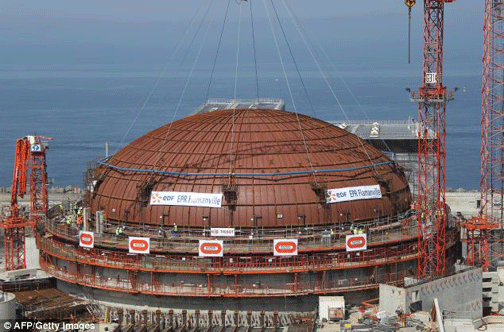
Examination has shown that the steel contains too much carbon, which can weaken the vessel’s structure and breaches safety rules. The Chinese, who have two similar 1,600 megawattEuropean Pressurised Reactors under construction, have been warned that they too may share the potentially catastrophic problem.
Investigations are continuing to check whether the problem can be rectified, but whatever happens it will add more delays and greater costs to the already troubled projects.
The problem also casts doubt on the much-heralded nuclear renaissance in Europe, where EPR reactors are being built not only in France but also in Finland.
Four more are planned for Britain, where they form a cornerstone of the UK government’s policy to fight climate change. A decision on whether to go ahead with the first two in the UK has already been postponed twice, and this revelation will cause further delays.
The French nuclear engineering firm Areva, involved in the EPR’s design and development, found the flawed steel and reported the problem to the country’s nuclear regulator, ASN, which has ordered an investigation. The French energy minister, Ségolène Royal, says the results of tests to check the extent of the problem will be released in October. Continue reading
Photos, videos of dead robot abandoned in Fukushima reactor No 1

On 4/13/2015, Tepco announced the dead robot had reported it measured approx. 10 Sv/h in Reactor 1 before it went out of order.
The robot was investigating the ground floor of PCV (Primary Containment Vessel) in Reactor 1.
The report shows the atmospheric dose was 7 〜 10 Sv/h. Temperature was around 20℃.
The video of 2:39 length shows steam coming up from the basement floor of PCV, where Tepco assumes molten fuel is retained, and grating was covered with something like yellow glue. The screen is full of white spots due to the extremely high level of radiation.
Tepco announced they gave up collecting the robot. They will cut off the cable and will not send the second robot until they figure out the reason why the robot went out of order.
Radiation within Fukushima reactor enough to kill a human within an hour

Radiation measured at deadly 9.7 sieverts in Fukushima reactor, Japan Times, JIJI APR 13, 2015 Tokyo Electric Power Co. said Monday that radiation in the primary containment vessel of the No. 1 reactor of the Fukushima No. 1 power station gets as high as 9.7 sieverts per hour — enough to kill a human within an hour.
The radiation levels at six locations in the western section of the first floor of the PCV ranged from 7.0 to 9.7 sieverts per hour, the beleaguered utility said in disclosing data collected by a remote-controlled robot on Friday.
By contrast, the temperatures at the six locations monitored were cool, ranging from 17.8 to 20.2 degrees.
Tepco sent the robot into the primary containment vessel on Friday, expecting it to stay alive for 10 hours. But the robot failed within three hours after completing about two-thirds of its planned route. Tepco has given up on recovering the robot.
The survey involved eight Tepco employees and 36 other workers who were hired by contractors. The maximum radiation dose logged was 1.73 millisieverts…….http://www.japantimes.co.jp/news/2015/04/13/national/radiation-measured-at-deadly-9-7-sieverts-in-fukushima-reactor/#.VS3jUNyUcnk
Danger of nuclear reactors as explained by Alvin Weinberg
 Top US Nuclear Physicist: “Iodine-131 will be lethal after ingestion of 30 billionths of a gram” — Main worry is not a Chernobyl-type accident, rather it’s a melt-through of containment vessel — “Not possible to disprove China Syndrome” http://enenews.com/top-nuclear-physicist-iodine-131-will-be-lethal-after-ingestion-30-billionths-gram-main-worry-chernobyl-type-accident-melt-containment-vessel-possible-disprove-china-syndrome?utm_source=feedburner&utm_medium=email&utm_campaign=Feed%3A+ENENews+%28Energy+News%29 The hazards of nuclear power plants and the related nuclear industries are reviewed
Alvin M. Weinberg, nuclear physicist (Director of Oak Ridge National Lab and pioneered the pressurized water reactors and boiling water reactors used in nuclear power plants, worked on the Manhattan Project, appointed to President’s Science Advisory Committee during the Eisenhower and Kennedy administrations), 1973:
- [A]re there concerns regarding the possibility that these systems may malfunction and cause hazard to people and to the environment? This is a perfectly legitimate question that deserves serious and thoughtful consideration; and it is this aspect of the matter that I shall address… The potential hazard of a nuclear system arises from the toxicity both of the materials that keep the system burning and from the fission product ashes. Plutonium-239… is lethal to man in doses of about 16 thousandths of a gram if ingested in the lungs; Strontium-90, with a half-life of 30 years, will be lethal if about 70 millionths of a gram is ingested; Iodine-131, with a half-life of eight days, will be lethal after ingestion of only about 30 billionths of a gram.
- As I have said, even during the Manhattan Project, we realized that a nuclear reactor could undergo what is known as an excursion [see Chernobyl] – that is, if too many control rods were removed, the reactor power could surge to dangerous levels. This, however, is not the main worry, for such excursions are inherently self-limiting both in time and magnitude.
- Rather, the worry is that in a very high-powered reactor, immediately after the chain reaction has stopped, the fission products at least momentarily continue to generate 7% as much energy… Thus a high-powered chain reactor must continue to be cooled for a considerable time after shutdown if fuel meltdowns are to be avoided. It was Edward Teller who some 25 years ago insisted with great prescience that in these respects nuclear reactors were potentially dangerous, and therefore they should be subjected to the most searching kind of technical scrutiny… The response of the engineer… was to build a… containment vessel around every reactor; the second [was] various back-up safety systems… to prevent the reactor core from melting. Why bother with the back-up cooling systems if the containment vessel in final analysis will catch whatever radioactive debris might be created in an accident and thus prevent harm befalling the public? And indeed this was the attitude in the earliest days… As long as reactors were relatively small we could prove by calculation that even if the coolant system and its back-up failed, the molten fuel could not generate enough heat to melt itself through the containment However, when reactors exceeded a certain size, then it was no longer possible to prove by calculation that an uncooled reactor fuel charge would not melt through its containment vessel. This hypothetical meltthrough is referred to as the China Syndrome for obvious reasons. Since we could not prove that a molten fuel puddle wouldn’t reach the basement of a power reactor, we also couldn’t prove whether it would continue to bore itself deeper into the ground. Whether or not the China Syndrome is a real possibility is moot. The point is, however, that it is not possible to disprove its existence. Thus, for these very large reactors, it is no longer possible to claim that the containment shell, which for smaller reactors could be relied upon to prevent radioactivity from reaching the public, was sufficient by itself. In consequence, the secondary back-up cooling systems… must now be viewed as the ultimate emergency protection against the China Syndrome… if one is trying to be practically 100 percent sure of always being able to cope with a reactor meltdown, then one must… be absolutely certain that the engineered safety features, particularly the emergency core cooling system, will work as planned.
French authorities warn China on safety issues regarding rectors under construction in Guangdong
 The French reactor, at the Flamanville EPR nuclear power plant, is a third-generation pressurised water reactor of similar design and build to the two reactors being installed at a new plant in Taishan. Quality inspectors at Flamanville found an abnormally high concentration of carbon in steel parts capping the reactor vessel’s top and bottom during a series of tests carried out by French nuclear company Areva, which is building the reactor.
The excessive carbon would lead to “lower than expected mechanical toughness values”, nuclear regulator ASN said in a press statement on its website, without giving more details.
The toughness of the reactor shell was crucial because it relates to the ability of the material to withstand the propagation of cracks. The steel shell of a reactor has to be extremely tough to withstand decades of operation.
It was unknown whether the Taishan reactors had the same problem, but the issue might be worth China’s concern, the French authorities said. ASN had “informed” relevant foreign counterparts, the statement said.
“The vessel of a pressurised water reactor is equipment that is particularly important for safety,” the ASN added. “It contains the fuel and takes part in the radioactivity second containment barrier.”
The problematic steel parts at Flamanville were made by Creusot Forge, a subsidiary of Areva, which also made the same parts for the two reactors in Taishan with similar manufacturing technology, according to a Reuters report. It was unclear whether the Taishan reactors had undergone similar tests before they were shipped to China……..http://www.scmp.com/news/china/article/1762861/french-warning-nuclear-reactors-being-built-guangdong
Nuclear power would be a ‘last resort’ for earthquake prone Indonesia: safer options preferred
Nuclear power a ‘last resort’, says VP The Jakarta Post, Jakarta | National | Tue, April 14 2015 Vice President Jusuf Kalla insists nuclear energy is a last resort for Indonesia, saying the country has alternative options more in line with the country’s geologic and sociological conditions for addressing the looming energy crisis.
“Nuclear is suitable only in Java, and this is a last resort. The sophisticated technology developed by Japan in building its nuclear energy [was not even foolproof], as its plant also leaked”, he said, in an apparent reference to the Fukushima nuclear meltdown in 2011. Such risk is very high for Indonesia, which would not be able to handle it extra cautiously,” he said in a seminar on energy diversification here on Tuesday…….He added it was difficult to build a nuclear power plant in the country because it would elicit strong protests from the public and environmentalists. – See more at: http://www.thejakartapost.com/news/2015/04/14/nuclear-power-a-last-resort-says-vp.html#sthash.1NRm8NuU.dpuf
– See more at: http://www.thejakartapost.com/news/2015/04/14/nuclear-power-a-last-resort-says-vp.html#sthash.1NRm8NuU.dpuf– See more at: http://www.thejakartapost.com/news/2015/04/14/nuclear-power-a-last-resort-says-vp.html#sthash.1NRm8NuU.dpuf
Utah State regulators have safety concerns about plans to bury nuclear wastes

 Regulators question plan to store depleted uranium in Utah By MICHELLE L. PRICE, Associated Press, April 13, 2015 SALT LAKE CITY (AP) — State regulators on Monday cited a number of concerns they need resolved before approving a plan to bury in Utah’s western desert a type of nuclear waste that grows more radioactive over a million years.
The Utah Department of Environmental Qualityreleased a 250-page report Monday that examines a plan from Salt Lake City-based EnergySolutions to store depleted uranium at its site about 80 miles west of Salt Lake City. The company said its plan would allow for it to safely bury the waste in a way that weathers changes in climate, civilization and other disruptions.
The state report highlights eight areas where regulators say EnergySolutions hasn’t answered enough questions about how the storage site will hold up in various scenarios, including large-scale geologic changes to the planet.
State officials had begun accepting public comment on the plan through May and may reconsider their conclusions based on that feedback. The division will also hold public meetings in Tooele and Salt Lake City in May……..
While the Monday report from Utah’s Department of Environmental Quality doesn’t make a final conclusion about the plan, some environmental groups said they’re hopeful about the state’s response.
Matt Pacenza, the executive director of HEAL Utah, said after reading the state report that he’s optimistic that regulators may lean toward rejecting the plan.
“You can’t possibly take waste that’s dangerous for two million years,” Pacenza said, “if you have a whole host of unanswered questions and huge gaps in scientific knowledge.” http://www.greenwichtime.com/news/science/article/Regulators-question-plan-to-store-depleted-6196824.php
Utah Radiation Control Board insists on public input to review of depleted uranium waste plan
Utah Radiation Control Board insists depleted uranium hearings go on By BRIAN MAFFLY | | The Salt Lake Tribune, 14 Apr 15 EnergySolutions wants to put the process on hold after state faulted its proposal to accept radioactive waste. Utah Radiation Control Board members Tuesday pushed back against EnergySolutions’ request to delay a public review of the company’s plans to bury depleted uranium in Tooele County.
Board members told company executives they want to move forward with a public process that will culminate this summer with a decision whether to accept the nation’s 700,000-metric-ton stockpile of radioactive waste that is low-level now, but becomes increasingly hotter over the next 2 million years.
“This literally is of national interest, and we keep punting it down the road,” said radiation board chairman Peter Jenkins. “It is time to get additional opinions on it.”
On Monday the state Department of Environmental Quality (DEQ) released a long-anticipated safety evaluation of EnergySolution’s plan to bury the waste at its Clive landfill 80 miles west of Salt Lake City……..
Depleted uranium is a byproduct of the enrichment process required to produce fissionable material for nuclear bombs and fuel. The nation’s stockpile of the waste is currently stored at three federal sites, in Kentucky, Ohio and South Carolina.
EnergySolutions proposes burying most of the waste in an 80-acre, west desert landfill cell, covering 55-gallon barrels of the stuff with concrete, clay and rocks.
Meanwhile, 5,800 drums already have been shipped to Clive from the U.S. Department of Energy’s Savannah River, S.C. site. After the state blocked further shipments, those barrels were placed in a metal warehouse in Clive.
EnergySolutions also has buried 49,000 tons of depleted uranium under previous disposal contracts………
Eight technical issues remain unresolved, including questions about frost damage, infiltration, evaporation and erosion of the cell that would hold the depleted uranium, as well as how the waste could affect the environment in “deep time” — tens of thousands of years from now. http://www.sltrib.com/home/2399963-155/utah-radiation-control-board-insists-depleted
100% renewable energy economically feasible for France: government report

 FRENCH FEDERAL GOVERNMENT REPORT: 100% RENEWABLE ELECTRICITY BY 2050 IN FRANCE WOULD NOT COST MORE THAN 50% NUCLEAR http://www.go100percent.org/cms/index.php?id=45&tx_ttnews%5Btt_news%5D=395&cHash=c49d899dffe50003b28e67bc8ffa6655The following is a brief summary of a piece that appeared in France’s center-left newspaper Le Monde, which reported on a piece published by Mediapart:
Ademe was reportedly to have shared the document with the public on April 14-15, but postponed it was not ready. However, a copy of the report was obtained by the French media and released to to the public, with the aim of raising the debate on French energy policy.
The 120 page report was written with the contribution of the General Direction of energy and climate, which functions under the French Minister of Ecology, and with “an objective of robustness and scientific solidity, the hypotheses and results were vetted by a scientific committee of national and international experts.”
Other highlights from the report, include:
– The potential for electricity generation by renewables in France by 2050 (1268 TWh a year) is triple the nation’s projected electricity demand for that time (422 TWh). Reaching this goal would require demand management that lowers consumption by 14%, despite a projected population increase of 6 million inhabitants.
– Achieving a 100% renewable electricity mix will require diversity of sources. The study projects a mix of 63% offshore and onshore wind, 17% solar, 13% hydro, and 7% thermal energy (including geothermal). The regions with the strongest renewable development potential are the Aquitane, Brittany, Midi-Pyrénées, the Pays de la Loire, Provence-Alpes-Côte d’Azur, and Rhône-Alpes.
– The report assumes that pre-tax consumer electricity costs will rise about 30% by mid century whether France opts for a 100% renewable power mix, or a combination of 50% nuclear power, 40% renewables, and 10% fossil fuel (primarily gas).
– Between 2019 and 2025, almost half of France’s 58 nuclear reactors will reach the 40 year lifespan for which they were designed. Even if they are granted a license extension, they must be replaced by newer technology that has continually been rising in price. Decommissioning of the reactors also adds to costs.
Scientists advise deep bore burial for high level nuclear wastes
 Nuclear waste: Bury nuclear waste down a very deep hole, say scientists, Science Daily April 14, 2015 Source: University of Sheffield
The concept — called deep borehole disposal — has been developed primarily in the UK but is likely to see its first field trials in the USA next year. If the trials are successful, the USA hopes to dispose of its ‘hottest’ and most radioactive waste — left over from plutonium production and currently stored at Hanford in Washington State — in a deep borehole………
Deep borehole disposal (DBD) has a number of advantages over the current solution envisaged for all UK nuclear waste, which is in a mined repository at 500m depth:
- DBD is effectively ‘pay-as-you-go’ disposal. A mined repository can cost from hundreds of millions to tens of billions of dollars to construct before any waste can be disposed of; DBD costs a few tens of millions of dollars per borehole.
- There are more geological sites suitable for DBD as the granite layer that is required can be found at appropriate depths under most of the continental crust.
- A borehole could be drilled, filled and sealed in less than five years, compared to the current timescale for a UK mined repository, which is to open in 2040 and take its first waste by 2075 (although a site has not yet been agreed).
- As DBD disposes of nuclear waste at greater depths and with greater safety and because there are more potential sites available, it should be easier to obtain public and political acceptance of the technology.
- DBD has limited environmental impact and does not require a huge site: the holes are a maximum 0.6m in diameter and can be positioned just a few tens of metres apart. Once a borehole is complete, all physical infrastructure on the surface can be removed.
- While seismic activity might damage the containers within the borehole, fracture the surrounding rock and disrupt some of the nearest barriers in the borehole, it would still not destroy the isolation of the waste or make it possible for radioactivity to reach the surface or any ground water.
The demonstration borehole in the USA will be drilled just under half a metre in diameter and trials will be conducted to ensure waste packages can be inserted into the borehole and recovered if required. Initial results are expected in 2016. If these results are positive, disposal of the Hanford waste capsules would then take place in another borehole, just 0.22m in diameter.
Story Source:
The above story is based on materials provided by University of Sheffield. http://www.sciencedaily.com/releases/2015/04/150414100956.htm
A nuclear arms race in Middle East must be avoided
The Ultimate Nightmare: A Nuclear Arms Race in the Middle East, The National Interest, John Carlson 14 Apr 15, If the framework announced in Switzerland on April 2 regarding Iran’s nuclear program and detailed in a US State Department Fact Sheet is successfully carried forward to an agreed Plan of Action (due to be concluded by June 30), it will be a major achievement.
But it should not be seen as the end of the process. It is a definitive step, but it will need to be followed by a number of concrete actions before we can consider that the Iranian nuclear problem has been resolved.
If the deal is agreed in June, and if it is faithfully implemented, it will give all parties – Iran, its neighbors, and the wider international community – 15 years of breathing space. It is essential to use this time effectively to ensure the deal doesn’t just kick the can down the road. During this period decisions need to be made by Iran and others to ensure that the Middle East does not end up in a South Asia-style nuclear arms race.
It is by no means a forgone conclusion that Iran wants nuclear weapons, though Iran no doubt believes that having the capability to produce nuclear weapons within a relatively short time – what is termed nuclear hedging – has major strategic value. It is essential to ensure that the consequences for crossing the threshold remain high enough to deter Iran from doing so. This will require the US to keep a high level of engagement in Middle East affairs for the foreseeable future.
But having Iran maintain “just” a hedging posture cannot be considered a good outcome – we have already seen some of Iran’s neighbors wanting to develop nuclear programs that will give them a similar capability. A situation of strategic competition in nuclear capability will be destabilizing for the Middle East……..
Another essential project to pursue during the breathing space is a Middle East WMD-free zone. Iran must be persuaded that the best way of ensuring its long-term national security is not through nuclear capability but through the establishment of such a zone, a point recently made by Saudi Arabia. If Iran pursues nuclear weapons, or a stronger hedging posture, its current advantage will erode over time as others pursue the same. Eventually Iran will find itself with nuclear-armed or nuclear-capable neighbors, and its strategic circumstances will be substantially worse than anything it can imagine today.
The same challenge confronts Israel. If others in the region become nuclear armed or even just nuclear capable, the strategic advantage Israel now enjoys will disappear. It would be very risky to rely on nuclear deterrence in these circumstances. For Israel as well as Iran, a WMD-free zone offers the best long-term future. This means that eventually Israel will have to divest itself of nuclear weapons. This may seem unthinkable today, but a future where others in the region also have nuclear weapons is even more unthinkable. Others in the region must be realistic; Israel cannot be expected to disarm as a pre-condition for a WMD-free zone. But Israel must be prepared to think in terms of a phased approach, disarming in stages as a WMD-free zone is established and is shown to be effective. ……http://nationalinterest.org/blog/the-buzz/the-ultimate-nightmare-nuclear-arms-race-the-middle-east-12627
US Senate gives Congress a voice in Iran nuclear negotiations
Senate Panel Passes Bill on Iran Nuclear Deal; Obama Indicates He’ll Sign It, NYT By JONATHAN WEISMAN and PETER BAKER APRIL 14, 2015 WASHINGTON — The Senate Foreign Relations Committee unanimously approved legislation granting Congress a voice in negotiations on the Iran nuclear accord, sending the once-controversial legislation to the full Senate after President Obama withdrew his opposition rather than face a bipartisan rebuke.
”We’re involved here. We have to be involved here. Only Congress can change or permanently modify the sanctions regime,” said Senator Benjamin L. Cardin of Maryland, the committee’s ranking Democrat, who served as a bridge between the White House and Republicans as they negotiated changes in the days before Tuesday’s vote…………..
Danger of nuclear tensions in volatile South Asia
This part of the world, according to analysts, is fast becoming a race for nuclear supremacy between three powers – India, Pakistan and China (while technically not classified as South Asia, the country shares borders with both India and Pakistan). This rivalry in the eyes of many analysts is dangerous in itself but is made even more complex by the mutual suspicions and historical enmities that bedevil the region………
Lethal cocktail?
The fierce nuclear competition in South Asia is seen by many as a recipe for instability in a region already burdened with problems.
Narendra Modi recently confirmed India’s No First Use doctrine
It is a potentially lethal addition to the cocktail of territorial disputes and cross-border terrorism. The capacity of other world powers to influence the situation is hampered by the fact that neither India nor Pakistan belong to the NPT.
Pakistan’s economic and political instability also poses huge and troubling questions. The country is persistently challenged by militant groups and fears persist that these groups could get their hands on nuclear materials, despite strong insistence from Pakistani officials that its nuclear facilities are secure.
America and Russia still possess more than 90% of the world’s nuclear weapons but South Asia, home to three nuclear states, remains a growing worry, perhaps one that will get more attention in the coming months. http://www.bbc.com/news/world-south-asia-32289368
Protests in Turkey against building of nuclear power facility
Protests as Turkey builds first nuclear power plant, DW 14 Apr 15 Turkey launched construction of its first nuclear power plant on Tuesday, which the government hopes will open a new era of greater energy self-sufficiency. But the ceremony faced protests from environmentalists. Dozens of environmental protesters converged on the iron gates of the site in Akkuyu, on the shores of the Mediterranean, as the launch ceremony ended.

Video footage showed that they managed to lock official delegations, security officers and journalists inside the site. The protesters were only dispersed when a water cannon was used against them.
The government is hailing the power station – which will have four power units with a capacity of 1200 MW each – as a major development for the country – ……..
The Akkuyu plant has become a major issue for environmentalists, who have raised concerns about safety issues and the decision to build the power station in an area rich in wildlife.
Environmental campaign group Greenpeace in January lodged a complaint in court against the awarding of an environmental impact license to the plant and says it should not be built.
“Turkey is not ready to build nuclear reactors – the country is still missing the key pieces of necessary legislation,” Jan Beranek, the director of Greenpeace Mediterranean, told news agency AFP.
He said that the seismic assessment had been “totally inadequate” and accused the authorities of ignoring issues related to radioactive spent fuel which risked being transported through Istanbul on the Bosphorus Strait.
“There is no need for the country to set on a path of unpredictable nuclear hazards and this outdated, yet very expensive technology,” he added. http://www.dw.de/protests-as-turkey-builds-first-nuclear-power-plant/a-18383884
1 This Month

of the week – Shut Down Drone Warfare!


Tell the Ukrainian Government to Drop Prosecution of Peace Activist Yurii Sheliazhenko

Petition to revoke the licensing of the Near Surface Nuclear Disposal Facility (NSDF) at Chalk River. https://www.ourcommons.ca/petitions/en/Petition/Details?Petition=e-7247
To see nuclear-related stories in greater depth and intensity – go to https://nuclearinformation.wordpress.com
-
Archives
- April 2026 (103)
- March 2026 (251)
- February 2026 (268)
- January 2026 (308)
- December 2025 (358)
- November 2025 (359)
- October 2025 (376)
- September 2025 (257)
- August 2025 (319)
- July 2025 (230)
- June 2025 (348)
- May 2025 (261)
-
Categories
- 1
- 1 NUCLEAR ISSUES
- business and costs
- climate change
- culture and arts
- ENERGY
- environment
- health
- history
- indigenous issues
- Legal
- marketing of nuclear
- media
- opposition to nuclear
- PERSONAL STORIES
- politics
- politics international
- Religion and ethics
- safety
- secrets,lies and civil liberties
- spinbuster
- technology
- Uranium
- wastes
- weapons and war
- Women
- 2 WORLD
- ACTION
- AFRICA
- Atrocities
- AUSTRALIA
- Christina's notes
- Christina's themes
- culture and arts
- Events
- Fuk 2022
- Fuk 2023
- Fukushima 2017
- Fukushima 2018
- fukushima 2019
- Fukushima 2020
- Fukushima 2021
- general
- global warming
- Humour (God we need it)
- Nuclear
- RARE EARTHS
- Reference
- resources – print
- Resources -audiovicual
- Weekly Newsletter
- World
- World Nuclear
- YouTube
-
RSS
Entries RSS
Comments RSS
 nuclear-news