As hydraulic fracturing (fracking) increases- so do indoor levels of radon
 Small increases in radon track natural gas development with fracking in Pennsylvania, The Conversation, Joan A. Casey Robert Wood Johnson Health and Society Scholar at University of California, San Francisco Brian S. Schwartz Professor of Environmental Health Sciences at Johns Hopkins University 11 Apr 15
Historically, Pennsylvania has had one of the biggest indoor radon problems in the country. Why? Much of the bedrock in Pennsylvania contains high levels of uranium, which is radioactive and eventually decays to radium and radon gas. Radon gas can then enter buildings by diffusing through cracks in the foundation or by dissolving in water. It can get trapped in the basement and other areas of the home and can lead to health effects. Radon is the second-leading cause of lung cancer in the United States.
Due to high levels in Pennsylvania, indoor measurements are often taken when buildings are bought and sold with results reported to the state. This created a huge database, with over 1.5 million measurements from 1989 to 2013. The first unconventional natural gas development in Pennsylvania was in 2005, and by 2013 the industry had drilled 7,469 unconventional wells in the Marcellus shale.
Fracking is just one step in the process of unconventional natural gas development. The sheer scale of development in Pennsylvania made us, and others, wonder if the industry might be influencing those indoor radon measurements collected by the state. Once fully developed, some have estimated that there will be over 50,000 wells in the state……….
In our study we sought to take into account the cumulative effect of thousands of wells drilled statewide, and at a location more relevant to health – in buildings where people live, work and play. By contrast, the state study evaluated a few point sources of radiation pollution.
But what happens if a building is surrounded by hundreds of wells, which are each a potential point source? Is there a cumulative impact that the state missed? We believe our study is better suited for that possibility.
As public health professionals, our goal is to protect public health. We discovered that 42% of basement radon levels exceeded the level at which the EPA recommends people take action. Homes using well water had 21% higher radon levels than homes using municipal water.
With upward trends in radon levels, Pennsylvania’s long-standing radon problem certainly hasn’t gone away. We now leave it up to others – health professionals, economists, politicians and community members debating together – to weigh the evidence regarding the risks and benefits of unconventional natural gas development. For now we suggest homeowners continue to measure radon in their homes, the state continue to be vigilant about possible impacts of this industry on pathways and levels, and that future studies move beyond this first look to better understand the relationships that we may have uncovered. http://theconversation.com/small-increases-in-radon-track-natural-gas-development-with-fracking-in-pennsylvania-39991
1 Comment »
Leave a reply to susan2196 Cancel reply
1 This Month
26 April – Chernobyl: Inside the Meltdown airs on National Geographic on Sunday 26th April from 4pm

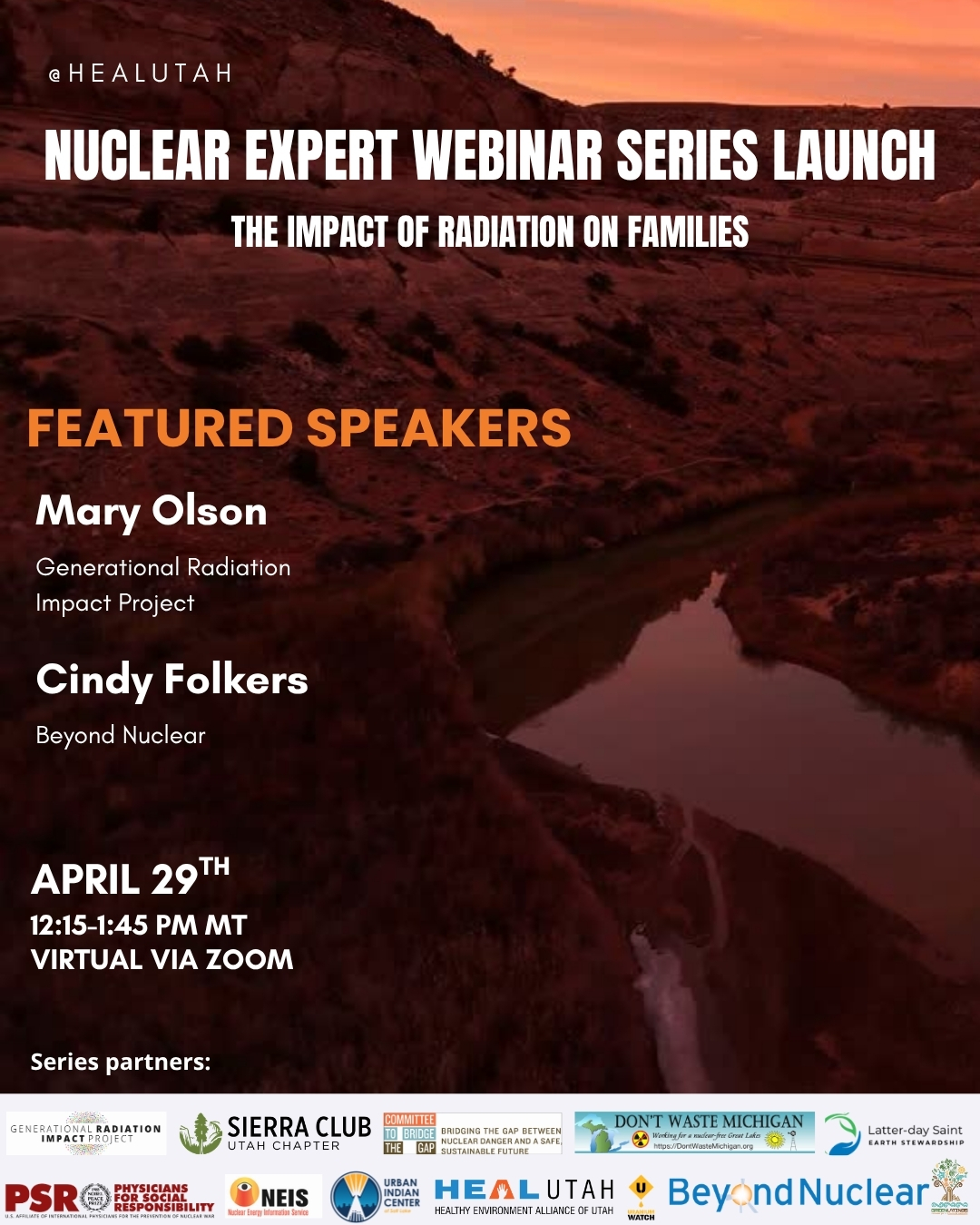
29 April – Nuclear Expert Webinar #1 – Radiation Impacts on Families with Mary Olson and Cindy Folkers
- 12:15 PM MT – 1:45 PM MT
- Location: Virtual – REGISTER TODAY

4 May -West Suburban Peace Coalition to discuss Iran war at May Educational Forum
Monday, May 4, 7:00 – 8:00 PM Central Standard Time
Title: : How Trump’s Narrative Tries to Shape the Reality of the War on Iran.
Contact Walt Zlotow, zlotow@hotmail.com 630 442 3045 for further information
14 May – online event From Bombs to Data Centres: the Face of Nuclear Colonialism

Pine Ridge Uranium is the real threat, not Tehran- Tell Burgum: Stop the Extraction.
Chernobyl: The Lost Tapes – A good documentary on Chernobyl on SBS available On Demand for the next 3 weeks– https://www.sbs.com.au/ondemand/tv-program/chernobyl-the-lost-tapes/2352741955560
To see nuclear-related stories in greater depth and intensity – go to https://nuclearinformation.wordpress.com
-
Archives
- April 2026 (356)
- March 2026 (251)
- February 2026 (268)
- January 2026 (308)
- December 2025 (358)
- November 2025 (359)
- October 2025 (376)
- September 2025 (257)
- August 2025 (319)
- July 2025 (230)
- June 2025 (348)
- May 2025 (261)
-
Categories
- 1
- 1 NUCLEAR ISSUES
- business and costs
- climate change
- culture and arts
- ENERGY
- environment
- health
- history
- indigenous issues
- Legal
- marketing of nuclear
- media
- opposition to nuclear
- PERSONAL STORIES
- politics
- politics international
- Religion and ethics
- safety
- secrets,lies and civil liberties
- spinbuster
- technology
- Uranium
- wastes
- weapons and war
- Women
- 2 WORLD
- ACTION
- AFRICA
- Atrocities
- AUSTRALIA
- Christina's notes
- Christina's themes
- culture and arts
- Events
- Fuk 2022
- Fuk 2023
- Fukushima 2017
- Fukushima 2018
- fukushima 2019
- Fukushima 2020
- Fukushima 2021
- general
- global warming
- Humour (God we need it)
- Nuclear
- RARE EARTHS
- Reference
- resources – print
- Resources -audiovicual
- Weekly Newsletter
- World
- World Nuclear
- YouTube
-
RSS
Entries RSS
Comments RSS
 nuclear-news
Reblogged this on abraveheart1.