Renewable energy development could be taken over by the same old neocolonial racist corporations
 Whose renewable future? New Internationalist MARCH 2015 Is big business poised to capture the renewables revolution? Danny Chivers draws up the battle lines.
“………. What are we up against?
Let’s not kid ourselves. The fossil fuel industry’s main response to clean energy is to try to squash it. Selling the highly concentrated energy in oil, coal and gas is far more profitable in the short term than the slow-release, distributed energy from wind or solar power – especially when you factor in generous government fossil fuel subsidies, an international energy infrastructure already set up to use these fuels, and free rein to pump carbon pollution into the air at little or no cost. Whether it’s funding pro-fossil politicians, forging cosy links with officials or pouring money into anti-renewable front groups, the big oil, gas and coal companies are working hard to keep society hooked on their highly profitable products, and prevent alternatives from getting off the ground.6
There are exceptions to this rule. If those alternatives can provide decent short-term returns or access to new subsidies without disrupting the existing energy markets, then the big players might be tempted to step in. This is why the likes of BP, Shell and Exxon have moved into liquid biofuels, and why major power plants like Drax in Britain are starting to mix large quantities of woodfuel in with their coal supply.
We need a democratically controlled, people-focused clean energy system
Industrial biofuels and wood-fired power stations – along with the continued destruction caused by large hydropower dams – provide perfect examples of what can happen if supposedly ‘renewable’ energy sources are exploited for maximum profit, without proper consideration for people and the environment. Energy crops and hydroelectricity may both be sustainable on a small, local, carefully managed scale – but the current profit-driven rush to turn food crops and forests into fuel is leading to hunger, land grabs and deforestation; while megadams threaten huge areas of natural habitat along with the homes, lands and livelihoods of hundreds of thousands of people.
These projects should act as a stark warning. Wind and solar power are still relatively small industries on a global scale, but are growing fast. These technologies are far less destructive than fossil fuels, but that doesn’t mean they’re impact-free – especially if they develop to the scale we need for a fossil-free future. Will they be carefully manufactured in renewably powered workshops with strict respect for workers’ rights and environmental standards; using largely recycled materials, and built as part of community-run, co-operatively owned and democratic energy schemes which benefit the communities where they are sited? Or will they be churned out in nightmarish sweatshop conditions, using minerals from exploitative mining projects and sited in giant energy parks on cleared rainforest land from which the residents have been forcibly evicted?
It could go either way. Renewables could transform our energy system, with solar panels particularly well-suited for decentralized use: 85 per cent of today’s solar panels are spread over millions of rooftops, with only 15 per cent in solar parks. Increased access to and control over energy could empower millions of people, improving lives and livelihoods and boosting the political and social influence of marginalized communities.
Unfortunately, the risks are also clear. Wind and solar generators require a significant amount of building material and land space. Though requiring less than 1 per cent of the extraction needed to keep pulling coal, oil and gas out of the ground, ramping up renewables will mean a significant spike in demand for steel, cement, aluminium and copper that could have serious local impacts around the world if not carefully managed. Wind power, unlike solar, is far more efficient when built on a large scale; big wind farms typically require levels of capital investment that are out of the reach of community groups. They’re more likely to be installed by governments or large utility companies such as E.ON. Seventy-five per cent of all wind turbines are manufactured by just 10 companies.
The Desertec initiative gives us an example of what a profit-driven, centralized solar energy future might look like. We shouldn’t be surprised to see it develop along the same neo-colonial and racist lines as our current fossil fuel industry, where the rights of Indigenous peoples and communities of colour around the world are trampled in the pursuit of ‘cheap’ energy for the industrialized nations…….” http://newint.org/features/2015/03/01/renewable-energy-keynote/
No comments yet.
1 This Month


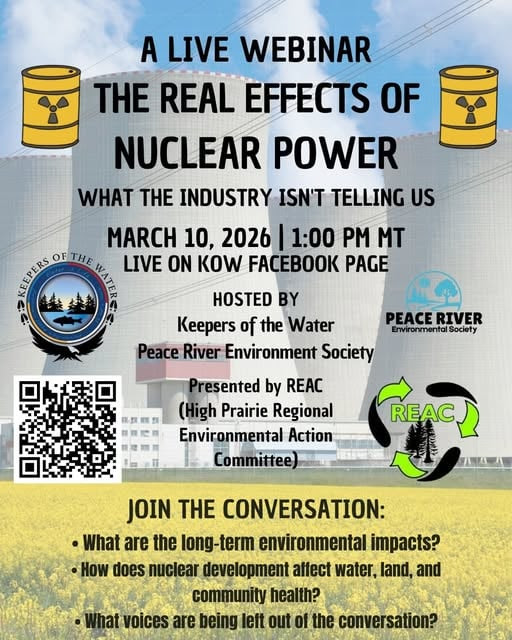
10 March A LIVE WEBINAR THE REAL EFFECTS OF NUCLEAR POWER
What the Industry Isn’t Telling Us
1:00 PM Mountain, 2 pm Central, 3 pm Eastern. Live on the Keepers of the Water Facebook page
18 March Webinar @ 1 PM EST: An Assessment of SMR Projects: The Case of Canada
register for the zoom:
https://us02web.zoom.us/webinar/register/WN_o8BIIOUvQ2ONJR1nta65DQ#/registration


of the week – STOP SMALL MODULAR REACTORS IN CANADA
To see nuclear-related stories in greater depth and intensity – go to https://nuclearinformation.wordpress.com
-
Archives
- March 2026 (62)
- February 2026 (268)
- January 2026 (308)
- December 2025 (358)
- November 2025 (359)
- October 2025 (376)
- September 2025 (258)
- August 2025 (319)
- July 2025 (230)
- June 2025 (348)
- May 2025 (261)
- April 2025 (305)
-
Categories
- 1
- 1 NUCLEAR ISSUES
- business and costs
- climate change
- culture and arts
- ENERGY
- environment
- health
- history
- indigenous issues
- Legal
- marketing of nuclear
- media
- opposition to nuclear
- PERSONAL STORIES
- politics
- politics international
- Religion and ethics
- safety
- secrets,lies and civil liberties
- spinbuster
- technology
- Uranium
- wastes
- weapons and war
- Women
- 2 WORLD
- ACTION
- AFRICA
- Atrocities
- AUSTRALIA
- Christina's notes
- Christina's themes
- culture and arts
- Events
- Fuk 2022
- Fuk 2023
- Fukushima 2017
- Fukushima 2018
- fukushima 2019
- Fukushima 2020
- Fukushima 2021
- general
- global warming
- Humour (God we need it)
- Nuclear
- RARE EARTHS
- Reference
- resources – print
- Resources -audiovicual
- Weekly Newsletter
- World
- World Nuclear
- YouTube
-
RSS
Entries RSS
Comments RSS
 nuclear-news
Leave a comment