TEPCO agrees to pay compensation for property damage in radiation ‘hotspot’ area
February 03, 2015
Tokyo Electric Power Co. (TEPCO), the operator of the crippled Fukushima No. 1 nuclear plant, has agreed to pay some 420 million yen in compensation for property damage to residents who live in a radiation “hotspot” area, the Mainichi Shimbun has learned.
Fifty-two residents of 10 households living in parts of Minamisoma, Fukushima Prefecture, which is designated as a recommended special evacuation zone due to radiation hotspots, and another nine people of one household in a neighboring district sought compensation from TEPCO over property damage via an alternative dispute resolution process.
Attorneys representing the residents told the Mainichi Shimbun on Feb. 2 that TEPCO has agreed to pay some 420 million yen, a large portion of the compensation payment recommended by the government-backed dispute resolution center.
However, as the utility refused to pay compensation to the one household which is located outside the recommended evacuation zone, the plaintiffs will not accept the payment until TEPCO agrees to pay everyone who filed the claim.
The dispute resolution center presented a settlement proposal over property damage in the recommended evacuation zones to TEPCO in December last year. It was the first case for the center to accept such a claim filed by a group of residents in those areas.
TEPCO rejected the damage claim filed by the one household (about 10 million yen in compensation), saying that the utility will not handle dispute resolution requests from residents outside the radiation hotspot areas in the same manner as those filed by people living in the recommended evacuation zones.
Source: Mainichi
http://mainichi.jp/english/english/newsselect/news/20150203p2a00m0na008000c.html
48 of 89 children found thyroid abnormality in Ushiku city Ibaraki
 February 3, 2015
By 1/30/2015, Ushiku city government of Ibaraki announced 48 of 89 children were given A2 or B diagnosis in their thyroid inspection.
A2 is given when they find thyroid nodule (≦5.0mm) or cysts (≦20.0mm), B is given when they find thyroid nodule (≧ 5.1mm) or cysts (≧20.1mm).
Since last August, 50 more children had the inspection. 40 children were given A2, 8 children were given B in total.
Only less than half of the testees turned out to be free of any abnormality.
Ushiku city government states 40 children of A2 don’t need any follow-up inspection.
http://www.city.ushiku.lg.jp/scms/admin76381/data/doc/1421893197_doc_54_0.pdf
http://www.city.ushiku.lg.jp/scms/admin76381/data/doc/1383177176_doc_54_0.pdf
Source: Fukushima Diary
48 of 89 children found thyroid abnormality in Ushiku city Ibaraki
Clean-up work resumes at Fukushima nuclear plant
Feb. 03, 2015
Tokyo Electric Power Co, operator of the wrecked Fukushima Daiichi nuclear power plant, on Tuesday recommenced clean-up work after a two-week break due to two fatal accidents at the Daiichi and Daini plants.
All work was halted following the accidents, in order for safety regulation checks to be conducted.
However, TEPCO said it expects delays to continue for up to a month on a project to build an ice wall intended to contain the leaking of contaminated water from reactors at the Daiichi plant, TV Asahi reported.
TEPCO has been fighting a daily battle against contaminated water since Fukushima was wrecked by an earthquake and tsunami in March 2011 and three reactors underwent meltdowns.
Water flushed over the wrecked reactors to keep them cool enough to prevent further radioactive releases is leaking into basements after contact with the melted uranium fuel.
The water mixes with groundwater that seeps into the basements, requiring more pumping, treatment and storage.
Missteps and leaks have dogged the efforts to contain the water, slowing down the overall decommissioning process, which is expected to take decades.
Source: Japan Today
Tepco unlikely to complete ice wall by March
Feb 3, 2015
Tokyo Electric Power Co. will probably not meet its target of completing by the end of March the first section of frozen soil shields to curb the buildup of radioactive water at the Fukushima No. 1 nuclear plant.
Construction is being delayed by two weeks to one month after two deadly accidents at Fukushima No. 1 and No. 2 nuclear plants last month forced the company to suspend work for safety checks, Tepco officials said Monday.
The shields are intended to block groundwater from the nearby mountains from flowing into the reactor building basements and mixing with water that has become highly radioactive after being used to cool the overheating reactors.
Tepco began the construction work last June.
The volume of contaminated water has been increasing by several hundred tons a day due partly to the inflow of groundwater.
Even after the construction is completed, Tepco will need approval from the Nuclear Regulation Authority to start circulating refrigerant to freeze the surrounding soil. The NRA is concerned that the shields may change the flow of groundwater and cause the ground to sink, which could allow contaminated water to flow out of the reactor buildings.
Source: Japan Times
Manga artist claims again Fukushima radiation is causing nosebleeds
Feb 2, 2015
Tetsu Kariya, author of the gourmet manga “Oishinbo,” says in the series’ latest edition that radiation is so high in Fukushima Prefecture it is causing nosebleeds among local residents.
The theme echoes one in a previous story that critics panned when Kariya had the main character suffer a nosebleed after visiting the Fukushima No. 1 nuclear power plant.
The controversial episodes ran in Shogakukan Inc.’s Big Comic Spirits magazine last May. But when the manga was compiled into book form, critical passages, including one linking nosebleeds and radiation exposure, were watered down.
In his latest book, published by Yugensha, Kariya questions the Environment Ministry’s assertion that radiation is unlikely to be causing nosebleeds locally. He cites surveys that found that “many people” have been suffering nosebleeds in the prefecture.
Kariya has written extensively about the plight of Fukushima farmers and fishermen, whose troubles he has studied at first hand. He has visited places around the nuclear power station.
He said he altered some controversial episodes in the new book to prevent misunderstanding and to protect real people who were identifiable in previous episodes and who others criticized.
In the final chapter, Kariya emphasizes that the reconstruction of the lives of the people is far more important than the recovery of the land of Fukushima.
“It is only you who can protect yourselves,” he said, addressing them in general. “Please have the courage to flee from Fukushima.”
Source: Japan Times
Dismantling nuclear weapons industry could become a political possibility in Britain
It is not just the SNP who oppose the continuation and renewal of Trident. The Green Party of England and Wales also support the abolishment of weapons and are rising steadily in the polls and could play a part in the waking-up of arapidly-rising share of the population’s younger voters to green issues, including the abolishment of these weapons. The Campaign for Nuclear Disarmament (CND) has for decades looked to end the madness and recently attracted tens of thousands of protestors to London for their“Wrap-up Trident” demo.
 There is a will there amongst many same-minded people and organisations and if given a chance they could help force an unprecedented move; the willing disarmament by a world power of their nuclear arsenal.

 Putting Nuclear Abolition on the Table The Nuclear Option for the British Elections, CounterPunch
 There is a chance that at the end of voting come the 2015 General Election in the United Kingdom, the nation’s nuclear “deterrent” and its renewal may become central to the formation of a coalition government. Imagine it, one of the biggest nuclear powers in the world committing to the dismantling of its nuclear weapons industry. How could this happen? Continue reading
A pro nuclear expert bemoans the fact that their “climate” propaganda is not working!
 Is climate change the worst argument for nuclear? Nuclear Engineering International 21 January 2015 Jumping on the environmental bandwagon may not be the best choice for the nuclear industry….. By Steve Kidd
My articles over the past three months have covered the failure of nuclear advocates to make much progress with gaining public acceptance over the past few years, with the prime need now to undertake a serious effort to gain better public understanding…
…….There remains one piece in the jigsaw and that is to abandon climate change as a prime argument for supporting a much higher use of nuclear power to satisfy rapidly-rising world power needs…….
We have seen no nuclear renaissance (instead, a notable number of reactor closures in some countries, combined with strong growth in China) the story has not changed very much. The 2014 edition of the International Energy Agency’s World Energy Outlook shows nuclear playing a small but indispensable part in those scenarios maintaining greenhouse gas emissions at much lower and environmentally safer levels to 2030 and beyond. ……….
The International Atomic Energy Agency has also just released the 2014 edition of its publication Climate Change and Nuclear Power which addresses the perceived need for a lot more nuclear power for this reason, together with the range of issues which inevitably surround this transition.
The problem is that the hoped-for process is not working. Countries such as Germany and Switzerland that claim environmental credentials are moving strongly away from nuclear. Even with rapid nuclear growth in China, nuclear’s share in world electricity is declining. The industry is doing little more than hoping that politicians and financiers eventually see sense and back huge nuclear building programmes. On current trends, this is looking more and more unlikely. The high and rising nuclear share in climate-friendly scenarios is false hope, with little in the real outlook giving them any substance.
Far more likely is the situation posited in the World Nuclear Industry Status Report covered in September’s article (September 2014, ‘The world nuclear industry – is it in terminal decline?’). Although this report is produced by anti-nuclear activists, its picture of the current reactors gradually shutting down with numbers of new reactors failing to replace them has more than an element of truth given the recent trends………
….The nuclear industry giving credence to climate change from fossil fuels has simply led to a stronger renewables industry. Nuclear seems to be “too difficult” and gets sidelined – as it has within the entire process since the original Kyoto accords. And now renewables, often thought of as useful complements to nuclear, begin to threaten it in power markets when there is abundant power from renewables when the wind blows and the sun shines.
Climate change is also an issue now seemingly irretrievably linked to some combination of higher taxes and prices, bigger and more intrusive government intervention, lower economic growth, and less disposable income. The nuclear sector doesn’t want to be associated with any of this. ……Nuclear should not be cosying up to anything that costs money. It should promote itself as inherently cheap energy, vital for economic growth…..http://www.neimagazine.com/opinion/opinionis-climate-change-the-worst-argument-for-nuclear-4493537/
Arizona close to classing nuclear power as RENEWABLE energy!
 AZ Senate Committee Says Nuclear Power Is a Renewable Energy Resource http://blogs.phoenixnewtimes.com/valleyfever/2015/02/senate_committee_declares_nuclear_power_a_renewable_energy_resource.php By Miriam Wasser Tue., Feb. 3 2015Arizona is one step closer to officially declaring nuclear power a renewable-energy source. (Yes, you read that correctly.)
The Senate Committee on Water and Energy narrowly passed SB 1134, a bill that classifies “nuclear energy from sources fueled by uranium fuel rods that include 80 percent or more of recycled nuclear fuel and natural thorium reactor resources under development” to be a renewable-energy source.
Environmentalists are not happy, and frankly, no one who cares about linguistics should be either.
A renewable resource doesn’t get depleted with use: the sun keeps shining if we harvest solar power, the wind keeps blowing if we erect turbines, the earth keeps producing heat if we harness geothermal power. But nuclear?
Sandy Bahr, chapter director of the Arizona Sierra Club, said “the very nature of mining”–which must be done to get nuclear material–“is that you are depleting a resource.” Thus, nuclear energy cannot be called renewable.
As it stands now, the Arizona Administrative Code R14-2-1801 says nuclear and fossil fuels are not renewable resources. But Senator Steve Smith, a Republican from District 23, and the main sponsor of SB 1134, would like that to be changed.
He told the committee that by not recycling nuclear fuel rods like some European countries do, Arizona is missing out on a lot of potential energy. “Basically we just want to burn that energy twice,” he said, and should Arizona decide to incorporate that technology in the future, this bill would allow us to count that as a renewable energy source.
After a handful of citizens and energy industry officials spoke for or against the bill, it was in the hands of the committee. Senator Lynne Pancrazi said she considers nuclear an “alternative energy,” but “can’t agree that nuclear is renewable;” Senator David Bradley said he “[appreciates] the fact that technology is allowing us to use rods a few times, but that doesn’t make it a renewable;” and Senator Sylvia Allen said they could argue back and forth about the definitions of renewable and recyclable, but that it isn’t the point of the bill.”
What is the point of the bill, then, Senator Allen?
In the end, SB 1134 passed by one vote. “Luckily, it has a ways to go,” Bahr told New Times.
The bill still needs to get through the rules committee, the Senate, and the House of Representatives, which rejected a similar bill last year. “We’ll see about this year, though” she said.
After the committee session, New Times caught up with Senator Smith and asked about his bill. What, for instance, is the difference between recyclable resources and renewable ones. He paused for moment, and then smiled. When it comes to nuclear materials, he said,”we have so much that can be reused that it’s almost renewable!”
Documents reveal America’s Doomsday Plan To Declare Martial Law
Plan C: America’s Nuclear Doomsday Plan To Declare Martial Law http://www.gizmodo.com.au/2015/01/plan-c-americas-nuclear-doomsday-plan-to-declare-martial-law/ MATT NOVAK31 JANUARY 2015Plan C evolved and changed as different people in the chain of command got involved. At one point, Plan C was envisioned as a measure that would be implemented before any potential war might start. In other iterations, it was to be the course of action only after nuclear war with the Soviets had begun.
On November 22, 1955 the Soviet Union first successfully detonated a hydrogen bomb, finally catching up to the United States with its nuclear tech capabilities. The H-Bomb was roughly 1000 times more powerful than the atomic bombs that had been dropped on Japan a decade earlier, and more than ever, the US was concerned about the prospect of worldwide nuclear annihilation. By April of 1956 it had drafted its new emergency response.
 One aspect of Plan C was the implementation of an emergency program to arrest precisely 12,949 individuals whose “affiliations with subversive organisations” made them a threat to the security of the United States. “Enemy diplomats” were to be arrested as well. The newly released documents don’t include who precisely was on these lists.Was there a Plan D? You bet. Plan D involved the relocation of all high ranking government personnel to secret locations. It was part of “Operation Alert, 1956″, which was tested in July of 1956. Details of the CIA’s plan for Operation Alert 1956 were released in 2009.
As Muckrock notes, Plan C was never distributed widely and details of the plan were ordered destroyed in July of 1957. Only about 30 pages about Plan C have been released so far. There are roughly 150 more pages that are still being processed. Some of the remaining unreleased documents are being looked over by FEMA.
We’re no longer embroiled in the middle of a Cold War. Or at least we’re not supposed to be. But you can bet that the US government has all kinds of contingency plans in place in the event of nuclear war or the like. Do those plans include martial law and the rounding up of people considered subversive? I suppose we’ll find out in another 60 years. Provided we’re lucky enough to avoid nuclear war in the first place.
You can read all of the documents released by the FBI about Plan C over at Muckrock.
Obama’s nuclear push to India – hypocrisy!
The president should not be prescribing medicine that he would not take himself. The United States has not installed any new nuclear plants for more than 30 years. There would be massive public protests if any were even proposed — anywhere in the country.
Instead of trying to chain India to the past with technologies such as nuclear, he should help the country leapfrog into the future with clean energy. This will benefit not only India, but also the world.
 Why Obama should stop pushing nuclear energy on India, WP, By Vivek Wadhwa February 2 The White House is claiming victory for a breakthrough in the impasse with India over nuclear energy. Indian laws have held suppliers, designers and builders of nuclear plants liable in case of an accident and this made U.S. companies fearful of doing business there. During his recent trip, President Obama persuaded India’s government to create an insurance pool to compensate victims of a potential disaster and to cap the liabilities of companies supplying the technology.
This is hardly a victory for the United States or for India. It no longer makes sense for any country to install a technology that can create a catastrophe such as Chernobyl or Fukushima — especially when far better alternatives are available. Technologies such as solar and wind are advancing so rapidly that by the time the first new nuclear reactors are installed in India, they will be less costly than nuclear energy. Most importantly, the alternative technologies are cleaner and safer.
Take solar energy Continue reading
Fukushima radiation is causing nosebleeds -Manga artist
Manga artist claims again Fukushima radiation is causing nosebleeds, Japan Times, Tetsu Kariya, author of the gourmet manga “Oishinbo,” says in the series’ latest edition that radiation is so high in Fukushima Prefecture it is causing nosebleeds among local residents.

The theme echoes one in a previous story that critics panned when Kariya had the main character suffer a nosebleed after visiting the Fukushima No. 1 nuclear power plant.
The controversial episodes ran in Shogakukan Inc.’s Big Comic Spirits magazine last May. But when the manga was compiled into book form, critical passages, including one linking nosebleeds and radiation exposure, were watered down.
In his latest book, published by Yugensha, Kariya questions the Environment Ministry’s assertion that radiation is unlikely to be causing nosebleeds locally. He cites surveys that found that “many people” have been suffering nosebleeds in the prefecture…..http://www.japantimes.co.jp/news/2015/02/02/national/manga-artist-claims-again-fukushima-radiation-is-causing-nosebleeds/#.VNF_0tKUcnk
New Zealand steadfastly maintains its Nuclear Ban
“There is only one thing more dangerous than being attacked by nuclear weapons and that is being protected by them.”
NEW ZEALAND ROBUSTLY DEFENDS NUCLEAR BAN Eurasia Review FEBRUARY 1, 2015 BY NEENA BHANDARI The small Pacific island country of New Zealand has punched above its weight in the international disarmament debate. For nearly three decades it has pursued an active nuclear free policy, banning entry of US warships carrying nuclear weapons or propelled by nuclear power into its ports despite being part of the ANZUS Treaty.

NZ, along with the United States (US) and Australia, was amongst the three original signatory governments to the ANZUS treaty, a trilateral framework for security arrangements and cooperation, which was concluded in 1951.
From the mid-1960s to the mid-1980s, New Zealand opposed French nuclear tests in the Pacific. In 1983, the visit of the nuclear-powered frigate USS Texas sparked protests. Ordinary people spurred an anti-nuclear movement, which reached its peak in the mid-1980s and shaped NZ’s foreign policy and identity as a nation.
“It was an extremely broad campaign, which included professionals, neighbourhood groups, students, religious, non-religious, young and old. In many ways, it was the diversity and the non-hierarchical nature of the movement that was part of its appeal and strength. At one point there were over 300 local activist groups across the country,” says Marie Leadbeater, the author of `Peace, Power and Politics: How New Zealand became nuclear free
The defining moment came in July 1985 with the sinking of the Greenpeace flagship, Rainbow Warrior, which had been involved in protests over French nuclear testing. Continue reading
Navajo community – a case study on deadly effects of uranium mining
The studies have found considerably increased rates of death by lung cancer and other lung or related diseases
“Navajo is a non-smoking population. That’s why the Navajo underground miners were such an important sub-unit of the cohort,” Shuey said. “The Navajo cohort debunks the whole notion that the uranium miners’ lung cancer relates to smoking.”
 Radon’s Deadly Connection With Uranium Mining As Seen From Navajo Nation, Indian Country, Konnie LeMay 2/2/15 Where you live may increasingly become as important as how you live in determining your health as we continue to recognize how environmental factors affect our lives and may hasten our deaths.
“No longer can we just kind of sit back and say those are all just lifestyle (influences) … just stop eating frybread and throw some vegetables in there,” said Chris Shuey, director of the Uranium Impact Assessment Program for theSouthwest Research and Information Center.
For more than three decades, Shuey has tracked the environmental influences on long-term health for the Navajo people linked to the region’s past uranium mining. He foresees growing acknowledgment of how human-caused environmental changes and naturally occurring threats may affect our health. Continue reading
Norwegian military found out that Russian bomber near Norway’s coast had nuclear warhead
Report: Russian bomber intercepted by Norwegian F-16s carried nuclear warhead, Alaska Dispatch News Thomas Nilsen, Barents Observer February 3, 2015 A Norwegian military listening post intercepted cockpit conversations revealing that one of the Tu-95 flying around the coast of Norway last Wednesday had a nuclear payload on board.
Two F-16s were scrambled from Bodø airbase and met the Russian planes outside Finnmark. A group of six Russian aircrafts were identified by the Norwegian fighter jets — two Tu-95 strategic long-range bombers, two Il-78 tankers and two MiG-31 fighter jets. The incident took place on Wednesday, Jan.28.
The Norwegian F-16s followed the Russian planes outside Norwegian airspace on the southbound route. For Norway, scrambling F-16s to meet Russian bombers has been routine since President Vladimir Putin in 2007 ordered his strategic bombers to resume flights in international airspace.
The British newspaper Sunday Express reported that there was a nuclear payload onboard.
The newspaper reports that both Prime Minister David Cameron and Defense Secretary Michael Fallon were alerted after cockpit conversions confirming the bomber’s nuclear payload were intercepted by a Norwegian military listening post and shared with the British Ministry of Defense…
….. BarentsObserver has not succeeded getting the nuclear warhead information confirmed, or disproved, from either the Norwegian military intelligence or the Joint Command Headquarters. http://www.adn.com/article/20150203/report-russian-bomber-intercepted-norwegian-f-16s-carried-nuclear-warhead
Iranium President Rouhani optimistic about a nuclear deal with the West
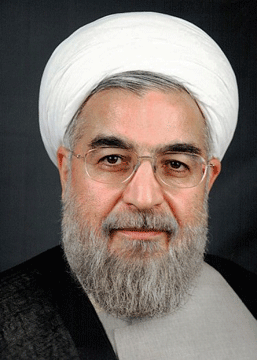 Iranian president says nuclear deal with the west is getting closer, Guardian, Julian Borger and Saeed Kamali Dehghan, 4 Feb 15 Mehr news agency quotes Hassan Rouhani saying sides have ‘narrowed the gaps’ as second report emerges of uranium enrichment deal with US. President Hassan Rouhani has said that a nuclear deal with the west is getting closer, as a report emerged of a possible compromise between American and Iranian negotiators over uranium enrichment.
After meeting the heads of the country’s parliament and judiciary, Rouhani was quoted by the Mehr news agency as saying: “We have narrowed the gaps,” adding that although “some issues and differences remain … The west has realised that it should recognise the rights of the Iranian people.”
Even Ali Larijani, the parliamentary speaker and a noted hardliner on nuclear talks, declared himself “not pessimistic” about the trajectory of the negotiations.
Nuclear talks between Iran and six major powers are due to resume later this month in Geneva ahead of a March deadline for arriving at a basic framework agreement. A comprehensive permanent settlement would be reached by the end of June………
The possible compromise under consideration, according to the AP, would see most of the 10,000 centrifuges in operation left in place but reconfigured so that they would be less productive. One way of doing that would be to spin the centrifuges more slowly. Other measures would be agreed upon to reassure the west that Iran could not make a warhead quickly, such as reducing its stockpile of uranium hexafluoride gas – the form in which uranium can be enriched by centrifuge………http://www.theguardian.com/world/2015/feb/03/iranian-president-nuclear-deal-west
1 This Month



Tell the Ukrainian Government to Drop Prosecution of Peace Activist Yurii Sheliazhenko

Petition to revoke the licensing of the Near Surface Nuclear Disposal Facility (NSDF) at Chalk River. https://www.ourcommons.ca/petitions/en/Petition/Details?Petition=e-7247


of the week – STOP SMALL MODULAR REACTORS IN CANADA
To see nuclear-related stories in greater depth and intensity – go to https://nuclearinformation.wordpress.com
-
Archives
- March 2026 (212)
- February 2026 (268)
- January 2026 (308)
- December 2025 (358)
- November 2025 (359)
- October 2025 (376)
- September 2025 (258)
- August 2025 (319)
- July 2025 (230)
- June 2025 (348)
- May 2025 (261)
- April 2025 (305)
-
Categories
- 1
- 1 NUCLEAR ISSUES
- business and costs
- climate change
- culture and arts
- ENERGY
- environment
- health
- history
- indigenous issues
- Legal
- marketing of nuclear
- media
- opposition to nuclear
- PERSONAL STORIES
- politics
- politics international
- Religion and ethics
- safety
- secrets,lies and civil liberties
- spinbuster
- technology
- Uranium
- wastes
- weapons and war
- Women
- 2 WORLD
- ACTION
- AFRICA
- Atrocities
- AUSTRALIA
- Christina's notes
- Christina's themes
- culture and arts
- Events
- Fuk 2022
- Fuk 2023
- Fukushima 2017
- Fukushima 2018
- fukushima 2019
- Fukushima 2020
- Fukushima 2021
- general
- global warming
- Humour (God we need it)
- Nuclear
- RARE EARTHS
- Reference
- resources – print
- Resources -audiovicual
- Weekly Newsletter
- World
- World Nuclear
- YouTube
-
RSS
Entries RSS
Comments RSS
 nuclear-news