Expert: “It’s completely unsafe… impossible to remove 100s of radioactive materials” — 1,200 radionuclides, only 62 reduced
January 21st, 2015
TV: Gov’t approves plan to ‘drain’ Fukushima nuclear waste into ocean — Professor: Monitoring necessary to detect ‘worrisome signals’ —
NHK, Jan 21, 2015 (emphasis added): Regulators approve Fukushima wastewater drainage — Japan’s nuclear regulator has approved a plan by [TEPCO] to drain filtered wastewater from the firm’s crippled Fukushima Daiichi plant into the sea… The firm also plans to reduce the level of radioactive material in the water before releasing it into the nearby Pacific. On Wednesday, the Nuclear Regulation Authority approved TEPCO’s plan to install drainpipes and a pumping system and to reduce the level of radioactive cesium-137 to less than one becquerel per liter.
NHK Transcript, Jan 21, 2015: Japanese regulators have approved a controversial plan by [TEPCO]. They say TEPCO officials can flush filtered waste water into the ocean… Fisherman: “We can’t trust Tepco… If they proceed with their plan the situation will surely go back to how it was before. I’m worried the government and Tepco will act to suit themselves.”
Wall St Journal, Jan 21, 2015: Japan’s nuclear regulator has officially called on [Tepco] to work toward discharging low-level contaminated water… just two days after a worker fell into [a tank] used to store contaminated water… Tepco is using a processing system [that] is unable to take out the tritium [and] is reluctant to release it into the ocean to avoid… criticism from neighboring countries and some nations with a Pacific Ocean coastline… there is no detailed study about tritium’s long-time effect on animal genes. Mamoru Takata, a Kyoto University professor and expert on radiation’s long-term effects, said monitoring would be necessary to detect any worrisome signals.
TEPCO: [ALPS] is designed to remove most remaining radioactive contaminants
TEPCO (pdf): (ALPS) — Removal capacity: Reduce 62 nuclides below the density limit
Asahi Shimbun in Jan. 2012: “To prevent a further contamination of the sea [Tepco] plans to remove about 1,000 kinds of radioactive materials from water”
Japan Atomic Energy Agency (pdf), Feb 2014: TOPICS Fukushima — [W]e carried out detailed calculations… for 1,200 radionuclides, and the results were incorporated into a database.
Dr. Gordon Edwards, court-certified nuclear expert, Aug 8, 2014 (50:00 in): It can’t be dumped into the ocean, because it’s completely unsafe because of these fission products. They have built over 1,000 large tanks, huge tanks… that contain this very, very radioactively contaminated water. At the moment they’re trying to filter out these fission products… It’s impossible for them to remove all those hundreds of radioactive materials. They know how to remove about 62 of them, but there’s other ones that they cannot.
Source: Enenews
TEPCO’s Fukushima Folly
January 20, 2015
Fission Stories #180
In early August 2014, the Tokyo Electric Power Company (TEPCO) announced that its latest analysis revealed the meltdown of the Unit 3 reactor at Fukushima Daiichi was worse than previously estimated.

Recall children’s books with dots and numbers? Children connect the dots to reveal pictures of clowns and puppies and spaceships and such.
TEPCO is essentially painting pictures using very few dots with no numbers. They keep running computer studies that put numbers almost randomly on the few dots they have to see what picture emerges. “Lo and behold” to quote a professor I had in college, different pictures emerge.
TEPCO doesn’t know when the Unit 3 core damage began
Or how much of the reactor core was damaged.
Or how and when the damaged core relocated after melting.
Or how, when, and where the molten burned through the reactor pressure vessel.
Or how it moved after it fell onto the containment’s concrete floor.
And they don’t know how much water, if any, was on the containment floor when the molten core joined it.
TEPCO fills in these information gaps with guesses. And they keep revising their results because they keep revising their guesses.
Our Takeaway
I choose not to play rate-a-guess. It would take me away from helping my nephew finish his connect-the-dots drawing. Only seven numbers remain to be connected. While it resembles a race car now, it might yet turn out to be a giraffe. Or maybe even a kitten.
Before I decide which TEPCO picture I most prefer, they are going to have to fetch more dots and put real numbers on as many of them as possible.
At some point in the next few years, TEPCO will maneuver a robot into the reactor area. That will reveal what the former reactor core looks like now. This information won’t answer all the questions, but it’ll number several more dots to support a meaningful analysis of what happened when.
Until then, TEPCO is just keeping their computer jockeys busy. They could get results of similar value using Ouija boards—and it would reduce their carbon footprint.
Source: Union of Concerned Scientists
Study: Fukushima plume spread worldwide, far exceeding the hundreds of miles mentioned previously — 100 Quadrillion becquerels of Cs-137 released tops Chernobyl
“Implicates radiological hazard at distances otherwise overlooked”
January 21st, 2015
International Journal of Environmental Research and Public Health (pdf), University of Florida College of Medicine, Weill-Cornell Medical College, etc. (2014):
- The Fukushima Dai-ichi nuclear power plant accident is an example of a contemporary nuclear plant accident with serious implications.
- The Fukushima NPP accident has had health implications due to the high levels of radiation released and vast area over which the radiation has disperse.
- The significant radiation release, as likened to Chernobyl, reflects the context and severity of the Fukushima accident.
- The level of 137Cs that was released is likened to Chernobyl levels, with 100,000 TBq released.
- Radioactive plume dispersion occurs worldwide, far exceeding 300 miles previously mentioned. This should implicate radiological hazard at distances otherwise overlooked.
Potassium Iodide Distribution
- Radioactive plumes from the Chernobyl accident containing 131I caused benign and malignant thyroid nodules to develop, especially in children within a 310 miles radius of the incident.
- The current recommendation is for KI [potassium iodide] availability to people 200 miles from a NPP. Plume radii for nuclear events have been shown to exceed 300 [miles]. Extension of KI availability to 300 miles only further underscores the inadequacy of current preparedness plans.
- In regard to KI prophylaxis, TEPCO utilized 17,500 KI tablets for 2,000 onsite workers… with one individual receiving and taking 85 tablets.
- Radiological plumes containing 131I cause benign and malignant thyroid nodules to develop within a 300 mile radius… This necessitates KI pre-distribution to all schools, hospitals and other of-interest sites extending 300 miles from any nuclear reactor. Evacuation or sequestering is impossible in congested urban areas… There is currently virtually no compliance with [the] 20 miles radius KI pre-distribution law, section 127 of the Bioterrorism Act of 2002. In fact, there is little compliance with the 10 miles Ki pre-distribution radius law in the United States.
- Japan did not utilize KI for prophylaxis of the general public, acknowledging it was not prepared to act accordingly.
Source: Enenews
Regulators approve Fukushima wastewater drainage
TEPCO officials plan to pump up contaminated groundwater through wells built around structures housing the plant’s damaged reactors. The firm also plans to reduce the level of radioactive material in the water before releasing it into the nearby Pacific.
On Wednesday, the Nuclear Regulation Authority approved TEPCO’s plan to install drainpipes and a pumping system and to reduce the level of radioactive cesium-137 to less than one becquerel per liter. It also agreed with the firm’s policy of starting the drainage system gradually.
The regulator asked the utility to ensure that no wastewater leaks and to fully disclose measurements for radioactive material.
Tokyo Electric said it will not drain filtered wastewater until local residents agree to the plan.
The timing of such agreement is unclear, as local fishermen are worried that rumors of tainted seawater would affect their business.
Fukushima Watch: Regulator Calls on Tepco to Discharge Tritium Water
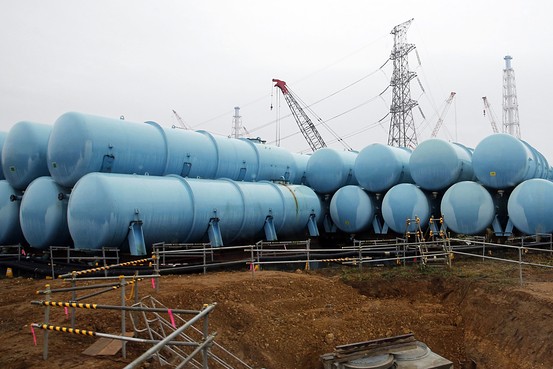 Water tanks storing contaminated water at Fukushima Daiichi nuclear plant are seen in this photo from November
Jan 21, 2015
By Mari Iwata
Japan’s nuclear regulator has officially called on Tokyo Electric Power Co.9501.TO +0.63% to work toward discharging low-level contaminated water into the ocean from the Fukushima Daiichi nuclear plant.
The call on Wednesday comes just two days after a worker fell into one of the hundreds of tanks used to store contaminated water at the plant during an inspection, a fatal accident that has refocused attention on the need for improved safety measures and a longer term solution for the huge amounts of water in storage.
“Tokyo Electric Power must consider whether it (storing the water) is really necessary,” said Shunichi Tanaka, chairman of the Nuclear Regulation Authority, at a regular board meeting Wednesday. “It is surely harmful if it leads to the death of workers.”
The regulator discussed Wednesday a draft timetable for action by Tepco to address risks at the plant that sets out a 2017 start for discharging the water. The draft is likely to be approved next week.
The International Atomic Energy Agency already recommended more than a year ago that Tepco consider releasing water with low level tritium contamination in a controlled way so that it could focus on other issues.
A Tepco spokesman, speaking after Mr. Tanaka’s remarks, said the company wasn’t currently considering releasing the water into the ocean.
Contaminated water has been a constant headache for the operator of the plant since the triple meltdowns in March 2011. A large amount of groundwater is flowing into the site, adding 300 to 400 tons to the amount of highly contaminated water at the plant on a daily basis.
Tepco is using a processing system to remove radioactive material from the highly contaminated water, but the system is unable to take out the tritium. Tepco has been storing the tritium-contaminated water in about 1,000 tanks, but is reluctant to release it into the ocean to avoid adding to tension with local communities and criticism from neighboring countries and some nations with a Pacific Ocean coastline.
But the power company is close to running out of space to build new tanks at the plant and workers are increasingly under pressure to juggle their other duties with the ever-increasing workload of tank management, prompting the IAEA call in late 2013.
Tritium is considered one of the least harmful radioactive materials at nuclear plants. Water contaminated with tritium is discharged from plants elsewhere in the world after dilution.
However, there is no detailed study about tritium’s long-time effect on animal genes. Mamoru Takata, a Kyoto University professor and expert on radiation’s long-term effects, said monitoring would be necessary to detect any worrisome signals.
Source: JapanRealTime
Plan OK’d for dumping Fukushima’s water into ocean after treatment
The plan is one of the measures aimed at curbing the amount of contaminated water building up at the seaside complex. But it remains uncertain when the operator may actually release the water.
Local fishermen have registered strong concerns that dumping the water will heighten consumer apprehension about marine pollution, and TEPCO has said it will not release the water unless it obtains consent from the locals.
The company plans to treat water pumped up through 42 of its wells at a water treatment facility at the plant. After treatment, the water will be temporarily stored in tanks to check whether the amount of radioactive materials left in it is within levels deemed safe for release into the sea.
According to TEPCO, the amount of radioactive water at the complex is believed to be increasing by some 350 tons every day as fresh, untainted groundwater is seeping into reactor buildings and mixing with toxic water generated in the process of cooling the reactors that suffered meltdowns in the 2011 nuclear disaster.
Separately, TEPCO is running a groundwater bypass that is aimed at pumping up untainted groundwater before it mixes with radioactive water. Since the earthquake- and tsunami-triggered disaster, the operator has dumped such water into the Pacific numerous times after confirming its safety.
Source: Mainichi
http://mainichi.jp/english/english/newsselect/news/20150121p2g00m0dm071000c.html
1 This Month
Chernobyl: The Lost Tapes – A good documentary on Chernobyl on SBS available On Demand for the next 3 weeks– https://www.sbs.com.au/ondemand/tv-program/chernobyl-the-lost-tapes/2352741955560

of the week–London Campaign for Nuclear Disarmament

Tell the Ukrainian Government to Drop Prosecution of Peace Activist Yurii Sheliazhenko
To see nuclear-related stories in greater depth and intensity – go to https://nuclearinformation.wordpress.com
-
Archives
- April 2026 (114)
- March 2026 (251)
- February 2026 (268)
- January 2026 (308)
- December 2025 (358)
- November 2025 (359)
- October 2025 (376)
- September 2025 (257)
- August 2025 (319)
- July 2025 (230)
- June 2025 (348)
- May 2025 (261)
-
Categories
- 1
- 1 NUCLEAR ISSUES
- business and costs
- climate change
- culture and arts
- ENERGY
- environment
- health
- history
- indigenous issues
- Legal
- marketing of nuclear
- media
- opposition to nuclear
- PERSONAL STORIES
- politics
- politics international
- Religion and ethics
- safety
- secrets,lies and civil liberties
- spinbuster
- technology
- Uranium
- wastes
- weapons and war
- Women
- 2 WORLD
- ACTION
- AFRICA
- Atrocities
- AUSTRALIA
- Christina's notes
- Christina's themes
- culture and arts
- Events
- Fuk 2022
- Fuk 2023
- Fukushima 2017
- Fukushima 2018
- fukushima 2019
- Fukushima 2020
- Fukushima 2021
- general
- global warming
- Humour (God we need it)
- Nuclear
- RARE EARTHS
- Reference
- resources – print
- Resources -audiovicual
- Weekly Newsletter
- World
- World Nuclear
- YouTube
-
RSS
Entries RSS
Comments RSS
 nuclear-news