Too massively expensive to really think about – getting rid of the world’s old nuclear reactors
Getting Rid Of Old Nuclear Reactors Worldwide Is Going To Cost Way More Than People Think, Business Insider, NINA CHESTNEY, GEERT DE CLERCQ LONDON/PARIS (Reuters) 20 Jan 15 – German utility E.ON’s breakup has led to worries that funds set aside for decommissioning reactors will not suffice, but globally the cost of unwinding nuclear is uncertain as estimates range widely.
As ageing first-generation reactors close, the true cost of decommissioning will be crucial for the future of the nuclear industry, already ailing following the 2011 Fukushima disaster and competition from cheap shale gas, falling oil prices and a flood of renewable energy from wind and solar.
The International Energy Agency (IEA) said late last year that almost 200 of the 434 reactors in operation around the globe would be retired by 2040, and estimated the cost of decommissioning them at more than $US100 billion.
But many experts view this figure as way too low, because it does not include the cost of nuclear waste disposal and long-term storage and because decommissioning costs – often a decade or more away – vary hugely per reactor and by country.
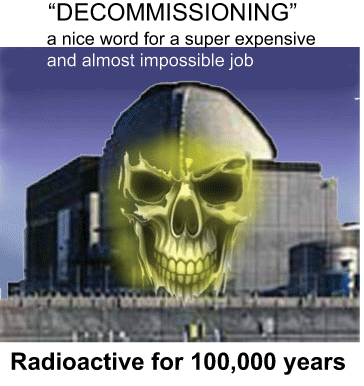
“Half a billion dollars per reactor for decommissioning is no doubt vastly underestimated,” said Mycle Schneider, a Paris-based nuclear energy consultant.
The IEA’s head of power generation analysis, Marco Baroni, said that even excluding waste disposal costs, the $US100 billion estimate was indicative, and that the final cost could be as much as twice as high. He added that decommissioning costs per reactor can vary by a factor of four.
Decommissioning costs vary according to reactor type and size, location, the proximity and availability of disposal facilities, the intended future use of the site, and the condition of the reactor at the time of decommissioning.
Although technology used for decommissioning might gradually become cheaper, the cost of final waste depositories is largely unknown and costs might spiral over time. Reactor lifespans are measured in decades, which means financing costs and provisions depend strongly on unpredictable interest rate levels.
“The IEA estimate is, without question, just a figure drawn out of the air. The reality is, the costs are quite phenomenal,” said Paul Dorfman honorary senior research associate at the Energy Institute, University College London………
The IEA’s Baroni said the issue was not the exact cost per reactor.
“What matters is whether enough funds have been set aside to provide for it,” he said. (Additional reporting by Vera Eckert in Frankfurt, Svetlana Burmistrova in Moscow, Scott DiSavino in New York and Aaron Sheldrick in Tokyo; Editing by Dale Hudson) http://www.businessinsider.com.au/r-global-nuclear-decommissioning-cost-seen-underestimated-may-spiral-2015-1
Cyber warfare now the goal of USA’s National Security Agency (NSA)
It’s a stunning approach with which the digital spies deliberately undermine the very foundations of the rule of law around the globe. This approach threatens to transform the Internet into a lawless zone in which superpowers and their secret services operate according to their own whims with very few ways to hold them accountable for their actions.
New Edward Snowden Files Reveal Scope of NSA Plans for Cyberwarfare At Der Spiegel, “The Digital Arms Race: NSA Preps America for Future Battle“: http://americanpowerblog.blogspot.com.au/ by Donald Douglas 19 Jan 15
The NSA’s mass surveillance is just the beginning. Documents from Edward Snowden show that the intelligence agency is arming America for future digital wars — a struggle for control of the Internet that is already well underway.
Normally, internship applicants need to have polished resumes, with volunteer work on social projects considered a plus. But at Politerain, the job posting calls for candidates with significantly different skill sets. We are, the ad says, “looking for interns who want to break things.”
Politerain is not a project associated with a conventional company. It is run by a US government intelligence organization, the National Security Agency (NSA). More precisely, it’s operated by the NSA’s digital snipers with Tailored Access Operations (TAO), the department responsible for breaking into computers.
Potential interns are also told that research into third party computers might include plans to “remotely degrade or destroy opponent computers, routers, servers and network enabled devices by attacking the hardware.” Continue reading

Dying Pacific Ocean?

Monday, January 19, 2015
Marine defaunation: Animal loss in the global ocean.
Science 16 January 2015: Vol. 347 no. 6219
DOI: 10.1126/science.1255641 Review
Douglas J. McCauley Malin L. Pinsky Stephen R. Palumbi James A. Estes Francis H. Joyce Robert R. Warner
[excerpted] Wildlife populations in the oceans have been badly damaged by human activity…. Human dependency on marine wildlife and the linked fate of marine and terrestrial fauna necessitate that we act quickly to slow the advance of marine defaunation….
Three lessons emerge when comparing the marine and terrestrial defaunation experiences:
- today’s low rates of marine extinction may be the prelude to a major extinction pulse, similar to that observed on land during the industrial revolution, as the footprint of human ocean use widens;
- effectively slowing ocean defaunation requires both protected areas and careful management of the intervening ocean matrix; and
- the terrestrial experience and current trends in ocean use suggest that habitat destruction is likely to become an increasingly dominant threat to ocean wildlife over the next 150 years.[end excerpt]
Ocean Releases
[Majia writes] Consensus holds that Fukushima constitutes the greatest radiological release into the ocean ever to occur. According to Woods Hole Oceanographic Institution in Massachusetts, levels of radioactive cesium reached more than 100,000 becquerels per cubic meter in early April of 2011.[i] The World Nuclear Association suggests that 169 Petabecquerels of Iodine-131 equivalent were releases into the ocean from Cesium-137, Cesium-134, and Iodine-131from March 26 to September 30th.[ii] This figure does not include March releases into the atmosphere, which the World Nuclear Association calculates at 1020 petabecquerels from March 12 to March 31, 011. The French Institute for Radiological Protection and Nuclear Safety (IRSN) described Fukushima as the world’s worst nuclear contamination event ever for the ocean,[iii] reporting that from March 21st to mid-July 27, 27.1 petabecquerels of cesium-137 contaminated the ocean. One peta becquerel is equivalent to a million billion becquerels, or 10^15. [iv]
Atmospheric and direct ocean releases occurring as contaminated water spilled from reactors into the ocean caused radionuclide levels to spike offshore. Woods Hole scientist Ken Buessler revealed (12/12/2011) that Fukushima cesium-137 radiation in the sea near the plant peaked in April 2011 at 50 million times above normal levels (http://www.forbes.com/sites/jeffmcmahon/2011/12/12/fukushima-ocean-radiation-was-50-million-times-above-normal-but-no-threat-scientists/).
In a separate interview with Straight on October 28, 2011, Ken Buesseler stated that Fukushima was by far the greatest accidental release of radiation into ocean waters, the magnitude of which in April 2011 was over one hundred times Chernobyl’s contamination of the Black Sea.[v]
These comments reflect concerns based on ocean emissions during the first few months of the disaster. Ocean contamination did not however end in the first months of the disaster. The releases of radioactive water from the plant into the ocean have been, in this writer’s opinion, ongoing because of the need for continuous cooling of melted reactor corium and the inability to effectively de-contaminate cooling water.
Reactors 1 through 3 have been continuously cooled since March of 2011 with water injections. The World Nuclear Association reports that by the end of March 2011 all water storage tanks – the condenser units and condensate tanks – around units 1 through 4 were full of contaminated water pumped from the buildings.[vi] Tepco built a wastewater treatment facility to decontaminate the water but has struggled with decontamination and storage given the volume of water being pumped into the reactor buildings and the level of contamination. During the summer of 2011 Tepco installed concrete panels designed to seal water intakes of units 1 through 4 in order to prevent contaminated water from reaching the ocean. In October 2011, Tepco installed a steel water shield wall between the units and the ocean.[vii]
Yet, despite these efforts ocean contamination has continued because the site is literally saturated from the ongoing water injections. In 2012, Tepco reported water injections as follows: five tons per hour at Unit 1reactor; seven tons per hour at unit 2; seven tons per hour at unit 3.[viii] No information was provided about any water injections into unit 4 or the common spent fuel pool. At 456 tons a day of water going into the units, we can expect substantial ongoing leakage into the ocean. In November of 2011,Tepco admitted that its filtration system at the plant dumped more 11,000 tons of water contaminated with cesium 134, 137, and Iodine 131 into the sea.[ix] Tepco stated that it had been spraying about 70 tons of water around the Daiichi compound a day since early October and that water in some trenches measured at 10,000 millisieverts an hour, which is 10 sieverts an hour, a fatal dose.[x]
Ken Buesseler speaking in March 2012, described the data from his international research cruise off Japan that took place in June 2011:
Despite the announcement in December that operators of the power plant had achieved cold shut down, we know they are still using tons of water to cool the reactors and that not all the water has been collected or treated. As a result, the ground around the site is like a dirty sponge, saturated with contaminated water that is leaking into the ocean. He noted that other scientists had confirmed his 2011 findings of radiation levels 400 miles offshore Japan. He pointed out that little was known about radiation levels at seafloor levels but evidence exists that marine sediments are collecting radioactive contamination at higher concentrations than in the water. He said that little information was available about the radiation levels of groundwater.
He tells the public that information about the extent of releases of contaminated water are lacking:
Other measurements show trends that are more worrisome. Levels of radioactivity found in fish are not decreasing and there appear to be hot spots on the seafloor that are not well mapped. There is also little agreement on exactly how much radioactivity was released or even whether the fires and explosions at the power plant resulted in more radioactive fallout to the ocean than did direct releases of radioactivity caused by dumping water on the reactors to keep them cool.[xi] The Mainichi reported on April 3, 2012 that “Cesium up to 100 times levels before disaster found in plankton far off nuke plant” and that the “high concentration of cesium, which is believed to derive from the Fukushima No. 1 Nuclear Power Plant, suggests that radioactive substances that have leaked from the complex are spreading extensively in the sea.” http://mdn.mainichi.jp/mdnnews/news/20120403p2a00m0na009000c.html
Cesium-134 deposits in marine snow gathered 2000 kilomters away from the plant at depths of 5000 meters measuring 1,200 Becquerels per kilogram indicate that radiation contamination from Fukushima spread far and wide.
Lack of certainty about the extent of initial and ongoing atmospheric and ocean releases of radiation from the plant complicates extrapolations of effects. Tepco has provided no concrete information about the extent of damage to the nuclear fuel in the reactors and pools. Mr. Yastel Yamada, a retired engineer and founder of the volunteer Fukushima Skilled Veterans Corps commented that the fuel from the reactors may possibly be in powder form.[xii]
The radiation contamination of the Pacific will be an ongoing problem. One study that modeled dilution declines of Cesium-137 published in Environmental Research Letters predicted that after seven years the “total peak radioactivity levels would still be about twice the pre-Fukushima values” off the coastal waters of North America”[xiii]. That study did not factor in ongoing contamination.
The risks from contaminated ocean water are not restricted to marine and coastal life. Long-lasting radioactive isotopes, such as Cesium-137 and Plutonium-239, will bio-accumulate in marine life in the same fashion that mercury bio-accumulates currently. Marine animals at the top of the food chain and birds that feed on marine life will become highly contaminated radioactively. The Canadian Museum of Nature notes that orcas are often considered toxic waste when they die based on their high toxicity.[xiv]
Furthermore, contaminants in the ocean do not necessarily stay in the ocean….
http://majiasblog.blogspot.com/2012/09/compromised-oceans-mean-compromised.html
The Pacific Ocean was imperiled before Fukushima: what have we wrought?
Pacific Ocean tipping points? http://majiasblog.blogspot.com/2014/11/pacific-ocean-tipping-points.html
Bioaccumulation: Cesium is One Among the 1000 Radi…
ENDNOTES
[i] Cited Hiroko Tabuchi. Fears Accompany Fishermen in Japanese Disaster Region The New York Times (2012, June 25): http://www.nytimes.com/2012/06/26/world/asia/fears-accompany-fishermen-in-japanese-disaster-region.html?nl=todaysheadlines&emc=edit_th_20120626
[ii] World Nuclear Association Fukushima Accident (2012, September last update), http://www.world-nuclear.org/info/fukushima_accident_inf129.html
[iii] Fukushima nuclear pollution in sea was world’s worst: French institute. Japan Today Oct. 28, 2011 – http://www.japantoday.com/category/national/view/fukushima-nuclear-pollution-in-sea-was-worlds-worst-french-institute
[iv] “Fukushima Disaster Produces World’s Worst Nuclear Sea Pollution. The Maritime Excective (2011, October 28) http://www.maritime-executive.com/article/fukushima-disaster-produces-world-s-worst-nuclear-sea-pollution.
[v] Alex Roslin http://www.straight.com/article-491941/vancouver/what-are-officials-hiding-about-fukushima?page=0%2C2
[vi] World Nuclear Association Fukushima Accident (2012, September last update), http://www.world-nuclear.org/info/fukushima_accident_inf129.html
[vii] World Nuclear Association Fukushima Accident (2012, September last update), http://www.world-nuclear.org/info/fukushima_accident_inf129.html
[viii] Sep 1 2012 TEPCO reports drop in water injection rate at N-plant. Yomiuri (2012, Sep 1), http://www.yomiuri.co.jp/dy/national/T120831004812.htm
[ix] Robert Mackey and Ravi Somaiya (November 1, 2011) 14 Japanese Official Drinks Water From Fukushima Reactor Buildings. The New York Times By ROBERT MACKEY and RAVI SOMAIYA http://thelede.blogs.nytimes.com/2011/11/01/japanese-official-drinks-water-from-fukushima-reactor-buildings/
[x] Robert Mackey and Ravi Somaiya (November 1, 2011) 14 Japanese Official Drinks Water From Fukushima Reactor Buildings. The New York Times By ROBERT MACKEY and RAVI SOMAIYA http://thelede.blogs.nytimes.com/2011/11/01/japanese-official-drinks-water-from-fukushima-reactor-buildings/
[xi] Ken Buessler What Fukushima accident did to the ocean By Ken Buesseler, Special to CNN March 11, 2012 http://www.cnn.com/2012/03/10/opinion/buesseler-fukushima-ocean/index.html
[xii] “I Don’t Know What Would Happen”: Fuel from Fukushima reactors may be powder — If so, work almost impossible (AUDIO). Enenews (2012, ) http://enenews.com/dont-happen-future-fuel-fukushima-reactors-be-powder-work-almost-impossible-video/comment-page-1#comment-291586Mr. Yastel Yamada, a retired engineer and founder of the Fukushima Skilled Veterans Corps
Uploaded by: OccupyUkiah Filmed: July 30, 2012 Uploaded on: Sept. 27, 2012
[xiii] Erik Behrens1, Franziska U Schwarzkopf1, Joke F Lübbecke2 and Claus W Böning1 Model simulations on the long-term dispersal of 137Cs released into the Pacific Ocean off Fukushima Erik Behrens et al 2012 Environ. Res. Lett. 7 034004
[xiv] Canadian Museum of Nature. Diving in (2011, March 3), of http://nature.ca/explore/di-ef/wcef_tfw_e.cfm.
Source: Majia’s Blog
http://majiasblog.blogspot.fr/2015/01/dying-pacific-ocean.html
USA efforts to reform its dysfunctional nuclear weapons complex are just not good enough

 Rebranding the nuclear weapons complex won’t reform it, Bulletin of the Atomic Scientists Robert Alvarez, 18 Jan 15 “…….Although it is also technically under the aegis of the Energy Department, the US nuclear weapons complex has operated for decades on an entirely different philosophy. Called “least interference,” it is a philosophy based on an “undocumented policy of blind faith in its contractors’ performance,” in the words of a 1996 Government Accountability Office report. Despite several attempts at reform, the Energy Department’s management of the weapons complex was widely conceded to be an extraordinary and expensive mess.
 In late November of last year, with little fanfare, the latest in a long line of advisory panels recommended ways to fix the dysfunctional administration of the nuclear weapons research and production complex, which commands more than 40 percent of the Energy Department’s budget. The Congressional Advisory Panel on the Governance of the Nuclear Security Enterprise calls for elimination of the semi-autonomous National Nuclear Security Agency, which Congress established within the Energy Department in 1999, and for the nuclear weapons program to be placed under the direct control of a rebranded Energy Department, henceforth to be known as theDepartment of Energy and Nuclear Security.
Given that the panel was dominated by members with ties to weapons contractors, it comes as no surprise that the panel’s report advocates a reduction in federal oversight of contractors that run the complex, in effect doubling-down on the least-interference policy that is at the heart of so many weapons complex problems.
And by focusing on branding and protection of contractors, this latest panel to examine the US nuclear weapons complex diverts attention from the thorny problem repeatedly raised by other expert panels: The nuclear weapons production and laboratory system created during the Cold War is simply far too large for the current military situation and needs drastic consolidation that includes the closing of labs and other facilities.
NNSA: A failed management fix. Wide latitude granted to nuclear weapons contractors, bolstered by national security secrecy, have enabled widespread problems in the handling and disposal of radioactive materials—problems that now constitute the largest and most expensive environmental mess in the United States. There were regular and frightening nuclear safety and safeguard lapses. Efforts to fix old weapons facilities and to build new ones became all-but-endless money-devouring boondoggles.
In response to these problems, Congress established the National Nuclear Security Agency (NNSA) in 1999, giving it semi-autonomous status within the Energy Department and a bureaucracy separate from the department’s. Within this new structure, the NNSA was expected to improve oversight of a variety of activities associated with the weapons complex, including maintenance and modernization of the US nuclear warhead stockpile; operation of national research laboratories; and direction of nuclear and non-nuclear weapons production sites. It was also tasked with carrying out nuclear non-proliferation activities and housing—but not interfering with—the Office of Naval Reactors. “The new organization should focus on reducing bureaucratic red tape to free scientists to spend more time with experiments and less time filling out forms,” said then-Sen. Pete Domenici, a New Mexico Republican who led the effort to create the NNSA.
Under the NNSA, however, management problems in the weapons complex not only continued but worsened. By November 2011, the Energy Department inspector general recommended elimination of “duplicative, redundant National Nuclear Security Administration functions” while calling for a process to downsize the Energy Department’s national laboratory complex.
To counteract this threat, the NNSA, its contractors, and Congressional supporters set into motion an effort to gain unfettered authority. By June of 2012, the House of Representatives passed a defense spending bill that, over the objection of the White House, granted unprecedented oversight of budgets to lab contractors and eliminated the Energy Department’s oversight and enforcement of health, safety, security, and financial standards. But the NNSA’s effort was punctured in late July, when three peace activists, one an 82-year-old Catholic nun, penetrated several security barriers to stage a non-violent protest at the nation’s largest nuclear explosive storage facility, inside the Y-12 plant in Tennessee.
Apparent conflicts of interest. After this embarrassing episode, a compromise was reached in Congress, establishing an advisory committee that would make recommendations about the fate of the NNSA. The Congressional Advisory Panel on the Governance of the Nuclear Security Enterprise was charged with recommending options for the “appropriate governance structure” of the nuclear weapons complex.
Congressional leaders appeared to pay little attention to appearances of conflict-of-interest as they appointed panel members who had remarkable connections to contractors that run the sites overseen by the NNSA—the agency whose leadership the panel was to review. The panel appointees with questionable connections include:…………..http://thebulletin.org/rebranding-nuclear-weapons-complex-wont-reform-it7935
Russia pulls out of US nuclear security alliance

 Russia ends US nuclear security alliance Accord worked to keep stockpiles secure By Bryan Bender BOSTON GLOBE STAFF JANUARY 19, 2015 WASHINGTON — The private diplomatic meetings took place over two days in mid-December in a hotel overlooking Moscow’s Red Square.
But unlike in previous such gatherings, the sense of camaraderie, even brotherhood, was overshadowed by an uncomfortable chill, according to participants.
In the previously undisclosed discussions, the Russians informed the Americans that they were refusing any more US help protecting their largest stockpiles of weapons-grade uranium and plutonium from being stolen or sold on the black market. The declaration effectively ended one of the most successful areas of cooperation between the former Cold War adversaries.
“I think it greatly increases the risk of catastrophic terrorism,” said Sam Nunn, the former Democratic senator from Georgia and an architect of the “cooperative threat reduction” programs of the 1990s.
Official word came in a terse, three-page agreement signed on Dec. 16. A copy was obtained by the Globe, and a description of the Moscow meeting was provided by three people who attended the session or were briefed on it. They declined to be identified for security reasons.
Russia’s change of heart was not unexpected. The Globe reported in August that US officials were concerned about the future of the programs, because of increased diplomatic hostilities between the United States and Russia. The New York Times reported in November that it appeared likely many of the programs would end……..
Now security upgrades have been cancelled at some of Russia’s seven “closed nuclear cities,” which contain among the largest stockpiles of highly enriched uranium and plutonium, according to the official “record of meeting” signed by the sides in December.
The Russians also told the Americans that joint security work at 18 civilian facilities housing weapons material would cease, effective Jan. 1. Another project at two facilities to convert highly enriched uranium into a less dangerous form also has been stopped.
Lack of US funding and expertise also jeopardizes planned construction of high-tech surveillance systems at 13 buildings that store nuclear material, as well as a project to deploy radiation detectors at Russian ports, airports, and border crossings to catch potential nuclear smugglers.
A limited amount of cooperation will continue in other countries that have highly enriched uranium that originated in Russia. The two sides also will continue working on ways to secure industrial sources of radioactive material, which could be used to make a “dirty bomb.’’ The Russian decision will not affect inspections that both sides regularly conduct of each other’s active nuclear arsenals as part of arms control treaties……….
Some warn that the distrust on both sides could bleed into other areas, including arms control treaties.
“It’s important for the US and Russia to have nuclear security, but it is also important for us to believe we have nuclear security,” said Matthew Bunn, a weapons proliferation specialist at the Belfer Center for Science and International Affairs at Harvard University. “That’s hard to do just by saying so.”
US government officials, for their part, insist they are trying to make the best of it.
“We are encouraged that they statedmultiple times that they intend to finish this work,” said David Huizenga, who runs the nonproliferation programs at the National Nuclear Security Administration, an arm of the Department of Energy. Huizenga led the US delegation to Moscow last month.
But he said US officials still hope that the Russians will change their mind and restart a partnership that by most accounts has significantly strengthened global security.
“[It will be] harder to resurrect if we don’t actually engage in any meaningful way,” Huizenga said.
Bryan Bender can be reached at bender@globe.com. Follow him on Twitter @GlobeBender. http://www.bostonglobe.com/news/nation/2015/01/19/after-two-decades-russia-nuclear-security-cooperation-becomes-casualty-deteriorating-relations/5nh8NbtjitUE8UqVWFIooL/story.html
These individuals have conflicts of interest on Congressional Advisory Panel on the Governance of the Nuclear Security Enterprise
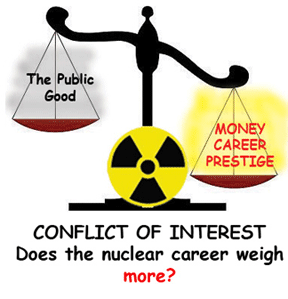 Rebranding the nuclear weapons complex won’t reform it, Bulletin of the Atomic Scientists Robert Alvarez, 18 Jan 15
 - “……….Panel co-chairman Norm Augustine, former chairman and CEO of the Lockheed Martin Corporation, a major member of consortia running the Y-12 nuclear weapons plant in Tennessee, the Pantex weapons assembly and disassembly facility in Texas and the Sandia National Laboratory in New Mexico.
- Panel co-chairman Richard W. Mies, a retired US Navy admiral who is a member of the board of directors of the Babcock and Wilcox Corporation (B&W). B&W operates the NNSA’s Y-12 plant. Mies is also a board member for a consortium managing Lawrence Livermore and Los Alamos National Laboratories.
- Michael R. Anastasio, the former director of the Los Alamos National Laboratory and former president of Los Alamos National Security LLC, the company that operated the laboratory until 2011. He is also the former director of Lawrence Livermore National Laboratory.
- Kirkland H. Donald, a former commander of US naval submarine forces and NNSA deputy administrator who’s now president and chief executive of Systems Planning and Analysis (SPA). SPA holds several contracts with the NNSA.
- Franklin C. Miller, a former special assistant to President George W. Bush who is a member of the board of directors of the Sandia Corporation, a wholly owned subsidiary of Lockheed Martin Corporation, which also runs the Y-12 and Pantex plants.
- Former California congresswoman Ellen O. Tauscher, who is on the board of governors for Lawrence Livermore National Security, LLC, and Los Alamos National Security LLC, the consortia that run the corresponding national labs.
- Former New Mexico Congresswoman Heather A. Wilson, who, according to the Energy Department inspector general, received nearly $450,000 in questionable payments, mostly from the Los Alamos and Sandia laboratories; the inspector general found that the Sandia lab paid Wilson to engage in an impermissible attempt to have the federal government extend the lab management contract held by the Sandia Corporation…….. http://thebulletin.org/rebranding-nuclear-weapons-complex-wont-reform-it7935

Cost overruns lead USA Air Force to weaken requirements for future missile alert system
Budget Busters: The USA’s SBIRS-High Missile Warning Satellites https://www.defenseindustrydaily.com/despite-problems-sbirs-high-moves-ahead-with-3rd-satellite-award-05467/ Jan 19, 2015 by Defense Industry Daily staff SBIRS early warning satellite: As part of its effort to institute cost reforms, the U.S. Air Force will weaken requirements  for the space-based infrared system (SIBRS), among others. The Space Based Infrared System (SBIRS)-High satellite program is a key component of the USA’s future missile alert system, designed to give maximum warning and monitoring of ballistic missile launches anywhere in the world. The new satellites will replace the existing Defense Support Program (DSP) fleet. Their infrared sensors have 3x the sensitivity of DSP and 2x the revisit rate, while providing better persistent coverage.
Unfortunately, the program has been beset by massive cost overruns on the order of 400%, technical challenges that continue to present problems, and uncertainties about performance. Despite these problems, the U.S. Air Force is proceeding with the program, and has terminated potential alternatives and supplements. However, as part of a January 2015 effort to institute cost reforms, the Air Force will weaken requirements  for the program, and at least three other major procurement programs.
VIDEO: France’ s nuclear dream sours
Video chat technology courtesy of Skype and Call Recorder.
– See more at: http://www.fairewinds.org/french-nuclear-cycle-crash/#sthash.Gbfawk8d.dpuf
Nations make (optimistic) guesses at the cost of getting rid of old nuclear reactors
Getting Rid Of Old Nuclear Reactors Worldwide Is Going To Cost Way More Than People Think Business Insider, NINA CHESTNEY, GEERT DE CLERCQ LONDON/PARIS (Reuters) 20 Jan 15 –”…….The U.S. Nuclear Regulatory Commission estimates that the cost of decommissioning in the United States – which has some 100 reactors – ranges from $US300 million to $US400 million per reactor, but some reactors might cost much more.
 France’s top public auditor and the nuclear safety authority estimate the country’s decommissioning costs at between 28 billion and 32 billion euros ($US32-37 billion).
 German utilities – such as E.ON, which last month said it would split in two, spinning off power plants to focus on renewable energy and power grids – have put aside 36 billion euros..
 Britain’s bill for decommissioning and waste disposal is now estimated at 110 billion pounds ($US167 billion) over the next 100 years, double the 50 billion pound estimate made 10 years ago.
 Japanese government estimates put the decommissioning cost of the country’s 48 reactors at around $US30 billion, but this is seen as conservative. Russia has 33 reactors and costs are seen ranging from $US500 million to $US1 billion per reactor……… http://www.businessinsider.com.au/r-global-nuclear-decommissioning-cost-seen-underestimated-may-spiral-2015-1
Canada’s record breaking wind energy results

 Record-setting year for Canadian wind industry http://www.renewableenergyfocus.com/view/41133/record-setting-year-for-canadian-wind-industry/19 January 2015
1,871 MW of wind energy capacity was installed in five provinces in Canada in 2014.
For the second consecutive year, Canada has set a record for the installation of new wind energy capacity. According to the Canadian Wind Energy Association (CanWEA), a total of 1,871 MW of wind energy capacity was installed in five provinces in Canada in 2014, with most growth centred in Ontario (999 MW), Quebec (460 MW) and Alberta (350 MW).
Canada ended 2014 with nearly 9,700 MW of installed wind energy capacity, producing enough electricity to meet the needs of more than 3 million average Canadian homes every year.
In Scotland, renewable energy beats nuclear power
 Renewable energy in Scotland exceeds nuclear, PennEnergy January 19, 2015 Source: Vattenfall In the first months of 2014 renewable energy in Scotland exceeded nuclear and became the top source of electricity.
The same period saw wind output rise by 20 percent, while hydro generation climbed by 50 percent………..
Although onshore wind and hydro power are indisputable leaders in Scotland’s renewable energy mix, there is significant growth potential in offshore wind, tidal and solar power.In October 2014, the Scottish Government gave the green light for 500 wind turbines spread across four offshore wind farms in the Forth and Tay region. http://www.pennenergy.com/articles/pennenergy/2015/01/renewable-energy-in-scotland-exceeds-nuclear.html
America’s $trillion nuclear weapons industry – now too big to succeed?

 Rebranding the nuclear weapons complex won’t reform it, Bulletin of the Atomic Scientists Robert Alvarez, 18 Jan 15
“…………Lab overcapacity, in particular, contributes to an inflated weapons complex cost structure, within which the average full time employee is two to three times as expensive as in the private sector. Since 2006, when management of the weapons labs was transferred from the nonprofit University of California to for-profit entities,administrative fees have jumped by 650 percent at Los Alamos. The bloat in the weapons complex is hardly limited to the national labs; the Y-12 nuclear weapons plant in Tennessee has excess capacity that is comparable, in size, to two auto assembly plants.
The Obama administration should establish a commission—one, this time, that is not dominated by the very contractors that run the nuclear weapons complex—to analyze and downsize the redundant elements of that complex. The Defense Department accomplished such a downsizing over the past 20 years; it’s long past time for the Energy Department to begin shedding its surplus capacity. Given that weapons facilities dominate the wage and benefit structures of large areas in several states, such streamlining will no doubt meet stiff congressional resistance. Still, the downsizing sword could eliminate redundant facilities and free up funding to rebuild those that are truly needed.
- Too big to succeed. Perhaps the most significant aspect of management reform in the nuclear weapons complex is coming to terms with its size. From the start, this newest review panel was directed to place the thorny problem of downsizing the weapons complex—an issue raised by several expert panels over some 20 years—off the table. By focusing on organizational boxes, Congress made sure that the panel would not tackle a most obvious problem: The nuclear weapons production and laboratory system is simply too large for the nation’s current needs.
- Finally, the most recent study of the weapons complex raises a fundamental question: Could it be that the “orphan” status of nuclear weapons in the United States reflects not presidential and congressional inattention, but changing priorities in the real world of international security? When the president spoke last year of “reducing the role of nuclear weapons in our security strategy,” he seemed to unequivocally answer this question.
- By rebranding the Energy Department in a way that gives nuclear weapons production equal status with the whole of US energy policy, the congressional panel has tried to impose on the government a Cold War urgency that does not reflect the actual relevance of nuclear weaponry in the 21st century. Some estimates have puta trillion-dollar price tag on replacing our decaying nuclear deterrent. With the stakes so high, is it really in the nation’s interest to rely on a panel dominated by the interests of weapons contractors for advice on managing the problems of the weapons complex? http://thebulletin.org/rebranding-nuclear-weapons-complex-wont-reform-it7935
Renewable energy on the way to beating fossil fuels, even without sibsidies
 Renewables Competitive With Fossil Fuels :IRENA http://www.energymatters.com.au/renewable-news/irena-renewables-cost-em4650/ January 20, 2015 [Good graphs] The International Renewable Energy Agency (IRENA) says the cost of generating power from some renewable energy sources has reached parity or is cheaper than cost of fossil fuels.
The Renewable Power Generation Costs in 2014 report states biomass, hydro, geothermal and onshore wind are all competitive with or cheaper than coal, oil and gas-fired power stations – and that’s even without subsidies.
Individual wind projects are consistently generating electricity for USD 0.05 per kilowatt-hour without financial support, compared to USD 0.045 to 0.14/kWh for fossil-fuel power plants.
Solar PV is rapidly closing the gap; with solar panel costs falling 75 per cent since the end of 2009 and utility-scale solar PV electricity generation costs plummeting 50 per cent since 2010.
IRENA notes a recent utility scale PV tender in Dubai was costed at just just 0.06USD/kWh…
Residential solar power systems are now as much as 70% cheaper than in 2008.
Between 2010 and 2014, the average LCOE (levelized cost of electricity) of residential systems in Australia declined by 52% and residential electricity price parity has been reached in parts of the nation. The report states the LCOE of solar PV in Australia is highly competitive due to the country’s excellent solar resources.
“Now is the time for a step-change in deployment for renewables,” said Adnan Z. Amin, Director-General of IRENA. “It has never been cheaper to avoid dangerous climate change, create jobs, reduce fuel import bills and future-proof our energy system with renewables. This requires public acknowledgement of the low price of renewables, an end to subsidies for fossil fuels, and regulations and infrastructure to support the global energy transition.”
The report says there are no technical barriers to the increased integration of variable renewable resources.
” At low levels of penetration, the grid integration costs will be negative or modest, but can rise as penetration increases. Even so, when the local and global environmental costs of fossil fuels are taken into account, grid integration costs look considerably less daunting, even with variable renewable sources providing 40% of the power supply. In other words, with a level playing field and all externalities considered, renewables remain fundamentally competitive.”
In terms of small scale off-grid and remote power, renewables now offer the best economic solution compared to diesel-fired generation – and this is despite the reduction in oil prices at the end of last year and the beginning of 2015.
The International Renewable Energy Agency (IRENA) is the global hub for renewable energy cooperation and information exchange. It consists of 138 members (137 States and the European Union), including Australia. Renewable Power Generation Costs in 2014 can be downloaded here (PDF).
In the interests of uranium mining, Australia’s Aborigines moved off their remote homelands

 Waging a war over land rights MEENA MENON , THE HINDU,January 19, 2015 ‘Protests are continuing in various parts of Australia over mining’
In her book of poems, Love Dreaming, aboriginal writer Ali Cobby Eckermann from Australia writes, “Every grain of sand in this big red country is a pore on the skin of my family.” Her writing and her new book, Too Afraid to Cry reflect the alienation of the ‘Stolen generation’ of children who were selectively taken away from their families and raised by white people and also the plight of her people who are waging a war over land rights.
Thousands of people from indigenous communities plan to hold massive protests over land issues on Australia Day on January 26, she says. Protests are continuing in various parts of Australia over mining uranium and minerals and even Kakadu National Park, on the UNESCO World Heritage Site is under threat.
In New Delhi to deliver the annual Navayana lecture, she told The Hindu in an interview that a serious lack of understanding between cultures persists in Australia at a political level and with mining it has expanded. “We worry for our children. Now the Western Australian government wants to use bulldozers and close 150 or 180 small aboriginal communities — they say it is not sustainable to keep these communities going. Where do these people go? They can wander to the city to become a makeshift community under tarpaulin as they are not going to rehouse them,” she says.
The sudden move, she suspects, is to do with mining and removing people from the area so that even that little bit of resistance is gone. That’s the scary part but the aboriginal people will survive. It’s all about land, the war is over land, she says and no one really articulates it like that. “Why would they want these remote areas which are mineral rich to be emptied of people. Western Australia is among the richest mining areas but why is not the government saying some percentage of that mining rights should go to the community. That doesn’t happen, the miners don’t pay tax and we watch the money fly away,” she points out.
Referring to the civil nuclear deal between India and Australia, she said, “Please consider when you support nuclear energy in India what happens to our culture. There will be a slow erosion of human rights but we will fight for the right of our children to have rights of lands.”
The government has given approvals for uranium mines in western Australia. Hailing from South Australia, she said this was a place of ancient knowledge. “In aboriginal culture we do not own the land, we belong to the land and the land does not belong to us, the land is our heart, “she says.
The struggle for land in the mid 70s when people drove to Adelaide and demanded their land back had resulted in some rights being restored. There was a strong law in place on mining but unknown to many communities the government in 2008 has sneaked in amendments which do not provide for negotiations as in the past. “So if a community agrees to exploration it has virtually given away the right to mining as well,” Ms. Eckermann adds.
In Northern Territory some ten years ago the government had proposed nuclear waste storage sites but a group of women pensioners living in old age homes got together with support from Friends of the Earth and fought the government and managed to convince them that this was not a good idea. Ms Eckermann who has learnt a lot from what she calls the “struggle of my grandmothers”, says the women essentially told the government from a cultural perspective their aversion to the nuclear waste dump on their lands and part of that was because they were young girls when the Maralinga atomic testing took place by the British in the 1950s. Many had lost their family in the nuclear fallout and for these women, it was an environmental war- and a cultural war and they were so dignified in their protest, she says.”I don’t know how they did it. They said never raise your voice except to sing traditional songs and they told the government to “get your ears out of your pockets.” It was a such a grass roots victory and there was no more room for lying and deceit. This was a jury of traditional women, against younger white men and the women won,” she grins.
Thousands of people from indigenous communities plan to hold massive protests over land issues on Australia Day on January 26 which many also call Invasion day for that’s when Captain Cook arrived on the country’s shores. ……..
“Land is like my family, that rock is like my grandfather and that sand dune is my mother. We have our ways and they can be customised to modern life but the core wisdom won’t change. We have to stop the intergenerational social impacts but every time the government meets us they have no concept of land or the people. And then we are called ungrateful, “she concludes. http://www.thehindu.com/news/national/waging-a-war-over-land-rights/article6800001.ec
Uranium selling at price way below its costs of production, by Australian miner Paladin Energy
 Paladin Energy Ltd revenues soar 79% but shares sink Motley Fool By Mike King – January 19, 2015 Uranium miner Paladin Energy Ltd (ASX: PDN) has announced sales of US$69.9 million in the December quarter, a rise of 79% over the previous quarter.
But despite the news, shares are down 2.8% at 35 cents at lunchtime.
So why are investors selling out of a stock reporting such strong growth?
The problem is that Paladin sold 1.9 million pounds of uranium in the quarter, at an average price of US$36.58 per pound. That last figure is the issue – that price is well below what it costs Paladin to produce the uranium, and there are no signs that the price is…[members only] http://www.fool.com.au/2015/01/19/paladin-energy-ltd-revenues-soar-79-but-shares-sink/
1 This Month

of the week – Shut Down Drone Warfare!


Tell the Ukrainian Government to Drop Prosecution of Peace Activist Yurii Sheliazhenko

Petition to revoke the licensing of the Near Surface Nuclear Disposal Facility (NSDF) at Chalk River. https://www.ourcommons.ca/petitions/en/Petition/Details?Petition=e-7247
To see nuclear-related stories in greater depth and intensity – go to https://nuclearinformation.wordpress.com
-
Archives
- April 2026 (114)
- March 2026 (251)
- February 2026 (268)
- January 2026 (308)
- December 2025 (358)
- November 2025 (359)
- October 2025 (376)
- September 2025 (257)
- August 2025 (319)
- July 2025 (230)
- June 2025 (348)
- May 2025 (261)
-
Categories
- 1
- 1 NUCLEAR ISSUES
- business and costs
- climate change
- culture and arts
- ENERGY
- environment
- health
- history
- indigenous issues
- Legal
- marketing of nuclear
- media
- opposition to nuclear
- PERSONAL STORIES
- politics
- politics international
- Religion and ethics
- safety
- secrets,lies and civil liberties
- spinbuster
- technology
- Uranium
- wastes
- weapons and war
- Women
- 2 WORLD
- ACTION
- AFRICA
- Atrocities
- AUSTRALIA
- Christina's notes
- Christina's themes
- culture and arts
- Events
- Fuk 2022
- Fuk 2023
- Fukushima 2017
- Fukushima 2018
- fukushima 2019
- Fukushima 2020
- Fukushima 2021
- general
- global warming
- Humour (God we need it)
- Nuclear
- RARE EARTHS
- Reference
- resources – print
- Resources -audiovicual
- Weekly Newsletter
- World
- World Nuclear
- YouTube
-
RSS
Entries RSS
Comments RSS
 nuclear-news