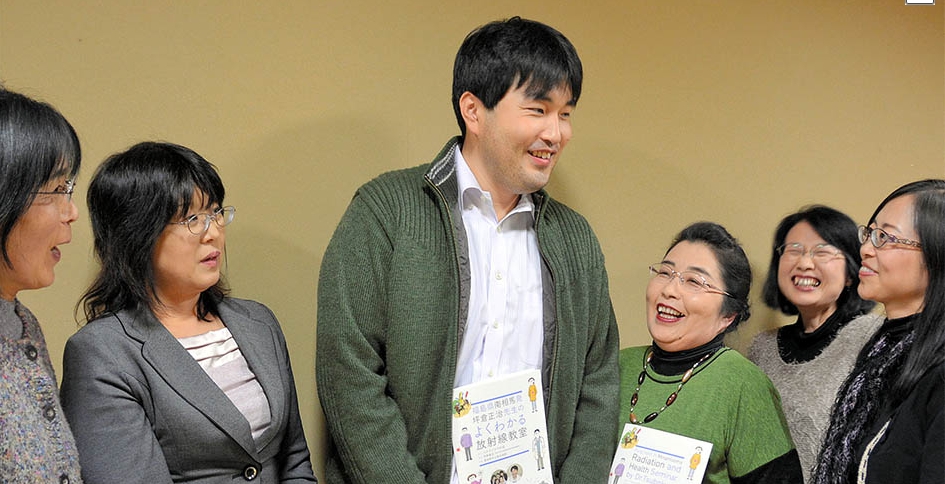
Masaharu Tsubokura, center, and the members of the Veteran Mothers’ Society in Minami-Soma, Fukushima Prefecture
December 29, 2014
MINAMI-SOMA, Fukushima Prefecture–Mothers living near the stricken Fukushima No. 1 nuclear plant have compiled a booklet offering basic knowledge about radiation and explanations addressing safety concerns arising from the disaster.
The booklet, titled “Yoku Wakaru Hoshasen Kyoshitsu” (Radiation and Health Seminar), is available in both Japanese and English and was created by the Veteran Mothers’ Society, which consists of five mothers from the city of Minami-Soma.
The members, some of whom are former high school classmates, decided to create the booklet “for children’s sake.”
The information incorporates lessons learned from doctors at seminars the group organized following the accident at Tokyo Electric Power Co.’s Fukushima No. 1 nuclear plant in March 2011.
Amid the confusion and fears over radiation after the disaster unfolded, the mothers convened their first seminar for children and guardians in December 2011. They invited Masaharu Tsubokura, a doctor of hematology from the University of Tokyo’s Institute of Medical Science who had been providing consultations at the Minami-Soma municipal general hospital.
Other physicians later joined the effort to spread accurate information about radiation, and the mothers have held the sessions once or twice a month.
In the seminars, the children peppered Tsubokura with questions, such as “Can I touch my pets?” and “Is it OK to lick the snow?”
Ikumi Watanabe, the society’s 54-year-old vice chairwoman, recalled that Tsubokura’s explanations “were spoken in an easy-to-understand manner so the information popped straight into our heads. It was nice that we could talk with him on the same level and in person.”
Even now, the nature of the questions has not changed much.
“People have felt pressured not to talk about radiation, and some mothers have finally gotten the information only now, more than three years after the accident,” Tsubokura said. “I hope I can help them make decisions without thinking negatively about themselves or losing their self-confidence.”
In addition to basic knowledge, such as the differences between external and internal radiation exposure and between becquerels and sieverts, the booklet answers questions like: “Can radiation be transmitted from one person to another?” and “Is the tap water OK?”
According to the Veteran Mothers’ Society, 20,000 copies of the Japanese version were distributed to schools, companies and other organizations. The English version has been ordered by international schools, international exchange organizations and other groups.
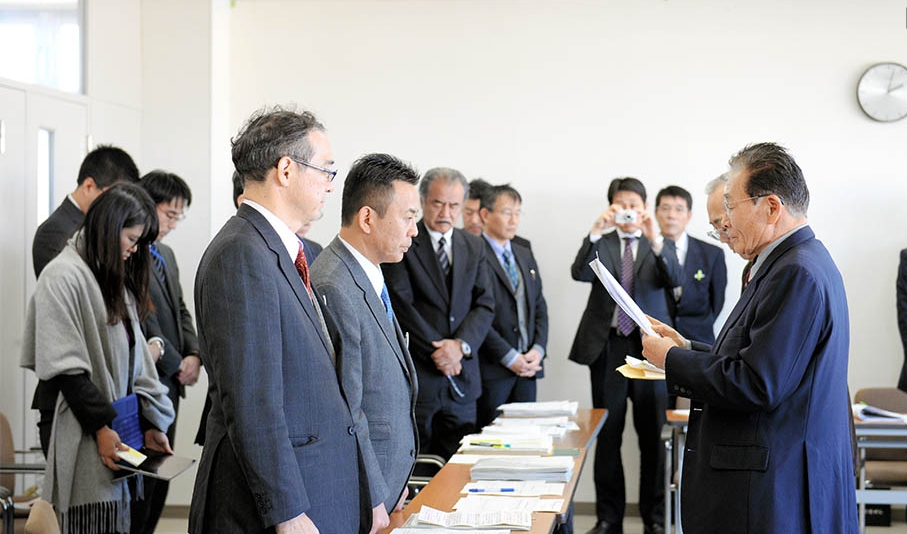
MINAMI-SOMA, Fukushima Prefecture–The central government lifted on Dec. 28 the last recommended evacuation advisory for several districts in this city, saying radiation levels from the nuclear accident fell below the annual exposure limit.
However, many of the residents of 152 households within these districts voiced their opposition to the lifting.
The central government designated areas that registered high radiation levels outside the zones under mandatory evacuation orders as specific recommended evacuation spots following the triple meltdown at the Fukushima No. 1 nuclear power plant. The residents living within these locales were encouraged to evacuate from their homes.
The districts in Minami-Soma were designated as such because they were at risk of exceeding the annual accumulated dose limit of 20 millisieverts, or 3.8 microsieverts per hour.
The central government in June 2011 issued the advisory for some locales in the cities of Minami-Soma and Date and the village of Kawauchi, all in Fukushima Prefecture, home to 281 households. The advisory for Date and Kawauchi was lifted earlier.
Central government officials explained their latest decision to the residents and local officials, saying that the health risks are not expected because radiation levels in their sites now measure well below the designated limit of 20 millisieverts.
They also presented support measures to encourage the residents to return to their homes.
However, evacuee Katsuji Sato, among the residents of the 152 households, said he would not immediately return home.
The 79-year-old, who lives in temporary housing in Minami-Soma, had lived in a family of six of four generations before the Great East Earthquake and tsunami on March 11, 2011, set off the nuclear disaster.
Sato’s mother died where she evacuated to, and his eldest son, the son’s wife and their elementary school child moved to Miyagi Prefecture.
“My wife and I cannot return to our home even though we want to unless decontamination work is undertaken again,” Sato said.
The head of the Takakura district, right, reads aloud a statement in opposition to the lifting of a recommended evacuation advisory to officials of the nuclear emergency local response headquarters
The $1.6 trillion estimate, which comes to $14 million per hour since 9/11, from the Congressional Research Service is up roughly half a trillion dollars from its 2010 estimate, which found that the post-9/11 military operations are second only to World War II in terms of financial cost.
In its report, which was released earlier this month, CRS finds that the 92 percent of the war-related expenditures since 9/11 have flowed into the Pentagon. Just 6 percent has been spent on foreign assistance and diplomacy, and 1 percent on medical services for veterans.
The report, which was posted on the website of the Federation of American Scientists, breaks down the war-related expenditures by different military operations. It finds that a little more than half the $1.6 trillion has gone toward operations in Iraq. Another $686 billion has been spent on military operations in Afghanistan.
CRS notes that the Obama administration is requesting nearly $6 billion in new funding to finance military operations against the Islamic State group, but researchers note that predicting “future costs of the new U.S. role in countering the Islamic State is difficult because of the nature of the air campaign and uncertainties about whether the U.S. mission may expand.”
Last week, a Defense Department official disclosed that since August, U.S. taxpayers have already spent more than $1 billion — or $8 million a day — on air strikes against the Islamic State in Iraq and Syria. Additionally, the Obama administration announced it is deploying 1,300 troops to Iraq in January
Pope Francis’s edict on climate change will anger deniers and US churches, Guardian, John Vidal, 28 Dec 14 Pontiff hopes to inspire action at next year’s UN meeting in Paris in December after visits to Philippines and New York “……can Francis achieve a feat that has so far eluded secular powers and inspire decisive action on climate change?It looks as if he will give it a go. In 2015, the pope will issue a lengthy message on the subject to the world’s 1.2 billion Catholics, give an address to the UN general assembly and call a summit of the world’s main religions.The reason for such frenetic activity, says Bishop Marcelo Sorondo, chancellor of the Vatican’s Pontifical Academy of Sciences, is the pope’s wish to directly influence next year’s crucial UN climate meeting in Paris, when countries will try to conclude 20 years of fraught negotiations with a universal commitment to reduce emissions.
“Our academics supported the pope’s initiative to influence next year’s crucial decisions,” Sorondo told Cafod, the Catholic development agency, at a meeting in London. “The idea is to convene a meeting with leaders of the main religions to make all people aware of the state of our climate and the tragedy of social exclusion.”
Following a visit in March to Tacloban, the Philippine city devastated in 2012 by typhoon Haiyan, the pope will publish a rare encyclical on climate change and human ecology. Urging all Catholics to take action on moral and scientific grounds, the document will be sent to the world’s 5,000 Catholic bishops and 400,000 priests, who will distribute it to parishioners.
According to Vatican insiders, Francis will meet other faith leaders and lobby politicians at the general assembly in New York in September, when countries will sign up to new anti-poverty and environmental goals………..
According to Neil Thorns, head of advocacy at Cafod, said: “The anticipation around Pope Francis’s forthcoming encyclical is unprecedented. We have seen thousands of our supporters commit to making sure their MPs know climate change is affecting the poorest communities.”
However, Francis’s environmental radicalism is likely to attract resistance from Vatican conservatives and in rightwing church circles, particularly in the US – where Catholic climate sceptics also include John Boehner, Republican leader of the House of Representatives and Rick Santorum, the former Republican presidential candidate.
Cardinal George Pell, a former archbishop of Sydney who has been placed in charge of the Vatican’s budget, is a climate change sceptic who has been criticised for claiming that global warming has ceased and that if carbon dioxide in the atmosphere were doubled, then “plants would love it”………
Cyber-attacks on South Korean nuclear power operator continue, GuardianFirm says nuclear power plants are operating safely and are secure from attack, and it has stepped up its cybersecurity South Korea’s nuclear power operator has said cyber-attacks on non-critical operations at its headquarters are continuing but the country’s nuclear power plants are operating safely and are secure from attack……since last Wednesday the operator and the government have had emergency teams on standby as a precaution, after a hacker demanded the shutdown of three reactors by last Thursday and in Twitter messages threatened “destruction” if the demand was not met. http://www.theguardian.com/world/2014/dec/28/cyber-attacks-south-korean-nuclear-power-operator
The flyovers have also exposed vulnerabilities on the ground. For example, spent-fuel pools are often unprotected or only protected by thin tin roofs.
Drones: The Threat to Nuclear Plants http://www.newsweek.com/drones-threat-nuclear-plants-294458BY CAROLINE BAYLON 12/27/14 From small commercial drones for express parcel delivery to military ones used to attack terrorist suspects, the past year has seen a proliferation in the use of all types of unmanned aerial vehicles. Yet the prospect of increasing numbers of drones filling the skies poses abundant security concerns for critical infrastructure—including for the nuclear industry.
Just last week, news media reported that in July a drone came within six yards of a plane landing at Heathrow airport in London. Last month, French authorities revealed that unidentified drones had breached restricted airspaceover 13 of France’s 19 nuclear power plants between early October and late November. The drones are believed to have been sophisticated civilian devices costing several thousands of pounds, and the intrusions were seemingly coordinated and generally occurred at night.
Given that the majority of security measures at nuclear power plants were conceived before the advent of drone technology, the flights over French facilities have exposed nuclear plants’ lack of adequate defenses against drones. This has left the French government—while outwardly reassuring the public that it has put in place ‘all means necessary to protect nuclear installations’—scrambling to find adequate solutions.
Drones can pose a number of problems for nuclear facilities. Flyovers could be used for reconnaissance by hostile actors, for example in the collection of photos and video footage of guard movements and the site layout. This could help to prepare for a ground-based attack. Drones could also provide air support in the event of an actual ground-based attack: They could drop explosives to damage power or communications networks, or could deliver weapons to insiders within the plant. Drones could also be used to bomb spent-fuel pools, which are less well protected than reactor cores. Continue reading →
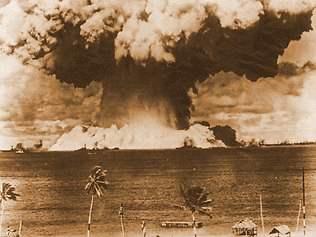
A Former Ground Zero Goes to Court Against the World’s Nuclear Arsenals NYT, By MARLISE SIMONSDEC. 27, 2014 THE HAGUE — Tony de Brum was 9 years old in 1954 when he saw the sky light up and heard the terrifying rumbles of “Castle Bravo.” It was the most powerful of 67 nuclear tests detonated by the United States in the Marshall Islands, the remote Pacific atolls he calls home.
Six decades later, with Mr. de Brum now his country’s foreign minister, the memory of those thundering skies has driven him to a near-Quixotic venture: His tiny country is hauling the world’s eight declared nuclear powers and Israel before the International Court of Justice. He wants the court to order the start of long-promised talks for a convention to ban atomic arsenals, much like the treaties that already prohibit chemical, biological and other weapons of mass destruction.
Mr. de Brum says the initiative is not about seeking redress for the enduring contamination and the waves of illness and birth defects attributed to radiation. Rather, by turning to the world’s highest tribunal, a civil court that addresses disputes between nations, he wants to use his own land’s painful history to rekindle global concern about the nuclear arms race………
In its first written arguments, presented to the court this month, the Marshall Islands contended that the nuclear powers had violated their legal obligation to disarm. Specifically, the arguments said, by joining the 1968 Nuclear Nonproliferation Treaty, five countries — the United States, Russia, Britain, France and China — undertook to end the arms race “at an early date” and to negotiate a treaty on “complete disarmament.”
Three other nuclear nations that did not agree to the treaty — India, Israeland Pakistan — and a fourth that withdrew from it — North Korea — are required to disarm under customary international law, the Marshall Islands’ case claims. The existence of Israeli nuclear weapons is universally assumed, but Israel has not acknowledged having them.
“All the nuclear weapons states are modernizing their arsenals instead of negotiating, and we want the court to rule on this,” said Phon van den Biesen, the leader of the islands’ legal team, who first asked the court to hear the case in April…….. Continue reading →
Fukushima rocked by strongest quakes to hit country this month; Epicenter just offshore from reactors; Nuke plant cam shows shaking for over a minute — Top Japan Newspaper: ‘Major quake disasters could strike anywhere in nation’… Great increases in probability; Measures urgently needed (VIDEO) http://enenews.com/fukushima-rocked-strongest-quakes-hit-country-month-footage-nuke-plant-shows-shaking-minute-top-japan-newspaper-major-quake-disasters-could-strike-anywhere-nation-great-increases-perceived-probabil?utm_source=feedburner&utm_medium=email&utm_campaign=Feed%3A+ENENews+%28Energy+News%29
Yomiuri Shimbun, Dec. 24, 2014 (emphasis added): Major earthquake disasters could strike anywhere in the nation — What is the probability of a major earthquake striking each part of the nation? The government’s Headquarters for Earthqake Research Promotion has unveiled its 2014 version of a geographical forecast for massive quakes… A glance at the map shows us that no region in this nation is free from the risk of seismic disaster… The data in question shows that no further delay may be permitted in taking necessary measures… Despite theurgent need for measures to cope with the situation, some municipal governments have not done enough… In producing the latest version, the headquarters expanded the scope of the areas with estimated epicenters while also extending the scales for predicted quakes. This resulted ingreat increases in the perceived probability of a major earthquake striking some areas, including Saitama [north of Tokyo]. The figure for the city marked a 21-point increase to 51 percent.
Prensa Latina, Dec 25, 2014: 5.5 Magnitude Quake Rocks Japan — A 5.5 magnitude quake rocked northeastern Japan yesterday night… The medium-intensity quake [was centered off] Futaba district, Fukushima, with epicenter at a depth of 30 km.
Epoch Times (China), Dec 25, 2014: Earthquake Today in Japan: Strong Quake Off Coast of Fukushima on Christmas… The US Geological Survey said the quake… was measured at 5.5-magnitude… The quake had a depth of 6.2 miles, said the USGS.
The Herald, Dec 21, 2014: Earthquake hits near Fukushima — A 5.9 magnitude earthquake hit Japan’s Honshu island… shaking Fukushima where crippled nuclear power plants are located… A spokesman for Tokyo Electric Power said no irregularities have been found at its Fukushima Daiichi or Daini plants.
Research by the International Renewable Energy Agency (Irena) shows that a doubling of the world’s share of renewable energy by 2030, from about 18% in 2010 to 36%, would help avoid the worst effects of climate change and would be cheaper than not doing so.
When considering factors like the cost of ill health and environmental damage due to pollution, switching to renewable energy could save up to $740bn (£476bn) per year by 2030. If these costs were factored into energy prices, renewable energy and energy efficiency measures would be cheaper than fossil fuel alternatives.
The Lima climate talks saw a shift towards action with renewable energy taking centre stage, says the head of the International Renewable Energy Agency
After two weeks of intense negotiation, governments settled on a draft text that will hopefully lead to a successful global climate deal in Paris next December. While opinions vary regarding the success or failure of the outcome, there is another story emerging outside the negotiation room.
This year’s conference represented a highly-significant shift in the positive momentum to act on climate change. While negotiators engaged in contentious debates, businesses, non-governmental organisations and local authorities stepped forward to present their own climate initiatives and committed to more action on the ground.
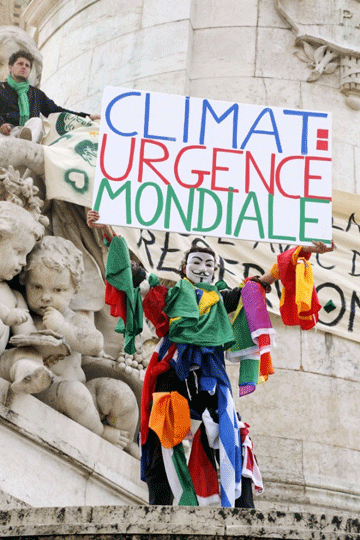
Let’s leave behind the age of fossil fuel. Welcome to Year One of the climate revolution, Guardian Rebecca Solnit column 24 Dec 14
“…………….This is the biggest of pictures, so find your role. Earlier this month, hundreds of Peruvian children formed the image of a tree on the beach to send a message to the world. It’s a start
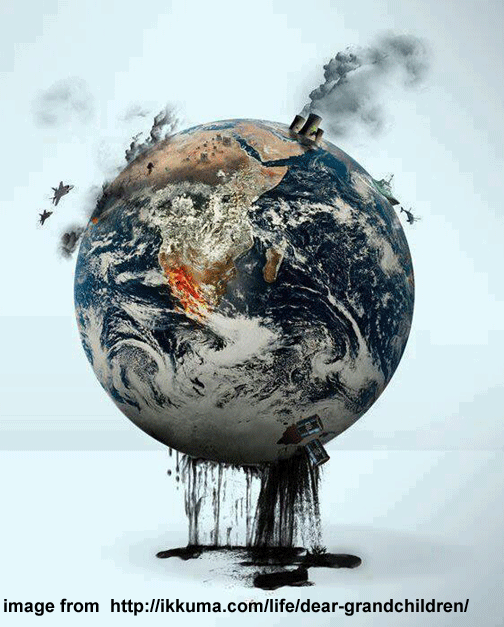
Just before that September climate march in New York, I began to contemplate how human beings a century from now will view those of us who lived in the era when climate change was recognized, and yet there was so much more that we could have done. They may feel utter contempt for us. They may regard us as the crew who squandered their inheritance, like drunkards gambling away a family fortune that, in this case, is everyone’s everywhere and everything. I’m talking, of course, about the natural world itself when it was in good working order. They will see us as people who fiddled while everything burned.
They will think we were insane to worry about celebrities and fleeting political scandals and whether we had nice bodies. They will think the newspapers should have had a gigantic black box above the fold of the front page every day saying “Here are some stories about other things, BUT CLIMATE IS STILL THE BIGGEST STORY OF ALL.”
They will think that we should have thrown our bodies in front of the engines of destruction everywhere, raised our voices to the heavens, halted everything until the devastation stopped. They will bless and praise the few and curse the many.
There have been heroic climate activists in nearly every country on the planet, and some remarkable things have already been achieved. The movement has grown in size, power, and sophistication, but it’s still nowhere near commensurate with what needs to be done. In the lead-up to the UN-sponsored conference to create a global climate treaty in Paris next December, this coming year will likely be decisive.
You are a citizen of this Earth and your responsibility is not private but public, not individual but social.
So this is the time to find your place in a growing movement, if you haven’t yet – as it is for climate organizers to do better at reaching out and offering everyone a part in the transformation, whether it’s the housebound person who writes letters or the 20-year-old who’s ready for direct action in remote places. This is the biggest of pictures, so there’s a role for everyone, and it should be everyone’s most important work right now, even though so many other important matters press on all of us. (As the Philippines’s charismatic former climate negotiator Yeb Sano notes, “Climate change impinges on almost all human rights. Human rights are at the core of this issue.”)
Many people believe that personal acts in private life are what matters in this crisis. They are good things, but not the key thing. It’s great to bicycle rather than drive, eat plants instead of animals, and put solar panels on your roof, but such gestures can also offer a false sense that you’re not part of the problem.
You are not just a consumer. You are a citizen of this Earth and your responsibility is not private but public, not individual but social. If you are a resident of a country that is a major carbon emitter, as is nearly everyone in the English-speaking world, you are part of the system, and nothing less than systemic change will save us.
The race is on. From an ecological standpoint, the scientists advise us that we still have a little bit of time in which it might be possible, by a swift, decisive move away from fossil fuels, to limit the damage we’re setting up for those who live in the future. From a political standpoint, we have a year until the Paris climate summit, at which, after endless foot-shuffling and evading and blocking and stalling and sighing, we could finally, decades in, get a meaningful climate deal between the world’s nations.
We actually have a chance, a friend who was at the Lima preliminary round earlier this month told me, if we all continue to push our governments ferociously. The real pressure for change globally comes more from within nations than from nations pressuring one another. Here in the United States, long the world’s biggest carbon-emitter (until China outstripped us, partly by becoming the manufacturer of a significant percentage of our products), we have a particular responsibility to push hard. Pressure works. The president is clearly feeling it, and it’s reflected in the recent US-China agreement on curtailing emissions – far from perfect or adequate, but a huge step forward.
be? No one knows, but we do know that we must keep moving in the direction of reduced carbon emissions, a transformed energy economy, an escape from the tyranny of fossil fuel, and a vision of a world in which everything is connected. The story of this coming year is ours to write and it could be a story of Year One in the climate revolution, of the watershed when popular resistance changed the fundamentals as much as the people of France changed their world (and ours) more than 200 ago.
Two hundred years hence, may someone somewhere hold in their hands a document from 2021, in wonder, because it was written during Year Six of the climate revolution, when all the old inevitabilities were finally being swept aside, when we seized hold of possibility and made it ours. “Any human power can be resisted and changed by human beings,” says Ursula K Le Guin. And she’s right, even if it’s the hardest work we could ever do.
New study confirms ‘Limits to Growth’ prediction of imminent global collapse by Michelle Kennedy Hogan, 12/27/14http://inhabitat.com/new-study-confirms-limits-to-growth-prediction-of-imminent-global-collapse/ When Limits of Growth was first published, it was almost impossible to believe that population growth and dire predictions of resource consumption could lead to the collapse of the planet. Researchers Donella and Dennis Meadows “built a computer model to track the world’s economy and environment,” according to The Guardian. The model was “cutting edge” and tracked industrialization, population, food, resource use, and pollution. Scenarios were generated out to the year 2100 and showed the inevitable collapse of the economy, the environment and the population if serious measures were not taken.
Now in 2014, data gathered by the University of Melbourne’s Melbourne Sustainable Society Institute shows that the projections made in Limits to Growth were dead on. Principal research fellow Graham Turner drew from a wide range of sources to confirm the projections – including the UN, the U.S National Oceanic and Atmospheric Administration, and BP.
In fact, the projections from 1972 through 2010 were in line with what has happened in every category – from the environment (including resources and pollution) to world population (including the birth and death rate) and the economy (including food, services and industrial output, per capita).
“As the MIT researchers explained in 1972, under the scenario, growing population and demands for material wealth would lead to more industrial output and pollution. The graphs show this is indeed happening. Resources are being used up at a rapid rate, pollution is rising, industrial output and food per capita is rising. The population is rising quickly,” according to the Guardian.
So now what?
If the book’s predictions are true, what will happen in the next 100 years – or less? Well, as we continue to use up resources they will become more expensive. As we use more capital to pull out more resources the “industrial output per capita starts to fall.” According to the book, this begins to happen in 2015. Once industrial output falls, a domino effect occurs through food production, and the resulting cutback in health and education. As health services fall, the death rate rises and the global population will start to fall by about “half a billion people per decade.” Living conditions will become similar to those in the early 1900′s.
While some of the blame can also be placed on climate change and carbon dioxide emissions, most of it is placed squarely on the shoulders of resource consumption. While the University of Melbourne could not find substantive proof of collapse, the book indicates that it will be more evident beginning in 2015. In fact, some believe the Global Financial Crisis of 2007-08 was caused by resource constraints as well as “The pursuit of material wealth contributed to unsustainable levels of debt, with suddenly higher prices for food and oil contributing to defaults – and the GFC.”
With oil production at its peak, other fossil fuels are being gobbled up quickly – and if they require too much capital to extract – the result could be devastating. Protecting ourselves and making serious changes will be necessary to survive, then, in the light of this growing crisis, according to Turner.
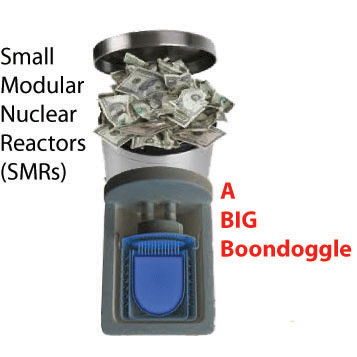
“……..it will likely be later than the estimated 2022 before TVA has an SMR online. And, the decision on whether one actually gets built will rest with the TVA board.
In April, B&W announced it was restructuring its mPower program. Instead of around $60 million a year, it would only spend $15 million per year.
The company also laid off about 200 people in Virginia and in Tennessee involved with the project. The company said in a statement that it was having trouble lining up investors.
Also on Nov. 5, B&W announced plans to spin off its nuclear operations, including the mPower program, into a separate company called BWX Technologies……” TVA shifts focus on Oak Ridge nuclear reactor, Knoxville News Sentinel 4 Dec 14
Ministry, TEPCO seek to end compensation for Fukushima businesses in Feb. 2016 Mainichi, 29 Dec 14The government and Tokyo Electric Power Co. (TEPCO) have proposed to Fukushima Prefecture’s commerce and industry federation a plan to end nuclear disaster compensation for businesses in February 2016, it has been learned.
The Ministry of Economy, Trade and Industry and TEPCO presented the plan to the Fukushima Federation of Societies of Commerce and Industry on Dec. 25. The ministry and the utility told the federation that they plan to end compensation payments to all businesses, except for those in the agricultural, forestry and fisheries sectors, in February 2016. Ministry and utility officials explained that they would map out future policies after hearing claims from business owners.
The federation’s secretary-general, Hideki Endo, however, criticized the proposal.
“Fukushima business owners face different situations depending on their evacuation statuses and their business categories,” he said. “While we understand the need to draw the line somewhere, we cannot accept the end of compensation payments within a year and a few months from now when the nuclear disaster has still not been brought to a conclusion and there are no prospects that harmful rumors will end in the foreseeable future.”…….http://mainichi.jp/english/english/newsselect/news/20141227p2a00m0na007000c.html
Gary Griggs, Our Ocean Backyard: Tracking Fukushima radiation across the PacificBy Gary Griggs, Our Ocean Backyard 26 Dec 14, Radiation from the meltdown of the three reactors at the Fukushima Daiichi Nuclear Plant in March 2011 quickly entered the offshore ocean.
The radiation was detected in the water immediately. Several species of fish caught offshore in 2011 and 2012 had radioactive cesium levels that exceeded Japan’s seafood consumption levels, but overall concentrations have dropped since the fall of 2011………..
Anything picked up by the Kuroshio Current as it passes by Japan, whether tsunami debris, glass fishing floats, or radioactive contaminants, heads towards North America, but slowly, a little more than 5 miles every day on average.
At this speed, water moving from Japan in a straight path would take about three years or longer to get to the west coast. Shortly after the Fukushima Daiichi meltdown and radiation release, oceanographers projected that it would likely take until 2014 until it reached the West Coast of North America……
the nuclear bomb testing that went on in the Pacific from the 1940s to the 1980s, contributed hundreds of times more radioactivity to the oceans than Fukushima. There is also uranium dissolved naturally in seawater.
So Fukushima is not the largest contributor to radiation in the waters of the Pacific Ocean.













 nuclear-news