St Lucie Nuclear Power Plant flooding raises safety problems
Flooding at St. Lucie nuclear plant prompts more oversight from regulators TCPALM, Will Greenlee, Nov 21, 2014 ST. LUCIE COUNTY — The Nuclear Regulatory Commission is stepping up oversight of one of two units at Florida Power & Light Co.’s St. Lucie Nuclear Power Plant after about 50,000 gallons of water entered a reactor auxiliary building during heavy rains in January, according to the NRC.
The incident at the nuclear plant on Hutchinson Island occurred Jan. 9, when more than 7 inches of rain fell on the site, a report states. A blocked storm drain system played a role.
“During the event, stormwater entered the reactor auxiliary building … through degraded electrical conduits that were later found not to have internal flood seals,” a report states………50,000 gallons is about the amount held by a 25-by-45-foot swimming pool with an average depth of 6 feet…….http://www.tcpalm.com/news/local-news/st-lucie-county/flooding-at-st-lucie-nuclear-plant-prompts-more-oversight-from-regulators_24283175
Vital need for nuclear deal with Iran – otherwise Iran will link up with Russia

 Failure to reach a nuclear deal will drive Iran into Russia’s arms, Ft.com November 20, 2014 Ariane TabatabaiIt is vital a comprehensive deal on Iran’s nuclear programme is reached, writes Ariane Tabatabai
This isolation has left Tehran no option but to turn to Moscow. And, as relations between the US and Russia have deteriorated, the Middle Eastern state has the scope to become an evermore decisive and divisive factor.
Failure to reach a comprehensive deal on Iran’s nuclear programme, and to lay the path for more normal economic and political relations with the world, would propel Tehran into Moscow’s arms. It would foster an even more powerful Russian-Iranian axis. This would be worrying for opponents of a deal on Capitol Hill, most of whom also do not want Russian influence to grow. By blocking the way to a deal, they could facilitate and accelerate what they want to prevent.
The writer is an associate with the Harvard Kennedy School’s Belfer Center for Science and International Affairs http://www.ft.com/cms/s/0/af14ed0c-6e57-11e4-afe5-00144feabdc0.html#axzz3Jm01599t
Australia: Foreign Minister and other Ministers take aim at President Obama, over climate change

 Foreign Minister Julie Bishop chides Barack Obama over Great Barrier Reef climate change remarks ABC News 20 Nov 14 Foreign Minister Julie Bishop has criticised US president Barack Obama for a speech in Brisbane last weekend in which he claimed climate change threatened the Great Barrier Reef.
Speaking to 7.30 from New York, where she is attending a meeting of the United Nations Security Council, Ms Bishop said “there was an issue regarding [Mr Obama’s] statement” and she could “understand the Queensland Government’s concern”……..
Bishop latest Coalition politician to take aim at Obama
Ms Bishop is not the only Coalition politician to voice criticism of Mr Obama, with frontbenchers Joe Hockey and Jamie Briggs making comments in the wake of the Brisbane speech.
Mr Briggs labelled the address as a “massive, massive distraction” from the rest of the G20 summit, while the Treasurer said it would be difficult for Mr Obama to deliver on his stricter emissions standard pledge.……..
The Intergovernmental Panel on Climate Change has warned the Great Barrier Reef could be at risk if more is not done to reduce carbon emissions………The UN’s World Heritage Committee has deferred a decision on whether to list the Great Barrier Reef as “in danger” until next year. http://www.abc.net.au/news/2014-11-20/julie-bishop-chides-barack-obama-over-climate-change-remarks/5906570
How the South African government shafts renewables, in its policy fixated on nuclear power
 Nuclear fixation shafts renewables, Mail &Guardian, Africa 21 NOV 2014 00:00 SIPHO KINGS The third window is waiting to be signed off but the energy department is preoccupied elsewhere Within two years, South Africa could have a further 1 200 megawatts (MW) of renewable energy entering the grid. The bidders have been selected and the companies are waiting for financial sign-off so they can start building.
But policy uncertainty and a new focus on nuclear energy are responsible for a nearly 18-month delay in the government giving them the go-ahead, industry insiders say.
In the wake of the 2009 energy crisis, the energy department set out an ambitious renewable energy programme: independent power producers (IPPs) would build the capacity to produce 3 725MW of electricity. This was split into three bidding opportunities, or windows, with companies bidding for a certain allocation in each.
The first two were hailed as great successes and, for the past three years, South Africa has been listed as one of the top five destinations for investment in renewable energy. Wind energy is already producing 660MW. Updated plans envision 9?800MW of solar, 3 300MW of concentrated solar and 4 400MW of wind energy by 2030.
But the third window has been delayed repeatedly. Several concerned individuals, working for renewable companies and unwilling to disclose their names for fear of jeopardising their relationship with the government, said political considerations were to blame.
“We have been told that the new minister’s [Tina Joemat-Pettersson] mandate is strongly towards nuclear energy,” said one………..
The renewable energy companies, the majority of which provide wind and photovoltaic power, are incurring costs all the time. These include leasing the land on which the power stations will be built, which is spread out across the Eastern, Western and Northern Cape.
If the delays continued, the sources said, there would be a point beyond which companies would be unable to recoup their costs, even if they started producing power soon. “We are not far from that point,” warned one renewable company employee. ………
A chance to reindustrialise
Groups such as Cosatu have hailed renewable energy as a chance to “reindustrialise” the country and companies are required to spend up to 70% of their budgets locally. Hundreds of millions of rands have been spent building factories to produce parts locally, such as the R300-million wind tower factory in Atlantis outside Cape Town. Solar panel factories alone have created 500 jobs.
This week the South Africa Renewable Energy Council said delaying the third window would have “extremely adverse consequences” for the industry and could also jeopardise the planned fourth renewable window.
Unlike South Africa’s centralised and state-owned power plants, renewables are financed by the private sector. The government, through Eskom, signs an agreement to buy their electricity at the rate presented in their bid. But they carry the risk.
The owner of one solar company said: “The worst thing for investors is uncertainty. The first two windows attracted so much investment and goodwill because the government was decisive. That is being thrown out of the window.”
If the third window was delayed, and there was another window to come, companies would hesitate to gamble with their money, they said………
Policy uncertainty
Twenty-six renewable energy projects have already been connected to the grid. The more than 60 projects have brought in R120-billion in foreign direct investment. Many of these are ahead of schedule, such as the 96MW Jasper solar plant near Upington in the Northern Cape.
It is the continent’s largest solar photovoltaic power plant. It has been built in the time that costs of the coal-fired Medupi and Kusile power stations, which are currently five years behind schedule, have nearly tripled.
But industry insiders are adamant that, if the policy uncertainty is not cleared up, the initial promise shown by the renewable programme will falter.
The department of energy was not available to respond to questions. http://mg.co.za/article/2014-11-20-nuclear-fixation-shafts-renewables
Yet another safety bungle in South Korea’s nuclear power

 Bungling Nuclear Safety – Fire at Kori Nuclear Power Plant Goes Undetected for Over an Hour Employees couldn’t hear audio alarm, couldn’t see visual alarm, Business Korea, 19 NOVEMBER 2014 Jung Yeon-jin
A fire occurred in the nuclear fuel storage facilities of the Kori Nuclear Power Plant located in Kijang County, Busan City, but none of the workers was aware of it for over an hour.
According to the Korea Hydro & Nuclear Power Corporation, the fire occurred at 4:26 p.m., Nov. 11, at Kori Power Plant Unit 4, burning up a waste dryer along with some gloves and towels. It is assumed that the dryer overheated and started the fire while drying wet gloves……….
Power Plant Attempts to Cover Up Reactor Shutdown
But this fire is only the latest incident at the Kori Nuclear Power Station this year.
This past summer was a busy time for Kori Nuclear Power Plant, as Unit 2 was shut off because of heavy rainfall. On Aug. 25, a localized torrential downpour of over 100 mm per hour in Busan City resulted in rainwater infiltrating one of its annexes, and the corporation had to close the facilities.
At that time, the corporation covered up the incident by saying, “We shut down the facilities just in case, and this has nothing to do with the safety of the power station.” However, the Nuclear Safety and Security Commission’s following report read, “The manual shutdown of the reactor was because of the malfunctioning of four of the circulation water pumps, attributable to the heavy rain.”
The EPR nuclear reactor is a “rotten design that they should have given up on a long time ago”
 French Nuclear Giant Areva Says Future Is Uncertain, Prompting a Sell-Off NYT, By DAVID JOLLY and STANLEY REEDNOV. 19, 2014 PARIS “……….The problems at Flamanville and Olkiluoto raise further questions about the future of the EPR reactor design that Areva and EDF are marketing around the world. All of the EPRs under construction including those being built at Taishan in China have run into delays. The giant power stations, for which the designs date to the early 1990s, were supposed to be safer and simpler than earlier nuclear plants, but they are proving fiendishly complex and expensive to build.
Mr. Thomas said the problems with the other EPRs around the world also raised doubts about whether two reactors of this type would be built at Hinkley Point in southwest England, as EDF planned. The European Union recently gave its approval to the project, which will cost at least 16 billion pounds, or $25.1 billion, but EDF still needs to put together an international consortium to finance and build it. http://www.nytimes.com/2014/11/20/business/international/french-nuclear-giant-areva-says-future-is-uncertain-prompting-a-sell-off.html?_r=0
Danger of nuclear fuel storage at Columbia Generating Station
Groups says fuel storage poses risk at the Northwest’s lone commercial nuclear plant Oregon Live By Ted Sickinger| tsickinger@oregonian.com Email the author | Follow on Twitter November 20, 2014 The growing stockpile of spent nuclear fuel at the Northwest’s lone commercial nuclear plant poses a safety risk to the public in the event of an earthquake, according to a study sponsored by anti-nuclear groups.
The study of spent fuel storage at the Columbia Generating Station is the latest of several commissioned by the Physicians for Social Responsibility and Heart of America Northwest. They collectively suggest that the plant is an expensive and dangerous way for the Northwest to generate electricity, and that it ought to be closed.
The study was authored by nuclear critic Robert Alvarez, senior scholar at the Institute for Policy Studies. Officials at Energy Northwest, the utility consortium that operates the plant, say it is riddled with hyperbole, data errors and fear mongering. They also suggest its backers are extrapolating earthquake risks from recent seismic data that doesn’t apply to the plant site.
The 1,200 megawatt boiling-water reactor is located on the Hanford nuclear reservation near Richland, Wash. It opened in 1984 and has since generated some 368,000 spent fuel rods in 4,588 assemblies.
In the absence of a national repository, about 60 percent of that waste has been transferred to durable, dry-cask storage, a safety measure that Alvarez applauds. But the remaining 40 percent remains in the reactor’s spent fuel pool, a 350,000-gallon tank located at the top of the reactor building, six stories above ground……….http://www.oregonlive.com/business/index.ssf/2014/11/groups_says_fuel_storage_poses.html
Goldman Sachs getting out of uranium trading
Goldman to wind down uranium desk; may sell Colombian coal mines -reportThu Nov 20, 2014 Nov 19 (Reuters) – Goldman Sachs will wind down its small uranium trading business after failing to find a buyer and may sell its Colombian coal mine subsidiary, two of its most controversial commodity divisions, according to a Senate report released on Wednesday…….http://www.reuters.com/article/2014/11/20/commodities-banks-goldman-uranium-idUSL2N0T931M20141120
Waste Isolation Pilot Plant contains volatile materials – “potential bombs”
 “Patented explosives” reported inside plutonium waste drums at US nuclear facility — TV: So volatile, experts comparing it to ‘bomb’ — Official: I’m appalled we weren’t told about real and present danger — Over 5,000 drums a threat — Invisible reactions may have already occurred (VIDEO) http://enenews.com/investigation-patented-explosives-drums-plutonium-waste-nuclear-facility-tv-volatile-experts-calling-potential-bomb-5000-drums-threat-invisible-reactions-occurred-other-containters-video?utm_source=feedburner&utm_medium=email&utm_campaign=Feed%3A+ENENews+%28Energy+News%29
Sante Fe New Mexican, Nov. 15, 2014 (emphasis added): The combination [of neutralizer and wheat-based organic litter] turned the waste into a potential bomb that one lab chemist later characterized as akin to plastic explosives, according to a six-month investigation by The New Mexican. [Los Alamos National Lab] then shipped [the waste] to the Waste Isolation Pilot Plant… Feb. 14… the drum’s lid cracked open… Temperatures in the underground chamber soared to 1,600 degrees, threatening dozens of nearby drums… Documents and internal emails show… officials downplayed the dangers… and withheld critical information.
Patented Explosives
- LANL chemist Steve Clemmons [found] the drum’s contents match the makeup of patented plastic, water-gel and slurry explosives… “All of the required components included in the patent claims would be present,” Clemmons wrote… “I am appalled that LANL didn’t provide us this information!” [wrote DOE official Dana Bryson]… On May 27, when they learned of the memo about patented explosives… WIPP abandoned plans for the next day to sample the area where the breach occurred, fearing it was too dangerous. “In a phone call withLANL, they indicated that there is a possibility that any sampling of the kitty litter/drum contents could cause another event,” [wrote] David Freeman, Nuclear Waste Partnership’s chief nuclear engineer… “We have a formal letter on LANL letterhead implying there is a real and present danger in the WIPP underground,” Bryson wrote.
Up to 55 more drums of waste ‘destabilized ‘
- The intense underground flare may have destabilized up to 55 more drums of waste [near the one that ruptured], calling into question whether they, too, had become poised to burst. “[The high heat event] may have dried out some of the unreacted oxidizer-organic mixtures increasing their potential for spontaneous reaction,” the report said. “The dehydration of the fuel-oxidizer mixtures… is recognized as a condition known to increase the potential for reaction.”
Over 5,000 more waste drums a threat
- LANL began treating waste with assorted varieties of organic kitty litter as early as Sept. 2012, spawning thousands of drums of waste that hold the same organic threat… [It] may have been mixed in up to 5,565 containers of waste at LANL.
LANL (pg. 21 of pdf): [The team] evaluated the effect of a heat generating event on the adjacent waste containers [that] could have chemically or physically changed the waste and introduced a reaction hazard. Unreacted drums of nitrate salt waste stream… continue to pose a potential reaction hazard… Reactions may have occurred within some of these drums at levels insufficient to lead to detectable visible evidence.
KOB, Nov. 16, 2014: Nuclear waste so volatile, it’s been called a potential bomb by experts… Greg Mello, former nuclear waste inspector for LANL: “The drum in question was basically kind of a time bomb.”… [A WIPP] assessment… estimates over 5,000 drums of waste may contain the volatile organic kitty litter that caused the one drum to split open.
US troops for combat, in the event of ISIS getting nuclear weapons
Obama ‘Would Order’ US Troops Into Combat If ISIS Got Nuclear Weapon, abc news, Nov 17, 2014, By DEVIN DWYER President Obama has been unwavering and definitive in declaring he will not deploy U.S. ground troops into combat to fight ISIS militants. Period.
But for the first time since the start of then anti-ISIS offensive dubbed Operation Inherent Resolve, the president volunteered a scenario which he said would change his mind.
“If we discovered that [ISIS] had gotten possession of a nuclear weapon, and we had to run an operation to get it out of their hands, then, yes,” the president told reporters at a news conference in Brisbane, Australia, on Sunday. “I would order it.”
There is no indication that ISIS currently possesses or could easily obtain a nuclear weapon, officials say.
Still, Obama’s declaration of a nuclear weapon in the hands of ISIS is a noteworthy new “red line” – and a very high bar for a U.S. offensive role on the ground……..http://abcnews.go.com/Politics/obama-order-us-troops-combat-isis-nuclear-weapon/story?id=26976710
Nuclear power’s dimming future, as wind, solar and biomass power races ahead
False promise of nuclear power, THE HINDU, BRAHMA CHELLANEY 19 Nov 14 The need for costly upgrades post-Fukushima and for making the nuclear industry competitive, including by cutting back on generous government subsidies, underscore nuclear power’s dimming future.
New developments highlight the growing travails of the global nuclear-power industry. France — the “poster child” of atomic power — plans to cut its nuclear-generating capacity by a third by 2025 and focus instead on renewable sources, like its neighbours, Germany and Spain. As nuclear power becomes increasingly uneconomical at home because of skyrocketing costs, the U.S. and France are aggressively pushing exports, not just to India and China, but also to “nuclear newcomers,” such as the cash-laden oil sheikhdoms. Still, the bulk of the reactors under construction or planned worldwide are located in just four countries — China, Russia, South Korea and India.
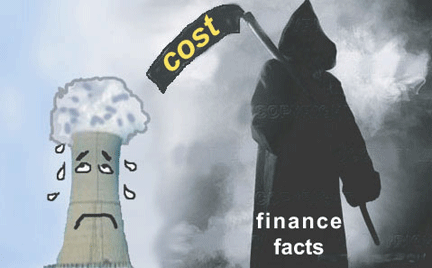 Six decades after Lewis Strauss, chairman of the U.S. Atomic Energy Commission, claimed that nuclear energy would become “too cheap to meter,” nuclear power confronts an increasingly uncertain future, largely because of unfavourable economics. The International Energy Agency’s World Energy Outlook 2014, released last week, states: “Uncertainties continue to cloud the future for nuclear — government policy, public confidence, financing in liberalized markets, competitiveness versus other sources of generation, and the looming retirement of a large fleet of older plants.”
Heavily subsidy reliant
Nuclear power has the energy sector’s highest capital and water intensity and longest plant-construction time frame, making it hardly attractive for private investors. Plant construction time frame, with licensing approval, still averages almost a decade, as underscored by the new reactors commissioned in the past decade. The key fact about nuclear power is that it is the world’s most subsidy-fattened energy industry, even as it generates the most dangerous wastes whose safe disposal saddles future generations. Commercial reactors have been in operation for more than half-a-century, yet the industry still cannot stand on its own feet without major state support. Instead of the cost of nuclear power declining with the technology’s maturation — as is the case with other sources of energy — the costs have escalated multiple times.
In this light, nuclear power has inexorably been on a downward trajectory. The nuclear share of the world’s total electricity production reached its peak of 17 per cent in the late 1980s. Since then, it has been falling, and is currently estimated at about 13 per cent, even as new uranium discoveries have swelled global reserves. With proven reserves having grown by 12.5 per cent since just 2008, there is enough uranium to meet current demand for more than 100 years.
Yet, the worldwide aggregate installed capacity of just three renewables — wind power, solar power and biomass — has surpassed installed nuclear-generating capacity. In India and China, wind power output alone exceeds nuclear-generated electricity……
Radioactive water keeps entering Fukushima Daiichi tunnels while water is pumped out
 Radioactive water to tunnels unlikely stopped http://www3.nhk.or.jp/nhkworld/english/news/20141118_03.html Nov. 17, 2014 The officials overseeing the decommissioning of the Fukushima Daiichi nuclear power plant say a barrier designed to prevent radioactive water from entering underground tunnels is likely not doing its job.
The decommissioning work includes a plan to remove highly-radioactive water from tunnels under the facility grounds and then fill them with concrete to prevent leaks to surrounding soil.
A barrier to hold out water during this process was under construction until November 6th.
On Monday, workers removed 200,000 liters of water, estimating that water levels in the tunnels would drop by 80 centimeters.
However, the levels went down by only 20 centimeters. This led officials to conclude that more water was likely entering the tunnels from the reactor building while water was being pumped out.
The officials considered the effects of radioactive water on ground water, and decided on a plan to fill tunnels in with cement before they are completely drained.
They say the operation will require carefully handling to prevent any overflow of contaminated water.
EDF’s nuclear power plants Flamanville and Olkiluoto delayed yet again
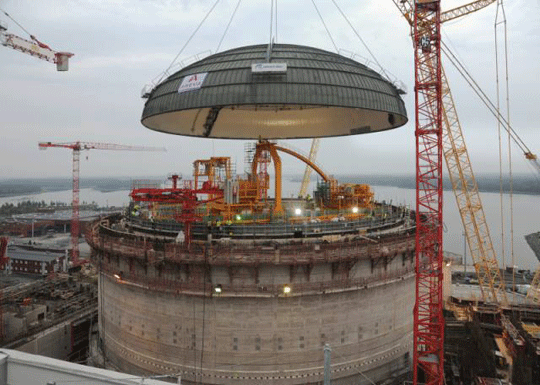 EDF says French nuclear reactor delayed another year to 2017 ,
* New one-year delay adds up to 10-year building period
* EDF says Areva unable to deliver key ingredients in time
* EDF still committed to EPR for UK Hinkley Point project (Adds EDF quote, background)
PARIS, Nov 18 (Reuters) – French utility EDF announced a new one-year delay for its Areva-designed EPR nuclear reactor in Flamanville, France, which it now expects to be connected to the grid in 2017, a decade after construction started.
EDF said the delay was due to Areva’s difficulties with ensuring a timely delivery of certain pieces of equipment, such as the lid and internal structure of the reactor vessel. It also said Areva had briefed it on a steam generator welding defect.
Construction on the Flamanville EPR reactor started in 2007 and it had initially been scheduled to be connected to the electricity grid in 2012, but it has been delayed repeatedly…….Four EPRs are under construction worldwide, one in France, one in Finland and two in China, but the Finnish and French projects have been plagued by billion euro cost overruns and multiyear delays.
Construction on the first EPR in Olkiluoto, Finland started in 2005 and it had originally been scheduled to go live in 2009, but it is now expected that will occurr in late 2018, almost a decade later than originally planned. Construction will have lasted 13 years, if it is not delayed again……..
Last month, European Union competition authorities gave the green light for state subsidies to EDF’s 16 billion pound project to build two EPR reactors in Hinkley Point C in southwest Britain, which are expected to start producing power from 2023……..http://in.reuters.com/article/2014/11/18/edf-nuclear-idINL6N0T85BN20141118
Nuclear Regulatory Commission’s chief warns that Commission is not geared for needs of decommissioning
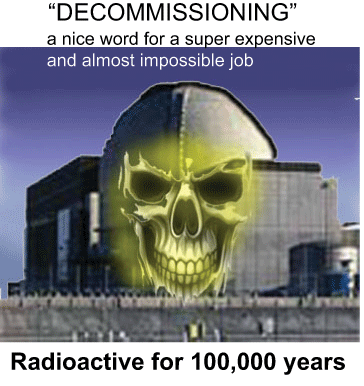
 Nuclear Agency Rules Are Ill-Suited for Plant Decommissioning, Leader Says NYT By MATTHEW L. WALDNOV. 17, 2014 WASHINGTON — The Nuclear Regulatory Commission’s rules are not geared for supervising the decommissioning of nuclear reactors, the task that will occupy much of its time in the coming years, the head of the agency, Allison M. Macfarlane, said Monday.
Speaking at the National Press Club in a wide-ranging look at her agency and the industry before she leaves the job at the end of the year, Dr. Macfarlane said the industry had instead set itself up about 15 years ago to oversee more reactor construction, a revival that did not occur. “The industry was really expecting to expand,” she said. “The agency’s not facing the future that five years ago people envisioned.”
Instead, a plunging price of natural gas and slack demand for electricity have made some existing plants uncompetitive, and the pace of retirements has been high. But the commission’s rules on areas like security and emergency planning are geared to operating plants, she said. So shut-down plants are applying for exemptions to the rules that no longer seem to fit the risk that the reactors pose when decommissioned.
As with nuclear waste, the commission’s rules on reactors seem more focused on construction and operation than on the “back end,” said Dr. Macfarlane, a geologist who is returning to academia.
In her comments, Dr. Macfarlane said that the future of a proposed nuclear waste repository near Las Vegas, blocked for years by Senator Harry Reid of Nevada as majority leader, was still far from assured, despite the coming change of party control in the Senate. The commission’s job would be to rule on whether the repository should be licensed, but it could never approve a license without “a willing applicant,” she said.
That applicant would be the Department of Energy, which dropped work on the project after a campaign promise by Barack Obama when he ran for president the first time.
To resume work on the proposed repository, at Yucca Mountain, the Energy Department and the commission would need a new appropriation, she said. And at the time work was stopped, in 2010, “there were more than 300 contentions challenging the application,” she said. Each must be argued before a panel of administrative law judges.
And even then, she noted, Yucca Mountain would not be big enough for all the waste.
In light of the accident at the Fukushima Daiichi plant in March 2011 in Japan, Dr. Macfarlane said that the commission should consider new rules on some reactors whose design does not resemble the ones that melted down in Japan. The commission has required older plants of the General Electric design to improve their systems for venting gases in an emergency, but perhaps other models should have to do the same, she said……..http://www.nytimes.com/2014/11/18/us/nuclear-agency-rules-are-ill-suited-for-plant-decommissioning-leader-says.html?_r=0
New robots for decontaminating Fukushima Daiichi nuclear power plant
Fukushima Daiichi Updates From IRID Part 2; New Robots & Work SimplyInfo, November 18th, 2014 (Great diagrams and photos)
As part of reviewing IRID’s updates on work progress for Fukushima Daiichi, new information about robots to be used and their proposed work has been released.
First Floor Robots, Floor Decontamination……..
Overhead Robots For First Floor………
Robots For Upper Floors …….
Containment Inspection Robots………
Penetration Checking Robot…… http://www.fukuleaks.org/web/?p=14099
-
Archives
- February 2026 (228)
- January 2026 (308)
- December 2025 (358)
- November 2025 (359)
- October 2025 (376)
- September 2025 (258)
- August 2025 (319)
- July 2025 (230)
- June 2025 (348)
- May 2025 (261)
- April 2025 (305)
- March 2025 (319)
-
Categories
- 1
- 1 NUCLEAR ISSUES
- business and costs
- climate change
- culture and arts
- ENERGY
- environment
- health
- history
- indigenous issues
- Legal
- marketing of nuclear
- media
- opposition to nuclear
- PERSONAL STORIES
- politics
- politics international
- Religion and ethics
- safety
- secrets,lies and civil liberties
- spinbuster
- technology
- Uranium
- wastes
- weapons and war
- Women
- 2 WORLD
- ACTION
- AFRICA
- Atrocities
- AUSTRALIA
- Christina's notes
- Christina's themes
- culture and arts
- Events
- Fuk 2022
- Fuk 2023
- Fukushima 2017
- Fukushima 2018
- fukushima 2019
- Fukushima 2020
- Fukushima 2021
- general
- global warming
- Humour (God we need it)
- Nuclear
- RARE EARTHS
- Reference
- resources – print
- Resources -audiovicual
- Weekly Newsletter
- World
- World Nuclear
- YouTube
-
RSS
Entries RSS
Comments RSS
 nuclear-news