China’s very rapid renewable energy growth- IRENA reports

 IRENA Says China Can Nearly Quadruple Renewable Energy By 2030 Clean Technica, November 25th, 2014 by Joshua S Hill A new report published Monday by the International Renewable Energy Agency (IRENA) has shown that China can increase its use of renewable energy from 13% to 26% by 2030, representing a nearly fourfold increase if the economic powerhouse is able to pull it off.
“As the largest energy consumer in the world, China must play a pivotal role in the global transition to a sustainable energy future,” said Adnan Z. Amin, Director-General of IRENA, at a launch event in Beijing. “China’s energy use is expected to increase 60 per cent by 2030. How China meets that need will determine whether or not the world can curb climate change.”
The report, Renewable Energy Prospects: China, was compiled by IRENA in association with the China National Renewable Energy Centre, and is part of IRENA’s renewable energy roadmap,REmap 2030, which aims to provide a plan to double the global share of the renewable energy mix by 2030.
Following the recent announcement made between China and the US, this report (and others like it) acquire even more significance, as China looks to be actively seeking ways to increase its renewable energy share……..
Economic Growth and Renewable Energy
Fears that economic growth must be stifled in favour of cleaner, more renewable sources of energy have recently been laid to rest, thanks partially to another report published recently that focused on China. The study, China and the New Climate Economy, showed that “China can achieve economic development, energy security and reduce pollution at the same time.”…….http://cleantechnica.com/2014/11/25/irena-says-china-can-nearly-quadruple-renewable-energy-2030/
China’s nuclear power investment might not be such a good deal
China Nuclear IPO Risks Fading Afterglow By ABHEEK BHATTACHARYA, WSJ Nov. 24, 2014 China’s largest nuclear power company is coming to the table with a high minimum bet.
State-owned CGN Power plans to sell shares worth up to $3.16 billionin Hong Kong this week, making it one of the few pure-play listed nuclear companies in the world. ………
 CGN Power’s multiple is substantially higher than U.S. nuclear operator Exelon ’s 6.7 times and French EDF’s 4.9 times. It is also more expensive than CGN Meiya, CGN Power’s smaller affiliate that went public in September and that fetches 11.2 times Ebitda.
High valuations for CGN Power are dicey because China regulates electricity prices more heavily than in the West. For instance, new nuclear-power plants can’t charge higher tariffs than neighboring coal-fired power, capping earnings potential.
Though Beijing’s plans to cut back on fossil fuels will help growth, the state-run grids prioritize wind and solar over nuclear power when buying and dispatching electricity, according to CGN’s prospectus. Given China’s ambitions to build out solar power, this means nuclear could occasionally lose out. It is also a reminder that nuclear energy may not always enjoy the government’s graces.
CGN Power’s novelty may attract some betting on China’s nuclear future. Yet like many Hong Kong IPOs that do well at first, this bet may lose its afterglow. http://online.wsj.com/articles/china-nuclear-ipo-risks-fading-afterglow-heard-on-the-street-1416819232
Abe government disregards public, and its (supposed) policy to reduce dependence on nuclear power
Editorial: Clarify vision for a society free of nuclear power. Mainichi, 26 Nov 14 “……Rather than phasing out atomic power, the 2-year-old government of Prime Minister Shinzo Abe has been once again trying to rely on nuclear power stations.
The Basic Energy Plan that the Abe Cabinet approved in April this year recognizes atomic power as an important base-load power source, while declaring that Japan will reduce its dependence on such power as much as possible. Moreover, the government has postponed a decision on an ideal ratio between power sources.
If the government is truly enthusiastic about pursuing a society that does not rely on atomic power, it is the role of politicians to clearly show a road map toward eliminating nuclear plants, set specific targets including the ratio between power sources and implement specific measures to achieve this goal. The government should also judge whether individual nuclear plants should be restarted within the framework of the policy toward phasing out nuclear power.
The Abe administration’s failure to do so suggests that the government intends to put as many nuclear power plants as possible into operation by carrying out a fait accompli.
In fact, the government is attempting to allow Kyushu Electric Power Co. to reactivate its Sendai nuclear plant in Kagoshima Prefecture based solely on the fact that its reactors meet the new regulatory standards set by the Nuclear Regulation Authority. The effectiveness of a plan to evacuate local residents in case of a serious disaster at the plant and efforts to convince residents of municipalities around the plant remain unaddressed. An opinion poll the Mainichi Shimbun conducted this past September shows that 60 percent of the public is opposed to restarting the power station. However, the government is showing no consideration of public opinion. Such an attitude could lead to a new safety myth, such as a massive amount of radiation would never be released in case of a meltdown since regulatory standards have been stiffened.
The government’s lack of enthusiasm about decreasing Japan’s dependence on nuclear power has led to power companies’ refusal to sign new contracts to purchase power generated with renewable energy. The promotion of renewable energy sources would help not only lessen the country’s dependence on atomic power but also create new industrial sectors and vitalize local economies. If Japan were to lose such chances because the government has failed to thoroughly implement measures to promote the introduction of renewable energy, it could be criticized as a serious policy misstep……Regardless, as long as a majority of the people of Japan, which experienced a serious nuclear disaster, are calling for a society without atomic power, it is the mission of politicians to make efforts to phase out nuclear power. http://mainichi.jp/english/english/perspectives/news/20141125p2a00m0na008000c.html
Nuclear power’s future gets gloomier
Nuclear power’s dark future Japan Times, 25 Nov 14 BY BRAHMA CHELLANEY Nuclear power constitutes the world’s most subsidy-fattened energy industry, yet it faces an increasingly uncertain future. The global nuclear power industry has enjoyed growing state subsidies over the years, even as it generates the most dangerous wastes whose safe disposal saddles future generations.
Despite the fat subsidies, new developments are highlighting the nuclear power industry’s growing travails. For example, France — the “poster child” of atomic power — is rethinking its love affair with nuclear energy. Its parliament voted last month to cut the country’s nuclear-generating capacity by a third by 2025 and focus instead on renewable sources by emulating neighboring countries like Germany and Spain.
As nuclear power becomes increasingly uneconomical at home because of skyrocketing costs, the U.S. and France are aggressively pushing exports, not just to India and China, but also to “nuclear newcomers,” such as the cash-laden oil sheikhdoms in the Persian Gulf. Such exports raise new challenges related to freshwater resources, nuclear safety and nuclear-weapons proliferation.

Still, the bulk of the reactors under construction or planned worldwide are in just four countries — China, Russia, South Korea and India.
Six decades after Lewis Strauss, the chairman of the U.S. Atomic Energy Commission, claimed that nuclear energy would become “too cheap to meter,” nuclear power confronts an increasingly uncertain future, largely because of unfavorable economics. The just-released International Energy Agency’s World Energy Outlook 2014 report states: “Uncertainties continue to cloud the future for nuclear — government policy, public confidence, financing in liberalized markets, competitiveness versus other sources of generation, and the looming retirement of a large fleet of older plants.”
The stock of the state-owned French nuclear technology giant Areva recently tumbled after it cited major delays in its reactor projects and a “lackluster” global atomic-energy market to warn of an uncertain outlook for its business………
Nuclear power has the energy sector’s highest capital and water intensity and longest plant-construction time frame, making it hardly attractive for private investors. The plant-construction time frame, with licensing approval, still averages about a decade, as underscored by the new reactors commissioned in the past decade. In fact, the World Nuclear Industry Status Report 2014 acknowledges that 49 of the 66 reactors currently under construction are plagued with delays and cost overruns. Commercial reactors have been in operation for more than half a century, yet the industry still cannot stand on its own feet without major state support. Instead of the cost of nuclear power declining with the technology’s maturation — as is the case with other sources of energy — the costs have escalated multiple times. Just in the past decade, average costs jumped from $1,000 per installed kilowatt to almost $8,000/kW.
In this light, nuclear power has inexorably been on a downward trajectory. The nuclear share of the world’s total electricity production reached its peak of 17 percent in the late 1980s. Since then, it has been falling, and is currently estimated at about 13 percent, even as new uranium discoveries have swelled global reserves. With proven reserves having grown by 12.5 percent since just 2008, there is enough uranium to meet current demand for more than 100 years. Yet the worldwide aggregate installed capacity of just three renewables — wind power, solar power and biomass — has surpassed installed nuclear-generating capacity. In India and China, wind power output alone exceeds nuclear-generated electricity…….— nuclear power is in no position to lead the world out of the fossil-fuel age.http://www.japantimes.co.jp/opinion/2014/11/25/commentary/world-commentary/nuclear-powers-dark-future/#.VHYvqNLF8nk
Nuclear power plant Vogtle in Georgia – more delays

 Plant Vogtle expansion falling further behind schedule, construction monitor reports The Augusta Chroncle, 24 Nov 14, By Meg Mirshak
William Jacobs, who monitors the Vogtle project for the Georgia Public Service Commission, wrote in a report released Monday that he thinks the new units will be delayed past their current forecasted completions of late 2017 and 2018. Based on current activities, “it is impossible to determine” when the units will be begin producing commercial power…….
Georgia Power’s agreement requires the contractor to cover the costs of inflation in building materials and labor as well as imposing penalties for being late. Still, expenses for the added costs of delays could be passed to ratepayers……..http://chronicle.augusta.com/latest-news/2014-11-25/plant-vogtle-expansion-falling-further-behind-schedule-construction-monitor?v=1416929111
Farming sunlight and wind in the California desert
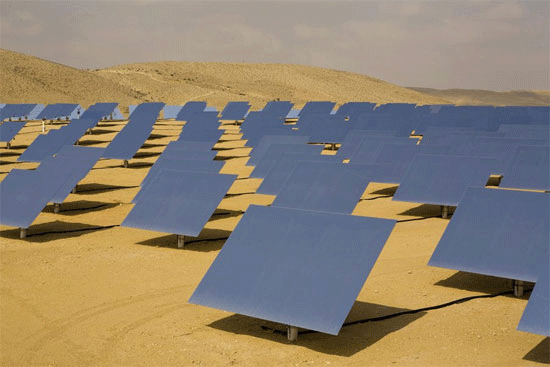 Renewable Energy Farms Spread Through California Deserts NewsWeek, BY ELIJAH WOLFSON / NOVEMBER 24, 2014 “…….. , part of the interconnected swatches of desert land in California that, combined, make up the largest wilderness area in the Lower 48. It’s also about to become host to the biggest renewable-energy projects in the world.
Already, 13 of them are built or on the way. There’s the Desert Sunlight Solar Farm, under construction just east of Joshua Tree National Park; its solar photovoltaic cells will cover over 4,000 acres of public land administered by the federal Bureau of Land Management (BLM). When completed in 2015 (assuming things go as planned), it is expected to peak at a nominal power of 550 megawatts—making it the most powerful solar farm on the planet. There’s also the McCoy Solar Energy Project, in the middle of the Mojave. When it’s done, it will be even bigger and more powerful than Desert Sunlight, covering 7,700 acres of BLM land and 470 acres of private land, and with an electrical production capacity of 750 megawatts.
Then there are the wind farms. These produce less power than their solar brethren and take up much more space. The Ocotillo Wind Energy Facility, for example, covers 12,436 acres at the edge of the Anza-Borrego Desert State Park, near the border with Mexico, and produces 315 megawatts of power……..
And these new wind and solar farms—cities, call them, since they aren’t like any farm you’ve seen—are only going to multiply in the coming years. The need for clean energy is expected to increase dramatically in the next decade, particularly after the U.S. and China recently announced a historic agreement to lower greenhouse gas emissions in their respective countries. At the core of the pact are two sets of commitments: The U.S. will lower emissions 26 to 28 percent by 2025 from the initial 2005 baselines, while China has agreed to set an emissions peak for 2030 and then commit to lowering emissions……….
It’s cheaper to have a big mass—having power all come from one source,” says Elkin. “But the advantages of having a more distributed rooftop-type solar is that you can provide the power generation really close to being used. It’s more efficient.” He says we are probably headed toward a mix, with “microgrids” providing neighborhoods with access to small, local solar farms.
Until then, though, achieving emissions reductions at the scale of what has been agreed to between the U.S. and China “is not going to happen without some level of large-scale renewable-energy development,” says Helen O’Shea, director of the National Resources Defense Council’s Western Renewable Energy Project.
And Michael Gerrard, director of the Sabin Center for Climate Change Law at Columbia University, says that if conservationists keep fighting that, they will be missing the forest for the trees. “We are facing a mass extinction,” he says. “The only pathway to solve that problem involves a massive increase in renewable energy. Unfortunately, many new renewable-energy facilities have been slowed down or stopped because of their adverse effects on certain species. I think we can no longer have the luxury of doing that.”ttp://www.newsweek.com/renewable-energy-farms-populate-california-286644
Google shows its ignorance about renewable energy
Why Google gave up on renewables (hint, they don’t understand energy), REneweconomy By Karel Beckman on 25 November 2014 The two scientists responsible for Google’s failed attempt to launch a renewable energy revolution have written an article explaining what, according to them, went wrong with their project. They have come to the conclusion that fighting climate change with today’s renewable energy technologies won’t work – but they present no evidence for it, writes Energy Post editor Karel Beckman.
Critics of renewable energy are having a field day in the blogosphere. It has now been proven beyond doubt, they cry, that “renewables simply won’t work”. Why not? Well, because Google says so.
Some years ago, in 2007, to be exact, Google embarked on an ambitious project to develop reneweable energy sources that would generate electricity more cheaply than coal-fired power. Google’s hope was that in this way the buildup of CO2 in the atmosphere could be halted and reversed. However, in 2011, after four years of trying, the company gave up the project, known as RE<C.
The two engineers who were responsbile for Google’s venture into renewables, Ross Koningstein and David Fork, have now written an article in which they try to explain what went wrong – and what lessons can be drawn from it……..they argue that renewables “won’t work” to effectively tackle climate change. They don’t say renewables won’t work, period. But even this first claim appears doubtful on the basis of the evidence offered in the article………
by 2011, they note, “it was clear that RE<C would not be able to deliver a technology that could compete economically with coal.”
Unfortunately, the reader has to take this assertion at face value. The authors do not cite any figures or published research. Nor do they make it clear whether these were all the “innovative technologies” they investigated or what they mean in the first place by “investigated”………..
They add this notable remark: “Let’s face it, businesses won’t make sacrifices and pay more for clean energy based on altruism alone. Instead, we need solutions that appeal to their profit motives.” Well, yes – unless of course we introduce regulations or put a price on carbon, for example, but such possibilities appear to lie outside the authors’ frame of reference.
The two Google-men have also come to the surprising – to them – discovery that in the electricity market “the value of generated electricity varies … depending on how easily it can be supplied to reliably meet local dmeand.” Thus, they write, dispatchable power can have added value to cover peak demand. Indeed. Distributed power, on the other hand, “can also be worth more as it avoids the costs and losses associated with transmission and distribution”.
These amazing insights into the nature of the electricity market have led them to a positive conclusion. Here, they write, “we see an apportunity for change. A distributed, dispatchable power source could prompt a switchover if it could undercut …end-user prices.” But, they add, “unfortunately, most of today’s clean generation sources can’t provide power that is both distributed and dispatchable. Solar panels, for example, can be put on every rooftop but can’t provide power if the sun isn’t shining.”
So what about solar PV-with-storage? Koningstein and Fork appear not to be aware that such a solution may be possible. Nor do they seem to have heard of microgrids or to have thought of a combination of solar and electric cars. They merely sigh that “if we invented a distributed, dispatchable power technology, it coud transform the energy marketplace and the roles by utilities and their customers”. They can’t think of any possible solution, though: we “don’t have the answers”. The technologies required to reverse climate change “haven’t been invented yet”, they write……..
what do Koningstein and Fork think that researchers in the energy sector are doing right now? Did they try to find out how much is being spent on cleantech research worldwide? Or what technologies are actually being developed? If so, they show no signs of it. Indeed, they seem to know very little about what’s going on in the energy sector. Perhaps it is too much expect Google to solve the world’s energy problems – they could search the internet a bit better. http://reneweconomy.com.au/2014/why-google-gave-up-on-renewables-hint-they-dont-understand-energy-12048
Germany steps up program to shut down coal power plants
 Germany may shut down eight more coal power plants, document shows, SMH, November 24, 2014 Germany is working on a new law to force energy companies to shut down several more coal-fired power plants as it tries to reach ambitious climate goals, a document seen by Reuters showed on Sunday.
According to a draft legislation prepared by the economy ministry, energy companies will be asked to reduce carbon emissions by at least 22 million tonnes by 2020.
Some 50 facilities already registered for decommission will not count, however, meaning that a further eight coal-fired power stations may be closed down……..
Although Germany has seen a boom in green energy, accounting for about 25 per cent of overall power generation, environmentalists criticise the country for its continued dependence on coal-fired plants, which made up nearly half of power generation last year.
The latest reduction in carbon emissions, if put into effect, would be shared equally between Germany’s power companies, among them major energy firms RWE, E.ON and Vattenfall…….
The latest measure is part of a raft of new climate rules which Chancellor Angela Merkel’s cabinet is expected to decide on Dec. 3. The programme will also include steps to boost energy efficiency.
Merkel’s government wants renewables to make up between 40-45 per cent of power generation by 2025 and 55-60 per cent by 2035 – targets that experts say are ambitious for an industrialised country.
The European Union agreed last month a pledge to cut greenhouse gases by at least 40 per cent in 2030. http://www.smh.com.au/business/carbon-economy/germany-may-shut-down-eight-more-coal-power-plants-document-shows-20141124-11sfdn.html#ixzz3KE3Ddv19
Demolition begins of massive uranium enrichment facility
Demolition of Uranium Facility, Once the Largest Building in U.S.http://www.rbaker.com/press-room.php?id=215&utm_source=twitterfeed&utm_medium=twitter
Tue November 25, 2014, When the K-25 uranium enrichment facility was built in the mid-1940s as part of the Manhattan Project in Oak Ridge, Tennessee, it was the world’s largest building under one roof. Seventy years later, demolition of the enormous forty-four acre building was completed after a five-year project.
K-25 was commissioned by the U.S. government during World War II as part of the top-secret race to build the world’s first atomic bomb. Within the walls of the half-mile-long, 2 million square foot U-shaped facility, 12,000 workers produced, via gaseous diffusion, the enriched uranium that was used in atomic bombs dropped on Japan in 1945. Following the war, K-25 remained in operation producing enriched uranium for defense and commercial purposes until it was shut down in 1964. Other buildings at the Oak Ridge facility continued producing uranium until 1987.
Though demolition contractors began taking down the K-25 building in 2008, the complex project was ten years in the making. Due to the hazardous nature of the uranium operation, extensive preparation and remediation were required before demolition could commence. Among numerous Radioactive sludge was removed from a series of underground gunite tanks in 1999, and an onsite waste processing facility was built in 2003 to accept contaminated waste generated during site cleanup. Depleted uranium cylinders were shipped, more than 47,000 tons of metal was removed, several other buildings were demolished, and roads were constructed to accommodate vehicles removing project debris.
Demolition of K-25 was slated to last six years, from 2008 to 2014, but demolition contractors were able to complete the project one year ahead of schedule and approximately $300 million under its original $2.2 billion budget.
Chile getting extreme UV radiation with increased risk of skin cancers
Rising UV radiation prompts skin cancer fears in Chile http://www.news24.com/Green/News/Rising-UV-radiation-prompts-skin-cancer-fears-in-Chile-20141124 Santiago – Cancer experts in Chile are warning people to limit their exposure to the sun as dangerously high levels of ultraviolet radiation are expected over the next few months.
A recently released report indicates the a hole in the ozone layer, which is normally situated over Antarctica, is moving towards the South American country.
Chilean’s might have to stay indoors this summer as experts warn that the country will be blasted by extremely high levels of ultraviolet radiation.
According to a study from Chile’s national cancer corporation, or Conac, the massive hole in the ozone layer above Antarctica is moving closer towards the South American country.
Conac’s Doctor Ernesto Gramsch says the rise in radiation levels is alarming. In October, UV levels were 175 higher than they were in October of last year, which was 10 or 15% higher than the year before that. So this year it’s been a little higher, almost 30% higher than in previous years.”
Gramsch says that rise is also due to shifts in climatic wind patterns which have thinned out ozone gases over Chile in recent years. And with less protection from harmful UV rays, the number of skin cancer cases are on the rise.
Dr Cecilia Orlandi says she has seen the number of patients double since 2000.
“The number of skin cancer cases has been increasing, which yes, we can detect at a fairly early stage. But cancers from epithelioma basal cells and squamous cells have been increasing as well, and those are directly related to exposure to ultraviolet rays A and B”, Said Orlandi.
Outside Chileans are bracing for a harsh summer.
But according to a recent United Nations report, a ray of hope is slowly emerging. Moves to tackle climate change have resulted in the ozone layer finally starting to recover, with estimates that it will be back at 1980 levels by 2050.
Pickering nuclear power station has radioactive leak
Radioactive leak at Pickering nuclear station, Caledon Enterprise, 26 Nov 14
Heavy water contained inside reactor; no impact to public, environment Pickering News Advertiser
PICKERING — Thousands of litres of radioactive heavy water leaked in a reactor at the Pickering nuclear station Friday.
The incident happened in Unit 7, which was undergoing a scheduled maintenance outage, at about 4 p.m. on Nov. 21.
A valve on the moderator system opened inside the reactor building, Ontario Power Generation reported on Twitter….. 6,900 litres of heavy water leaked……http://www.caledonenterprise.com/news-story/5154334-updated-radioactive-leak-at-pickering-nuclear-station/
Call for independent Radiation Monitoring in Cumbria and Lancashire
‘Nuclear Madness’ Protest at Carlisle Railway Station http://mariannewildart.wordpress.com/2014/11/24/nuclear-madness-protest-at-carlisle-railway-station/
100 people also stopped to sign a letter to Cumbria and Lancashire County Council regarding the lack of independent radiation monitoring .
Radiation Free Lakeland The letter says:
Dear Cumbria and Lancashire County Council,Dear Cumbria and Lancashire County Council,
RADIATION RELEASES TO THE ENVIRONMENT
The North West’s environment used to be independently monitored by the council run Radiation Monitoring in Lancashire, RADMIL.
RADMIL was stopped a few years ago due to council cuts. The Environment Agency often leaves monitoring and reporting to the nuclear industry
The nuclear industry and government’s new build plan includes:
Manufacture of fuel for new reactors. This begins with uranium hexafluoride shipped to Ellesmere Port, then to Capenhurst, Near Chester. Then on to Preston’s Springfields plant. Proposed new nuclear build on greenfields in Cumbria would also mean escalating radioactive releases from fuel manufacture.
This means radioactively polluting the River Ribble and Clifton Marsh Landfill in Lancashire. And in Cumbria increasing releases to the Irish Sea, Lillyhall landfill and previously nuclear free areas! Nuclear materials are routinely sent by train and road and even by plane.
Given this escalation in radioactive emissions we urge you to reinstate regular and frequent independent radiation monitoring in Cumbria and Lancashire
Tepco starts filling cable trench with cement as it pumps out radioactive water
Nov 26, 2014
IWAKI, FUKUSHIMA PREF. – Tokyo Electric Power Co. started work Tuesday to fill an underground trench at the disaster-stricken Fukushima No. 1 nuclear power plant with cement while pumping up radioactive water inside at the same time.
The power company reported the beginning of the cement-pouring work for the cable trench for reactor 2 at a meeting in Iwaki, Fukushima Prefecture, with government representatives on measures to deal with increasing radioactive water at the power station.
Tepco expects to finish the work by the end of next March. The company will begin next month pouring cement in reactor 3′s trench, hoping to complete the work also by the end of March.
The trenches for the two reactors are estimated to hold 11,000 tons of radioactive water in total. The water is believed to be causing the pollution of groundwater under the seaside section of the power plant.
On Tuesday, Tepco injected 80 cu. meters of cement in the reactor 2 trench in an operation that lasted two and a half hours from around 9:30 a.m. The trench holds radioactive water that has flowed from the reactor’s turbine building.
At first, Tepco planned to stop the flow by freezing water inside the joints between the turbine building and the trench so that it can entirely remove the radioactive water from there.
But Tepco could not fully freeze the water or block the flow. So, the firm switched to the current plan to inject cement in and remove the radioactive water from the trench simultaneously.
Source: Japan Times
Fukushima I NPP: Plan C Also Failed in Plugging Reactor 2 Trench… Now What?
November 24, 2014
Plan D of Course!
But first, recall that Plan A was to install freezing pipes at the head of the trench leading from Reactor 2 turbine building to create an ice plug so that the extremely contaminated water that had been sitting in the trench since the very beginning of the nuclear accident could be pumped out. TEPCO started the work in April this year.
That failed. The ice plug didn’t quite form.
Then recall that Plan B was to dump tons (literally) of ice and dry ice in the trench near the freezing pipes to lower the temperature of the water around the freezing pipes so that the ice plug would finally form. Workers dumped ice all day and all night, in the high ambient radiation right at the trench. That was in hot August. Try to freeze the trench with ice in hot August.
 That also failed. Dry ice clogged the pipe, and the ice plug didn’t quite form, and TEPCO admitted there was water still coming into the trench from the turbine building. The water sitting in the turbine building comes from the reactor building after it cools the molten core somewhere in the building, and it is warm.
So TEPCO came up with Plan C.
What was Plan C? It was to fill the gap between the incomplete ice plug and the turbine building wall with fillers. TEPCO chose the combination of grout and concrete. A plug of ice, grout and concrete was formed. Sort of.
From TEPCO’s document uploaded at Nuclear Regulation Authority’s site on 11/21/2014, the plug – pink and light green in the diagram is grout (different types), dark green is concrete:

That failed, just as I predicted.
TEPCO finally admitted on November 17 that it was a failure after pumping out some 200 tonnes of this highly contaminated water on November 17 and seeing that the water level in the trench didn’t go down as much as they had calculated. The water was still coming in from the turbine building, and the groundwater was probably seeping in.
But not to worry. TEPCO has Plan D, and it has been already approved by Nuclear Regulation Authority.
So what is Plan D? To fill the trench with cement while pumping out the water that gets displaced (in theory) by the cement.
(Do you want to bet whether that is going to fail?)
From Mainichi English (11/18/2014), from the original Japanese article on 11/17/2014:
An effort to stop contaminated water from flowing into a trench at the crippled Fukushima No. 1 Nuclear Power Plant failed to completely halt the flow, announced Tokyo Electric Power Co. (TEPCO), the plant’s operator, on Nov. 17.
A TEPCO representative said, “We believe we have not completely stopped the water. Groundwater may also be entering the trench. We will closely analyze the changes in water level in the trench.”
TEPCO says that when around 200 tons of contaminated water was removed from the trench, the water level in the trench should have fallen by around 80 centimeters if the point of leakage between the plant’s No. 2 reactor turbine building and the trench had been fully sealed. However, the water level only fell by 21 centimeters, so TEPCO determined that the leak must be continuing.
…While the water remains in the trench, TEPCO cannot create a planned underground wall of frozen soil around the No. 1 through 4 reactor buildings to stop water leakages.
And this image from Tokyo Shinbun (11/21/2014):
and reference to Plan D:
トンネルから汚染水を少しずつ抜きながら、水中で薄く広がる特殊なセメントを流し込んでトンネルをふさぐ方法への切り替えを提案する
(TEPCO) will propose (to Nuclear Regulation Authority) a new method of plugging the trench by pouring in the special cement that spread thin and wide in the water while removing the contaminated water in the trench gradually.
Special cement?
TEPCO says in the document (page 9) they submitted to NRA that it will be a mixture of cement, fly ash and underwater-inseparable admixtures (セメント、フライアッシュおよび水中不分離混和剤などの配合調整). They will use the tremie concrete placement method.
(Do you want to bet whether that is going to fail?)
The NRA meeting on November 21, 2014 was funny without participants intending to be funny, from what I read in the tweets by people watching the meeting.
At one point, Commissioner Fuketa exasperatedly asked TEPCO representatives, “So what was the point of trying to freeze the water? Was freezing even necessary at all?”
The answer was no. TEPCO’s Shirai admitted (according to the tweet by @jaikoman on 11/21/2014) that there was a talk inside TEPCO that the ice plug was not necessary.
So why did they do it, and why did NRA approve it?
No one knows and no one is held accountable, while workers had to set up freezing pipes, then to pour ice, dry ice, grout, concrete, and to pump this highly contaminated water over the past 8 months in high radiation exposure. TEPCO hasn’t disclosed the radiation exposure for the workers.
Source: EXSKF
http://ex-skf.blogspot.nl/2014/11/fukushima-i-npp-plan-c-also-failed-in.html

LDP Government in Japan on Suicide Mission
November 24, 2014
The LDP aims for collective suicide by extending Japan’s nuclear reactors’ life span to 60 years while pushing forward with the Oma nuclear plant, which will purportedly be the world’s first 100 percent MOX facility!
Does everyone remember what Fukushima Daiichi Unit 3 explosion looked like? Unit 3 was running MOX fueld. Its explosion strongly resembled a mushroom cloud and has been interpreted as involving a nuclear criticality. Plutonium from the Daiichi explosions, likely from Unit 3, was found in Lithuania.
MOX fuel is extraordinarily dangerous. Japan’s earthquake activity has been increasing. At least one of Japan’s volcanoes is displaying increased activity. Japan must be intent on self-destruction and will take the Pacific Ocean and North America with it, if the US, Russia, UK, or France, don’t beat them to annihilating humans on Earth:
Gen Kaga, Toshio Kawada, Koji Nishimura and Tomoyoshi Otsu (2014, November 14) Nuclear operators push to open new plant, extend life of aging reactors. The Asahi Shimbun,
http://ajw.asahi.com/article/0311disaster/fukushima/AJ201411140068
The government set the acceptable operational term of nuclear reactors at 40 years, in principle, after the Fukushima disaster, but it allows utilities to extend the period on a one-time basis by a maximum of 20 years….
The Oma plant will be the world’s first 100 percent MOX nuclear facility, where only mixed-oxide (MOX) fuel, consisting of plutonium and uranium, is used at reactor cores for the purpose of consuming plutonium produced in processing spent nuclear fuel.
At conventional plutonium-thermal nuclear plants, MOX fuel is used at just one-fourth to one-third of their reactor cores at most, and conventional uranium fuel is used for the remaining part. Compared with uranium fuel, it is more difficult for control rods to suppress nuclear chain reactions of MOX fuel.
Although countermeasures, such as enhancing the capabilities of control rods and introducing larger tanks for boric acid water to better control atomic reactions, will be taken at the full MOX facility, those efforts are expected to be carefully examined during the safety screening by the NRA to check if they are sufficient…. “No full MOX facility has so far gone online around the world,” NRA Chairman Shunichi Tanaka said at a Nov. 12 news conference. “We will examine extremely carefully (if countermeasures are sufficient).”
Unbelievable. That is all I can think to write.
Meanwhile, emissions at Daiichi look worse this morning than they have the last week or so. Radiation readings in the US have been higher than I’ve seen since winter 2011. The forces of entropy reign.
Source: Majia’Blog
http://majiasblog.blogspot.jp/2014/11/ldp-government-in-japan-on-suicide.html?m=1
-
Archives
- February 2026 (228)
- January 2026 (308)
- December 2025 (358)
- November 2025 (359)
- October 2025 (376)
- September 2025 (258)
- August 2025 (319)
- July 2025 (230)
- June 2025 (348)
- May 2025 (261)
- April 2025 (305)
- March 2025 (319)
-
Categories
- 1
- 1 NUCLEAR ISSUES
- business and costs
- climate change
- culture and arts
- ENERGY
- environment
- health
- history
- indigenous issues
- Legal
- marketing of nuclear
- media
- opposition to nuclear
- PERSONAL STORIES
- politics
- politics international
- Religion and ethics
- safety
- secrets,lies and civil liberties
- spinbuster
- technology
- Uranium
- wastes
- weapons and war
- Women
- 2 WORLD
- ACTION
- AFRICA
- Atrocities
- AUSTRALIA
- Christina's notes
- Christina's themes
- culture and arts
- Events
- Fuk 2022
- Fuk 2023
- Fukushima 2017
- Fukushima 2018
- fukushima 2019
- Fukushima 2020
- Fukushima 2021
- general
- global warming
- Humour (God we need it)
- Nuclear
- RARE EARTHS
- Reference
- resources – print
- Resources -audiovicual
- Weekly Newsletter
- World
- World Nuclear
- YouTube
-
RSS
Entries RSS
Comments RSS
 nuclear-news