Nuclear power as solution to Climate Change? Quite the reverse
Nuclear solutions to climate change are anything but, Aljazeera Americaby Gregg Levine @GreggJLevine 23 Sept 14 “……While major climate polluting nations such as China, India and Canada have declined to send a top-level official to this year’s summit, the U.S. was expected to go all in, with President Obama touting his recent proposals to curtail the nation’s carbon output.
That plan to limit CO2 production has already come under fire from fossil fuel-friendly corporations, trade groupsand politicians who balk at the regulation, and from climate scientists and activists who point out that the president’s plan does not do enough to meet the maximum-2-degrees-of-warming goal, but a group you will not hear complaining is the nuclear energy sector.
Buried in the proposal and absent from many initial reports on the plan is a series of programs and pledges thatencourage the preservation and possible expansion of the nation’s nuclear electrical generation capacity. The president’s proposed carbon rules assume nuclear power to be a clean, low-carbon energy option, and so put forth a nuclear industry Christmas list of subsidies, incentives and financial backstops that potentially funnels billions of public dollars into private industry hands and risks missing emissions targets while increasing the danger of a nuclear mishap.
The inventory of specifics that make nuclear power a terrible option in the fight to stem global warming would almost work as a joke if the consequences of this wrong turn weren’t so serious. Here are but some of the many reasons why nuclear power is a terrible way to deal with climate change.
First and foremost, nuclear power is not greenhouse neutral. Nuclear boosters of late have grabbed hold of climate change as their latest raison d’être, if not their last best hope of restoring relevance to their half-century-old technology. And sure, the fission going on inside a nuclear reactor is not a major source of greenhouse pollution, but nuclear reactors do not exist in a vacuum.
Beyond the operation of the reactor, the nuclear fuel cycle includes the mining, milling, processing, enrichment, fabrication and transport of the uranium-based fuel — each step is energy intensive and greenhouse pollution rich.
The plants themselves have huge carbon footprints, requiring in most cases over a decade of heavy construction, large staffs and elaborate waste-handling protocols. The operation of the plant and the storage of the waste both require a constant flow of electricity — a loss of power for any significant amount of time creates a scenario much like that seen in Fukushima, Japan. In fact, it is one of the most paradoxical parts of the world’s light-water reactor fleet — in order to safely generate electricity, the plants need a significant and consistent supply of electricity. Sometimes the plant can supply that electricity — meaning the net output of the plant is lower than the announced rate — and sometimes it cannot, in which case, the plant becomes an energy consumer.

Another thing nuclear plants consume in copious amounts is water, making them particularly ill suited to a warming climate. Reactors need water to keep their cores and condensers cool — not to mention their spent fuel storage pools — and that water needs to be plentiful, circulating, and relatively cool. Over the last decade, as the globe has warmed, nuclear plants have experienced numerous shutdowns and many more days of reduced output because there was simply no effective heat sink.
In some cases, especially in some European plants set on rivers, droughts caused the water level to drop too low for a plant’s intake valves. In the case of plants that rely on lakes, warmer days and, perhaps more importantly, warmer nights have meant the water is simply not cold enough to effectively cool the reactors. In recent summers across the U.S., this has become a regular problem, especially during prolonged heat waves, which, ironically, are when demand for electricity is highest.
Even nuclear facilities built on the coasts are vulnerable to warming water. In recent years, plants in Connecticut and Massachusetts have had to reduce output or shut down entirely because of water temperature.
But plants near the oceans have other headaches exacerbated by climate change. Rising sea levels, increasingly severe hurricanes and superstorms, and the surges that come with them all threaten to overwhelm the cooling systems and the plants themselves. Superstorm Sandy caused seven plants in the eastern U.S. to shutdownbecause of flooding, storm debris, wind damage, or interruptions to the external power supply. In the case of one aging reactor in southern New Jersey, rising waters came within inches of breaching flood walls, and external pumps and hoses were brought in to provide water for the reactors when the cooling system’s intake valves were clogged with flotsam.
Clogging is also a major concern for southern and west-coast reactors. In those cases, fish, jelly fish and an invertebrate called salp, made more numerous by warming seas, have completely blocked cooling system intakes, requiring weeks of plant shutdown, cleaning, and filter replacements.
But even if all these problems, insurmountable though they seem, could somehow be solved, nuclear power is a poor investment for a world on the brink of climate disaster.
Numerous studies predict that something like 1,500 to 2,000 new nuclear reactors would need to be up-and-running to have a significant affect on greenhouse emissions (there are currently fewer than 400 reactors operating worldwide). If those reactors replaced coal plants, it is predicted the world would see realize a 20 percent decrease in CO2 production. But if the new plants were just there to service new demand, there would actually be an increase in carbon emissions (because, as noted, these are not greenhouse-neutral endeavors).
What would such an undertaking cost? Well, the only new plants under construction in the US, the Vogtle reactors in Georgia, were projected to cost around $15 billion, but only a couple of years into production, those plants are already billions of dollars over budget. They are also already years behind schedule.
And that brings up the time it would take to build the new nuclear capacity. It takes 6 to 10 years in the best cases to bring a new reactor online. Some of the newer plants in the US (which means they are still decades old) took more than twenty years to begin operation. Building 1,500 reactors would mean firing up a new one every two weeks for the next 60 years, which is not only an impossible schedule to meet, it puts the planet long past its drop-dead date for zero greenhouse emissions.
But let’s say, through the magic of magical thinking, you get all of that out of the way, what will you do with the waste? http://america.aljazeera.com/blogs/scrutineer/2014/9/23/nuclear-solutionstoclimatechangeareanythingbut.html
1 Comment »
Leave a reply to andrewblarkin Cancel reply
1 This Month
26 April – Chernobyl: Inside the Meltdown airs on National Geographic on Sunday 26th April from 4pm

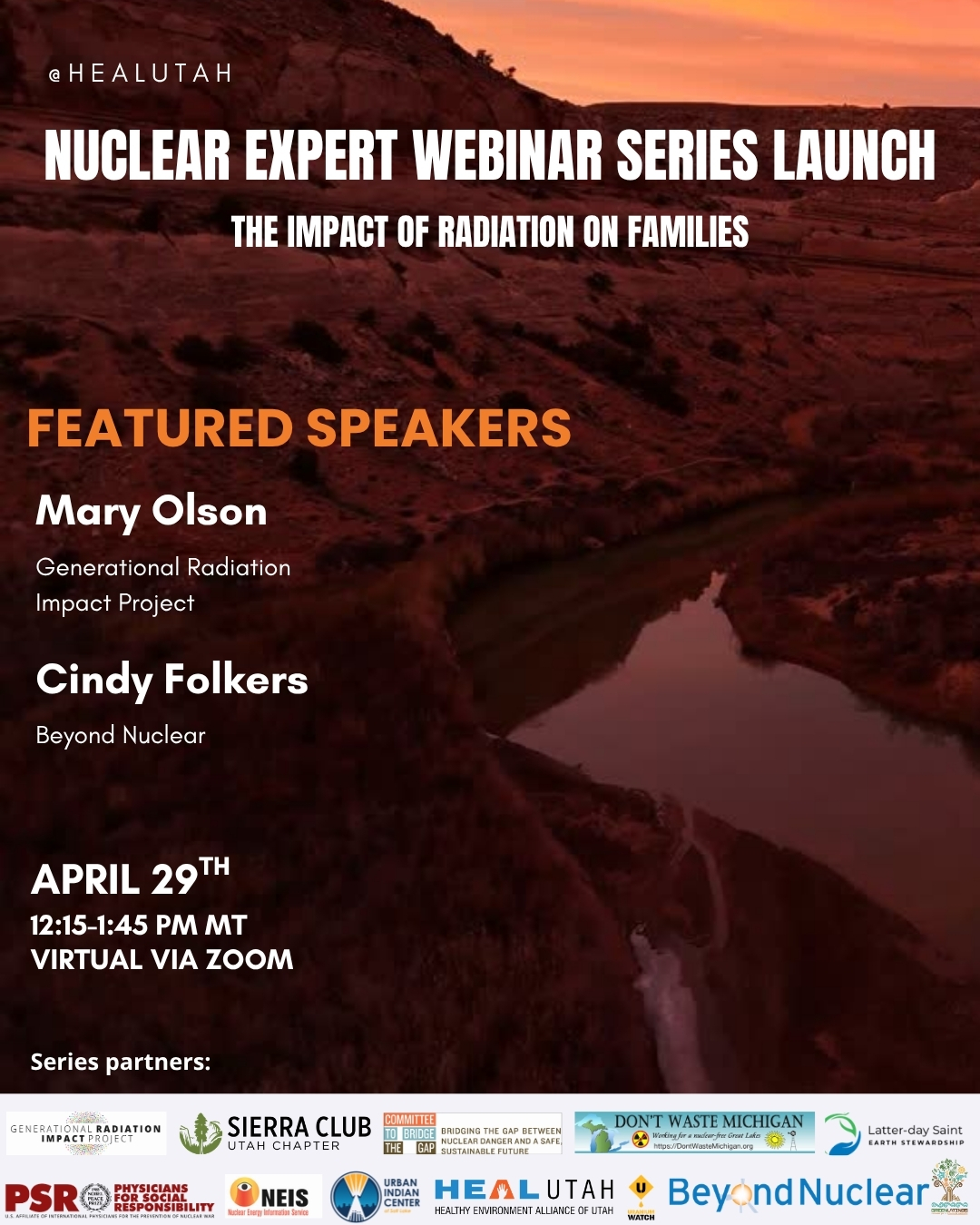
29 April – Nuclear Expert Webinar #1 – Radiation Impacts on Families with Mary Olson and Cindy Folkers
- 12:15 PM MT – 1:45 PM MT
- Location: Virtual – REGISTER TODAY

4 May -West Suburban Peace Coalition to discuss Iran war at May Educational Forum
Monday, May 4, 7:00 – 8:00 PM Central Standard Time
Title: : How Trump’s Narrative Tries to Shape the Reality of the War on Iran.
Contact Walt Zlotow, zlotow@hotmail.com 630 442 3045 for further information
14 May – online event From Bombs to Data Centres: the Face of Nuclear Colonialism

Pine Ridge Uranium is the real threat, not Tehran- Tell Burgum: Stop the Extraction.
Chernobyl: The Lost Tapes – A good documentary on Chernobyl on SBS available On Demand for the next 3 weeks– https://www.sbs.com.au/ondemand/tv-program/chernobyl-the-lost-tapes/2352741955560
To see nuclear-related stories in greater depth and intensity – go to https://nuclearinformation.wordpress.com
-
Archives
- April 2026 (356)
- March 2026 (251)
- February 2026 (268)
- January 2026 (308)
- December 2025 (358)
- November 2025 (359)
- October 2025 (376)
- September 2025 (257)
- August 2025 (319)
- July 2025 (230)
- June 2025 (348)
- May 2025 (261)
-
Categories
- 1
- 1 NUCLEAR ISSUES
- business and costs
- climate change
- culture and arts
- ENERGY
- environment
- health
- history
- indigenous issues
- Legal
- marketing of nuclear
- media
- opposition to nuclear
- PERSONAL STORIES
- politics
- politics international
- Religion and ethics
- safety
- secrets,lies and civil liberties
- spinbuster
- technology
- Uranium
- wastes
- weapons and war
- Women
- 2 WORLD
- ACTION
- AFRICA
- Atrocities
- AUSTRALIA
- Christina's notes
- Christina's themes
- culture and arts
- Events
- Fuk 2022
- Fuk 2023
- Fukushima 2017
- Fukushima 2018
- fukushima 2019
- Fukushima 2020
- Fukushima 2021
- general
- global warming
- Humour (God we need it)
- Nuclear
- RARE EARTHS
- Reference
- resources – print
- Resources -audiovicual
- Weekly Newsletter
- World
- World Nuclear
- YouTube
-
RSS
Entries RSS
Comments RSS
 nuclear-news
Reblogged this on Vernon Radiation Safety and commented:
This essay summarizes the argument that nuclear power has significant burdens on the carbon footprint. Nuclear power should not be seen as a green energy. There is a nice illustration showing how nuclear power is dependent upon carbon for the entire manufacturing process.