Uncompetitive nuclear industry is rigging regulations and “spinning” media in order to survive
 Killing the Competition
The Nuclear Power Agenda to Block Climate Action, Stop Renewable Energy, and Subsidize Old Reactors, Report by Nuclear Information and Resource Center (NIRS) Sept 14
The electric utility industry has begun an aggressive push to change energy policy in the United States to favor nuclear power. Led by the country’s largest nuclear generators, Exelon and Entergy, this campaign represents what would be the single largest change in energy policy in twenty years. While their intent is to make nuclear the preferred energy source, the changes they seek necessarily go far beyond that. They would also support coal and natural gas-fired electricity generation, and block the growth of renewable energy and attempts to address climate change.
Exelon and Entergy see sustainable energy solutions—renewable energy, efficiency, conservation, etc.—as a long-term threat to
their profits. This is not because of excessive regulations or safety requirements on nuclear power: the industry has not had to implement a single safety upgrade due to the Fukushima meltdowns and faces less regulatory enforcement than it did twenty years ago. The closure of a record number of reactors since 2013 has exposed fundamental economic problems facing the industry, and a growing number of nuclear plants simply cannot compete with modern, efficient, cost-effective
energy resources.
The industry’s campaign is an attempt to “fix” this problem and restore the economic viability of nuclear power for the next 20 years or more. But in effect, these corporations would have us sacrifice our best opportunity to create millions of jobs, revitalize our economy, and rise to the challenge of addressing climate change—just to keep old,
obsolete, uncompetitive nuclear reactors in business
This agenda would be unpopular at best, so Exelon and Entergy have focused on drumming up fears of job losses, power
shortages, and carbon emissions if some of their unprofitable reactors were to close in the coming years. They have only discussed their agenda in vague terms, and disclosed particulars in piecemeal fashion.
Like the Manhattan Project that gave birth to nuclear technology, they are counting on people not putting the pieces together so they can see the full picture. The purpose of this brief is to complete that picture, and enable America to see the nuclear industry’s plan in full and to understand the implications.
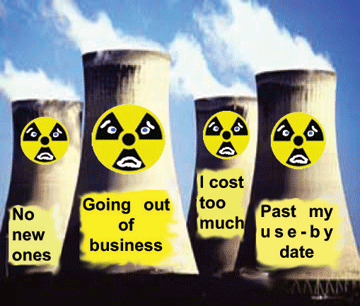
Nuclear’s Economic ProblemIn order to survive, the nuclear industry must remain economically competitive or prove that
it is necessary and should be propped up. But if uncompetitive reactors close and more of our energy needs are met by economically and environmentally sustainable solutions, the rationales offered for producing electricity by splitting atoms would lose relevance The industry’s economic problem is actually quite simple:
Running nuclear reactors is becoming
more expensive as they age.
Electricity markets generally favor the
lowest-cost energy sources.
Energy prices have fallen to levels
lower than the costs of running
reactors.
Energy efficiency has reduced growth
in electricity demand.
The costs of renewable energy
sources are falling dramatically………
The industry has settled on a three-part
strategy:
Repeal or weaken renewable energy
and efficiency programs
Include subsidies for nuclear in carbon
reduction programs.
Rig energy markets to guarantee
higher prices………http://www.nirs.org/neconomics/killingthecompetition914.pdf
2 Comments »
Leave a reply to CaptD Cancel reply
-
Archives
- May 2026 (62)
- April 2026 (356)
- March 2026 (251)
- February 2026 (268)
- January 2026 (308)
- December 2025 (358)
- November 2025 (359)
- October 2025 (376)
- September 2025 (257)
- August 2025 (319)
- July 2025 (230)
- June 2025 (348)
-
Categories
- 1
- 1 NUCLEAR ISSUES
- business and costs
- climate change
- culture and arts
- ENERGY
- environment
- health
- history
- indigenous issues
- Legal
- marketing of nuclear
- media
- opposition to nuclear
- PERSONAL STORIES
- politics
- politics international
- Religion and ethics
- safety
- secrets,lies and civil liberties
- spinbuster
- technology
- Uranium
- wastes
- weapons and war
- Women
- 2 WORLD
- ACTION
- AFRICA
- Atrocities
- AUSTRALIA
- Christina's notes
- Christina's themes
- culture and arts
- Events
- Fuk 2022
- Fuk 2023
- Fukushima 2017
- Fukushima 2018
- fukushima 2019
- Fukushima 2020
- Fukushima 2021
- general
- global warming
- Humour (God we need it)
- Nuclear
- RARE EARTHS
- Reference
- resources – print
- Resources -audiovicual
- Weekly Newsletter
- World
- World Nuclear
- YouTube
-
RSS
Entries RSS
Comments RSS
 nuclear-news
I believe that every ratepayer in the UK will curse the day that they decided to go with the Hinkley nuclear option instead of renewables, while the owners are guaranteed a 100 year income stream when operation and decommissioning are included! Since Solar Development is just getting started, the above ratepayers are going to be really unhappy in the future, since the price of Solar will continue to drop, which will make NPP’s ever more expensive, and that is if everything goes according to plan, which we all know is not always the case. Scotland will be lucky to gain its freedom before being saddled with the UK poor energy planning which will make them even less Energy competitive as the decades pass and that is if everything goes according to plan, all bets are off if ☢ goes BAD, ask the Japanese!
Posted before at http://cleantechnica.com/2014/09/05/net-savings-71-trillion-2050-transition-renewable-energy/#comment-1577343518
well said Capt D 🙂