The terrorism risk of new geewhiz nuclear reactors – theme for August 14
The promoters of the Integral Fast Reactors’ (IFRs), Liquid Fluoride Thorium Reactor ( LFTR), and Small Modular Reactors (SMRs) like to pretend that these geewhiz new schemes are quite different from the well known dirty, dangerous, and expensive nuclear power plants.
Note the way that they carefully leave out the word “nuclear” from the titles.
First of all – they depend on the whole vulnerable nuclear chain for their existence, anyway.
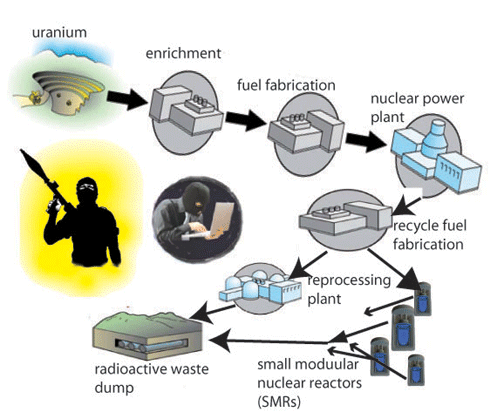
For now, I’ll leave aside those matters of Cost, Environment, Radioactive Wastes – and just look at the much touted Safety of these supposedly different new electricity producers.
PRISM (Power Reactor Innovative Small Modular) latest manifestation of much-hyped but non-existent IFRs: It would require converting plutonium oxide powder into a metal alloy, with uranium and zirconium. This would be a large-scale industrial activity on its own that would create large amount of plutonium contaminated salt waste. This plutonium metal would be even more vulnerable to theft for making bombs than the plutonium oxide.
Smaller versions of present-day pressurized water reactors, planned to be built underground, will be hard to get to, in an emergency situation. Pebble-bed reactors- high-temperature gas-cooled reactors (HTGRs) run risk of cracking of their tiny fuel kernels, and of temperature rise, resulting in Chernobyl-type graphite fire.
Thorium The risks inherent in nuclear reactors are due to the massive concentrations of radioactive materials and the huge amount of heat they produce . No matter if the fuel is based on uranium or thorium, if it’s solid or liquid. Thorium itself can’t be used as weapons fuel – but to be used in a nuclear reactor it has to be transmuted into the fissile uranium isotope, U-233, which can be used for nuclear weapons.
While the entire chain leading to these new, and non-existent reactors carries terrorism risks, the end result is just as vulnerable or more so . In the case of Small Modular Reactors this means not just a few targets for terrorism, but multiple targets. That means more safety regulations, more security guarding – and then of course – more costs too. It is a particularly vicious cycle!
Plutonium contamination at Fukushima becomes ever more alarming
 ‘Increasing alarm’ at Fukushima: Trenches filled with thousands of tons of plutonium contaminated liquid leaking into ocean — ‘Biggest risk’ at plant — ‘Exceptionally difficult’ problem — ‘Constant flow’ in and out of trenches — ‘Racing to stop’ more from coming in (PHOTO) http://enenews.com/japan-officials-increasingly-alarmed-thousands-tons-plutonium-contaminated-liquid-fukushima-trenches-leaking-ocean-biggest-risk-plant-exceptionally-difficult-problem?utm_source=feedburner&utm_medium=email&utm_campaign=Feed%3A+ENENews+%28Energy+News%29
Wall St. Journal, Aug 7, 2014(emphasis added): [Shunichi Tanaka, chairman of the Nuclear Regulation Authority] said [Tepco] needs to get its priorities straight when it comes to work to decommission […] Fukushima Daiichi […] “The biggest risk is the trench water. Until that matter is addressed, it will be difficult to proceed with other decommissioning work,” [Tanaka] said on Wednesday at his weekly news conference. “It appears that they are getting off track,” he told reporters. Tepco has been trying to remove some 11,000 metric tons of water that contains dangerous radioactive materials such as uranium and plutonium from a trench that runs from the Fukushima Daiichi plant’s No.2 reactor building. […] “What if another tsunami hits the plant and the highly contaminated water in the trench is discharged…
NHK, July, 30, 2014: TEPCO initially planned to freeze radioactive wastewater that’s been flowing into underground utility tunnels [trenches] at the plant. It hoped the measure would prevent the wastewater from mixing with groundwater and flowing out to sea. But 3 months into the project, the water hasn’t frozen as planned.
Nuclear Engineering International,August 7, 2014: TEPCO has admitted that it has having problems with freezing contaminated water flowing in trenches […] The water in the trenches is […] coming into contact with nuclear material[…] because the water flows in and out of the trenches because of water pumping operations, it has proved ‘exceptionally difficult’ to freeze, TEPCO said. This was despite increasing the flow of coolant, adding ice and dry ice to the trench water[…]
Kyodo, Aug. 5, 2014: Tepco is racing to stop the buildup of radioactive cooling water in the trenches. […] Tepco inserted refrigeration rods in the trenches to try to freeze the water butabandoned the effort after more than three frustrating months. […] Though [Tepco has now put] 58 tons of ice in the trenches, the utility has “yet to see” whether it will work […] The new method was introduced after an increasingly alarmed Nuclear Regulation Authority urged the company last month to take additional steps as soon as possible […]
World Nuclear News, July 24, 2014: New approaches to removing the contaminated water from trenches […] after attempts to freeze it failed. […] The trenches contain highly-contaminated water that has flowed from the main power plant buildings […] Tepco said that, despite the success of early experiments, “it has proved exceptionally difficult” to freeze the trench water. This, it said, is due to the constant flow of water into and out of the trench […]
The nuclear bombing of Nagasaki
The day the bomb fell on Nagasaki BRIAN MCKENNA The Globe and Mail Aug. 07 2014, The atomic bomb destined for the ancient trading port of Nagasaki was called Fat Man. Sister Regina McKenna, my grandfather’s sister, was close enough to ground zero to feel the death wind on her face. She might have preferred another name: Terror. Or, as the Japanese call it: Slaughter.
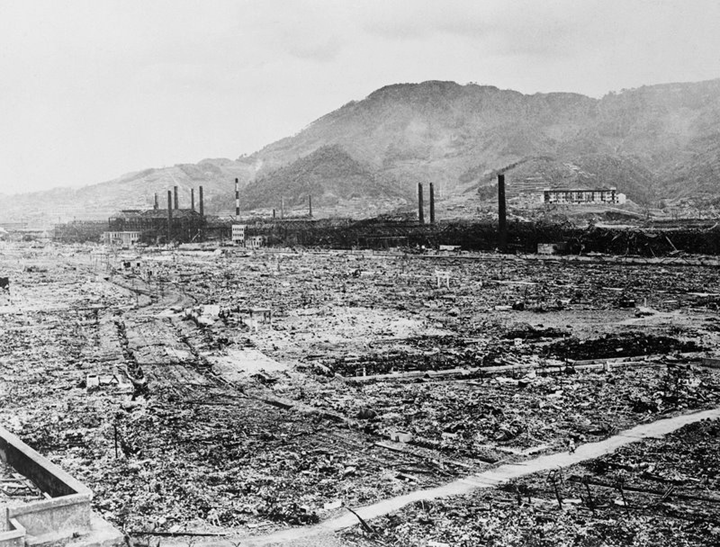
We knew her as Aunt Reggie, a nun with Montreal’s order of the Sacred Heart. She was teaching in Japan when war broke out. She was imprisoned in an internment camp outside Nagasaki.
Boasting some beautiful churches, Nagasaki was home to Japan’s biggest colony of Christians. Thus far, the city had been spared the U.S. Army Air Force campaign of annihilation. Under General Curtis LeMay, armadas of B-29s were systematically bombing Japan “back to the stone age.”………
……….Fat Man was released, flying like an angel of death toward an unsuspecting population. The bomb exploded at 500 metres at precisely 11:02 a.m.
“It seemed as though the sun had burst and I was lost in its midst. I threw myself at once into a clump of young bamboo trees. I was lying on a big bag of grass. My face only felt hot.”
She was spared the worst of the physical blast, shielded by the tall hills encircling Nagasaki. She ran back to the camp. All the windows had imploded. The shattering glass inflicted minor wounds. Downtown Nagasaki was another story.
The city burned for days. Almost all of the churches were destroyed. The survivors wrote of unspeakable suffering, 70,000 dead within 90 days, and everywhere a stench of death and corruption.
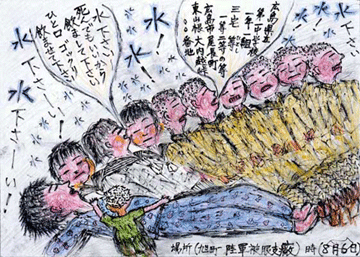 Sister McKenna wrote that the medical system is overwhelmed. “Two-thirds of the population of Nagasaki are dead. The city itself is a mass of ruins. They are still burning the dead. The hospitals having been destroyed, the wounded are not being cared for.”
In 1945, the medical world knew little of radiation poisoning, so her next line resonates. “Some patients apparently recover, then suddenly die from hemorrhages.”
All reporting from Nagasaki was censored.
A Japanese and American film crew rushed to the site. But their footage was suppressed for more than 50 years. When footage finally aired, the impact on public policy (“why two bombs?”) that the nuclear attack should have triggered was diminished by the passage of time.
For Sister McKenna, the imprint of that explosion was like a gigantic X-ray, searing her body and mind for a lifetime. Her fellow teaching sisters said “she was never quite right” after experiencing that cataclysm. And in the end she succumbed to a cancer brought on by radiation poisoning……http://www.theglobeandmail.com/life/facts-and-arguments/the-day-the-bomb-fell-on-nagasaki/article19959476/
A nuclear boondoggle exposed – Small Modular Reactors (SMRs)
Report: New Nuclear Power Technology Would Siphon Resources Away From Renewable Energy, PROGRESS ILLINOIS Ellyn Fortino Friday August 8th, 2014, “…….one nuclear financing expert argues in a new report that SMRs, which have yet to be built in the United States, would be no cheaper than their larger counterparts. Mark Cooper, a senior fellow for economic analysis at theInstitute for Energy and the Environment at the Vermont Law School, also warns that SMR development would suck up funding that could otherwise be used for what he says are more attractive energy options like wind and solar.
“Large reactors have never been economically competitive and there is no reason to believe that smaller reactors will fare any better,” Cooper said. “Giving nuclear power a central role in climate change policy would not only drain away resources from the more promising alternatives, it would undermine the effort to create the physical and institutional infrastructure needed to support the emerging electricity systems based on renewables, distributed generation and intensive system and demand management.”………
Although SMRs would be smaller in size, “creating an assembly line for SMR technology would require a massive financial commitment,” Cooper writes in his report, “The Economic Failure of Nuclear Power and the Development of a Low-Carbon Electricity Future: Why Small Modular Reactors Are Part of the Problem, Not the Solution.”

He projects it would cost between $72 billion and $90 billion by 2020 to fund the development of just two SMR designs and assembly lines.
The estimated price tag to invest in SMRs is roughly equivalent to 75 percent of the total projected investment in U.S. electricity generation over the same time period, the report noted. It is also “substantially more” than what is expected to be spent on renewables, Cooper said.
“This massive commitment reinforces the traditional concern that nuclear power will crowd out the alternatives,” he added.
SMRs themselves would also cost more, not less, than larger reactors, according to the report.
“The higher costs result from: lost economies of scale in containment structures, dedicated systems for control, management and emergency response, and the cost of licensing and security; operating costs between one-fifth and one-quarter higher; and decommissioning costs between two and three times as high,” Cooper noted.
SMRs are up against greater challenges than previous technologies because they are “a radical new technology that its advocates would like to have treated in a very different way with respect to safety and licensing,” Cooper explained.
“They would like to deploy lots of reactors close to population centers. That’s the way they can make their economics work,” he continued. “And they need to relax safety … They’ve asked for a number of changes in safety to try to drive down the cost, and even then they cannot compete on costs.”……
the industry’s hype around SMRs is now fizzling, Cooper explained. The “unproven” SMR technology has already experienced setbacks in the marketplace, he said, pointing to recent announcements from Babcock & Wilcox and Westinghouse Electric Co., another small-reactor industry leader developing a 225-megawatt SMR.
Babcock & Wilcox said last month that it is slowing the development of and funding for its mPower technology because the company cannot find major investors for the effort. Westinghouse — after being passed up twice by the DOE for SMR cost-sharing agreements — announced in February that it is shifting its attention away from small-reactor technology because it does not have a customer base for SMRs.
“They are cutting back for simple reasons: They can’t find customers. They can’t find investors,” Cooper said. “In a market economy like ours, that is a death knell, and so they have slashed their commitment to small modular reactors……….”http://progressillinois.com/quick-hits/content/2014/05/18/report-new-nuclear-power-technology-would-siphon-resources-away-renewa
Nuclear lobby wants EPA to promote its industry!
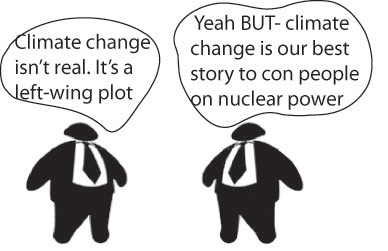 EPA rule not such a boon for nuclear after all — utilities Jean Chemnick, E&E reporter Greenwire: Friday, August 8, 2014 U.S. EPA’s greenhouse gas proposal for existing power plants doesn’t do enough to boost nuclear energy, advocates for the industry say.
Two months after EPA unveiled the proposal — and just over two months before the end of the public comment period — companies that have invested billions of dollars in the United States’ primary source of zero-carbon baseload energy say they are still reviewing the draft.
But while the industry has yet to reach a consensus position, some utilities say they are discouraged by the way the June 2 proposal treats new nuclear projects that are coming online or attempts to help existing facilities overcome the economic factors that threaten them with retirement. The agency has proposed tougher state carbon intensity targets for states that host nuclear in the hopes of encouraging them to provide incentives for the industry, but some advocates say it hasn’t rewarded states for past nuclear investment………
“We therefore propose that the emission reductions supported by retaining in operation six percent of each state’s historical nuclear capacity should be factored into the state goals for the respective states,” EPA states in the rule’s preamble. If states do not retain their nuclear fleets, they must make up that 6 percent zero-carbon energy through other measures, like new demand-side efficiency or renewable energy.
But utilities that have invested or are investing in nuclear facilities say that’s not enough……. the nuclear crediting mechanism needs to be improved to achieve EPA’s intended objective,” said Paul Adams, a spokesman for Exelon Corp., which operates the largest nuclear fleet in the nation. He called on EPA to finalize a rule that will “treat zero-carbon resources the same and ensure states do not double-count these resources.”……
But analysts say EPA faced a tough task when it came to deciding how the rule should treat nuclear energy. In contrast to wind and solar facilities, nuclear plants are so large, they say, that giving full credit for facilities that are already slated to come online could mean giving states like South Carolina a way to meet their targets without making any reductions elsewhere….http://www.eenews.net/stories/1060004265
DAP party blasts Malaysia’s dangerous nuclear power plans

 DAP blasts BN’s nuclear power plans, calls it a threat to health, safety, The Malaysian Insider By LOOI SUE-CHERN 8 August 2014 Barisan Nasional (BN) is putting profit ahead of the interest of the people if it goes ahead with plans to build two nuclear power reactors in the country, said the DAP.
Party secretary-general Lim Guan Eng (pic) said BN would be gambling with the people’s health and safety if it goes ahead with the plans. Lim disagreed with Minister in the Prime Minister’s Department Datuk Seri Mah Siew Keong, who had said that Malaysia cannot continue on an energy status quo and nuclear energy was a serious option for energy resources sustainability.
“Mah is wrong because Malaysia will be able to shift to a sustainable energy paradigm without relying on nuclear power plants,” Lim said in a statement today.
The Penang chief minister said Putrajaya would be able to achieve energy sustainability by wiping out corruption, investing in renewable energy projects, diversifying its domestic economies and reducing reliance on hydrocarbon resources.
“Lest Mah forgets the risks of nuclear energy, more than 150,000 evacuees are still unable to return home after the Fukushima nuclear disaster in 2011, following the huge earthquake and tsunami.
“Japan is still dealing with contaminated groundwater around the Fukushima nuclear power plants everyday,” Lim said.
He also said it is “irresponsible” of BN to decide to proceed with the proposed two nuclear power plants, when there are serious concerns about safety and the environment.
Lim said BN could not even ensure uninterrupted water supply, which would be a key component to cool and clean nuclear power reactors.
Apart from that, Malaysia still enjoys a high energy reserve margin of over 30%.
“Both the Pakatan Rakyat Penang government and DAP have adopted a firm and uncompromising stand against nuclear reactors due to their unsustainable costs, huge environmental and humanitarian risks.”The Penang state government had written to the then Energy, Green Technology and Water Minister Tan Sri Peter Chin on March 21, 2011 to object against the building of any nuclear power plant in Malaysia,” he said, adding that Penang will also ban such facilities………. http://www.themalaysianinsider.com/malaysia/article/dap-blasts-bns-nuclear-power-plans-calls-it-a-threat-to-health-safety#sthash.UMEY14oX.dpuf
The collapse of the Small Modular Nuclear Reactor hype – ominous for the nuclear industry
Report: New Nuclear Power Technology Would Siphon Resources Away From Renewable Energy, PROGRESS ILLINOIS Ellyn Fortino Friday August 8th, 2014 “………With the industry currently unable to garner enough customer and investor interest around SMRs, it is trying to save nuclear power by making a “desperate attempt to undermine the alternatives, which are succeeding,” Cooper added.
The nuclear energy industry “says, ‘Look, just get rid of their subsides. Gerry-rig the market so that we can stay in business. Avoid policies that will let (alternatives) stay in business … and then we’ll have a level playing field.’ But of course it doesn’t look anything like a level playing field,” he said.
Over the past 60 years, the nuclear energy industry has collected 10 times more subsidies than what renewables have received, Cooper said. Government funding for SMR research and development currently represents the smallest subsidy out of many received by the nuclear power industry, he added.
He said the U.S. nuclear energy industry is grappling with a “fundamental conflict.” After failing to bring online 90 percent of new reactors as part of a “nuclear renaissance” suggested by nuclear power advocates in the early 2000s, the hope was that SMR technology would rescue the industry. And since that has yet to happen, the industry is “now struggling to save the aging reactors… simply because they cannot compete against the alternatives available.”

“The death of the small modular reactor hype really is emblematic of the fundamental conflict that’s going on in the industry,” he said. “The near term will decide, not just the fate of nuclear power, but the fundamental approach that we take to addressing the challenge of climate change.”
Looking ahead, Cooper said he questions nuclear power’s place in the emerging “integrated, two-way electricity system based on decentralized alternatives.” In such a system, an “inflexible source of supply like nuclear does not have value,” he said, adding that nuclear power “becomes a burden on the flexible system rather than a benefit.”
Nuclear power, Cooper said, is not a smart “economic proposition” or “portfolio asset” for a low-carbon electricity future.
“And looking carefully at the urgency of dealing with climate change, it’s also the most costly, most risky approach to climate change,” he stressed. http://progressillinois.com/quick-hits/content/2014/05/18/report-new-nuclear-power-technology-would-siphon-resources-away-renewa
Federal regulators cite Calvert Cliffs nuclear plant for safety issue
Calvert Cliffs nuclear plant cited for safety issue Miscalculation might have triggered unnecessary evacuation By Timothy B. Wheeler, The Baltimore Sun August 8, 2014
The Nuclear Regulatory Commission said Friday it had preliminarily classified the mistake by Exelon Generation Co. as one of “low to moderate” safety significance. But an NRC spokesman said it could lead to increased federal scrutiny of the twin-reactor plant in Lusby, 70 miles south of Baltimore…… http://www.baltimoresun.com/features/green/blog/bs-bz-calvert-cliffs-nuclear-citation-20140808,0,325214.story#ixzz39w4kFJxG
Atomic bombing of Nagasaki remembered
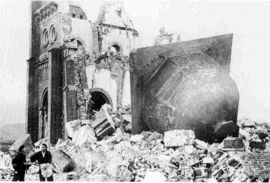 Nagasaki commemorates 68th anniversary of atomic bombing,Global Post 8 Aug 13 Nagasaki began marking the 68th anniversary of the U.S. atomic bombing Friday, with Mayor Tomihisa Taue expected to urge the government later in the day to take leadership as the world’s only atomic bombed country and realize the quick elimination of nuclear weapons.
In his peace declaration at the memorial event, at which representatives of 44 countries will attend, Taue plans to criticize Tokyo’s recent failure to sign an international statement rejecting any use of nuclear weapons as well as its deal with India to restart talks on nuclear energy cooperation.
Nuclear-armed India is set to send a representative to the event for the first time, while all five nuclear powers — Britain, China, France, Russia and the United States — that are signatories to the Nuclear Non-Proliferation Treaty are set to be represented, along with de facto nuclear power Israel that is not a signatory, according to the city office.
U.S. Ambassador to Japan John Roos who became the first U.S. ambassador to attend Hiroshima’s memorial ceremony in 2010, is to attend the Nagasaki ceremony for the second time.
Taue is also expected to call on the United States and Russia to drastically reduce their nuclear arsenals while urging the Japanese government to enact its three non-nuclear principles of not producing, possessing or allowing nuclear weapons on Japanese territory into law and provide better support for aging atomic bomb survivors……. http://www.globalpost.com/dispatch/news/kyodo-news-
The Hiroshima and Nagasaki message: abolish nuclear weapons
Message from Hiroshima: Abolish nuclear weapons http://peoplesworld.org/message-from-hiroshima-abolish-nuclear-weapons/ by: JOELLE FISHMAN August 7 2014 NEW HAVEN, Conn. – Matsui Kazumi, Mayor of the City of Hiroshima, Japan, witnessed all of his school mates die when the atom bomb was dropped on his populous city 69 years ago on August 6, 1945 at 8:15 am. That horror lives with him today, and shaped the Peace Declaration he delivered this year to cities across the world.
Standing on the New Haven Green, the City of New Haven’s Peace Commission annual vigil heard his declaration along with a proclamation from this city’s Mayor Toni Harp calling for the United States to “lead by example in the area of nuclear weapons reductions so we can work towards President Obama’s goal of controlling nuclear weapons proliferation and abolishing nuclear weapons.”

A United Nations Peace Messenger City, New Haven is also hosting films and a library exhibit to raise awareness of the extreme danger that nuclear weapons pose to the planet. Toward the goal of a nuclear-free world by 2020, the United Nations has declared September 26 as International Day for the Total Elimination of Nuclear Weapons. This mobilization comes just one week after the September 21 People’s Climate March which is expected to draw up to a million participants on the eve of a UN conference on global warming.
The reality of the economic, human and environmental cost of nuclear weapons which sap national resources needed by cities and towns and could obliterate all life, led to a ballot referendum in New Haven where 80 percent of voters called for abolition of nuclear weapons.
Al Marder, chair of the Peace Commission, said peace forces are now calling on the United States to send a delegation to the Third Conference on the Humanitarian Impact of Nuclear Weapons to be convened by the United Nations in Vienna, Austria on December 8 “and take part in the discussions of the humanitarian consequences of nuclear disaster and finally negotiate a ban and total abolition of nuclear weapons.”
In the Hiroshima Peace Declaration, Mayor Kazumi said, “Each one of us will help determine the future of the human family. Please put yourself in the place of the Hibakusha (survivors of the A-bomb). Imagine their experiences, including that day from the depths of hell, actually happening to you or someone in your family. To make sure the tragedies of Hiroshima and Nagasaki never happen a third time, let’s all communicate, think and act together with the Hibakusha for a peaceful world without nuclear weapons and without war.”
Recalling that Japan is the only nation to have been A-bombed, he said that “precisely because our security situation is increasingly severe, our government should accept the full weight of the fact that we have avoided war for 69 years thanks to the noble pacifism of the Japanese Constitution.”
That section of the Constitution, Article 9, which eliminated armed forces is now being re-interpreted by the current government. In response, a Global Article 9 Campaign has been initiated featuring a Japanese initiated international petition.
Tepco under-reported Fukushima release of plutonium – by 200 times!
 New report estimates 278 trillion Bq of plutonium released from Fukushima reactors — Over 200 times higher than amount reported by Tepco — “Highly radiotoxic when incorporated into human body” as it decays http://enenews.com/new-report-estimates-278-trillion-bq-of-plutonium-released-from-fukushima-reactors-over-200-times-higher-than-amount-reported-by-tepco?utm_source=feedburner&utm_medium=email&utm_campaign=Feed%3A+ENENews+%28Energy+News%29
Evaluation of the Fukushima Accident Source Term through the fast running code RASCAL 4.2(pdf),ENEA Bologna Research Centre, May 23, 2014: This Report presents the results of the application of the fast-running US-NRC direct code RASCAL 4.2 to the estimation of the Fukushima Source Term. […] it is plausible that the ventings that TEPCO announced during the accident as being conducted from the wetwell were, as a matter of fact and because of the degraded conditions of the plants, conducted actually from the drywell. […] wetwell properties imply releases which can be several oder of magnitudes lower than those from the drywell […] it can clearly be seen that the most probable path is the combination of Drywell+Direct option […] the true venting path, i.e. from Drywell instead of from Wetwell, is an extremely important issue. […] in several instances when TEPCO tried to operate venting, in order to release pressure outside the building through the stack, it proved impossible […] there are many indications that probably the radioactive material escaped from the drywell; this may have occurred without TEPCO’s immediate knowledge and because of several factors; for example: structural damages to the pipings connecting drywell to torus room (vent piping bellows), due either to the earthquake, and/or to the too violent pressure and temperature increase in the D/W; leakages through the top head manhole, the top head flange, the piping penetrations, the electrical wiring penetrations, the personal airlocks, the S/C manholes, the machine hatches, etc. […] The value of 1%/h was chosen by ENEA because of the possible highly damaged conditions of the Fukushima NPPs due to the BDB [Beyond Design Basis] earthquake.
> Table 7. Cumulative Source Term (Bq) TEPCO MELCOR
- Pu-241 Total = 1.2E+12 (1,200,000,000,000 Bq)
> Table 7. Cumulative Source Term (Bq) ENEA RASCAL 4.2
- Pu-241 Unit 1 = 6.52E+13 (65,200,000,000,000 Bq)
- Pu-241 Unit 2 = 1.86E+14 (186,000,000,000,000 Bq)
- Pu-241 Unit 3 = 2.67E+13 (26,700,000,000,000 Bq)
- Pu-241 Total = 2.78E+14 (278,000,000,000,000 Bq)
Environmental Science & Technology (American Chemical Society), July 11, 2014: [S]tandard alpha spectrometry techniques […] are not able […] to measure 241Pu.
Boreal Environment Research (pdf), Feb. 28, 2014: The 241Pu isotope was introduced into the environment from […] accidents that released nuclear reactor fuel, such as […] the 2011 Fukushima catastrophe. As compared with other Pu isotopes in the environment that are alpha-emitting and long-lived, 241Pu is a short-lived isotope with a half-life of 14.35 years […] 241Pu decays to the alpha emitter 241Am, that has a much longer half-life (432.2 years) and is highly radiotoxic when it is incorporated into either the human or animal body. […] The 241Pu isotope has been studied less extensively than the α-emitting Pu isotopes for several reasons. Activity concentration of 241Pu cannot be determined from the same alpha spectrum as the Pu isotopes 238, 239, and 240, and extra effort is needed in order to analyze 241Pu concentration of a sample. Actually, 241Pu emits alpha particles, but they have so low probability (0.002%) that 241Pu cannot be measured directly by α-spectrometry […]
Red Cross calls for nuclear disarmament – plans for Humanitarian Conference in December
 Remembering Hiroshima: Nuclear disarmament is a humanitarian imperative International Committee of the Red Cross, Geneva 06-08-2014 Statement Geneva (IFRC/ICRC) – The International Red Cross and Red Crescent Movement’s involvement in the nuclear debate dates back to the moment the first atomic bomb was dropped on Hiroshima. On 6 August, 1945, at 8.15am, there was a flash of light over the city and in an instant, tens of thousands of people were dead, hospitals and health centres were incinerated and the city was left in ruins.
But in the midst of this appalling devastation, one hospital survived. The Hiroshima Red Cross Hospital – which miraculously escaped complete destruction despite its closeness to the epicentre of the blast – began to fill with casualties. Yet, most equipment and medicine had been destroyed or was unusable, and many of its doctors and nurses had been killed or injured. But there was dedication, and there was help to come. Dr. Marcel Junod of the International Committee of the Red Cross heard of the devastation and became the first non-Japanese doctor to assess the event. His reports are a chilling account of what occurs in the aftermath of a nuclear detonation.
The issue of nuclear weapons has remained a serious concern of the International Red Cross and Red Crescent Movement for the past 69 years.
The issue of nuclear weapons has remained a serious concern of the International Red Cross and Red Crescent Movement for the past 69 years. We voiced our concern about the humanitarian impact of nuclear weapons after their use in Hiroshima and Nagasaki. As a result, in 1948 the 17th International Conference of the Red Cross and Red Crescent Movement adopted a resolution calling for the prohibition of atomic weapons. This was followed by a resolution of the 18th International Conference in 1952. Later resolutions also urged the prohibition of all weapons of mass destruction. ……..
States will continue to consider the consequences of nuclear weapons at the Third Conference on the Humanitarian Impact of Nuclear Weapons being hosted by the Government of Austria in December. The 2015 Review Conference of the Treaty on the Non-proliferation of Nuclear Weapons will also be an important moment for States to consider the discussions of the Oslo, Nayarit and Vienna meetings and to reflect on how best to advance nuclear disarmament. We hope that the States in these fora will take into account the Movement’s views on nuclear weapons and our calls for greater action in this area. The 2015 Council of Delegates and the International Conference of the Red Cross and Red Crescent will also be an opportunity to take stock of the Movement’s activities on this subject.
In closing, we believe that the coming year is a pivotal time in the discussions about nuclear weapons. We urge international and non-governmental organizations as well as the components of the Red Cross and Red Crescent Movement to redouble their efforts to raise awareness of the humanitarian consequences of nuclear weapons. We also urge all States to recognize that nuclear disarmament is a humanitarian imperative and to reflect on how to make significant progress towards a world without nuclear weapons.
Humanity has been fortunate that nuclear weapons have not been used since those tragic days in August 1945 and we must do all that we can to make sure that instances such as Hiroshima and Nagasaki never happen again.
Tadateru Konoe,
President, International Federation of Red Cross and Red Crescent Societies
Peter Maurer,
President, International Committee of the Red Cross http://www.icrc.org/eng/resources/documents/statement/2014/08-06-japan-hiroshima-atomic-bomb.htm
Melted nuclear fuel cores leaking radiation directly into groundwater at Fukushima
 Official: “Unfortunately, the fuel itself is exposed” at Fukushima — Scientist: Our tests show contamination isn’t going away… reactors are leaking out into ocean… there’s still a problem — PBS: Plume of water tainted with radiation is reaching to other side of Pacific (VIDEO) http://enenews.com/official-fuel-exposed-fukushima-scientist-tests-show-contamination-going-away-reactors-leaking-ocean-problem-pbs-plume-water-tainted-radiation-reaching-other-side-pacific-video?utm_source=feedburner&utm_medium=email&utm_campaign=Feed%3A+ENENews+%28Energy+News%29
PBS NewsHour’s ‘Return to Fukushima’, Aug 6, 2014: NewsHour science correspondent Miles O’Brien […] has traveled to Fukushima three times and six times entered the exclusion zone, which he described as a “post-apocalyptic landscape of abandoned towns, frozen in time.” We’ve stitched his latest reports together into this documentary-length video. They include his tour of the hazardous Fukushima Daiichi nuclear power plant and a look at the health of marine life off the coast of Japan […] Plus, a never-before-seen exclusive tour of Fukushima Daini, Daiichi’s sister plant, which narrowly escaped the same fate.
- 3:30 in – Miles O’Brien, PBS: 3 of [Fukushima Daiich’s] cores are now melted down, still steaming hot, their steel containment structures breached. Engineers believe some of the nuclear fuel has melted right through the steel containment vessels on to a concrete basement floor, where it is exposed to groundwater. […] Each and every day, about 100,000 gallons of fresh groundwater seeps into the basements of the plant, where it becomes contaminated with a witch’s brew of radionuclide. […] No one disputes the plant is steadily leaking radiation-tainted water into the sea.
- 14:00 in – O’Brien: [Naohiro Masuda, leader of Fukushima Daiichi’s decommissioning company and head of Fukushima Daiini during 3/11] explained where the melted nuclear fuel has gone.
- 14:05 in — Masuda: Unfortunately, the fuel itself is exposed.
- 14:10 in — O’Brien: Melted through?
- 14:15 in — Masuda: Melted through the pressure vessel, and coming down to this room and it goes down to the floor.
- 17:30 in — Crystal Breier, Woods Hole Oceanographic Institution: This is Fukushima water, this is from our cruise this past September. We found there’s still contamination. […] It’s been persistent, it hasn’t gone away. It’s indicating that the reactors are leaking out more cesium — and there is still a problem.
- 18:15 in – O’Brien: The plume of water tainted with radiation from Fukushima is only now reaching the other side of the Pacific. This has prompted an online tsunami of pseudoscience, blog rumors and wild accusations […]
- 32:45 in – O’Brien: Of course local health officials have been following the evacuees in the Fukushima region and they say there have been more than 1,600 deaths attributed to stress. In the end, perhaps the biggest risk associated with nuclear energy might very well be the fear of nuclear energy. Thanks for watching.
- Watch the PBS broadcast here
Toxicity of planned wastes raises anxiety about Lake Huron nuclear dump scheme
Lake Huron nuclear dump scheme in trouble Hamilton Spectator by Thomas Walkom 7 Aug 14, Ontario’s plan to bury nuclear waste beside Lake Huron is running into heavy weather.
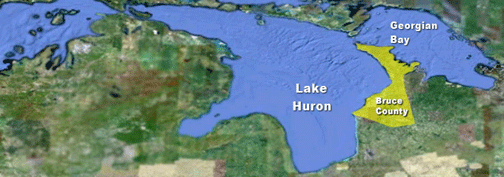
Ontario Power Generation, the Crown corporation behind the proposed dump site for low and intermediate level radioactive waste, has publicly acknowledged that its long-term safety plans are based, in part, on new technologies that have not yet been invented.
As the Star’s John Spears reported this week, that explanation hasn’t endeared itself to the small but politically important aboriginal communities near the proposed Kincardine dump site.
In a brief to the federal review panel that will eventually rule on the plan, the Saugeen Ojibway Nation reminds OPG of its assurance that no nuclear waste dump will be built without aboriginal consent
Will that consent be given? The first nation doesn’t say. But in its brief, it does express profound unease with what it calls OPG’s vague and open-ended scheme.
Plans for this so-called deep geological repository at Kincardine have been in the works since 2005.
Initially, the proposed dump was supposed to house waste such as the rubber gloves used by nuclear workers — items with relatively low levels of radioactivity.
Right now, nuclear waste from Ontario atomic power generating plants is stored on the surface.
But once federal hearings started last fall, OPG changed tack. It announced it wanted to double the size of the underground dump to roughly 400,000 cubic metres in order to accommodate waste that will be produced when the province’s existing nuclear plants are taken apart.
This so-called decommissioning waste, which includes components such as pressure tubes (but not nuclear fuel), will remain highly radioactive for thousands of years.
Critics cried foul. The three-member federal panel hearing the proposal ordered OPG to better explain how it would handle this more difficult waste.
It also told the Crown utility to look into why a similar U.S. nuclear waste facility near Carlsbad New Mexico — cited by dump proponents as a model — suffered two accidents in February……….http://www.thespec.com/opinion-story/4737032-lake-huron-nuclear-dump-scheme-in-trouble/
Dr Helen Caldicott exposes the fallacies of the push for Small Modular Nuclear Reactors
Small Modular Reactors Huffington Post, Dr Helen Caldicott 08/07/2014 Now that the “nuclear renaissance” is dead following the Fukushima catastrophe, when one sixth of the world’s nuclear reactors closed, the nuclear corporations — Toshiba, Nu-Scale, Babcock and Wilcox, GE Hitachi, General Atomics, and the Tennessee Valley Authority — will not accept defeat.
Their new strategy is to develop small modular reactors (SMRs), allegedly free of the dangers inherent in large reactors: safety issues, high cost, proliferation risks and radioactive waste.
But these claims are fallacious, for the reasons outlined below.
Basically, there are three types of SMRs, which generate less than 300 megawatts of electricity compared with current 1,000-megawatt reactors.
1. Light-water reactors
These will be smaller versions of present-day pressurized water reactors, using water as the moderator and coolant, but with the same attendant problems as Fukushima and Three Mile Island. Built underground, they will be difficult to access in the event of an accident or malfunction.
Because they’re mass-produced (turnkey production), large numbers must be sold yearly to make a profit. This is an unlikely prospect, because major markets — China and India — will not buy U.S. reactors when they can make their own.
If safety problems arise, they all must be shut down, which will interfere substantially with electricity supply.
SMRs will be expensive because the cost per unit capacity increases with a decrease in reactor size. Billions of dollars of government subsidies will be required because Wall Street is allergic to nuclear power. To alleviate costs, it is suggested that safety rules be relaxed, including reducing security requirements, and reducing the 10-mile emergency planning zone to 1,000 feet.
2. Non-light-water designs
These include high-temperature gas-cooled reactors (HTGRs) or pebble-bed reactors. Five billion tiny fuel kernels consisting of high-enriched uranium or plutonium will be encased in tennis-ball-sized graphite spheres that must be made without cracks or imperfections — or they could lead to an accident. A total of 450,000 such spheres will slowly and continuously be released from a fuel silo, passing through the reactor core, and then recirculated 10 times. These reactors will be cooled by helium gas operating at high very temperatures (900 degrees C).
A reactor complex consisting of four HTGR modules will be located underground, to be run by just two operators in a central control room. Claims are that HTGRs will be so safe that a containment building will be unnecessary and operators can even leave the site (“walk-away-safe” reactors).
However, should temperatures unexpectedly exceed 1,600 degrees C, the carbon coating will release dangerous radioactive isotopes into the helium gas, and at 2,000 degrees C the carbon would ignite, creating a fierce, Chernobyl-type graphite fire.
If a crack develops in the piping or building, radioactive helium would escape, and air would rush in, also igniting the graphite.
Although HTGRs produce small amounts of low-level waste, they create larger volumes of high-level waste than conventional reactors.
Despite these obvious safety problems, and despite the fact that South Africa has abandoned plans for HTGRs, the U.S. Department of Energy has unwisely chosen the HTGR as the “next-generation nuclear plant.”
3. Liquid-metal fast reactors (PRISM)
It is claimed by proponents that fast reactors will be safe, economically competitive, proliferation-resistant, and sustainable.
They are fueled by plutonium or highly enriched uranium and cooled by either liquid sodium or a lead-bismuth molten coolant. Liquid sodium burns or explodes when exposed to air or water, and lead-bismuth is extremely corrosive, producing very volatile radioactive elements when irradiated.
Should a crack occur in the reactor complex, liquid sodium would escape, burning or exploding. Without coolant, the plutonium fuel could reach critical mass, triggering a massive nuclear explosion, scattering plutonium to the four winds. One millionth of a gram of plutonium induces cancer, and it lasts for 500,000 years. Extraordinarily, they claim that fast reactors will be so safe that they will require no emergency sirens, and that emergency planning zones can be decreased from 10 miles to 1,300 feet.
There are two types of fast reactors: a simple, plutonium-fueled reactor and a “breeder,” in which the plutonium-reactor core is surrounded by a blanket of uranium 238, which captures neutrons and converts to plutonium.
The plutonium fuel, obtained from spent reactor fuel, will be fissioned and converted to shorter-lived isotopes, cesium and strontium, which last 600 years instead of 500,000. The industry claims that this process, called “transmutation,” is an excellent way to get rid of plutonium waste. But this is fallacious, because only 10 percent fissions, leaving 90 percent of the plutonium for bomb making, etc.
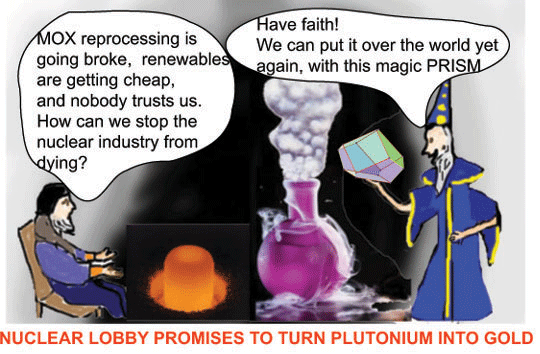
Then there’s construction. Three small plutonium fast reactors will be grouped together to form a module, and three of these modules will be buried underground. All nine reactors will then be connected to a fully automated central control room operated by only three operators. Potentially, then, one operator could face a catastrophic situation triggered by loss of off-site power to one unit at full power, another shut down for refueling and one in startup mode. There are to be no emergency core cooling systems.
Fast reactors require a massive infrastructure, including a reprocessing plant to dissolve radioactive waste fuel rods in nitric acid, chemically removing the plutonium, and a fuel fabrication facility to create new fuel rods. A total of 15 to 25 tons of plutonium are required to operate a fuel cycle at a fast reactor, and just five pounds is fuel for a nuclear weapon.
Thus fast reactors and breeders will provide extraordinary long-term medical dangers and the perfect situation for nuclear-weapons proliferation. Despite this, the industry plans to market them to many countries.
1 This Month
26 April – Chernobyl: Inside the Meltdown airs on National Geographic on Sunday 26th April from 4pm

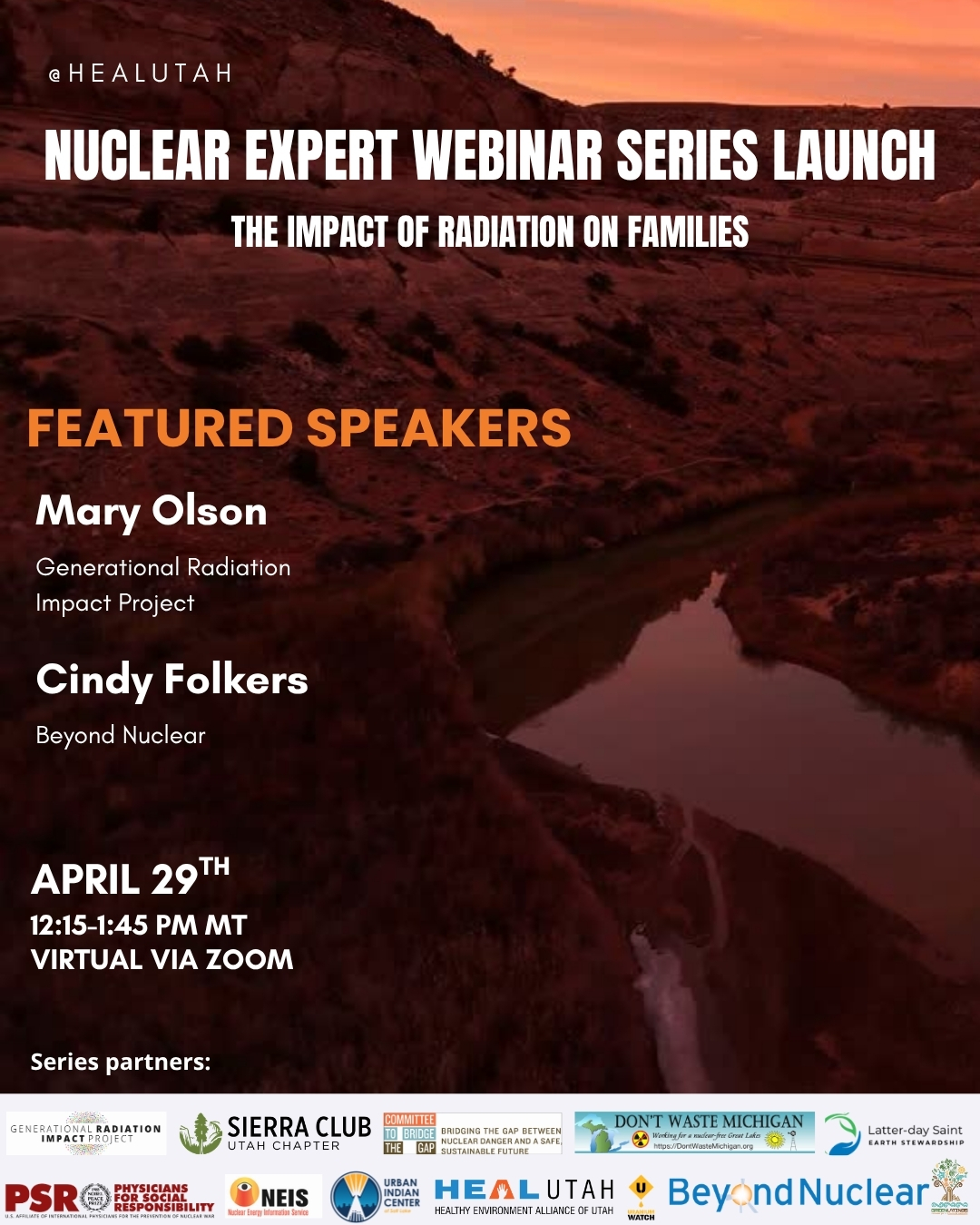
29 April – Nuclear Expert Webinar #1 – Radiation Impacts on Families with Mary Olson and Cindy Folkers
- 12:15 PM MT – 1:45 PM MT
- Location: Virtual – REGISTER TODAY

4 May -West Suburban Peace Coalition to discuss Iran war at May Educational Forum
Monday, May 4, 7:00 – 8:00 PM Central Standard Time
Title: : How Trump’s Narrative Tries to Shape the Reality of the War on Iran.
Contact Walt Zlotow, zlotow@hotmail.com 630 442 3045 for further information
14 May – online event From Bombs to Data Centres: the Face of Nuclear Colonialism

Pine Ridge Uranium is the real threat, not Tehran- Tell Burgum: Stop the Extraction.
Chernobyl: The Lost Tapes – A good documentary on Chernobyl on SBS available On Demand for the next 3 weeks– https://www.sbs.com.au/ondemand/tv-program/chernobyl-the-lost-tapes/2352741955560
To see nuclear-related stories in greater depth and intensity – go to https://nuclearinformation.wordpress.com
-
Archives
- April 2026 (288)
- March 2026 (251)
- February 2026 (268)
- January 2026 (308)
- December 2025 (358)
- November 2025 (359)
- October 2025 (376)
- September 2025 (257)
- August 2025 (319)
- July 2025 (230)
- June 2025 (348)
- May 2025 (261)
-
Categories
- 1
- 1 NUCLEAR ISSUES
- business and costs
- climate change
- culture and arts
- ENERGY
- environment
- health
- history
- indigenous issues
- Legal
- marketing of nuclear
- media
- opposition to nuclear
- PERSONAL STORIES
- politics
- politics international
- Religion and ethics
- safety
- secrets,lies and civil liberties
- spinbuster
- technology
- Uranium
- wastes
- weapons and war
- Women
- 2 WORLD
- ACTION
- AFRICA
- Atrocities
- AUSTRALIA
- Christina's notes
- Christina's themes
- culture and arts
- Events
- Fuk 2022
- Fuk 2023
- Fukushima 2017
- Fukushima 2018
- fukushima 2019
- Fukushima 2020
- Fukushima 2021
- general
- global warming
- Humour (God we need it)
- Nuclear
- RARE EARTHS
- Reference
- resources – print
- Resources -audiovicual
- Weekly Newsletter
- World
- World Nuclear
- YouTube
-
RSS
Entries RSS
Comments RSS
 nuclear-news