Not much chance of restarting Kewaunee nuclear plant
Restarting Kewaunee nuclear plant no quick task Richard Ryman, Press-Gazette Media July 17, 2014 CARLTON – Any attempt to restart the Kewaunee Power Station nuclear plant would take years.
RGA Labs Inc. of Barrington Hills, Ill., wants to buy the plant, which closed in 2013, and put it back into operation, according to Robert Abboud, company president and co-owner.
RGA, an engineering consulting firm, faces steep hurdles. The nuclear plant’s owner, Dominion Resources Inc. of Richmond, Va., has said it is not for sale, and the Nuclear Regulatory Commission, which is responsible for nuclear safety, said Wednesday it would be just like starting over……..http://www.greenbaypressgazette.com/story/money/2014/07/16/restarting-kewaunee-nuclear-plant-quick-task/12760325/
Global warming bringing extreme weather to Australia – droughts and floods
 Australia’s drought – yes, it’s climate change http://www.theecologist.org/News/news_round_up/2483139/australias_drought_yes_its_climate_change.html Tim Radford 18th July 2014 Australia’s prime minister thinks climate change is ‘crap’ and has just abolished his country’s carbon-pricing system. But scientists say that it’s rising levels of CO2 that are leaving the south of the country parched and sweltering – and it’s only going to get worse.
American scientists have just confirmed that parts of Australia are being slowly parched because of greenhouse gas emissions.
A report in Nature Geoscience shows that the long-term decline in rainfall over south and south-west Australia is a consequence of fossil fuel burning and depletion of the ozone layer by human activity. Such a finding is significant for two reasons. One remains contentious: it is one thing to make generalised predictions about the consequences overall of greenhouse gas levels, but it is quite another to pin a measured regional climatic shift directly on human causes, rather than some possible as-yet-unidentified natural cycle of climatic change.
The other is contentiously political.
Australia’s prime minister, Tony Abbott, has in the past dismissed climate science as “crap”, and more recently has cut back on Australian research spending.
Bush fires and catastrophic flooding
Australia has already experienced a pattern of heat waves and drought – punctuated by catastrophic flooding – and even now, in the Australian winter, New South Wales is being hit by bush fires.
Tom Delworth, a research scientist at the US National Oceanic and Atmospheric Administration, reports in Nature Geoscience that he and a colleague conducted a series of long-term climate simulations to study changes in rainfall across the globe.
One striking pattern of change emerged in Australia, where winter and autumn rainfall patterns are increasingly a cause of distress for farmers and growers in two states.
The simulation showed that the decline in rainfall was primarily a response to man-made increases in greenhouse gases, as well as to a thinning of the stratospheric ozone layer in response to emissions of destructive gases by human sources.
The computer simulations tested a series of possible causes for this decline, such as volcanic eruptions and changes in solar radiation. But the only cause that made sense of the observed data was the greenhouse explanation.
It began in 1970, and it hasn’t stopped yet
South Australia has never been conspicuously lush and wet, but decline in precipitation set in around 1970, and this decline has increased in the last four decades.
The simulations predict that the decline will go on, and that average rainfall will drop by 40% over south-west Australia later this century.
Dr Delworth described his model as “a major step forward in our effort to improve the prediction of regional climate change”.
In May, scientists proposed that greenhouse gas emissions were responsible for a change in Southern Ocean wind patterns, which in turn resets the thermostat for the world’s largest island.
Australian scientists report in Geophysical Research Letters that they, too, have been using climate models to examine Antarctic wind patterns and their possible consequences for the rest of the planet.
Another consequence: accelerated ice sheet melt
“When we included projected Antarctic wind shifts in a detailed global ocean model, we found water up to 4°C warmer than current temperatures rose up to meet the base of the Antarctic ice shelves”, said Paul Spence, a researcher at Australian Research Council’s Centre of Excellence for Climate System Science. This temperature rise is twice previous estimates.
“This relatively warm water provides a huge reservoir of melt potential right near the grounding lines of ice shelves around Antarctica. It could lead to a massive increase in the rate of ice sheet melt, with direct consequences for global sea level rise.”
Since the West Antarctic ice sheet holds enough water to raise sea levels by 3.3 metres, the consequences would indeed be considerable.
“When we first saw the results it was quite a shock”, said Dr Spence. “It was one of the few cases where I hoped the science was wrong.”
Largest hybrid renewable energy project unveiled in Jamaica
“World’s largest” hybrid renewable energy project unveiled in Jamaica (incl video) Gizmag, By Stu Robarts July 18, 2014 Generating renewable electricity at home or in commercial buildings is becoming increasingly viable. WindStream Technologies has installed what it says is the world’s largest wind-solar hybrid array on an office roof in Kingston, Jamaica. The array is expected to generate over 106,000 kWh annually.
The array is expected to generate 25kW of wind power and 55kW of solar power. Windstream says it will return its investment within four years and will produce savings of around US$2 million over the course of its estimated 25-year lifespan.
Nuclear Regulatory Commission to investigate crack in Oconee Nuclear Station weld
 Regulators to look at Oconee Nuclear Station weld crack BY STAFF REPORTS Greenville News July 18, 2014 The Nuclear Regulatory Commission staff has scheduled a regulatory conference with officials of Duke Energy for July 31 to discuss an apparent violation of NRC requirements.
The apparent violation involved a crack in a weld on the Unit 1 high pressure injection system at the Oconee Nuclear Station near Seneca about 30 miles west of Greenville, according to the NRC.
GreenvilleOnline.com first reported in November the shutdown of Unit 1 after a leak was discovered in what Duke Energy described as the reactor’s containment building.
“On Nov. 11, 2013, the licensee (Duke Energy) determined that a leak in the 1B2 high pressure injection line was pressure boundary leakage. Unit 1 was subsequently shutdown as required … ,” according to an NRC document.
“Your measures failed to identify and correct a significant condition adverse to quality involving a crack in a weld located in the Unit 1 High Pressure Injection (HPI) system,” according to the document addressed to Duke Energy.
NRC and Duke Energy officials will discuss the safety significance of the apparent violation related to an undetected crack in a weld that led to reactor coolant system pressure boundary leakage and a forced shutdown of Unit 1, NRC officials said……..http://www.thestate.com/2014/07/18/3570369/regulators-to-look-at-oconee-nuclear.html?sp=/99/101/
Biological Consequences of Nuclear Disasters: From Chernobyl to Fukushima – Video and transcript
EXTRACTS
[…]
We found that most organisms show significantly increase rates of genetic damage where it’s radioactive, no surprise there. Most, many of the organisms show increased rates of deformities and other kinds of developmental abnormalities again in proportion to the contamination levels, reduced fertilities, shortened lifespans.
[…]
Starting first with Three Mile Island in 1979. Most of us in the room are familiar with that one. And Chernobyl, 1986, 28 years ago and of course Fukushima 2011. So that’s three out of 600. It’s kind of a, I don’t know, any statisticians in the room? What, what’s the probability there? I don’t know if any of you would get on an airplane if there was a 1 in 200 chance of it crashing.
[…]
So, nobody really cared too much when the tritium was contained within the borders of the power plant. But when it, once it starts getting offsite, the potential for it to get into the ground water and to effect drinking water is significant. And there’s also the fact that we know very little about what the potential ecological and environmental health consequences of tritium leaks might be.
[…]
Of course we have no idea what the impacts will be on the marine side. Again very little research is being done there other than to catch a few fish now and then and see how radioactive they are. And a little bit of modeling going on to see where these contaminants might end up. But not a whole lot of investment really.
[…]
Maybe you’ve seen, you know, the video, Radioactive Wolves and, you know, Disney Channel has these kind of Cinderella stories for Chernobyl on a regular basis. And we, but there, when we went to look for it there wasn’t any quantitative scientific data published.
[…]
We’re not so interested in dose because of the way we do our studies but we are interested in knowing if it’s a high, medium or low dose. And so we’ve actually made a lot of progress in this area.
[…]
And the basic answer is that overwhelmingly from, you know, the 50 plus studies that happened on genetic damage is associated with radiation exposure in Chernobyl. It’s, you know, the question is answered. All right, so now that we know that there’s increase mutation rates
[…]
And then
last year they actually were fairly methodical and found 15 cases of these partial albinos in about 70 or 80 barn swallows. So about the same frequency as we see in Chernobyl in the radioactive areas. Fairly strong evidence that, that this is good biomarker for radiation exposure.[…]
But nobody, it had been lost to the world until my colleague Anders discovered it and started applying it to our birds. And sure enough it allows us to get tiny, tiny minute amounts of the material. And we can actually look at the morphology of the sperm. We can look at the behavior of the sperm. And there are large effects on both
[…]
And when we did this we realized again in these Chernobyl areas, dramatically higher levels of tumors. Many of them on the head and around the eyes but also on the chin, here’s another example here. Some strange developmental abnormalities as well again often where the birds are being exposed I suspect. But just strange kinds of growths that are almost never seen in normal populations.
[…]
And found again very striking significant relationship between the frequency of cataracts, the degree of cataract and background radiation but only for females, not in males in this case.
[…]
It turns out neurological tissue is well known to be quite sensitive to the effects of radiation, more sensitive than most other tissues. It had been observed in children in Belarus as well but of course nobody wanted to ascribe radiation as the source of that. But, just
to skip over the statistics. The other thing we learned though is that for a bird, 5 percent decrease in brain size is important.[..]
turns out that in the hotter parts of Chernobyl abundance is depressed by 2/3. There’s on 1/3 as many birds as there should be living in these hot areas. So if you went there you’d still see a few birds. And you might go oh, looks kind of normal. But when you go and count them and you relate this to the radiation and everything else that’s important, very, very strong signal, only 1/3 as many birds, about 1/2 as many species of birds in the area. So big effects on the abundance of biodiversity of birds. But it’s not just birds. Spiders, again very few in the hot areas. Grasshoppers, fewer in the hot
areas. Dragonflies, fewer in the hot areas. Bumblebees are quite sensitive it turns out and missing from the hot areas. Butterflies missing from the hot areas.[…]
Look at the size of this thing. It’s huge. There are wolves inside the zone. But when you look at the entire assemblage of mammals using this technique, many fewer mammals especially the smaller mammals in the hot areas.
[….]
And when we compare the relationship between decline in abundance versus radiation the effect is about twice as strong in Fukushima as we currently see in Chernobyl. And this lead somebody, some journalist who suggests, I didn’t say this but the journalist came up with this all on his own. Good journalist. He’s provided a lot of inspiration. Suggested that maybe this difference was because of adaptation going on in Chernobyl where there’s been, you know, more than 20 generations.
[….]
We found that most organisms show significantly increase rates of genetic damage where it’s radioactive, no surprise there. Most, many of the organisms show increased rates of deformities and other kinds of developmental abnormalities again in proportion to the contamination levels, reduced fertilities, shortened lifespans. I didn’t talk about that but we have data on this. Reduced population sizes and reduced biodiversity in many of these hot areas. Some other more interesting speculative suggestions are that there may be in some groups, there’s some evidence of sort of amplification, magnification of genetic damage because of chronic multigenerational exposure to the radiation.
[…]
We have very little information, almost no information concerning developmental genetic effects in Fukushima. That’s just starting. We have some of the ecological observations, the population sizes but the genetic stuff is just coming in. So we don’t know what’s going on at that level very well. But all of our data is consistent with, it may not be a linear response but there’s certainly no evidence of a threshold response. There’s no evidence that the effect disappears below a certain level. It disappears but it disappears into the noise as it becomes harder and harder to detect any kind of signal given the noise that exists at these lower levels. So sample sizes would need to be larger if we were to really just, you know, attempt to figure out whether that was a some kind of gradual linear response or a threshold response.
But there’s no evidence of a threshold. Certainly we see strong statistically significant signals at the levels of, you know, half a microsievert per hour which was set 4, 5 millisieverts per year. So that’s not really, that’s a pretty low level and we still see detectable effects on most of these things.[…]
And we have an interest in fire issues in this zone, especially with climate change. Because litter has, is where most of the radioactive contaminants are located. And we noticed that the litter area was getting thicker, was quite thick in some of these areas. So we did the experiment. Basically we went and put out our fresh clean dead plant material in little bags, you can see these little bags filled with plant material that we scattered throughout the zone, left for almost a year and then retrieved them after a year of decomposition. And low and behold decomposition rates presumably reflecting the microbial community primarily, also some invertebrates, but mostly the microbial community were dramatically effected and much lower in the hottest parts. Again we weren’t the first to notice this but we were first to do the experiment to demonstrate experimentally in this case, not just a correlation, this was an experimental
manipulation that the microbial community was affected[…]
Published on 17 Jul 2014
Timothy Mousseau discusses the impact of radioactive fallout from the Chernobyl disaster on natural populations and the impact of high radiation levels on the Fukushima, Japan, area. One aim of his research is to determine whether or not organisms can adapt to radioactive environments.
Speaker Biography: Timothy Mousseau is a professor of Biological Sciences at the University of South Carolina. He recently served on the National Academy of Sciences committee to examine the incidence of cancer near nuclear power plants.
For transcript, captions, and more information, visit http://www.loc.gov/today/cyberlc/feat…
TITLE: Biological Consequences of Nuclear Disasters: From Chernobyl to Fukushima
SPEAKER: Timothy Mousseau
EVENT DATE: 2014/05/15
FORMAT: Video + Captions
RUNNING TIME: 63 minutes
TRANSCRIPT: View Transcript (link will open in a new window)
DESCRIPTION:
Timothy Mousseau discusses the impact of radioactive fallout from the Chernobyl disaster on natural populations and the impact of high radiation levels on the Fukushima, Japan, area. One aim of his research is to determine whether or not organisms can adapt to radioactive environments.
Speaker Biography: Timothy Mousseau is a professor of Biological Sciences at the University of South Carolina. He recently served on the National Academy of Sciences committee to examine the incidence of cancer near nuclear power plants.
Full transcript also here ;
>> From the Library of Congress in Washington, DC.
^M00:00:05
[ Silence ]
^M00:00:24
>> Today's event is organized by Science Technology and Business Division of this Library of Congress.
I'm Tomoko Steen, research specialist here at the Library of Congress.  Today's speaker, Tim Mousseau,
maybe I say Professor Tim Mousseau, currently professor at the Department of Biological Sciences,
University of South Carolina.  He has Ph.D. from McGill University in Canada.  And he had served as the Dean
of the Graduate School, Associate Vice President for Research and the Graduate Education at the University of
South Carolina.  And he also was in the Washington area. He was a Program Officer at NSF, National Science
Foundation.  He serves for the many editorial boards for both domestic and international scientific journals.
 And he was also on the advisory panel for NSF, USGS and the many other variety of agencies.
And also international grant foundations. He has over 160 publications, probably a lot more now but also 2 published edited books published from the Oxford University Press. And he’s also co-editor of the annual review series, The Year in Evolutionary Biology. I have one copy on Chernobyl in the back there and picture was taken by Professor Mousseau. And that was published from New York Academy of Sciences. Since 1999,
Professor Mousseau has been collaborating with colleagues from CNRS and the University of Paris working on these cases of Chernobyl, especially focusing on the biological effects of radiation, various species, birds, insects and people. And now his focus is Fukushima and comparing his data with Chernobyl to Fukushima. So before further adieu and the all interesting stories waiting for you. And please join me welcoming Professor Mousseau.
Prospective buyer urges community to push for nuclear plant sale
During the shutdown we asked the NRC if they would ever see the reopening of the plant, and they said they have never done it,” Tadisch said. “But the plant is in good shape, and they saw no problem with seeing it run for those 20 years or longer.”
CARLTON — Community action is the next step in RGA Labs’ pursuit of the Kewaunee Nuclear Plant.
The Chicago-based engineering and technology firm presented its case for taking on ownership of the plant, which is just over a year into the decommissioning process.
Robert G. Abboud, president of RGA, said his company approached current owner Dominion Resources Inc. of Richmond, Va., in November 2012 about buying the plant. Abboud and company vice president Ron Chin presented their case Thursday night to 110 community members and elected officials at the Carlton Town Hall.
Dominion has shown no interest in selling the facility. Abboud urged community members to contact legislators and share their views of what they want to see happen with the plant.
“The real power is in the community and the elected officials,” Abboud said. “If it is going to happen, it will because the community demands Dominion relook at this issue, and I think Dominion owes it to them.”
Town of Carlton Supervisor Steve Tadisch said the town is looking into alternatives to shutting the plant down, including the best case scenario of facilitating a sale and generating power again.
March 2011 power loss at Fukushima plant caused by tsunami: regulator
TOKYO, July 18, Kyodo
The power loss at the Fukushima Daiichi nuclear plant’s No. 1 reactor in March 2011 was triggered by tsunami, Japan’s nuclear regulator said Friday, denying the possibility raised by the Diet’s investigation commission that it could have been caused by the powerful earthquake.
The Nuclear Regulation Authority’s interim report on the 2011 nuclear disaster said the power loss — which led to the failure to cool the reactor and resulted in a meltdown — and damage to equipment occurred as tsunami waves flooded the plant, citing results of its on-site probe.
Panels of the Diet, the government, plant operator Tokyo Electric Power Co. and the private sector have separately released investigation reports so far, but they differ regarding some issues…. Rest of article behind firewall http://english.kyodonews.jp/news/2014/07/302889.html
Global Warming Stops Nuclear power in its tracks!
“”If tidal waves knock out the water pumps you can have a meltdown.”

http://www.fairewinds.org/global-warming-stops-nukes/
July 17th, 2014
Two Turkey Point reactors owned by Florida Power & Light are cooled by water from 168 miles of canals. Due to global warming, and exacerbated by discharge from the reactors, the canals are now overheated, and one degree from the maximum temperature allowed by the NRC. Arnie Gundersen was interviewed by Miami News Radio, which has a news brief.
The reactor could shut down or reduce power, but demand for air conditioning is high. Rather than shutting down, FPL wants to draw 30 million gallons of water a day from an underground aquifer.
In 2011, Arnie talked about another challenge facing Turkey Point due to global warning: sea level rise. Some of Miami is expected be under water before Turkey Point’s licenses expire. “”If tidal waves knock out the water pumps” — as they did at the Fukushima reactor in Japan earlier this year — “you can have a meltdown.”
The Miami Herald covers the current story in more depth. The 2011 story is posted here.
INDOOR Pokemon Playground for All opens in Fukushima for victims of one the “worst nuclear disaster in history “
The project not only involved Pokemon, but also Tsutaya and Yahoo! Japan. Thanks to this collaborative project, an indoor park has been constructed for the kids who have suffered various traumas during the disaster to forget their worries and play. A large Pokemon-themed sandbox can be seen inside the facility for these kids to play in. Pikachu was even present for the facility’s opening.
Published on July 18, 2014, by spartanchef
http://sgcafe.com/2014/07/pokemon-playground-opens-fukushima-victims-2011-earthquake/

In 2011, the entire world witnessed the tragedy which befell Japan as a series of powerful earthquakes and tsunamis rock the country between March and April.
Three years after the tragedy, Nintendo’s popular Pokemon franchise has built the “Playground for All” in one of the worst-hit areas of the disaster, Fukushima, which not only suffered yet another strong earthquake in April 2011, but also experienced one of the worst nuclear disasters in history which has been dubbed the Fukushima Daiichi nuclear incident.
The project not only involved Pokemon, but also Tsutaya and Yahoo! Japan. Thanks to this collaborative project, an indoor park has been constructed for the kids who have suffered various traumas during the disaster to forget their worries and play. A large Pokemon-themed sandbox can be seen inside the facility for these kids to play in. Pikachu was even present for the facility’s opening.
Tsutaya meanwhile has released a special Pokemon T Card which will help give funds to the area and Yahoo! Japan is currently doing an internet fundraising drive to gather funds for the Playground for All Project. The Pokemon With You project, which has helped much in the reconstruction of Iwaki City, Fukushima has visited a temporary housing project for the victims and entertained the kids who have experienced the disaster first hand.
The Playground for All Project aims to not only the children who will be the future of Fukushima prefecture, but also the community which has suffered so much this past few years thanks to the series of disasters they have experienced.
Exelon appeals to New York to keep nuclear plant running for four more years
http://www.utilitydive.com/news/exelon-appeals-to-new-york-to-keep-nuclear-plant-running/287687/
By
Dive Brief:
- Exelon has filed a proposal to New York’s Public Service Commission for a power purchase agreement with a New York utility to keep its R.E. Ginna nuclear plant, which provides up to 581 MW of electricity to New York, running for four more years.
- The plant’s last agreement, with Rochester Gas & Electric Corp, ran out at the end of June of this year. The ten-year contract was not renewed.
- Since 2011, the plant has lost more than $100 million, mainly to operating costs and poor performance in the state’s wholesale power markets. Currently the plant is entirely dependent on wholesale market performance.
Dive Insight:
R.E. Ginna does not suffer from the same issues some other plants do: It has license to keep running until 2029, which means it has yet to age out of operation. Further, the New York Independent System Operator has calculated that the plant needs to stay open and running for at least three years, until October 2018. Planned construction of new transmission lines and a new substation in the Rochester area of the state should be completed by then, which will guarantee a reliable supply of electricity to the region.
If the plant closes, the state could have another problem. New York belongs to the Northeast Greenhouse Gas Market, which follows a cap-and-trade protocol allowing states to pay to buy and sell each others’ carbon emissions in order to bring them down overall. If the plant closes, then prices of carbon emissions from New York will rise as more carbon, produced from natural gas generation that would need to replace the plant’s output, will be emitted. That could have a knock-on effect for rate payers.
In Illinois, three of Exelon’s six nuclear plants are in danger of closing for much the same reasons as R.E. Ginna: A lack of money to keep operating. However, last week Exelon said it had “no plans” to close the plants any time soon, seeing the Environmental Protection Agency’s plans to reduce carbon emissions as a possible advantage.
Ageing nuclear systems increase accident risk globally – Oxford Analytica Ltd
( Behind firewall) https://www.oxan.com/display.aspx?ItemID=DB192027&StoryDate=20140718

The Oxford Analytica Daily Brief ® – Friday, July 18 2014
Nuclear weapons are complex devices with enormous explosive force. The means by which nuclear weapons can be delivered — aircraft and long-range missiles — are also highly complex feats of engineering and require sophisticated maintenance to keep in working order. Invented 70 years ago, nuclear weapons are now in the possession of at least nine countries (United States, Russia, United Kingdom, France, China, Israel, India, Pakistan and North Korea). During the height of the Cold War, the United States and Soviet Union possessed over 70,000 nuclear weapons; many of them now pose significant accident risks.
Sendai nuclear plant with five active volcanoes deemed safe and a problem with fish die offs?
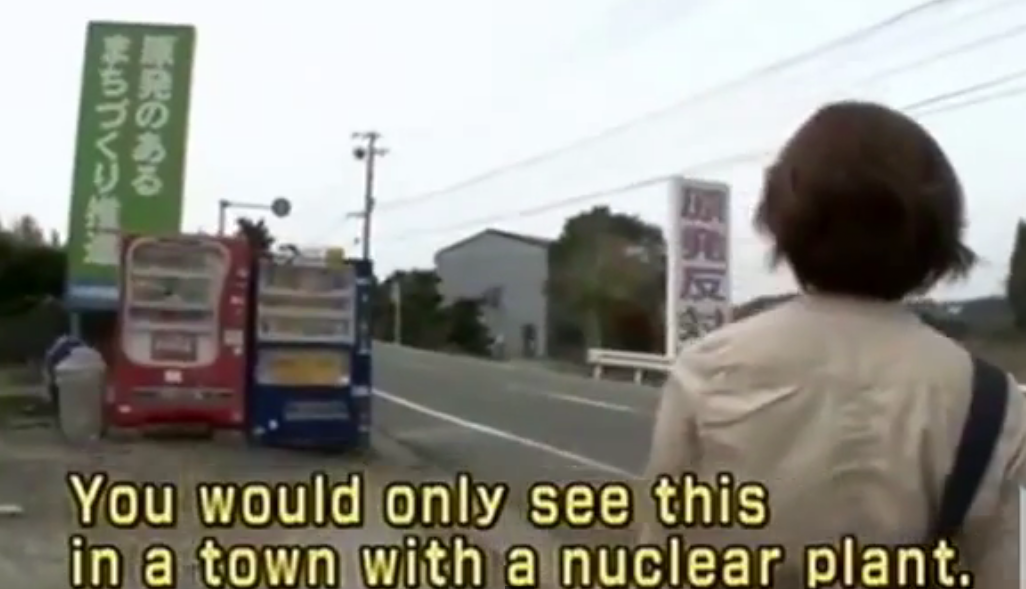
Picture shows 2 signs in nearby town, one is pro nuclear and the other is anti nuclear
Published on 29 Oct 2013
After the accident in Fukushima,
what is happening with Japan’s nuclear power plants?
What was seen from walking around the fences that surround the nuclear power plants and through nearby towns?
1/ An increase in fish deaths
2/ Loss of fishing grounds if reactor 3 is to be built on reclaimed land
3/ Bribes to fishermen with compensation
4/ Desperate business needing customers
5/ A community split apart
Reports from the scene by newscasters
from 24 hours news channel,TBS News Bird.
h/t
Japan Nuclear Plant, Surrounded by Volcanos, Deemed Safe After Improvements
The Sendai plant is surrounded by at least five active volcanos. Commissioner Kunihiko Shimazaki, a seismologist, said it’s impossible to accurately predict eruptions, although the current assessment suggests a catastrophic eruption is extremely unlikely.
http://hocdethi.blogspot.ie/2014/07/japan-nuclear-plant-surrounded-by.html
Niseko Accommodation Announced The Support For Project Fukushima Kids For Charity
“We strongly believe in the efforts of this project and hope to protect the residents from the risk of developing cancer,” said Chris Pickering, Operations Manager of HT Holidays. “We are proud to be able to provide places for the kids and parents to stay in Niseko.”
Niseko, Japan (PRWEB) July 17, 2014
The most established Niseko accommodation provider and market leader, HT Holidays, is proud to announce that they will be providing summer accommodation in late July to support the efforts of the Protect Fukushima Kids.
In order to provide a radiation free summer to the kids and parents affected by the Great East Japan Earthquake in the Tohoku region in 2011, HT Holidays has decided to offer services for their six-day long stay in Niseko during late July. HT Holidays is proud to support this charitable cause, as it will help lower the visitors’ exposure to high radiation levels and also the risk of cancer amongst residents.
“We strongly believe in the efforts of this project and hope to protect the residents from the risk of developing cancer,” said Chris Pickering, Operations Manager of HT Holidays. “We are proud to be able to provide places for the kids and parents to stay in Niseko.”
The Great East Japan Earthquake on March 11th in 2011 caused the high radiation levels of exposure and higher risk of developing cancer to the residents around the Tohoku region. More than 300,000 people were evacuated and many deaths were related to poor evacuation conditions.
“The beautiful summer here makes it the perfect place for people to escape from the tragic and unfortunate incident,” continued Pickering. “This long break in Niseko is a great chance for them to feel relaxed, unconstrained and to participate in hands-on activities. The kids are able to play outside, study and go on a trip to a neighboring area.”
HT Holidays is dedicated to provide what they can to help the kids learn and grow in a healthy environment. To learn more, please visit HT Holidays’ website: http://htholidays.com.
About HT Holidays
HT Holidays is the most established Niseko accommodation provider with over 10 years of experience. They are the market leaders in relation to services and service delivery and look forward to welcoming guests to Niseko.
For the original version on PRWeb visit: http://www.prweb.com/releases/2014/07/prweb12016922.htm
Interview with Navy sailor suffering after Fukushima radiation exposure
Emotional interview with Navy sailor suffering after Fukushima exposure: Others with same symptoms “told to be quiet… nobody’s heard from them” — Health is worsening, worried I’m going to die — Can’t really use legs or arms, hands ‘barely functional’ — Rashes all over body, spasms, shaking — Doctors tell us “it’s all psychological” (AUDIO) http://enenews.com/emotional-interview-navy-sailor-suffering-serious-illness-after-fukushima-exposure-others-same-symptoms-told-be-quiet-nobodys-heard-worry-about-dying-health-keeps-worsening-really-legs-arms-h?utm_source=feedburner&utm_medium=email&utm_campaign=Feed%3A+ENENews+%28Energy+News%29
Interview with Navy Lt. Steve Simmons who served on the USS Ronald Reagan for 3/11 relief mission, Nuclear Hotseat hosted by Libbe HaLevy, July 8, 2014 (emphasis added):
- 21:30 in — November 2011 I noticed something was wrong… The black-out was the first thing… I started dealing with gastrointestinal issues, at first I thought I was coming down with a stomach bug… Fevers as high as 102.9°F… January 2012 was the first time I was hospitalized… [They] sent me home with a sinus infection. Three days later I was readmitted to the hospital because my lymph nodes were swelling… that’s when my legs buckled and the muscle weakness started to onset… it’s been ascending from legs, trunk, arms, hands… I can’t really use the muscles much at all. I’m down to about 20 lbs. of grip strength in my hands, which is barely functional… I do have to catheterize every 4 hours in order to empty the bladder. The migraines still get worse. The fevers still come and go, and they keep calling it a fever of unknown origin. My vitamin D is in the gutter, they just keep calling it an unspecified vitamin D deficiency… 2nd degree burns on my legs just from being out in the sun for 3 or 4 hours… that had never been a concern. Nobody can figure it out. I’ve been getting these rashes that come and go; they’ll go up my arms, my neck, around my eyes, back, stomach, legs. I deal with tremors and spasms… I am [in a wheelchair]… There’s days I don’t even get out of bed… for a long time I thought I was the only one. I had no idea there were other individuals that were even sick or dealing with ailments… Doctors wouldn’t tell us anything… I’ve had doctors tell me maybe you’re better off not knowing what you’re dealing with… You can’t have over 100 or 200 people sick, and one who has died last April, and say there is absolutely no health risk.
- 35:00 in — Finding out that there’s more people that are sick, finding out there were some other individuals at Walter Reed [Hospital]… almost identical symptoms to what I was dealing with… they we’re told to be quiet, and next thing I know they’re, who knows where they’re at, nobody’s heard from them, nobody has seen them. I have a buddy at Walter Reed right now, whose going through the same exact thing, very similar to what I’m dealing with — maybe 6 months to a year behind on the symptoms… His wife would call my wife and my wife would explain what he could expect next and sure as anything that happens next… Him and I both had doctors who have actively tried to convince us that there’s physically nothing wrong and it’s all psychological… This is ridiculous… He’s also in a wheelchair and when he went to the clinic to get fitted for a wheelchair, this doctor told him that it’s all in his head, and he doesn’t need a wheelchair… This is uncalled for.
- 46:00 in — We now realize how bad it was… the worst disaster in history, then it’s time to acknowledge the fact that, yeah there is a problem, and there are going to be some effects on human life… If the worst case happens, and some more folks pass — I would have to be naive to think that nobody else is going to pass away from this — it’s only a matter of time before there’s more lives lost. I would be lying if I don’t think every day that I’m going to be next because of how bad my health keeps going downhill.
Tokyo protesters say”NO” to restart of nuclear reactors
 Anti-nuclear protesters say “no” to possible reactor restart, Channel News Asia By Japan Bureau Chief Michiyo Ishida 17 July 14 Protesters have gathered in central Tokyo to demonstrate against a decision by Japan’s nuclear watchdog to push ahead with plans to consider restarting a nuclear plant, which it now considers safe. TOKYO: Protesters have gathered in central Tokyo to demonstrate against a decision by Japan’s nuclear watchdog to push ahead with plans to consider restarting a nuclear plant, which it now considers safe.
Shinzo Abe’s government has been pushing to bring reactors back online, after introducing tougher regulations on the industry last year. However, it faces determined opposition from concerned residents.
Protesters in Tokyo surrounded the building where the Nuclear Regulation Authority has its office, calling for the NRA to drop the plan to give the green light for the Sendai nuclear plant in Kyushu to consider the restart of its nuclear reactors.
Kyushu — Japan’s third largest island — has suffered heavily from power shortages. But steps still need to be taken for Sendai to officially restart.
The most difficult hurdle — to gain the approval of residents. Those opposed to the restart question the vulnerability of the plant’s location as it is surrounded by active volcanoes.
One of the protesters said: “We don’t think any of them should be restarted. It’s not about debating what figures indicate their safety.”……..This type of protest however, is not expected to be a one-off event, with 19 nuclear plants having applied to the NRA for a possible restart. http://www.channelnewsasia.com/news/asiapacific/anti-nuclear-protesters/1267526.html
-
Archives
- February 2026 (228)
- January 2026 (308)
- December 2025 (358)
- November 2025 (359)
- October 2025 (376)
- September 2025 (258)
- August 2025 (319)
- July 2025 (230)
- June 2025 (348)
- May 2025 (261)
- April 2025 (305)
- March 2025 (319)
-
Categories
- 1
- 1 NUCLEAR ISSUES
- business and costs
- climate change
- culture and arts
- ENERGY
- environment
- health
- history
- indigenous issues
- Legal
- marketing of nuclear
- media
- opposition to nuclear
- PERSONAL STORIES
- politics
- politics international
- Religion and ethics
- safety
- secrets,lies and civil liberties
- spinbuster
- technology
- Uranium
- wastes
- weapons and war
- Women
- 2 WORLD
- ACTION
- AFRICA
- Atrocities
- AUSTRALIA
- Christina's notes
- Christina's themes
- culture and arts
- Events
- Fuk 2022
- Fuk 2023
- Fukushima 2017
- Fukushima 2018
- fukushima 2019
- Fukushima 2020
- Fukushima 2021
- general
- global warming
- Humour (God we need it)
- Nuclear
- RARE EARTHS
- Reference
- resources – print
- Resources -audiovicual
- Weekly Newsletter
- World
- World Nuclear
- YouTube
-
RSS
Entries RSS
Comments RSS
 nuclear-news