Solar energy to blossom in Japan, with $1 billion loan from Deutsche Bank
$1bn solar loans ‘to blossom for Japan’ Energy live News 15 july 14 Deutsche Bank is said to be planning loans worth around $1 billion (£0.6bn) to solar energy projects in Japan.
Hans Van Der Sande at the German bank’s Tokyo branch said it is ready to dish out loans for three to six projects in the next year or 18 months, reported Bloomberg.
He said: “We got reverse inquiries from some of our clients offshore saying ‘we are interested in Japan solar and developing projects there but having difficulty getting finance from Japanese banks,’” according to the news site….http://www.energylivenews.com/2014/07/14/1bn-solar-loans-to-blossom-for-japan/
Petition calls on Japan to resign as host of 2020 Olympics
 Why Japan should resign as host of 2020 Summer Olympics OpEdNews 7/15/2014 By carol wolman, MD (about the author “,…….The [Fukushima radioactive water clean-up] team is headed by Naohiro Masuda, who has a reputation for toughness, and reportedly saved Fukushima Plant #2, also hit by the tsunami in 2011, from being seriously damaged. He has promised Prime Minister Abe that the groundwater problem would be solved by the end of 2015!
This hope is based on the premise that an ice wall can be formed around the complex. There is no backup plan.
Fukushima Daiichi sits on a floodplain between mountains and the ocean. The idea is to divert the groundwater around the complex so that it’s no longer contaminated by contact with the underground molten cores. Smaller ice walls have been built, but nothing on this scale. The Japan Nuclear Regulatory Commission is worried that diverting the water will cause the ground under the reactors to settle, destabilizating the buildings and perhaps toppling them. Nevertheless, the plan is going forward.
After three months of placing pipes deep in the ground and sending hypercooled solution through them, TEPCO has failed to freeze the ground around the plant. It blames the problem on the fact that the groundwater is flowing too fast, but it seems to me that the molten cores inside the wall must make the ground itself pretty hot. Even if the plan succeeds, it will take an enormous amount of energy and money to maintain the freezing. But so far, Mr. Masuda has no guarantee that he can keep his promise.
The country is still facing an unprecedented nuclear crisis that continues to spread across its land and ocean, and even across national borders. There still is no provisions for a safe work environment at Fukushima Complex. The evacuated people still haven’t secured safe and healthy living environments, nor are they financially stable. Instead of spending resources on the Olympic Games, Japan should make it a priority to restore the affected people’s livelihood as well as to prevent further radioactive contamination.
Please sign this petition:
We, the undersigned, join Ambassador Mitsuhei Murata in calling for “an honorable retreat” for Japan, resigning the position of Host for the 2020 Olympic Games. Since Fukushima is already contaminating Tokyo, says Mr. Murata, bringing people there in large numbers for the games (and the workers building the facilities before that event) is immoral and unethical.
http://www.thepetitionsite.com/352/112/859/radioactive-tokyo-resign-as-host-of-2020-olympics/
Iran nuclear talks likely to continue in coming months

 Iran nuclear talks extension ‘probable’ http://www.skynews.com.au/news/top-stories/2014/07/16/iran-nuclear-talks-extension–probable-.html#sthash.H6xxFYuj.dpuf 16 July 14, US Secretary of State John Kerry and his Iranian counterpart have laid the groundwork for an extension of a Sunday deadline to strike a historic nuclear deal after intense talks in Vienna.
A Western diplomat went as far as to say that it was now ‘highly probable’ Iran and world powers would agree to such a move, and that the extension would be months not weeks.
‘As it’s highly improbable that we will finalise in Vienna before the weekend, it is highly probable that there will be a wish to continue to negotiate in the coming months,’ the diplomat said on condition of anonymity.
After a decade of rising tensions, the mooted accord between Iran and the five permanent members of the UN Security Council plus Germany is aimed at easing concerns that Iran might develop nuclear weapons and silencing talk of war.
Kerry said he would return to Washington to discuss with President Barack Obama ‘the prospects for a comprehensive agreement, as well as a path forward if we do not achieve one by the 20th of July, including the question of whether or not more time is warranted’.
He told a news conference after two days of talks with Iranian counterpart Mohammad Javad Zarif that there had been ‘tangible progress on key issues, and we had extensive conversations in which we moved on certain things’, although ‘very real gaps’ persisted between the two sides. Zarif, in a separate news conference, said that although he still hopes a deal would be possible by Sunday, he believed enough progress has been made to justify a continuation.
‘As we stand now, we have made enough headway to be able to tell our political bosses that this is a process worth continuing,’ Zarif said. ‘This is my recommendation. I am sure Secretary Kerry will make the same recommendation.’
An interim accord struck in November between Iran and the five permanent members of the UN Security Council plus Germany expires on July 20.
Extending the deadline has always been a possibility in order to keep the parties talking, but Washington in particular has stressed it will not agree to such a move without key concessions from Iran first.
CWS to map radiation hot spots in 50 nurseries and schools within Fukushima city
The disaster has surely affected the lifestyle of children in Fukushima. According to Kuniaki Sato, the principal of the nursery, in the first two years after the nuclear power plant accident, the children were playing only indoors with curtains shut all the time, which has caused decreases in their physical strength. Until today, they cannot play in fields to pick wild flowers and catch insects. The nursery teachers told us how they have made efforts to nurse children in such a difficult environment.
July 15, 2014
http://www.cwsglobal.org/newsroom/news-features/cws-committed-to-fukushima.html

Three years after the Fukushima nuclear disaster in Japan, CWS continues to support local partners working to help survivors. Yukiko Maki-Murakami, project officer for CWS Japan, visited Fukushima with one of our generous donors in May 2014 to see firsthand some results of CWS’s recovery work with survivors of the disaster. Following are some of her impressions:
I regretted that due to my overseas assignment during the period it took me over three years to make my first visit to Fukushima after the nuclear power plant disaster. When I heard the stories of actual victims, I felt ashamed of the superficial knowledge I had gained from secondhand reports.
I accompanied Eiichiro Kuwana of the Japanese American Association of New York. The association was one of the donors to the Great Eastern Japan Earthquake and Tsunami project, which ended after three years. Kuwana was very much interested in seeing and knowing the current situation and issues toward the recovery of Fukushima.
Our host, Hiroyuki Yoshino of Shalom, one of our implementing partners, took us to Sayuri Nursery School to show us how children in Fukushima were surviving under difficult circumstances. Sayuri Nursery currently accommodates 97 local pre-school children including infants and evacuated children from other areas. The municipality decontaminated their playground and re-opened it to the children one year ago.
The disaster has surely affected the lifestyle of children in Fukushima. According to Kuniaki Sato, the principal of the nursery, in the first two years after the nuclear power plant accident, the children were playing only indoors with curtains shut all the time, which has caused decreases in their physical strength. Until today, they cannot play in fields to pick wild flowers and catch insects. The nursery teachers told us how they have made efforts to nurse children in such a difficult environment.
As the mother of a teenager, I felt pity for those children for whom access to the natural environment was restricted because of high radiation.
One of the nursery teachers told us of her experiences during the critical period of radioactive contamination. She wished she could have evacuated if she had not been a nursery teacher. She expressed her worries about a high staff turnover rate in the nursery.
Furthermore, while evacuated people are beginning to return, the psychological distances between evacuees and the survivors who remained in contaminated areas is now becoming a divisive issue. An income difference between compensated ones and others is another issue dividing the community. Although this may not be a well-known issue outside Fukushima, it could lead to serious problems in the local communities in the future.
Taking into account the lessons learned from the last three years’ experiences, Yoshino now is starting a new psycho-social program and a mapping project to monitor radiation around 50 nurseries and schools within Fukushima City.
CWS Japan also is committed to supporting the implementing partners continuously in this development phase in order to hasten the rehabilitation of Fukushima.
There seems to be no end in sight for the struggles of people in Fukushima. It is my sincere hope that our support can continue to be of some help to relieve the tensions in Fukushima.
Taiwan – Decision on nuclear waste disposal site years away: official – Or its war!
Lawmaker Tien, an Yilan native, threatened on behalf of the county to launch a war against the government if the greater Nan’ao area is chosen as the permanent disposal site.
“We will fight until the end!” she declared.[…]
Image source ; http://news.asiaone.com/news/asia/anti-nuclear-protest-taiwan-attracts-nearly-13000

2014/07/14 21:35:04
http://focustaiwan.tw/news/aeco/201407140030.aspx
aipei, July 14 (CNA) No decision has been made on the location of a permanent nuclear waste disposal site, an official said Monday, after residents of Nan’ao Township in Yilan County reacted angrily to speculation that their town was being considered for the site.
The search remains in its initial stage, which is focused on evaluating the quality of potential “host rock” for nuclear waste repositories, said Lee Hsiao-tung, the head of the Ministry of Economic Affairs office responsible for nuclear waste storage.
Lee explained that the high-level radioactive waste disposal plan proposed by state-run utility and nuclear power plant operator Taiwan Power Co. (Taipower) is divided into five stages, with the project’s completion set for 2055.
In the current stage that concludes in 2017, the goal is to study and evaluate underground rock strata that would be suitable for hosting and storing nuclear waste, Lee said.
The second stage, aimed at choosing candidate sites and determining the most suitable one, will not begin until 2018.
“No one can say now that Nan’ao is the ultimate place” for the nuclear waste disposal site, Lee said in a presentation of the nuclear waste disposal site selection plan held at Yilan County Hall.
The presentation was attended by opposition Democratic Progressive Party lawmakers Tien Chiu-chin, Hsiao Bi-khim and Chen Ou-po, government officials, Taipower executives, Yilan County officials and representatives of Yilan residents.
According to the Atomic Energy Council, the country’s top nuclear power regulator, several potential host rock areas are being evaluated, including the granite strata of the Taiwan-controlled island groups of Kinmen and Matsu and rock formations in the greater Nan’ao area in southern Yilan County.
Chen Teng-chin, the head of Yilan County’s Environmental Protection Bureau, contended, however, that none of the sites being studied in Kinmen and Matsu are suitable for a permanent waste disposal site because of the small scale of their rock beds.
Given that Taipower has conducted drilling tests in Hualien County’s Xiulin Township near Nan’ao, all signs point to the greater Nan’ao area, which covers a river valley plain south of Suao Township, as the final choice, Chen said.
“Don’t even think” of that possibility, Nan’ao Township chief Chiang Ming-shun said at the presentation, arguing that all Nan’ao residents are strongly opposed to the idea.
Lawmaker Tien, an Yilan native, threatened on behalf of the county to launch a war against the government if the greater Nan’ao area is chosen as the permanent disposal site.
“We will fight until the end!” she declared.
(By Worthy Shen and Elizabeth Hsu)
ENDITEM/ls
Ukraine & Singapore may cooperate on nuclear safety – Buisness is buisness!

Ambassador of Ukraine to Singapore Pavlo Sultansky met with Professor Lim Hock, Director, Division of Research Governance and Enablement, NUS and PhD Chung Keng Yeow, Deputy Head, Department of Physics, NUS.
Ukraine-Singapore possibilities of cooperation in nuclear safety were discussed.
Turkey’s nuclear projects to exceed $70 billion – But what about Turkeys poor?
 Image source ; http://revolution-news.com/greenpeace-turkey-confronts-nuclear-power-plants-summit-in-istanbul/
Turkey aims to build three nuclear power plants in its bid to diversify its energy sources.
World Bulletin / News Desk
http://www.worldbulletin.net/news/140733/turkeys-nuclear-projects-to-exceed-70-billion
Total cost of Turkey’s nuclear power plant projects will exceed $70 billion by 2023, Turkish parliament’s energy sub-commission head Halil Mazicioglu said on Tuesday.
“Our goal is to have both Akkuyu and Sinop nuclear power plants to be operational and a third one to be under construction by 2023,” Mazicioglu told Anadolu Agency. “With the additional third project, the sum of Turkey’s nuclear program will exceed $70 billion.”
Several new legislations need to be introduced in order to restructure Turkey’s nuclear field, including the creation of a “Nuclear Energy General Directorate” for coordinating the nuclear projects and preparing necessary infrastructure and programming.
These legislations are expected to be ratified by the parliament during the upcoming legislative term.
The Russian energy company Rosatom signed an agreement to build and operate a four reactor nuclear power plant in the Mersin province on Turkey’s Mediterranean coast.
Turkey also has plans to build a second four reactor nuclear plant in the port city of Sinop on the Black Sea coast with a Franco-Japanese consortium.
A third nuclear project is expected to be constructed with Turkey’s own domestic resources.
Turkey currently relies heavily on foreign energy resources like natural gas and oil, which drives almost half of its electricity production and costs up to 60 billion dollars a year.
Athabasca Nuclear and Strike Graphite Announce Intent to Merge – Bull or bust?
“….The parties caution that no assurance can be given at this time that the Transaction will be completed, that the conditions to closing will be satisfied, or that the terms of the Transaction will not change materially from those described in this news release….”
Image source ; http://www.stockhouse.com/companies/quote/ywrlf/athabasca-nuclear-corp
Image source ; http://www.4-traders.com/STRIKE-GRAPHITE-CORP-7641147/technical_analysis-full/
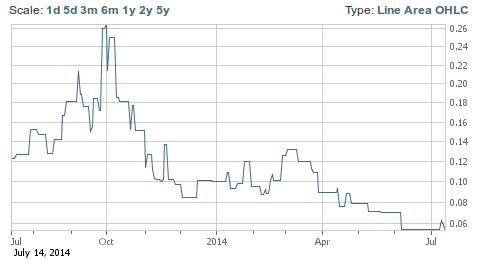
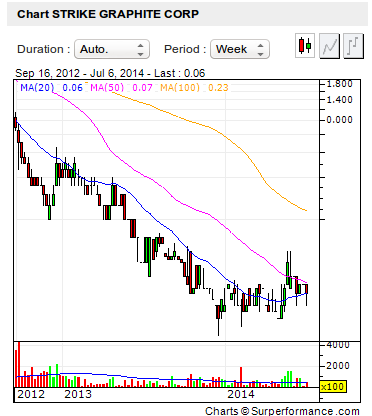
http://online.wsj.com/article/PR-CO-20140715-904725.html
Athabasca Nuclear and Strike Graphite Announce Intent to Merge
VANCOUVER, BRITISH COLUMBIA–(Marketwired – July 15, 2014) –
NOT FOR DISTRIBUTION TO U.S. NEWS WIRE SERVICES OR DISSEMINATION IN THE UNITED STATES
🙂
Athabasca Nuclear Corporation (TSX VENTURE:ASC) (“Athabasca Nuclear”) and Strike Graphite Corporation (TSX VENTURE:SRK) (“Strike”) are pleased to jointly announce that they intend to merge and form a combined Saskatchewan-centered exploration and development company with a multi-faceted project portfolio being focused on the Preston Lake uranium and the Sask Craton diamond projects.
The transaction (the “Transaction”) will be completed by way of a plan of arrangement, or other business combination, in which Athabasca Nuclear will acquire all of the issued and outstanding common shares of Strike. Each Strike shareholder will receive one common share of Athabasca Nuclear for each common share of Strike held. All outstanding Strike options and warrants will be exchanged for options and warrants of Athabasca Nuclear in an amount and at exercise prices adjusted in accordance with the same exchange ratio.
Merged Entity Highlights:
   -- Athabasca Nuclear is the Operator of and a working interest partner in
      the Western Athabasca Syndicate, which is advancing the Preston Uranium
      Project, a large-scale uranium exploration project that is regionally
      proximate to the high-grade uranium discovery made by Fission Uranium
      Corp. in the SW Athabasca Basin. Approximately $3,500,000 dollars in
      exploration has been carried out since July 2013 by the Western Athabasca
      Syndicate in advancing the Preston Uranium Project within a broader
      tenure base consisting of approximately 709,513 acres.

   -- Strike's principal asset is the early-stage Sask Craton and Sask Craton
      North diamond exploration properties ("Sask Craton Properties"), for
      which Strike has received conditional TSX Venture Exchange approval. The
      Sask Craton Properties, in which Strike will hold an 80% undivided
      interest, are contiguous and proximate to the recent Pikoo diamond
      discovery made by North Arrow Minerals Inc. and consists of a mineral
      tenure base of approximately 1,300,000 acres.

   -- The combined entity stands to benefit from reduced operating costs
      associated with the elimination of certain duplicative administrative and
      staffing costs affiliated with running a publicly-traded company. The
      elimination of such duplicative costs may result in incremental capital
      being available to be allocated to exploration of the combined entity's
      project base rather than to administrative expenses.

   -- The aggregation of multiple large-scale project interests within the same
      jurisdiction (Saskatchewan) offers the prospective benefit of being able
      to coordinate regional service companies on a multi-project basis with
      potential economic advantages resulting from volume-based work.

   -- The combined entity stands to benefit from a stronger working capital
      position and balance sheet. Leveraging the fiscal strength of Athabasca
      Nuclear, Strike shareholders will gain access to funding to advance their
      project and address a working capital deficiency which previously would
      have required significant dilution.

   -- The combined entity stands to benefit from a diversified project base
      attracting capital market interest in multiple commodity areas.

   -- The combined entity will offer shareholders of both companies greater
      liquidity by way of a larger combined capitalization and the benefit of
      trading volumes for both equities being concentrated into a single
      vehicle.
“This proposed transaction offers valuable benefits to the current shareholders of both Athabasca Nuclear and Strike. Not only will a combined entity present a superior fiscal situation, but it will also uniquely capture and focus the interest of the capital markets in two of Canada’s emerging resource plays, the SW Athabasca Basin and the Sask Craton, into a single listed vehicle,” stated Ryan Kalt, Chairman & Chief Executive Officer of Athabasca Nuclear.
“Strike is in a fortunate position to have successfully negotiated for its Sask Craton and Sask Craton North properties which recently received conditional approval by the TSX Venture Exchange. By combining with a larger exploration company, Strike will be in an improved position to better access exploration capital for its projects, fund current liabilities, and benefit from a diversified project base,” noted Geoff Balderson, President of Strike.
Athabasca Nuclear currently has 48,593,954 common shares outstanding, and Strike currently has 4,490,649 shares outstanding with a further 12,691,453 shares expected to be issued as a result of its previously announced property acquisitions and debt settlement.
Terms of Transaction
Kyushu’s nuclear restart is not enough – A perfect storm? – Moodys Japan K.K.
“The current tariff, implemented in May last year, is based on four of the company’s nuclear power plants being operational – so even if two reactors are restarted Kyushu will still not be able to return to profitability,” Kazusada Hirose, vice president of Moody’s Japan K.K., told Interfax.
[…]
“On the expenditure side, ordinary expenses increased by 2.5% to ¥1,938.1 billion, affected by […] performances in [the] electricity business as thermal fuel costs increased due to the influence of a weaker yen and costs for power purchases from renewable energy sources increased,” Kyushu said in its FY 2014 results.
[…]

Image source ; http://online.wsj.com/articles/safety-clearance-for-japan-reactors-wont-guarantee-restarts-1405340244
http://interfaxenergy.com/gasdaily/article/11395/kyushus-nuclear-restart-is-not-enough
Restarts at two shuttered nuclear reactors will not be enough to return Japan’s Kyushu Electric to profitability, Moody’s Japan warned on Tuesday in a stark reminder of the difficulties still facing the country’s beleaguered power providers more than three years after the Fukushima crisis.
“The current tariff, implemented in May last year, is based on four of the company’s nuclear power plants being operational – so even if two reactors are restarted Kyushu will still not be able to return to profitability,” Kazusada Hirose, vice president of Moody’s Japan K.K., told Interfax.
“The company’s financial situation is not sustainable on two reactors, and it will have to raise electricity rates again, which the government may be unwilling to do,” said Hirose.
Moody’s warning came one day before the Nuclear Regulation Authority (NRA) was expected to release a draft report on whether the company’s two reactors at Sendai are safe to restart.
The NRA said on Monday it would issue a draft assessment on whether the Sendai reactors had passed updated safety regulations, which were revised in the wake of the Fukushima disaster. The assessment would then be open for public comment for a month before further on-site NRA checks.
“Kyushu Electric’s two Sendai reactors are at the front of the line in terms of inspections. However, since this is the first time reactors would be brought back online, the restart procedure is still uncertain and it remains unclear where the ultimate authority to clear shuttered plants lies,” said Hirose.
Even with central government support, however, Japan’s power providers must secure approval from local communities, many of which have remained staunchly opposed to restarts because of safety concerns.
Earlier in the summer, protestors surrounded government offices in Kagoshima prefecture, the home of the Sendai plant, calling for the reactors to be permanently shut down. During the protest, prefectural officials were handed a petition opposing the restarts signed by around 120,000 people, according to local media. Meanwhile, a March poll by national broadcaster NHK showed 44% of people still believe the country’s nuclear fleet should be permanently shut down.
Deteriorating finances
Peadophile victims attacked by UK government – Bloggers fight back!
Op Ed by Arclight
Posted to nuclear-news.net
Posted on 14 July 2014
A stunning expose of government corruption and attacks on sex victims and supporters in the UK using the “Law”
link source
http://www.dailymotion.com/video/x21g7en_uk-column-news-july-14-2014_news
In a follow up to the attacks on bloggers in the UK, I am posting another video on behalf of, and in support of UK Column and the anti Fracking activist Ian Crane, who are being targetted by the UK`s security services and Home office via “independent organisations”. Having been at the brunt of this sort of operation myself, I feel an obligation to support my fellow citizens in having their right to free speech and discourse not being impeded. So my you tube channel will be used in this support for the near future as I now live outside the UK national borders.
In my earlier ATVOD video, A commenter appeared and left a link to another video that insulted UK Column in true JTRIG style. I looked into the video source and left my findings in the comments. Briefly, the source was from another “Charity” style organisation that is in support of big business. I left links and commentary underneath that video .
In this video from UK Column you will see victims and supporters being persecuted by being sent to jail to destroy there credibility and sex offenders being supported. This is not the way the Law in the Uk is supposed to work but in the new paradaigm UK citizens find themselves in, this is becoming the norm.
Here is a link to other great research in this area and you can get all the UK column videos a few hours after they have been shown live. The video stream is not very good and I wonder if it is not being messed with .. I have personal experience of bandwidths being slowed in the UK and know of other bloggers having the same problem.
All the most recent investigations can be found at this source (to be updated if it gets blocked )
http://www.dailymotion.com/f100004576424298
Please share and distribute widely
Creative commons is enabled for easy download and reupload to another video site please use it and get the word out
here is Chunky mark making an impassioned commentary on the sex offenders cover up
https://www.youtube.com/watch?v=RIlhj_tB_SE
and here is a shocked German citizen asking the European parliament to look into the terrible issue of enforced adoptions at a time that pedophiles in the UK government and their security services supporters are running wild with the ultimate digital control mechanism. These Pedophiles also have the “Law” in their pocket.
Sabine Kurjo McNeill (German), on behalf of Association of McKenzie Friends, on Abolition of Adoptions without Parental Confirm (forced adoption)
Fukushima’s ice wall – a hazardous and dubious operation
 Doubts over ice wall to keep Fukushima safe from damaged nuclear reactors Frozen barrier, costing £185m, being built around Fukushima Daiichi’s four damaged reactors to contain irradiated water The Guardian, Monday 14 July 2014 “…..f all goes to plan, by next March Fukushima Daiichi’s four damaged reactors will be surrounded by an underground frozen wall that will be a barrier between highly toxic water used to cool melted fuel inside reactor basements and clean groundwater flowing in from surrounding hills.
Up to 400 tonnes of groundwater that flows into the basements each day must be pumped out, stored and treated – and on-site storage is edging closer to capacity. Decommissioning the plant will be impossible until its operator, Tokyo Electric Power [Tepco] addresses the water crisis.
Last month workers from Tepco and the construction firm Kajima Corp began inserting 1,550 pipes 33 metres vertically into the ground to form a rectangular cordon around the reactors. Coolant set at -30C will be fed into the pipes, eventually freezing the surrounding earth to create an impermeable barrier.
“We started work a month ago and have installed more than 100 pipes, so it is all going according to plan to meet our deadline,” Tadafumi Asamura, a Kajima manager who is supervising the ice wall construction, said as workers braved rain, humidity and radiation to bore holes in the ground outside reactor No 4, scene of one of three hydrogen explosions at the plant in the early days of the crisis.
But sealing off the four reactors – three of which melted down in the March 2011 disaster – is costly and not without risks. The 32bn-yen (£185m) wall will be built with technology that has never been used on such a large scale.
“I’m not convinced the freeze wall is the best option,” Dale Klein, former head of the US Nuclear Regulatory Commission and a senior adviser to Tepco, recently told Kyodo News. “What I’m concerned about is unintended consequences. Where does that water go and what are the consequences of that? I think they need more testing and more analysis.”
The 1,500-metre wall will stay in use until 2020, using enough electricity every year to power 13,000 households, according to officials.
Over the next eight months, 360 workers from Tepco and Kajima will work in rotating shifts of up to four hours a day, with each shift beginning in the early evening to combat heat exhaustion. Each worker is wrapped in hazardous materials suits and full-face masks, along with tungsten-lined rubber torso bibs for added protection against radiation.Tepco’s record of mishaps in the three years since Fukushima Daiichi suffered a triple meltdown suggests the wall project will not be trouble free. The firm has had problems freezing irradiated water – using the same method being used to build the underground wall – that has accumulated in underground trenches, raising concerns that the ice technology is flawed…….http://www.theguardian.com/environment/2014/jul/13/doubts-giant-ice-wall-fukushima-nuclear-reactors
Iran’s nuclear programme – 5 unresolved issues
-
Enrichment
The biggest obstacle to a deal is the fundamental question of how big the Iranian nuclear programme should be. The key issue here is the country’s capacity to enrich uranium…………
-
Arak
For more than 12 years, Iran has been building a heavy water reactor in Arak, which is now close to completion. Officially it is for the production of isotopes for various industrial, agricultural, medical and other scientific uses. Western sceptics point out the planned reactor is more powerful than would be needed for such uses. They believe it is for the production of plutonium, another route to make a bomb, which is created as part of the spent fuel.
Iran refuses to scrap the project, saying it has invested a lot of time and money in it, building a heavy water production plant nearby. But this could be a relatively easy issue to fix……..
-
Past weaponisation work
The question of whether Iran had a large-scale programme to develop technologies for making a warhead, at least until 2003 as most western intelligence agencies believe, has not been resolved. For many years, IAEA inspectors have been presenting a shopping list of requests to see documents, interview scientists, and visit suspects sites, but have made little progress……..
-
Oversight
Long-term increased scrutiny by IAEA inspectors would have to be part of any nuclear deal. At a minimum, this would involve a regime of enhanced inspections which the IAEA calls the “additional protocol”. This would involve access by inspection teams to all parts of the nuclear cycle, from uranium mining onwards, and would allow them to take environmental samples anywhere they deem fit………
-
Sanctions
Sanctions relief is the main bargaining chip the six powers have in their hands at the negotiating table, and it is one of the thorniest issues, because having placed sanctions on Iran, western governments are going to find it hard to take them off. Over the years, the US and EU have gone beyond measures agreed at the UN, and built up a tangle of interlocking and overlapping punitive restrictions on doing business with Iran……….
- Buying Iranian oil and gas would go a long way towards rescuing the country’s economy, as would allowing insurance of Iranian shipping, and unfreezing an estimated $100bn in Iranian oil revenues held abroad. The problem of US sanctions and Congress could be sidestepped because some of the American sanctions have a sunset clause that means they lapse next year anyway.http://www.theguardian.com/world/2014/jul/13/five-unresolved-issues-iran-nuclear-programme-vienna-talks
Nuclear plant shakes at Fukushima as strong M6.8 quake occurs off coast
CNN Breaking News: Strong M6.8 quake off Fukushima — Tsunami warning issued — Gov’t: “Marine threat is in place… Get out of the water and leave the coast immediately” — Footage shows nuclear plant shaking for over a minute (VIDEO) http://enenews.com/cnn-breaking-news-strong-m6-8-quake-off-fukushima-tsunami-warning-issued-govt-marine-threat-is-in-place-get-out-of-the-water-and-leave-the-coast-immediately-video?utm_source=feedburner&utm_medium=email&utm_campaign=Feed%3A+ENENe
CNN: Earthquake rocks region of northern Japan; tsunami advisories issued — A 6.8-magnitude earthquake early Saturday struck in the area of Fukushima, Japan – the epicenter of a nuclear crisis following a massive 2011 earthquake and tsunami – the Japan Meteorological Agency reported. The same agency issued a tsunami warning for the Pacific coast in the region of Tohoku. […] “Marine threat is in place,” the meteorological agency warned for those in imperiled areas. “Get out of the water and leave the coast immediately.” >> Watch CNN here
AFP: Japan issues tsunami warning after strong quake near Fukushima […] Japan Meteorological Agency said a local tsunami of up to one metre could impact the Pacific coastline […]
AP: Strong quake hits Japan, triggering tsunami — A 6.8-magnitude earthquake has hit Japan’s northern coast near the [Fukushima] nuclear power plant […] Japan’s Meteorological Agency says the quake struck early Saturday 10 kilometers (6 miles) below the sea surface off the coast of Fukushima […] The agency issued tsunami advisory along the Japanese northern coast. Public broadcaster NHK says the Fukushima Dai-ichi nuclear power plant is checking if there is any damage from the quake.
Telegraph: The Japan Meteorological Agency said a local tsunami of up to 3.3 feet could impact the Pacific coastline in Fukushima, Iwate and Miyagi prefectures after the quake. The quake was measured at a depth of 6 miles and occurred at 4.22am local time [3:22p ET], the US Geological Survey said. […] Plant operators Tokyo Electric said there were no immediate reports of abnormality after the quake, according to Kyodo news agency. […] The meteorological agency advised people to leave the coast immediately, while Japan’s public broadcaster NHK said some local authorities issued evacuation advisories to their residents.
Watch quake hit Fukushima Daiichi here (4:22:28 – 4:23:40 JST)
The nuclear safety myth – a danger that is returning to Japan
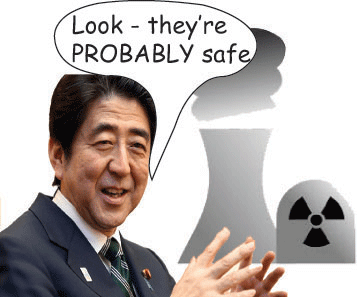 Beware the safety myth returning to Japan’s nuclear debate,Ft.com By Jonathan Soble, 12 July 14,
 Those leaders knew better, of course. But absolute guarantees were the only way to bring the national psyche into line with what were, in an energy-poor country, powerful political and economic incentives. The strategy worked. Japan ultimately built 54 commercial reactors, and before the Fukushima disaster there were plans for more. But the approach did nothing to make those reactors safer, and arguably made them less so. The need to maintain the myth prompted utilities and the government to dismiss suggestions that standards could be improved……… Today, all of Japan’s surviving nuclear reactors remain offline, despite efforts by successive governments to restart them. Shinzo Abe is the most pro-nuclear prime minister since the accident, and also the most popular. Yet much of the public remains sceptical. This week regulators are expected to certify the first plant since tighter safety standards were introduced a year ago, a move that could lead to the restarting of nuclear power production as early as autumn. Mr Abe once said an accident such as Fukushima “could never happen”. Today he is more circumspect, talking about making Japan a world leader in nuclear safety rather than a fantastical land without risks. Yet the broader debate has not changed as much as some had hoped.
Fukushima radioactive releases – Cesium 137 onto the Pacific Ocean
 TV: Fukushima radioactive releases into ocean can continue thousands of more years, says nuclear expert — Japan gov’t concerned with tracking radioactive waste in Pacific as it returns to Fukushima from U.S. West Coast after several decades (VIDEO) http://enenews.com/tv-radioactive-releases-pacific-thousands-years-fukushima-melted-fuel-be-removed-nuclear-expert-japan-govt-concerned-radioactive-waste-ocean-coming-fukushima-several-decades-after-being-west-coast?utm_source=feedburner&utm_medium=email&utm_campaign=Feed%3A+ENENews+%28Energy+News%29
American Chemical Society — Environmental Science & Technology (pdf),Apr. 29, 2014 (emphasis added): 135Cs/137Cs Isotopic Ratio as a New Tracer of Radiocesium Released from the Fukushima Nuclear Accident […] many important issues with respect to its atmospheric transport, deposition processes, and distributions in terrestrial and marine environments remain to be investigated. It has been estimated that ∼80% of the atmospherically released 137Cs was deposited in the western North Pacific Ocean, in addition to […] 137Cs directly discharged into the ocean […] continuous input of 137Cs into the ocean due to river runoff of the 137Cs deposited in heavily contaminated Fukushima forest soil can be expected. Recent studies have revealed the start of the transport of the Fukushima accident-sourced 137Cs into the ocean interior […] it is predicted that in 30 years the Fukushima accident-derived 137Cs will come back to the ocean surface in the western North Pacific Ocean off the Fukushima coast through its transport by the Kuroshio current. Thus, to understand the environmental behavior and the fate of Fukushima accident-sourced radionuclides in the environment, a powerful Cs tracer is strongly required, because the currently widely used 134Cs/137Cs activity ratio tracer will become unavailable in several years because of the rapid decay of 134Cs […] 135Cs has a half-life of 2 × 10^6 [2.3 million] years; therefore, we are confident that the 135Cs/137Cs isotopic ratio can be considered as a new powerful tracer for long-term source identification and environmental behavior studies. […] This study was supported […] partially by the Agency for Natural Resources and Energy, the Ministry of Economy, Trade and Industry (METI), Japan [7 of study’s 8 authors are from Japan’s National Institute of Radiological Sciences]
Nuclear analyst John Large, July 9, 2014: The cores remain active for hundreds, if not thousands, of years, so there’s a commitment to keep either the ice wall technology in place or to replace it with an alternate technology by some future generation. […] Water is coming off the escarpment above the three reactors, it’s then percolating through the ground — there’s hydrostatic pressures pushing the water up toward the sea level — it’s then collecting the fission products and radioactive products from the melted-down cores and taken out to sea. […] What I think they should now have a plan to tackle the root cause… How do you control, manage and eventually remove the reactor cores? […] If the reactor cores remain in there, it’s going to be a constant leachate (water that percolates through a solid and leaches out some of the constituents) of radioactivity.
-
Archives
- February 2026 (228)
- January 2026 (308)
- December 2025 (358)
- November 2025 (359)
- October 2025 (376)
- September 2025 (258)
- August 2025 (319)
- July 2025 (230)
- June 2025 (348)
- May 2025 (261)
- April 2025 (305)
- March 2025 (319)
-
Categories
- 1
- 1 NUCLEAR ISSUES
- business and costs
- climate change
- culture and arts
- ENERGY
- environment
- health
- history
- indigenous issues
- Legal
- marketing of nuclear
- media
- opposition to nuclear
- PERSONAL STORIES
- politics
- politics international
- Religion and ethics
- safety
- secrets,lies and civil liberties
- spinbuster
- technology
- Uranium
- wastes
- weapons and war
- Women
- 2 WORLD
- ACTION
- AFRICA
- Atrocities
- AUSTRALIA
- Christina's notes
- Christina's themes
- culture and arts
- Events
- Fuk 2022
- Fuk 2023
- Fukushima 2017
- Fukushima 2018
- fukushima 2019
- Fukushima 2020
- Fukushima 2021
- general
- global warming
- Humour (God we need it)
- Nuclear
- RARE EARTHS
- Reference
- resources – print
- Resources -audiovicual
- Weekly Newsletter
- World
- World Nuclear
- YouTube
-
RSS
Entries RSS
Comments RSS
 nuclear-news