Sendai nuclear power plant in Kagoshima Prefecture, a lesson in manipulation of the truth.
opednews.com

(image by http://www.tbs.co.jp/newsbird/)
Image courtesy of TBS News bird
A recent court ruling in Japan, Fukui District Court’s landmark ruling on May 21, has brought into question the justification for taking the risks associated with nuclear power.
The ruling states that the risks of earthquake-safety planning concerning nuclear reactors are impossible to measure because the science of earthquake prediction today is not able to allow for the risk of damage to nuclear power plants.
As we can see by the nuclear disaster in Fukushima, these risks are and have been seriously underestimated. Even so, the Japanese nuclear corporations are still trying to claim that they can allow for any possible future disaster.
Risk assessment is a core part of any project and it takes into account the profit and other benefits of having a nuclear plant and this is balanced against the social, health and environmental issues.
For a corporation the profit element is the most important as the corporations need to be able to show profits to their shareholders whilst local community and other interested NGOs would normally voice the issues and risks from a social, health and environmental point of view.
Court ruling puts a spanner in the works
AJW.ASAHI.COM reported these facts on the May 21, 2014;
“…An anti-nuclear citizens’ network has translated a Japanese court’s ruling blocking the restarts of two reactors into English, Korean and Chinese to spread the ‘universal values’ of the judgment.
“Part of the translated ruling says: ‘this court considers national wealth to be the rich land and the people’s livelihoods that have taken root there, and that being unable to recover these is the true loss of national wealth.
“…The ruling also says, ‘the operation of nuclear power plants as one means of producing electricity is legally associated with freedom of economic activity and has a lower ranking in the Constitution than the central tenet of personal rights.
“…Lawyer Hiroyuki Kawai, who heads a network of plaintiff groups demanding the abolishment of nuclear energy, said it is ‘extremely rare’ for a Japanese court ruling other than in patent cases to be translated into foreign languages.
“The ruling has resonated with people around the world because it declared universal values by placing priority on the lives of people over the merits of nuclear energy, Kawai said….”
Full article here;
http://ajw.asahi.com/article/behind_news/social_affairs/AJ201405210079
The Green Action Japan website has this to say:
“English translation of the epoch-making Japanese court verdict issuing an injunction against restart of Japan’s nuclear power plants Ohi Units 3 and 4.
“On May 21, 2014, the Fukui District Court in Japan issued a scathing indictment against restart of the Ohi Nuclear Power Plant owned and operated by the second largest electric utility in Japan.
The injunction against the plant is epoch-making because it addresses generic issues applicable to nuclear power plants worldwide.”
English translation of summary now available.
Translation: Greenpeace / Cooperation: Green Action
https://www.greenpeace.de/sites/www.greenpeace.de/files/publications/fukui-urteil-03072014_0.pdf
Kyushu Electric Power fights back regardless
Kyushu Electric power has recently managed to get a ruling from the NRA to restart 2 of its 4 nuclear-reactor units. However, there are some problems with this ruling aside from the Ohi nuclear plant ruling mentioned above.
There are problems with the safety of this nuclear site such as the evacuation plan for the 30,000 residents, in the case of a nuclear incident.
“The (evacuation) plan itself is very sloppy, just slotting bits and pieces into a manual without giving any consideration to the special features of the area,” said Zenyu Niga.
http://in.reuters.com/article/2014/06/30/us-japan-nuclear-evacuation-idINKBN0F513N20140630
The volcanic issue ignored
Also, aside from earthquake threats there is an issue with volcanoes with this nuclear plant. In fact there was a large eruption in 2013 at a local volcano reported here;
Apart from a number of calderas, Sakurajima, an active volcano, is just 50 Km away and a scientist said, “No-one believes that volcanic risks have been adequately discussed,” said Setsuya Nakada, a professor of volcanology at the University of Tokyo, who advised officials when they were forming regulatory guidelines for monitoring volcanoes.
http://www.reuters.com/article/2014/06/04/us-japan-nuclear-volcano-idUSKBN0EE2BF20140604

(image by Christina mac Phearson)
Image courtesy of Christina mac Phearson
The manipulation of safety agencies who wish to ignore the court ruling
Kunihiko Shimazaki, who was one of the members of the post-Fukushima formed NRA that was supposed to oversee a new safety regime, was recently replaced. An executive of the Kyushu Electric Power Co said that “Shimazaki made us suffer,” and on “May 14, executives of the Kansai Economic Federation and Kyushu Economic Federation met with Katsuhiko Ikeda, the NRA secretary-general.”
Then “Yasuhisa Shiozaki, the deputy policy chief, openly criticised Shimazaki when he said, “While it is acceptable to have seismologists on the NRA, the same cannot be said for someone who knows absolutely nothing about nuclear energy.”
These three quotes were reported here:
http://ajw.asahi.com/article/behind_news/politics/AJ201405280023
Shimazaki was then replaced, leaving the NRA without a seismology expert for at least the next 5 years.
A financial problem exists
Concerning the issue of profitability Moodys of Japan KK reported that even if the Kyushu Sendai plant did start the 2 reactors, “The current tariff, implemented in May last year, is based on four of the company’s nuclear power plants being operational — so even if two reactors are restarted Kyushu will still not be able to return to profitability,” Kazusada Hirose, vice president of Moody’s Japan K.K.
Full article here:
http://interfaxenergy.com/gasdaily/article/11395/kyushus-nuclear-restart-is-not-enough
Social, environmental and economic manipulation.
Half the population of the local town have voted to reject the local plant even though there is no alternative funding for other infrastructure to stimulate business unconnected to the nuclear industry. A video from an independent media company shows this clearly and shows how the nuclear company uses money to buy its way. That short video can be seen here (Reporting by Hitomi Yagi from TBS News Bird):
In the video, we see that there are many social and economic impacts caused by the nuclear plant, such as the possible loss of fishing grounds if another reactor is to be built on reclaimed land and how bribes to fishermen with compensation payments are used to achieve this. We also see the desperation of business needing customers because no other infrastructure projects have been put in place these last 3 years or so resulting in economic hardship and the local community being split apart.

(image by http://www.tbs.co.jp/newsbird/)
Image courtesy of TBS News Bird
Fish dying because of nuclear-associated pollution?
There is even a statement from a local in the video mentioned above, that increasing amount of “fish have been dying for the last five years” and we see some evidence of that, I wonder if that is why the fishermen are so ready to accept the compensation for the loss of their fishing grounds?
Summary
It is obvious that local government, national government and nuclear industry has contrived to fully manipulate the situation in this and other areas to the benefit of the nuclear industry and to the detriment of peoples safety, financial security and to the quality of the environment. It is obvious that the Sendai Kyushu reactor will be opened no matter the dangers involved.
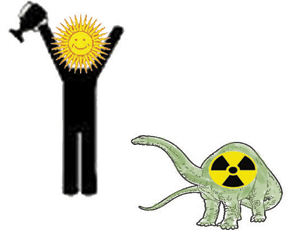
Glum future for nuclear industry as wind and solar power get ever cheaper
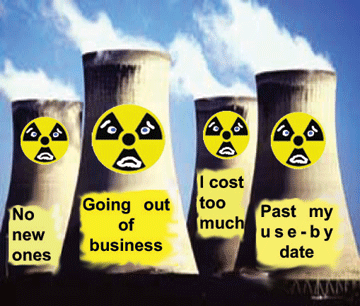
 “Even if the government can get over that hurdle, there are many problems to overcome—for example, the designs of the stations have to be finalised. The process could take years, by which time wind, solar and other renewables will have expanded so much it will make nuclear redundant.”
Boom-or-Doom Riddle for Nuclear Industry, truthdig, 27 July 14 “………The figures show that nuclear production is currently in decline from a peak in 2006, and is now producing less than 10% of the world’s electricity needs.
World solar capacity, on the other hand, increased by 35% in 2013, and wind power by 12.5%—although, added together, they still do not produce as much power as nuclear.
All the evidence is that wind and solar will continue to grow strongly, and particularly solar, where technological advances and quantity of production means that prices have dropped dramatically.
Costs of producing energy are hard to compare because solar is small and local and dependent on sunshine, while nuclear is large and distant and must be kept on all the time. However, research suggests that solar is already producing cheaper power per kilowatt hour than nuclear, the costs of which have not come down.
Commercial market
Both costs and time seem to be major factors in deciding which technology will gain market share. Nuclear stations are expensive and a long time passes before electricity is produced, making them almost impossible to finance in a normal commercial market. Solar panels, in contrast, can be up and running in days, and wind turbines within weeks.
Historically, nuclear power plants have always been built with government subsidy—a pattern that is continuing across the world. For example, the two countries with the largest number of reactors under construction—China, with 29, and Russia, with 10—have populations with no democratic say in the matter.
Critics of the WNA figures say that while the claims for reactors planned and proposed might be real, the chances of most of them actually being built are remote.The US is said to have five reactors under construction, five more planned and 17 proposed—but with existing nuclear stations closing because they cannot compete with gas on price, it is unlikely that all of these will be completed by 2030.
The UK, which has a government keen to build nuclear stations, is said to have four stations planned and seven more proposed. The first of these stations was due to be opened by 2017, but work has not yet been started. The earliest completion date is now expected to be 2024, and the rest will follow that.
The delay in Britain is partly because the subsidies offered to French, Chinese and Japanese companies to build the UK reactors are under investigation by the European Commission to see if they breach competition rules.
Massive subsidies
Martin Forward is from the English Lake District, where one of the four nuclear stations is planned, and runs Cumbrians Opposed to a Radioactive Environment. He said: “I cannot see how nuclear has any future in Europe because of cost. Nuclear needs massive subsidies to be financially viable, but these are currently illegal under European law, so it is unlikely that the British ones will be built.
“Even if the government can get over that hurdle, there are many problems to overcome—for example, the designs of the stations have to be finalised. The process could take years, by which time wind, solar and other renewables will have expanded so much it will make nuclear redundant.”…….http://www.truthdig.com/report/item/boom-or-doom_riddle_for_nuclear_industry_20140727
Serious effects on Europe’s nuclear power if Europe puts sanctions on Russia

 Sanctions on Russia have potential for nuclear impact, PennEnergy, July 23, 2014 By Diarmaid Williams International Digital Editor Recent events in Ukraine have put Europe’s energy security again under scrutiny, and while there is great concern about the bloc’s vulnerability to Russia retaliating to sanctions by turning of the gas, not as much attention has been paid to the nuclear power aspect.
It is an important supplier of the raw material for nuclear fuel, uranium, accounting for 18 per cent of EU supplies.
The BBC reports that 30 per cent of the enrichment work to make uranium suitable for power generation is done by Russian companies.
Meanwhile, many countries within the EU have a significant number of older, Russian-designed nuclear reactors – 18 in all. Finland has two – and all the reactors in Bulgaria, the Czech Republic, Slovakia and Hungary (who are in deals with Russia to build two more) are Russian-designed.
These states are heavily reliant on their nuclear capacity, with 50 per cent of Slovakia’s electricity and 45 per cent of Hungary’s being accounted for by these plants.The fuel for a reactor also has to be supplied in a form – called a fuel assembly – that meets the specifications of the particular reactor, and for Russian-designed nuclear reactors the fuel comes from a Russian company, TVEL. Anything that disrupts the supply of the fuel assemblies needed for these countries’ reactors would be a serious problem for them. A recent European Commission report argued that, “Ideally, diversification of fuel assembly manufacturing should take place, but this would require some technological efforts because of the different reactor designs.”
Because of the implications to countries’ power sectors and, subsequently, their economies, many are reluctant to back aggressive sanctions against Russia……..http://www.pennenergy.com/articles/pei/2014/07/sanctions-on-russia-have-potential-for-nuclear-impact.html
USA’s new nuclear power construction is not working out
 Promises of easier nuclear construction fall short, Tri City Herald, BY RAY HENRY Associated Press July 26, 2014 WAYNESBORO, GA. The U.S. nuclear industry has started building its first new plants in decades using prefabricated Lego-like blocks meant to save time and money and revive the once promising energy source.
So far, it’s not working.
Quality and cost problems have cropped up again, raising questions about whether nuclear power will ever be able to compete with other electricity sources. The first two reactors built after a 16-year lull, Southern Co.’s Vogtle plant in Georgia and SCANA Corp.’s VC Summer plant in South Carolina, are being assembled in large modules. Large chunks of the modules are built off-site, in an effort to improve quality and avoid the chronic cost overruns that all but killed the nuclear industry when the first wave of plants was being built in the 1960s and 1970s.
Analysts say engineers created designs that were hard or impossible to make, according to interviews and regulatory filings reviewed by The Associated Press. The factory in Louisiana that constructed the prefabricated sections struggled to meet strict quality rules. Utility companies got early warnings but proved unable to avoid the problems. Now the firms leading the project are phasing out the Louisiana factory for work on the biggest modules and contracting with new manufacturers………
Inspectors for the U.S. Nuclear Regulatory Commission halted their first review of the plant the following month, saying it was not ready for in-depth scrutiny. Follow-up inspections found more issues with the plant’s quality assurance programs. NRC officials proposed a $36,400 fine against The Shaw Group for firing a quality insurance supervisor elsewhere in its company who warned a potentially faulty part may have been shipped to a project in New Mexico. The fine was dropped after the company agreed to changes. The agency also said workers at the Lake Charles facility feared raising safety and quality concerns to their supervisors………http://www.tri-cityherald.com/2014/07/26/3079384/promises-of-easier-nuclear-construction.html?sp=/99/915/
Joseph Mangano’s new book “Mad Science THE NUCLEAR POWER EXPERIMENT”
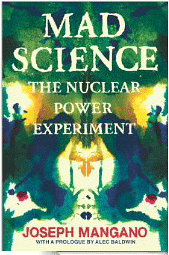 Mad Science THE NUCLEAR POWER EXPERIMENT Joseph Mangano http://www.orbooks.com/catalog/mad-science/ Foreword by Alec Baldwin
“Joe Mangano is the constant, tireless voice that has helped keep me linked to reports from the front lines of the battle to expose the staggering risks to public health posed by nuclear power . . . Joe has been one of the most dedicated, intelligent and even-handed public activists I have ever known. He has also proven to be one of the most effective, on a battlefield where gains are measured in inches, if not centimeters.” —from the foreword by Alec Baldwin
Will Americans once again play nuclear roulette?
Just one year after the Fukushima meltdown, all 54 reactors in Japan have been closed, and may never be restarted. Germany recently closed several reactors, and will shutter them all within a decade. Italy revoked its pledge to build new reactors, keeping that nation nuclear-free. All these decisions are based on the understanding that reactors are extremely dangerous and expensive.
In the U.S., the remnants of the once-overwhelmingly powerful nuclear lobby are making their last stand for “clean” nuclear energy. The sixty-year-old vision of power “too cheap to meter” (words originally uttered by a banker promoting the industry) is back. While other countries end their reliance on nuclear energy, Americans contemplate its revival, even as existing reactors, which produce a fifth of U.S. electricity, pass retirement age and are corroding.
In Mad Science, Joseph Mangano strips away the near-smothering layers of distortions and outright lies that permeate the massive propaganda campaigns on behalf of nuclear energy. He explores the history of the industry, with its origins in the Manhattan Project, through its heightening promotion during the Cold War and its entwinement with nuclear weapons.
Mad Science includes an account of nuclear accidents and meltdowns and their consequences, from Chernobyl to Santa Susana and beyond; as well as a point-by-point refutation of pro-nuke arguments. Atomic energy is unsafe – it deals with staggeringly poisonous substances at every stage of its creation – un-economical in the extreme and impractical.
Publication October 2012 • 336 pages
paperback ISBN 978-1-935928-85-0 • ebook ISBN 978-1-935928-86-7
Japanese residents near Sendai to get iodine tablets, in case of nuclear power accident
 Kagoshima residents near Sendai nuclear plant given iodine tablets http://www.japantimes.co.jp/news/2014/07/27/national/kagoshima-residents-near-sendai-nuclear-plant-given-iodine-tablets/#.U9bY_ONdUnk KYODO JUL 27, 2014 Local authorities in Kagoshima Prefecture on Sunday started handing out iodine tablets to residents living within 5 km of the Sendai nuclear power plant, which may be restarted in the fall.
It is the first time iodine tablets have been distributed under guidelines instituted by the Nuclear Regulation Authority, which was set up in the wake of the 2011 Fukushima nuclear disaster. Iodine tablets help people protect their thyroid glands from radiation.
The move by the Kagoshima prefectural and Satsumasendai municipal governments came after Kyushu Electric Power Co.’s Sendai plant cleared a key safety hurdle for restarting operations earlier this month.
About 2,700 of the roughly 4,700 residents over 3 who live within the 5-km radius were given a supply of tablets after hearing an official briefing, submitting medical interview sheets and receiving the green light from doctors, according to prefectural officials.
Briefings for the remaining residents will resume in September, they said.
A total of 39 residents declined to receive the tablets. Children under 3 will receive the equivalent at shelters in the event of a nuclear accident, the officials said.
Delaware residents to get iodine tablets just in case of nuclear [power accident
Del. distributing radiation protection tablets http://newsok.com/del.-distributing-radiation-protection-tablets/article/feed/715584 July 26, 2014 MIDDLETOWN, Del. (AP) — Officials say they’ll be distributing free potassium iodide tablets to Delaware residents who live within 10 miles of the Salem/Hope Creek nuclear power plant in New Jersey.
If a radiation emergency were to occur, officials would inform the public through the use of emergency alert system radio stations. The information would include evacuation instructions as well as instructions on when to take the potassium iodide tablets.
Washington gearing up for a pre-emptive nuclear attack on Russia?
 Preparing for War with Russia. Removing Russia with a Preemptive Nuclear Attack? What is the Future of Humanity? By Dr. Paul Craig Roberts Global Research, July 26, 2014 paulcraigroberts.org “……..NATO commander General Breedlove and Senate bill 2277 clearly indicate that Washington is organizing itself and Europe for war against Russia (see my previously posted column).
Europe is reluctant to agree with Washington to put Ukraine in NATO. Europeans understand that if Washington or its stooges in Kiev cause a war with Russia Europe will be the first casualty. Washington finds its vassals’ noncompliance tiresome. Remember Assistant Secretary of State Victoria Nuland’s “f**ck the EU.” And that is just what Washington is about to do.
The US Senate’s Russian Aggression Prevention Act, about which I reported in my previous column, does even more mischief than I reported. If the bill passes, which it likely will, Washington becomes empowered to bypass NATO and to grant the status of “allied nation” to Ukraine independently of NATO membership. By so doing, Washington can send troops to Ukraine and thereby commit NATO to a war with Russia………
As Stephen Starr explained in a guest column, there are no winners of nuclear war. Even if the US escapes retaliatory strikes, everyone will die regardless.
The view in Washington of the neoconservatives, who control the Obama regime, is that nuclear war is winnable. No expert opinion supports their assumption, but the neocons, not the experts, are in power,
Notice how quickly Washington escalated the orchestrated Ukrainian “crisis” without any evidence into “Russian aggression.” Overnight we have the NATO commander and US senators taking actions against “Russian aggression” of which no one has seen any evidence.
With Iraq, Libya, and Syria, Washington learned that Washington could act on the basis of baldfaced lies. No one, not Great Britain, not France, not Germany, not Italy, not the Netherlands, not Canada, not Australia, not Mexico, not New Zealand, not Israel, nor Japan, nor S. Korea, nor Taiwan, nor (substitute your selection) stepped forward to hold Washington accountable for its blatant lies and war crimes. The UN even accepted the package of blatant and obviously transparent lies that Colin Powell delivered to the UN.
Everything Powell said had already been refuted by the UN’s own weapons inspectors.
Yet the UN pussies gave the go-ahead for a devastating war…….http://www.globalresearch.ca/preparing-for-war-with-russia/5393375
Pacific islands need help to move to renewable energy-powered shipping

Of course, as with the Abbott government, Australia barely gives any aid at all, so does this matter to Australia?
Expert calls on Pacific donor community to focus on renewable energy for shipping There’s been a call for international donors to adjust their priorities and invest in sustainable sea transport to reduce the Pacific’s reliance on expensive and high-polluting fossil fuels.http://www.abc.net.au/news/2014-07-27/an-pacific-sea-transport/5627330
Dr Peter Nuttall, head of the sustainable sea transport research program at the University of the South Pacific, says the region’s strategies for moving to a low-carbon economy appear to be ignoring the need to reform the maritime sector. He says sea transport in the Pacific is facing a “looming crisis” due to the spiralling cost of fuel. “For Pacific island communities and countries, shipping is an absolute lifeline,” Dr Nuttall told the ABC. “For many small maritime communities, if you cannot get ships out to the islands, then those communities simply have no futures.”
But Dr Nuttall says the donor community has focused on funding renewable energy projects in the electricity sector but ignored the need to do the same in the shipping industry. “We’re the most dependent region in the world on imported fossil fuel,” he said. “Seventy per cent, maybe as high as seventy-five per cent, of all fossil fuel burnt in the Pacific today is burnt for transport. “Many consultants (working for aid donors) come from a continental mindset where transport is the lowest user of energy and the whole concept that sea transport is critical is totally alien.”
Dr Nuttall says the maritime sector is ripe for investment in more sustainable methods of transport. “There are a range of renewable energy technologies and there are a whole lot of things you can do with conventional diesel-powered ships or heavy fuel-powered ships to make them more efficient,” he said. Dr Nuttall was one of the organisers of the second Sustainable Sea Transport Talanoa conference, held recently at the University of the South Pacific in Suva.
Fewer nuclear weapons, but we are still not safer?
I think there’s a flaw in this argument . It sounds a bit like the USA pro-gun argument “Guns don’t kill people – people kill people”. But in fact USA has so many homicides, in which if just fists or a non-gun weapon had been used, death would not result. The wide possession of guns means a greater rate of violent deaths in USA. Are you saying that “Nuclear weapons don’t kill people. The person pressing the nuclear button kills people”. Therefore nuclear weapons in themselves are “innocent”?
BC’s Tales of the Pacific: Marshall Islands sues nuclear powers http://www.mvariety.com/cnmi/cnmi-news/editorials/67603-bc-s-tales-of-the-pacific-marshall-islands-sues-nuclear-powers, July 28, 2014 By BC Cook
BACK in the 1950s the Marshall Islands experienced massive destruction and radiation as the island nation hosted hundreds of nuclear bomb tests.
The United States sponsored most of these tests, though other nations exploded bombs there and throughout the Pacific region. You might assume a current lawsuit filed by the Marshall Islands against the U.S. and eight other nuclear powers has to do with demanding compensation for the testing. But you would be wrong. They are suing in U.S. court and in the World Court at the Hague, Netherlands. What do they want?
So the Marshall Islands is calling them out on the hollowness of their lofty promises. The Marshallese are saying, in effect, “Put your money where your mouth is. You talk a good game but don’t live up to your own hype.”They want the world to disarm its nuclear weapons. Come again? Well, the nine nations named in the lawsuits all signed the Nuclear Non-Proliferation Treaty in 1968. Part of that treaty committed the signatories to rid the world of nuclear weapons for good, but none of the countries has made any move in that direction. Talks were supposed to have been held, deals were to be made, agreements reached. And while some of those things came to pass we still have huge stockpiles of nuclear weapons.
It is not likely that anything will come of the lawsuits, not in terms of actual change. It is interesting to note, however, that there are fewer nuclear weapons in the world than there were in the Sixties, by a large margin. So the nuclear powers could claim that they have, in fact, greatly reduced the number of nuclear weapons in the world, just as they promised they would. The problem is that none of us feels much safer than they did back then. Why?
Because war and violence are still everywhere. There is constant strife in the world. We all feel like we could be swept up in the violence at any time: a terrorist strike here, a rebellion there, jets being shot out of the sky for simply being in the wrong place. And since the second world war atomic and nuclear bombs have come to symbolize everything wrong with the world we live in, our inability to get along with each other.
I am reminded of a scene in the Terminator movies when children are seen playing war with toy guns. In a profound moment of clarity, a machine explains to a person why humanity is doomed. He says it is in our nature to destroy ourselves. Take away the nuclear weapons and we will find another way to kill each other.
So a lawsuit has been filed, arguments will be had, promises will be made and broken, and people will go on dying. Was the machine right? Can we save ourselves? BC Cook, PhD teaches Pacific history and other subjects at St. Charles Community College. He lived on Saipan and has taught at universities in the U.S., including the University of Missouri.
1 This Month


Tell the Ukrainian Government to Drop Prosecution of Peace Activist Yurii Sheliazhenko

Petition to revoke the licensing of the Near Surface Nuclear Disposal Facility (NSDF) at Chalk River. https://www.ourcommons.ca/petitions/en/Petition/Details?Petition=e-7247


of the week – STOP SMALL MODULAR REACTORS IN CANADA
To see nuclear-related stories in greater depth and intensity – go to https://nuclearinformation.wordpress.com
-
Archives
- March 2026 (193)
- February 2026 (268)
- January 2026 (308)
- December 2025 (358)
- November 2025 (359)
- October 2025 (376)
- September 2025 (258)
- August 2025 (319)
- July 2025 (230)
- June 2025 (348)
- May 2025 (261)
- April 2025 (305)
-
Categories
- 1
- 1 NUCLEAR ISSUES
- business and costs
- climate change
- culture and arts
- ENERGY
- environment
- health
- history
- indigenous issues
- Legal
- marketing of nuclear
- media
- opposition to nuclear
- PERSONAL STORIES
- politics
- politics international
- Religion and ethics
- safety
- secrets,lies and civil liberties
- spinbuster
- technology
- Uranium
- wastes
- weapons and war
- Women
- 2 WORLD
- ACTION
- AFRICA
- Atrocities
- AUSTRALIA
- Christina's notes
- Christina's themes
- culture and arts
- Events
- Fuk 2022
- Fuk 2023
- Fukushima 2017
- Fukushima 2018
- fukushima 2019
- Fukushima 2020
- Fukushima 2021
- general
- global warming
- Humour (God we need it)
- Nuclear
- RARE EARTHS
- Reference
- resources – print
- Resources -audiovicual
- Weekly Newsletter
- World
- World Nuclear
- YouTube
-
RSS
Entries RSS
Comments RSS
 nuclear-news