Nuclear power commercial and military – the perfect terrorism targets – theme for August 14
We know what a suicide plane crash can do to buildings. We know what missiles can do to planes. But what about the radioactive devastation that terrorist missiles, bombs, computer hacking could do to nuclear facilities?
While the nuclear nations ramp up their nuclear weapons – supposedly for “security” “defense” – they are in fact increasing their vulnerability – setting up targets for terrorists.
Nuclear reactors, nuclear fuel pools, nuclear waste containers, nuclear transports – these are indeed the perfect targets for terrorist attack. Meanwhile the nuclear lobby spins out its guff about “energy security” blah blah. Governments worry about earthquakes, floods, tsunamis – and well they should.
The “twin towers” attack of September 2011, the missile attack on a civilian plane over Ukraine – surely these are indications of why it is time to get rid of those even more terrible targets – the world’s nuclear facilities.

Japan Three Years after the Earthquake – Energy Policy Discussion with Ueta and Suzuki
EXTRACTS FROM DEBATE
(Full transcript below)
It’s not simply the matter of cleaning up and asking people to come back. We affected their lives that much and changed their course by promoting nuclear power and causing that accident.
The Views state in Point 2 that the accident imposed restrictions on people’s right to live.
but I think there was also an aspect to the accident that strictly questioned whether or not this technology called atomic power generation can coexist with our society in a broader sense.
In response to the request, the Seismological Society of Japan asked the Agency of Natural Resources and Energy to clarify whether this working group has the status of a third-party organ or not, taking a proposal made by the Science Council of Japan (refer to Footnote 6) into consideration. (Refer to an essay by Kato that appeared in the February 2014 issue of Science Journal Kagaku for details.) However, the Agency of Natural Resources and Energy has ignored this request and provided no reply to the Society whatsoever.
However, disaster prevention plans are not included in items inspected by the Authority. The government cannot win the confidence of residents without disaster prevention plans
We should set up organizations for such activities and build systems for exchanging opinions with citizens. Unless such actions are taken, things will not advance smoothly even if the government comes to the front. We have said this repeatedly.
There is no upper limit for the cost of nuclear power generation. No ceiling has been set on the cost of nuclear power generation because the cost depends on the size of an accident if it happens.
There have been no published data about cost distribution among existing plants. Oshima Kenichi of Ritsumeikan University calculated costs, but they were averages for existing plants.
Japanese systems have a built-in tendency to hide information in administration. What should we do about this tendency?
Power companies stop publishing their costs if and when competition results from electric power deregulation. The government must take steps to prevent such a response
The government talks about responsible energy policies. But the government will not be able to perform its responsibilities if it leaves the policies in the hands of business operators.
It is wrong to say that nuclear power is not necessary while it is OK for power companies to fail without such discussions. At the same time, it is unreasonable to say nuclear power is necessary by speaking as if our lives will be thrown into trouble if power companies become bankrupt.
The latest nuclear accident was so huge in scale that it could cause a big, global company called Tokyo Electric Power Company to fail if decontamination and compensation are assumed as its responsibilities.
Damage compensation is rising in value as the actual conditions of the Fukushima Nuclear Accident become more and more known. Where to go for securing funds for compensation becomes a problem under the circumstance. One approach is to obtain the funds by raising power rates. Another approach is to secure the funds by restarting nuclear power plants. The third approach is to build up the funds by asking to reduce damage compensation. There are no other alternatives. All these three approaches appear in the business plans of Tokyo Electric Power Company.
The government is shifting the burden to power rates and taxes after all. As for the fourth approach, the government is taking over compensation by using tax revenues
There are private companies that implement a national policy. In several places, the Opinions say the government comes to the front. I think the government must deal with nuclear power generation responsibly in many respects.
I feel that investing tax revenues in the organization in charge of decommissioning is inevitable in a sense.
As a matter of fact, the Nuclear Damage Compensation Facilitation Corporation Act prescribes these points should be discussed within one year. But no discussion has yet taken place. We must discuss these points.
The elimination of the nuclear power industry resembles the abolition of nuclear weapons. They are parallel issues.
http://www.japanpolicyforum.jp/en/backnumber/no22/pt20140628122948.html
 |
 |
[Introductory notes by the Editorial Department of Science Journal Kagaku]
The Basic Act on Energy Policy stipulates the formulation of the Basic Energy Plan (a basic plan for energy supply and demand). In formulating the Plan, the Minister of Economy, Trade and Industry is asked to listen to the opinions of the Advisory Committee for Natural Resources and Energy, an advisory council for the Agency of Natural Resources and Energy under the Ministry of Economy, Trade and Industry. The Subcommittee on Basic Policies presented Opinions on the Basic Energy Plan (hereinafter referred to as the “Opinions”) to the Advisory Committee for Natural Resources and Energy on December 13, 2013. The secretariat for the Advisory Committee had suddenly submitted the Opinions during a Committee meeting on December 6, 2013. Even though the Opinions were still a proposal, public comments on them were sought from that day. (The period for accepting the comments was initially announced to end on January 4, 2014, but it was later extended to January 6, 2014.)
Ueta acted as a member of the Subcommittee on Basic Policies (which held its first meeting on July 24, 2013, and its 13th meeting on December 13, 2013) and as a member of the Committee on Basic Issues, an organ that had performed roles similar to the Subcommittee before a government changeover (and held its first meeting on October 3, 2011, and its 33rd meeting on November 14, 2012) . In the meantime, the Japan Atomic Energy Commission (JAEC) published Views on Opinions on the Basic Energy Plan (hereinafter referred to as the “Views”; refer to the Appendix for details) on January 9, 2014. Science Journal Kagaku asked Ueta, who had taken part in these discussions, and Suzuki, the JAEC vice-chairman, to come to its office and discuss where Japan’s energy policies will go from here.
Original Problems with the Committee on Basic Issues and the Subcommittee on Basic Policies
Ueta: Needless to say, the substance of energy policies is crucial, but I feel that how decisions are made about the policies is an extremely big issue related to their substance. I wrote that in my book [Midori-no enerugii genron (The Principles of Greening Energy) published by Iwanami Shoten, Publishers]. I feel this way based on my own experience as a member of the Committee on Basic Issues and the Subcommittee on Basic Policies.
Looking back, the Committee on Basic Issues was established in response to the Fukushima Nuclear Accident. At the time when the Committee was launched, some of its members asked if it was all right for this Committee to have its secretariat located where it was (at the Agency of Natural Resources and Energy under the Ministry of Economy, Trade and Industry) in the first place. They also questioned if it was OK for a stakeholder of this kind to become the chairman of this Committee (aside from the question of personal qualifications) and for individuals involved in past policies to serve as members of the Committee.
There is a tendency for the secretariat to decide who will be members of these panels. As reported in the mass media, the composition of panel members changed considerably when the Committee on Basic Issues dissolved as a result of a government changeover and the Subcommittee on Basic Policies was born. (There were reports that Committee members critical of nuclear power plants fell substantially in number.) I think the change in members caused a considerable difference in the substance of published energy policies.
Personally, I felt the change in the panel members gave Japanese citizens doubts and caused them to wonder if the Subcommittee on Basic Policies could really come up with energy policies that are trustworthy.
The Committee on Basic Issues had problems in the first place, but there was a feature of its panel composition that permitted Committee members to lock horns with each other. Additionally, the Committee was originally designed to propose choices of a certain kind regarding energy policies. The Committee had an established process through which those choices were submitted to national debate. The Committee on Basic Issues was limited in many ways, but I give it high marks on this point.
What surprised me about the Subcommittee on Basic Policies was that the Opinions were explained for the first time in the latter half of its meeting on December 6, 2013, and became finalized before long on December 13. This seems excessively fast to me. I also felt public comments were not sought sufficiently.
I think we can say whether or not trustworthy energy policies will be formulated based on lessons learned from the Fukushima Nuclear Accident for the first time when a trustworthy process to form decisions becomes available. In my view, the Opinions have a considerably big problem from that viewpoint. The Subcommittee on Basic Policies must have a great deal of discussions on the substance of energy policies. At the same time, the Subcommittee must build a process for discussing a fair way to form decisions that can ultimately convince citizens. I think things will go wrong unless the Subcommittee does that.
The JAEC’s Views Point Out a Lack of Explanations to Citizens
Suzuki: The JAEC stated that the Subcommittee on Basic Policies should carefully explain the Opinions to Japanese citizens in Point 1 of the Views, and discuss Views on Initiatives for Building the Confidence of Citizens (issued on December 25, 2012) in Point 8 of the Views. These points are close to what Mr. Ueta said. In the Views, the JAEC mentioned transparency, fairness, and citizens’ participation in the decision-making process as principles for building citizens’ confidence. The three members of the JAEC share the view that the Opinions do not take these principles into consideration.
Process transparency does not simply mean providing information. The point is that the type of information sought by people who wish to verify a process must be provided in a manner that permits its verification.
The JAEC also received criticism regarding the issue of fairness. Fairness in this context means how to take various opinions into account and how to listen to the opinions of people who occupy different positions.
We also stated public participation is essential in the Views. We asked the Subcommittee to give Japanese citizens opportunities to gain knowledge and express opinions through a decision-making process.
The Opinions published on this occasion are extremely insufficient in these respects. That is the shared opinion of the JAEC members. I agreed with Mr. Ueta precisely as I listened to his opinions just now.
The Opinions were decided on abruptly and quickly. The way they were decided came from public comments that were extremely large in number. The number of comments surpassed 10,000. There were national debates about it when the Democratic Party of Japan was in power, though these were insufficient. There must have been both good and bad sides to those debates as a matter of course. But I think discussions were insufficient this time around.
My impression is that the substance of the Opinions is inclined toward positioning nuclear power as an important baseload power source, though there are many opinions about nuclear power. Granted that such positioning is accepted as one view, the Opinions offer no sufficient explanation for nuclear power’s positioning as an important baseload power source under the policy (stated by Prime Minister Abe Shinzo) of lowering the degree of reliance on atomic power generation as much as possible. There is no explanation about the expression “important baseload power source” written in the Opinions, either.
We invited a METI official to a regular meeting of the JAEC and asked the official how an important baseload power source differs from a key power source, an expression that had been used to describe atomic power generation. An important baseload power source is positioned slightly lower than a key power source,
if we understood the official’s explanation correctly. A key power source means the most important power source. In the meantime, a baseload power source is but one of the important power sources. Using baseball players in the same club as an example, a base power source is one of the starting pitchers. The official didn’t say exactly this, but that’s how I interpreted the explanation the official supplied.
If that is the case, the positioning must be written exactly as such and its meaning must be explained accurately. Unless that is done, citizens do not understand how a baseload power source is positioned and what it means.
The Opinions also say the period for checking the structure of energy supply and demand is about twenty years. I think the statement means that twenty years is the time for positioning energy policies that originally adopt long-term perspectives. I feel the Opinions do not give sufficient explanations. The period for reducing reliance on nuclear power and positioning it as an important base power source is set at twenty years this time around. However, the Opinions left unknown what would happen after this period ends.
In concrete terms, the question is whether or not to build and expand nuclear power plants. The Opinions say nuclear power plants will be positioned as a baseload power source, and their scale will be kept at the required level. Doing so requires replacement (of old nuclear power plants with new ones). However, Prime Minister Abe said Japan will not build or expand nuclear power plants for the foreseeable future. The Opinions say nothing about their replacement, either. Explanations have been insufficient. We wrote that in the Views.
Ueta: Frankly speaking, the Opinions are not written in language that is easy to understand. Sections of the Opinions that demand explanations increase in number as we discuss them more and more. It may be my shrewd guess, but I think explanations for the Opinions ended quickly to prevent such sections from further increasing.
As Mr. Suzuki said, the Opinions positioned nuclear power as an important base power source. The Opinions also stated Japan should lower the degree of reliance on nuclear power plants, but their scale should be maintained at a required level. How do these three statements connect to each other? That is an essential question. I think people who read the Opinions did not understand them. I feel the incomprehensibility of the Opinions strengthened Japanese citizens’ feeling of doubt about nuclear power.
It is often said that the restoration of public confidence is essential for energy policies. My impression is that the Subcommittee adopted an approach that was not sufficient for restoring public confidence.
What Kind of Society Should Japan Aim to Realize with March 11 as the Starting Point?
Editorial Department: Thinking about energy over the long-term amounts to thinking about how a society should be, doesn’t it?
FREE WEBINAR ON NUCLEAR ZERO LAWSUITS: WEDNESDAY, AUGUST 6
>FREE WEBINAR ON NUCLEAR ZERO LAWSUITS:
WEDNESDAY, AUGUST 6
On April 24, 2014, the Republic of the Marshall Islands (RMI) filed landmark cases in the International Court of Justice and U.S. Federal District Court against the nine nuclear-armed nations.
Speakers on the Webinar:
Rick Wayman is Director of Programs at the Nuclear Age Peace Foundation. He will give an overview of the lawsuits and their current status in the courts, as well as a report on the civil society campaign that is happening in support of the lawsuits.
Neisen Laukon is originally from Rongelap Atoll (part of the Republic of the Marshall Islands). She works with the Marshallese Educational Initiative to share her story across the United States about the health effects she and her community suffered following the Castle Bravo nuclear bomb test by the U.S. military on March 1, 1954. Neisen was not on Rongelap on the day of the test, but was returned to the heavily contaminated atoll by the United States with her family in 1957.
Erica Fein, Nuclear Weapons Policy Officer at WAND, will introduce the speakers and moderate the hour-long webinar.
The webinar takes place on August 6, the 69th anniversary of the U.S. atomic bombing of Hiroshima. Please join us to learn about this important campaign to ensure that nuclear weapons are never used again. Click hereto register.
For more information about the Nuclear Zero Lawsuits and to sign the petition in support of the Marshall Islands’ courageous action, visit www.nuclearzero.org.
Tokyo’s growing nuclear radiation danger

 ‘Tokyo should no longer be inhabited,’ Japanese doctor warns residents regarding radiation http://www.naturalnews.com/046112_radiation_fukushima_tokyo.html 25 July 14 (NaturalNews)In an essay addressed to his colleagues, Japanese doctor Shigeru Mita has explained why he recently moved away from Tokyo to restart his practice in western Japan: He believes that Tokyo is no longer safe to inhabit due to radioactive contamination caused by the March 11, 2011, meltdowns at the Fukushima Daiichi nuclear plant.
The essay, titled “Why did I leave Tokyo?” was published in the newsletter of the Association of Doctors in Kodaira, metropolitan Tokyo.
Soil tests prove contamination
Dr. Mita opens his essay by contextualizing his decision to leave, noting that he had a long history as a doctor in Tokyo.
“I closed the clinic in March 2014, which had served the community of Kodaira for more than 50 years, since my father’s generation, and I have started a new Mita clinic in Okayama-city on April 21,” he wrote.
Dr. Mita notes that, for the past 10 years, he had been working to persuade the municipal government of Tokyo to stock iodine pills to distribute to the population in the case of a nuclear accident. Dr. Mita’s concern had been that an earthquake might trigger a meltdown at the Hamaoka nuclear power plant. All of his requests were rejected, however, under the excuse that there was no reason to expect such an accident.
Prior to 2011, Shinjuku (the region of Tokyo that houses the municipal government) tested at only 0.5-1.5 Bq/kg. Today, levels at nearby Kodaira are at 200-300 Bq/kg.
“Within the 23 districts of Metropolitan Tokyo, contamination in the east part is 1000-4000 Bq/kg and the west part is 300-1000 Bq/kg,” Dr. Mita wrote.
For comparison, Kiev (capital of the Ukraine) has soil tested at 500 Bq/kg (Cs-137 only). Following the Chernobyl accident, West Germany and Italy reported levels of 90-100 Bq/kg, and both experienced measurable health effects on their populations.
Dr. Mita notes that the radiation situation in Tokyo is getting worse, not better, due to urban practices of concentrating solid waste in small areas such as municipal dumps and sewage plants. That is why, he says, radiation levels in Tokyo riverbeds have actually been increasing over the prior two years.
Dr. Mita’s essay also chronicles the many cases he has observed of patients presenting with radiation-induced health problems. He notes that, since 2011, he has observed while blood cell counts declining in children under the age of 10, including in children under one year old. In all of these cases, symptoms typically improve if the children move to western Japan. He has similarly observed persistent respiratory symptoms that improve in patients who move away.
Other patients have shown symptoms including “nosebleed, hair loss, lack of energy, subcutaneous bleeding, visible urinary hemorrhage, skin inflammations, coughs and various other non-specific symptoms.” He also notes high occurrences of rheumatic muscle symptoms similar to those observed following the Chernobyl disaster.
“Ever since 3.11, everybody living in Eastern Japan including Tokyo is a victim, and everybody is involved,” he wrote.
Sources for this article include:
Time that Nuclear Regulatory Commission paid more attention to external nuclear safety threats

 Nuclear Plants Should Focus on Risks Posed by External Events, Study Says NYT. By MATTHEW L. WALD JULY 24, 2014 Engineers at American nuclear plants have been much better at calculating the risk of an internal problem that would lead to an accident than they have at figuring the probability and consequences of accidents caused by events outside a plant, a report released Thursday by the National Academy of Science said.
Accidents that American reactors are designed to withstand, like a major pipe break, are “stylized” and do not reflect the bigger source of risk, which is external, according to the study. That conclusion is one of the major lessons from the Fukushima Daiichi nuclear accident in Japan in 2011, which began after an earthquake at sea caused a tsunami.
The Nuclear Regulatory Commission calculates which problems are most likely and most troublesome, and aims to find components or systems that should be improved. B. John Garrick, a nuclear engineering consultant and vice chairman of the two-year study, said that engineers had more experience calculating the probability of failure in a valve or a pipe than in predicting earthquakes or floods. Better predictions of such events were possible, he said.
The study, ordered by Congress after the triple meltdown at Fukushima Daiichi’s reactors, said that the Nuclear Regulatory Commission and the American nuclear industry should focus on the main sources of risk: accidents set off by “extreme external events,” like earthquakes or floods; multiple human or equipment failures; and “violations of operational protocols.”……….
In addition, the study said that safety officials should take into account the reduced capacity and maneuverability of outsiders to help a nuclear plant in trouble after a major earthquake or flood.
The United States should study costs not currently accounted for in making cost-benefit analyses about safety, like the expense of decontaminating areas distant from the plant, which the authors said was another lesson of Fukushima.
Psychological and social costs of evacuation or “sheltering in place,” meaning the confinement of people to homes, should also be considered, the study said, and so should decision-making about resettling people who had been evacuated because of the release of radioactive material.
And if two reactors at the same site had an accident at the same time, the study said that staffing might be inadequate for an event of long duration.
Congress also asked the academy to study the safety of spent-fuel storage,an area of concern since the Japanese accident. In the Fukushima accident, American officials became convinced — mistakenly — that water had drained or boiled from a pool of spent fuel and they urged Americans in Japan to stay 50 miles away. But the academy has not finished that part of its study.http://www.nytimes.com/2014/07/25/us/nuclear-plants-should-focus-on-risks-posed-by-external-events-study-says.html?_r=0
New Nuclear Waste Confidence Rule (same nonsense under a new name?)

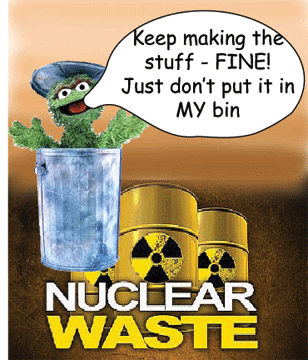
the only sane thing is to stop making the stuff
Waste Confidence Final Rule Now Before the Commission http://public-blog.nrc-gateway.gov/2014/07/24/waste-confidence-final-rule-now-before-the-commission/ July 24, 2014 Andy Imboden Communications Branch Chief Waste Confidence Directorate

After thousands of public comments, dozens of meetings and hundreds of written pages, the NRC Commissioners are now deliberating the draft final rule and draft generic environmental impact statement on the continued storage of spent nuclear fuel – what used to be called “waste confidence.”
Under NRC procedures, and in support of our agency’s transparency and openness goals, we are making three documents including the draft final rule and environmental impact statement available – you can find them on the NRC’swaste confidence webpage:
- A staff paper, SECY-14-0072: Final Rule: Continued Storage of Spent Nuclear Fuel;
- A draft Federal Register notice on the final rule; and
- A draft NUREG-2157: Generic Environmental Impact Statement for Continued Storage of Spent Nuclear Fuel – Final Report (GEIS).
To be clear, the draft final rule and draft GEIS are not yet final and are not for public comment. NUREG-2157 includes a lengthy Appendix D that summarizes and responds to more than 33,000 written comments we received when the draft GEIS and proposed rule were published for comment last year. They are “draft final” documents because they need Commission approval before they become final agency action. The Commission may approve, modify, or disapprove them.
Some important points to remember: The final Continued Storage rule represents a generic finding on the environmental impacts of continued storage of spent nuclear fuel beyond the licensed operating life of a reactor. It does not license or approve any storage facility or any nuclear power reactors. The facilities are licensed – or licenses are renewed – based on site-specific application reviews.
The rule is to be used as a part of the overall environmental review for new reactor license applications, current reactor renewal applications, and spent fuel storage facility license reviews in these site-specific proceedings. The GEIS serves as the regulatory basis for the rule, and does not replace the staff’s comprehensive environmental review in individual licensing proceedings.
The name change from “waste confidence” to “continued storage” is just one way the new rule differs from previous versions, including the 2010 version that was struck down by the D.C. Circuit U.S. Appeals Court. (That ruling two years ago prompted the current rulemaking effort.) The name change and other changes are in part due to public comment, and are further explained in the staff paper and the Federal Register notice. The latter also includes an extensive question-and-answer section about the staff’s review and conclusions.
UK will pay communities just to “think about” hosting nuclear wastes

 Communities could be paid £40m for considering nuclear waste dump Damian Carrington The Guardian, Thursday 24 July 2014 Renewed effort to find site for underground disposal site will not allow veto for any one level of local government Local communities could be paid over £40m by government for simply considering the building of an underground nuclear waste disposal facility in their area, ministers announced on Thursday.
The renewed effort to find a permanent solution for the UK’s growing stockpile of nuclear waste comes after Cumbria council vetoed a proposed waste dump site in January 2013. But the new approach will not allow any one level of local government to veto future site decisions.
The plan allows for communities to get up to £1m a year for about five years whilst local consultations take place. If the community moves to accepting exploratory drilling, which would take five to 15 years, they would get up to £2.5m a year, meaning a total of over £40m before a decision is taken on whether or not to build the waste burial facility.
Additional and much higher community investment would follow a decision to build the facility. There is no cap on the number of communities that could apply for local consultation.
The Liberal Democrat energy secretary, Ed Davey, said: “Geological disposal provides the secure, long-term solution we need to deal with the radioactive waste we have been creating for more than 60 years.
“Building and running a geological disposal facility will be a multi-billion pound infrastructure project, which will bring significant economic benefits to a community.” He said the new process was “based on a fundamental principle of listening to people”.
But the plan was immediately attacked by the president of the LibDems, Tim Farron, who is a Cumbrian MP. “The geological disposal facility should not be foisted on a community without their wholehearted support. The mooted plans to remove the veto for local councils against a nuclear repository is undemocratic and makes an absolute mockery of the idea of localism.”
Anti-nuclear campaigners dismissed the “no-strings-attached” payments to local communities as “bribes”.
 Following the government’s failure to persuade Cumbria to accept a deep nuclear waste disposal site, the new plan represents another return to the drawing board. Ministers have been trying without success to find a suitable site for over two decades.
David Cameron said in 2007: “The problems of nuclear waste have not been dealt with and they have got to be dealt with to make any new investment possible.” However, the government has already given the green light for a new EDF nuclear power station at Hinkley Point in Somerset…………http://www.theguardian.com/environment/2014/jul/24/communities-could-be-paid-40m-for-considering-nuclear-waste-dump
Belarus’ new nuclear reactors bypass regulations and international conventions
 Belarus anti-nuclear activist fears for ‘another Chernobyl’ on her doorstep Nabeelah Shabbir theguardian.com, Friday 25 July 2014 Tatyana Novikova says new Russian-funded nuclear power plant bypassed official planning regulations and violates international conventions
In 2009, Tatyana Novikova bought a wooden house near the border between Belarus and Lithuania. She chose the area carefully, she says. It’s next to a lake, untouched by industry and – crucially for the mathematician who worked on contamination models in the aftermath of Chernobyl – unaffected by the fallout from the world’s worst nuclear disaster in 1986.
But six months after she bought her dream home, Belarus announced that a new nuclear power station, financed by Russia, would be built nearby in Ostrovets.
“I’m completely devastated,” says Novikova, who says the government bypassed official planning regulations, ignored safety concerns and failed to carry out an adequate environmental impact assessment for the plant.
Her experience with Chernobyl, when radioactive contamination forced around 350,000 people to leave their homes and led to an unknown number of deaths, have left her cautious about nuclear power and distrustful of government safety promises.
“Another Chernobyl cannot happen,” she says.
Novikova has appealed to international environmental authorities to try to stop the NPP project, without any success. In the meantime authorities have already started work on construction.
“The problem is that [Belarusian president Alexander] Lukashenko does not give his citizens a voice,” she says.
In a country which does not tolerate activism or public protest – the annual Chernobyl anniversary marches she organises often end in arrests – Novikova has taken her opposition abroad.
She is in London to raise awareness about the issue and hopes to spur the EU to put pressure on Belarus, as the plant would be 60km from Vilnius, the capital of Lithuania.
 A group of Belarusian activists, including the theatre company Belarus Free Theatre, have launched a petition against the power station – and have won support from some high-profile figures:
 Another Chernobyl?! No thanks! Join me – sign petition to block dodgy new nuclear plant in Belarus http://chn.ge/1pNrmGO
The petition cites several problems with the plant:
- Construction was started before design plans were in place, and before a license had been issued
- The design is experimental and has not been properly tested
- An assessment by more that 50 independent experts found gaping holes in the government’s environmental impact assessment
Novikova says the plans flaunt international regulations; Belarus is a signatory of the Espoo and Aarhus conventions, which specify environmental protections and monitor requirements such as public consultations over construction projects.
She approached the Aarhus committee in Maastricht in June, asking them to prevent the power plant because Belarus had violated the convention by not obtaining official planning permission. The committee came back to her with bad news; they would only issue what she calls a “caution of a caution” to Belarus, believing the government wouldn’t listen anyway. …….http://www.theguardian.com/world/2014/jul/25/belarus-anti-nuclear-chernobyl-on-her-doorstep
UK blockade of Devonport Dockyard by anti nuclear protestors
 Anti-nuclear protesters blockade Devonport Dockyard By Plymouth Herald July 25, 2014
Two people have been arrested after chaining themselves to a car in a three-hour, rush-hour protest at Devonport Dockyard. Traffic was badly delayed as people were left unable to turn into the Camel’s Head gate entrance at the dockyard from 6am, to 9am today.
Anti-nuclear protesters this morning set up a blockade at Devonport Dockyard. A number of people blocked the entrance to the yard at Camels Head with a car parked across the road – two people chained themselves to the vehicle.
The protesters are from the anti-nuclear group Trident Ploughshares which objects to work done on nuclear submarines at the yard.
The groups’ long-running campaign at the yard most recently included every member attending Charles Cross police station to demand yard bosses be arrested for war crimes.
At six o’clock this morning, a group of local people from Plymouth, Devon, Cornwall, Somerset and beyond blocked the main entrance.
Theo Simon, an anti-nuclear campaigner and former Devonport resident said: “When we see things like with Israel in Gaza, we want our government to stand up for international law and humanitarian law. But it’s harder for Britain to condemn other peoples’ war crimes if we are prepared to commit one ourselves.
“That is exactly what is happening here in Devon – they are working on a weapon of mass destruction, which can never be used. “It is a terrible waste of resources, a waste of people’s skills, and a real danger to the future of our children in Devon and across the planet.”
Mother of two, Nikki Clarke said: “I’m here today because I believe the work that goes on here in refitting Britain’s Nuclear weapons system is immoral and dangerous….. http://www.plymouthherald.co.uk/Anti-nuclear-protesters-blockade-Devonport/story-21937166-detail/story.html#ixzz38YVLq8Dh
Japan – Deciding the future of spent nuclear fuel as plutonium stockpile grows – Solved? Bury it deep!
If spent nuclear fuel is buried 1,000 meters underground for 1 million years, the radiation level at the earth’s surface will peak in 3,000 years, at 0.3 microsieverts per year.
Deep13th Nuclear Waste Info
Published on 25 Jul 2014
The Japan Atomic Energy Agency is reported to be looking at the direct disposal of spent nuclear fuel instead of reprocessing it.
NHK has obtained a draft report compiled by the agency which analyzed the environmental impact of disposing of spent nuclear fuel.
The conclusion of the analysis is expected to touch off controversy, because the government has long maintained the policy of reprocessing all spent nuclear fuel. It has conducted few studies about disposing of it as waste.
Spent nuclear fuel is known to have higher radiation levels than high-level radioactive waste.
But the agency’s draft report says it is technically possible to directly dispose of spent nuclear fuel at a low radiation level.
If spent nuclear fuel is buried 1,000 meters underground for 1 million years, the radiation level at the earth’s surface will peak in 3,000 years, at 0.3 microsieverts per year.
Even though reprocessing remains official government policy, the Rokkasho reprocessing plant is nowhere near full operating capacity.
Japan’s nuclear power plants have accumulated 17,000 tons of spent nuclear fuel.
The agency’s analysis is expected to lead to greater attention on future discussions on dealing with the stockpile of spent nuclear fuel.
Professor Tatsujiro Suzuki at Nagasaki University says the conclusion that direct disposal is possible is a very important step forward. Suzuki is a former member of the government’s Atomic Energy Commission.
Jul. 25, 2014 – Updated 11:06 UTC
Russian firms to star in nuclear materials, nuclear weapons sales festival in London
 Diary: Russians selling nuclear weapons expertise in Westminster? What’s not to like? Reception at Westminster Abbey, gala dinner in Kensington, maybe even a night of top-flight football at the Crabble. Business as usual for Alexander, Lyudmila and comrades, you might say
Will there be a resounding silence in September at the World Nuclear Association symposium and exhibition in Central Hall, Westminster?
The world’s nuclear industries will be strutting their stuff: 700 business and leaders from 30 countries discussing such issues as the fuel cycle front-end (no, me neither), the security of nuclear fuel supplies, financing new builds, and uranium resources. There will be a reception at Westminster Abbey and a gala dinner at the Natural History Museum.
And, to crown it all, a discussion panel. That is due to feature Alexander Lokshin, deputy director general of Rosatom, the organisation that controls Russia’s nuclear weapons companies, research institutes and safety agencies; and Lyudmila Zalimskaya of Tenex, which exports the country’s nuclear materials, such as enriched uranium, and is big in the Emirates and China. So far 34 Russian delegates have booked (last year there were 70), but it’s early days. “We have not been told that they will not be allowed to come,” says an organiser. So, business as usual. Maybe…….http://www.theguardian.com/politics/2014/jul/24/stephen-bates-diary-tenex-crabble
USA Senate report: nuclear materials vulnerable to theft
 U.S. Nuclear Material Vulnerable to Theft, Panel Fears http://blogs.rollcall.com/five-by-five/u-s-nuclear-material-vulnerable-to-theft-panel-fears/?dcz= By Tim Starks July 25, 2014 The Senate Appropriations Committee is perturbed at a whole host of things contributing to large quantities of nuclear and radiological materials — including in the United States — being “still unsecure and vulnerable to theft.”
That’s the word from John M. Donnelly, writing for CQ.com subscribers. He details how the panel, in its fiscal 2015 Energy-Water bill committee report, restores nuclear non-proliferation funding and chides the administration for abandoning a 2025 goal of securing 2,900 buildings, such at medical facilities and universities, where there is “little or no security.”
Also from the committee report, by this author for the Energy Xtra blog, is another nuclear-related buildings issue: the fact that the National Nuclear Security Administration is sitting on 450 unused facilities, and has a maintenance backlog that has made some of the buildings still being used dangerous.
USA’s nuclear power plants not prepared for big accidents
Nuclear plants ill-prepared for worst-case scenarios, report says, LA Times, By MAYA SRIKRISHNAN, 25 JULY 14 THe current approaches for regulating nuclear plant safety in the U.S. are “clearly inadequate” for preventing meltdowns and “mitigating their consequences,” according to a report released Thursday.
U.S. safety regulations traditionally ensure that plants are designed to withstand ordinary equipment failures, power losses and the loss of ability to cool the reactor core — the part of a plant where the nuclear reactions take place. But this is not enough, according to the report by the National Academy of Sciences.
“To what extent are they proactive versus reactive?” said Najmedin Meshkati, an engineering professor at USC who worked on the report. “Complacency and hubris are the worst enemies to nuclear safety.”
The U.S. nuclear industry should prepare for unlikely, worst-case scenarios when designing, building and regulating plants, the report recommends.
The report said the accident at Fukushima — caused by an earthquake, which knocked out power, and a tsunami, which inundated the plant — should not have come as a surprise………..
Officials at the U.S. Nuclear Regulatory Commission said they were reviewing the report and would provide detailed comments later. http://www.latimes.com/nation/nationnow/la-na-nuclear-safety-20140724-story.html
Hot weather forcing Sweden to cut nuclear reactors’ output

 Sweden’s nuclear plants forced to cut output due to warm weather Planet Ark, 24-Jul-14 Balazs Koranyi Sweden’s top nuclear power generators have been forced to cut output because of exceptionally warm weather in Scandinavia, and their output could be reduced for over a week, their operators said on Wednesday.
Oskarshamn, part of Germany’s E.ON and Forsmark, operated by Swedish utility Vattenfall have both cut output because warm sea water temperatures are limiting their ability to cool down.
“For each degree above 23 decrees Celsius in the cooling water, each unit has to decrease power by 3 percent,” Forsmark said in a market message. “It is uncertain how long this will last, but according to meteorologists, the warm weather will last for at least 11 more days.”
Temperatures exceeded 30 degrees in the southern part of Scandinavia this week, hitting their highest level in years…….http://planetark.org/enviro-news/item/71927
Shut down Indian point nuclear plant for summer – say environmental regulators
New York environment regulators seek summer shutdown at Indian Point Planet Ark, : 22-Jul-14 Scott DiSavino New York state environmental regulators are proposing shutting the giant Indian Point nuclear power plant to protect fish in the Hudson River during summer months, when demand for electricity for air-conditioning is greatest…………The DEC said in an email that the proposal, which will be discussed in a public meeting on Tuesday, is similar to what Consolidated Edison Inc did when it owned the reactors and is consistent with the practice of other facilities on the Hudson……
The DEC proposal is the latest salvo in a lengthy battle between Entergy Corp, which owns Indian Point and wants to keep the plant operating for another 20 years, and state environmental regulators, who are seeking to protect fish and other aquatic life.
Indian Point withdraws up to 2.5 billion gallons of water per day from the Hudson to cool equipment, and then discharges that water back into the river warmer than before.
Environmental groups and the DEC have long argued that Indian Point’s water intake system kills about a billion fish, fish eggs and larvae each year, and the plant should install cooling towers to reduce the use of river water by recycling it…….Before the NRC can grant new licenses, the state must approve water permits. http://planetark.org/enviro-news/item/71913
1 This Month
Chernobyl: The Lost Tapes – A good documentary on Chernobyl on SBS available On Demand for the next 3 weeks– https://www.sbs.com.au/ondemand/tv-program/chernobyl-the-lost-tapes/2352741955560

of the week–London Campaign for Nuclear Disarmament

Tell the Ukrainian Government to Drop Prosecution of Peace Activist Yurii Sheliazhenko
To see nuclear-related stories in greater depth and intensity – go to https://nuclearinformation.wordpress.com
-
Archives
- April 2026 (152)
- March 2026 (251)
- February 2026 (268)
- January 2026 (308)
- December 2025 (358)
- November 2025 (359)
- October 2025 (376)
- September 2025 (257)
- August 2025 (319)
- July 2025 (230)
- June 2025 (348)
- May 2025 (261)
-
Categories
- 1
- 1 NUCLEAR ISSUES
- business and costs
- climate change
- culture and arts
- ENERGY
- environment
- health
- history
- indigenous issues
- Legal
- marketing of nuclear
- media
- opposition to nuclear
- PERSONAL STORIES
- politics
- politics international
- Religion and ethics
- safety
- secrets,lies and civil liberties
- spinbuster
- technology
- Uranium
- wastes
- weapons and war
- Women
- 2 WORLD
- ACTION
- AFRICA
- Atrocities
- AUSTRALIA
- Christina's notes
- Christina's themes
- culture and arts
- Events
- Fuk 2022
- Fuk 2023
- Fukushima 2017
- Fukushima 2018
- fukushima 2019
- Fukushima 2020
- Fukushima 2021
- general
- global warming
- Humour (God we need it)
- Nuclear
- RARE EARTHS
- Reference
- resources – print
- Resources -audiovicual
- Weekly Newsletter
- World
- World Nuclear
- YouTube
-
RSS
Entries RSS
Comments RSS
 nuclear-news