Tomioka Mayor Katsuya Endo said that although the government has set up several thousand barricades and many areas are still off-limits, the new zone designations allow for some 11,200 people, around 70% of the town’s former residents, to return to their former homes and begin clean-up operations. “Finally, we can start rebuilding the city’s infrastructure,” Endo told reporters. Mar. 25, 2013

Photograph of the Prime Minister receiving a letter of request from Mayor Katsuya Endo of Tomioka Town, Fukushima Prefecture March 14, 2012
Article source ; http://mainichi.jp/english/english/newsselect/news/20140721p2g00m0dm050000c.html
July 21, 2014(Mainichi Japan)
FUKUSHIMA (Kyodo) — Katsuya Endo, the former mayor of Tomioka in northeastern Japan who was forced to evacuate the town along with his fellow residents following the 2011 Fukushima nuclear disaster, died of gum cancer on Sunday, his family said. He was 74.
Endo served as mayor of the Fukushima Prefecture town for a total of 16 years over four four-year terms between 1997 and 2013. He lost his re-election bid last year.
After a powerful earthquake and tsunami crippled Tokyo Electric Power Co.’s Fukushima Daiichi power plant north of the town, all Tomioka residents were forced to evacuate their seaside town. Town hall operations were also moved.
Endo was living in Koriyama, an inland Fukushima city west of Tomioka, when he died at a hospital there.
Tomioka plays host to Tokyo Electric’s Fukushima Daini nuclear power plant, which remains offline following the disaster at the nuclear complex nearby.
Epidemiology of gum cancer
The incidence rates of oral cancer differ from region to region. The annual age-adjusted incidence rates per 100 000 in several European countries vary from 2.0 (UK, south Thames Region) to 9.4 in France. In the Americas the incidence rates vary from 4.4 (Cali, Colombia) to 13.4 in Canada. In Asia, it ranges from 1.6 (Japan) to 13.5 (India). In Australia and New Zealand, it varies from 2.6 (New Zealand – Maori) to 7.5 in South Australia. In Papua New Guinea, in the Lowlands and the Highlands the incidence per 100 000 among men was 6.8 and 1.0 and among women 3 and 0.4, respectively. In Iran the incidence was reported to be 1.1 per 100 000 per year 2,3.
The prevalence rates of oral cancer available from Burma and India indicate that in Burma, among 600 villagers aged 15 years and above, the prevalence was 0.03 per cent4. In a study of 150 000 villagers aged 15 years and above in six districts of India, the prevalence rate of 0.1 per cent was the highest reported5,6. The relative frequency of oral cancer in several countries compiled from several reports published over a 25-year period varies from 2 to 48 per cent. http://ispub.com/IJDS/1/2/5720
July 22, 2014
Posted by arclight2011part2 |
Uncategorized |
Leave a comment
http://fukushima-diary.com/2014/07/two-doctors-judged-cerebral-hemorrhage-woman-minamisoma-almost-entirely-due-nuclear-accident/

Two doctors judged a health problem of a woman in Minamisoma to be “almost entirely” caused by Fukushima nuclear accident.
The woman (66) was livng in Minamisoma city when 311 took place. She started evacuating on 3/12/2011.
10 days after, she had cerebral hemorrhage in a toilet of a shelter. She had a past illness of high blood pressure but healthy enough to work in her farm.
She still doesn’t have the sense of her left hand and leg.
Regarding her cerebral hemorrhage, both of her family doctor and rehabilitation doctor judged it was due to Fukushima nuclear accident.
This was a diagnosis to be submitted to ADR (Alternative Dispute Resolution) of Fukushima accident.
However the ADR center picked up the diagnosis of the doctor who was recommended by Tepco, has never seen this woman.
Tepco’s doctor asserted her cerebral hemorrhage is only 50% affected by Fukushima accident, which the basis has never been shown.
The center suggested the compromise settlement of 7 million yen compensation for her.
http://radiation7.blog.fc2.com/blog-entry-4125.html
Iori Mochizuki
July 22, 2014
Posted by arclight2011part2 |
Uncategorized |
Leave a comment
By Harvey Wasserman

Available in Japanese here.
Some 39 months after the multiple explosions at Fukushima, thyroid cancer rates among nearby children have skyrocketed to more than forty times (40x) normal.
More than 48 percent of some 375,000 young people-nearly 200,000 kids-tested by the Fukushima Medical University near the smoldering reactors now suffer from pre-cancerous thyroid abnormalities, primarily nodules and cysts. The rate is accelerating.
More than 120 childhood cancers have been indicated where just three would be expected, says Joseph Mangano, executive director of the Radiation and Public Health Project.
The nuclear industry and its apologists continue to deny this public health tragedy. Some have actually asserted that “not one person” has been affected by Fukushima’s massive radiation releases, which for some isotopes exceed Hiroshima by a factor of nearly 30.
But the deadly epidemic at Fukushima is consistent with impacts suffered among children near the 1979 accident at Three Mile Island and the 1986 explosion at Chernobyl, as well as findings at other commercial reactors.
But a wide range of independent studies confirm heightened infant death rates and excessive cancers among the general population. Excessive death, mutation and disease rates among local animals were confirmed by the Pennsylvania Department of Agriculture and local journalists.
Continue reading →
July 22, 2014
Posted by arclight2011part2 |
Uncategorized |
Leave a comment
Dr Richard Dixon, Director of Friends of the Earth Scotland said: “The proposal to use ships sounds like a ploy to get this problem out of people’s minds rather than the safest option.”
http://www.heraldscotland.com/news/home-news/sea-trials-for-waste-transportation.24817598
Tuesday 22 July 2014
Sea trials will soon be conducted to establish whether it is a realistic option to transport highly radioactive material from Dounreay to Sellafield
Sea trials will soon be conducted to establish whether it is a realistic option to transport highly radioactive material from Dounreay to Sellafield
But Dounreay Site Restoration Ltd (DSRL), the consortium in charge of the £1.6 billion decommissioning of the Caithness plant, insists no decision has been taken on whether to take 26 tonnes of material south by rail or by ship.
Concerns have been raised about such a dangerous cargo being taken through the Pentland Firth and down through the Minch and passed the Argyll islands to the giant nuclear plant in Cumbria.
Dounreay accumulated more than 100 tonnes of nuclear fuel and material when the decision was taken in 1998 to close down and clean up the site.
A few tonnes belonged to foreign reactor operators and most of this has now been returned by road, air and sea over the last decade.
The remainder belongs to the Nuclear Decommissioning Authority quango which wants the spent fuel to be managed at Sellafield.
But 26 tonnes are made of so-called ‘Dounreay exotics’ , highly radioactive fuels, some of which include highly enriched uranium.
Dr Richard Dixon, Director of Friends of the Earth Scotland said: “The proposal to use ships sounds like a ploy to get this problem out of people’s minds rather than the safest option.”
A DSRL spokeswoman said “The sea trial has not been conducted yet. It is planned for later on in the year. There has no decision to take the material by sea. The Dounreay Stakeholder Group was informed in March that trials of a sea route would be carried out. If successful, this will give the option of two routes.”
July 22, 2014
Posted by arclight2011part2 |
Uncategorized |
Leave a comment
There are plenty of reasons for EU countries to be wary about tighter sanctions against Russia. The need for nuclear supplies is only one of them.
A recent document produced by the European Commission put it like this: “There is no diversification, nor back-up in case of supply problems (whether for technical or political reasons).”

http://www.bbc.com/news/business-28203907?ocid=socialflow_twitter
By Andrew Walker
21 July 2014
Following the loss of the Malaysian airliner last week, European leaders are once again wrestling with the question of how to respond to Russia over its role in the Ukraine crisis.
They are reluctant to get tough, much more so than the United States.
The EU could easily end up doing itself a lot of economic harm, most obviously if Russia were to respond by turning down the gas.
Russia is a very important oil exporter too, though that is a more liquid market – to coin a phrase – where it is not so hard to find alternatives if you fall out with one major supplier.
But there is also a significant role in Europe’s energy sector for Russian nuclear supplies and the potential for significant disruption in the EU.
Nuclear energy is an important source of electricity in the EU.
Some countries are planning to phase it out, notably Germany. But even so, projections last year from the European Union see more than a fifth of EU electricity coming from nuclear power plants up to the middle of the century.
About half of EU states have some nuclear power – though there is a marked variation between countries.
In France, which is the world’s biggest producer and user of nuclear power, 75% of total electricity generation is nuclear. In the UK, the figure is 18%, while Italy is the largest EU economy to have none.
Russian connection
Russia comes into this picture at several points.
“Start Quote
There is no diversification, nor back-up in case of supply problems”
European Commission report
First, it is an important supplier of the raw material for nuclear fuel, uranium.
There is an international market for uranium, so there are alternative sources, but Russia accounts for 18% of EU supplies (behind Kazakhstan and Canada), so switching is not that simple.
Second, there is the business of enrichment to make the uranium suitable for power generation – and 30% of this work is done by Russian companies.
There is another potential source of vulnerability, too. The EU has a significant number of older, Russian-designed nuclear reactors – 18 in all.
This is a reflection of past political relations with the Soviet Union.
Finland, which was never formally part of the Soviet bloc but did have a close relationship, has two – and all the reactors in Bulgaria, the Czech Republic, Slovakia and Hungary are Russian-designed.
Hungary also has an agreement for two more to be built.
Continue reading →
July 22, 2014
Posted by arclight2011part2 |
Uncategorized |
Leave a comment
Millions of fish and larvae are killed as Indian Point sucks in 2.5 billion gallons of Hudson River water daily to cool its plant components. While the state and some environmentalists say Entergy should engineer a closed-cycle cooling system—which would rely less on the river—the power company says that idea is unfeasible and too costly.
Besides dying as they are sucked into the plant system, fish and other aquatic life are harmed when they come into contact with warmer water discharged back into the river by the plant, said Mr. Musegaas.

http://online.wsj.com/articles/temporary-closing-of-indian-point-power-plant-is-considered-1405992707?mod=yahoo_hs
Business groups and the operator of the Indian Point Energy Center have aligned against a proposal by New York state to close the nuclear power plant in spring and summer months to protect fish in the Hudson River, an idea drawing tentative support from some environmental advocates.
Indian Point produces about 25% of the electricity consumed in New York City and the lower Hudson Valley. The state Department of Environmental Conservation, which is proposing the shutdown, hasn’t specified how the loss of power produced by Indian Point would be made up, though it said it would do what it could to prevent service disruptions.
The DEC is advocating the shutdown as an alternative to proposed engineering changes to the facility that have largely been rejected by Entergy Corp. , the plant’s operator.
Millions of fish and larvae are killed as Indian Point sucks in 2.5 billion gallons of Hudson River water daily to cool its plant components. While the state and some environmentalists say Entergy should engineer a closed-cycle cooling system—which would rely less on the river—the power company says that idea is unfeasible and too costly.
The DEC has proposed to shut down the plant during the May 10-Aug. 10 period—for stints of 42, 62 or 92 days—to coincide with the presence of migrating or spawning fish in the Hudson. Two public hearings on the matter are scheduled for Tuesday in Cortlandt Manor, N.Y.
“This would not curtail operations this summer,” said Emily DeSantis, a spokeswoman for DEC said, in an email.
Entergy said the DEC’s latest public information on the proposal, released in May, failed to say how electricity would be replaced during the high-usage period of the summer or to assess the risk of blackouts or brownouts during that time. It said such a requirement would be unprecedented for a nuclear plant.
Continue reading →
July 22, 2014
Posted by arclight2011part2 |
Uncategorized |
Leave a comment
Remember: The modern hydrogen-bomb technology of Russia, China and the United States makes such weapons as those possessed by India and Pakistan seem antique.
An exchange between these big players would likely produce far worse effects.
The scientists are confident in the accuracy of their assessment.

http://www.news.com.au/technology/environment/a-new-study-predicts-2-billion-dead-25year-winter-after-a-limited-nuclear-war/story-fnjwvztl-1226997278678
July 22, 2014
IT’S a horrifying scene burned into our collective conscious: A flash of light, a blast of hot air — and a ballooning mushroom cloud. But there’s much more to a nuclear war, as a new study reveals.
Filmmakers and novelists have been tackling the subject for decades. Some have been somewhat sanitised in their approach (Jericho, 2006). Others have been brutally confronting (Threads, 1984, and The Road, 2009).
All have simply speculated about the fate of life on Earth after an apocalyptic nuclear exchange.
Now, a team of US atmospheric and environmental scientists have taken a detailed look at exactly what all that dust, ash and debris in the air means.
Specifically, they ran computer models on a fight between Pakistan and India through advanced climate predicting software developed to study pollution-based climate change.
The outcome?
It’s bad.
Even for this “limited, regional nuclear war”, it means a one-to-two degree plunge in global temperatures and a nine-per cent cut in worldwide rainfall.
In practical terms, that equates to worldwide crop failures and famine.
A separate study last year matched similar conditions to a projected death toll: We’re talking 2 billion lives lost.
And that’s the result of a little nuclear spat.
Not a big one between the likes of China and Russia.
The researchers based their calculations upon the detonation of 100 nuclear warheads. These were set at roughly the size of the atomic bomb dropped on Hiroshima.
Continue reading →
July 22, 2014
Posted by arclight2011part2 |
Uncategorized |
Leave a comment
Lockheed’s new Chinese nuclear division is lodged between a Subway restaurant and a construction contractor. The office has been designated part of the People’s Republic of China — as a sign in the spartan lobby reads.
http://www.dallasnews.com/business/energy/20140721-lockheed-goes-global-to-build-its-nuclear-business.ece
By JAMES OSBORNE
Staff Writer
josborne@dallasnews.com
Published: 21 July 2014 09:12 PM
Updated: 21 July 2014 09:16 PM
FORT WORTH — In a nondescript strip mall across town from the heavy security of its fighter jet operations, defense contractor Lockheed Martin opens its doors each day to a rotating crew of Chinese engineers.
While the U.S. and Chinese governments spar over the theft of classified military data, Lockheed has entered into a deal with China’s State Nuclear Power Technology Corp. to help build that country’s next generation of nuclear plants.
The only hitch is that the Chinese want their own engineers working on the project. As a military contractor, Lockheed has to be sensitive about employing foreign nationals anywhere where classified military technology is being developed. So it found alternative digs near Dallas/Fort Worth International Airport.
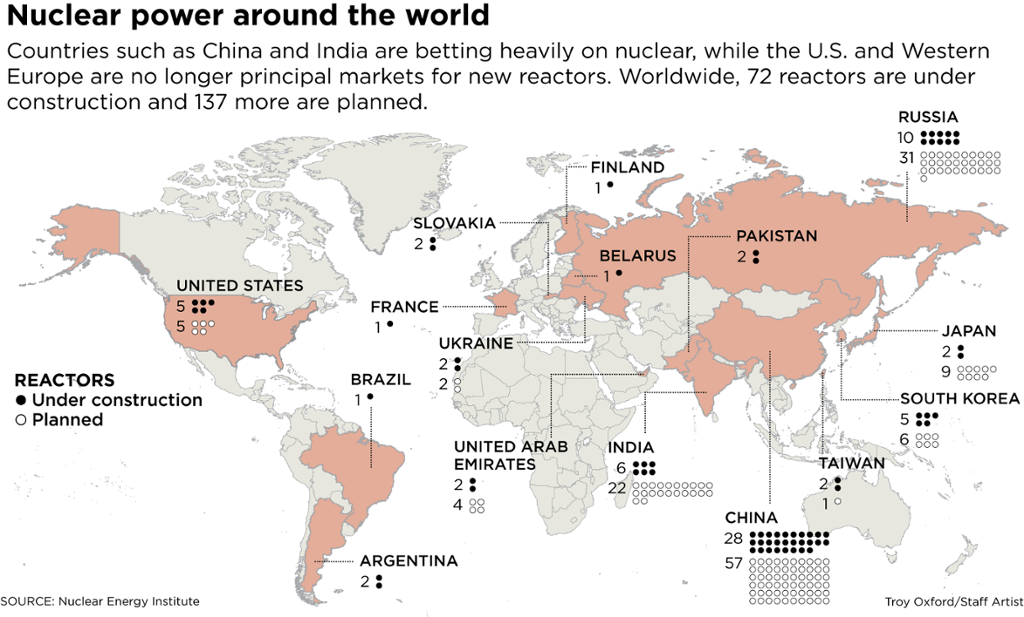
Nowhere is the outlook for nuclear powerbrighter than in China, where the government is on a campaign to clean up the country’s air. Most of China’s electricity is generated by burning coal, which casts a lung-wrenching haze over its major cities. One of China’s goals is to add to its existing fleet of around 15 nuclear power plants. Analysts believe China will build between 60 and 100 more nuclear plants over the next four decades.
Right now Lockheed has a contract to engineer its reactor control system for China through 2017. But Michael Syring, director of nuclear systems for Lockheed, says the company believes the project will lead to a longer-term relationship helping China develop its nuclear sector.
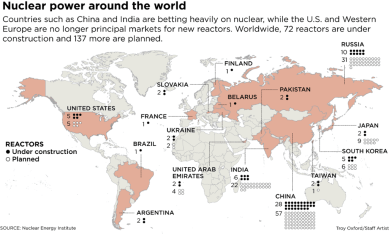
Lockheed and other U.S. nuclear technology companies are looking for new markets in the wake of 2011’s Fukushima meltdown in Japan. The United States and most Western European countries are backing away from nuclear power. That means Lockheed and other companies worldwide that build nuclear plantsare scrambling to court power companies in Asia and Eastern Europe.
Continue reading →
July 22, 2014
Posted by arclight2011part2 |
Uncategorized |
Leave a comment




 nuclear-news