()Aileen Mioko Smith from Green Action Japan discusses the Fukushima nuclear tragedy – Video
Fukushima may be eclipsing Chernobyl as the greatest nuclear disaster in history
Published on 17 Jul 2014
This video is from August 2013 http://voiceofrussia.com/us/2013_08_19/Fukushima-may-eclipse-Chernobyl-as-the-worst-nuclear-disaster-in-history-8491/
Thanks to MF
Host Kate Zickel talks with Aileen Mioko Smith about the current state of affairs in Japan regarding the Fukushima clean up.
Two years after the Fukushima nuclear power plant meltdown, the disaster is still causing problems, and the Japanese government is looking at new ways to address the issue. Fukushima may be eclipsing Chernobyl as the greatest nuclear disaster in history. Public sentiment appears to be against the continuing reliance on nuclear power in Japan, but the government has been slow to move in that direction.
Nuclear news snippets this week

Christina Macpherson’s websites & blogs
Ukraine I cannot yet find information on what the airline tragedy might mean for nuclear power in Ukraine – and sanctions perhaps on Russia.
Iraq. ISIS insurgents seize nuclear materials
USA – Radiation Safety Standards The Environment Protection Austhority (EPA) is calling for comments on its planned update of “Environmental Radiation Protection Standards for Nuclear Power Operations.” The nuclear lobby is of course very keen to weaken those standards. Sophiticated and disingenuous arguments are being pushed towards that aim. This is acomplcated and difficult matter. I would hope that the EPA is concerned first for the public, and second for the nuclear industry, but I doubt this.
Japan. Even with safety clearance Japan’s nuclear reactors might not restart. Big protest in Tokyo against nuclear restart.
Fukushima. Now available first hand witness: The Yoshida Testimony. The Fukushima Nuclear accident as told by plant manager Masao Yoshida The ice wall plan to stop leakage of radioactive water is not working
TEPCO workers leaving Fukushima for better paid, clean, safe jobs in solar energy projects. $1 billion in loans for Japan’s solar energy.
Iran Diplomacy struggles on, as the nuclear talks between Iran and the West are extended until November
Renewable Energy. International Renewable Energy Agency estimates that there are now 6.5 direct and indirect jobs in renewable energy. 10 top USA corporations call for renewable energy
6 issues for America’s EPA on radiation safety limits

 EPA Wants My Opinion? Well, Here It Is, Enformable Joieau Website Joy Thompson 18 July 14,
 The Environmental Protection Agency – the overseers of the suspiciously on-again/off-again RadNet monitoring system in the wake of the 2011 mass meltdown/blow-outs at Japan’s Fukushima Daiichi power station – has helpfully extended the public comment period on its proposed “update” to 40CFR.190, “Environmental Radiation Protection Standards for Nuclear Power Operations.”
Citizens now have until August 4th to submit their comments on exposure limits, dose calculations, new fuel cycle technologies and related topics.
Advance Notice of Proposed Rulemaking (ANPR).
The EPA is seeking public comment and information that they may or may not use for planned updates to the old rules for Environmental Radiation Protection issued in 1977, ostensibly to make them easier to understand and implement. Given how often the public is treated to professions of ignorance from the nuclear industry (such as, “we don’t know how to measure beta radiation levels!” when caught disseminating blatantly false data), this could be a good thing. The Nuclear Regulatory Commission [NRC] is responsible for implementing and enforcing the standards established by the EPA, and we have watched with some jaded dismay as NRC has steadily abdicated its responsibilities, entrusting them to the utilities it’s supposed to be regulating. Utilities now enjoy little to no oversight or auditing of their monitoring or records, and requirements for public notification and protection (like evacuation of nearby residents if releases reach certain levels) have been demonstrated pointless because they are routinely ignoredPerhaps if EPA can tweak its rules so that even the NRC can understand them, we could expect much better compliance all around……..
To help interested people who may be confused by the technical gobbledygook that frames the issues in the EPA’s documents, I am listing the issues here, offering an abbreviated look at EPA reasoning in presenting these issues for comment, and supplying my own responses to the questions EPA is posing to the public………
Issue 1: Consideration of a Risk Limit to protect individuals. Should the Agency express its limits for the purpose of this regulation in terms of radiation risk or radiation dose?
My Response to Issue 1:
Because both national and international radiation protection guidelines developed by non-governmental radiation experts such as the ICRP and the National Council on Radiation Protection and Measurements recommend that radiation exposure standards be established in terms of dose to members of the public, the EPA should continue to base its limits on effective dose to members of the public.
Issue 2: Updated Dose Methodology (dosimetry). How should the Agency update the radiation dosimetry methodology incorporated in the standard?
Current limits on exposures to the public during normal operation are 25mr [millirems] whole body, 75mr to the thyroid, and 25mr to any other organ, over a year’s time. There are no effective limits on accident releases, and anyone who followed the disaster at Fukushima in 2011 will understand why. If releases during an accident/event are calculated to deliver a set level of exposure [dose] to any member of the public over the duration of the event, the requirement for evacuation kicks in.
In the end, and given the past record of deception by the industry and its regulators concerning public exposures to radiation, it probably doesn’t matter which methodology is used to calculate and/or estimate doses to the public during a serious accident, so long as requirements for evacuation of the public when a certain set dose level is reached remain in place. That dose level should remain equivalent to the one(s) now in place.
My Response to Issue 2:
If using a more sophisticated method of calculating and estimating doses/harm to the public will make the task of radiation protection easier, there is no reason not to do so. If EPA decides to go to ICRP’s more recent methodology it should use the ICRP methodology that exists at present [60] and not the one ICRP might eventually quantify. Utilities should not be exempted from requirements for evacuation plans and notifications, nor should the allowable doses to the public be raised.
Issue 3: Radionuclide Release Limits. The Agency has established individual limits for release of specific radionuclides of concern. Based on a concept known as collective dose, these standards limit the total discharge of these radionuclides to the environment. The Agency is seeking input on: Should the Agency retain the radionuclide release limits in an updated rule and, if so, what should the Agency use as the basis for any release limits?
The original EPA release limits (Final Environmental Statement, 1976) were based on the assumption that spent fuel reprocessing would be the one area of the total fuel cycle that would release the most radionuclides to the environment. In 2014 we know from long experience with serious accidents, meltdowns and exploding reactor plants that the generation facilities themselves have proven to be the worst offenders. We do not reprocess commercial spent fuel in this country, and haven’t done so since the 1970s. The government reprocessing facilities that do exist are notoriously filthy, as are fabrication facilities working with plutonium to make MOX fuels. Still, in overall environmental contamination, power plants suffering nasty oopses are right up there for consideration. And power plants suffering nasty oopses are not subject to radionuclide release limits because there is no way to stop those releases.
Now, however, we are looking at decommissioning aged and aging nuclear facilities, doing something with the accumulated tonnage of spent fuel waste, and applying release limitations to any/all new technologies that will come with future nuclear energy development (if that happens). Nuclear pollution from these activities must also be considered.
My Response to Issue 3:
EPA should continue to use the existing standards of limiting environmental burden as a guide, calculate and apply equivalent radionuclide standards for individual facilities at any stage of the nuclear fuel cycle. This need not be based on estimated doses to the wider public or to individual members of the public. It does need to be recalculated as necessary whenever weapon/accident releases occur to release very large amounts of radionuclides to the biosphere, with an eye to maintaining a biosphere-wide environmental burden limit for all dangerous long-lived isotopes.
If such an effort ends up reducing the allowable radionuclide releases from any type of nuclear facility at any point along the fuel cycle to a level that cannot be reasonably applied, then those facilities should be closed and decommissioned. Humanity should not be asked to tolerate the nuclear pollution of our planet to the point where everyone’s health and longevity are materially compromised. If that means the end of the nuclear industry itself, then that’s what it means.
Issue 4: Water Resource Protection. How should a revised rule protect water resources?
Ground and surface water are necessary resources for organic life forms and entire ecosystems. EPA says it wishes to prevent water contamination rather than have to clean it up after it’s polluted. This is great. Existing standards don’t impose water-specific standards because nuclear plants do not release what they consider to be significant radionuclides to water sources during normal operation, and any such releases have had far less impact on public health than airborne releases. There are some fluid effluent limits for specific radionuclides.
As the industry’s facilities have aged, however, water pollution issues have come to the fore. Tritium contamination of groundwater, aquifers, rivers and lakes has become more problematic. Unfortunately, there are no technologies in existence that can effectively remove tritium from water. EPA wishes to establish off-site water standards commensurate with the Clean Water Act, which has specific limitations on concentration of carcinogens.
My Response to Issue 4:
The basis of any new EPA ground and/or surface water standards should be the limits specified in the Clean Water Act, diminished by the concentration of pollutants that may already be present in the water source. The dirtier the ground/surface water already is, the less any nuclear facility will be allowed to release. If the allowance goes to zero, the facility must be closed and decommissioned.
Issue 5: Spent Nuclear Fuel and High-Level Radioactive Waste Storage. How, if at all, should a revised rule explicitly address storage of spent nuclear fuel and high-level radioactive waste?……..
. The failure over the past 40 years to develop medium and long term spent fuel storage has turned operating nuclear plants into de facto storage facilities they were never designed to be. Government/industry agencies, commissions, industry think tanks and international bodies can recommend the development of medium and long term storage facilities all they like. Fact is if nobody’s building them, they flat don’t exist and recommendations accomplish exactly zip.
If it ever looks like such facilities may at long last come to be, then the EPA may have a regulatory role in limiting the amount of radioactive substances those facilities can be allowed to release in any form to the environment. …….
My Response to Issue 5:
The same limitations on releases to air and water from nuclear operations should be applied to on-site storage of spent fuel. There should also be a limitation on how much spent fuel can be stored in a single pool, as well as a time limit on how long it can stay there before being dry-casked. The industry should be forced to dry-cask all spent fuel in their pools that has been stored for 2 years or more. Any dry cask storage facilities on-site should have an area radiation limit to protect workers, and should not contribute at all to off-site radiation levels.
Issue 6: New Nuclear Technologies – What new technologies and practices have developed since 40CFR.190 was issued, and how should any revised rule address these advances and changes?……
My Response to Issue 6:
Reality is that there is no pressing need for the EPA to develop separate or differing limits for possible future nuclear technologies that are entirely unlikely to be deployed. If any of them ever are deployed, the existing (or revised) standards should be applicable to any new nuclear technologies. All applications involving nuclear fission should have to abide by the EPA protective regulations throughout the fuel cycle to limit harm to the general public, nuclear workers and the environment.
EPA should definitely develop and apply specific rules for MOX fuels as those are fabricated and used in power reactors. Plutonium is a dangerous radionuclide, as are other high energy alpha and beta emitters that occur during production, enrichment and fuel fabrication. Limits on levels and releases of these elements should be strict, and dutifully enforced.
Comments should be identified by Docket ID No. EPA-HQ-OAR-2013-0689. Comments may be submitted in the following ways:
• www.regulations.gov: follow the on-line instructions.
• Email: a-and-r-docket@epa.gov
• Fax: (202) 566-9744
• Mail: EPA Docket Center, Environmental Radiation Protection Standards for Nuclear Power Operations – Advance Notice of Proposed Rulemaking Docket, Docket ID No. EPA-HQ-OAR-2013-0689, 1200 Pennsylvania Ave. NW., Washington, DC 20460. Please include two copies.
• Hand Delivery: In person or by courier, deliver to: EPA Docket Center, EPA West, Room 3334, 1301 Constitution Ave. NW., Washington, DC 20004. During Docket’s normal hours of operation. Please include two copies. http://enformable.com/2014/07/epa-wants-opinion-well/
Tokyo in danger from Fukushima radiation, says Japanese doctor
 Japan Doctor: “Tokyo should no longer be inhabited” — Everyone here is a victim of Fukushima — People truly suffering — Bleeding under skin, urinary hemorrhaging — Children’s blood tests started changing last year — Time running short… up to physicians to save our citizens and future generations http://enenews.com/japan-doctor-tokyo-longer-be-inhabited-everyone-living-victim-fukushima-disaster-began-notice-childrens-blood-test-results-around-mid-2013-time-running-short-physicians-save-citizens-future-g?utm_source=feedburner&utm_medium=email&utm_campaign=Feed%3A+ENENews+%28Energy+News%29
Dr. Shigeru Mita’s essay published in the newsletter of Association of Doctors in Kodaira (Tokyo), translated by WNSCR, July 16, 2014: Why did I leave Tokyo? To my fellow doctors, I closed the clinic in March 2014, which had served the community of Kodaira for more than 50 years, since my father’s generation, and I have started a new Mita clinic in Okayama-city on April 21. […] It is clear that Eastern Japan and Metropolitan Tokyo have been contaminated with radiation […] contamination in the east part [of Tokyo] is 1000-4000 Bq/kg and the west part is 300-1000 Bq/kg. […] 0.5-1.5 Bq/kg before 2011. […] Tokyo should no longer be inhabited […] Contamination in Tokyo is progressing, and further worsened by urban radiation concentration […] radiation levels on the riverbeds […] in Tokyo have increased drastically in the last 1-2 years. […] Ever since 3.11, everybody living in Eastern Japan including Tokyo is a victim, and everybody is involved. […] The keyword here is “long-term low-level internal irradiation.” This differs greatly from medical irradiation or simple external exposure to radiation. […] People are truly suffering from this utter lack of support. […] If the power to save our citizens and future generations exists somewhere, it [is] in the hands of individual clinical doctors ourselves. […] Residents of Tokyo are unfortunately not in the position to pity the affected regions of Tohoku because they are victims themselves. Time is running short. […]
Dr. Mita on patient symptoms since 2011: White blood cells, especially neutrophils, are decreasing among children […] Patients report nosebleed, hair loss, lack of energy, subcutaneous bleeding, visible urinary hemorrhage, skin inflammations […] we began to notice changes in children’s blood test results around mid-2013 […] Other concerns I have include symptoms reported by general patients, such as persistent asthma and sinusitis […] high occurrences of rheumatic polymyalgia […] Changes are also noticeable in the manifestation of contagious diseases such as influenza, hand-foot-and-mouth disease and shingles. […]
Problem of the Fukushima ice wall against radioactive leaking – it doesn’t work
 Fukushima ‘ice wall’ can’t get cold enough to stop radioactive water flow Dr Leonard Coldwell Jul 09, 2014 A Tokyo Electric Power Co. (TEPCO) project to freeze radioactive water to prevent it from further contaminating surrounding areas and the Pacific Ocean has hit a major snag: the water won’t freeze. ……. Not freezing, and behind schedule
Recently, TEPCO launched two related programs to contain existing contamination and limit the flow of new water into the contaminated area. Both consist of digging trenches for pipes, then filling the pipes with an aqueous solution of calcium chloride cooled to -30°C (-22°F). The goal of the first, smaller project is to freeze 11,000 metric tons of radioactive water that has pooled beneath two of the failed reactors.
This project is widely seen as a pilot project for the much larger, more ambitious plan to use pipes to actually freeze the soil and create a 1.4 km (0.9 mile) “ice wall” to prevent more groundwater from infiltrating down into the underground reactors and becoming radioactive.
But on June 17, TEPCO announced that even the smaller project was having difficulties.
“We have yet to form an ice plug because we can’t get the temperature low enough to freeze the water,” a company spokesperson said.
The company also said that fluctuating water levels were making it difficult for the water to actually freeze.
“We are behind schedule, but have already taken additional measures, including putting in more pipes, so that we can remove contaminated water from the trench starting next month,” the spokesperson said.
Cleanup plagued with gaffes and errors………. http://drleonardcoldwell.com/2014/07/09/fukushima-ice-wall-cant-get-cold-enough-to-stop-radioactive-water-flow/
The foul legacy of mounting radioactive nuclear trash
The nuclear option still dogged by waste disposal problems http://www.independentaustralia.net/environment/environment-display/the-nuclear-option-still-dogged-by-waste-disposal-problems,6675 Climate News Network 16 July 2014 Nuclear power is seen as one of the possible solutions to climate change, but the recent closure of five U.S. power stations is forcing the industry to face up at last to the damaging legacy of how to deal with radioactive waste. Paul Brown fromClimate News Network reports.
LONG-TERM employment is hard to find these days, but one career that can be guaranteed to last a lifetime is dealing with nuclear waste.
The problem and how to solve it is becoming critical. Dozens of nuclear power stations in the U.S., Russia, Japan, and across Europe and Central Asia are nearing the end of their lives.
And when these stations close, the spent fuel has to be taken out, safely stored or disposed of, and then the pressure vessels and the mountains of concrete that make up the reactors have to be dismantled. This can take between 30 and 100 years, depending on the policies adopted.
In the rush to build stations in the last century, little thought was given to how to take them apart 40 years later. It was an age of optimism that science would always find a solution when one was needed, but the reality is that little effort was put into dealing with the waste problem. It is now coming back to haunt the industry.
Profitable business
Not that everyone sees it as a problem. A lot of companies view nuclear waste as a welcome and highly profitable business opportunity.
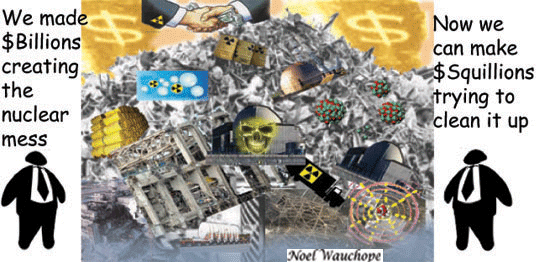
Either way, because of the dangers of radioactivity, it is not a problem that can be ignored. The sums of money that governments will have to find to deal with keeping the old stations safe are eye-wateringly large. They will run into many billions of dollars — an assured income for companies in the nuclear waste business, stretching to the end of this century and beyond.
The U.S. is a prime example of a country where the nuclear waste issue is becoming rapidly more urgent.
The problem has been brought to the fore in the U.S. because five stations have closed in the last two years. The Crystal River plant in Florida and San Onofre 1 and 2 in California have closed down because they were judged too costly to bring up to modern standards. Two more – Kewaunee in Wisconsin and the Vermont Yankee plant – could no longer compete on cost with the current price of natural gas and increased subsidies for renewables.
Nuclear Energy Insider, which keeps a forensic watch on the industry, predicts that several other nuclear power stations in the U.S. will also succumb to premature closure because they can no longer compete.
The dilemma for the industry is that the U.S. government has not solved the problem of what to do with the spent fuel and the highly radioactive nuclear waste that these stations have generated over the last 40 years. They have collected a levy – kept in a separate fund that now amounts to $31 billion – to pay for solving the problem, but still have not come up with a plan.
Legal action
Since it costs an estimated $10 million dollars a year to keep spent fuel safe at closed stations, electricity utilities saddled with these losses, and without any form of income, are taking legal action against the government.
The U.S. government has voted another $205 million to continue exploring the idea of sending the waste to the remote Yucca Mountain in Nevada — an idea fought over since 1987 and still no nearer solution. Even if this plan went through, the facility would not be built and accepting waste until 2048.
The big problem for the U.S., the utility companies and the consumers who will ultimately pay the bill is what to do in the meantime with the old stations, the spent fuel, and the sites. Much of the fuel will be moved from wet storage to easier-to-manage dry storage, but it will still be a costly process. What happens after that, and who will pay for it, is anyone’s guess.
The industry is having a Nuclear Decommissioning and Used Fuel Strategy Summit in October in Charlotte, North Carolina, to try to sort out some of these issues.
But America is not alone. The U.K. has already closed a dozen reactors. Most of the rest are due to be retired by 2024, but it is likely that the French company EDF, which owns the plants, will try to keep them open longer.
The bill for dealing with existing nuclear waste in Britain is constantly rising and currently stands at £74 billion, even without any other reactors being decommissioned.
The government is already spending £2 billion each year trying to clear up the legacy of past nuclear activities, but has as yet found no solution to dealing with the thousands of fuel rods still in permanent store at power stations.
As with the U.S., even if a solution is found, it would be at least 2050 before a facility to deal with this highly dangerous waste could be found. By that time, billions of pounds will have been expended just to keep the used fuel from igniting and causing a nuclear meltdown.
It is hard to know how the industry’s finances could stand such a drain on its resources without going bankrupt.
Similar problems are faced by Germany, which is already closing its industry permanently in favour of renewables, and France, with more than 50 ageing reactors.
Japan, still dealing with the aftermath of the Fukushima accident in 2011, is composed of crowded islands where few people will welcome a nuclear waste depository.
Many countries in the former Soviet bloc with ageing reactors look to Russia – which provided them – to solve their problems. But this may be a false hope, as Russia has an enormous unsolved waste problem of its own.
Dramatic rise
In all these countries, the issue of nuclear waste and what to do with it is a problem that has been put off – both by the industry and politicians – as an issue to be dealt with sometime in the future. But the problem is becoming more urgent as the costs and the volume of waste rises dramatically.
Unlike any other form of generation, even dirty coal plants, getting rid of nuclear stations is no simple matter. To cleanse a nuclear site so that it can be used for another industrial use is difficult. Radioactivity lasts for centuries, and all contamination has to be physically removed.
For many critics of the industry, the nuclear waste issue has always been a moral issue – as well as a financial one – that should not be left to future generations to solve. The industry itself has always relied on its continuous expansion, and developing science, to deal what it calls “back end costs” at some time in the distant future.
But as more stations close, and fewer new ones are planned to raise revenue, putting off the problem no longer seems an option, either for the industry or for the governments that ultimately will have to pick up the bill.
Iran nuclear talks extended to November

 Iran, six powers agree to four-month extension of nuclear talks: envoys BY PARISA HAFEZI AND FREDRIK DAHL VIENNA Fri Jul 18, 2014 (Reuters) – Iran and six world powers on Friday agreed to a four-month extension of negotiations on a long-term nuclear deal that would gradually end sanctions on Tehran in exchange for curbs on its nuclear programme, diplomats close to the talks said.
Iran, the United States, Britain, France, Germany, Russia andChina had set a July 20 deadline to complete a long-term agreement that would resolve the decade-old dispute over Tehran’s nuclear ambitions. But diplomats said they were unable to overcome significant differences on major sticking points.
“We have reached an agreement to extend the talks,” a senior Iranian diplomat told Reuters on condition of anonymity. Several Western diplomats echoed his remarks.
The extension agreed to on Friday begins on July 21 and negotiations on a long-term deal are likely to resume in September, diplomats said. They added that the talks were set to conclude by late November……http://www.reuters.com/article/2014/07/19/us-iran-nuclear-idUSKBN0FN27020140719
Living on a radioactive uranium dump
 What does uranium do?
When uranium is ingested it is deposited in the kidneys, lungs, brain and bone marrow. The alpha particles – which contain massive doses of energy – sit in these parts and damage the tissue around them. Because it is an endocrine disrupter, it increases the risk of fertility problems and reproductive cancer. Large doses are fatal, but the constant exposure to low levels has intergenerational effects that are still not fully understood
 One man’s home is another man’s uranium dump, Mail & Guardian, Africa 18 JUL 2014 SIPHO KINGS With nowhere else to live, many seek refuge in the radiation wastelands in Gauteng, unaware of the deadly dangers the abandoned mining areas present……..Faded photographs in the town museum show people sunbathing and swimming in the lake in the 1980s. There were bars, a jetty and a miniature putting course. Now only the foundations remain after it was closed because of the increasing concentration of uranium in Robinson Lake.
In the past it was a place for the residents of Randfontein – 50km west of Johannesburg – to relax on the weekend and forget their jobs in the mining industry. But in the late 1990s the underground mines started closing because the falling price of gold and uranium made them unprofitable. The mines were abandoned and the water levels inside started rising. Acid mine drainage began seeping into the dam, increasing the level of uranium to levels 220 times higher than the safe limit. The resort closed.
Deep into winter a chill breeze blows across the lake, creating ripples in the clear water. The surface is a stark blue reflection of the sky, with the bottom tainted red from the heavy metals in the water. No alga grow here, no fish swim, no underwater life ripples the surface.
The periphery of the lake is a wide ring of cracked yellow earth. The soil beyond is brown. There are 20m-high blue gum trees. There are yellow signs with “Radiation area – Supervised area” wired to the fence around the area and nailed to the trees.
Gold seam
The Witwatersrand gold seam runs for about 100km, from Randfontein in the west of Johannesburg to Springs in the east. A century of mining drove a mining boom, thanks to this being the world’s largest concentration of the precious metal.
Mine shafts up to 3km deep were sunk. The waste was dumped above ground in over 400 mine dumps or tailings dams that now dot the province. These contain a mixture of heavy metals, and an estimated 600 000 tonnes of uranium.
The Cancer Association of South Africa (Cansa) says this is the only place in the world where large numbers of people live next to dumps full of uranium. Continue reading
Turkey Point nuclear power plants could shut down , due to hot cooling canals
Hot cooling canals threaten shutdown of Turkey Point nuclear power plants BY JENNY STALETOVICH JSTALETOVICH@MIAMIHERALD.COM 18 July 14, Rising water temperatures and severe algae blooms in cooling canals have threatened to force the shutdown of two nuclear reactors at Florida Power & Light’s Turkey Point plant over the last few weeks.
The utility and federal regulators say there isn’t a public safety risk but the canal temperatures, climbing to 94 to 99 degrees, have come within one degree of a federal limit that would mandate an expensive shutdown at a time when power demands are soaring. The hot water has also stoked the spread of algae through the 168-mile long canal system, which has helped keep temperatures high and reignited concerns about the power plant’s impact on water quality in Biscayne Bay………
Mining companies just west of Turkey Point have also argued that saltier water from the sprawling canal system, which is heavier than freshwater, has sunk deep within the aquifer and migrated west, threatening their business as well as drinking water wells.
“When they were originally conceived and designed in the late 60s and early 70s, they were supposed to theoretically operate in a way that the salinity in the canals was going to mimic what’s in the bay,” said Ed Swakon, president of EAS Engineering and a consultant for Atlantic Civil, which operates a large mine just west of the canals. But over the years, salt built up, he said, making the water heavier and forcing it deeper underground.
At some 70 feet below the surface, he said, “it begins to spread like an inverted mushroom.”………
on Wednesday, Scott Burns, a chief environmental scientist with the water management district, said tests conducted in recent years indicate underground water is creeping west. And in a letter last month, Justin Green, chief of DEP’s office that permits power plants, said FPL has been “put on notice” about the creeping plume. DEP and the water management district, he said, are drafting an order to deal with it, which will include pumping water from the Floridan Aquifer, deep below the Biscayne.
“When we increase pumping, that will reduce salt seepage and stabilize the system,” Burns said.
But Phil Stoddard, mayor of South Miami and a longtime critic of Turkey Point’s nuclear operations, worries drawing more water from the lower aquifer will make things worse.
“All the crap we’ve thrown into the Floridan is going to end up in the Biscayne Aquifer heading toward the drinking water,” he said. “The green slime is absorbing heat and heating up the water. The problem for FPL is hot water doesn’t do such a good job of cooling the pipes.” http://www.miamiherald.com/2014/07/16/4239899/hot-weather-threatens-cooling.html
Renewable energy wanted – call by 12 top USA corporations
 12 Mainstream American Corporations Want More Renewable Energy Clean Technica, uly 17th, 2014 by Jake Richardson Just a couple of weeks ago, we reported that a number of mainstream American companies are saving about $1.1 billion a year by using renewable energy. Now, 12 prominent and very large corporations have combined their voices to say they want more renewables. Renewable energy might seem like a marginal part of American society, even something for ‘hippies,’ but if you believe that take a look at some of the companies that want more of it.
- General Motors
- Walmart
- Johnson & Johnson
- Proctor and Gamble
- Sprint
- Intel
- Hewlett-Packard
- Bloomberg
- Mars
- Novelis
- REI
- Facebook…….
- No one would say any of these companies are ‘radical,’ so it seems that renewable energy, like solar and wind are definitely mainstream now. In other words, it’s not for ‘kooks,’ ‘granolas,’ ‘socialists,’ ‘treehuggers,’ or ‘vegans’.The twelve companies listed above are brands recognizable to almost any American. They are thoroughly mainstream and some are even part of American history. Take Johnson and Johnson, for example. This huge corporation was founded in 1886. Similarly, General Motors was founded in 1908. These two companies are part of American culture and have been around for over one hundred years……..http://cleantechnica.com/2014/07/17/12-mainstream-american-corporations-want-renewable-energy/
Not much chance of restarting Kewaunee nuclear plant
Restarting Kewaunee nuclear plant no quick task Richard Ryman, Press-Gazette Media July 17, 2014 CARLTON – Any attempt to restart the Kewaunee Power Station nuclear plant would take years.
RGA Labs Inc. of Barrington Hills, Ill., wants to buy the plant, which closed in 2013, and put it back into operation, according to Robert Abboud, company president and co-owner.
RGA, an engineering consulting firm, faces steep hurdles. The nuclear plant’s owner, Dominion Resources Inc. of Richmond, Va., has said it is not for sale, and the Nuclear Regulatory Commission, which is responsible for nuclear safety, said Wednesday it would be just like starting over……..http://www.greenbaypressgazette.com/story/money/2014/07/16/restarting-kewaunee-nuclear-plant-quick-task/12760325/
Global warming bringing extreme weather to Australia – droughts and floods
 Australia’s drought – yes, it’s climate change http://www.theecologist.org/News/news_round_up/2483139/australias_drought_yes_its_climate_change.html Tim Radford 18th July 2014 Australia’s prime minister thinks climate change is ‘crap’ and has just abolished his country’s carbon-pricing system. But scientists say that it’s rising levels of CO2 that are leaving the south of the country parched and sweltering – and it’s only going to get worse.
American scientists have just confirmed that parts of Australia are being slowly parched because of greenhouse gas emissions.
A report in Nature Geoscience shows that the long-term decline in rainfall over south and south-west Australia is a consequence of fossil fuel burning and depletion of the ozone layer by human activity. Such a finding is significant for two reasons. One remains contentious: it is one thing to make generalised predictions about the consequences overall of greenhouse gas levels, but it is quite another to pin a measured regional climatic shift directly on human causes, rather than some possible as-yet-unidentified natural cycle of climatic change.
The other is contentiously political.
Australia’s prime minister, Tony Abbott, has in the past dismissed climate science as “crap”, and more recently has cut back on Australian research spending.
Bush fires and catastrophic flooding
Australia has already experienced a pattern of heat waves and drought – punctuated by catastrophic flooding – and even now, in the Australian winter, New South Wales is being hit by bush fires.
Tom Delworth, a research scientist at the US National Oceanic and Atmospheric Administration, reports in Nature Geoscience that he and a colleague conducted a series of long-term climate simulations to study changes in rainfall across the globe.
One striking pattern of change emerged in Australia, where winter and autumn rainfall patterns are increasingly a cause of distress for farmers and growers in two states.
The simulation showed that the decline in rainfall was primarily a response to man-made increases in greenhouse gases, as well as to a thinning of the stratospheric ozone layer in response to emissions of destructive gases by human sources.
The computer simulations tested a series of possible causes for this decline, such as volcanic eruptions and changes in solar radiation. But the only cause that made sense of the observed data was the greenhouse explanation.
It began in 1970, and it hasn’t stopped yet
South Australia has never been conspicuously lush and wet, but decline in precipitation set in around 1970, and this decline has increased in the last four decades.
The simulations predict that the decline will go on, and that average rainfall will drop by 40% over south-west Australia later this century.
Dr Delworth described his model as “a major step forward in our effort to improve the prediction of regional climate change”.
In May, scientists proposed that greenhouse gas emissions were responsible for a change in Southern Ocean wind patterns, which in turn resets the thermostat for the world’s largest island.
Australian scientists report in Geophysical Research Letters that they, too, have been using climate models to examine Antarctic wind patterns and their possible consequences for the rest of the planet.
Another consequence: accelerated ice sheet melt
“When we included projected Antarctic wind shifts in a detailed global ocean model, we found water up to 4°C warmer than current temperatures rose up to meet the base of the Antarctic ice shelves”, said Paul Spence, a researcher at Australian Research Council’s Centre of Excellence for Climate System Science. This temperature rise is twice previous estimates.
“This relatively warm water provides a huge reservoir of melt potential right near the grounding lines of ice shelves around Antarctica. It could lead to a massive increase in the rate of ice sheet melt, with direct consequences for global sea level rise.”
Since the West Antarctic ice sheet holds enough water to raise sea levels by 3.3 metres, the consequences would indeed be considerable.
“When we first saw the results it was quite a shock”, said Dr Spence. “It was one of the few cases where I hoped the science was wrong.”
Largest hybrid renewable energy project unveiled in Jamaica
“World’s largest” hybrid renewable energy project unveiled in Jamaica (incl video) Gizmag, By Stu Robarts July 18, 2014 Generating renewable electricity at home or in commercial buildings is becoming increasingly viable. WindStream Technologies has installed what it says is the world’s largest wind-solar hybrid array on an office roof in Kingston, Jamaica. The array is expected to generate over 106,000 kWh annually.
The array is expected to generate 25kW of wind power and 55kW of solar power. Windstream says it will return its investment within four years and will produce savings of around US$2 million over the course of its estimated 25-year lifespan.
Nuclear Regulatory Commission to investigate crack in Oconee Nuclear Station weld
 Regulators to look at Oconee Nuclear Station weld crack BY STAFF REPORTS Greenville News July 18, 2014 The Nuclear Regulatory Commission staff has scheduled a regulatory conference with officials of Duke Energy for July 31 to discuss an apparent violation of NRC requirements.
The apparent violation involved a crack in a weld on the Unit 1 high pressure injection system at the Oconee Nuclear Station near Seneca about 30 miles west of Greenville, according to the NRC.
GreenvilleOnline.com first reported in November the shutdown of Unit 1 after a leak was discovered in what Duke Energy described as the reactor’s containment building.
“On Nov. 11, 2013, the licensee (Duke Energy) determined that a leak in the 1B2 high pressure injection line was pressure boundary leakage. Unit 1 was subsequently shutdown as required … ,” according to an NRC document.
“Your measures failed to identify and correct a significant condition adverse to quality involving a crack in a weld located in the Unit 1 High Pressure Injection (HPI) system,” according to the document addressed to Duke Energy.
NRC and Duke Energy officials will discuss the safety significance of the apparent violation related to an undetected crack in a weld that led to reactor coolant system pressure boundary leakage and a forced shutdown of Unit 1, NRC officials said……..http://www.thestate.com/2014/07/18/3570369/regulators-to-look-at-oconee-nuclear.html?sp=/99/101/
1 This Month

Petition to revoke the licensing of the Near Surface Nuclear Disposal Facility (NSDF) at Chalk River. https://www.ourcommons.ca/petitions/en/Petition/Details?Petition=e-7247


of the week – STOP SMALL MODULAR REACTORS IN CANADA
To see nuclear-related stories in greater depth and intensity – go to https://nuclearinformation.wordpress.com
-
Archives
- March 2026 (158)
- February 2026 (268)
- January 2026 (308)
- December 2025 (358)
- November 2025 (359)
- October 2025 (376)
- September 2025 (258)
- August 2025 (319)
- July 2025 (230)
- June 2025 (348)
- May 2025 (261)
- April 2025 (305)
-
Categories
- 1
- 1 NUCLEAR ISSUES
- business and costs
- climate change
- culture and arts
- ENERGY
- environment
- health
- history
- indigenous issues
- Legal
- marketing of nuclear
- media
- opposition to nuclear
- PERSONAL STORIES
- politics
- politics international
- Religion and ethics
- safety
- secrets,lies and civil liberties
- spinbuster
- technology
- Uranium
- wastes
- weapons and war
- Women
- 2 WORLD
- ACTION
- AFRICA
- Atrocities
- AUSTRALIA
- Christina's notes
- Christina's themes
- culture and arts
- Events
- Fuk 2022
- Fuk 2023
- Fukushima 2017
- Fukushima 2018
- fukushima 2019
- Fukushima 2020
- Fukushima 2021
- general
- global warming
- Humour (God we need it)
- Nuclear
- RARE EARTHS
- Reference
- resources – print
- Resources -audiovicual
- Weekly Newsletter
- World
- World Nuclear
- YouTube
-
RSS
Entries RSS
Comments RSS
 nuclear-news