CWS to map radiation hot spots in 50 nurseries and schools within Fukushima city
The disaster has surely affected the lifestyle of children in Fukushima. According to Kuniaki Sato, the principal of the nursery, in the first two years after the nuclear power plant accident, the children were playing only indoors with curtains shut all the time, which has caused decreases in their physical strength. Until today, they cannot play in fields to pick wild flowers and catch insects. The nursery teachers told us how they have made efforts to nurse children in such a difficult environment.
July 15, 2014
http://www.cwsglobal.org/newsroom/news-features/cws-committed-to-fukushima.html

Three years after the Fukushima nuclear disaster in Japan, CWS continues to support local partners working to help survivors. Yukiko Maki-Murakami, project officer for CWS Japan, visited Fukushima with one of our generous donors in May 2014 to see firsthand some results of CWS’s recovery work with survivors of the disaster. Following are some of her impressions:
I regretted that due to my overseas assignment during the period it took me over three years to make my first visit to Fukushima after the nuclear power plant disaster. When I heard the stories of actual victims, I felt ashamed of the superficial knowledge I had gained from secondhand reports.
I accompanied Eiichiro Kuwana of the Japanese American Association of New York. The association was one of the donors to the Great Eastern Japan Earthquake and Tsunami project, which ended after three years. Kuwana was very much interested in seeing and knowing the current situation and issues toward the recovery of Fukushima.
Our host, Hiroyuki Yoshino of Shalom, one of our implementing partners, took us to Sayuri Nursery School to show us how children in Fukushima were surviving under difficult circumstances. Sayuri Nursery currently accommodates 97 local pre-school children including infants and evacuated children from other areas. The municipality decontaminated their playground and re-opened it to the children one year ago.
The disaster has surely affected the lifestyle of children in Fukushima. According to Kuniaki Sato, the principal of the nursery, in the first two years after the nuclear power plant accident, the children were playing only indoors with curtains shut all the time, which has caused decreases in their physical strength. Until today, they cannot play in fields to pick wild flowers and catch insects. The nursery teachers told us how they have made efforts to nurse children in such a difficult environment.
As the mother of a teenager, I felt pity for those children for whom access to the natural environment was restricted because of high radiation.
One of the nursery teachers told us of her experiences during the critical period of radioactive contamination. She wished she could have evacuated if she had not been a nursery teacher. She expressed her worries about a high staff turnover rate in the nursery.
Furthermore, while evacuated people are beginning to return, the psychological distances between evacuees and the survivors who remained in contaminated areas is now becoming a divisive issue. An income difference between compensated ones and others is another issue dividing the community. Although this may not be a well-known issue outside Fukushima, it could lead to serious problems in the local communities in the future.
Taking into account the lessons learned from the last three years’ experiences, Yoshino now is starting a new psycho-social program and a mapping project to monitor radiation around 50 nurseries and schools within Fukushima City.
CWS Japan also is committed to supporting the implementing partners continuously in this development phase in order to hasten the rehabilitation of Fukushima.
There seems to be no end in sight for the struggles of people in Fukushima. It is my sincere hope that our support can continue to be of some help to relieve the tensions in Fukushima.
Taiwan – Decision on nuclear waste disposal site years away: official – Or its war!
Lawmaker Tien, an Yilan native, threatened on behalf of the county to launch a war against the government if the greater Nan’ao area is chosen as the permanent disposal site.
“We will fight until the end!” she declared.[…]
Image source ; http://news.asiaone.com/news/asia/anti-nuclear-protest-taiwan-attracts-nearly-13000

2014/07/14 21:35:04
http://focustaiwan.tw/news/aeco/201407140030.aspx
aipei, July 14 (CNA) No decision has been made on the location of a permanent nuclear waste disposal site, an official said Monday, after residents of Nan’ao Township in Yilan County reacted angrily to speculation that their town was being considered for the site.
The search remains in its initial stage, which is focused on evaluating the quality of potential “host rock” for nuclear waste repositories, said Lee Hsiao-tung, the head of the Ministry of Economic Affairs office responsible for nuclear waste storage.
Lee explained that the high-level radioactive waste disposal plan proposed by state-run utility and nuclear power plant operator Taiwan Power Co. (Taipower) is divided into five stages, with the project’s completion set for 2055.
In the current stage that concludes in 2017, the goal is to study and evaluate underground rock strata that would be suitable for hosting and storing nuclear waste, Lee said.
The second stage, aimed at choosing candidate sites and determining the most suitable one, will not begin until 2018.
“No one can say now that Nan’ao is the ultimate place” for the nuclear waste disposal site, Lee said in a presentation of the nuclear waste disposal site selection plan held at Yilan County Hall.
The presentation was attended by opposition Democratic Progressive Party lawmakers Tien Chiu-chin, Hsiao Bi-khim and Chen Ou-po, government officials, Taipower executives, Yilan County officials and representatives of Yilan residents.
According to the Atomic Energy Council, the country’s top nuclear power regulator, several potential host rock areas are being evaluated, including the granite strata of the Taiwan-controlled island groups of Kinmen and Matsu and rock formations in the greater Nan’ao area in southern Yilan County.
Chen Teng-chin, the head of Yilan County’s Environmental Protection Bureau, contended, however, that none of the sites being studied in Kinmen and Matsu are suitable for a permanent waste disposal site because of the small scale of their rock beds.
Given that Taipower has conducted drilling tests in Hualien County’s Xiulin Township near Nan’ao, all signs point to the greater Nan’ao area, which covers a river valley plain south of Suao Township, as the final choice, Chen said.
“Don’t even think” of that possibility, Nan’ao Township chief Chiang Ming-shun said at the presentation, arguing that all Nan’ao residents are strongly opposed to the idea.
Lawmaker Tien, an Yilan native, threatened on behalf of the county to launch a war against the government if the greater Nan’ao area is chosen as the permanent disposal site.
“We will fight until the end!” she declared.
(By Worthy Shen and Elizabeth Hsu)
ENDITEM/ls
Ukraine & Singapore may cooperate on nuclear safety – Buisness is buisness!

Ambassador of Ukraine to Singapore Pavlo Sultansky met with Professor Lim Hock, Director, Division of Research Governance and Enablement, NUS and PhD Chung Keng Yeow, Deputy Head, Department of Physics, NUS.
Ukraine-Singapore possibilities of cooperation in nuclear safety were discussed.
Turkey’s nuclear projects to exceed $70 billion – But what about Turkeys poor?
 Image source ; http://revolution-news.com/greenpeace-turkey-confronts-nuclear-power-plants-summit-in-istanbul/
Turkey aims to build three nuclear power plants in its bid to diversify its energy sources.
World Bulletin / News Desk
http://www.worldbulletin.net/news/140733/turkeys-nuclear-projects-to-exceed-70-billion
Total cost of Turkey’s nuclear power plant projects will exceed $70 billion by 2023, Turkish parliament’s energy sub-commission head Halil Mazicioglu said on Tuesday.
“Our goal is to have both Akkuyu and Sinop nuclear power plants to be operational and a third one to be under construction by 2023,” Mazicioglu told Anadolu Agency. “With the additional third project, the sum of Turkey’s nuclear program will exceed $70 billion.”
Several new legislations need to be introduced in order to restructure Turkey’s nuclear field, including the creation of a “Nuclear Energy General Directorate” for coordinating the nuclear projects and preparing necessary infrastructure and programming.
These legislations are expected to be ratified by the parliament during the upcoming legislative term.
The Russian energy company Rosatom signed an agreement to build and operate a four reactor nuclear power plant in the Mersin province on Turkey’s Mediterranean coast.
Turkey also has plans to build a second four reactor nuclear plant in the port city of Sinop on the Black Sea coast with a Franco-Japanese consortium.
A third nuclear project is expected to be constructed with Turkey’s own domestic resources.
Turkey currently relies heavily on foreign energy resources like natural gas and oil, which drives almost half of its electricity production and costs up to 60 billion dollars a year.
Athabasca Nuclear and Strike Graphite Announce Intent to Merge – Bull or bust?
“….The parties caution that no assurance can be given at this time that the Transaction will be completed, that the conditions to closing will be satisfied, or that the terms of the Transaction will not change materially from those described in this news release….”
Image source ; http://www.stockhouse.com/companies/quote/ywrlf/athabasca-nuclear-corp
Image source ; http://www.4-traders.com/STRIKE-GRAPHITE-CORP-7641147/technical_analysis-full/
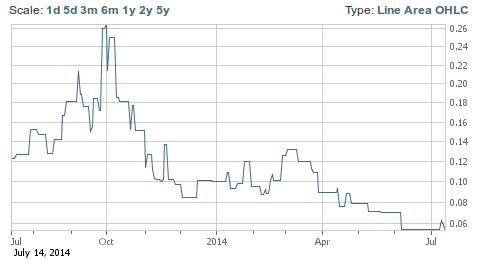
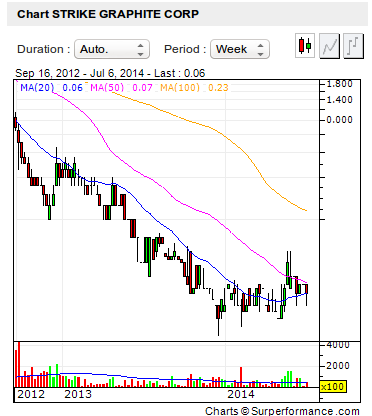
http://online.wsj.com/article/PR-CO-20140715-904725.html
Athabasca Nuclear and Strike Graphite Announce Intent to Merge
VANCOUVER, BRITISH COLUMBIA–(Marketwired – July 15, 2014) –
NOT FOR DISTRIBUTION TO U.S. NEWS WIRE SERVICES OR DISSEMINATION IN THE UNITED STATES
🙂
Athabasca Nuclear Corporation (TSX VENTURE:ASC) (“Athabasca Nuclear”) and Strike Graphite Corporation (TSX VENTURE:SRK) (“Strike”) are pleased to jointly announce that they intend to merge and form a combined Saskatchewan-centered exploration and development company with a multi-faceted project portfolio being focused on the Preston Lake uranium and the Sask Craton diamond projects.
The transaction (the “Transaction”) will be completed by way of a plan of arrangement, or other business combination, in which Athabasca Nuclear will acquire all of the issued and outstanding common shares of Strike. Each Strike shareholder will receive one common share of Athabasca Nuclear for each common share of Strike held. All outstanding Strike options and warrants will be exchanged for options and warrants of Athabasca Nuclear in an amount and at exercise prices adjusted in accordance with the same exchange ratio.
Merged Entity Highlights:
   -- Athabasca Nuclear is the Operator of and a working interest partner in
      the Western Athabasca Syndicate, which is advancing the Preston Uranium
      Project, a large-scale uranium exploration project that is regionally
      proximate to the high-grade uranium discovery made by Fission Uranium
      Corp. in the SW Athabasca Basin. Approximately $3,500,000 dollars in
      exploration has been carried out since July 2013 by the Western Athabasca
      Syndicate in advancing the Preston Uranium Project within a broader
      tenure base consisting of approximately 709,513 acres.

   -- Strike's principal asset is the early-stage Sask Craton and Sask Craton
      North diamond exploration properties ("Sask Craton Properties"), for
      which Strike has received conditional TSX Venture Exchange approval. The
      Sask Craton Properties, in which Strike will hold an 80% undivided
      interest, are contiguous and proximate to the recent Pikoo diamond
      discovery made by North Arrow Minerals Inc. and consists of a mineral
      tenure base of approximately 1,300,000 acres.

   -- The combined entity stands to benefit from reduced operating costs
      associated with the elimination of certain duplicative administrative and
      staffing costs affiliated with running a publicly-traded company. The
      elimination of such duplicative costs may result in incremental capital
      being available to be allocated to exploration of the combined entity's
      project base rather than to administrative expenses.

   -- The aggregation of multiple large-scale project interests within the same
      jurisdiction (Saskatchewan) offers the prospective benefit of being able
      to coordinate regional service companies on a multi-project basis with
      potential economic advantages resulting from volume-based work.

   -- The combined entity stands to benefit from a stronger working capital
      position and balance sheet. Leveraging the fiscal strength of Athabasca
      Nuclear, Strike shareholders will gain access to funding to advance their
      project and address a working capital deficiency which previously would
      have required significant dilution.

   -- The combined entity stands to benefit from a diversified project base
      attracting capital market interest in multiple commodity areas.

   -- The combined entity will offer shareholders of both companies greater
      liquidity by way of a larger combined capitalization and the benefit of
      trading volumes for both equities being concentrated into a single
      vehicle.
“This proposed transaction offers valuable benefits to the current shareholders of both Athabasca Nuclear and Strike. Not only will a combined entity present a superior fiscal situation, but it will also uniquely capture and focus the interest of the capital markets in two of Canada’s emerging resource plays, the SW Athabasca Basin and the Sask Craton, into a single listed vehicle,” stated Ryan Kalt, Chairman & Chief Executive Officer of Athabasca Nuclear.
“Strike is in a fortunate position to have successfully negotiated for its Sask Craton and Sask Craton North properties which recently received conditional approval by the TSX Venture Exchange. By combining with a larger exploration company, Strike will be in an improved position to better access exploration capital for its projects, fund current liabilities, and benefit from a diversified project base,” noted Geoff Balderson, President of Strike.
Athabasca Nuclear currently has 48,593,954 common shares outstanding, and Strike currently has 4,490,649 shares outstanding with a further 12,691,453 shares expected to be issued as a result of its previously announced property acquisitions and debt settlement.
Terms of Transaction
Kyushu’s nuclear restart is not enough – A perfect storm? – Moodys Japan K.K.
“The current tariff, implemented in May last year, is based on four of the company’s nuclear power plants being operational – so even if two reactors are restarted Kyushu will still not be able to return to profitability,” Kazusada Hirose, vice president of Moody’s Japan K.K., told Interfax.
[…]
“On the expenditure side, ordinary expenses increased by 2.5% to ¥1,938.1 billion, affected by […] performances in [the] electricity business as thermal fuel costs increased due to the influence of a weaker yen and costs for power purchases from renewable energy sources increased,” Kyushu said in its FY 2014 results.
[…]

Image source ; http://online.wsj.com/articles/safety-clearance-for-japan-reactors-wont-guarantee-restarts-1405340244
http://interfaxenergy.com/gasdaily/article/11395/kyushus-nuclear-restart-is-not-enough
Restarts at two shuttered nuclear reactors will not be enough to return Japan’s Kyushu Electric to profitability, Moody’s Japan warned on Tuesday in a stark reminder of the difficulties still facing the country’s beleaguered power providers more than three years after the Fukushima crisis.
“The current tariff, implemented in May last year, is based on four of the company’s nuclear power plants being operational – so even if two reactors are restarted Kyushu will still not be able to return to profitability,” Kazusada Hirose, vice president of Moody’s Japan K.K., told Interfax.
“The company’s financial situation is not sustainable on two reactors, and it will have to raise electricity rates again, which the government may be unwilling to do,” said Hirose.
Moody’s warning came one day before the Nuclear Regulation Authority (NRA) was expected to release a draft report on whether the company’s two reactors at Sendai are safe to restart.
The NRA said on Monday it would issue a draft assessment on whether the Sendai reactors had passed updated safety regulations, which were revised in the wake of the Fukushima disaster. The assessment would then be open for public comment for a month before further on-site NRA checks.
“Kyushu Electric’s two Sendai reactors are at the front of the line in terms of inspections. However, since this is the first time reactors would be brought back online, the restart procedure is still uncertain and it remains unclear where the ultimate authority to clear shuttered plants lies,” said Hirose.
Even with central government support, however, Japan’s power providers must secure approval from local communities, many of which have remained staunchly opposed to restarts because of safety concerns.
Earlier in the summer, protestors surrounded government offices in Kagoshima prefecture, the home of the Sendai plant, calling for the reactors to be permanently shut down. During the protest, prefectural officials were handed a petition opposing the restarts signed by around 120,000 people, according to local media. Meanwhile, a March poll by national broadcaster NHK showed 44% of people still believe the country’s nuclear fleet should be permanently shut down.
Deteriorating finances
1 This Month


Tell the Ukrainian Government to Drop Prosecution of Peace Activist Yurii Sheliazhenko

Petition to revoke the licensing of the Near Surface Nuclear Disposal Facility (NSDF) at Chalk River. https://www.ourcommons.ca/petitions/en/Petition/Details?Petition=e-7247


of the week – STOP SMALL MODULAR REACTORS IN CANADA
To see nuclear-related stories in greater depth and intensity – go to https://nuclearinformation.wordpress.com
-
Archives
- March 2026 (204)
- February 2026 (268)
- January 2026 (308)
- December 2025 (358)
- November 2025 (359)
- October 2025 (376)
- September 2025 (258)
- August 2025 (319)
- July 2025 (230)
- June 2025 (348)
- May 2025 (261)
- April 2025 (305)
-
Categories
- 1
- 1 NUCLEAR ISSUES
- business and costs
- climate change
- culture and arts
- ENERGY
- environment
- health
- history
- indigenous issues
- Legal
- marketing of nuclear
- media
- opposition to nuclear
- PERSONAL STORIES
- politics
- politics international
- Religion and ethics
- safety
- secrets,lies and civil liberties
- spinbuster
- technology
- Uranium
- wastes
- weapons and war
- Women
- 2 WORLD
- ACTION
- AFRICA
- Atrocities
- AUSTRALIA
- Christina's notes
- Christina's themes
- culture and arts
- Events
- Fuk 2022
- Fuk 2023
- Fukushima 2017
- Fukushima 2018
- fukushima 2019
- Fukushima 2020
- Fukushima 2021
- general
- global warming
- Humour (God we need it)
- Nuclear
- RARE EARTHS
- Reference
- resources – print
- Resources -audiovicual
- Weekly Newsletter
- World
- World Nuclear
- YouTube
-
RSS
Entries RSS
Comments RSS
 nuclear-news