Peadophile victims attacked by UK government – Bloggers fight back!
Op Ed by Arclight
Posted to nuclear-news.net
Posted on 14 July 2014
A stunning expose of government corruption and attacks on sex victims and supporters in the UK using the “Law”
link source
http://www.dailymotion.com/video/x21g7en_uk-column-news-july-14-2014_news
In a follow up to the attacks on bloggers in the UK, I am posting another video on behalf of, and in support of UK Column and the anti Fracking activist Ian Crane, who are being targetted by the UK`s security services and Home office via “independent organisations”. Having been at the brunt of this sort of operation myself, I feel an obligation to support my fellow citizens in having their right to free speech and discourse not being impeded. So my you tube channel will be used in this support for the near future as I now live outside the UK national borders.
In my earlier ATVOD video, A commenter appeared and left a link to another video that insulted UK Column in true JTRIG style. I looked into the video source and left my findings in the comments. Briefly, the source was from another “Charity” style organisation that is in support of big business. I left links and commentary underneath that video .
In this video from UK Column you will see victims and supporters being persecuted by being sent to jail to destroy there credibility and sex offenders being supported. This is not the way the Law in the Uk is supposed to work but in the new paradaigm UK citizens find themselves in, this is becoming the norm.
Here is a link to other great research in this area and you can get all the UK column videos a few hours after they have been shown live. The video stream is not very good and I wonder if it is not being messed with .. I have personal experience of bandwidths being slowed in the UK and know of other bloggers having the same problem.
All the most recent investigations can be found at this source (to be updated if it gets blocked )
http://www.dailymotion.com/f100004576424298
Please share and distribute widely
Creative commons is enabled for easy download and reupload to another video site please use it and get the word out
here is Chunky mark making an impassioned commentary on the sex offenders cover up
https://www.youtube.com/watch?v=RIlhj_tB_SE
and here is a shocked German citizen asking the European parliament to look into the terrible issue of enforced adoptions at a time that pedophiles in the UK government and their security services supporters are running wild with the ultimate digital control mechanism. These Pedophiles also have the “Law” in their pocket.
Sabine Kurjo McNeill (German), on behalf of Association of McKenzie Friends, on Abolition of Adoptions without Parental Confirm (forced adoption)
Fukushima’s ice wall – a hazardous and dubious operation
 Doubts over ice wall to keep Fukushima safe from damaged nuclear reactors Frozen barrier, costing £185m, being built around Fukushima Daiichi’s four damaged reactors to contain irradiated water The Guardian, Monday 14 July 2014 “…..f all goes to plan, by next March Fukushima Daiichi’s four damaged reactors will be surrounded by an underground frozen wall that will be a barrier between highly toxic water used to cool melted fuel inside reactor basements and clean groundwater flowing in from surrounding hills.
Up to 400 tonnes of groundwater that flows into the basements each day must be pumped out, stored and treated – and on-site storage is edging closer to capacity. Decommissioning the plant will be impossible until its operator, Tokyo Electric Power [Tepco] addresses the water crisis.
Last month workers from Tepco and the construction firm Kajima Corp began inserting 1,550 pipes 33 metres vertically into the ground to form a rectangular cordon around the reactors. Coolant set at -30C will be fed into the pipes, eventually freezing the surrounding earth to create an impermeable barrier.
“We started work a month ago and have installed more than 100 pipes, so it is all going according to plan to meet our deadline,” Tadafumi Asamura, a Kajima manager who is supervising the ice wall construction, said as workers braved rain, humidity and radiation to bore holes in the ground outside reactor No 4, scene of one of three hydrogen explosions at the plant in the early days of the crisis.
But sealing off the four reactors – three of which melted down in the March 2011 disaster – is costly and not without risks. The 32bn-yen (£185m) wall will be built with technology that has never been used on such a large scale.
“I’m not convinced the freeze wall is the best option,” Dale Klein, former head of the US Nuclear Regulatory Commission and a senior adviser to Tepco, recently told Kyodo News. “What I’m concerned about is unintended consequences. Where does that water go and what are the consequences of that? I think they need more testing and more analysis.”
The 1,500-metre wall will stay in use until 2020, using enough electricity every year to power 13,000 households, according to officials.
Over the next eight months, 360 workers from Tepco and Kajima will work in rotating shifts of up to four hours a day, with each shift beginning in the early evening to combat heat exhaustion. Each worker is wrapped in hazardous materials suits and full-face masks, along with tungsten-lined rubber torso bibs for added protection against radiation.Tepco’s record of mishaps in the three years since Fukushima Daiichi suffered a triple meltdown suggests the wall project will not be trouble free. The firm has had problems freezing irradiated water – using the same method being used to build the underground wall – that has accumulated in underground trenches, raising concerns that the ice technology is flawed…….http://www.theguardian.com/environment/2014/jul/13/doubts-giant-ice-wall-fukushima-nuclear-reactors
Iran’s nuclear programme – 5 unresolved issues
-
Enrichment
The biggest obstacle to a deal is the fundamental question of how big the Iranian nuclear programme should be. The key issue here is the country’s capacity to enrich uranium…………
-
Arak
For more than 12 years, Iran has been building a heavy water reactor in Arak, which is now close to completion. Officially it is for the production of isotopes for various industrial, agricultural, medical and other scientific uses. Western sceptics point out the planned reactor is more powerful than would be needed for such uses. They believe it is for the production of plutonium, another route to make a bomb, which is created as part of the spent fuel.
Iran refuses to scrap the project, saying it has invested a lot of time and money in it, building a heavy water production plant nearby. But this could be a relatively easy issue to fix……..
-
Past weaponisation work
The question of whether Iran had a large-scale programme to develop technologies for making a warhead, at least until 2003 as most western intelligence agencies believe, has not been resolved. For many years, IAEA inspectors have been presenting a shopping list of requests to see documents, interview scientists, and visit suspects sites, but have made little progress……..
-
Oversight
Long-term increased scrutiny by IAEA inspectors would have to be part of any nuclear deal. At a minimum, this would involve a regime of enhanced inspections which the IAEA calls the “additional protocol”. This would involve access by inspection teams to all parts of the nuclear cycle, from uranium mining onwards, and would allow them to take environmental samples anywhere they deem fit………
-
Sanctions
Sanctions relief is the main bargaining chip the six powers have in their hands at the negotiating table, and it is one of the thorniest issues, because having placed sanctions on Iran, western governments are going to find it hard to take them off. Over the years, the US and EU have gone beyond measures agreed at the UN, and built up a tangle of interlocking and overlapping punitive restrictions on doing business with Iran……….
- Buying Iranian oil and gas would go a long way towards rescuing the country’s economy, as would allowing insurance of Iranian shipping, and unfreezing an estimated $100bn in Iranian oil revenues held abroad. The problem of US sanctions and Congress could be sidestepped because some of the American sanctions have a sunset clause that means they lapse next year anyway.http://www.theguardian.com/world/2014/jul/13/five-unresolved-issues-iran-nuclear-programme-vienna-talks
Nuclear plant shakes at Fukushima as strong M6.8 quake occurs off coast
CNN Breaking News: Strong M6.8 quake off Fukushima — Tsunami warning issued — Gov’t: “Marine threat is in place… Get out of the water and leave the coast immediately” — Footage shows nuclear plant shaking for over a minute (VIDEO) http://enenews.com/cnn-breaking-news-strong-m6-8-quake-off-fukushima-tsunami-warning-issued-govt-marine-threat-is-in-place-get-out-of-the-water-and-leave-the-coast-immediately-video?utm_source=feedburner&utm_medium=email&utm_campaign=Feed%3A+ENENe
CNN: Earthquake rocks region of northern Japan; tsunami advisories issued — A 6.8-magnitude earthquake early Saturday struck in the area of Fukushima, Japan – the epicenter of a nuclear crisis following a massive 2011 earthquake and tsunami – the Japan Meteorological Agency reported. The same agency issued a tsunami warning for the Pacific coast in the region of Tohoku. […] “Marine threat is in place,” the meteorological agency warned for those in imperiled areas. “Get out of the water and leave the coast immediately.” >> Watch CNN here
AFP: Japan issues tsunami warning after strong quake near Fukushima […] Japan Meteorological Agency said a local tsunami of up to one metre could impact the Pacific coastline […]
AP: Strong quake hits Japan, triggering tsunami — A 6.8-magnitude earthquake has hit Japan’s northern coast near the [Fukushima] nuclear power plant […] Japan’s Meteorological Agency says the quake struck early Saturday 10 kilometers (6 miles) below the sea surface off the coast of Fukushima […] The agency issued tsunami advisory along the Japanese northern coast. Public broadcaster NHK says the Fukushima Dai-ichi nuclear power plant is checking if there is any damage from the quake.
Telegraph: The Japan Meteorological Agency said a local tsunami of up to 3.3 feet could impact the Pacific coastline in Fukushima, Iwate and Miyagi prefectures after the quake. The quake was measured at a depth of 6 miles and occurred at 4.22am local time [3:22p ET], the US Geological Survey said. […] Plant operators Tokyo Electric said there were no immediate reports of abnormality after the quake, according to Kyodo news agency. […] The meteorological agency advised people to leave the coast immediately, while Japan’s public broadcaster NHK said some local authorities issued evacuation advisories to their residents.
Watch quake hit Fukushima Daiichi here (4:22:28 – 4:23:40 JST)
The nuclear safety myth – a danger that is returning to Japan
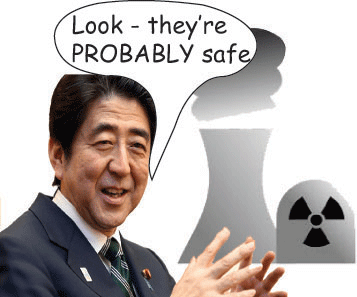 Beware the safety myth returning to Japan’s nuclear debate,Ft.com By Jonathan Soble, 12 July 14,
 Those leaders knew better, of course. But absolute guarantees were the only way to bring the national psyche into line with what were, in an energy-poor country, powerful political and economic incentives. The strategy worked. Japan ultimately built 54 commercial reactors, and before the Fukushima disaster there were plans for more. But the approach did nothing to make those reactors safer, and arguably made them less so. The need to maintain the myth prompted utilities and the government to dismiss suggestions that standards could be improved……… Today, all of Japan’s surviving nuclear reactors remain offline, despite efforts by successive governments to restart them. Shinzo Abe is the most pro-nuclear prime minister since the accident, and also the most popular. Yet much of the public remains sceptical. This week regulators are expected to certify the first plant since tighter safety standards were introduced a year ago, a move that could lead to the restarting of nuclear power production as early as autumn. Mr Abe once said an accident such as Fukushima “could never happen”. Today he is more circumspect, talking about making Japan a world leader in nuclear safety rather than a fantastical land without risks. Yet the broader debate has not changed as much as some had hoped.
Fukushima radioactive releases – Cesium 137 onto the Pacific Ocean
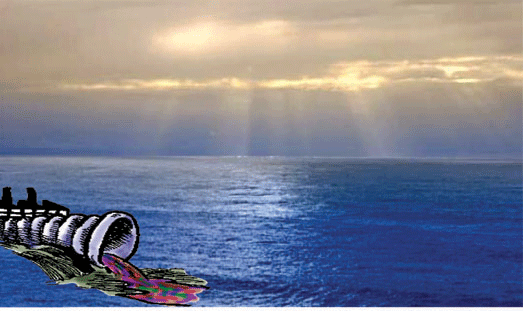 TV: Fukushima radioactive releases into ocean can continue thousands of more years, says nuclear expert — Japan gov’t concerned with tracking radioactive waste in Pacific as it returns to Fukushima from U.S. West Coast after several decades (VIDEO) http://enenews.com/tv-radioactive-releases-pacific-thousands-years-fukushima-melted-fuel-be-removed-nuclear-expert-japan-govt-concerned-radioactive-waste-ocean-coming-fukushima-several-decades-after-being-west-coast?utm_source=feedburner&utm_medium=email&utm_campaign=Feed%3A+ENENews+%28Energy+News%29
American Chemical Society — Environmental Science & Technology (pdf),Apr. 29, 2014 (emphasis added): 135Cs/137Cs Isotopic Ratio as a New Tracer of Radiocesium Released from the Fukushima Nuclear Accident […] many important issues with respect to its atmospheric transport, deposition processes, and distributions in terrestrial and marine environments remain to be investigated. It has been estimated that ∼80% of the atmospherically released 137Cs was deposited in the western North Pacific Ocean, in addition to […] 137Cs directly discharged into the ocean […] continuous input of 137Cs into the ocean due to river runoff of the 137Cs deposited in heavily contaminated Fukushima forest soil can be expected. Recent studies have revealed the start of the transport of the Fukushima accident-sourced 137Cs into the ocean interior […] it is predicted that in 30 years the Fukushima accident-derived 137Cs will come back to the ocean surface in the western North Pacific Ocean off the Fukushima coast through its transport by the Kuroshio current. Thus, to understand the environmental behavior and the fate of Fukushima accident-sourced radionuclides in the environment, a powerful Cs tracer is strongly required, because the currently widely used 134Cs/137Cs activity ratio tracer will become unavailable in several years because of the rapid decay of 134Cs […] 135Cs has a half-life of 2 × 10^6 [2.3 million] years; therefore, we are confident that the 135Cs/137Cs isotopic ratio can be considered as a new powerful tracer for long-term source identification and environmental behavior studies. […] This study was supported […] partially by the Agency for Natural Resources and Energy, the Ministry of Economy, Trade and Industry (METI), Japan [7 of study’s 8 authors are from Japan’s National Institute of Radiological Sciences]
Nuclear analyst John Large, July 9, 2014: The cores remain active for hundreds, if not thousands, of years, so there’s a commitment to keep either the ice wall technology in place or to replace it with an alternate technology by some future generation. […] Water is coming off the escarpment above the three reactors, it’s then percolating through the ground — there’s hydrostatic pressures pushing the water up toward the sea level — it’s then collecting the fission products and radioactive products from the melted-down cores and taken out to sea. […] What I think they should now have a plan to tackle the root cause… How do you control, manage and eventually remove the reactor cores? […] If the reactor cores remain in there, it’s going to be a constant leachate (water that percolates through a solid and leaches out some of the constituents) of radioactivity.
Nuclear Gambling with Earth’s future
Sino-American rivalry: Energy consumption, nuclear energy and deadly nukes Dr. Can Erimtan is an independent scholar residing in İstanbul, with a wide interest in the politics, history and culture of the Balkans and the Greater Middle East. He tweets at @theerimtanangle July 10, 2014“……….. not content with just matching Chinese commitment to fossil fuel imports and consumption by means of production, the Obama administration also “incentivizes oil, gas, and coal production overseas by providing billions of dollars in favorable financing each year to fossil fuel projects through its participation in multilateral development bank lending as well as bilateral financing through the US Export-Import Bank and the Overseas Private Investment Corporation … Since President Obama was elected, US financing of fossil fuel projects overseas through these international financial institutions has increased by 14 percent from $4.1 billion in 2009 to $4.7 billion in 2013, having declined from a peak of $6.3 billion in 2012.
Both global powerhouses thus appear to persist in gambling with the Earth’s future. In fact, American and Chinese willingness to continue playing with fire is also demonstrated by their actions in the field of nuclear energy and weapons. Some time ago, the award-winning journalist Ken Silverstein wrote in the Christian Science Monitor that the “Obama administration wants to seed the United States with pint-size nuclear reactors … The US Department of Energy said it would provide $217 million in matching funds over five years to [the private company] NuScale, which builds small, ready-made reactors that can be strung together”. These pint-size nuclear reactors would be added to the already existing “100 commercial nuclear power reactors [that] are licensed to operate at 62 sites in 31 States.”
Meanwhile, in China 20 nuclear power reactors are in operation, with a further 28 under construction, and even more about to start construction. The recent Fukushima disaster in Japan (11 March 2011) and the now-legendary Chernobyl disaster in the Ukraine (26 April 1986) provide ample evidence that the mere principle of nuclear energy seems patently absurd: in order to boil water to operate some turbines, nuclear material is fused to produce high levels of energy (or heat) that is then put to use to boil water basically, or to put it in more formal words, as can be found on the website Three Mile Island (named after another famous nuclear mishap on 28 March 1979): the “only purpose of a nuclear power plant is to produce electricity. To produce electricity, a power plant needs a source of heat to boil water which becomes steam. The steam then turns a turbine, the turbine turns an electrical generator, and the generator produces electricity”. And the dangers of nuclear radiation are manifold, as explained by Dr. Helen Caldicott, the well-known Australian anti-nuclear advocate: “[n] dose of radiation is safe. Each dose received by the body is cumulative and adds to the risk of developing malignancy or genetic disease … Children are ten to twenty times more vulnerable to the carcinogenic effects of radiation than adults. Females tend to be more sensitive compared to males, whilst fetuses and immuno-compromised patients are also extremely sensitive … High doses of radiation received from a nuclear meltdown or from a nuclear weapon explosion can cause acute radiation sickness, with alopecia, severe nausea, diarrhea and thrombocytopenia”.
All in all, the US and China seem well-matched in their dedication to endangering the continued existence of humanity on this earth: either by their use and propagation of fossil fuels leading to disastrous climate change. Or by sticking to nuclear energy as an alternative, which is a dangerous proposition to begin with, while the issue of the resultant nuclear waste material has not even been touched upon.
The military perspective
Even more ominous is the continued presence of nuclear arsenals in the US as well as in China. During the Cold War the US and the Soviet Union superpowers adhered to the principle of mutually assured destruction, which meant that the whole world was basically kept hostage to a game of chicken. Now that the Cold War is over, one would think that these nuclear warheads would finally be confined to the dustbin of history. Alas, nothing seems further from the truth, as the US still deploys about 2,000 strategic warheads, with even more in reserve.
Just the other day, the Associated Press (AP) released a timely report on America’s still-existing nuclear arsenal,http://rt.com/op-edge/171824-sino-american-rivalry-energy/
No advantage in developing nuclear weapons, says Iran
| Iran sees no benefit in developing nuclear weapons: Zarif |

 Tehran Times 13 july 14, TEHRAN – In an exclusive interview with NBC News, Iranian Foreign Minister Mohammad Javad Zarif said that Iran sees no benefit in developing nuclear weapons.
Renewabl eenergy providing 6.5 million jobs
 Career in renewable energy? 6.5m jobs for grabs, Emirates 24/7 July 12, 2014 There may now be as many as 6.5 million direct and indirect jobs in renewable energy, according to updated data from the International Renewable Energy Agency (Irena).
Earlier assessments had put the global estimate at 2.3 million jobs in 2008 (United Nations Environment Programme) and at 5 million jobs in 2012 (International Labour Organisation).
Although these estimates suggest a strong expansion in employment in renewable energy, the figures also represent successive efforts to broaden data collection across countries and sectors, reads the Worldwatch Institute’s latest Vital Signs Online trend.

The overall upward trend in renewable energy jobs has been accompanied by considerable turmoil in some industries.
Nowhere are the upheavals more noticeable than in the solar photovoltaic (PV) sector, where intensified competition, massive overcapacities, and tumbling prices have caused a high degree of turbulence in the last two to three years, but they have also triggered a boom in installations.
Global PV employment is thought to have expanded from 1.4 million jobs in 2012 to as many as 2.3 million in 2013……….
All in all, available information suggests that renewable energy has grown to become a significant source of jobs. Rising labour productivity notwithstanding, the job numbers are likely to grow in coming decades as the world’s energy system shifts toward low-carbon sources.
Solar PV has bypassed biofuels (ethanol and biodiesel) as the top renewable energy job generator……….http://www.emirates247.com/news/career-in-renewable-energy-6-5m-jobs-for-grabs-2014-07-12-1.556215
Ultra Violet radiation damages eyes: protection is needed
The Asian Age Jul 14, 2014 – Kaniza Garari“……..Sunglasses must be used only outdoors. People who work for long hours outdoors need sunglasses as the UV damage to the eyes is slow and cumulates over a person’s lifetime. Those who are close to the equator, at higher elevations or constantly exposed to the mid-day sun have a higher risk of developing sun-related eye diseases. The damage to the eye is not visible in the first decade of life. So protection from the sun’s UV rays must be practiced right from childhood.
Dr Rachna Vinaya Kumar, consultant, pediatric ophthalmology and adult strabismus, at Apollo Hospitals, explains, “Sunglasses are required during summer while outdoors as the level of UV radiation is three times higher than during winter. Similarly they are required at the beach and also for those indulging in winter sports at high altitudes. They must not be worn indoors as the dark glass lenses adapt the vision by increasing photo sensitivity of the eyes and the darker the glasses the more light-sensitive your eyes get. Indoor use thus causes eye strain.”……” http://www.asianage.com/science-health/protect-your-eyes-ultra-violet-radiation-108
Radioactive Caesium 137 found in motor part imports from Japan
Radiation found in Japanese import http://colombogazette.com/2014/07/13/radiation-found-in-japanese-import/ July 13, 2014 The Customs Department had detected radiation emanating from motor spare parts imported from Japan and the consignment was sent back to Japan.
Customs Media Spokesperson Leslie Gamini said that the radioactive chemical Caesium 137 was detected in the consignment at the Colombo port.
He said that equipment installed at the port to detect radiation materiel had detected the chemical emanating from the consignment.
The Customs spokesman said that residue of the chemical had been found from the spare parts and so the consignment was detained at the port and sent back.
He said the consignment had originated from a company operating from close proximity to the Fukushima nuclear power plant which was damaged in a massive earth quake in 2011.
The Customs Department said that while only a small amount of residue was found in the consignment, a major disaster was averted by ensuring the items did not enter the local market.
Comparison between USA and China’s management of their nuclear arsenals
Sino-American rivalry: Energy consumption, nuclear energy and deadly nukes Dr. Can Erimtan is an independent scholar residing in İstanbul, with a wide interest in the politics, history and culture of the Balkans and the Greater Middle East. He tweets at @theerimtanangle July 10, 2014
“………Just the other day, the Associated Press (AP) released a timely report on America’s still-existing nuclear arsenal, in which Robert Burns insightfully explained that the “nuclear missiles hidden in plain view across the prairies of northwest North Dakota reveal one reason why trouble keeps finding the nuclear Air Force. The ‘Big Sticks’, as some call the 60-foot-tall Minuteman 3 missiles, are just plain old. The Air Force asserts with pride that the missile system, more than 40 years old and designed during the Cold War to counter the now-defunct Soviet Union, is safe and secure. None has ever been used in combat or launched accidentally. But it also admits to fraying at the edges: time-worn command posts, corroded launch silos, failing support equipment and an emergency-response helicopter fleet so antiquated that a replacement was deemed ‘critical’ years ago. The Minuteman is no ordinary weapon. The business end of the missile can deliver mass destruction across the globe as quickly as you could have a pizza delivered to your doorstep.”Even as the Minuteman has been updated over the years and remains ready for launch on short notice, the items that support it have grown old, Burns also writes.
In 2012, Michelle Spencer, Aadina Ludin and Heather Nelson compiled a troubling report for the USAF Counterproliferation Center. The report’s title illustrates just how dangerous these remnants from the Cold War on US soil today are: The Unauthorized Movement of Nuclear Weapons and Mistaken Shipment of Classified Missile Components. The authors present a narrative of frolic and detour that is unsettling to say the least: “[o]n August 31, 2007, a US Air Force B-52 plane with the call sign ―Doom 99‖ took off from Minot Air Force Base (AFB), North Dakota, inadvertently loaded with six Advanced Cruise Missiles loaded with nuclear warheads and flew to Barksdale AFB, Louisiana. After landing, Doom 99‖ sat on the tarmac at Barksdale unguarded for nine hours before the nuclear weapons were discovered… While the Air Force was reeling from the investigations of the unauthorized movement of nuclear weapons, it was revealed that Taiwan had received classified forward sections of the Minuteman III intercontinental ballistic missile rather than the helicopter batteries it had ordered from the US, bringing to light a second nuclear-related incident”. Particularly, the phrase “inadvertently loaded with six Advanced Cruise Missiles loaded with nuclear warheads” should make everyone’s blood boil.
In contrast, the up-and-coming superpower of the 21st century China does not seem to dispose of such a wide array of technical and/or other difficulties besetting its nuclear arsenal. In 2011, the Washington Post ran a story indicating that the Chinese (or rather the CCP) constructed “a vast network of tunnels designed to hide their country’s increasingly sophisticated missile and nuclear arsenal”, called the“Underground Great Wall”. An associate professor of strategy at the US Naval War College, James Holmes, then, writes that in “March 2008, China’s state-run CCTV network broke the news about a 5,000 kilometer network of hardened tunnels built to house the Chinese Second Artillery Corps’s increasingly modern force of nuclear-tipped ballistic missiles. Tunneling evidently commenced in 1995. Located in, or rather under, mountainous districts of Hebei Province, in northern China, the facility is reportedly hundreds of meters deep”
In the end, the US as the only nation to have ever exploded a nuclear device during wartime appears to be experiencing difficulties managing its now-aging stockpile of nuclear warheads. While China, on the other hand, seems to have devised a novel way of controlling its own nuclear arsenal. In a way, these two different stories of nuclear arms’ storage could be understood as a metaphor for the waning and the rising of fortunes … Does the dragon ascend to ever-loftier heights as the eagle is slowly touching down? Will the ongoing yet somewhat unseen rivalry between Obama’s America and Xi Jinping’s China determine the course of humanity in the coming year or will the large-scale food shortages expected by 2050 combined with the ill-effects of climate change make the continuation of such competitions utterly futile and pointless? http://rt.com/op-edge/171824-sino-american-rivalry-energy/
VIDEO Special Report: Radiation & the Universe
Special Report: Radiation & the Universe – VIDEO http://www.prisonplanet.com/special-report-radiation-the-universe.html Prison Planet.com July 12, 2014
Many of the thousands of nuclear reactors in the world today were built on fault lines and ocean shores at risk for tsunamis, like Fukushima in Japan for example. More than 90% of the reactors are also leaking but industry groups do not seem to care, even though too much radiation and the wrong types of radiation can lead to accelerated aging of our bodies or even our deaths.
1 This Month


Tell the Ukrainian Government to Drop Prosecution of Peace Activist Yurii Sheliazhenko

Petition to revoke the licensing of the Near Surface Nuclear Disposal Facility (NSDF) at Chalk River. https://www.ourcommons.ca/petitions/en/Petition/Details?Petition=e-7247


of the week – STOP SMALL MODULAR REACTORS IN CANADA
To see nuclear-related stories in greater depth and intensity – go to https://nuclearinformation.wordpress.com
-
Archives
- March 2026 (212)
- February 2026 (268)
- January 2026 (308)
- December 2025 (358)
- November 2025 (359)
- October 2025 (376)
- September 2025 (258)
- August 2025 (319)
- July 2025 (230)
- June 2025 (348)
- May 2025 (261)
- April 2025 (305)
-
Categories
- 1
- 1 NUCLEAR ISSUES
- business and costs
- climate change
- culture and arts
- ENERGY
- environment
- health
- history
- indigenous issues
- Legal
- marketing of nuclear
- media
- opposition to nuclear
- PERSONAL STORIES
- politics
- politics international
- Religion and ethics
- safety
- secrets,lies and civil liberties
- spinbuster
- technology
- Uranium
- wastes
- weapons and war
- Women
- 2 WORLD
- ACTION
- AFRICA
- Atrocities
- AUSTRALIA
- Christina's notes
- Christina's themes
- culture and arts
- Events
- Fuk 2022
- Fuk 2023
- Fukushima 2017
- Fukushima 2018
- fukushima 2019
- Fukushima 2020
- Fukushima 2021
- general
- global warming
- Humour (God we need it)
- Nuclear
- RARE EARTHS
- Reference
- resources – print
- Resources -audiovicual
- Weekly Newsletter
- World
- World Nuclear
- YouTube
-
RSS
Entries RSS
Comments RSS
 nuclear-news