Czech’s Temelin nuclear power plant ceases supplying electricity to the grid
Czech nuclear plant out of action due to defect July 11, 2014 By Diarmaid Williams PennEnergy International Digital Editor Temelin nuclear power plant has stopped supplying power to the Czech grid as its second unit was disconnected over a pump defect on Thursday evening.
Dirty bomb could be made from stolen Iraqi uranium

 Stolen Iraqi uranium could make dirty bomb THE AUSTRALIAN THE TIMES JULY 12, 2014 INTERNATIONAL fears increased yesterday as it was revealed that Islamic State terrorists have seized 40kg of radioactive uranium in Iraq, which some experts say could be used to make a dirty bomb.
The revelation followed reports this week that they may have obtained chemical weapons when they seized a factory in Iraq.
The jihadists from the Islamic State (known formerly as the Islamic State of Iraq and al-Sham) seized the uranium after they overran a university complex in the city of Mosul, in their swift offensive across northern Iraq.
The Iraqi government has appealed to UN Secretary-General Ban Ki-moon for international help to “stave off the threat of their use by terrorists in Iraq or abroad”……http://www.theaustralian.com.au/news/world/stolen-iraqi-uranium-could-make-dirty-bomb/story-fnb64oi6-1226986185204
Secretive transport of nuclear bombs through centre of Glascow
 This is the stuff of nightmares, says CND’s Scottish co-ordinator http://glasgow.stv.tv/articles/282363-nuclear-weapons-driven-through-scotlands-streets-cnd-chief-john-ainslie/?fromstreampost=141179By David Bateman on Friday 11 July 2014 Here John Ainslie, Scottish Campaign for Nuclear Disarmament (CND) coordinator, blogs about claims of nuclear weapons being driven through Scotland’s streets, and why his group opposes it.
‘In the early hours of this morning I was driving along the M74, through the centre of Glasgow, just behind a convoy of more than 20 military vehicles.
At the heart of the convoy were four special transporters carrying nuclear bombs which had a total explosive power equivalent to 42 of the bombs which destroyed Hiroshima in 1945.
Nuclear weapons are kept out of sight as much as possible. They are normally onboard Trident submarines or in an underground bunker at Coulport, overlooking Loch Long. But from time to time they need to be moved.
This means driving them by road across the length of Britain from the nuclear weapons factory at Burghfield in Berkshire to the Clyde. Britain is currently upgrading all the Trident bombs. The latest convoy was probably carrying these upgraded Weapons of Mass Destruction.
The detonation of just one Trident bomb would cause far more destruction than was seen in Japan at the end of the Second World War. There would be virtually no survivors within one mile of the explosion. Lethal radiation would be scattered for hundreds of miles, and eventually around the globe.
This is only the second time that the nuclear convoy has taken this route, along the M74 then across the Erskine Bridge. But the Ministry of Defence will be planning many more convoys in the future and some will be scheduled to travel through the heart of Scotland’s largest city.
This is the stuff of nightmares.
A few drivers who were on the motorway in the earlier hours will have seen the flashing lights, the line of police vans and the armoured cars escorting Trident. But most residents of Glasgow would have been in their beds, oblivious to the nuclear arms travelling through Rutherglen, Kinning Park, Bellahouston and Renfrew as they weaved their way along Glasgow’s newest motorway.
In 2011 the Ministry of Defence held an exercise which simulated a nuclear convoy accident at the Raith interchange on the M74. This envisaged a situation where plutonium was released, but there was no nuclear explosion.
Their post-exercise report showed that emergency services were unable to deal adequately with the scenario and that coordination of the response was disorganised.
The timing of the latest convoy shows that the MOD are not really concerned about public safety. They choose to send these vehicles across England on the one day that firefighters were on strike.
The MOD may try to keep these nuclear lorries out of sight, but they can’t keep them out of the minds of the people of Glasgow, a city which has a long tradition of opposing nuclear weapons.’
A MoD spokesperson said: “We take the safety and security of our nuclear convoys very seriously, and at no point has the security of nuclear materials been put at risk.”
$US1 billion loan for Japanese solar projects, from Deutsche bank and Goldman Sachs
 Deutsche Bank lends $US1 billion in Japan’s solar gold rush, SMH, July 9, 2014 Chisaki Watanabe and Finbarr Flynn Deutsche Bank plans to lend about $US1 billion ($1.06 billion) for Japanese solar projects, joining Goldman Sachs in funding cleaner energy as the government struggles to restart nuclear power plants after the Fukushima disaster.
The bank is ready to provide financing for three to six projects in the next 12 to 18 months, said Hans Van Der Sande, director of Deutsche Bank’s structured products group at its Tokyo branch. The Frankfurt-based lender agreed last month to provide a 11.1 billion yen ($116 million) loan for a solar power project on a former golf course north of Tokyo to be operated by a unit of Spain’s Gestamp Renewables Corp.
Japan may add the most solar power capacity in the world this year, according to Bloomberg New Energy Finance, as a two- year-old incentive program attracted investors including Goldman Sachs…http://www.smh.com.au/business/carbon-economy/deutsche-bank-lends-us1-billion-in-japans-solar-gold-rush-20140709-zt0uh.html#ixzz378jMBQUy
Earthquake near New York area nuclear plant
‘Puzzling’ quake hits next to NYC-area nuclear plant — “Not along any known fault lines” — Many reports of ‘loud boom’ echoing through area — Residents ‘startled into streets’ — Professor: “They tend to come in bursts… I’m concerned, let’s put it that way… Significant hazard… We don’t understand why these occur” (AUDIO) http://enenews.com/quake-near-indian-point-loud-boom?utm_source=feedburner&utm_medium=email&utm_campaign=Feed%3A+ENENews+%28Energy+News%29
Journal News, July 6, 2014 (emphasis added): People living in the Hudson Highlands were startled Saturday morning by an earthquake that […] was accompanied by a loud boom […] those near the epicenter were startled into the streets. […] The U.S. Geological Survey listed the event at a category 5 earthquake, which typically causes light shaking and no damage.
WAMC, July 7, 2014: Nano Seeber is a research professor with Columbia University […] He says the small quake was not along any fault lines. “The Hudson Highlands is a belt of old crystalline rocks [and] have a concentration of earthquakes […] There is fault […] toward the southeast […] and there’s a concentration of earthquakes near this fault. And of course this is of great concern because there is a nuclear power plant as well along this fault […] I am concerned, let’s put it that way.” […] Seeber says, as a seismologist, the earthquake is bit puzzling. “There is significant earthquake hazard […] we don’t understand basically why these earthquakes occur.”
Kathy Percacciolo, Garrison resident: “I thought somebody hit the house. I went outside to look and my daughter came running out and said, ‘What was that?’ I said maybe it was an earthquake.” She felt one once before, around 1984.
Christine Schaetzl, Garrison resident: “We heard this loud boom and the windows shook. My husband went outside to see if someone’s gas grill blew up… It was kind of scary. It echoed through the valley.” She’d felt earthquakes before, but had never heard one.
Thomas Pitt, Highland Falls resident: [Pitt] heard and felt the quake as well, even though he’s on the other side of the Hudson River. “There’s this big rumble, a loud boom. Everyone was coming out of their houses, looking for smoke.”
Robert Pidgeon, Cortlandt Manor resident: He heard a loud, short sound “that wasn’t normal […] The trees made an odd sound like something was shaking them. I actually thought it was a bunch of deer running.”
Prof. Leonardo Seeber, Columbia University: The earthquake was […] not along any known fault lines […] Scientists keep a close eye on the Ramapo Fault because of the Indian Point nuclear power plant […] more earthquakes might be coming soon. “They tend to come in bursts.”
Rafael Abreu, USGS geophysicist: New Yorkers have nothing to worry about. “Definitely not an indication that there is a larger earthquake coming or anything else.”
Open a Nuclear Fuel Bank please! says the IAEA – Ignoring the earthquakes again?
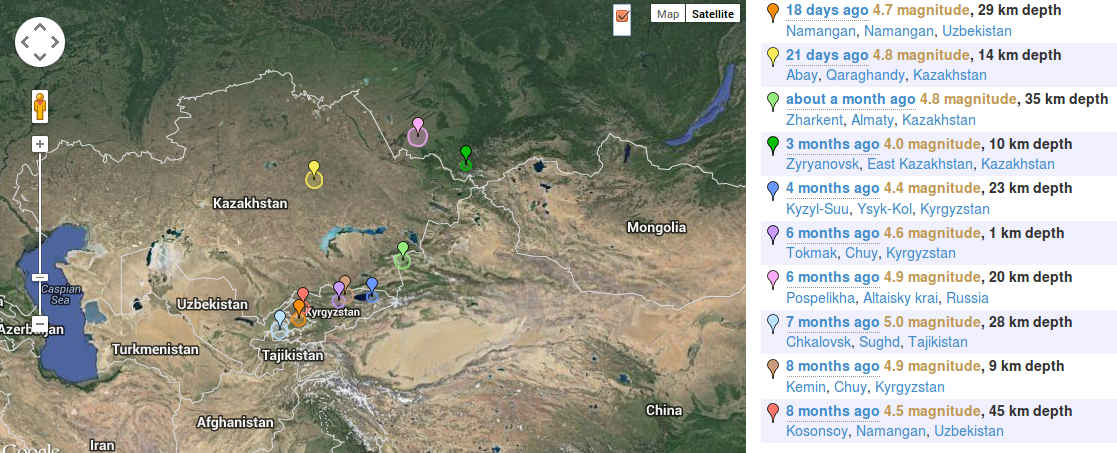
…..But in the three years since, the agency and Kazakhstan have not been able to finalize plans. The I.A.E.A. and Kazakhstan should work together to quickly resolve the remaining issues, including determining the seismic stability of the Ulba facility. Given the investment made by both sides in the viability of the site, implementing any required precautions to manage seismic risks should be the highest priority and demands good-faith cooperation.
Image source ; http://earthquaketrack.com/p/kazakhstan/recent
If this site does not meet safety requirements, the parties must find another site in Kazakhstan or the I.A.E.A. must identify another national host to fulfill the 2010 mandate of its board of governors……

WASHINGTON — As the United States and its negotiating partners continue nuclear talks with Iran in Vienna, the pressure is rising. The deadline for a final accord is July 20, and success hinges on Iran agreeing to verifiable commitments to prove to the world that its nuclear program is exclusively peaceful.
http://www.nytimes.com/2014/07/12/opinion/open-a-nuclear-fuel-bank.html?_r=0
11 July 2014
Unfortunately, at this critical point in the talks, a separate development that could support and reinforce an agreement with Iran has stalled. This development — the creation of an international fuel bank, to be owned and managed by the International Atomic Energy Agency — would allow countries full assurance that they could access nuclear fuel in the unusual case of an interruption of their supply.
A key element of any agreement with Tehran is the number and type of centrifuges Iran will have. Centrifuges can be used to enrich uranium from the level that is found in nature to a level that can fuel a nuclear power plant or to a level that could be used in a nuclear bomb. If a country has the capacity to make low-enriched uranium for a nuclear power plant, it also has the technical capability to make highly enriched uranium for a nuclear weapon. This is the key source of concern over uranium enrichment in Iran, given the country’s repeated violations of international nonproliferation obligations and the work the Iranians have already done that could lead to the development of a nuclear bomb.
Iran is not the only potential problem. Uranium enrichment is also a concern globally: A world where more and more countries make their own nuclear fuel — and thus can also produce nuclear weapons materials — is a far more dangerous world, as we have seen from North Korea.
According to the International Atomic Energy Agency, or I.A.E.A., over 30 countries are exploring whether to build their first nuclear power plant. Either these countries will import their fuel or make it themselves.
Despite Russia’s commitment to supply the necessary fuel for Iran’s only operating nuclear power reactor at Bushehr, Iran has claimed it needs national enrichment capability to protect against an interruption in its nuclear fuel supply. So, in principle, if Iran’s concerns about security of supply are addressed, it should have no need for a large domestic enrichment program that would raise fears regionally and globally.
To address this issue, the Nuclear Threat Initiative pledged $50 million in 2006 to help create a low-enriched uranium stockpile. The pledge — made possible with financial support from Warren Buffett — was later matched by more than $100 million in contributions from the United States, the European Union, the United Arab Emirates, Norway and Kuwait.
The ability to acquire low-enriched uranium on a nonpolitical basis in case of interrupted supply could be a significant factor in the negotiations with Iran. After the international fuel market and national fuel resources, the fuel bank would provide a final layer of assurance. The I.A.E.A. bank is a last-resort source if the first two backups could not fill the gap.
In addition to its relevance for Iran, the fuel bank could be important for Ukraine, should its nuclear fuel supply from Russia be cut off. This would be an aggressive move, but not unthinkable. President Vladimir Putin of Russia was reported to have announced a nuclear fuel embargo in March, though it has not been carried out.
Unfortunately, at a time when the fuel bank could be a valuable asset for countries making decisions about their nuclear programs, the bank’s completion is stalled.
1 This Month
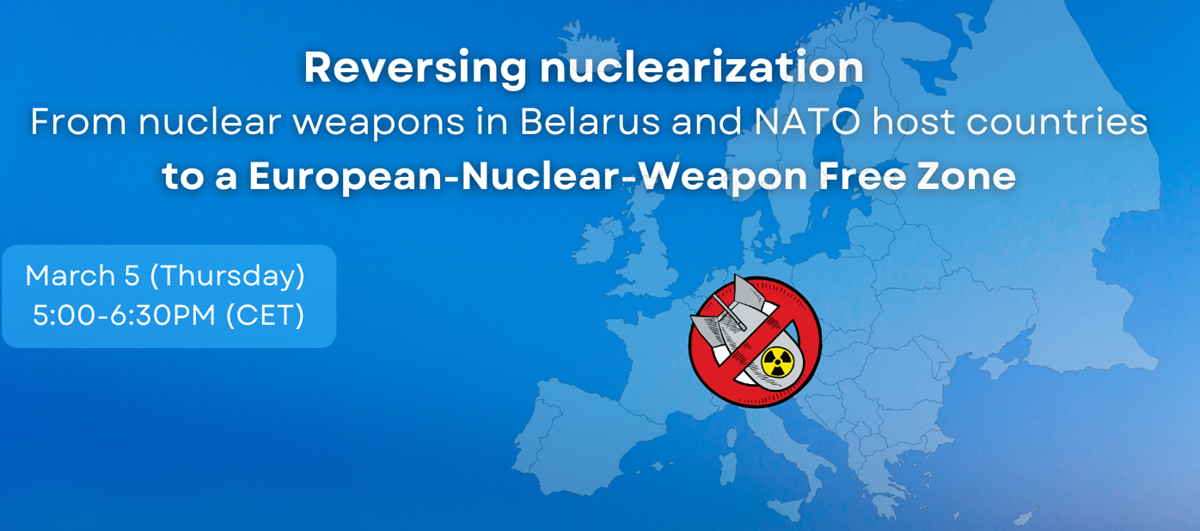
5 March -Online – Reversing nuclearization:
From nuclear weapons in Belarus and NATO host countries to a European-Nuclear-Weapon Free Zone
11am-12:30pm Eastern Time USA / 5pm-6:30pm CET

of the week – Advocating for a
nuclear free beach – https://www.samuellawrencefoundation.org/
The Samuel Lawrence Foundation advocates for a Nuclear Waste Free Beach at San Onofre, join us and take action!

10 March A LIVE WEBINAR THE REAL EFFECTS OF NUCLEAR POWER
What the Industry Isn’t Telling Us
1:00 PM Mountain, 2 pm Central, 3 pm Eastern. Live on the Keepers of the Water Facebook page

18 March Webinar @ 1 PM EST: An Assessment of SMR Projects: The Case of Canada
register for the zoom:
https://us02web.zoom.us/webinar/register/WN_o8BIIOUvQ2ONJR1nta65DQ#/registration

of the week – STOP SMALL MODULAR REACTORS IN CANADA
To see nuclear-related stories in greater depth and intensity – go to https://nuclearinformation.wordpress.com
-
Archives
- March 2026 (51)
- February 2026 (268)
- January 2026 (308)
- December 2025 (358)
- November 2025 (359)
- October 2025 (376)
- September 2025 (258)
- August 2025 (319)
- July 2025 (230)
- June 2025 (348)
- May 2025 (261)
- April 2025 (305)
-
Categories
- 1
- 1 NUCLEAR ISSUES
- business and costs
- climate change
- culture and arts
- ENERGY
- environment
- health
- history
- indigenous issues
- Legal
- marketing of nuclear
- media
- opposition to nuclear
- PERSONAL STORIES
- politics
- politics international
- Religion and ethics
- safety
- secrets,lies and civil liberties
- spinbuster
- technology
- Uranium
- wastes
- weapons and war
- Women
- 2 WORLD
- ACTION
- AFRICA
- Atrocities
- AUSTRALIA
- Christina's notes
- Christina's themes
- culture and arts
- Events
- Fuk 2022
- Fuk 2023
- Fukushima 2017
- Fukushima 2018
- fukushima 2019
- Fukushima 2020
- Fukushima 2021
- general
- global warming
- Humour (God we need it)
- Nuclear
- RARE EARTHS
- Reference
- resources – print
- Resources -audiovicual
- Weekly Newsletter
- World
- World Nuclear
- YouTube
-
RSS
Entries RSS
Comments RSS
 nuclear-news