Britain’s nuclear waste cleanup spirals above £110 billion
Britain’s nuclear clean-up bill soars to £110bn http://www.telegraph.co.uk/finance/newsbysector/energy/10921309/Britains-nuclear-clean-up-bill-soars-to-110bn.html Spiralling costs at Sellafield site in Cumbria contribute to £6.6bn increase in bill for tackling Britain’s nuclear waste By Emily Gosden
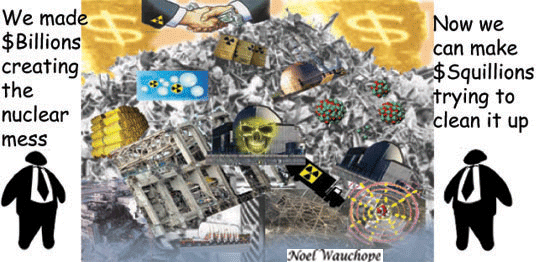
8:16PM BST 23 Jun 2014 The bill for cleaning up Britain’s nuclear waste has topped £110bn, after a £6.6bn increase in the cost estimate for work required over the next 120 years
The Nuclear Decommissioning Authority said that the biggest increase derived from a fresh assessment of the work required at Sellafield, the country’s biggest and most toxic nuclear site.
Sellafield, in Cumbria, is now estimated to cost £79.1bn to clean up, but the NDA warned that the total would “increase significantly next year” once it had fully assessed a new “performance plan” for the site.
The NDA controversially renewed a contract with Nuclear Management Partners to manage Sellafield despite fierce criticism from MPs on the Public Accounts Committee and the National Audit Office of the company’s performance.
The NDA’s annual report and accounts make clear the huge scale of uncertainty that exists over the ultimate bill for Britain’s civil and military nuclear waste.
It says it has “reviewed a number of scenarios with a range of possible outcomes” and found that “the estimated cost could have a potential range from £88bn to £218bn”.
The figure of £110bn is on an “undiscounted” basis. Once discounted, the total is £65bn.
Doubts about Fukushima’s ice wall against radioactive water leaks
 Fukushima ‘ice wall’ looking more like a dirt Slurpee http://america.aljazeera.com/blogs/scrutineer/2014/6/18/fukushima-ice-walllookingmorelikeadirtslurpee.html by Gregg Levine Skeptics of the plan to build a massive ice wall around Japan’s crippled Fukushima Daiichi nuclear facility didn’t have to wait particularly long for their first “I told you so.”
TEPCO, the nominal operator of the battered plant, announced Tuesday that while construction on the network of pipes, pumps, and compressors has begun on what is intended to be a huge ice barrier to prevent mountain runoff from mixing with radioactive water inside the facility, attempts to form a smaller ice wall around already-contaminated water are failing.
“We have yet to form the ice stopper because we can’t make the temperature low enough to freeze water,” a TEPCO spokesman said.
The project is already behind schedule and over budget, and engineers are adding more cooling pipes in hopes they can complete this first small step next month.
While the ground freezing procedure has been used to construct tunnels near waterways, it has never been used for nuclear cleanup and has never been done on such a massive scale. Estimates of the project’s success can best be termed “hopeful.” But freezing the ground around the plant is not strictly a “Why the hell not?” proposition. As previously noted, the plan comes with a list of concerns:
What if freezing causes the ground to sink? What if the ice and the ensuing expansion and contraction interrupts or further damages drainage in the reactor buildings? What if a heat wave or heat from the plant causes parts of the wall to melt? And, what if there is a prolonged loss of power to this cooling system?
The ice wall is only intended to help with the problem of irradiated runoff — the question of what to do with the thousands upon thousands of gallons of water contaminated in the daily fight to cool the melted cores of the damaged reactors and the stored rods in the spent fuel pools remains largely unanswered.
Last month TEPCO began diverting what they say is only moderately radioactive water into the ocean after assuring local fishermen that the levels were safe. Last summer, it was revealed that 300 tons of contaminated water was seeping from the nuclear site into the Pacific every day.
While freezing parts of the ground surrounding the disaster site may or may not be an effective part of the final cleanup and decommissioning, problems continue to outpace response at Fukushima. TEPCO’s experiment around the margins does nothing to address the hot mess at the core (as it were) of the crisis, and is cold comfort to those people still displaced or a country and hemisphere facing generations of radiologic contamination.
Netherlands reveal facts on US use of depleted uranium weapons in civilian areas
 US fired depleted uranium rounds in civilian areas during 2003 Iraq campaign – report http://rt.com/news/167220-depleted-uranium-us-iraq/ June 20, 2014 US-led forces in Iraq used depleted uranium weapons in civilian-populated areas during the 2003 military campaign, according to a new Dutch NGO study that also exposes a lack of adequate cleanup efforts by the invading troops.
Depleted uranium used by US forces blamed for birth defects and cancer in Iraq
For the first time the location of several sites where the invaders fired some 10,000 depleted uranium rounds were released by the Dutch Defense Ministry, and published in a study by Dutch peace group PAX.
Most of the DU rounds fired by the US-led coalition were in heavily populated areas, the group says. Samawah, Nasiriyah and Basrah are just some urban areas where ammunition was deployed – with around 1,500 anti-armor rounds fired directly at Saddam Hussein’s infantry forces. The GPS coordinates of DU rounds were initially handed over to the Dutch Defense Ministry because the Netherlands was worried about the potential contamination of its own troops in the country. The ministry later shared the information with PAX under a freedom of information law.
Most of the firing locations remain unknown, as more than 300,000 DU rounds are believed to have been fired by US-led coalition.
NGO says that the health risks of more than 440,000 kg of DU fired by Western forces remains unclear, as “neither coalition forces nor the Iraqi government have supported health research into civilian DU exposure.”
“Coalition forces were aware of the potential health and environmental impact of DU munitions, yet refrained from undertaking the necessary clean-up of DU outside their own bases,” a summary of the report reads.
Wim Zwijnenburg, the author of the report, said the US Air Force knew of the consequences of using DU ammunition.
“The use of DU against these targets questions the adherence of coalition forces to their own principles and guidelines. They should be held accountable for the consequences,” Zwijnenburg said, citing a 1975 memo from the Air Force Office of the Judge Advocate that restricted the use of such ammunition.
“Use of this munition solely against personnel is prohibited if alternative weapons are available,” the memo said, because of “unnecessary suffering and poison.”
According to an earlier PAX report, more than 300 sites in Iraq are currently contaminated with depleted uranium and it would cost at least $30 million to clean up.
Hanford nuclear facility hiding health effects of radiation
 Hanford nuclear site employees not allowed to speak out about chemical exposure, brain damage, Monday, June 23, 2014 by: Ethan A. Huff, (NaturalNews) Workers at a large nuclear waste storage facility in south-central Washington are falling gravely ill from exposure to radiation, according to new reports. But a former company insider says they are too afraid to come out about it for fear of losing their jobs.
NBC Right Now in the Tri-Cities reports that Lonnie Poteet, a former truck driver at the federal government’s Hanford Site, suffered major injuries after encountering leaked radiation earlier in the spring. Poteet says site managers failed to notify him that there had been a spill upon arriving to deliver fuel.
“I was already burning from my glove line to my t-shirt line and the side of my face and I was already starting to lose a little bit of vision in my right eye,” recalled Poteet about arriving at the site just hours following the spill.
Rather than post a notice or warn workers directly that a spill had occurred, Poteet says Hanford officials did nothing. Consequently, he and others continued to access the site, even though some crews had been notified to stay home that day while the spill was addressed…….
Meanwhile, other former workers harmed by nuclear exposure at Hanford are having trouble getting compensation for their injuries. According to KING5 News in Seattle, a government audit found that claims for compensation sometimes take up to seven years to get processed, and many valid applications are being denied.
http://www.naturalnews.com/045684_Hanford_Site_chemical_exposure_brain_damage.html##ixzz35by5vlm6
Nuclear and Coal plants at increasing risk from climate change impacts
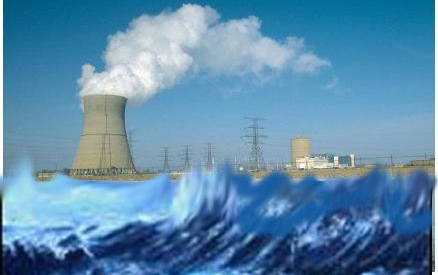 World’s energy systems vulnerable to climate impacts, report warns Generators from nuclear reactors to coal-fired power plants will feel the brunt of the weather changes Fiona Harvey, environment correspondent theguardian.com, Wednesday 18 June 2014 Rising sea levels, extremes of weather and an increase in the frequency of droughts and floods will all play havoc with the world’s energy systems as climate change takes hold, a new report has found
 Many large plants are particularly at risk from droughts, because they need water to cool their facilities, and floods, because they lack protection from sudden storms. Electricity distribution networks are also likely to be affected.
The vulnerability of energy systems to natural shocks was shown starkly when the Fukushima nuclear plant in Japan had to be closed down following the 2011 tsunami, which prompted governments around the world to review their nuclear policies.
The World Energy Council (WEC), which compiled the study along with Cambridge University and the European Climate Foundation, urged generators to examine their vulnerability to climate change……http://www.theguardian.com/environment/2014/jun/18/world-energy-systems-vulnerable-climate-impacts-report
More delays, more costs for Georgia’s new nuclear power plants
 Monitor warns of delays building Ga. nuclear plant Seattle Pi By RAY HENRY, Associated Press , June 23, 2014 ATLANTA (AP) — The companies building one of the first U.S. nuclear plants in a generation have missed project deadlines, and government monitors questioned in reports released Monday whether those delays could grow.
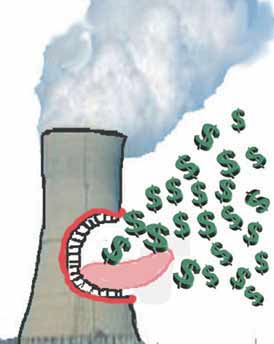
Southern Co. subsidiary Georgia Power and its partners are building two more nuclear reactors at Plant Vogtle (VOH’-gohl) southeast of Augusta using a first-of-its-kind technology. The construction project was originally estimated to cost $14 billion, but the final price tag is likely to rise.
The plant in Georgia and an identical facility under construction in South Carolina are widely viewed as tests of whether the nuclear industry can build new power plants without the big delays and cost overruns common decades ago. Total project costs could jump $2 million every day there is a delay, according to estimates released by state analysts. Utility customers ultimately pay those costs unless regulators intervene………http://www.seattlepi.com/business/energy/article/Monitor-warns-of-delays-building-Ga-nuclear-plant-5573404.php
USA Tea Party types created Tony Abbott the world’s new warrior on behalf of the fossil fuel industries
 How Rupert Murdoch created the world’s newest climate change villain, Salon Australia was once a leader on climate action. Thanks to American conservative powerhouses, that’s no longer true ALEXANDER WHITE 21 June 14, Australia, the sunburned country, is uniquely vulnerable to the dangers and risks of global warming. Whether it is the severe effects of flooding, unseasonal heat waves, devastating bush fires or decade-long droughts, Australia’s people, economy and natural environment have all keenly felt the impact of extreme weather and climate change.
Australia’s national scientific organizations have been raising the alarm for more than a decade, and the previous government accepted that scientific consensus and enacted a cap-and-trade scheme in 2012. But after a divisive election last year — one that saw native-born Rupert Murdoch exercise his considerable influence in Australian media markets to disastrous effect — the country is now governed by a deeply unpopular Liberal-National government, crafted in the image of the most climate-denying elements of the Tea Party. And its position on climate change has significant impacts on global efforts to reduce carbon emissions: Australia is not only the chair of the G-20 group of nations, but also holds a place on the U.N. Security Council.
The rest of the world saw this ideology on full, embarrassing display with the recent visit by Prime Minister Tony Abbott to Canada and the United States. Continue reading
Canada’s nuclear watchdog recommends iodine pills for communities near nuclear reactors
Nuclear watchdog recommends distributing iodine pills to residents near reactors Canadian Nuclear Safety Commission is proposing that those within 10 kilometres of reactor sites — about a quarter-million people in the GTA — be given thyroid blocking pills as a precaution.The Star, By: Jennifer Ditchburn The Canadian Press, Jun 23 2014
OTTAWA—Canada’s nuclear watchdog is proposing for the first time that people living near reactors be given a precautionary stock of radiation-fighting pills in case of an accident.
But at a consultation meeting Monday in Ottawa, sources in the room said the nuclear power producers expressed reservations about the plan, and how it would be implemented.
The Canadian Nuclear Safety Commission has been reviewing the country’s emergency preparedness and response regulations in the wake of the meltdown at Japan’s Fukushima reactor in 2011. Many countries have already adopted a system whereby residents near nuclear reactors are given iodine thyroid-blocking tablets to store in their homes.
The thyroid glands, especially in younger children, are the most susceptible to absorbing radiation that is ingested or inhaled. The pills are supposed to be taken immediately before or after a major radiation leak.
Mass distribution has occurred in New Brunswick and in Quebec, but not in Ontario, where the major reactors are located. Pills are available to residents at local pharmacies and stockpiled at schools.
A 2013 focus group conducted for Ontario Power Generation said that among residents surveyed around the Darlington and Pickering nuclear plants, “almost none had obtained free pills that have been advertised in regional communications or pamphlets.”
The safety commission has been consulting with various groups, including environmentalists and nuclear licence holders, on its latest regulatory drafts.
It is proposing the tablets be pre-distributed within the “plume” area of radiation — about 10 kilometres — for a selective portion of the population. In the Greater Toronto Area, that means about a quarter-million people……..
Groups such as Greenpeace and the Canadian Environmental Law Association are supportive of the commission’s work — a somewhat rare occurrence.
“This is a good step towards catching up with other countries, Canadians deserve protection on par with international best practices,” said Shawn-Patrick Stensil, a nuclear analyst with Greenpeace. “The way it’s written right now, it doesn’t meet international best practices, but it’s a good step towards that.”
The groups emphasize that leaving it up to people to pick up pills on their own has obviously not worked, and in the aftermath and chaos of a nuclear accident and evacuation, people might not have the ability to get the pills in time.
“Our response is that we’ve had 30-plus years of making the pills available … for people to pick up at pharmacies, and there’s very low awareness by people that they should do so and that it matters to their health,” said Theresa McClenaghan, executive director and counsel of the Canadian Environmental Law Association.
“Instead, the messaging that people have had is that the plants are safe and there’s nothing to worry about.” http://www.thestar.com/news/canada/2014/06/23/nuclear_watchdog_wants_iodine_pill_stockpiles_near_reactors.html
Hungary to borrow $13.7 billion from Russia, to expand nuclear power
 Hungary approves multi-billion nuclear loan ENCA 23 June 2014 – BUDAPEST – Hungarian lawmakers on Monday approved a multi-billion-euro loan from Russia for an upgrade of the country’s only nuclear power plant, a deal critics say increases Hungary’s dependence on Moscow.
In January, Prime Minister Viktor Orban struck an agreement with Russian President Vladimir Putin for Russia’s atomic energy corporation Rosatom to build two new reactors at the Paks plant — located about 100 kilometres south of Budapest.
The loan agreement, which was signed in March but required approval by Hungary’s parliament, stipulated that Moscow would lend Budapest up to 10 billion euros ($13.7 billion) — around 80 percent of the estimated cost.Parliament gave the loan the green light by 100 votes for, 29 against with 19 abstentions.
Details of the deal were not published nor was any formal bidding process for the plant’s expansion ever launched, prompting an ongoing enquiry from the European Commission into possible breaches of EU law. http://www.enca.com/hungary-approves-multi-billion-nuclear-loan
Indian officials deny covert expansion of India’s nuclear weaponry
Indian officials trash U.S. think-tank report THE HINDU, ATUL ANEJA 21 JUNE 14, Indian officials have trashed the report published by a military intelligence think tank based in the United States, which, citing satellite imagery alleged that New Delhi was covertly expanding its nuclear weapons programme.
The report is “mischievously timed,” ahead of a meeting on Monday of the Nuclear Suppliers Group (NSG) in Buenos Aires, and is intended to divert focus from the real culprits of proliferation, said an official source, who did not wish to be named. “It is interesting that such reports questioning India’s nuclear credentials are planted at regular intervals,” he observed.
The Hindu carried a news report based on the findings published by the IHS Jane’s group that satellite imagery had revealed extension of the Mysore nuclear centrifuge plant, which could “substantially” expand India’s nuclear submarine fleet and support development of thermonuclear weapons…….
Defence officials told The Hindu, on conditions of anonymity, that India’s indigenously designed nuclear submarine Arihant has concluded “harbour trials” and final preparations are underway for an imminent commencement of “sea trials,” ahead of formal induction of the platform into the naval fleet. The nuclear submarine – which has a long undersea endurance – is central to India’s “second strike” capability, and its induction in the navy’s stables would complete the triad of nuclear delivery systems.
The Defence Research and Development Organisation (DRDO), that steers India’s weapons development programme is developing a string of submarine launched ballistic missiles including the K-4 which has a 2,000 kilometer range. http://www.thehindu.com/news/national/indian-officials-trash-us-thinktank-report/article6136856.ece
UNhappy Fukushima PR song .. With high radiation readings at pro nuclear video locations discovered – Ooops!!
take 2 🙂
Thanks to missmilky the clown for the video share // i am unable to cut and paste her text on youtube ??
And here is the link to the main model working for big nuclear corporation .. And not for the victims of the nuclear disaster..
Ian Thomas Ash was attacked by a media outlet here and some links to the companies behind the attacks
“This is not to say that all of the response has been positive. One notable (and particularly vicious) attack on me, the film and the mothers who appear in it, was published this week in Asa Ge Plus (アサ芸プラスここ) under the title “Fukushima Discrimination Film ‘A2-B-C’ Encourages International Discrimination of Fukushima” (福島差別映画「A2-B-C」が国際的な“福島差別”を助長する). ”
http://ianthomasash.blogspot.fr/2014/06/anonymous-attack.html
but the happy fukushima song needed models etc and copyright permission .. http://www.j-m-a-a.com/en/about-jmaa.html
About J.M.A.A|Japan Modeling Agencies Association
http://www.j-m-a-a.com
Outline of J.M.A.A
put this here to check out later .. http://zakko.or.jp/outline_eng/04.html
Japan Magazine Advertising Association-JMAA Overview
zakko.or.jp
一般社団法人 日本雑誌広告協会WebSiteです。
i feel the beginnings of an article coming on .. i hope some Japanese speakers can have 5 minutes searching also .. for connections .. got ADK as well .. Hmmm?
OKUMA SHOTEN PUBLISHING CO., LTD. http://whois.net/whois/asagei.com
Whois Lookup & IP | Whois.net
whois.net
Whois.net, Your Trusted Source for Secure Domain Name Searches, Registration & A…
LOL == http://zakko.or.jp/outline_eng/06.html director is a trustee of JMAA //
Japan Magazine Advertising Association-JMAA Overview
zakko.or.jp
一般社団法人 日本雑誌広告協会WebSiteです。
Illness and deaths among Fukushima’s nuclear clean-up volunteers
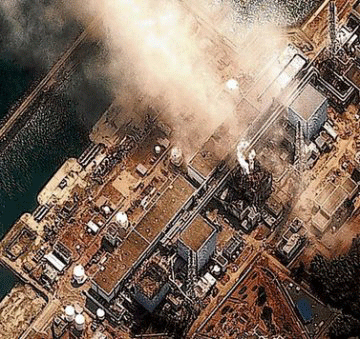 Fukushima Guide: “Lots of people suddenly started having nose bleeds, cats and dogs too, it lasted for some time” after 3/11 — Article: Many who volunteered in Fukushima have died, including 2 students from group of 15 helping to decontaminate http://enenews.com/fukushima-guide-lots-of-people-suddenly-started-having-nose-bleeds-cats-and-dogs-too-it-lasted-for-some-time-after-311-article-many-who-volunteered-in-fukushima-have-died-including-2-stud?utm_source=feedburner&utm_medium=email&utm_campaign=Feed%3A+ENENews+%28Energy+News%29
Zukunashi no Hiyamizu, June 9, 2014 (h/t Dissensus Japan]: Why many of decontamination volunteers died — “Genpatsu Mondai” wrote a blog article in the May 21, 2014 titled “Joining the volunteer with Fukushima citizens result in sudden death!!! Two of fifteen students in the neighborhood already died from an unknown cause”. In this article, you can read many dead cases of volunteers who went to Fukushima and worked there. They went to contaminated area and worked for decontamination as volunteers. […] Basically the purpose of volunteers is to go to the contaminated area where the air dose rate is high and to work there.
Sulejman Brkic, June 12, 2014: We left for Fukushima by bus very early on May 31, from Yokohama […] At the rest area where we stopped to pick up our guide, Masumi K. […] According to Masumi san, the population is divided between those who trust the government and the ones who don’t […] Don’t forget Fukushima are the words spoken to us by Masumi K. […] Masumi is from Okuma which she fled with her family after the nuclear explosions in 2011 […] She has been also battling cancer for some time now […] her husband got seriously sick and needed a new kidney, Masumi gave him one of hers. […] [A] young anonymous worker [at Fukushima Daiichi] told us […] about so many small and big acts of exploitation […] that…well…one stops listening, not on purpose, but it’s just too much, too overwhelming, it starts sounding normal after a while, I am sorry I can’t remember all of it. At every step in that area one can see or hear or feel the Japanese government’s lies and crimes. […] After the young anonymous worker, Masumi K talked again. She told us, again among many other stories of suffering, about the increase in suicides, consumption of alcohol, domestic violence, depression…she also told us how after the ongoing nuclear disaster there was a time when quite lots of people suddenly started having nose bleeds, cats and dogs too, it lasted for some time and then it suddenly stopped.
40 times above normal – thyroid cancer rates in Fukushima’s children
 Fukushima’s Children are Dying (includes audio)http://ecowatch.com/2014/06/14/fukushima-children-dying/2/ Harvey Wasserman | June 14, 2014 Some 39 months after the multiple explosions at Fukushima, thyroid cancer rates among nearby children have skyrocketed to more than forty times (40x) normal.
More than 48 percent of some 375,000 young people—nearly 200,000 kids—tested by the Fukushima Medical University near the smoldering reactors now suffer from pre-cancerous thyroid abnormalities, primarily nodules and cysts. The rate is accelerating.
More than 120 childhood cancers have been indicated where just three would be expected, says Joseph Mangano, executive director of the Radiation and Public Health Project.
The nuclear industry and its apologists continue to deny this public health tragedy. Some have actually asserted that “not one person” has been affected by Fukushima’s massive radiation releases, which for some isotopes exceed Hiroshima by a factor of nearly 30.
But the deadly epidemic at Fukushima is consistent with impacts suffered among children near the 1979 accident at Three Mile Island and the 1986 explosion at Chernobyl, as well as findings at other commercial reactors. Continue reading
Anxiety in China, over its not so safe rush to nuclear power
Losers aplenty in China’s race for nuclear power THE AUSTRALIAN JUNE 21, 2014 Scott Murdoch China
 Correspondent Beijing IN China’s far eastern region of Rongsheng, the government is rolling out one of the most ambitious nuclear power developments in the world.
China has commissioned at least three power plants in the Shandong province as it attempts to reduce its reliance on fossil fuels. However, the details of the projects remain tightly controlled, with hundreds of residents, farmers and business owners left to question their future amid concerns over the safety of nuclear technology.
A journalist, photographer and news assistant from The Weekend Australian were recently detained by police while researching the Shidaowan project. The company behind the development, the China Huaneng power company, refused to answer questions. French nuclear regulators this week warned China needs to step up its level of supervision, control and interaction with the rest of the world as it invests more in nuclear generation. There are 20 nuclear reactors in operation in China and a further 28 under construction.
It has been mooted that Shidaowan will come online by 2017, more than three years behind schedule, after the 2011 Fukushima disaster in Japan halted nuclear development around the world.
Under the government’s plans, next-generation CAP1400 reactors are being developed in Shandong. The program has been approved by the National Development and Reform Commission, the peak economic planning agency in China.
It is forecast that nuclear power generation will almost triple, from 15.69 gigawatts to at least 58GW, by 2020, as China aims to reduce its reliance on coal-fired power generation.
However, in the small villages around the new power plant in Rongsheng, the human and environmental costs of the development are already clear.
Villages have been razed, with dozens of residents forced from their homes in the early stages of the plant’s construction.
The project has brought work, with labourers housed in cramped conditions. But residents are concerned about the use of world-first technology. Some have been told they will be moved and placed in high-rise accommodation, leaving behind their friends, family, traditions and culture………
“The villagers have had land by the seaside for generations, we could grow our own food, we could fish, and not only feed our family but we could make some money from that.
“But now the land has been seized and if something goes wrong then the seas will be completely damaged and our villages could be wiped out.”………
Former nuclear power engineer Du Minghai said while China was rolling out the most ambitious nuclear program in the world, it had to ensure it strengthened safeguards to prevent environmental, social and health problems.
“In terms of the plant design, equipment manufacturing and maintenance management, China still has gaps compared with the world’s most advanced levels,” he said.
“We should introduce and insist that foreign-management methods are put in place, and make sure that we don’t localise the management systems of the plants.
“Some people are saying that China is using the highest standards and building the most advanced nuclear units, but to some extent I think this is just political language being used to make sure politicians support their projects.”
Additional reporting: Wang Yuanyuan http://www.theaustralian.com.au/news/world/losers-aplenty-in-chinas-race-for-nuclear-power/story-e6frg6so-1226961728367#
Fukushima reactors too “hot” to allow workers to look for molten nuclear cores
 Hemisphere facing generations of radiologic contamination” from Fukushima — TV: It’s a major humanitarian crisis — NYT: “Nobody really knows” if 100s of tons of plutonium & uranium fuel resolidified — Experts: It’s certain reactor cores ‘moved around’; “Flowed to different part of buildings”? (VIDEO)
Al Jazeera, June 17, 2014: Fukushima ‘ice wall’ looking more like a dirt Slurpee […] Skeptics of the plan to build a massive ice wall […] didn’t have to wait particularly long for their first “I told you so.” […] “We have yet to form the ice stopper because we can’t make the temperature low enough to freeze water,” a TEPCO spokesman said. […] What if freezing causes the ground to sink? What if the ice and the ensuing expansion and contraction interrupts or further damages drainage in the reactor buildings? […] TEPCO’s experiment around the margins does nothing to address the hot mess at the core (as it were) of the crisis, and is cold comfort to those people still displaced or a country and hemisphere facing generations of radiologic contamination.
Christopher Morris, Muon Radiography Program Leader, June 16, 2014: “It’s certain that the reactor cores melted and the material moved around. By using muons going through the cores, we can make a radiograph of the uranium material and find out how much is left inside the pressure vessel, how much has leaked out of the pressure vessel.”
Duncan McBranch, Los Alamos Lab’s Chief Technology Officer, June 18, 2014: “The material itself may have melted and flowed to a different part of the building. Invasive techniques such as video endoscopy or introduction of robots run the risk of releasing radiation.”
New York Times, June 17, 2014: […] there are three wrecked reactor cores, twisted masses of hundreds of tons of highly radioactive uranium, plutonium, cesium and strontium. […] most of the material in the plant’s reactors resolidified, in difficult shapes and in confined spaces, wrapped around and through the structural parts of the reactors and the buildings. […] that is what the engineers think. Nobody really knows, because nobody has yet examined […] “nobody knows what happened inside,” [McBranch] said. “Nobody wants to go in to find out.” […] concrete, steel and water will all be distinguishable from uranium, plutonium and other very heavy materials. […] Testing will begin later this year, officials say, and final images will be produced next year.
KRQE, June 18, 2014: LANL technology to examine Fukushima damage […] “This is a major humanitarian crisis,” said Matt Durham, a post-doctoral researcher at Los Alamos […] “They are much too radioactive to go in and look at things,” said Christopher Morris, the lead researcher on the project. […] LANL hopes the detectors will be used in about a year. >> Full broadcast here
-
Archives
- February 2026 (228)
- January 2026 (308)
- December 2025 (358)
- November 2025 (359)
- October 2025 (376)
- September 2025 (258)
- August 2025 (319)
- July 2025 (230)
- June 2025 (348)
- May 2025 (261)
- April 2025 (305)
- March 2025 (319)
-
Categories
- 1
- 1 NUCLEAR ISSUES
- business and costs
- climate change
- culture and arts
- ENERGY
- environment
- health
- history
- indigenous issues
- Legal
- marketing of nuclear
- media
- opposition to nuclear
- PERSONAL STORIES
- politics
- politics international
- Religion and ethics
- safety
- secrets,lies and civil liberties
- spinbuster
- technology
- Uranium
- wastes
- weapons and war
- Women
- 2 WORLD
- ACTION
- AFRICA
- Atrocities
- AUSTRALIA
- Christina's notes
- Christina's themes
- culture and arts
- Events
- Fuk 2022
- Fuk 2023
- Fukushima 2017
- Fukushima 2018
- fukushima 2019
- Fukushima 2020
- Fukushima 2021
- general
- global warming
- Humour (God we need it)
- Nuclear
- RARE EARTHS
- Reference
- resources – print
- Resources -audiovicual
- Weekly Newsletter
- World
- World Nuclear
- YouTube
-
RSS
Entries RSS
Comments RSS
 nuclear-news