http://www.japanfocus.org/-Eiichiro-Ochiai/4138
The Asia-Pacific Journal, Vol. 11, Issue 25, No. 4, June 23, 2014
Eiichiro OCHIAI
“Oishinbo” is the title of a series of manga (comic), meaning “Gourmet Craze”, created and written by Kariya Tetsu. It has been continuously published since 1983 in a comic magazine “Big Comic Spirits” published by Shogakukan (Tokyo), and enjoyed great popularity in Japan. The series, mainly centered on gourmet food, has been re-published in more than 100 books, and in the past caused controversies regarding its criticisms of food and food regulations.

Oishinbo volume 102 |
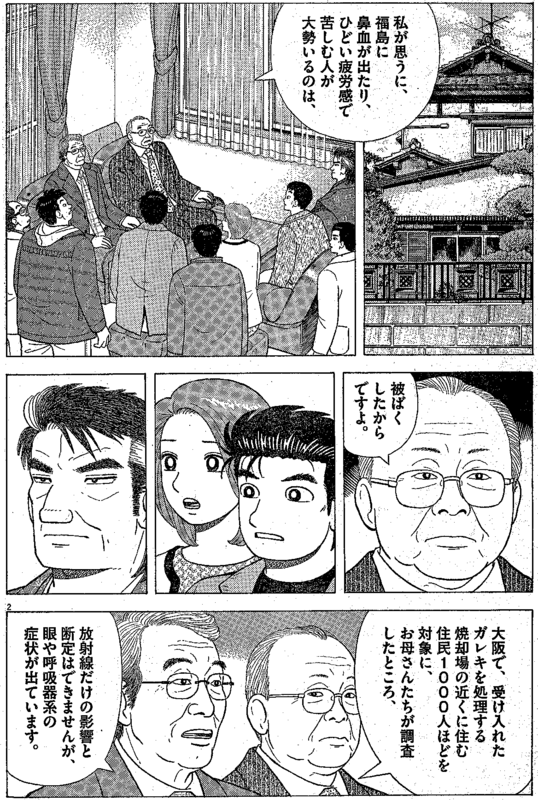
An episode titled “The Truth about Fukushima (series 604)”, with episode 22/23 published on May 12, 2014. It depicted a conversation about “Nose Bleeding” among the comic’s protagonist Yamaoka Shiro, a scientist and the former mayor of Futaba-machi a town adjacent to the Fukushima Dai-ichi Nuclear Power Plant, which had severe accidents on the occasion of the Great East Japan Disaster when a powerful earthquake (magnitude 9) combined with the huge Tsunami on March 11 of 2011 (the 3.11 incident). A portion of a key scene of the comic is shown below. The controversy, centered on the issue of the main character suffering nose bleed after a visit to the plant, and another character modeled on the former Futaba Mayor, warning people against living in the prefecture. After the Fukushima prefectural government issued a protest against the manga for inflaming fears about the safety of the prefecture’s fish, the publisher announced that the popular series would take a break following a final issue on “The Truth about Fukushima” on May 19.
This episode in the comic, centered on nose bleeding in the wake of 3.11, provoked an unusual controversy immediately upon publication, and all printed copies of the comic were rumored to have sold out quickly. Essentially there are two views. One is “denial of the fact” that many people have experienced nose bleeding after the Fukushima incident, with the assertion that nose bleeding cannot be caused by the radiation emitted from Fukushima Dai-ichi. The other view is that it is reasonable that the nose bleeding observed among the people of Fukushima prefecture and surrounding areas including Tokyo could be caused by radiation, as suggested in the comic.

Courtesy of Shogakukan (Tokyo)
(The conversation goes like this (top to bottom, right to left): “I think the reason that so many people in Fukushima are suffering from nose bleeding and serious fatigue…” “It is due to exposure to radiation.” “Concerned mothers in Osaka investigated 1000 persons living near the incinerating facility dealing with the debris brought from the affected areas.” “They found problems with the eyes and respiratory system, though I would not say that all are due to radiation.”) |
The fact is that no scientifically definitive proof has been found for the cause-effect relationship in the case of nose bleeding. No serious studies have been conducted on this issue. The question is then whether the scientific arguments “against” causality are more reasonable than the arguments “for” causality or the reverse. If the former (against) is reasonable, and is very likely based on the best human knowledge available, it would suggest that it is not necessary to worry about the entire issue of radiation effects on living organisms at current levels. On the hand, if the latter (for) is more reasonable and conforms to the best human knowledge, there would be need to worry about radiation effects, and action would be required to reduce such danger to the minimum.
The Political Aspect
The denial has two aspects: one is political, the other scientific. The political powers, including the current mayor of Futaba-machi, the minister of the environment and even the prime minister, strongly criticized the episode, saying that the contents do not hold up to scrutiny. They deny categorically the facts depicted in the comic. The intention seems to be to suppress any suggestion of a causal relationship between nose bleeding and the radiation emitted as a result of the disaster and any criticism of the government and the nuclear industry. People, including locals, have been keenly aware of government intentions in strongly reacting to this trivial incident. After all, it was simply a description of certain incidents observed by the author and associates and presented in a comic. Why did the government go to such lengths to suppress mention of nose bleeding? The incident suggests the desperation of the government and the industry to suppress the facts concerning the danger of radiation.
The local governments of Fukushima prefecture and local communities expressed concern, coining the term “damage caused by rumors”. This suggests that to express something that cannot be verified may adversely affect those for which the concern is expressed. In this case, the idea was to suggest that people (Japanese citizens) may receive a false impression that radiation is still significant in Fukushima, and might become afraid of approaching the area, buying products made in the area, etc., despite the fact that the radiation level has already been reduced significantly, as the local governments and the Japanese government insist. However, it is to be recognized that the damages caused by radiation are indeed more serious than rumors such as these. But what is the true situation concerning radiation? Unfortunately, precise, accurate and detailed data are non-existent or have been hidden from public scrutiny. Besides, a more significant issue is the question of how low a level of radiation should cause us to worry. Is there a threshold? This is a scientific issue, so we now turn to the scientific aspects of the controversy, which are the main focus of this article.
The Facts about Nose Bleeding and Other Symptoms
There have been a number of reports of unusual nose bleeding after the Fukushima Dai-ichi accident. These have been made mostly by individuals who have had nose bleeding themselves or have observed their children’s experience of unusual nose bleeding. Some prominent persons, such as a medical doctor who appeared in the comic, have reported observations of nose bleeding. Nose bleeding has also been reported in connection with the Chernobyl incident (1986). Dr. Hida Shuntaro, a medical doctor and a survivor of Hiroshima Atomic Bomb, has witnessed many examples of radiation-related illnesses, including nose bleeding and unusual fatigue syndrome after the Hiroshima bombing. Fatigue is another symptom discussed in the comic. One of the more recent reports can be seen here,1 in which several citizens from Fukushima prefecture describe in detail their experiences of ill-health including nose bleeding.
It is true that there are many causes for nose bleeding. This fact may have influenced some people to belittle the possible causality between nose bleeding and radiation. Whether this is the case or not, no official detailed data on nose bleeding has been collected in any of these situations (Hiroshima/Nagasaki, Chernobyl and others), let alone the Fukushima case. This is a fact, and the deniers use this fact as a ground for their claim that no widespread nose bleeding incidence has been observed, and that such a description even in a comic is demagogic.
A few relatively large data sets have, however, been collected. One on the Chernobyl incident was collected by a group led by Hirokawa Ryuichi.2 Over the years 1993-96 he collected data from 25,564 persons who were evacuated from the immediate vicinity of Chernobyl. The following results were obtained from 2127 persons who evacuated from Chernobyl city 8-9 days after the accident.
(a) Ill-health effects experienced one week after the accident:
headache: 64.5 %; nausea: 41.5 %; sore throat: 42.5 %; pain on the skin: 7.1 %; nose bleeding: 21.6 %; fainting: 9.7 %; unusually strong fatigue: 61.7 %; state like being drunk 22.1 %; other ill effects: 13.4 %
(b) Current health conditions:
healthy: 2.7 %; headache: 74.6 %; sore throat 35.6 %; anemia: 14.2 %; dizziness: 50.2 %; nose bleeding: 19.6 %; fatigue: 74.9 %; susceptible to cold: 59.0 %; pain in limbs and bones: 64.0 %; eye sight problem (cataract): 30.5 %; abnormalities in thyroid glands: 37.8 %; tumors: 3.8 %; leukemia: 0.7 %; congenital abnormalities: 0.1 %; others 20.0 %.
A team from Kumamoto Gakuen University led by Nakachi Shigeharu3 in Nov. 2012 investigated nose bleeding and other illness among the people living in Futaba-machi adjacent to Fukushima dai-ichi and Marumori-machi 60 km north west north of Fukushima dai-ichi, and compared the data to those for people living in Kinomoto-cho in Shiga prefecture 600 km west of Fukushima dai-ichi. The odds ratio of nose bleeding among the people living in Futaba- and Marumori-machi were 3.5 and 3.8, respectively. This indicates that nose bleeding incidence was significantly higher (by 3 to 4 times) in towns close to Fukushima Dai-ichi compared to that in a place far from it. Other symptoms including headache, dizziness, nausea and fatigue were also high among people living in Futaba-machi.
Continue reading →
June 25, 2014
Posted by arclight2011part2 |
Uncategorized |
Leave a comment
http://www.katu.com/news/local/Working-climate-at-Hanford-nuclear-site-is-strained-264505811.html
By Nicholas K. Geranios, Associated Press Published: Jun 24, 2014
SPOKANE, Wash. — Few of the U.S. Department of Energy workers who are helping build a plant to treat the most dangerous radioactive wastes at a nuclear site in Washington state feel they can openly challenge management decisions, according to a report obtained Tuesday by The Associated Press.
The survey conducted by the Energy Department shows only 30 percent of the agency’s employees at the Hanford Nuclear Reservation feel they can question their bosses.
The results were somewhat better for the plant’s managers who responded, with 65 percent saying they could openly challenge decisions by higher-level managers.
Democratic Sen. Ron Wyden of Oregon said the study shows recent allegations of retaliation against Hanford workers who raised safety concerns made other employees less likely to come forward.
The Energy Department, in a news release, said it “remains committed to developing and sustaining a strong nuclear safety culture.”
The agency said it has taken many steps in the past year to improve the safety at Hanford and other nuclear weapons production sites around the nation.
“We have more work to do,” the agency said.
Continue reading →
June 25, 2014
Posted by arclight2011part2 |
Uncategorized |
Leave a comment
25 June 2014
http://www.businesskorea.co.kr/article/5166/nuclear-export-korea%E2%80%99s-nuclear-reactor-technology-succeeds-first-european-export
South Korea’s nuclear R&D technology marks its first success in export to Europe.
The Ministry of Science, ICT and Future Planning revealed on June 24 that the Korea Atomic Energy Research Institute (KAERI) consortium wins a bid as a partner to upgrade Delft University of Technology’s experimental reactor, also known as the OYSTER Project.
The KAERI-run Consortium consists of KAERI, Hyundai Construction, and Hyundai Engineering.
The objective of this project is to complete the upgrade of the reactor’s capacity from the current two megawatts to three megawatts by the end of 2017. This deal costs 19 million euros (about US$26 million).
This bidding holds significant meaning as it won a brutally relentless competition against international consortia from nuclear-power dominant nations such as France, Germany, and Russia.
South Korea’s nuclear technology projects so far were limited to Asia, such as the UAE’s commercial atomic power plant contract in 2009, Jordan’s research system contract in 2009, Thailand’s nuclear research facility upgrade
project in 2009, and Malaysia’s nuclear digital system upgrade in 2012.
In contrast, this is acclaimed to be a significant move, as South Korea’s nuclear energy proves to be world class to win a deal in the nuclear-technology dominant Europe.
Above all, this winning bid proves that President Park Geun-gye’s diplomacy played a major role in the 3rd Nuclear Security Summit in Prague March this year.
President Park had actively engaged in promoting the highly-skilled domestic nuclear technology along with research-related projects including OYSTER.
This upgrade is based on a cold neutron source, a US$39.6 million model developed by KOAERI for seven years since July 2003.
The science minister, Choi Moon-gi, stated that “The winning OSTER bid is a success marking the bright future for nuclear technology export in Europe. It will also serve as a great advantage in the future bid for Netherland’s construction of reactor known as the PALLAS project.”
S. Korea says nuclear programs won’t guarantee N. Korea’s future
SEOUL, June 25 (Yonhap) — Prime Minister Chung Hong-won called on North Korea on Wednesday to cooperate with South Korea and choose the path of co-prosperity on the divided Korean Peninsula.
“North Korea should clearly recognize that what can guarantee its future is cooperation with us, not its nuclear programs,” Chung said in a ceremony marking the 64th anniversary of the outbreak of the 1950-53 Korean War……….
http://english.yonhapnews.co.kr/national/2014/06/25/0301000000AEN20140625004100315.html
June 25, 2014
Posted by arclight2011part2 |
Uncategorized |
Leave a comment
http://www.chicagotribune.com/news/politics/sns-rt-us-usa-military-industry-20140624,0,1291365.story
By Andrea Shalal Reuters
6:20 p.m. CDT, June 24, 2014
WASHINGTON (Reuters) – U.S. weapons makers must focus on affordability and be more upfront about the cost of new, cutting-edge technologies given a large “bow wave” of increased spending facing the Pentagon in the 2020s, Comptroller Robert Hale told Reuters on Tuesday.
Hale, who will leave office soon after five years as the Pentagon’s top financial officer, said he worried that constant increases in military requirements would undermine a range of efforts under way to drive down the cost of weapons systems.
He said efforts to develop a new long-range bomber would be the “canary in the coal mine” that showed whether budget caps would be effective in curbing runaway weapons costs. The department has said it plans to spend no more than $550 million apiece for 80 to 100 new bombers.
“That would be an enormous achievement,” Hale said in an interview, saying it would be a “struggle” for the Air Force to stay under the cost cap since it developed a new bomber only once every 30 years. Boeing Co and Lockheed Martin Corp have joined forces to compete against Northrop Grumman Corp for the multibillion-dollar order.
Typically, new weapons wound up costing two to three times as much as the ones they replaced, Hale said.
He said the Pentagon faced a “bow wave” or large increase in weapons spending in the 2020s when it hopes to buy the new bomber, large numbers of new ground vehicles for the Army, and hundreds of Lockheed Martin Corp F-35 fighter jets.
The Navy is also working on a new submarine to replace the nuclear-armed Ohio-class submarines, and the Air Force needs to replace the Minuteman nuclear ballistic missiles, he said.
Given those pressure to fund those new systems, he said it was critical for firms to find ways to cut costs, and to ensure that military leaders understood the true cost of new technologies.
“I hope more of them will have to courage to say, ‘Look this is going to be very expensive, maybe you ought to consider (something else),'” he said.
Companies could help government by “sounding an alarm” about the cost of new technologies. That would help firms in the long run, he said, because otherwise the military would simply buy fewer numbers of ships, planes and ground vehicles.
Hale said he hoped the Pentagon could still avoid breaking a multiyear procurement deal with Sikorsky Aircraft, a unit of United Technologies Corp, and Lockheed for new MH-60 helicopters, a Navy plan that has worried industry.
“But ultimately if we have to choose between readiness and multiyears, it would be a tough call,” he said.
Hale said companies needed to “sharpen their pencils” and cut costs, but the Pentagon understood that industry needed to make profits to keep shareholders happy. “They’ve got to make money or they can’t stay in business,” he said.
(Reporting by Andrea Shalal; editing by Gunna Dickson)
June 25, 2014
Posted by arclight2011part2 |
Uncategorized |
Leave a comment
http://www.zawya.com/story/Emiratis_leaving_nuclear_regulator_jobs_raised_at_UAE_FNC-GN_24062014_250616/
Tuesday, Jun 24, 2014Abu Dhabi: A member of the Federal National Council on Tuesday put a question to Dr Anwar Mohammad Gargash, Minister of State for FNC Affairs, on the reasons behind many Emiratis quitting jobs in a certain department of the federal nuclear authority.
Thirteen employees resigned from the nuclear regulator last year due to dissatisfaction with their jobs, it was revealed at a previous meeting of the council.
Hamad Al Rahoumi, a member from Dubai, said the Federal Authority for Nuclear Regulation (FANR) has to investigate the reasons behind these citizens’ resignations and why they were mostly from a specific department.
A letter was sent to the House about the bonus details and a timetable with the names, job details and reasons why the 13 quit.
It said that bonuses were mostly granted to specialised staff in technical fields and all of the employees’ reasons for leaving included job dissatisfaction. Some got better job opportunities, while others spoke of unhappiness over job security, work environment and teamwork.
Rules to make the use of the Emirates ID card mandatory for Emiratis and expatriates across the board were also debated by the Federal National Council on Tuesday.
The use of the Emirates ID card is mandatory for Emiratis and expatriates in pursuance of federal law No 9 of 2006 on the Demographic Registry and Identity Card and Cabinet Resolution No 25 of 2011.
Members of the House approved changes in the law, giving more powers to the board of directors of the Emirates Identity Authority to set up a system of implementation, deadlines and exemptions from Demographic Registry rules.
Under the rules, it is mandatory for all Emiratis to produce the ID card along with the passport and the family book to finalise all transactions and dealings at work places, schools and to enjoy the benefits.
All expatriates and their family members, who work in government, semi-government and private sectors, have to produce the ID card and the passport which contains the residence visa to have their transactions finalised and completed at the work place.
The rules state all entities, departments and establishments across the country must abide by the provisions of federal law No 9 of 2006 on Demographic Registry and ID card. Anyone in his/her capacity as employee, official, worker or student or having any other status, must obtain the ID card to use any service.
By Samir Salama, Associate Editor
Gulf News 2014. All rights reserved.
June 25, 2014
Posted by arclight2011part2 |
Uncategorized |
Leave a comment
By Kyle Stucker
June 24, 2014 – 9:56 PM
HAMPTON — Seacoast residents again questioned Tuesday during an annual meeting about Seabrook Station’s safety why owners of the degraded nuclear power plant can apply for a new license 20 years before their current license expires.
“I just don’t understand how you could be considering relicensing this far ahead with all the problems down there,” said Don Tilbury, an area resident, to Nuclear Regulatory Commission officials running the meeting. “You’re in the midst of something you don’t know the results of. … You don’t really know that they’re safe.”
Roughly 40 people, including elected officials and Seabrook Station employees, attended Tuesday’s annual open house and safety meeting for Seabrook Station at the Best Western in Hampton.
The purpose of the meeting was to inform the public that NRC officials have deemed the plant operated safely in 2013 despite increasing degradation and cracking caused by an alkali-silica reaction within the plant’s concrete, according to the NRC.
NextEra Energy is seeking to extend its license from 2030 to 2050. A determination about Seabrook Station’s license application won’t be made until specialized ASR tests are completed and various action plans are implemented, according NRC Division of Reactor Safety Deputy Director Jim Trapp.
Those tests, being conducted at the University of Texas at NextEra’s expense, are expected to take roughly a few years or longer to complete.
University of Massachusetts Lowell nuclear engineering professor Gil Brown raised several questions and concerns about the plant’s safety and the relicensing process during the question and answer period of Tuesday’s meeting, although he said the seemingly “arbitrary” and “early” 20-year relicensing application period is a good thing.
He said the plant “has to be safe” and that it’s not wise to wait until “five years” or “one year” before a plant’s license expires to conduct time-consuming tests to evaluate safety and structural integrity.
“I would say 20 years gives time to resolve things that have shown up, like ASR,” Brown said.
NRC staff say recent visual inspections indicate there are 171 locations of cracking throughout Seabrook Station’s various concrete structures due to the gel that slowly forms when the alkali and silica within the concrete react.
NRC Public Affairs Officer Neil Sheehan said tests last year indicate there were 131 locations of cracking due to ASR, which is a common problem with concrete. The number of locations is expected to grow over time, and the University of Texas tests are being conducted to determine how the cracking will affect the plant’s concrete and operability decades down the line.
The NRC claims the plant’s concrete is still able to handle its required loads despite the cracking, though, because the plant was constructed to structural specifications that far exceeded the design loads. NRC staff say Seabrook Station’s ASR is not “infringing” on those margins.
Detailed information about ASR findings at Seabrook Station, recent safety inspections and evaluations, and updates and findings from the University of Texas tests can be found online at www.nrc.gov.
June 25, 2014
Posted by arclight2011part2 |
Uncategorized |
Leave a comment
http://news.yahoo.com/nrc-raises-risk-significance-2013-arkansas-nuclear-plant-181841548–finance.html
23 June 2014
(Reuters) – The U.S. Nuclear Regulatory Commission (NRC) said on Tuesday that after a series of investigations, it has declared a 2013 incident at an Arkansas nuclear power plant to be of substantial safety significance, the penultimate of four emergency classifications.
An industrial accident at Entergy Corp’s Arkansas Nuclear One plant in Russellville killed one worker and injured eight others on March 31 last year, when a generator fell as it was being moved out of the turbine building.
The accident was initially classified as an unusual event, the lowest of four emergency classifications, because the incident caused a small explosion inside electrical cabinets.
The incident caused unit 2 of the plant to automatically shut down when a reactor coolant pump tripped due to vibrations caused by the heavy component hitting the turbine building floor, damaging electrical cables and equipment, leading to a loss of off-site power.
Unit 1 at the plant was in a refueling outage at the time, with all of the fuel still in the reactor vessel, safely cooled.
Emergency diesel generators were relied upon for six days to supply power to cooling systems.
If the diesel generators would have failed, there was no alternate means of providing electrical power to key safety-related systems at the plant at that time, due to the damaged electrical cables and equipment.
“The NRC determined that the lifting assembly collapse resulted from the plant’s failure to adequately review the assembly design and ensure an appropriate load test in accordance with its procedures or approved standards,” the NRC statement said.
NRC held a regulatory conference with Entergy officials on May 1 and after considering information provided by Entergy, determined that ‘substantial safety significance’ was appropriate to characterize the risk significance of the event for both Unit 1 and 2.
“The NRC will determine the appropriate level of agency oversight and notify Entergy officials of the decision in a separate letter,” the statement said.
(Reporting by Anupam Chatterjee in Bangalore; Editing by Marguerita Choy)
June 25, 2014
Posted by arclight2011part2 |
Uncategorized |
Leave a comment
http://timesofindia.indiatimes.com/City/Chandigarh/Fatehabad-DC-recommends-shifting-of-nuclear-plants-residential-colony-site/articleshow/37157089.cms
Bhaskar Mukherjee,TNN | Jun 25, 2014
Fatehabad: The proposed residential colony of the nuclear power plant at Badopal village of Fatehabad district is likely to be shifted to another site, as the area is inhabited by endangered species like blackbucks and neel gai (blue bull). Project developer Nuclear Power Corporation of India Ltd (NPCIL) had acquired 125 acres of land to build a residential colony for plant workers.
Fatehabad deputy commissioner Dusmanta Kumar Bahera has sent a letter to the state government asking it to shift the proposed residential colony site. Animal rights activists and members of Bishnoi community have been protesting against the proposed colony since last year, demanding its shifting to another site.
Bahera told mediapersons that the administration’s proposal was being considered by the state government and a final decision was likely to be taken soon.
NPCIL is coming up with a 2,800 MW nuclear power plant on 1,313 acres of land acquired at Gorakhpur village in Fatehabad. NPCIL had acquired about 125 acres more at Badopal, about 8 kms from the plant site, to build houses for its employees and personnel of Central Industrial Security Force (CISF).
In September 2013, several blackbucks were trapped and killed in the fencing put up by NPCIL around the colony site which trigged anger among the Bishnoi community. Later, a team of scientists from Wildlife Institute of India (WII), Dehradun, conducted a survey of the spot and submitted a report that Badopal was a key habitat for wildlife and the residential colony should be shifted to some other place.
June 25, 2014
Posted by arclight2011part2 |
Uncategorized |
Leave a comment






 nuclear-news