Irish seaweed versus Japanese seaweed – Geiger readings showing contamination with relevant links
Posted by Shaun Mc Gee
8th June 2014
Contributer to nuclear-news.net
There is a story flying around the web and on main stream media sources that comments on Irish seaweed from the northern Ireland’s being exported to Japan for Miso soup etc.
Whilst i was unable to get seaweed from the north of Ireland to test, I decided to show you a comparison using seaweed from the cleaner western coastline soaked with sea salt. The northern islands seaweed might be contaminated with Americium 241 from Sellafield in the UK as recent reports have shown.
The western part of Ireland should only have radioactive potassium (sea salt) which is a natural radioactive substance which our bodies have learned to assimilate and regulate.
here is the link to the article explaining the export. with the added Geiger reading from Japan;
https://nuclear-news.net/2014/06/08/rathlin-island-family-plan-to-export-irish-seaweed-to-japan/
Here is the link to the report of contamination from Sellafield in the Irish sea that is going to get worse over coming decades;
“…At Garlieston there was an increase in concentrations in mud from 1985 -1997, and at Carlingford in Northern Ireland the concentration of Am-241 in mud appears to be increasing still. This effect of the spread of activity away from Sellafield may continue, at least into the near future…..”
More here;
https://nuclear-news.net/?s=sellafield+sea
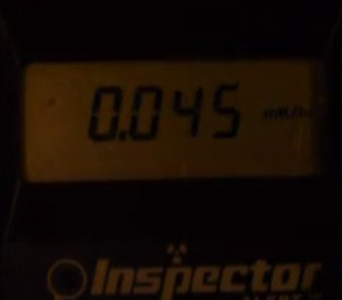
Video showing the Irish reading taken as of the date of this post.
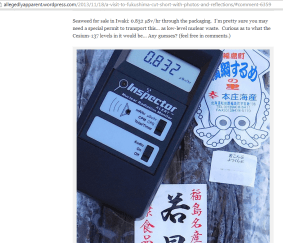
Japanese reading above and Irish reading below (you will need to move the decimal place to the right on the Irish reading to work out comparison though this is explained on the video)
If you would like to contribute to the researcher who did this article for materials and costs, please follow this link;
Thank you
Rathlin Island family plan to export Irish seaweed to Japan
http://www.sundayworld.com/top-stories/rathlin-island-family-plan-to-export-irish-seaweed-to-japan
Sunday 8th June 2014
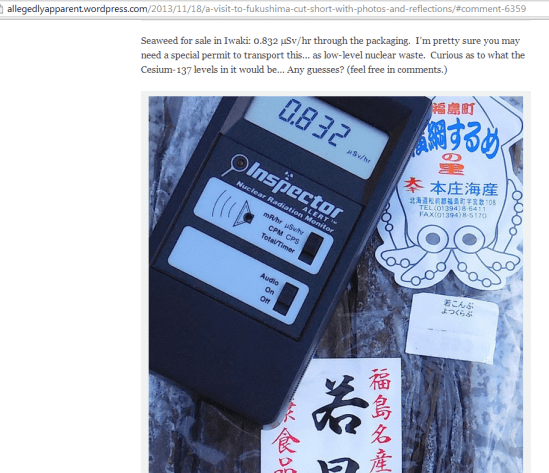
Image source ; http://agreenroad.blogspot.ie/2013/04/radioactive-seaweed-found-with-40000000.html
A small island off the north coast has emerged as an unlikely potential supplier of edible seaweed to Japan – a country whose own stocks have been hit by the Fukushima nuclear disaster.
A mother and son team from Rathlin, the isolated island with a population of around 100, are trying to exploit the gap in the market caused by the contamination of the waters around the ruptured reactor.
Kate Burns and her son Benji McFaul are growing thousands of tonnes of kelp on ropes that extend out from the shoreline into the sea around Rathlin.
They have found conditions are optimum for growing the fine species used in traditional Japanese miso soup and the thicker variety used in noodle recipes.
“Due to the Fukushima nuclear disaster in Japan, a lot of the seaweed production in that part of the world has been closed down,” said Ms Burns.
“Combine that with the growth of the Asian population who eat seaweed, plus the growth in the European population who now are interested in seaweed, and sushi is a big growth market. So we will be pursuing the European and Asian markets.”
Ms Burns, who lived on Rathlin for 20 years before settling on mainland Co Antrim after a stint working at a marine science centre in the US, explained why the island was proving a great source of kelp.
“The waters around Ireland and Britain are particularly suitable because of the Gulf Stream as it means our temperatures are near optimum the year round,” she said.
“But especially round Rathlin – Rathlin is a very strong tidal place and kelp like strong tides. If the tides are too strong the kelp gets too coarse, but there are places in Rathlin where the tides are ideal, between one and two knots.”
She said the waters are all but free of minuscule organisms that harm seaweed.
Having initially relied on natural spores in the water to spawn the seaweed plants that grow on the ropes, the company has now set up a laboratory on the shore to germinate their own miniature kelp, before transferring them on to the ropes.
The lab employs four Rathlin residents as technicians.
1 This Month



Tell the Ukrainian Government to Drop Prosecution of Peace Activist Yurii Sheliazhenko

Petition to revoke the licensing of the Near Surface Nuclear Disposal Facility (NSDF) at Chalk River. https://www.ourcommons.ca/petitions/en/Petition/Details?Petition=e-7247


of the week – STOP SMALL MODULAR REACTORS IN CANADA
To see nuclear-related stories in greater depth and intensity – go to https://nuclearinformation.wordpress.com
-
Archives
- March 2026 (212)
- February 2026 (268)
- January 2026 (308)
- December 2025 (358)
- November 2025 (359)
- October 2025 (376)
- September 2025 (258)
- August 2025 (319)
- July 2025 (230)
- June 2025 (348)
- May 2025 (261)
- April 2025 (305)
-
Categories
- 1
- 1 NUCLEAR ISSUES
- business and costs
- climate change
- culture and arts
- ENERGY
- environment
- health
- history
- indigenous issues
- Legal
- marketing of nuclear
- media
- opposition to nuclear
- PERSONAL STORIES
- politics
- politics international
- Religion and ethics
- safety
- secrets,lies and civil liberties
- spinbuster
- technology
- Uranium
- wastes
- weapons and war
- Women
- 2 WORLD
- ACTION
- AFRICA
- Atrocities
- AUSTRALIA
- Christina's notes
- Christina's themes
- culture and arts
- Events
- Fuk 2022
- Fuk 2023
- Fukushima 2017
- Fukushima 2018
- fukushima 2019
- Fukushima 2020
- Fukushima 2021
- general
- global warming
- Humour (God we need it)
- Nuclear
- RARE EARTHS
- Reference
- resources – print
- Resources -audiovicual
- Weekly Newsletter
- World
- World Nuclear
- YouTube
-
RSS
Entries RSS
Comments RSS
 nuclear-news