New Czech MEPs go nuclear, anti russian – with a little help from the EU
http://www.praguepost.com/eu-news/39336-new-czech-meps-go-nuclear
Published: 30 May 2014 Written by Czech News Agency
Majority of newly elected representatives in Brussels say they will support nuclear energy
Prague, May 30 (ČTK) — The government can rely on a large majority of newly elected Czech MEPs advocating the Czech Republic’s right to subsidize new nuclear power plants before European authorities, daily Mladá fronta Dnes (MfD) writes today.
MfD asked all 21 Czech MEPs about the interests they want to advocate in the EP.
In the section relating to energy industry, 16 of them spontaneously voiced support for nuclear energy, MfD writes.
“We will insist on EU members having the right to determine for themselves their energy mix, including nuclear energy, which must not be restricted for ideological reasons,” Jan Zahradil, a re-elected MEP for the center-right Civic Democrats (ODS), is quoted as having said.
The view is shared by MEPs from the opposite side of the political spectrum, MfD writes.
“I am for support of the nuclear program,” re-elected Communist (KSČM) Miloslav Ransdorf told the paper.
Only the MEPs for TOP 09 are more reserved on the issue, MfD writes, and only Jaromír Štětina will actively support nuclear energy.
“I support the completion of the Temelín nuclear power plant, but by companies other than Russian ones,” Štětina said.
However, another MEP elected for TOP 09, Luděk Niedermayer, is rather skeptical. “I do not think the support for nuclear energy can be pushed through,” Niedermayer is quoted as saying.
Petr Mach, from the euroskeptical Free Citizens Party (SSO), is against giving any support to energy sources.
All Czech MEPs are for European cooperation in the effort to provide for energy security at the time Russia is using its gas deliveries as a strategic weapon; however, they differ on the tools of the European policy, MfD writes.
TOP 09 MEPs want to renew the plans to build the Nabucco pipeline from Azerbaijan via Georgia and Turkey to Europe, MfD writes.
Along with Štětina, Polish Prime Minister Donald Tusk’s proposal of a joint European purchase of gas from Russia is supported by the Christian Democrats (KDU-ČSL) and ODS MEP Evžen Tošenovský, it adds.
The idea is clearly rejected by Communist Jiří Maštálka, MfD writes.
“The Czech Republic should be able to negotiate more advantageous conditions than the rest of the European countries. It is a question of diplomatic acumen,” Maštálka told the paper.
Czech MEPs largely want to rely on nuclear energy, which is connected with their opposition to the growing role of renewable energy sources, MfD writes.
“We do not support the European target to produce 27 percent of energy from renewable sources as it pushes up the price of energy compared with global competition,” Petr Ježek said on behalf of MEPs for Finance Minister Andrej Babiš’s ANO.
“Nuclear energy is still the best solution for the Czech Republic,” Industry and Trade Minister Jan Mládek (Social Democrat, ČSSD) told the paper.
“I am assigned to prepare a draft nuclear energy concept along with the finance minister by the end of the year,” he added.
How the corporations run the European Union using lobbyist
Evolution of spent nuclear fuel in dry storage conditions for millennia and beyond
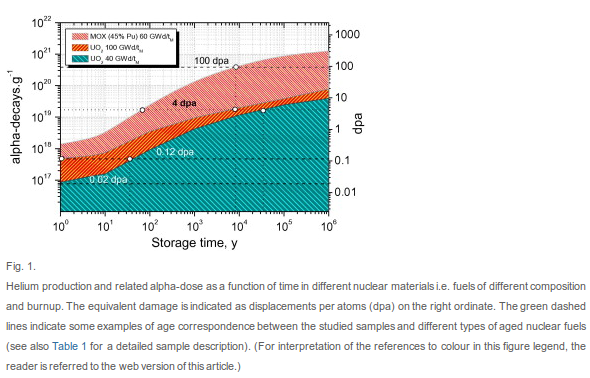
Given the temperature needed to anneal alpha-defects and to initiate helium thermal diffusion it can be expected that the fluorite type dioxides based on U and Pu will be able to accommodate in their structure a large part of the radiogenic helium that will be created but, while remaining crystalline, these materials will experience high stress levels, and it is expected that their overall microstructure will be perturbed by formation of these nano-sized gas bubbles (latest after 1 dpa, hence 1000 years of storage of standard LWR fuel) and extended alpha-damage defects (dislocation loops). Based on the results presented here, such bubbles are not expected to start forming in conventional spent fuel for several thousand years; however, in MOX fuels, they could begin forming within 1000 years. On the contrary it was observed that the alpha-damage evolves rapidly even at low alpha-doses. In time, these two effects could lead to micro-cracking and partial loss of integrity. Consequently, the pressure exerted by the loss of helium on the next confinement barrier should be considered in any modelling assessment of spent fuel storage performance.
http://www.sciencedirect.com/science/article/pii/S0022311514001822
Abstract
Significant amounts of spent uranium dioxide nuclear fuel are accumulating worldwide from decades of commercial nuclear power production. While such spent fuel is intended to be reprocessed or disposed in geologic repositories, out-of-reactor radiation damage from alpha decay can be detrimental to its structural stability. Here we report on an experimental study in which radiation damage in plutonium dioxide, uranium dioxide samples doped with short-lived alpha-emitters and urano-thorianite minerals have been characterized by XRD, transmission electron microscopy, thermal desorption spectrometry and hardness measurements to assess the long-term stability of spent nuclear fuel to substantial alpha-decay doses. Defect accumulation is predicted to result in swelling of the atomic structure and decrease in fracture toughness; whereas, the accumulation of helium will produce bubbles that result in much larger gaseous-induced swelling that substantially increases the stresses in the constrained spent fuel. Based on these results, the radiation-ageing of highly-aged spent nuclear fuel over more than 10,000 years is predicted.
1. Introduction
Plutonium and minor actinides (americium, curium) constitute a small but very radiotoxic fraction of the elements produced in today’s widely used UO2 fuel but also in the mixed oxide (Ux, Pu1−x)O2 fuel (MOX) during the production of electricity from nuclear reactors. These elements pose the main problems for non-proliferation issues, spent fuel disposition (the spent fuel stored worldwide will amount ∼350,000 t of heavy metals in 2020 [1]), or for high level waste disposal in the countries where spent fuel is reprocessed (the reprocessed spent fuel will amount 120,000 t of heavy metals worldwide in 2020 [1]). Public acceptance of nuclear energy is strongly affected by the proposed solutions for these sensitive issues. Today’s strategy for the back end of the nuclear fuel cycle varies from one country to the other [2], [3] and [4]. However, whatever option will be chosen, i.e. reprocessing and recycling or direct disposal, potentially following interim storage, the nuclear waste will have to be safely stored for long periods of time.
While nuclear fuel in reactor undergoes significant restructuring due to the radiation effects from fission and to high operating temperatures [5], the radiation and temperature environment for spent fuel out of reactor is substantially different. After decay of the predominantly beta-decaying short-lived fission products, the spent fuel will be subjected primarily to alpha-decay self-radiation damage and radiogenic helium accumulation at near ambient conditions, where completely different atomic level processes will dominate for millions of years. Fig. 1 shows as an example the alpha-dose evolution, hence helium production, during time for different types of nuclear fuels. Thus, the spent nuclear fuel available and characterized today is not representative of the structure and state of aged fuel after hundreds or thousands years of storage because it has not yet experienced a significantly long accumulation of microstructural defects and of helium due to alpha-decay [6].
Because of the handling, transport and storage of spent fuel, it is of critical importance to study the aging of these materials in order to predict their long term behaviour and risk to the biosphere. The goal is to understand and assess the processes responsible for the alteration of materials subject to radiation damage in view of their long term integrity. The foremost alteration process is associated with the build-up of radiogenic helium and alpha-damage that could cause early material degradation and enhanced corrosion [7], [8], [9], [10], [11] and [12]. Whether the fuel can or cannot retain the helium is of prime importance in assessing its long term mechanical stability. An increase of about 20 bars, in addition to the 25 bars of helium present at the beginning of irradiation, has to be accounted for in the fuel rod after a typical irradiation of a UO2 fuel at a standard burnup. About 55% of this pressure increase is due to swelling of the fuel and consequent decrease of the free volume. If helium is generated during storage and not retained in the fuel, it will increase further the pressure. If disintegration of the fuel pellet occurs, additional gas will be released to the free volume from the opening of pressurized bubbles with a small compensation from the pores to the overall new free volume. This aspect would be more critical for fuel containing more shorter living actinides, as is the case for example for MOX fuel which in turn will produce more helium during storage (see Fig. 1). As a matter of fact, the cladding, which constitutes in some operational approaches the first confinement barrier after the fuel pellet in case of interim or long term storage, and should withstand over-pressurisation due to the production of helium in case it is released because of fuel embrittlement. For example, the production of 1020 He g−1 in a MOX (burn-up 40 GWd t−1) fuel after 10,000 years would result in an increase of 50 bar of total pressure if one assumes a free volume of ∼20 cm3 in a cladding tube and a total release of He from the spent fuel pellet.
Increases in lattice parameter induced by the accumulation of gas and of defects from alpha-decay might cause swelling of the spent fuel and its early failure. Interactions between the radiogenic helium formation and the defects produced by alpha-particles and recoil nuclei need to be understood to predict the evolution of the system. Aged spent fuel is not available today it can only be simulated by accelerated aging of materials with a structure comparable to fuel or by studying natural analogues having cumulated high alpha-dose [7], [13], [14], [15] and [16].
Greenpeace stages protest at nuclear summit in Istanbul, nine detained

Nine activists have been detained in a protest staged by Greenpeace Mediterranean against the Nuclear Plants Summit in Istanbul on May 30.
The activists had hung a 28 square-meter poster carrying the words “Nuclear disaster starts here” on the outside wall of the hotel in Şişli where the summit was held, and greeted attendees with the same poster at the building’s entrance.
Greenpeace also hacked the hotel’s wireless Internet connection, so that when guests at the conference tried to connect to the Internet, they saw a message posted by the activist group.
Volunteers who attempted to distribute cookies carrying messages against nuclear energy were prevented by security officials.
During the summit, Vladimir Chuprov, who is in charge of Greenpeace’s anti-nuclear campaign in Russia, was set to make a presentation about mistakes previously made by Russian company Rosatom that is set to build a plant in Turkey.
The manager of Greenpeace Mediterranean campaigns in Turkey, Hilal Atıcı, said the conference aimed to catch the attention of companies involved in the building of the nuclear plant, adding that 64 percent of the Turkish people were against the project.
“Energy Minister Taner Yıldız is making the same mistakes that caused the Soma disaster for nuclear plants today. Rosatom, the company that is planning to build the plant, could cut security measures to increase its profit because it will be able to earn only the cost of its investment from the sale of electricity. This is worrying. The nuclear industry is not safe anywhere in the world. But the situation is scarier in Turkey. We have no experience about safety or inspection,” Atıcı said.
“In addition, if an accident happens, Russia will not be responsible. We as the Turkish nation will have to pay for the financial and humanitarian costs of a nuclear accident,” she added.
May/30/2014
Speaker Madigan, Exelon Declare “Nuclear War” on Renewables
– 2014/05/29
Resolution prelude to “bailout” for unprofitable nukes, national anti-renewables campaign
CHICAGO— By voice vote the Illinois House approved a resolution introduced by House Speaker Michael Madigan with extensive cooperation from Exelon Corporation that would create massive subsidization of unprofitable Exelon nuclear plants in Illinois, and do serious damage to the growth of the renewable energy sector.
HR1146, the Nuclear Power Plant Closure resolution was introduced by Speaker Madigan only last Friday, May 23rd, largely at the behest of Exelon Corporation. It sets in motion policy and governmental mechanisms that would essentially “nuke” renewable energy in Illinois, and guarantee that nuclear and coal would be the mainstay of Illinois electricity production for the foreseeable future.
“This Resolution takes energy in Illinois backwards at least 15 years,” says David Kraft, Director of the Chicago-based Nuclear Energy Information Service, a nuclear watchdog and renewable energy advocacy organization. “If its clauses ever become legislated, they would literally mandate the use of nuclear energy in Illinois, all the while Speaker Madigan conspires with Exelon to not fix the Renewable Energy Portfolio Standard law. He might as well have titled it, ‘Forward – Into the Past!” says Kraft.
Last week in the Legislature, Madigan and Exelon conspired on an agreement to kill the Renewable Energy Portfolio Standard (RPS) fix, in exchange for Exelon keeping running for the next year five nuclear reactors it said were unprofitable, and was threatening to close. This week Exelon and Madigan are attempting to unleash every aspect of State government to support the continuation of running nuclear reactors, potentially awarding them “clean energy credits” like solar and wind would get, and use the upcoming EPA air standard requirements as a way to use nukes to offset the pollution from coal plants, many of which otherwise face shutdown, allowing them to continue operating.
“This Resolution is not just a pro-nuclear resolution. It is an overt effort to destroy renewable energy statewide, a way to keep dirty coal plants running, and a way to continue and make permanent the outdated system of ‘centralized baseload power,’ in spite of the fact that the Legislature already granted ComEd 10 years of rate increases to finish a “smart grid” which was supposed to begin to replace the outdated baseload utility model, and be more renewables friendly,” Kraft maintains.
[…]
Wanting to insure that his Resolution appeared to have no opposition, Speaker Madigan took a particularly paranoid approach to getting it out of the House Environment Committee unanimously. He used an arcane Speaker privilege to temporarily dismiss six Committee members likely to vote against the Resolution – Reps. Sente, Gabel, Harris, Jakobsson, Nekritz, and Halbrook – and replaced them with six Reps who voted in favor of HR1146.
Read more.
Children from Chernobyl treated in UK halved after Government began charging them to enter country
- 4,000 children have had annual month-long trips since 1986
- But charities can not afford the new £86-per-child charge imposed
- The trips, with dentist and optician visits, can add two years to their lives
Countering the misinformation promoting Thorium Nuclear Reactors

 Thorium Nuclear Information Resources http://kevinmeyerson.wordpress.com/2012/04/26/thorium-nuclear-information-resources/ There is a rash of misinformation on the net about the supposed merits of the ‘new’ nuclear energy source on the block, thorium. I am sure that in a perfect world where nobody lies, thorium would be the perfect answer to the world’s energy needs as is claimed. This is unfortunately not the case.
Apparently, every time there is a new nuclear catastrophe, the thorium ‘miracle’ is promoted again as the ‘savior’ for the world. The Fukushima nuclear radiation catastrophe was not unique and the thorium misinformation artists have come out in droves. It’s the nuclear industry’s defense mechanism – create a new ‘safety myth’ that regular people can latch onto.
In reality, the thorium nuclear fuel cycle has been under development since the very early days of the nuclear industry. India, for example, has spent decades trying to commercialize it, and has failed. The US, Russia, Germany, and many others tried and failed as well. At best, thorium based nuclear power generation may be commercialized in a few decades.
I doubt it.
Fortunately, there are a number of independent trustworthy and expert sources of information on the internet regarding thorium nuclear. Here they are: Continue reading
1 This Month


10 March A LIVE WEBINAR THE REAL EFFECTS OF NUCLEAR POWER
What the Industry Isn’t Telling Us
1:00 PM Mountain, 2 pm Central, 3 pm Eastern. Live on the Keepers of the Water Facebook page


18 March Webinar @ 1 PM EST: An Assessment of SMR Projects: The Case of Canada
register for the zoom:
https://us02web.zoom.us/webinar/register/WN_o8BIIOUvQ2ONJR1nta65DQ#/registration


of the week – STOP SMALL MODULAR REACTORS IN CANADA
To see nuclear-related stories in greater depth and intensity – go to https://nuclearinformation.wordpress.com
-
Archives
- March 2026 (76)
- February 2026 (268)
- January 2026 (308)
- December 2025 (358)
- November 2025 (359)
- October 2025 (376)
- September 2025 (258)
- August 2025 (319)
- July 2025 (230)
- June 2025 (348)
- May 2025 (261)
- April 2025 (305)
-
Categories
- 1
- 1 NUCLEAR ISSUES
- business and costs
- climate change
- culture and arts
- ENERGY
- environment
- health
- history
- indigenous issues
- Legal
- marketing of nuclear
- media
- opposition to nuclear
- PERSONAL STORIES
- politics
- politics international
- Religion and ethics
- safety
- secrets,lies and civil liberties
- spinbuster
- technology
- Uranium
- wastes
- weapons and war
- Women
- 2 WORLD
- ACTION
- AFRICA
- Atrocities
- AUSTRALIA
- Christina's notes
- Christina's themes
- culture and arts
- Events
- Fuk 2022
- Fuk 2023
- Fukushima 2017
- Fukushima 2018
- fukushima 2019
- Fukushima 2020
- Fukushima 2021
- general
- global warming
- Humour (God we need it)
- Nuclear
- RARE EARTHS
- Reference
- resources – print
- Resources -audiovicual
- Weekly Newsletter
- World
- World Nuclear
- YouTube
-
RSS
Entries RSS
Comments RSS
 nuclear-news