Problems in nuclear reactor decommissioning thrashed out in US Senate hearing
 Senate Hearing on Nuclear Reactor Decommissioning Challenges Energy Collective May 22, 2014 Bemnet Alemayehu, Project Scientist, Nuclear Program, Washington, D.C.
U.S. Senator Barbara Boxer’s Environment & Public Works Committee held a hearing on Wednesday, May 14th, 2014 to assess the challenges of nuclear reactor decommissioning nationwide. Panelists called to testify at Wednesday’s senate hearing included Christopher Recchia, Public Service Department Commissioner of Vermont, Geoffrey Fettus, Senior attorney of NRDC, Donald Mosier, Council Member of the City of Del Mar, Michael Weber, Deputy Executive Director for Compliance Programs of NRC and Marvin Fertel, President & Chief Executive Officer of NEI.
Christopher Recchia’s testimony to the senate opposed a request by operators of the Vermont Yankee nuclear power plant to discontinue off-site emergency planning after the reactor shuts down. He argued that the off-site emergency planning should continue after the reactor shuts down until all of the plant’s spent fuel rods are removed from pools and placed in dry cask storage. ……… Continue reading
Politicians oppose nuclear power in seismic zone in India
 Left parties turns up heat on Kovvada nuclear plant, The Hindu NATIONAL » ANDHRA PRADESH SRIKAKULAM, May 23, 2014 Setting up the plant in seismic zone a threat to people, they say. CITU leader D. Govinda Rao said that workers, residents of Ranasthalam would launch massive agitations soon to oppose the construction activity in Kovvada.
The Left parties have turned the heat on the construction of a nuclear power project in Kovvada of Ranasthalam mandal again after mild tremor rattles the district on Wednesday saying that the project site comes under highly seismic zone and it would be dangerous for the people.
 Representatives of the Left Parties have asked the government to reconsider its decision over the establishment of the nuclear plant in the district. Senior CPI (M) leader V.G.K. Murthy said that the government should clarify over the dangers posed with the setting up the nuclear plant in a seismic zone. “The Nuclear Power Corporation of India officials always say that adequate precautions would be taken up to avoid disasters during natural calamities. We feel that such disasters can’t be avoided even in highly advanced countries. So, the government should come up with scientific data to clear the doubts of people,” he added.
CITU leader D. Govinda Rao said that workers, residents of Ranasthalam would launch massive agitations soon to oppose the construction activity in Kovvada. He said that several nuclear experts including Surendra Gadekar had already expressed doubts over the safety of the project. Mr. Surendra Gadekar on Sunday cautioned that Srikakulam town would be affected badly with the establishment of nuclear power plant at Kovvada, which is 35 km away from the district headquarters.
According him, Srikakulam, which is very close to Kovvada, would face radiation problem with the establishment of the nuclear power plant with an installed capacity of 10,000 Megawatts…..http://www.thehindu.com/news/national/andhra-pradesh/left-parties-turns-up-heat-on-kovvada-nuclear-plant/article6037482.ece
The Energy and Policy Institute (EPI) ‘outs’ the fossil fuel groups behind the attacks on renewable energy
 New Report Exposes Fossil Fuel Front Groups Behind Attacks on Renewables http://www.desmogblog.com/2014/05/22/new-report-exposes-fossil-fuel-interest-groups-behind-clean-energy-
 attacks Fossil fuel exploitation in the United States has reached a fevered pitch. Oil production is at a near-record high, and fracking activities have made the U.S.the number one producer of natural gas. All of this comes at a cost. In 2013, the oil industry averaged 20 oil spills per day, destroying countless swaths of the environment and leaving toxic chemicals for nearby residents to deal with. Meanwhile, oil and gas train derailments have totaled at least 11 in the last 11 months.
During this period of dirty energy dominance, investments in renewable energy continued to fall by 14% in 2013. The United States is averaging 20 oil spills per day, 1 dirty energy transport train derailment and explosion per month, and yet we’re still doubling down on fossil fuels.
This all seems fairly shocking, until you peel back the curtain on who is behind the efforts to keep renewable energy solutions out of the picture, which is exactly what a new report has done. The Energy and Policy Institute (EPI) has released a report detailing not only the fossil fuel front groups behind the attacks on clean energy, but also how they are able to use their money and political muscle to prevent a viable market for clean energy, limiting energy choices for consumers.
From the report, Attacks on Renewable Energy Standards and Net Metering Policies By Fossil Fuel Interests & Front Groups 2013-2014:
The fossil fuel lobby aggressively uses lobbying and propaganda to achieve their goals. Self-identified “free market think tanks” are among the most effective advocates for the fossil fuel industry to lobby for policy changes. Dozens of these so-called free market organizations, a majority of which are members of the State Policy Network (SPN), worked to influence state level energy policies and attack the clean energy industry…
Fossil fuel-funded front groups operate in multiple areas to influence the policy-making process in their attempts to eliminate clean energy policies. Continue reading
Solar power in every Indian home by 2019 – that’s the goal of new Prime Minister Modi
 Modi to Use Solar to Bring Power to Every Home by 2019 http://www.bloomberg.com/news/2014-05-19/modi-to-use-solar-to-bring-power-to-every-home-by-2019.html By Rakteem Katakey and Debjit Chakraborty May 18, 2014 India’s new government led b yNarendra Modi plans to harness solar power to enable every home to run at least one light bulb by 2019, a party official said.
“We look upon solar as having the potential to completely transform the way we look at the energy space,” said Narendra Taneja, convener of the energy division at Modi’s Bharatiya Janata Party, which swept to power on May 16 in the biggest electoral win in three decades. About 400 million people in India lack access to electricity, more than the combined population of the U.S. and Canada. The outgoing government led by Prime Minister Manmohan Singh missed a 2012 target to provide electricity to all households.
The five-year goal will require the cooperation of state-level administrations with which the central government shares control over the power industry, Taneja said. If successful, solar panels could allow every home to have enough power to run two bulbs, a solar cooker and a television, he said.
Expanding clean-power generation will be the administration’s top energy-related priority, especially solar because it has the potential to create jobs and supply millions of scattered households not connected to the grid, he said.
Modi, as chief minister of Gujarat state, pioneered India’s first incentives for large-scale solar power in 2009. The party will take lessons from Gujarat’s program as it designs policies on a national level that will include both larger, grid-connected photovoltaic projects and smaller, decentralized applications for solar, Taneja said.
To contact the reporters on this story: Rakteem Katakey in New Delhi atrkatakey@bloomberg.net; Debjit Chakraborty in New Delhi at dchakrabor10@bloomberg.net
Environmental law puts a stumbling block in front of nuclear power for Poland
Poland’s nuclear energy programme stumbles again: Has PGE lost control of its sub-contractors? Greenpeace, Jan Haverkamp – May 22, 2014 In late February, during one of our regular strolls through the Lubiatowo dunes where the Polish government and the utility PGE are planning to build 3,000 MW of nuclear capacity, we found something peculiar. Bright orange sticks – exactly on the locations where the PGE subcontractor, Worley Parsons, wants to drill 20- to 200-meter-deep holes for their site assessment. Such drilling directly next to two Natura2000 areas, in a unique dune landscape with wet valleys, could easily cause irreversible damage to this home of red deer, white-tailed and lesser spotted eagles. The EU Habitat Directive and the Aarhus Convention do not leave much space for interpretation: when irreversible damage to Natura2000 sites is possible, an environmental impact assessment has to be made with full public participation.
Taiwan’s nuclear dilemma – a return to authoritarian past?
 Taiwan’s Nuclear Future and Authoritarian Past The intense debate in Taiwan over nuclear power has echoes of a less democratic past. The Diplomat, By Brent Crane May 21, 2014 Last August, chaos erupted in Taiwanese parliament. Opposing lawmakers thrust hard-clenched fists at one another while fervent activists tossed opened water-bottles from the stands like Molotov cocktails. Politicians and otherwise civilized men wrestled like teenage boys on the floor amid shouts, screams and camera flashes.
The Legislative Yuan had initially assembled to discuss the conditions of a national referendum deciding the fate of Taiwan’s fourth nuclear power plant in Gongliao, New Taipei City. The controversial plant, known ominously throughout the country as Nuke 4, remains a rallying cry for opponents of one of Taiwan’s most charged political subjects: nuclear power. The debate has been energized in recent weeks after former opposition party leader and staunch nuclear energy opponent Lin Yi-hsiung went on hunger-strike in protest of the government’s unwillingness to make concessions with Taiwan’s antinuclear lobby. On the surface, the conflict appears rather black-and-white: it’s the safety-conscious, environmentalists and academics versus the pragmatic economists and government bureaucrats. But the nuclear power debate in Taiwan is about much more than just safety and economics. It’s about reconciling Taiwan’s autocratic past with its democratic present……….
On the Taiwanese political front today, only reunification is as hotly debated as nuclear energy. The antinuclear camp, which polls suggest finds support from up to 70 percent of the 23 million Taiwanese, advocates full denuclearization of the island. Simply put, their biggest beef with nuclear power in Taiwan is that it poses too great a safety risk. The disaster at Japan’s Fukushima Daiichi Nuclear Power Plant in 2011 represents the type of nightmare scenario that antinuclear activists conjure up when they denounce the energy source. After all, Taiwan is highly prone to typhoons, tsunamis and earthquakes. In late September 1999, for instance, a 7.9 magnitude earthquake killed 2,415 people in central Taiwan, injuring more then 11,000. Last September, Typhoon Usagi left Taiwan with 35 dead and with more than $4.33 billion in damages. The list goes on. And Taiwan’s compact size ensures that any plant destruction or malfunction on the scale of the Fukushima fiasco would be disastrous for the island, whose densely packed urban centers are never too far from any of the country’s four plants.
Yet despite the risks, the ruling KMT party remains firmly pro-nuclear, and has proven resilient in weathering the antinuclear storm. ……In true Jeffersonian fashion, the electorate, though hollering at an often unresponsive government, are demanding that their voices be heard. And with the ebb and flow of the youth-led Sunflower Movement, a government accountability project akin to Occupy Wall Street, Taiwan’s political atmosphere has been particularly energized lately………
Opposition to Nuke 4 has galvanized tens of thousands of Taiwanese to hold demonstrations throughout the country in recent years. Clearly, the anti-nuclear camp is no longer a fringe element. On the contrary, opposition to nuclear power has become a household inclination, with some studies showing 55 percent to 70 percent of the population anti-nuclear………
Of course, shifting an entire country from autocracy to democracy is no easy task. But Taiwan’s nuclear energy debate is a reminder that its transition isn’t yet wholly complete. http://thediplomat.com/2014/05/taiwans-nuclear-future-and-authoritarian-past/
NextGen Climate, – a progressive, pro-environment counterbalance to the wealthy oil and gas industry
 Green billionaire prepares to attack ‘anti-science’ Republicans By Peter Hamby, CNN National Political Reporter May 22, 2014 Washington An environmental advocacy group backed by hedge fund tycoon Tom Steyer is set to unleash a seven-state, $100 million offensive against Republican “science deniers” this year, a no-holds-barred campaign-style push from the green billionaire that could help decide which party controls the Senate and key statehouses come November.
The Steyer-backed outside group, NextGen Climate, has billed itself as a progressive, pro-environment counterbalance to the wealthy oil and gas industry — as well as the primary foil to the pro-business Koch brothers and their well-funded conservative donor network.
The outfit, launched last year by the San Francisco billionaire, has already pledged to spend heavily this midterm year in Iowa to assist the Democratic Senate nominee Bruce Braley, and in Florida, where Gov. Rick Scott is facing a difficult re-election fight against Democrat Charlie Crist……….
GOP candidates in the NextGen cross hairs — Scott in Florida, Terri Lynn Land in Michigan, Scott Brown in New Hampshire and Cory Gardner in Colorado — hew closely to the “Republican troglodyte brand,” Lehane argued.
“They are anti-immigrant, anti-women, anti-science,” he said. “It’s a tough brand to win elections around.”
The group said that climate can be successfully used as a wedge issue — Lehane framed it as a moral clash between “right and wrong” — to boost turnout among Democratic voting groups that tend not to show up in midterm election years, specifically young voters, Hispanics and African-Americans……….
he primary difference between Steyer and conservative mega-donors, Lehane said, is that Steyer is not personally profiting from his political efforts. “He is giving all the money away,” he said. “He doesn’t have stand to gain some economic benefit by spending money that translates into his own personal economics.”
Lehane added, “We are spending a drop in the big oil bucket as compared to the fossil fuel industry, especially the Koch brothers. All Tom is trying to do is try to balance and level the playing field. We are never going to have as much money as the other side.” http://edition.cnn.com/2014/05/22/politics/steyer-climate-change-campaign/
AUDIO: the dumping of radioactive groundwater into Pacific, near Fukushima
 AUDIO: Tepco dumps groundwater near Fukushima into Pacific ocean http://www.radioaustralia.net.au/international/radio/program/asia-pacific/tepco-dumps-groundwater-near-fukushima-into-pacific-ocean/1315044 22 May 2014,
The operator of Japan’s troubled Fukushima nuclear power plant has started releasing tonnes of groundwater into the Pacific ocean. Tepco says the groundwater being dumped into the sea flowed from nearby hills and met radiation safety levels.
The controversial move followed an agreement with local fishermen.
The so-called Bypass System aims to prevent groundwater seeping into the basement of the stricken plant, and becoming contaminated.
Presenter: Sen Lam
Speakers: Ken Buesseler, senior scientist at the Woods Hole Oceanographic Institution, Massachusetts, United States………
Burying nuclear wastes close to Great Lakes is a “shocking idea”
Michigan protests plan to store millions of gallons of nuclear waste next to the Great Lakes RT 221 May 14, A Canadian proposal that calls for a nuclear waste storage facility less than a mile away from the Great Lakes is coming under heavy fire from Michigan lawmakers and environmental groups, who are now attempting to stop the project.Under a plan crafted by energy supplier Ontario Power Generation (OPG), the company would construct a “deep geologic repository” (DGR), which would feature waste storage sites more than 2,200 feet underground to store nearly 53 million gallons of both low- and intermediate-level nuclear waste. The location of the proposed site, however – in Kincardine, Ontario, just three-quarters of a mile away from Lake Huron – has drawn criticism from numerous groups who fear potential contamination.
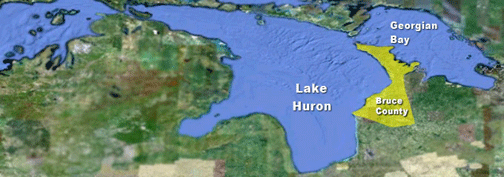
The fact that Lake Huron is connected to all the other Great Lakes via waterways has also drawn concern, since the five bodies of water make up the largest collection of freshwater lakes on the Earth and provide drinking supplies to tens of millions of Americans and Canadians.
According to the Detroit News, lawmakers from both sides of the aisle have continued criticizing the plan, and are now proposing legislation that calls on the federal government to get involved. In addition to requesting that President Obama stake out a position on the issue, state Senate and House members are asking Secretary of State John Kerry to officially ask the International Joint Commission – established to mediate disputes over the Great Lakes – to rule on the matter.
The legislation would also “stop the importation of radioactive waste into Michigan from Canada.”
“Building a nuclear waste dump less than a mile from one of the largest freshwater sources in the world is a reckless act that should be universally opposed,” Michigan Rep. Dan Lauwers (R-Brockway Township) said in a statement Monday, as quoted by the Huffington Post.
While lawmakers continue to get involved in the situation – Michigan’s Senators in Washington have also urged the State Department to bring the IJC into the debate – environmental groups have come out against the plan.
“Burying nuclear waste a quarter-mile from the Great Lakes is a shockingly bad idea — it poses a serious threat to people, fish, wildlife, and the lakes themselves,” said Andy Buchsbaum, regional executive director for the National Wildlife Federation’s Great Lakes Regional Center, in a statement to the Detroit News………http://rt.com/usa/160564-michigan-canada-nuclear-great-lakes/
Several decades of high radiation levels along California coast
Gov’t Report: Elevated radiation on California coast to last “several decades” — Local marine life “will accumulate” Fukushima radioactive material — Plutonium a potential concern — “On-going monitoring clearly warranted” yet ‘surprisingly little’ underway (VIDEO) http://enenews.com/inseveral-decades
California Coastal Commission (State of Calif. Natural Resources Agency), Apr. 30, 2014:
‘Several Decades’ of Fukushima Contamination
“The most recently reported measurements of radioactive cesium in North Pacific seawater indicate that the Fukushima plume is beginning its arrival off the west coast of North America. […] It remains uncertain exactly when, and at what concentration, the radioactive plume will reach the California coast […] Once the radioactive plume does reach California, concentrations of radiocesium are predicted to increase to peak values between 2016 and 2019, declining gradually thereafter over the next several decades.”
Plutonium Concerns?
“Fukushima releases were dominated by gases and volatile fission products […] with little of the […] primary nuclear fuels (plutonium, uranium) […] long-lived nuclear fission products of potential concern include isotopes of strontium and plutonium […] a very small amount of plutonium may have been released to the atmosphere”
Marine life/Seafood
“When the plume of radioactivity currently spreading across the North Pacific reaches the California coast, local marine life will accumulate Fukushima-derived radioactive cesium (and other radionuclides present at much lower levels, such as 90Sr). […] marine organisms are unlikely to accumulate dangerous quantities of radioactivity. However, on-going monitoring of the situation is clearly warranted.” [See also
On-going Monitoring?
“[S]urprisingly little research effort has been devoted to [the potential for dangerous levels of contamination] in California. […] Outside of Japan, ocean monitoring of Fukushima radiation has received much less attention and support from government agencies […] neither the U.S. federal government nor the state of California is currently testing for Fukushima-derived radiation off the California coast.”
Watch a discussion of this report at the last Coastal Commission meeting here
Better cut supply of uranium, as price drops below production costs

 Uranium supply cuts needed as spot price continues to tumble,Financial Post, Peter Koven | May 21, 2014 |Last week was another bad one in the uranium market, as the spot price dropped yet another dollar to US$28 a pound, the lowest level since 2005. By comparison, the price was US$66.50 prior to the Fukushima disaster in 2011, and topped out at more than US$135 in 2007.
Uranium miners maintain they are optimistic about prices in the coming years, as demand is expected to increase and outstrip supply. But that doesn’t help anyone in the short term, while Fukushima still looms large over the market. Scotiabank analyst Ben Isaacson said demand upside is “unlikely to stabilize” the uranium market this year, even with some Japanese reactor restarts, an acceleration of reactor starts in China and inventory building.
Instead, he said there has to be a response on the supply side, both from existing and planned mines.
“The challenge will be to figure out when/where the next supply cuts will come from,” he said in a note.
Mr. Isaacson noted that a lot of global production is inelastic to price moves, either because it is low cost, locked into contracts or politically important. He did not speculate on where the cuts will come from.
Another complication is that uranium enrichment capacity continues to expand globally. He said a glut of enriched supply could cause marginal demand for uranium to slow down…….http://business.financialpost.com/2014/05/21/uranium-supply-cuts-needed-as-spot-price-continues-to-tumble/?utm_source=feedburner&utm_medium=feed&utm_campaign=Feed%3A+FP_TopStories+%28Financial+Post+-+Top+Stories%29
Serbias flood brings old mines and Depleted Uranium nuclear waste back into the frame
“….Entrance in contaminated locations was forbidden till the end of decontamination The clean-up of some 5,000 square meters of land in the village of Bratoselce near Bujanovac, contaminated by depleted uranium during the 1999 NATO bombing of Yugoslavia, was finished on Nov. 9, 2003. During the clean-up, the team performing the task discovered around 100 kilograms of depleted uranium in the soil and stored some 2.5 tons of contaminated earth in the Vinca nuclear institute’s facilities near Belgrade…”
http://www.sepa.gov.rs/download/Environment_in_Serbia_Full.pdf
http://news.yahoo.com/flood-surge-belgrade-threatens-power-plant-125519607.html
By DUSAN STOJANOVIC May 19, 2014
BELGRADE, Serbia (AP) — Belgrade braced for a river surge Monday that threatened to inundate Serbia’s main power plant and cause major power cuts in the crisis-stricken country as the Balkans struggle with the consequences of the worst flooding in southeastern Europe in more than a century.
At least 35 people have died in Serbia and Bosnia in the five days of flooding caused by unprecedented torrential rain, laying waste to entire towns and villages and sending tens of thousands of people out of their homes, authorities said.
But the death toll is expected to rise as floodwaters started to recede in some locations, laying bare the full scale of the damage after three months’ worth of rain fell on the region in three days, producing the worst floods since rainfall measurements began 120 years ago.
Bosnian Foreign Minister Zlatko Lagumdzija compared the flood damage to the carnage during the 1990’s war that killed at least 100,000 people and left millions homeless. He said about 100,000 houses, 230 schools and health institutions were destroyed in the floods in Bosnia and about a million people lack drinking water.
The damage is “immense,” he said, adding: “the only difference from the war is that less people have died.”
The coal-fired Nikola Tesla power plant supplies electricity for half of Serbia and most of Belgrade. It is located in Obrenovac, the worst flood-hit town near Belgrade where some 7,800 people have been evacuated from their homes, which were mostly completely submerged in water. Some 2,000 people are still believed trapped in higher floors of buildings, without power or phone lines.
Credibility Questions on Fukushima – Undisclosed testimony by the plant manager, Masao Yoshida

http://www.nytimes.com/2014/05/22/opinion/credibility-questions-on-fukushima.html?smid=fb-share&_r=0
At the most dire moment of the crisis at the Fukushima Daiichi nuclear plant three years ago, nine-tenths of the employees, including executives, panicked and fled the plant following an explosion.
So reports one of Japan’s most prestigious newspapers, The Asahi Shimbun. This report, based on previously undisclosed testimony by the plant manager, Masao Yoshida, is in direct conflict with the official account of that fateful day provided by the plant’s operator, Tokyo Electric Power Company, or Tepco. It calls into question the truthfulness of both the company and, indeed, the government, which even now is trying to persuade the public to go along with the reopening of 48 nuclear reactors shut down after the accident, which traumatized the country.
The official version of events is that workers left the plant in a disciplined manner and retreated to another facility a few miles away — leaving behind a small band of intrepid workers who risked their lives to prevent the crisis from getting worse. According to the newspaper, Mr. Yoshida told investigators that he and 68 other employees had remained behind but that the flight of the others had been anything but orderly, contrary to company propaganda. Tepco’s official report states that Mr. Yoshida had ordered an evacuation to the undamaged Fukushima Daini plant about 6 miles away, but the newly revealed testimony indicated that he gave no such order and that the workers fled on their own. Mr. Yoshida died of cancer last year.
Japan’s nuclear industry has always acted under a veil of secrecy. One obvious imperative after the Fukushima disaster was for the government and the nuclear industry to be more transparent. But, even now, transparency seems to be elusive. And without it, ordinary citizens can hardly be expected to support the government’s plans. This latest revelation should jolt the Japanese public out of its creeping complacency about nuclear safety and demand proof from the government that it is proceeding with the utmost caution.
More here;
https://nuclear-news.net/2013/10/20/former-head-of-fukushima-nuclear-plant-dies-of-cancer/
https://nuclear-news.net/2013/03/14/analysis-fukushima-two-years-later-nils-bohmer/
https://nuclear-news.net/2011/04/01/the-fukushima-50-heroic-workers-expect-to-die-from-radiation/
https://nuclear-news.net/2011/09/08/bravery-honors-for-fukushimas-nuclear-emergency-workers/
大 中 小 文字サイズ 記事を印刷 Japan court orders power supplier not to run Oi nuke plant
http://mainichi.jp/english/english/newsselect/news/20140521p2g00m0dm087000c.html
22 May 2014
FUKUI, Japan (Kyodo) — The Fukui District Court ruled Wednesday that it will not allow the restart of two reactors at Kansai Electric Power Co.’s Oi nuclear plant, now under safety examination by Japan’s top nuclear watchdog.
It is the first time since the Fukushima nuclear crisis erupted in March 2011 that a Japanese court has ordered a power supplier not to bring a nuclear plant online.
In the lawsuit, a group of 189 people from Tokyo, the plant’s host prefecture of Fukui and 20 other prefectures contended that the No. 3 and 4 reactors at the Oi plant resumed commercial operations in August 2012 under provisional safety standards.
The court acknowledged the claim by 166 of them, who live within 250 kilometers of the Oi plant, saying, “An evacuation advisory was considered for those who live within 250 km of the Fukushima Daiichi complex at the time of the accident.”
In the ruling, Presiding Judge Hideaki Higuchi admitted the importance of nuclear plants for society, but pointed out that they are “merely a tool for generating electricity and thus inferior to people’s fundamental rights (to life).”
“It would be only natural to suspend nuclear plants if they pose specific risks of danger,” the judge said.
The August 2012 resumption of the two reactors in Oi came after all of Japan’s reactors were shut down amid strong public concern over nuclear safety in the wake of the Fukushima disaster caused by the devastating earthquake and tsunami in March 2011.
The two reactors at the four-unit Oi plant on the Sea of Japan coast are now offline after being suspended again in September 2013 for regular checkups.
The reactors are under examination by the Nuclear Regulation Authority to determine whether they can resume operations under Japan’s new safety standards introduced last July.
“I have nothing to say about the legal judgment,” Shunichi Tanaka, chairman of the Nuclear Regulation Authority, said at a press conference Wednesday in response to the court ruling. “We will just continue our examination of the Oi plant.”
Fukushima gov to open swimming beach after decision to release contaminated water – La pref de Fukushima ouvre une plage à la baignade
Posted by Mochizuki on May 21st, 2014
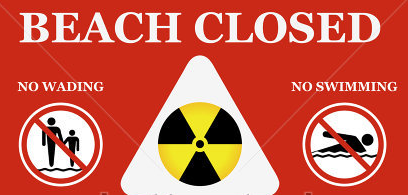
Image source ; http://www.shutterstock.com/pic-103530890/
Fukushima prefectural government and Iwaki city government are going to open 2 swimming beaches this summer (Yotsukura & Nakoso) without analyzing the beach sand.
They measured 3,167 Bq/Kg of Cesium-134/137 from the beach sand last year, which is 32 times much as food safety limit. (cf, Iwaki city opened Yotsukura swimming beach / 3,200 Bq/kg from sand [URL])
They won’t analyze the sand this year and the reason is not announced. The analysis data of last year is also removed from their website for some reason.
Instead of beach sand, they analyzed the sand of sea floor for some reason. However they measured Cs-134/137 from all of the 5 samples taken in the 2 swimming beaches.
The highest reading was 93.8 Bq/Kg. This is almost the equivalent of food safety limit.
These swimming beaches will be open from 7/20 to 8/17/2014 even for the children.
Related article.. Tepco discharged 561t of bypass contaminated groundwater to the Pacific [URL 2]
Iori Mochizuki
You read this now because we’ve been surviving until today.
_____
Français :
La pref de Fukushima ouvre une plage à la baignade : 94 Bq/kg au fond de la mer mais ils ne contrôlent même pas le sable
La préfecture de Fukushima et la municipalité d’Iwaki vont ouvrir deux plages à la baignade l’été prochain (Yotsukura & Nakoso) sans faire d’analyse du sable des plages.
L’an dernier ils avaient relevé 3 167 Bq/kg de césium-134/137 dans le sable de la plage, soit 32 fois la limite de sécurité alimentaire. (cf. La ville d’Iwaki ouvre la plage de Yotsukura à la baignade : 3 200 Bq/kg dans le sable)
Ils n’analyseront pas le sable cette année et la raison n’en est pas donnée. Les résultats des analyses de l’an dernier ont également été retirés de leur site web sans explication.
A la place du sable de la plage, ils ont analysé celui du fond de la mer. Ils y ont quand même trouvé du Cs-134/137 sur l’ensemble des 5 échantillons pris pour ces 2 plages.
Le record en a été de 93,8 Bq/kg. C’est pratiquement équivalent à la limite de sécurité alimentaire.
Ces plages seront ouvertes à la baignade du 20 juillet au 17 août 2014, même aux enfants.
Article lié : Tepco a déversé dans le Pacifique 561 tonnes d’eaux radioactives souterraines de la dérivation
Vous pouvez lire ceci parce que nous avons survécu jusqu’à aujourd’hui.
1 This Month
26 April – Chernobyl: Inside the Meltdown airs on National Geographic on Sunday 26th April from 4pm


4 May -West Suburban Peace Coalition to discuss Iran war at May Educational Forum
Monday, May 4, 7:00 – 8:00 PM Central Standard Time
Title: : How Trump’s Narrative Tries to Shape the Reality of the War on Iran.
Contact Walt Zlotow, zlotow@hotmail.com 630 442 3045 for further information
14 May – online event From Bombs to Data Centres: the Face of Nuclear Colonialism

Pine Ridge Uranium is the real threat, not Tehran- Tell Burgum: Stop the Extraction.
Chernobyl: The Lost Tapes – A good documentary on Chernobyl on SBS available On Demand for the next 3 weeks– https://www.sbs.com.au/ondemand/tv-program/chernobyl-the-lost-tapes/2352741955560
To see nuclear-related stories in greater depth and intensity – go to https://nuclearinformation.wordpress.com
-
Archives
- April 2026 (288)
- March 2026 (251)
- February 2026 (268)
- January 2026 (308)
- December 2025 (358)
- November 2025 (359)
- October 2025 (376)
- September 2025 (257)
- August 2025 (319)
- July 2025 (230)
- June 2025 (348)
- May 2025 (261)
-
Categories
- 1
- 1 NUCLEAR ISSUES
- business and costs
- climate change
- culture and arts
- ENERGY
- environment
- health
- history
- indigenous issues
- Legal
- marketing of nuclear
- media
- opposition to nuclear
- PERSONAL STORIES
- politics
- politics international
- Religion and ethics
- safety
- secrets,lies and civil liberties
- spinbuster
- technology
- Uranium
- wastes
- weapons and war
- Women
- 2 WORLD
- ACTION
- AFRICA
- Atrocities
- AUSTRALIA
- Christina's notes
- Christina's themes
- culture and arts
- Events
- Fuk 2022
- Fuk 2023
- Fukushima 2017
- Fukushima 2018
- fukushima 2019
- Fukushima 2020
- Fukushima 2021
- general
- global warming
- Humour (God we need it)
- Nuclear
- RARE EARTHS
- Reference
- resources – print
- Resources -audiovicual
- Weekly Newsletter
- World
- World Nuclear
- YouTube
-
RSS
Entries RSS
Comments RSS
 nuclear-news