Fukushima gov to open swimming beach after decision to release contaminated water – La pref de Fukushima ouvre une plage à la baignade
Posted by Mochizuki on May 21st, 2014
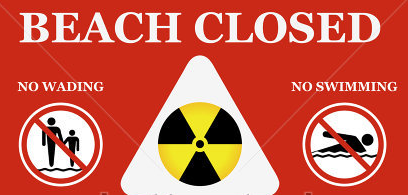
Image source ; http://www.shutterstock.com/pic-103530890/
Fukushima prefectural government and Iwaki city government are going to open 2 swimming beaches this summer (Yotsukura & Nakoso) without analyzing the beach sand.
They measured 3,167 Bq/Kg of Cesium-134/137 from the beach sand last year, which is 32 times much as food safety limit. (cf, Iwaki city opened Yotsukura swimming beach / 3,200 Bq/kg from sand [URL])
They won’t analyze the sand this year and the reason is not announced. The analysis data of last year is also removed from their website for some reason.
Instead of beach sand, they analyzed the sand of sea floor for some reason. However they measured Cs-134/137 from all of the 5 samples taken in the 2 swimming beaches.
The highest reading was 93.8 Bq/Kg. This is almost the equivalent of food safety limit.
These swimming beaches will be open from 7/20 to 8/17/2014 even for the children.
Related article.. Tepco discharged 561t of bypass contaminated groundwater to the Pacific [URL 2]
Iori Mochizuki
You read this now because we’ve been surviving until today.
_____
Français :
La pref de Fukushima ouvre une plage à la baignade : 94 Bq/kg au fond de la mer mais ils ne contrôlent même pas le sable
La préfecture de Fukushima et la municipalité d’Iwaki vont ouvrir deux plages à la baignade l’été prochain (Yotsukura & Nakoso) sans faire d’analyse du sable des plages.
L’an dernier ils avaient relevé 3 167 Bq/kg de césium-134/137 dans le sable de la plage, soit 32 fois la limite de sécurité alimentaire. (cf. La ville d’Iwaki ouvre la plage de Yotsukura à la baignade : 3 200 Bq/kg dans le sable)
Ils n’analyseront pas le sable cette année et la raison n’en est pas donnée. Les résultats des analyses de l’an dernier ont également été retirés de leur site web sans explication.
A la place du sable de la plage, ils ont analysé celui du fond de la mer. Ils y ont quand même trouvé du Cs-134/137 sur l’ensemble des 5 échantillons pris pour ces 2 plages.
Le record en a été de 93,8 Bq/kg. C’est pratiquement équivalent à la limite de sécurité alimentaire.
Ces plages seront ouvertes à la baignade du 20 juillet au 17 août 2014, même aux enfants.
Article lié : Tepco a déversé dans le Pacifique 561 tonnes d’eaux radioactives souterraines de la dérivation
Vous pouvez lire ceci parce que nous avons survécu jusqu’à aujourd’hui.
No comments yet.
1 This Month


Tell the Ukrainian Government to Drop Prosecution of Peace Activist Yurii Sheliazhenko

Petition to revoke the licensing of the Near Surface Nuclear Disposal Facility (NSDF) at Chalk River. https://www.ourcommons.ca/petitions/en/Petition/Details?Petition=e-7247


of the week – STOP SMALL MODULAR REACTORS IN CANADA
To see nuclear-related stories in greater depth and intensity – go to https://nuclearinformation.wordpress.com
-
Archives
- March 2026 (212)
- February 2026 (268)
- January 2026 (308)
- December 2025 (358)
- November 2025 (359)
- October 2025 (376)
- September 2025 (258)
- August 2025 (319)
- July 2025 (230)
- June 2025 (348)
- May 2025 (261)
- April 2025 (305)
-
Categories
- 1
- 1 NUCLEAR ISSUES
- business and costs
- climate change
- culture and arts
- ENERGY
- environment
- health
- history
- indigenous issues
- Legal
- marketing of nuclear
- media
- opposition to nuclear
- PERSONAL STORIES
- politics
- politics international
- Religion and ethics
- safety
- secrets,lies and civil liberties
- spinbuster
- technology
- Uranium
- wastes
- weapons and war
- Women
- 2 WORLD
- ACTION
- AFRICA
- Atrocities
- AUSTRALIA
- Christina's notes
- Christina's themes
- culture and arts
- Events
- Fuk 2022
- Fuk 2023
- Fukushima 2017
- Fukushima 2018
- fukushima 2019
- Fukushima 2020
- Fukushima 2021
- general
- global warming
- Humour (God we need it)
- Nuclear
- RARE EARTHS
- Reference
- resources – print
- Resources -audiovicual
- Weekly Newsletter
- World
- World Nuclear
- YouTube
-
RSS
Entries RSS
Comments RSS
 nuclear-news
Leave a comment