AUDIO: the dumping of radioactive groundwater into Pacific, near Fukushima
 AUDIO: Tepco dumps groundwater near Fukushima into Pacific ocean http://www.radioaustralia.net.au/international/radio/program/asia-pacific/tepco-dumps-groundwater-near-fukushima-into-pacific-ocean/1315044 22 May 2014,
The operator of Japan’s troubled Fukushima nuclear power plant has started releasing tonnes of groundwater into the Pacific ocean. Tepco says the groundwater being dumped into the sea flowed from nearby hills and met radiation safety levels.
The controversial move followed an agreement with local fishermen.
The so-called Bypass System aims to prevent groundwater seeping into the basement of the stricken plant, and becoming contaminated.
Presenter: Sen Lam
Speakers: Ken Buesseler, senior scientist at the Woods Hole Oceanographic Institution, Massachusetts, United States………
Burying nuclear wastes close to Great Lakes is a “shocking idea”
Michigan protests plan to store millions of gallons of nuclear waste next to the Great Lakes RT 221 May 14, A Canadian proposal that calls for a nuclear waste storage facility less than a mile away from the Great Lakes is coming under heavy fire from Michigan lawmakers and environmental groups, who are now attempting to stop the project.Under a plan crafted by energy supplier Ontario Power Generation (OPG), the company would construct a “deep geologic repository” (DGR), which would feature waste storage sites more than 2,200 feet underground to store nearly 53 million gallons of both low- and intermediate-level nuclear waste. The location of the proposed site, however – in Kincardine, Ontario, just three-quarters of a mile away from Lake Huron – has drawn criticism from numerous groups who fear potential contamination.
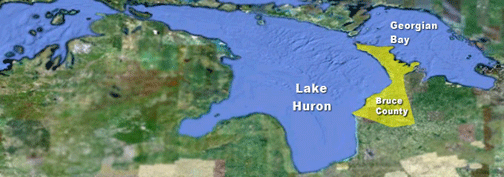
The fact that Lake Huron is connected to all the other Great Lakes via waterways has also drawn concern, since the five bodies of water make up the largest collection of freshwater lakes on the Earth and provide drinking supplies to tens of millions of Americans and Canadians.
According to the Detroit News, lawmakers from both sides of the aisle have continued criticizing the plan, and are now proposing legislation that calls on the federal government to get involved. In addition to requesting that President Obama stake out a position on the issue, state Senate and House members are asking Secretary of State John Kerry to officially ask the International Joint Commission – established to mediate disputes over the Great Lakes – to rule on the matter.
The legislation would also “stop the importation of radioactive waste into Michigan from Canada.”
“Building a nuclear waste dump less than a mile from one of the largest freshwater sources in the world is a reckless act that should be universally opposed,” Michigan Rep. Dan Lauwers (R-Brockway Township) said in a statement Monday, as quoted by the Huffington Post.
While lawmakers continue to get involved in the situation – Michigan’s Senators in Washington have also urged the State Department to bring the IJC into the debate – environmental groups have come out against the plan.
“Burying nuclear waste a quarter-mile from the Great Lakes is a shockingly bad idea — it poses a serious threat to people, fish, wildlife, and the lakes themselves,” said Andy Buchsbaum, regional executive director for the National Wildlife Federation’s Great Lakes Regional Center, in a statement to the Detroit News………http://rt.com/usa/160564-michigan-canada-nuclear-great-lakes/
Several decades of high radiation levels along California coast
Gov’t Report: Elevated radiation on California coast to last “several decades” — Local marine life “will accumulate” Fukushima radioactive material — Plutonium a potential concern — “On-going monitoring clearly warranted” yet ‘surprisingly little’ underway (VIDEO) http://enenews.com/inseveral-decades
California Coastal Commission (State of Calif. Natural Resources Agency), Apr. 30, 2014:
‘Several Decades’ of Fukushima Contamination
“The most recently reported measurements of radioactive cesium in North Pacific seawater indicate that the Fukushima plume is beginning its arrival off the west coast of North America. […] It remains uncertain exactly when, and at what concentration, the radioactive plume will reach the California coast […] Once the radioactive plume does reach California, concentrations of radiocesium are predicted to increase to peak values between 2016 and 2019, declining gradually thereafter over the next several decades.”
Plutonium Concerns?
“Fukushima releases were dominated by gases and volatile fission products […] with little of the […] primary nuclear fuels (plutonium, uranium) […] long-lived nuclear fission products of potential concern include isotopes of strontium and plutonium […] a very small amount of plutonium may have been released to the atmosphere”
Marine life/Seafood
“When the plume of radioactivity currently spreading across the North Pacific reaches the California coast, local marine life will accumulate Fukushima-derived radioactive cesium (and other radionuclides present at much lower levels, such as 90Sr). […] marine organisms are unlikely to accumulate dangerous quantities of radioactivity. However, on-going monitoring of the situation is clearly warranted.” [See also
On-going Monitoring?
“[S]urprisingly little research effort has been devoted to [the potential for dangerous levels of contamination] in California. […] Outside of Japan, ocean monitoring of Fukushima radiation has received much less attention and support from government agencies […] neither the U.S. federal government nor the state of California is currently testing for Fukushima-derived radiation off the California coast.”
Watch a discussion of this report at the last Coastal Commission meeting here
Better cut supply of uranium, as price drops below production costs

 Uranium supply cuts needed as spot price continues to tumble,Financial Post, Peter Koven | May 21, 2014 |Last week was another bad one in the uranium market, as the spot price dropped yet another dollar to US$28 a pound, the lowest level since 2005. By comparison, the price was US$66.50 prior to the Fukushima disaster in 2011, and topped out at more than US$135 in 2007.
Uranium miners maintain they are optimistic about prices in the coming years, as demand is expected to increase and outstrip supply. But that doesn’t help anyone in the short term, while Fukushima still looms large over the market. Scotiabank analyst Ben Isaacson said demand upside is “unlikely to stabilize” the uranium market this year, even with some Japanese reactor restarts, an acceleration of reactor starts in China and inventory building.
Instead, he said there has to be a response on the supply side, both from existing and planned mines.
“The challenge will be to figure out when/where the next supply cuts will come from,” he said in a note.
Mr. Isaacson noted that a lot of global production is inelastic to price moves, either because it is low cost, locked into contracts or politically important. He did not speculate on where the cuts will come from.
Another complication is that uranium enrichment capacity continues to expand globally. He said a glut of enriched supply could cause marginal demand for uranium to slow down…….http://business.financialpost.com/2014/05/21/uranium-supply-cuts-needed-as-spot-price-continues-to-tumble/?utm_source=feedburner&utm_medium=feed&utm_campaign=Feed%3A+FP_TopStories+%28Financial+Post+-+Top+Stories%29
Serbias flood brings old mines and Depleted Uranium nuclear waste back into the frame
“….Entrance in contaminated locations was forbidden till the end of decontamination The clean-up of some 5,000 square meters of land in the village of Bratoselce near Bujanovac, contaminated by depleted uranium during the 1999 NATO bombing of Yugoslavia, was finished on Nov. 9, 2003. During the clean-up, the team performing the task discovered around 100 kilograms of depleted uranium in the soil and stored some 2.5 tons of contaminated earth in the Vinca nuclear institute’s facilities near Belgrade…”
http://www.sepa.gov.rs/download/Environment_in_Serbia_Full.pdf
http://news.yahoo.com/flood-surge-belgrade-threatens-power-plant-125519607.html
By DUSAN STOJANOVIC May 19, 2014
BELGRADE, Serbia (AP) — Belgrade braced for a river surge Monday that threatened to inundate Serbia’s main power plant and cause major power cuts in the crisis-stricken country as the Balkans struggle with the consequences of the worst flooding in southeastern Europe in more than a century.
At least 35 people have died in Serbia and Bosnia in the five days of flooding caused by unprecedented torrential rain, laying waste to entire towns and villages and sending tens of thousands of people out of their homes, authorities said.
But the death toll is expected to rise as floodwaters started to recede in some locations, laying bare the full scale of the damage after three months’ worth of rain fell on the region in three days, producing the worst floods since rainfall measurements began 120 years ago.
Bosnian Foreign Minister Zlatko Lagumdzija compared the flood damage to the carnage during the 1990’s war that killed at least 100,000 people and left millions homeless. He said about 100,000 houses, 230 schools and health institutions were destroyed in the floods in Bosnia and about a million people lack drinking water.
The damage is “immense,” he said, adding: “the only difference from the war is that less people have died.”
The coal-fired Nikola Tesla power plant supplies electricity for half of Serbia and most of Belgrade. It is located in Obrenovac, the worst flood-hit town near Belgrade where some 7,800 people have been evacuated from their homes, which were mostly completely submerged in water. Some 2,000 people are still believed trapped in higher floors of buildings, without power or phone lines.
Credibility Questions on Fukushima – Undisclosed testimony by the plant manager, Masao Yoshida

http://www.nytimes.com/2014/05/22/opinion/credibility-questions-on-fukushima.html?smid=fb-share&_r=0
At the most dire moment of the crisis at the Fukushima Daiichi nuclear plant three years ago, nine-tenths of the employees, including executives, panicked and fled the plant following an explosion.
So reports one of Japan’s most prestigious newspapers, The Asahi Shimbun. This report, based on previously undisclosed testimony by the plant manager, Masao Yoshida, is in direct conflict with the official account of that fateful day provided by the plant’s operator, Tokyo Electric Power Company, or Tepco. It calls into question the truthfulness of both the company and, indeed, the government, which even now is trying to persuade the public to go along with the reopening of 48 nuclear reactors shut down after the accident, which traumatized the country.
The official version of events is that workers left the plant in a disciplined manner and retreated to another facility a few miles away — leaving behind a small band of intrepid workers who risked their lives to prevent the crisis from getting worse. According to the newspaper, Mr. Yoshida told investigators that he and 68 other employees had remained behind but that the flight of the others had been anything but orderly, contrary to company propaganda. Tepco’s official report states that Mr. Yoshida had ordered an evacuation to the undamaged Fukushima Daini plant about 6 miles away, but the newly revealed testimony indicated that he gave no such order and that the workers fled on their own. Mr. Yoshida died of cancer last year.
Japan’s nuclear industry has always acted under a veil of secrecy. One obvious imperative after the Fukushima disaster was for the government and the nuclear industry to be more transparent. But, even now, transparency seems to be elusive. And without it, ordinary citizens can hardly be expected to support the government’s plans. This latest revelation should jolt the Japanese public out of its creeping complacency about nuclear safety and demand proof from the government that it is proceeding with the utmost caution.
More here;
https://nuclear-news.net/2013/10/20/former-head-of-fukushima-nuclear-plant-dies-of-cancer/
https://nuclear-news.net/2013/03/14/analysis-fukushima-two-years-later-nils-bohmer/
https://nuclear-news.net/2011/04/01/the-fukushima-50-heroic-workers-expect-to-die-from-radiation/
https://nuclear-news.net/2011/09/08/bravery-honors-for-fukushimas-nuclear-emergency-workers/
大 中 小 文字サイズ 記事を印刷 Japan court orders power supplier not to run Oi nuke plant
http://mainichi.jp/english/english/newsselect/news/20140521p2g00m0dm087000c.html
22 May 2014
FUKUI, Japan (Kyodo) — The Fukui District Court ruled Wednesday that it will not allow the restart of two reactors at Kansai Electric Power Co.’s Oi nuclear plant, now under safety examination by Japan’s top nuclear watchdog.
It is the first time since the Fukushima nuclear crisis erupted in March 2011 that a Japanese court has ordered a power supplier not to bring a nuclear plant online.
In the lawsuit, a group of 189 people from Tokyo, the plant’s host prefecture of Fukui and 20 other prefectures contended that the No. 3 and 4 reactors at the Oi plant resumed commercial operations in August 2012 under provisional safety standards.
The court acknowledged the claim by 166 of them, who live within 250 kilometers of the Oi plant, saying, “An evacuation advisory was considered for those who live within 250 km of the Fukushima Daiichi complex at the time of the accident.”
In the ruling, Presiding Judge Hideaki Higuchi admitted the importance of nuclear plants for society, but pointed out that they are “merely a tool for generating electricity and thus inferior to people’s fundamental rights (to life).”
“It would be only natural to suspend nuclear plants if they pose specific risks of danger,” the judge said.
The August 2012 resumption of the two reactors in Oi came after all of Japan’s reactors were shut down amid strong public concern over nuclear safety in the wake of the Fukushima disaster caused by the devastating earthquake and tsunami in March 2011.
The two reactors at the four-unit Oi plant on the Sea of Japan coast are now offline after being suspended again in September 2013 for regular checkups.
The reactors are under examination by the Nuclear Regulation Authority to determine whether they can resume operations under Japan’s new safety standards introduced last July.
“I have nothing to say about the legal judgment,” Shunichi Tanaka, chairman of the Nuclear Regulation Authority, said at a press conference Wednesday in response to the court ruling. “We will just continue our examination of the Oi plant.”
Fukushima gov to open swimming beach after decision to release contaminated water – La pref de Fukushima ouvre une plage à la baignade
Posted by Mochizuki on May 21st, 2014
Image source ; http://www.shutterstock.com/pic-103530890/
Fukushima prefectural government and Iwaki city government are going to open 2 swimming beaches this summer (Yotsukura & Nakoso) without analyzing the beach sand.
They measured 3,167 Bq/Kg of Cesium-134/137 from the beach sand last year, which is 32 times much as food safety limit. (cf, Iwaki city opened Yotsukura swimming beach / 3,200 Bq/kg from sand [URL])
They won’t analyze the sand this year and the reason is not announced. The analysis data of last year is also removed from their website for some reason.
Instead of beach sand, they analyzed the sand of sea floor for some reason. However they measured Cs-134/137 from all of the 5 samples taken in the 2 swimming beaches.
The highest reading was 93.8 Bq/Kg. This is almost the equivalent of food safety limit.
These swimming beaches will be open from 7/20 to 8/17/2014 even for the children.
Related article.. Tepco discharged 561t of bypass contaminated groundwater to the Pacific [URL 2]
Iori Mochizuki
You read this now because we’ve been surviving until today.
_____
Français :
La pref de Fukushima ouvre une plage à la baignade : 94 Bq/kg au fond de la mer mais ils ne contrôlent même pas le sable
La préfecture de Fukushima et la municipalité d’Iwaki vont ouvrir deux plages à la baignade l’été prochain (Yotsukura & Nakoso) sans faire d’analyse du sable des plages.
L’an dernier ils avaient relevé 3 167 Bq/kg de césium-134/137 dans le sable de la plage, soit 32 fois la limite de sécurité alimentaire. (cf. La ville d’Iwaki ouvre la plage de Yotsukura à la baignade : 3 200 Bq/kg dans le sable)
Ils n’analyseront pas le sable cette année et la raison n’en est pas donnée. Les résultats des analyses de l’an dernier ont également été retirés de leur site web sans explication.
A la place du sable de la plage, ils ont analysé celui du fond de la mer. Ils y ont quand même trouvé du Cs-134/137 sur l’ensemble des 5 échantillons pris pour ces 2 plages.
Le record en a été de 93,8 Bq/kg. C’est pratiquement équivalent à la limite de sécurité alimentaire.
Ces plages seront ouvertes à la baignade du 20 juillet au 17 août 2014, même aux enfants.
Article lié : Tepco a déversé dans le Pacifique 561 tonnes d’eaux radioactives souterraines de la dérivation
Vous pouvez lire ceci parce que nous avons survécu jusqu’à aujourd’hui.
Organic cat litter linked to nuke leak – Arnold Gunderersen interview
Published on 20 May 2014
CNN’s Brianna Keilar talks to Arnie Gundersen about the New Mexico radiation leak linked to Kitty litter.
Nuclear Hotseat #152: Voices from Japan: Idogawa, Horikiri and Oishinbo
http://www.nuclearhotseat.com/1935/

DOWNLOAD HERE:
http://lhalevy.audioacrobat.com/download/70fa7193-ee5e-c6fc-9ae6-37710ceb8a2d.mp3
| ニュークリアーホットシート |
日本語版を聞く場合はここをクリックして下さい。LISTEN HERE (JAPANESE): (pending)
ダウンロードをして聞く場合はここをクリックして下さい。DOWNLOAD HERE (JAPANESE): (pending)
FEATURED: Voices from Japan features former Futuba Mayor Idogawa, filmmaker Satomi Horiki, and an examination of the Oishinbo manga comic controversy over nosebleeds, radiation fatigue and government suppression of the medical facts.
NUMNUTZ OF THE WEEK:
A Kennedy and a Beatle? Yep! When they could get together and save the world. Imagine…
PLUS:
- Fukushima Prefectural Government and Fukushima Medical University found to have signed secrecy pact with pro-nuclear IAEA;
- Radiation keeps peaking over previous peaks at Fukushima, but TEPCO plans to just dump radwater into the Pacific starting next week;
- Thyroid cancer in Fukushima kids jumps 51.5% over February numbers;
- Los Alamos is the definite source of WIPP underground explosion and radiation leak – more containers at risk at WIPP, at WCS in Texas, and at Los Alamos;
- Ukraine stops armed gunmen from forcing their way into nuclear power plant;
- Canada throws out preliminary approvals for two new nukes in Ontario;
- CA Public Utilities Commission President Michael R. Peevey gets peeved and shouts/curses down honest question at SCE pork barrel evidentiary hearing;
- …and much more!
While the USA gets in on the decommissioning funding after the Kennedy visit, funding for research science remains non exsistent!
…. Current Japanese Prime Minister Shinzo Abe and his government have promised to boost science; they should encourage and support researchers from around the world in collecting and sharing information. Chernobyl was a missed opportunity for post-accident research — in that sense at least, Fukushima could do much better…..
03 September 2013

http://www.nature.com/news/nuclear-error-1.13667
Letter from Professor Timothy Mousseau concerning a recent
report on a limited study on birds in Fukushima - 27 April 2014

Extract
"Let me start by saying the Dr. Galvan is a very bright and hard working young biologist whose scientific credentials are impeccable, in fact beyond excellent. Through his hard work he has managed to find these novel and potentially very important responses in natural populations that have never been seen before. His credentials are beyond reproach in every way and we are very grateful for his very significant contributions to this evolving study of wildlife in Chernobyl and Fukushima. My only regret is that we don't have the resources to find more creative, bright, hard working young biologists like him to help us with these studies.
Full text;
Hopefully there will be some more comprehensive coverage of this latest paper that includes some discussion of the broader picture that includes the context for how such “positive” responses have evolved and how they are not unexpected given the intensity of “unnatural” selection (i.e.
Negative effects) imposed by the radioactive contaminants in the area.
Let me start by saying the Dr. Galvan is a very bright and hard working young biologist whose scientific credentials are impeccable, in fact beyond excellent. Through his hard work he has managed to find these novel and potentially very important responses in natural populations that have never been seen before. His credentials are beyond reproach in every way and we are very grateful for his very significant contributions to this evolving study of wildlife in Chernobyl and Fukushima. My only regret is that we don’t have the resources to find more creative, bright, hard
working young biologists like him to help us with these studies.
Below are some quotes that I am sharing related to the current study on adaptation that puts things into an evolutionary context:
“Our previous studies in Chernobyl show a wide array of negative consequences of exposure to radiation for most species. However, the species that are remaining appear to have either evolved or are pre-adapted to the contaminants through increased allocation of antioxidants as a defense against the radiation. Some of these birds even show reduced levels of genetic damage in areas of intermediate contamination perhaps reflecting an effect of acclimation to the radiation. It remains to be shown experimentally whether all birds show such a response, or just the ones that are surviving under these hazardous conditions.
“These observations do not suggest that these birds are not negatively impacted overall our previous studies show significant increases in cataracts, tumors, reduced fertility, and smaller brain sizes, even in these birds that show some level of adaptation. However, the “unnatural selection” imposed by radiation appears to favor individuals with the ability to allocate antioxidants towards protection from ionizing radiation, and this is not surprising given the strength of the negative effects in the hottest parts of the Chernobyl Zone.
“Comparisons between Fukushima and Chernobyl suggest that 20+ years of selection has led to smaller negative impacts on population growth rates in Chernobyl than for the same birds in Fukushima four months after the disaster further supporting the hypothesis that natural selection has favored individuals that have allocated antioxidants towards the defense of cellular damage caused by ionizing radiation.
“This latest paper may be a little confusing to some as it appears to contradict some of our previous findings. However, these two messages are not contradictory and positive and negative responses are not mutually exclusive when it comes to evolution by natural selection in the face of environmental stress. These latest observations simply suggest that evolution is proceeding as expected, all the more so given the intensity of selection we have previously documented. Negative fitness consequences of the radiation provide the evolutionary “pressure” for organisms to
evolve adaptations in the face of this stress.”
In short, “positive” (as in adaptive) responses are an expected outcome of the negative pressures exerted by the elevated radiation levels in these regions. Given all that we know about evolution, it would be surprising if we didn’t see adaptations arising in this way.
1 This Month


Tell the Ukrainian Government to Drop Prosecution of Peace Activist Yurii Sheliazhenko

Petition to revoke the licensing of the Near Surface Nuclear Disposal Facility (NSDF) at Chalk River. https://www.ourcommons.ca/petitions/en/Petition/Details?Petition=e-7247


of the week – STOP SMALL MODULAR REACTORS IN CANADA
To see nuclear-related stories in greater depth and intensity – go to https://nuclearinformation.wordpress.com
-
Archives
- March 2026 (212)
- February 2026 (268)
- January 2026 (308)
- December 2025 (358)
- November 2025 (359)
- October 2025 (376)
- September 2025 (258)
- August 2025 (319)
- July 2025 (230)
- June 2025 (348)
- May 2025 (261)
- April 2025 (305)
-
Categories
- 1
- 1 NUCLEAR ISSUES
- business and costs
- climate change
- culture and arts
- ENERGY
- environment
- health
- history
- indigenous issues
- Legal
- marketing of nuclear
- media
- opposition to nuclear
- PERSONAL STORIES
- politics
- politics international
- Religion and ethics
- safety
- secrets,lies and civil liberties
- spinbuster
- technology
- Uranium
- wastes
- weapons and war
- Women
- 2 WORLD
- ACTION
- AFRICA
- Atrocities
- AUSTRALIA
- Christina's notes
- Christina's themes
- culture and arts
- Events
- Fuk 2022
- Fuk 2023
- Fukushima 2017
- Fukushima 2018
- fukushima 2019
- Fukushima 2020
- Fukushima 2021
- general
- global warming
- Humour (God we need it)
- Nuclear
- RARE EARTHS
- Reference
- resources – print
- Resources -audiovicual
- Weekly Newsletter
- World
- World Nuclear
- YouTube
-
RSS
Entries RSS
Comments RSS
 nuclear-news