It’s a Pro Life issue: Conservative Christians want action on climate change
 Evangelical Group: Climate Change Is A ‘Pro-Life’ Issue CLIMATE PROGRESS, BY KATIE VALENTINE
 MAY 20, 2014 A GROUP OF EVANGELICAL CHRISTIANS ARE CALLING ON FLORIDA GOV. RICK SCOTT TO CREATE A PLAN TO MITIGATE AND ADAPT TO CLIMATE CHANGE, HOPING THAT THEIR MESSAGE WILL RESONATE WITH SCOTT’S STAUNCH CHRISTIAN VALUES.
Rev. Mitch Hescox, president of the Evangelical Environmental Network (EEN), is leading the group’s campaign for Scott to recognize climate change as a major threat in Florida. EEN is collecting signatures for a petition asking Gov. Scott to create a plan for climate change, one which so far has garnered about 12,000 signatures. Hescox told ThinkProgress that EEN chose to focus on Florida because of its vulnerability to climate change — Floridians, especially in the Southeast region of the state, are already struggling to adapt to rising seas that lead to sunny-day flooding and stronger storm surges.
“We wanted to help the evangelical church understand in Florida that climate change is not a liberal issue or any issue other than a people issue,” he said.
Gov. Scott, however, has expressed doubt before that climate change is occurring — in 2010, he told reporters he hadn’t “been convinced” that the problem existed, and last week, he avoided a question on whether his 2010 beliefs are the same today by responding, “I’m not a scientist.”……..
The group emphasizes creation care, the idea that humans have a duty to take care of the Earth, because the Earth and its creatures are the creation of God and to love God’s creation is to love God. The group also notes that the poor are often those who are affected most by pollution, and many Christians believe they have a duty to help the poor.
“The first real handbook of sustainability is the Biblical book of Leviticus. It talks about crop rotation, about how to care about animals,” Hescox said. “That’s why it’s a matter of life for us — everything we do, as human beings, to mess up God’s creation impacts human life.”
Hescox pointed to the suffering climate change has caused around the world as reason why climate change is something Christians should care about. Air pollution is linked to asthma, kidney disease and heart problems, and climate change is expected to cause a rise in vectorborne illnesses like malaria and West Nile. These are some of the most compelling reasons to act on climate change, Hescox said.
“For us, it’s a pro-life issue,” he said. “We are pro-life from conception to natural death, and we believe anything that affects the quality of life is something that’s a pro-life value.”………http://thinkprogress.org/climate/2014/05/20/3439695/evangelical-environmental-network-rick-scott-petition/
Finland – TVO postpones Olkiluoto 4 nuclear project by 5 years!
05/20/2014
http://www.power-eng.com/articles/2014/05/tvo-postpones-olkiluoto-4-nuclear-project.html

Finland’s utility Teollisuuden Voima (TVO) asked to postpone its newest nuclear power plant by five years.
The utility asked for a five-year extension to submit a construction license application for Unit 4 at the Olkiluoto nuclear power plant, according to Reuters. TVA was due to apply for the license in 2015, but repeated delays and increasing costs at the current project, the 1,600-MW Olkiluoto 3, made it impossible to make any decisions on Unit 4.
TVO announced in February that Olkiluoto 3 is now expected to start in 2016, up from its original target date of 2009. Both units will use the European Pressurized Reactor technology.
Contaminated Fukushima water released into sea by a failing TEPCO
http://www.skynews.com.au/news/world/asiapacific/2014/05/21/fukushima-water-released-into-sea.html
Published: 3:35 pm, Wednesday, 21 May 2014

Image source ; http://www.greenpeace.org/japan/ja/news/blog/staff/blog/49297/
Hundreds of tons of groundwater which seeped into a stricken nuclear plant in Japan has begun to be released out to sea, the plant’s operators say.
Tokyo Electric Power Co, which operates the Fukushima Daiichi Nuclear Power Station, said the water’s radiation level met safety guidelines, but it was not clear whether the water was more radioactive than normal groundwater.
The operator said it would discharge a total of 560 tonnes of the water, which enters the basement of the reactor buildings daily, into the Pacific Ocean.
The operator has been battling with a massive amount of radiation-tainted water as it continues to inject water into three of its six reactors to keep them cool.
The plant suffered meltdowns at the three reactors after a tsunami swept through the complex in March 2011.
See also:
http://ex-skf.blogspot.jp/2014/05/just-in-all-three-lines-of-alps-have.html
Monday, May 19, 2014
Just In: All Three Lines of ALPS Have Stopped at #Fukushima I Nuclear Power Plant
The entire ALPS multi-nuclide removal system is down again, as Line C has just been stopped as the water sample from Line C is found with high calcium content.
Line A was stopped three days ago, and Line B has been idle since March this year, when the water treated in Line B was found with high beta (in the order of 10 million Bq/L) and brand-new storage tanks got contaminated.
Stopping ALPS won’t affect the cooling of reactors, as the treatment for the cooling water is done by SARRY (removal of radioactive cesium) and by the reverse osmosis apparatus (desalination).
From TEPCO’s email alert for the press, 5/20/2014:
多核種除去設備(ALPS)C系については処理運転中でしたが、本日(5月20日)の定例のサンプリングにおいて、系統水に若干の白濁があること、カルシウム濃度が高いことを確認しました。
Line C of the multi-nuclide removal system ALPS has been in operation. However, we noted in today (May 20, 2014)’s scheduled sampling that the water [coming out of] Line C was clouded, and that it had high calcium content.
このため、多核種除去設備(ALPS)C系について、同日午前9時00分、処理運転を停止し、循環待機運転に切り替えました。
Therefore, we stopped Line C at 9:00AM today, and switched it to the circulation stand-by operation. [I don’t know exactly what TEPCO means; I’m guessing they are circulating the water within Line C instead of sending treated water into a storage tank.]
この結果、多核種除去設備(ALPS)は3系統ありますが、全て処理運転を停止している状況となります。
As the result, all three lines of ALPS have stopped treatment operation.
原因等については、今後調査いたします。
We will investigate the cause.
The cause, if it is the same as Line A which stopped three days ago after the water sample was found with high calcium content, is likely to be the defective cross flow filter, like this one on Line B (from TEPCO’s Roadmap update page 24, 4/24/2014) (English labels are by me):
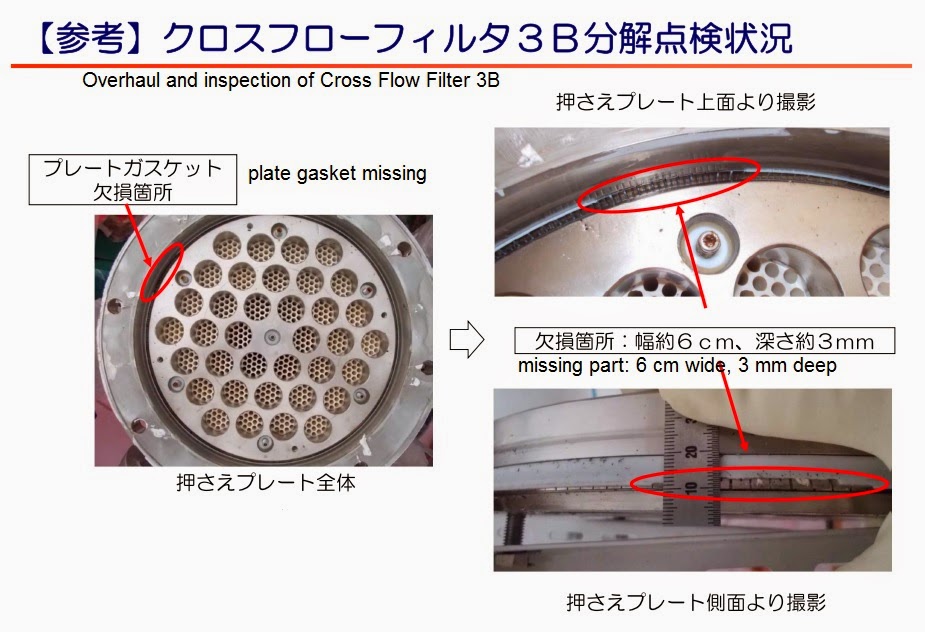
Whether the defective gasket is due to material defect, design defect or irradiation is unknown at this point.
AREVA’s nuclear reactor sales target postponed
Areva says nuclear reactor sales target may slip by 1-2 years PARIS Tue May 20, 2014 May 20 (Reuters) – Areva’s chief executive softened his forecast that the French state-controlled nuclear group would sell 10 reactors by 2016, saying it would be no problem if that deadline slips by a year or two.
Thyroid cancer rates rise in Fukushima children
 50% jump in cancer in Fukushima children’s thyroids since last report 3 months ago — Now 90 cases suspected or confirmed — Gov’t Experts: “Difficult to determine” if cancers caused by nuclear disaster http://enenews.com/50-increase-in-cancer-in-fukushima-childrens-thyroids-since-last-report-3-months-ago-total-number-jumps-to-50-from-33-90-cases-suspected-or-confirmed?utm_source=feedburner&utm_medium=email&utm_campaign=Feed%3A+ENENews+%28Energy+News%29
Jiji Press, May 19, 2014: 50 Fukushima Children Confirmed as Thyroid Cancer Sufferers […] The cancer figure […] increased by 17 from the previously reported figure […] the panel said it is hard to think that there is a causal link between the children’s cancer and the March 2011 reactor meltdowns […]
Fukushima Voice, May 19, 2014: In summary, there were 17 more cancer cases confirmed since the last report on February 7th, 2014. The total number of cases confirmed or suspected of cancer is 90. Of these, 51 had surgeries as March 31, 2014 and 1 turned out to be a benign nodule, 49 were confirmed to be papillary thyroid cancer, and 1 still has no confirmed cytological diagnosis […] As usual, no information was offered such as the type of nodules […]
Total number of children whose initial examination results are confirmed: 287,056 […]
Assessment A1 148,182 (51.6%) (no nodules or cysts found)
Assessment A2 136,804 (47.7%) (nodules 5.0 mm or smaller or cysts 20.0 mm or smaller)
Assessment B 2,069 (0.7%) (nodules 5.1 mm or larger or cysts 20.1 mm or larger)
Assessment C 1 (0.0%) (requiring immediate secondary examination)
Japan Times, May 20, 2014: Number of Fukushima kids with thyroid cancer jumps by 17 from December […] 50 children in the prefecture have developed thyroid cancer [and] 39 children suspected of having developed cancer, sources said. The cancer figure was taken at the end of March […] the panel said it was difficult to determine that a causal link existed between the children’s cancers and the triple meltdown […] Once the results of the first round checkups become available, likely in August, the panel will again assess the thyroid cancer numbers and any possible connection between the cancers and the accident, the sources said.
17 new cases of thyroid cancers / 33 reported in Feb. 2014 = 51.5% increase
See also: Cancer Specialist in Fukushima: There are simply too many cases, I see a connection
USA’s Plutonium facility at Los Alamos ruled not safe
 Federal Safety Board Cautions DOE on LANL Plutonium Facility L0s Alamos Study Group, 20 May 14
Main plutonium facility might “collapse” in earthquake unless repairs are completed; scope of work needed still unknown
Board says full re-start of LANL plutonium facility premature; nuclear criticality accidents not ruled out
On May 16, the Defense Nuclear Facilities Safety Board (DNFSB, Board), cautioned Congress about the structural integrity of the main plutonium facility at Los Alamos National Laboratory (LANL) in the event of an earthquake similar to those which have rocked the site in recent millenia. The building in question, “PF-4,” was built in 1978 to earlier, less stringent earthquake standards.
The Board was established by Congress in 1988 to advise the Department of Energy (DOE) on the safety of DOE’s nuclear facilities.
Also on the 16th, DNFSB Chairman Peter Winokur wrote National Nuclear Security Administration (NNSA) Administrator Frank Klotz about the Board’s concerns regarding LANL’s planned re-start of higher-hazard plutonium operations in PF-4 without first evaluating the potential of those operations to result in nuclear criticality accidents. Such accidents, were they to occur as a result of human error, mechanical failure or any other cause, would invariably involve very high levels of radiation and have often been fatal to surrounding workers. Such accidents have happened before at LANL and at other nuclear facilities in the U.S. and abroad. (See for example this LANL review.)
Regarding the first issue DNFSB writes in its “Report to Congress on the Status of Significant Safety Issues Concerning the Design and Construction of DOE’s Defense Nuclear Facilities” that:
..the Board remains concerned that PF-4 is vulnerable to seismic collapse. The large plutonium inventory of PF-4, coupled with the facility’s proximity to the public, creates the potential for high off-site radiological consequences. DOE is pursuing actions to address the collapse vulnerability, but maintains that PF-4 is safe to operate in the interim and complies with DOE standards for seismic performance. The Board communicated to DOE in a letter dated July 17, 2013, that it does not agree… -: http://lasg.org/press/2014/press_release_20May2014.html#sthash.cCZ6igPz.VLFKX1CD.dpuf
Fossil fuel lobby’s media war against climate scientists
David Suzuki Discusses the War on Climate Scientists http://ecowatch.com/2014/05/18/suzuki-climate-scientists/ Everybody ought to be doing their part to fight climate change, but instead some are focusing their energy on taking down the folks providing the research on our planet’s future.
From laughter to vehemence, it’s clear that the war on climate scientists and their research is on. In the second part of his conversation with Bill Moyers, Dr. David Suzuki says climate deniers are engaging in a good ol’ game of “kill the messenger.”
“This is a very effective thing that we know has been done by the tobacco industry [and] it’s being done by the fossil fuel industry… You attack a person on the basis of their trustworthiness, their ulterior motives, anything to get away from dealing with the issues,” the scientist, author and philanthropist said.
He said it’s not unlike the attacks he has experienced from Canada’s prime minister, corporations and others over the years for speaking his mind about the government and the fossil fuel industry.
“The fossil fuel industry knows that fossil fuel use is at the heart of climate change,” Suzuki said. “But the problem is their job as CEOs and executives is to make money for their shareholders, and they’ll do it.”
Japan’s atomic bomb survivors – now a dwindling band
Hibakusha: Disappearing A-bomb survivors leave movement’s future in question Mainichi By Sakiko Takahashi, Hiroshima Bureau 20 May 14 HIROSHIMA — The sun cast its soft rays on the green summer vegetation as I headed on my way to visit atomic bomb survivor and poet Hiroshi Maruya, 89, this May 1 after I received his invitation…..
“Finally, only I am left,” said Maruya, his eyes wide open and his voice lonely.
At the end of April, a general meeting of an A-bomb survivors’ group was held at Hiroshima Kyoritsu Hospital, for which Maruya serves as honorary head. The subject of the meeting: how to shrink down the group’s activities. As chairman, Maruya spoke to those gathered, saying, “We haven’t the vitality to actively campaign against nuclear weapons, and must have the younger generation take over the reins.”
At the meeting the subject of disbanding the group even came up, but on the request of members it was decided to leave it in existence.
Meanwhile, as Maruya and I talked, he relayed to me his recent activities: heading to Tokyo to demand improvements for a law supporting A-bomb victims and his visit to South Korea’s Hapcheon County, said to be “South Korea’s Hiroshima” because of its many residents who were exposed to A-bomb radiation.
Regarding the end of the activities by A-bomb survivors’ groups as their members die out, Maruya said, “It’s sad, but I think this is what history is. For both nuclear weapons and nuclear plants, it’s about how vividly and carefully people’s memories of them are preserved, and about how much creativity is born in the process.”…….http://mainichi.jp/english/english/features/news/20140520p2a00m0na006000c.html
Media ignoring the catastrophic global danger of the nuclear industry
How the nuclear industry may unintentionally obliterate humankind (NaturalNews) May 20, 2014 by: J. D. Heyes In modern times, the nuclear disaster at Japan’s Fukushima Daiichi plant in March 2011 has been one of the most under-reported of cataclysmic events, and some critical analyses have concluded that coverage likely would have been more complete had the accident occurred in a country not allied with the United States.
That said, notes Andrew McKillop at 21st Century Wire, we might as well “write off” most of the American (and Japanese) media, as well as politicians from both nations, regarding the dangers that the accident truly poses to Mankind. “For reasons associated with the nuclear lobby and its corporate machine, their tongues are tied on the issue,” he writes.
The ‘alternative media’ keeping an eye on Fukushima developments
Continuing his criticism, McKillop jabbed further:
More silence, a few new theories and a couple of less than convincing assurances like, “It’s all under control, the humming birds and the badgers have returned to the exclusion zone and there’s a lot of very affordable property now, lost of economic opportunity in Fukushima”, (if you had any doubt of how spineless and redundant our leadership would be in the event of a true humanitarian crisis, this should be your ‘eureka’ moment). The best they could manage is release a new Godzilla film production — and that’s about as close as you’ll get to an admission from the global elite’s media machine.
For his part, McKillop sees the nuclear issue overall as some Darwinian self-destruction plan implemented by Man to ensure the end of the world. Why else, he argues, would so large a catastrophe be so underwhelming and unimportant?
“Incredibly, many politicians, economists and even hard-core environmental priests, still love nuclear power. It’s a strange kind of love, or a Strangelove to be precise,” he writes.
Citing The Economist magazine, which he describes as “an elite talking shop” publication, McKillop says observations made in a recent edition regarding previous nuclear disaster at Chernobyl are particularly noteworthy because they undermine the rosy picture being painted by Japanese and U.S. officials regarding environmental conditions surrounding Fukushima:….McKillop labeled such proclamations as “paid-for junk science” that has become “weaponized” and now poses a direct threat to humans……http://www.naturalnews.com/045213_nuclear_industry_humankind_extinction.html
Nuclear industry: costs and delays cast a gloom on chance of “new nuclear’
 In Europe and the U.S. cost overruns and delays raise questions about the market for a new generation of safer nuclear reactors Scientific American, May 20, 2014
 More than a decade ago a contract was signed to build the world’s first third-generation European pressurized reactor (EPR) in Finland. The cutting-edge, 1,600-megawatt nuclear power plant, Olkiluoto 3, which its French maker Areva boasted as the most advanced safety design of the time, is still under construction today. There have been various setbacks as well as endless finger-pointing between Areva and the Finnish utility TVO, which are locked in court battle over expanding costs. Now the reactor might not be completed until at least 2017, if at all, with a price tag of $11 billion, more than double its original estimate.
The Olkiluoto 3 situation is not unique. Another Areva EPR in Flamanville, France, is also behind schedule and over budget. A recent government deal for two new EPRs in the U.K. has also come under fire.
The prospects for a nuclear power revival are no better in the U.S. Although the technology has never been cheap, cost overruns and delays are plaguing the handful of next-generation pressurized water reactors currently being built, the first since Japan’s Fukushima nuclear disaster in 2011. Even before that event, a study from Massachusetts Institute of Technology found that the cost of new nuclear plants, globally, doubled from 2002 to 2009. The third-generation reactors have safety features that should prevent a meltdown similar to Fukushima’s but political controversy, along with the high price tag means that new nuclear complexes in the U.S. and Europe could be in the single digits instead of dozens originally planned less than a decade ago……….
Costs and delays are also rising for the AP1000 being built by Georgia Power, in part because the units must meet more stringent safety requirements that regulators have introduced in the wake of September 11, 2001, attacks and the Fukushima meltdown. ……
Although the AP1000 is an intrinsically simpler design than the EPR, they both have also faced cost overruns because they are first-of-their-kind deployments. A report by Citi Research found that the Vogtle project is about six months behind schedule and will cost at least $1 billion above original projections. “We’re learning how to do this as efficiently as we can,” says Benjamin, who admits there has been a learning curve. Finalizing the design for construction, which has been approved by American and Chinese regulators, has taken longer than anticipated. So has securing delivery on certain components, such as reactor coolant pumps, because they are being produced for the first time. “We take these lessons as we learn them,” says Benjamin, “and make sure these issues get [resolved] so we don’t face them again.”
Westinghouse hopes that working out the kinks in the first designs will drive down the tim
Death of peace activist and atomic veteran Acie Byrd
Peace Activist, Broadcaster Acie Byrd Dies at 77 OpEd News, By Democracy Now! 20 May 14 Peace activist and radio commentator Acie Byrd has died at the age of 77 following a battle with cancer. Byrd was among an estimated quarter of a million U.S. military personnel exposed to radiation from U.S. nuclear tests that took place from 1945 to 1962.
He was exposed to hydrogen bomb testing in the mid-1950s in the Pacific. He became a leading advocate for fellow atomic veterans, calling for healthcare compensation and a comprehensive test ban treaty. In 1977, Byrd was one of the founding members of Pacifica station #WPFW in Washington DC, where he served as a local and national commentator and board member for many years……..http://www.opednews.com/articles/Peace-Activist-Broadcaste-by-Press-Release-Acie-Byrd_Military_Peace-Advocacy-Activism_Radiation-140520-67.html
India’s new Prime Minister Modi to take over nuclear weapons codes
 Modi to take control of nuclear codes Shishir Gupta, Hindustan Times New Delhi, May 20, 2014 Although Prime Minister-designate Narendra Modi is scheduled to be covered by the Special Protection Group (SPG) three hours before his swearing in at 6 pm next Monday, he will be handed over top secret nuclear codes, keys and command and briefed about India’s strategic perception by outgoing National Security Advisor Shiv Shankar Menon after he takes over as PM.
Sources told HT that Modi will be briefed about India’s strategic weapon capabilities, their location and the strength of nuclear arsenal after taking over as PM by Menon and top members of nuclear establishment and strategic force command.
Menon will also hand over codes and keys required to activate the strategic weapons in case of a nuclear attack.
White House an Republicans at odds over Nuclear Security Provisions
GOP, White House Clash over Nuclear Security Provisions in Defense Bill National Jurnal, By Douglas P. Guarino 20 May 14, As annual defense authorization legislation nears the House floor, the Obama administration and House Republicans continue to clash over key nuclear weapons and nonproliferation issues.
In a statement of administration policy released Monday evening, the White House says it “strongly objects” to bill language that would prevent the Energy Department from continuing to conduct nuclear security work in Russia until the Ukraine crisis — and concerns about potential Russian violations of various arms control treaties — are resolved.
The work includes efforts to secure buildings in Russia where sensitive nuclear materials are stored, among other projects. “Cooperation with Russia remains an essential element to the global effort to address the threat posed by nuclear terrorism,” the statement says, echoing sentiments of U.S. Undersecretary of State Rose Gottemoeller. The State Department official said earlier this month that stopping such collaboration would be tantamount to shooting “ourselves in the foot.”
According to the White House, “Critical bilateral nuclear nonproliferation activities are continuing in a number of key areas, and nuclear security is of paramount importance.”
Similarly, the administration “strongly objects to the significant reduction of funds” the House bill seeks to make to the Energy Department’s Second Line of Defense program, which aims to prevent the smuggling of dangerous nuclear materials across borders.
Congressional Democrats and nuclear watchdog groups, meanwhile, have complained that the Obama administration has not been requesting enough funds for the program in recent years………http://www.nationaljournal.com/global-security-newswire/gop-white-house-clash-over-nuclear-security-provisions-in-defense-bill-20140520
Armenia – Metsamor nuclear plant is a liability and the IAEA does not care!
“…Responding to a question about the safety of Metsamor, a nuclear power plant in Armenia, Amano said “it’s the responsibility of each state to be sure that its nuclear is safe…Some improvement has been made in Metsamor but more needs to be done.”…” http://www.turkishpress.com/news/405511/ May 14, 2014
….The international community and regional countries like Azerbaijan, Turkey and Georgia have repeatedly urged Armenia to close the dangerous Metsamor NPP immediately. The European Commission recently called Armenia to work towards the earliest possible closure of the Metsamor NPP. But, Armenia does not attach any particular importance to nuclear safety…..


http://en.trend.az/regions/scaucasus/armenia/2275640.html
By Jamila Babayeva
19 May 2014,
Armenia is becoming more unpopular among Russian government and investors as Moscow faces economic difficulties following its interference in the crisis in Ukraine.
Armenia intended to sign an agreement with the Russian government to get loans to start the Metsamor nuclear power plant project by May 1, 2014.
The governments decided in March to extend the operation period of the second power unit of the nuclear power plant in Metsamor and at the same time start the construction of a new nuclear power plant.
But, Russia seems not to hurry to allocate loans to Armenia for this project so far.
The Armenian government, in search of ways to convince Russia to immediately allocate loans for the “investment-hungry” nation, uses every chance in this regard. Azerbaijan’s intention to construct a nuclear plant in the next three to four years as part of programs of its National Nuclear Research Center has pushed Armenian authorities to take urgent steps.
“Armenia needs to take the immediate benefits of constructing a new nuclear power unit,” Deputy Energy Minister Areg Galstyan said at the parliament on May 14 in response to Azerbaijan’s recent decision.
He added that the construction of a power unit is the first priority of Armenia.
“Given the current situation, it is necessary to complete the project as soon as possible,” Galstyan said. “Maybe we can benefits from the construction of more nuclear power plants. Maybe we will be forced to take this step.”
Thus, Galstyan sent a signal to Russia to accelerate allocating a loan to Armenia for outdated Metsamor NPP. Russia’s economy now is in difficult situation and the country may see serious economic slowdown. Russia in this situation will hardly be interested in supporting Armenia in nuclear projects.
Metsamor NPP is a real nuclear threat for the region. Metsamor NPP, built in 1970, was closed down after the devastating earthquake in Spitak in 1988, but resumed its operation in 1995 despite international outrages.
The international community and regional countries like Azerbaijan, Turkey and Georgia have repeatedly urged Armenia to close the dangerous Metsamor NPP immediately. The European Commission recently called Armenia to work towards the earliest possible closure of the Metsamor NPP.
But, Armenia does not attach any particular importance to nuclear safety.
Now Armenia intends to operate Metsamor NPP, which does not meet current safety standards, till 2026.
Azernews
1 This Month

of the week – Shut Down Drone Warfare!


Tell the Ukrainian Government to Drop Prosecution of Peace Activist Yurii Sheliazhenko

Petition to revoke the licensing of the Near Surface Nuclear Disposal Facility (NSDF) at Chalk River. https://www.ourcommons.ca/petitions/en/Petition/Details?Petition=e-7247
To see nuclear-related stories in greater depth and intensity – go to https://nuclearinformation.wordpress.com
-
Archives
- March 2026 (230)
- February 2026 (268)
- January 2026 (308)
- December 2025 (358)
- November 2025 (359)
- October 2025 (376)
- September 2025 (257)
- August 2025 (319)
- July 2025 (230)
- June 2025 (348)
- May 2025 (261)
- April 2025 (305)
-
Categories
- 1
- 1 NUCLEAR ISSUES
- business and costs
- climate change
- culture and arts
- ENERGY
- environment
- health
- history
- indigenous issues
- Legal
- marketing of nuclear
- media
- opposition to nuclear
- PERSONAL STORIES
- politics
- politics international
- Religion and ethics
- safety
- secrets,lies and civil liberties
- spinbuster
- technology
- Uranium
- wastes
- weapons and war
- Women
- 2 WORLD
- ACTION
- AFRICA
- Atrocities
- AUSTRALIA
- Christina's notes
- Christina's themes
- culture and arts
- Events
- Fuk 2022
- Fuk 2023
- Fukushima 2017
- Fukushima 2018
- fukushima 2019
- Fukushima 2020
- Fukushima 2021
- general
- global warming
- Humour (God we need it)
- Nuclear
- RARE EARTHS
- Reference
- resources – print
- Resources -audiovicual
- Weekly Newsletter
- World
- World Nuclear
- YouTube
-
RSS
Entries RSS
Comments RSS
 nuclear-news