Astrid, 4th Generation Reactor: Miracle Technology or Dangerous Chimera?
 Pétition NON à ASTRID ! http://marcoule.ecoloweb.fr/
Le Collectif Non à Astrid appelle à signer une pétition à l’attention du Commissariat général à l’investissement demandant l’arrêt du projet ASTRID, le projet de réacteur à neutrons rapides refroidi au sodium (filière de 4ème génération RNR-Na) qui doit se construire à Marcoule, dans le Gard.
Dites non à un nouveau réacteur à neutrons rapides refroidi au sodium liquide !
Dites non à une installation nucléaire supplémentaire à Marcoule !
Dites «NON à ASTRID !»
NON à ASTRID !
Dans le cadre de la loi du 13 juillet 2005 sur le développement des technologies des réacteurs nucléaires du futur et des technologies nécessaires à une gestion durable des déchets nucléaires, la France a donné la priorité à la technologie des RNR-Na et décidé de construire le réacteur ASTRID pour démontrer la capacité de la filière àtransmuter les actinides mineurs à l’échelle industrielle. En 2010, le C.E.A. a reçu 651,6 M€ pour élaborer l’Avant Projet Détaillé du réacteur.
 Nuclear Free by 2045? Enough of this century of dread. Make the world nuclear free before the centennial of the Trinity Nuclear Bomb Test at Alomogordo, July 16, 1945.
France experienced nothing but nightmares with its 20th century experiment with fast breeder reactor technology. I covered this topic previously in a series of translations of French documents about the Superphénix reactor failure: Superphénix Part 1, Superphénix Part 2, andSuperphénix Part 3.
The first time around, the French fast breeder reactor was met with vigorous resistance by protesters. In 1977, 60,000 protesters assembled on the construction site and were met by riot police. One fatality ensued and there were other injuries of protesters and police. During construction, a small cell of eco-warriors attacked the reactor with a bazooka. They hoped to destroy the reactor vessel before it was loaded with fuel, but the missile missed the mark. In 2003, a Swiss member of parliament confessed to the deed after the statute of limitations had passed. To this day, some pro-nuclear advocates use this case as proof that some in the ecology movement are dangerous radicals who would cause a nuclear disaster to prove their point. One may disagree with the tactic, but one thing that should be understood about this attack is that it was deliberately carried out before nuclear materials were loaded into the reactor. There was no intention to cause a nuclear disaster.
After the Superphénix reactor was switched on, it was plagued with technical problems and cost overruns. The government shut it down and decommissioning work began in 1997. The job is set to last another 20 years at least. Nonetheless, the French breeder reactor is back like an undead beast that needs to be continually fed then beaten back into the grave by vigilant citizens. Incredibly, France, Britain and Japan are co-operating on this project as if it’s a Three Stooges movie. France brings its expertise with the failed Superphénix reactor, Britain shares its valuable experience in ecological contamination from Sellafield, and Japan feels it has a contribution to make with the lessons learned from its Monju boondoggle. Like nuclear waste itself, the dream of the perfectibility of nuclear technology is persistent, indestructible and toxic.
The text that follows is a translation of a report on the latest incarnation of the fast breeder reactor.
________________________________
Astrid, 4th Generation Reactor: Miracle Technology or Dangerous Chimera?
Originally published in French by Sortir du Nucléaire, May 2014: Le réacteur Astrid: miracle technologique ou dangereuse chimère ?……. http://nf2045.blogspot.jp/2014/05/long-night-of-living-dead-superphenix.html
Radiation levels in sea off Fukushima at record high
 Record high radiation in seawater off Fukushima plant, Japan Times, 17 May 14 Radiation has spiked to all-time highs at five monitoring points in waters adjacent to the crippled Fukushima No. 1 power station, plant operator Tokyo Electric Power Co. said Friday.
The measurements follow similar highs detected in groundwater at the plant. Officials of Tepco, as the utility is known, said the cause of the seawater spike is unknown.
Three of the monitoring sites are inside the wrecked plant’s adjacent port, which ships once used to supply it.
At one sampling point in the port, between the water intakes for the No. 2 and No. 3 reactors, 1,900 becquerels per liter of tritium was detected Monday, up from a previous high of 1,400 becquerels measured on April 14, Tepco said.
Nearby, also within the port, tritium levels were found to have spiked to 1,400 becquerels, from a previous high of 1,200 becquerels.
And at a point between the water intakes for the No. 1 and No. 2 reactors, seawater sampled Thursday was found to contain 840 becquerels of strontium-90, which causes bone cancer, and other beta ray-emitting isotopes, up from a previous record of 540 becquerels.
At two monitoring sites outside the port, seawater was found Monday to contain 8.7 becquerels and 4.3 becquerels of tritium. The second site was about 3 km away……… http://www.japantimes.co.jp/news/2014/05/17/national/record-high-radiation-in-seawater-off-fukushima-plant/#.U3ptgdJdWik
How DO you make a sign to warn against radioactive site for 10,000 years?
How To Make A Warning Label For Humans 10,000 Years From Now, Fast Code Design, 18 May 14 Nuclear waste can remain deadly for thousands of years. Plutonium-23, an isotope used in nuclear weapons production, has a half-life of more than 24,000 years. By contrast, some of the earliest human writing emerged only 5,000 years ago. This presents a challenge of near-eternal proportions: How do you create a label that will convey danger to someone thousands of years in the future–someone who probably won’t share any common culture or language with you?……

Episode 114: Ten Thousand Years
Britain’s Ministrty of Defence fails in bid to censor report on radioactive contamination
 MoD loses battle to block radioactive waste contamination report, Rob Edwards, Guardian 14 May 14, Report warning contamination of military sites could pose public health risk to be published next week after six-month delay
The report was submitted for publication last October by the 18-memberCommittee on Medical Aspects of Radiation in the Environment (Comare). To the frustration of its authors and the Scottish government, UK ministers have sat on it for the past six months after objections from the MoD.
But after the 75-page report was leaked to the Guardian, a decision was taken in Whitehall on Tuesday to publish it early next week. It will reveal that Comare is concerned about radium contamination from the second world war at Dalgety Bay in Fife and at least 25 other sites across the UK.
The contamination at Dalgety Bay poses “a potential risk to public health”, the report says. It condemns the MoD’s failure to provide a comprehensive list of other potentially contaminated sites as “unacceptable” as it “implies an unknown risk to the general population”.
Because of the “extensive” contamination, parents should be recommended not to allow their children to dig on the beach, the report says. Although it concludes that there is no immediate evidence of increased cancers, it points out that side-effects can take time to appear and recommends a study of cancer rates to be carried out around Dalgety Bay in five or 10 years.
Comare’s report recommends that the Scottish government should ensure that Dalgety Bay is cleaned up as soon as is possible. An evaluation of the best means of remediation should be instituted immediately, “considering efficacy, practicability and cost”, it says.
According to the report, disposal of radium – used to paint aircraft dials so that they could be read in the dark – was “very widespread”. It criticises the MoD for only providing a limited list of sites where this could have happened. Though the only site named in the report is Dalgety Bay, 15 have been previously listed by the MoD.They include the old SAS headquarters at Stirling Lines in Hereford, a former naval air base near Portsmouth and a previous home to the Red Arrows in Gloucestershire. There are also potentially contaminated sites in Hampshire, Bedfordshire, Nottingham, Shropshire, Cumbria, Stirling, Perth and Kinross, Angus, Moray and the Mull of Kintyre.
Comare is demanding authority from the government to force the MoD to draw up a full list of potentially contaminated sites. “The information available for each site should be evaluated and, where deemed necessary, investigation and/or remediation instituted,” it says.
The MoD has been accused of resisting funding an expensive cleanup at Dalgety Bay to avoid setting a precedent for dozens of other sites around the country. “The MoD would rather this report hadn’t existed,” said one insider……….http://www.theguardian.com/environment/2014/may/14/mod-nuclear-waste-contamination-report-dalgety-bay
Chernobyl still a nuclear ticking time bomb
 Chernobyl: Ukraine’s nuclear time bomb still ticking, SMH, May 17, 2014 Jan Villalon Video journalist While the current political tensions in Ukraine continue to threaten stability in the region, an even larger spectre looms in Chernobyl, the site of the world’s worst nuclear accident.
Nearly three decades later, recovery from the disaster continues, with construction currently under way on an immense shield designed to entomb the radioactive remains of the reactor that exploded all those years ago.
At nearly 110 metres high and 275 metres wide, and weighing around 32,000 tonnes, the arch-like New Safe Confinement is one of the most complicated feats of modern engineering that, once complete, will be the largest movable structure ever built. It’s designed to last 100 years – the estimated time to finish clean-up at the site.
But the project is already years behind schedule. Though plans have been in the works to contain the leaky, crumbling reactor since 1992, construction on the New Safe Confinement only began in 2010. Originally slated to be finished 2015, developers have now pushed the date back to 2017.
Half of the arch has been assembled so far, but the future of the $2.2 billion project, funded by the European Bank for Reconstruction and Development, now hangs in the balance. With Ukraine thrown into an economic crisis and Russia at its borders, there are concerns the shelter may not be completed in time – if at all.
“It is unfortunately a situation which can further deteriorate and it’s very difficult, then, to predict what the impacts on our project will be,” said Vince Novak, director of nuclear safety at the EBRD.
“You must not forget that this is a project about nuclear safety,” Novak said in an interview with The Verge. “And its importance transcends borders and transcends political divisions and differences.”
Adi Roche, head of the NGO Chernobyl Children International, recently returned from a trip to study the progress of the shelter’s construction and describes the situation as a “ticking time bomb”.
“Chernobyl is the old Soviet Union’s deadly legacy to Ukraine and the world has very real reason to be extremely concerned about the ongoing threat it poses, especially at a time of great instability and growing hostility between Ukraine and Russia,” she said.
For many Ukrainians, Chernobyl remains a deep wound, a stark reminder of an era during which government policies of secrecy and corruption bred deep mistrust among the public. ………….
Former Soviet leader Mikhail Gorbachev admitted in a 2006 opinion piece that the disaster was a catalyst for the dismantling of the USSR.
“The nuclear meltdown at Chernobyl . . . was perhaps the real cause of the collapse of the Soviet Union five years later. Indeed, the Chernobyl catastrophe was an historic turning point: there was an era before the disaster, and there is the very different era that followed,” he wrote……..
With no warnings of the true dangers of radiation, and no basic safety guidelines in place, firefighters had rushed to the scene at Chernobyl completely unaware they were being exposed to lethal doses of radioactive waste. Many of the first responders, as well as workers sent in to help contain the disaster, suffered severe symptoms of acute radiation poisoning within days.
When calculating the human cost of the Chernobyl disaster, figures vary widely. Two workers were killed in the initial explosion, with a further few dozen more deaths linked to the incident. Many claim thousands more died as a result of the aftermath and clean-up operations.
The wider impact of radiation exposure is difficult to measure, however. Over the years, various reports have pointed to rises in fatal cancers among the population as well as the number of children born with genetic defects linked to radiation. Some estimates put the number of people affected as high as a million across Europe, while more conservative figures hover in the tens of thousands. …..Meanwhile, what remains of reactor four is still at risk. Encased in its shoddy, rusting sarcophagus, Chernobyl’s time bomb is just one spontaneous chain reaction away from another disaster. http://www.smh.com.au/world/chernobyl-ukraines-nuclear-time-bomb-still-ticking-20140517-zrfpn.html#ixzz32C5tLeaw
Breaking UK – Daring dawn blockade of Britain’s Nuclear weapons factory

This morning at 7.20am a group of peace campaigners began blockading the Atomic Weapons Establishment (AWE) site at Burghfield, near Reading. The protesters, acting as part of ActionAWE [1] campaign of non-violent direct action, are trying to disrupt construction of a new nuclear warhead factory on the site.
The new development at AWE Burghfield is being built at a cost to the tax payer of almost £2 billion, despite the fact that parliament has yet to vote on replacing the current generation of nuclear warheads that the site would build.
The protesters were locked together using handcuffs inside ‘lock-on’ devices – made from drainpipes, and vegetable oil drums filled with concrete in order to block the gate to the construction site to prevent further work on the site.
Amy Clark, 19, a Peace Studies Student at Bradford University said “Public money is already being spent in its millions toward the renewal of trident. The final decision on renewal must be made by 2016 so it’s time to act now to stop it.”
Phil Wood, 20, a Politics Student also at Bradford University added “To be spending millions of pounds and planning to spend billions more on nuclear weapons while cutting back on essential public services that people rely on is unforgivable”
Catherine Bann, 40, mother of two from Todmorden, said: “The money we would spend renewing Trident could pay for all A & E hospital departments in the country for the next 40 years! It’s a huge waste of public money to be investing in nuclear weapons, and people like us must make a stand now, so that future generations do not have to bear the cost.”
Matt Fawcett, 39, from Yorkshire CND said: “This ‘do as we say, not as we do’ policy of telling other countries they can’t develop nuclear weapons while we spend billions developing new weapons of our own, not only undermines attempts to limit the spread of nuclear weapons but also discredits Britain on the world stage. Polls show 87% of the British public are against spending on new nukes at a time of such drastic cuts, yet the construction goes on at Burghfield without any parliamentary debate”
For further details contact:
Sarah 07737 596 808
Nina 07812 104 279
Notes to editors
The UK has an armed nuclear submarine on patrol and ready to fire at all times, with the ability to wipe out cities almost anywhere on earth within 15 minutes[2]. The UK has a stockpile of around 225 nuclear warheads[3], each with eight times the explosive power of the bomb dropped on Hiroshima in 1945 [4] that killed an estimated 140,000 to 200,000 people. Running the Trident nuclear weapons system currently costs £2 billion a year[5], and has not seen any of the cutbacks facing other government spending and public services. The government will vote in 2016 to decide whether to invest in the UK’s Trident nuclear weapon system for another 30 years.
Operated by a consortium of Jacobs Engineering Group, Lockheed Martin and Serco, AWE Burghfield plays an integral part in the final assembly and maintenance of nuclear warheads for use in the Trident system[6]. In 2011 Peter Luff, the then Minister for Defence Equipment, announced £2 billion of spending for redevelopment of the Burghfield and Aldermaston weapons factories[7]. The total spending on Weapons of Mass Destruction in the UK will soar to over £100 Billion should the government take the decision to renew Trident in 2016 [8].
Action AWE (Atomic Weapons Eradication) is a grassroots campaign of nonviolent action dedicated to halting nuclear weapons production at the Atomic Weapons Establishment factories at Aldermaston and Burghfield.
[2] http://www.greenpeace.org.uk/peace/trident-the-uks-nuclear-weapons-system
[3]Stockholm International Peace Research Institute:
http://www.sipri.org/research/armaments/nuclear-forces
[4] http://www.cnduk.org/information/briefings UK warheads are thought to have a yield of 80-100kt.
[5] http://fullfact.org/factchecks/cost_trident_nuclear_deterrent-28864
[6] http://www.awe.co.uk/aboutus/the_company_eb1b2.html
[8] http://www.cnduk.org/information/briefings/trident-briefings
Tags:Aldermaston, Bradford, Disarmament Activism, Nuclear, Nuclear weapon, Warfare and Conflict, Weapons, Yorkshire Campaign for Nuclear Disarmament
Accident at US repository highlights need for tougher nuclear safety monitoring

 Call for better oversight of nuclear-waste storage Accident at US repository highlights need for tougher safety monitoring, say experts.Nature, Declan Butler 13 May 2014 A serious accident in February at the United States’ only deep-storage repository for nuclear waste might never have happened had the government not disbanded a key independent scientific body charged with oversight of the safety of the facility.
The Waste Isolation Pilot Plant (WIPP), carved out of a salt bed 655 metres below the desert near Carlsbad in New Mexico, is run by the Department of Energy (DOE) and stores low- and medium-level military nuclear waste, containing long-lived, man-made elements such as plutonium and americium. But there are politically controversial plans to store far hotter high-level waste at the site. Nuclear-waste experts say that the accident — in which a container is thought to have ruptured or exploded — along with management errors and a lack of oversight at WIPP, highlight the need for an independent risk assessment of any proposed expansion.
The facility was opened in 1999 and is designed to operate for a few decades, after which it will be sealed forever. The accident on 14 February released moderate levels of radioactivity into the repository, as well as small amounts into the environment, and officials say that the plant will not reopen for at least 18 months.
According to a preliminary report released on 24 April by a DOE-appointed Accident Investigation Board, the root cause of the accident lies with the department’s field office and Nuclear Waste Partnership, the contractor that operates the site, both in Carlsbad. They failed to identify radiological risks and make plans to control them, the report’s authors said. They added that maintenance of safety systems was neglected, and that DOE oversight was “ineffective”………
Ed Lyman, a nuclear expert with the Union of Concerned Scientists in Washington DC, says that he strongly supports exploring the storage of down-blended weapons-grade plutonium at WIPP. Such waste generates much less heat than does spent fuel, he adds. But he rejects storing spent fuel at WIPP, as its likely impacts on the surrounding salt “would be inviting trouble”.
The DOE Field Office in Carlsbad and the Nuclear Waste Partnership had not responded to Naturewhen this article went to press.
Several scientists say that whatever the test results or arguments, the storage of high-level waste at WIPP should be ruled out because of the nature of the site. The area is rich in oil, gas and minerals, and oil and gas wells hug the 41-square-kilometre area. Hydraulic fracturing — fracking — of gas is also carried out nearby. This poses the risk that the WIPP repository could be disturbed by future drilling and mining, for example, by the puncture of the high-pressure brine reservoirs beneath WIPP.
There is no way that the authorities would ever approve such a site for storing high-level waste, says Chaturvedi. http://www.nature.com/news/call-for-better-oversight-of-nuclear-waste-storage-1.15211
Spanner in the works for Fukushima’s planned ice wall against radiation
 Work on frozen soil walls at Fukushima plant hits glitch Asahi Shimbun, May 17, 2014 By AKIRA HATANO/ Staff Writer Plans to start construction in June of frozen underground soil walls at the crippled Fukushima No.1 nuclear power plant are now askew after concerns were raised by the nation’s nuclear watchdog body.
The Nuclear Regulation Authority said plant operator Tokyo Electric Power Co. has yet to submit documents demonstrating the safety and efficacy of the project, which is unprecedented in scale.
Announced in May 2013, the frozen walls are intended to stem the flow of groundwater into the nuclear complex.
“Once the project is started, it will be difficult to turn back,” said Toyoshi Fuketa, an NRA commissioner who is screening the project planned by TEPCO and the central government. “We have to thoroughly examine every aspect of this project because it is such a drastic measure.” TEPCO has been grappling with ways to staunch the daily flow of 400 tons of groundwater into the plant complex. The groundwater mixes with melted nuclear fuel debris and has significantly raised the volume of contaminated water that TEPCO has to deal with, in addition to tons of highly radioactive water used to cool the reactors.
The technique to build the walls of frozen soil is similar to a method used in the construction of tunnels.
A series of steel pipes that contain a liquid at minus 30 degrees spaced at 1-meter intervals will be placed around the buildings housing the four reactors, as well as the turbine buildings.
Stretching 1,500 meters, the frozen walls are expected to cut the inflow of groundwater to 130 tons from the current 400 tons a day.
TEPCO and the government plan to begin the actual freezing of soil in March 2015, with the expectation the walls could last for seven years.
The government has provided 32 billion yen ($313 million) in funding for the project…….
Fuketa pointed out at a review meeting that the document fell far short of providing the necessary safety assurances to pass screening.
The NRA told the utility to provide answers to 24 items that the watchdog is concerned about, such as the possibility of land sinking, leaks of contaminated water and countermeasures in the event the frozen soil thaws.
The NRA is also demanding that TEPCO explain how the construction of the walls of frozen soil will be able to cut the volume of contaminated water…….http://ajw.asahi.com/article/0311disaster/fukushima/AJ201405170031
Japan to check lefelong health of 20,000 Fukushima nuclear workers
 Lifelong health checks planned for 20,000 workers at Fukushima plant http://ajw.asahi.com/article/0311disaster/fukushima/AJ201405170037 THE ASAHI SHIMBUN 17 May 14, The government will look for increased rates of leukemia and other cancers linked to radiation exposure as part of a lifelong study of 20,000 workers mobilized in the recovery effort after the 2011 nuclear disaster.
The Ministry of Health, Labor and Welfare study is projected to be still continuing 60 years from now because many of the workers are in their early 20s. The triple meltdown at the Fukushima No. 1 nuclear power plant was triggered by the March 11, 2011, Great East Japan Earthquake and tsunami. The individuals taking part in the study worked at the plant between March 14 and Dec. 16 of that year.
A panel of experts on May 16 approved the ministry’s plan, including the methodology of the study, the subjects to be covered and conditions to be checked.
Under the plan, blood and liver function tests will be conducted once a year during routine health checks. Every three to five years, doctors will check for signs of kidney failure.
The ministry plans to start the study on a trial basis during the current fiscal year, which will then be expanded on a full-scale basis in fiscal 2015.
The ministry will decide at a later date which entity it will contract to carry out the study.
During the nine-month period in question, the government raised the safety limit for radiation exposure in cases of emergency from 100 millisieverts to 250 millisieverts.
Of the 20,000 workers, 174 were exposed to radiation doses that exceeded the safety limit of 100 millisieverts over five years for those working under normal conditions.
Today’s Small Modular Nuclear Reactor (SMR) plans are retreads of old failed technologies
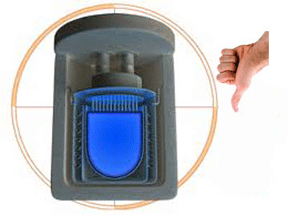 WHY SMALL MODULAR REACTORS ARE PART OF THE PROBLEM,
 “……..EXHIBIT II-7: SMALL MODULAR REACTOR SAFETY CONCERNS
German government will not pay costs of burying dead reactors
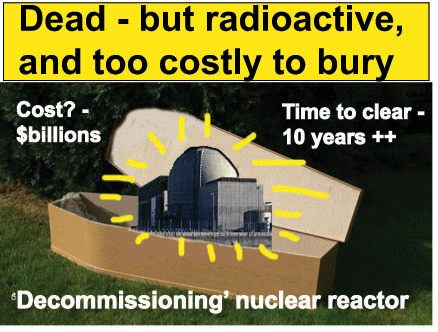 Germany’s Gabriel says state won’t pay for nuclear decommissioning http://uk.reuters.com/article/2014/05/18/uk-germany-energy-nuclear-idUKKBN0DY0EM20140518 BERLIN Sun May 18, (Reuters) – Germany‘s economy minister has joined Angela Merkel in rejecting talk that utilities might hand over responsibility for decommissioning Germany’s nuclear powerplants to a new public entity, as the projected costs of decommissioning rise.
“It should not be tax payers who pay for the clean-up of atomic waste but rather those who made money for decades through running nuclear power stations,” Sigmar Gabriel told the newspaper Bild am Sonntag in an interview published on Sunday.
Two sources told Reuters last weekend that utilities were in talks with the government about setting up a “bad bank” for nuclear plants, in response to Chancellor Angela Merkel’s decision to close them all by 2022 after the Fukushima disaster.
The foundation would use provisions earmarked by the nuclear plant operators but would also take on the risk of unforeseen extra costs, effectively capping the utilities’ liability.
The Environment Ministry said last week the utilities bore full responsibility for safely decommissioning and dismantling the nine nuclear power plants still on the grid.
One of the sources had told Reuters that if the state takes over responsibility for the decommissioning, the utilities might be willing to drop their legal claims against the government for compensation for having to shut the plants. The four operators of nuclear plants in Germany – the German companies E.ON (EONGn.DE), RWE (RWEG.DE) and EnBW (EBKG.DE) and Sweden’s Vattenfall VATN.UL – have set aside total provisions of around 36 billion euros (29.3 billion pounds) for dismantling the plants and disposing of nuclear waste.
Germany’s Spiegel magazine reported on Sunday that government experts predicted a possible shortfall of 3.5 billion euros for the clean up, as costs had risen sharply. (Reporting by Alexandra Hudson; Editing by Larry King)
Fukushima’s ice wall – massive cost, massive drain on electricity
Record high radiation in seawater off Fukushima plant, Japan Times, 17 May 14 “………..Tepco is struggling to reduce contamination at the poorly protected plant, which was damaged by the March 2011 earthquake and tsunami. Measures include plans to build a gigantic underground ice wall around the plant to keep the daily flow of groundwater from entering the cracked reactor buildings and mingling with the highly radioactive cooling water in their basements.
The ice wall project is expected to cost ¥31.9 billion and will put a massive burden on the power grid when completed: It will need about 45.5 million kilowatt-hours of electricity to operate, equal to annual power consumption of 13,000 average households.
The project involves freezing the soil into barricades 30 meters deep and 2 meters thick for a distance of 1,500 meters around the buildings housing reactors 1 through 4.
The soil will be frozen by sinking pipes into the ground and running liquids through them at a temperature of minus 30 degrees.
On Friday, the Ministry of Economy, Trade and Industry and contractor Kajima Corp. demonstrated a miniature ice wall to reporters at the site.
“We can confirm the frozen soil’s effect in blocking water,” a ministry official said afterwards.
The department aims to begin construction next month. But the Nuclear Regulation Authority has not approved the plan, saying its backers have so far provided insufficient reassurances about public safety. International nuclear experts have also expressed concern about the effectiveness of the plan. http://www.japantimes.co.jp/news/2014/05/17/national/record-high-radiation-in-seawater-off-fukushima-plant/#.U3ptgdJdWik
The news is bad for the uranium industry – again!
 Uranium Slides as Banks Reduce Outlook Amid Japan Delays, Bloomberg, 18 May 14 By Ben Sharples Delays in restarting Japan’s nuclear reactors are prolonging a uranium supply glut that’s driven prices to an eight-year low, making banks from UBS AG to Credit Suisse Group AG less bullish on the fuel.
Uranium dropped to $29 a pound on May 2, the lowest since June 2005 and extending this year’s drop to 16 percent, according to TradeTech, a Denver, Colorado-based consultant to the nuclear industry. UBS reduced its 2014 forecast by 9 percent last month as Credit Suisse cut its projection by 7 percent.
Kansai Electric Power Co. (9503) and other utilities are taking longer than expected to restart reactors that closed after the Fukushima disaster in March 2011 as Japan’s nuclear regulator seeks more safety checks. While producers from Australia to Africa shut mines as prices retreated to unprofitable levels, Raymond James Ltd. is among those who say supply will still outstrip demand this year.
“There is too much supply floating around the marketplace and demand is highly limited,” said David Sadowski, a Vancouver-based analyst at Raymond James, a financial adviser, who cut his 2014 forecast by 14 percent to $36 a month ago. “Japanese restarts are the key catalyst to get utilities to resume long-term contracting, which should support prices.”
Uranium for immediate delivery averaged $33.93 this year, compared with $38.47 in 2013 and $46.27 in 2010, the year before the earthquake and meltdown of the Fukushima Dai-Ichi plant and subsequent closure of Japan’s reactors for safety checks. Uranium closed at $28.40 yesterday on the New York Mercantile Exchange………
Forecasts Cut
UBS reduced its 2014 forecast for uranium on April 9 to $39, while Credit Suisse cut its estimate to $38.80, according to an April 1 note. The exit of traders such as Goldman Sachs Group Inc. from the market is also reducing transactions, according to Roswell, Georgia-based Ux Consulting Co.
Deutsche Bank AG is cutting back parts of its commodities business including uranium, Nick Bone, a London-based spokesman, said by e-mail May 7. Michael DuVally, a spokesman for Goldman Sachs in New York, declined to comment in an e-mail on the sale of its unit trading the fuel………
Prices are below the marginal cost of production of $35 estimated by UBS. Paladin Energy Ltd. said in February it will halt its Kayelekera operation in Malawi while Russia’s Atomredmetzoloto last year shuttered Honeymoon in Australia. Kazakhstan, the world’s biggest producer, said in November it will halt all projects to increase output after the decline.
Paladin, which gets all of its revenue from selling uranium, fell as much as 4.6 percent today in Sydney trading………http://www.bloomberg.com/news/2014-05-15/uranium-slides-as-banks-reduce-outlook-amid-japan-delays.html
Safety of USA’s The Waste Isolation Pilot Plant in question
Radiation leak at nuclear waste dump raises questions New York Post, May 16, 2014 ALBUQUERQUE, N.M. — A radiation leak at the government’s troubled nuclear waste dump has been linked to a waste container shipped from Los Alamos National Laboratory, officials said Friday, raising questions about the safety of other barrels being stored on the lab’s northern New Mexico campus and at a temporary site in West Texas…….. watchdog Don Hancock of the Southwest Research and Information Center in Albuquerque said that until more is known about the breach, “we can’t have assurances.”
In a statement, the U.S. Department of Energy said pictures from the latest entry into the half-mile deep Waste Isolation Pilot Plant (WIPP) near Carlsbad in southeastern New Mexico confirm that a container from Los Alamos has a cracked lid and evidence of heat damage.
Officials last week zeroed in on the containers from Los Alamos, prompting officials to suspend shipments of waste from Los Alamos to the temporary site in West Texas. In a statement, the U.S. Department of Energy said pictures from the latest entry into the half-mile deep Waste Isolation Pilot Plant (WIPP) near Carlsbad in southeastern New Mexico confirm that a container from Los Alamos has a cracked lid and evidence of heat damage.
Officials last week zeroed in on the containers from Los Alamos, prompting officials to suspend shipments of waste from Los Alamos to the temporary site in West Texas.
Los Alamos is under orders to remove thousands of such barrels of toxic waste from outdoor storage on a mesa. The presence of the waste, and its potential dangers, came to light three summers ago as a massive wildfire lapped at the edge of lab property. The lab had been on target to have the last of the containers shipped to the Waste Isolation Pilot Plant by June 30 when the repository was shuttered by the leak Feb. 14 that contaminated 22 workers with low levels of radiation……..
The Waste Isolation Pilot Plant is the federal government’s only permanent repository for low-level nuclear waste from Los Alamos National Laboratories and other federal facilities…….http://nypost.com/2014/05/16/radiation-leak-at-nuclear-waste-dump-raises-questions/
UK’s Ministry of Defence short of nuclear safety officers
 Nuclear safety on Clyde at risk SNP. 18/05/2014 It has been revealed that the Ministry of Defence (MoD) is suffering a severe and worsening shortage of skilled nuclear engineers that could threaten the safety of nuclear weapons and submarines on the Clyde.
SNP Westminster defence spokesperson Angus Robertson MP was told by the UK Defence Equipment and personnel Minister, Philip Dunne, that the MoD was short of 165 suitably qualified and experienced nuclear personnel on March 31, 2014. Some 60 of those vacancies relate to nuclear submarine activities, and 26 vacancies are at the Faslane and Coulport nuclear bases in Argyll.
Commenting, Angus Robertson MP said:
“The revelations are shocking and completely unacceptable.
“This is extremely dangerous and unsustainable, and lays bare the reality of the risks of the shambolic MoD cuts agenda. The MoD must immediately explain what it is doing to rectify this and when.
“Although the MoD insists that none of vacancies defined as “safety critical” is in nuclear operations, it has repeatedly been warned by its own advisers that nuclear safety is at risk. The Defence Nuclear Safety Regulator, the MoD’s internal watchdog, has described shortages of skilled nuclear staff as “the principal threat to safety in the defence nuclear programme in the medium term.”
“The majority of Scots do not want weapons of mass destruction in Scotland but to find out there is a significant safety risk will add salt to the wound. Only a Yes vote will ensure Scotland is rid of weapons of mass destruction.”……http://www.snp.org/media-centre/news/2014/may/nuclear-safety-clyde-risk
1 This Month


Tell the Ukrainian Government to Drop Prosecution of Peace Activist Yurii Sheliazhenko

Petition to revoke the licensing of the Near Surface Nuclear Disposal Facility (NSDF) at Chalk River. https://www.ourcommons.ca/petitions/en/Petition/Details?Petition=e-7247


of the week – STOP SMALL MODULAR REACTORS IN CANADA
To see nuclear-related stories in greater depth and intensity – go to https://nuclearinformation.wordpress.com
-
Archives
- March 2026 (204)
- February 2026 (268)
- January 2026 (308)
- December 2025 (358)
- November 2025 (359)
- October 2025 (376)
- September 2025 (258)
- August 2025 (319)
- July 2025 (230)
- June 2025 (348)
- May 2025 (261)
- April 2025 (305)
-
Categories
- 1
- 1 NUCLEAR ISSUES
- business and costs
- climate change
- culture and arts
- ENERGY
- environment
- health
- history
- indigenous issues
- Legal
- marketing of nuclear
- media
- opposition to nuclear
- PERSONAL STORIES
- politics
- politics international
- Religion and ethics
- safety
- secrets,lies and civil liberties
- spinbuster
- technology
- Uranium
- wastes
- weapons and war
- Women
- 2 WORLD
- ACTION
- AFRICA
- Atrocities
- AUSTRALIA
- Christina's notes
- Christina's themes
- culture and arts
- Events
- Fuk 2022
- Fuk 2023
- Fukushima 2017
- Fukushima 2018
- fukushima 2019
- Fukushima 2020
- Fukushima 2021
- general
- global warming
- Humour (God we need it)
- Nuclear
- RARE EARTHS
- Reference
- resources – print
- Resources -audiovicual
- Weekly Newsletter
- World
- World Nuclear
- YouTube
-
RSS
Entries RSS
Comments RSS
 nuclear-news