Thorium nuclear lobby pretends thorium is not part of the toxic nuclear fuel chain
 I am not impressed by the claims of the thorium nuclear lobby. Their sales pitch would have us believe that thorium nuclear reactors are some kind of clean safe alternative to the current dangerous nuclear technology, based on uranium or plutonium as fuel.
Not true. Thorium reactors have safety and environmental hazards, as does every part of the toxic nuclear fuel chain. The thorium lobby believes in this fantasy of the “nuclear fuel cycle” – meaning that by some magic they provide a way in which some toxic products of nuclear reactors, – plutonium and enriched uranium, now play their part in kicking off the thorium fission. And it’s supposed to be all clean and lovely.
The mainstream, established nuclear lobby allows the thorium dream to persist only because the thorium dream offers some hope for the economically failing nuclear industry to hang on.
The thorium lobby on Twitter, regularly attacks me as being “in the pay” of the coal lobby, among other imagined offenses. Their ludicrous pretense is that if one is against nuclear power, one must be for coal power.- Christina Macpherson
Israel, Vanunu and the Bomb (2007 BBC FULL 1 HOUR DOCUMENTARY)
Published on 16 Mar 2012
I apologize that this is not available on mobile devices or TV but this is due to Youtube policy as (apart from being BBC) it has 15 secs of a song by “DJ Shadow” in there somewhere….this is also the reason the video is completely unavailable in Germany, out of my hands sorry again. :O(
That all said…Enjoy.
Vanunu and the Bomb synopsis below:
“This is the first man to tell the world nuclear weapons have arrived in the most troubled region on the Earth, the Middle East. In doing so he’s exposed the West’s opposition to nuclear proliferation as little more than a sham. Vanunu is banned from talking to foreign media, based on eyewitness testimony, this film is his story.”
—Sean Pertwee’s opening narration
February 1977 Nuclear Technician Mordechai Vanunu is assigned to work at the top secret Dimona facility. In 1986 he reveals to journalists Oscar Guerrero and Peter Hounam the presence of an underground plutonium plant there. Former Israeli Prime Minister Ben Gurion had commissioned construction of the plant in 1958. Vanunu had made the discovery after 7-years at the plant and had photos to prove his story. Hounam takes Vanunu to The Sunday Times in London, where Nuclear Physicist Frank Barnaby confirms the data, but Mossad is tailing them.
Guerrero arrives in London and tries to sell the story to rival paper The Sunday Mirror. France, Britain and the U.S. had been complicit in the construction under a secret agreement between U.S. President Richard Nixon and Israeli Prime Minister Golda Meir. The lonely Vanunu befriends intern Wendy Robbins but she insists that they remain just friends. The discredited story in the Mirror causes the Times to delay their publication. Israeli Prime Minister Shimon Perez forbids Mossad from kidnapping Vanunu on British soil so they spring a honey trap to lure him to Rome.
In Italy Vanunu is abducted and shipped back to Israel but the Times decides to publish in the hopes of protecting his life. The Western powers that had professed a stance of non-nuclear proliferation while collaborating in the construction of Dimona were exposed as hypocrites and yet the press in those countries remained curiously silent on the subject. The Israelis confirm that they have Vanunu in detention but refuses to explain how. Convicted of treason Vanunu was sentenced to 18-years in prison.

Tepco to start dumping Fukushima water into the ocean next week
Japan’s TEPCO to Start Dumping Fukushima Water into Ocean Next Week MOSCOW, May 16 (RIA Novosti) – Tokyo Electric Power (TEPCO), the operator of the crippled Fukushima nuclear power plant, plans to begin releasing underground water near the facility into the Pacific Ocean as early as next Wednesday, The Asahi Shimbun reported Friday.
The first water to be released will total around 560 tons, the agency said citing an official from the Ministry of Economy, Trade and Industry. TEPCO will begin releasing the water as soon as it presents results of radiation tests to local government and the fishing industry.
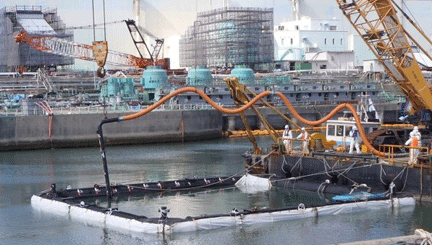
Initial talks between the government and TEPCO agreed that only water with 1,500 becquerels of radiation or less per liter could be released. Tests conducted by TEPCO and two outside agencies have revealed that the Fukushima underground water met the standards, averaging 220 to 240 becquerels of tritium per liter.
TEPCO began pumping out groundwater from the Fukushima nuclear plant in April in an effort to prevent further radioactive leaks.
The company continues to grapple with the problem of contaminated water storage, with about 450,000 tons of highly-radioactive water currently being stored in Fukushima’s underground facilities and tanks. Experts say some 15,000 tons is also being held in a service tunnel. According to recent estimates, up to 400 tons of contaminated water from the damaged plant is seeping into the Pacific Ocean every day.
In an effort to prevent further irradiation, TEPCO has adopted a plan to draw off groundwater from the plant. The fallout from Fukushima is later to be sent for analysis that will determine whether it is safe to be disposed of by dumping into the ocean.
The practice will allow the operator to reduce the accumulation of radioactive water at the plant by 100 tons a day……..https://news.google.com/news?ncl=d_uao6qIU8QsFkM74lsq0LkpKVl4M&q=radiation&lr=English&hl=en&sa=X&ei=l7N2U52sB8mtlQXZ_4HYBw&sqi=2&pjf=1&ved=0CDsQqgIwAw
Unfounded and irresponsible claims in favour of Small Modular Nuclear Reactors (SMRs)
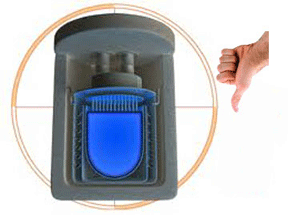 WHY SMALL MODULAR REACTORS ARE PART OF THE PROBLEM, NOT THE SOLUTION Mark Cooper, Ph.D. Senior Fellow for Economic Analysis Institute for Energy and the Environment Vermont Law School May 2014
“………..Unachievable assumptions about cost: Even industry executives and regulators believe the SMR technology will have costs that are substantially higher than the failed “nuclear renaissance” technology on a per unit of output. The higher costs result from
• lost economies of scale in containment structures, dedicated systems for control,
management and emergency response, and the cost of licensing and security,
• operating costs between one-fifth and one-quarter higher, and
• decommissioning costs between two and three times as high.
Irresponsible assumptions about a rush to market: To reduce the cost disadvantage and meet the urgent need for climate policy, advocates of SMR technology propose to deploy large numbers of reactors (50 or more), close to population centers, over a short period of time. This compressed RD&D schedule embodies a rush to market that does not make proper provision for early analysis, testing, and demonstration to provide an opportunity for experience-based design modifications. This is exactly the problem that arose in the 1970s, when utilities ordered 250 reactors and ended up cancelling more than half of them when the technology proved to be expensive and flawed.
Unrealistic assumptions about the scale of the sector: While each individual reactor would be smaller, the idea of creating an assembly line for SMR technology would require a massive financial commitment. If two designs and assembly lines are funded to ensure competition, by 2020 an optimistic cost scenario suggests a cost of more than $72 billion; a more realistic level would be over $90 billion. This massive commitment reinforces the traditional concern that nuclear power will crowd out the alternatives. Compared to U.S. Energy Information Administration (EIA) estimatesof U.S. spending on generation over the same period, these huge sums are equal to
• three-quarters of the total projected investment in electricity generation and
• substantially more than the total projected investment in renewables.
Radical changes in licensing and safety regulation: SMR technologies raise unique safety challenges including inspection of manufacturing and foreign plants, access to below ground facilities, integrated systems, waste management, retrieval of materials with potentially higher levels of radiation, flooding for below-ground facilities, and common designs that create potential “epidemic” failure. Yet ,SMR advocates want pre-approval and limited review of widely dispersed reactors located in close proximity to population centers and reductions in safety margins, including shrinking containment structures, limitations of staff for safety and security, consolidation of control to reduce redundancy, and much smaller evacuation zones. In the wake of global post-Fukushima
Calls for more rigorous safety regulation, policymakers and safety regulators are likely to look askance at proposals to dramatically relax safety oversight.
Unfounded claims of unique supply and demand advantages: Despite their high costs, advocates argue that smaller reactors are more attractive than large reactors because they are moreflexible, requiring smaller capital commitments and shorter construction times.
• By these same criteria, non-nuclear alternatives are far more attractive – smaller, less
costly, quicker to market, and already scalable.
• The alternatives also do not possess the security and proliferation risks and environmental problems that attach to nuclear power. …….. http://216.30.191.148/Cooper%20SMRs%20are%20Part%20of%20the%20Problem,%20Not%20the%20Solution%20FINAL2.pdf
Japan soon to start making ice wall around groundwater at Fukushima nuclear plant
Japan Tries Ice Wall to Stem Radiation Planned Frozen Barrier to Hold Back Water Contaminated by the Stricken Fukushima Daiichi Nuclear Plant WSJ, By MARI IWATA NARAHA, Japan—The idea of freezing ground to block the flow of water has been around for more than a century, but never has it been tried on the scale Japan plans at its stricken nuclear plant to hold back water contaminated by radiation.
As early as next month, workers are set to start installing pipes for a 1.5-kilometer-long and 30-meter-deep subterranean ice wall around four reactors of the Fukushima Daiichi nuclear plant here…….

The Fukushima effort is unprecedented because of the size of the apparatus—its electricity alone is projected to cost $1 million a month—and the period it is expected to operate. The Fukushima decommissioning is expected to take 40 years or longer.
The ice-wall plan has already met a hurdle. Continue reading
Low levels of radioactive cesium produced insect deformities at Fukushima
New study reveals deaths and mutations ”increased sharply’ from exposure to Fukushima contamination, “especially at low doses” — ‘Small’ levels of cesium may be ‘significantly toxic’ — Smithsonian: “In other words, things don’t look good for the animals living around Fukushima” http://enenews.com/just-in-new-study-reveals-sharp-increase-in-deaths-and-mutations-from-exposure-to-fukushima-contamination-especially-at-low-doses-small-levels-of-cesium-may-be-significantly-toxic?utm_source=feedburner&utm_medium=email&utm_campaign=Feed%3A+ENENews+%28Energy+News%29
 Smithsonian Magazine, May 14, 2014: Even Tiny Amounts of Radioactive Food Made Caterpillars Become Abnormal Butterflies […] Researchers in Japan […] discovered, even a small amount of radiation is too much. […] The scientists collected plant material from around Fukushima and fed it to pale grass blue butterfly caterpillars. When the caterpillars turned into butterflies, they suffered from mutations and were more likely to die early [… even if they] had only eaten a small amount of artificial caesium […] In other words, things don’t look good for the animals living around Fukushima.
Nature — Scientific Reports (pdf), Published May 15, 2014: [We] examined possible relationships between the dose of ingested cesium per larva and the mortality and abnormality rates. Both the mortality and abnormality rates increased sharply, especially at low doses […] the mortality and abnormality rates increased sharply, especially at low doses. Additionally, there seemed to be no threshold level below which no biological response could be detected. […] the dose-response data suggests that the relatively small level of artificial cesium from the Fukushima Dai-ichi NPP may be significantly toxic to some individuals in butterfly populations […] the half lethal [i.e. LD50, amount that will kill 50% of a test subjects] dose [is 1.9 Bq per larva] and the half abnormal dose [is 0.76 Bq per larva] […] relatively small [levels] of artificial cesium from the Fukushima Dai-ichi NPP may be significantly toxic to some individuals in butterfly populations […] we assert that the half lethal and abnormal doses we obtained were quite high. […] it should be noted that we sampled contaminated leaves from Fukushima City, which many people inhabit as though nothing had happened […] Implications of the half lethal and abnormal doses we obtained in the present study will impact future discussions on the effects of radioactive exposure on other organisms, including humans. […] In conclusion, it is important to recognize the risk of internal radiation exposure due to ingested radioactive cesium, at least for the pale grass blue butterfly, and likely for certain other organisms living in the polluted area, possibly including humans. […]
Thorium nuclear fuel. They make out that it’s safe. But it’s not
 Is the “Superfuel” Thorium Riskier Than We Thought? A new study in Nature says that using thorium as a nuclear fuel has a higher risk for proliferation into weapons than scientists had believed. Popular Mechanics 16 May 14, By Phil McKenna Imagine a cheap, plentiful source of energy that could provide safe, emissions-free power for hundreds of years without refueling and without any risk of nuclear proliferation. The fuel is thorium, and it has been trumpeted by proponents as a “superfuel” that eludes many of the pitfalls of today’s nuclear energy. But now, as a number of countries including China, India, and the United States explore the potential use of thorium for nuclear power, researchers say one of the biggest claims made about the fuel—its proliferation resistance—doesn’t add up.
But Ashley and his co-authors say a simple tweak in the thorium irradiation recipe can sidestep the radioactive isotope’s formation. If an element known as protactinium-233 is extracted from thorium early in the irradiation process, no uranium-232 will form. Instead, the separated protactinium-233 will decay into high purity uranium-233, which can be used in nuclear weapons.
“Eight kilograms of uranium-233 can be used for a nuclear weapon,” Ashley says. “The International Atomic Energy Agency views it the same as plutonium in terms of proliferation risk.” Creating weapons-grade uranium in this way would require someone to have access to a nuclear reactor during the irradiation of thorium fuel, so it’s not likely a terrorist group would be able to carry out the conversion. The bigger threat is that a country pursuing nuclear energy and nuclear weapons (say, Iran) could make both from thorium. “This technology could have a dual civilian and military use,” Ashley says. …..

Top secret cargo. Plutonium from Canada?
 Covert mission: Plutonium source might be Canada Questions being asked about mystery cargo BY IAN MACLEOD, OTTAWA CITIZEN MARCH 30, 2014 The nuclear fuel carrier Pacific Egret slipped into the harbour at Charleston, South Carolina, on March 19 and unloaded a top-secret cargo at the port’s Naval Weapons Station.
Fitted with naval guns, cannons and extensive hidden means of repelling a terrorist assault, the three-year-old British vessel was purpose-built to transport plutonium, highly enriched uranium (HEU) and mixed-oxide (MOX) nuclear fuel on the high seas.
Its previous publicly reported position had been exiting the Mediterranean at the Strait of Gibraltar almost two weeks earlier on March 7, carrying a delicate nuclear cargo loaded at the La Spezia naval base in northern Italy.
As the vessel entered the North Atlantic that day, its tracking image vanished from an online marine traffic monitoring system. The ship the size of a football field became all but invisible to unauthorized eyes.
Questions are now being raised about whether the sensitive cargo included recycled plutonium that originated here in Canada.
The clandestine business of transporting shiploads of fissile nuclear materials between nations rarely comes into public view. An eight-kilogram piece of plutonium-239 the size of a grapefruit could obliterate much of Ottawa in seconds — as it did to Nagasaki in August 1945. It’s aptly named after the ancient Greek god of the underworld……… Continue reading
USA Energy Dept in a fix about legal cases and no answer for nuclear wastes

they should stop making this toxic radioactive trash
 Tiny nuclear waste fee added up to billions LA Times, 17 May 14 A charge for electricity that millions of Americans didn’t even know they pay will suddenly disappear Friday, after the Energy Department this week quietly notified utilities across the country that it was suspending its fees for a future nuclear waste dump.
The Energy Department has been collecting $750 million from electricity bills every year  for such a dump since 1983, putting it into a trust fund that now contains $31 billion.
The court-ordered suspension may be a modest victory for consumers, but it reflects the government’s failure over the last 40 years to get rid of what is now nearly 70,000 metric tons of highly radioactive spent fuel, accumulating at 100 nuclear reactors across the nation……… Continue reading
Nuclear industry’s frantic campaign for Small Modular Reactors as solution to climate chnage

Mark Cooper, Ph.D. Senior Fellow for Economic Analysis Institute for Energy and the Environment Vermont Law School May 2014
EXECUTIVE SUMMARY
The Marshall Islands Nuclear Zero Lawsuit deserves all our support
The Nuclear Zero Lawsuits: Who will speak for the people? http://thehill.com/blogs/congress-blog/homeland-security/206271-the-nuclear-zero-lawsuits-who-will-speak-for-the-people#ixzz3216oOGyg By Jody Williams and Robert Dodge, M.D. 16 May 14, The U.N. just concluded the Nuclear Non-Proliferation Treaty (NPT) Preparatory Committee with representatives from the 189 signatory nations and of civil society. The meeting was in preparation for next year’s NPT conference and to discuss the current status of fulfilling the obligations under the treaty and in particular, the mandate of the nuclear weapons states for global disarmament. The outcome was a continued foot dragging by the nuclear states motivating a demand for meaningful steps and progress toward disarmament by the other 184 nations in view of current international events.
Recent scientific studies by the International Physicians for the Prevention of Nuclear War on the humanitarian consequences of limited nuclear war have shed additional light on the danger these weapons pose. Describing a hypothetical conflict between India and Pakistan using less than ½ of 1 percent of the global nuclear arsenals, the studies confirm 2 billion people would be at risk of dying due to global climatic change.
Combined with recent scandals involving U.S. ICBM missile controllers and a growing accounting of nuclear mishaps and near misses in our nuclear forces over the years, the sense of urgency for disarmament is greater than ever. It has become a question of who will step forward and speak for humanity.
On April 24, the Republic of the Marshall Islands (RMI) filed the Nuclear Zero Lawsuits in the International Court of Justice against all nine nuclear-armed nations, as well as against the United States in U.S. Federal District Court. RMI claims that the nuclear weapon states are in breach of Article VI of the Non-Proliferation Treaty (NPT), which entered into force 16,121 days prior to the filing. In this David vs. Goliath action this tiny island nation has found the voice to speak on behalf of the world and the other nations signatory to the Treaty.
The case for the Nuclear Zero Lawsuit comes directly from the NPT where Article VI states: “Each of the Parties to the Treaty undertakes to pursue negotiations in good faith on effective measures relating to cessation of the nuclear arms race at an early date and to nuclear disarmament, and on a treaty on general and complete disarmament under strict and effective international control.”
This was the grand bargain that convinced many non-nuclear weapon states to sign the treaty and agree not to develop nuclear weapons of their own. Forty-four years later, with no meaningful negotiations on the horizon and no end in sight to the “step-by-step” process heralded by the permanent five members of the UN Security Council (P5), the RMI has stepped in to change the discourse on nuclear disarmament.
RMI is seeking declaratory relief from the courts that will compel the leaders of the Nuclear Weapons States (NWS) to initiate good-faith negotiations for an end to the nuclear arms race and to nuclear disarmament. They are challenging the leaders of the NWS to answer, on the record, why 44 years have passed and nuclear arsenals continue to be modernized, national security strategies continue to place nuclear weapons at the top of the list, and the P5 don’t even expect to have a “Glossary of Key Nuclear Terms” to talk about nuclear disarmament until 2015.
In addition to the five Nuclear Weapon States named in the NPT, the lawsuit also includes the four nuclear weapon states that are not parties to the NPT – Israel, India, Pakistan and North Korea – which, RMI argues, are bound to Article VI obligations under customary international law.
The RMI is a small sovereign nation, among the smallest in the world. However, their courage could not be greater. Having been a testing ground for 67 nuclear tests between 1946 and 1958, the Marshall Islanders have seen their land, sea and people poisoned from radiation. These tests had an equivalent explosive force greater than 1.5 Hiroshima bombs being detonated daily for 12 years. The Marshall Islanders paid a heavy price in terms of their health and well-being for these destructive tests. They have experienced firsthand the horrible destruction caused by nuclear weapons and those that possess them. They are willing to stand up to the nine nuclear giants and say, “Never again. We have seen the destructive impact of these horrific weapons and vow to do all we can so the world never sees such atrocities again.”
The RMI does not act alone in this action. A consortium of NGOs working to highlight the legal and moral issues involved in the Nuclear Zero Lawsuit has come together around the world coordinated by the Nuclear Age Peace Foundation in Santa Barbara. Respecting the courage of the plaintiff in bringing these lawsuits against some of the most powerful nations in the world they have developed a call to action.
The consortium urges everyone to join them by raising your voice in support of the Nuclear Zero Lawsuit. Go to www.nuclearzero.org, where you can read more about the lawsuits and sign the petition encouraging leaders of the Nuclear Weapon States to begin good-faith negotiations.
Williams received the 1997 Nobel Peace Prize for her work with the International Committee to Ban Landmines (ICBL) and is chair of the Nobel Women’s Initiative. Dodge is a family physician on the Board of the Nuclear Age Peace Foundation and Physicians for Social Responsibility Los Angeles. PSR is the U.S. affiliate of the International Physicians for the Prevention of Nuclear War – recipient of the 1985 Nobel Peace Prize.
6.5 million jobs already in renewable energy
 Renewable Energy Jobs Rise To Nearly 6.5 Million Worldwide http://www.the9billion.com/2014/05/15/renewable-energy-jobs-rise-to-nearly-6-5-million-worldwide/ by JOHN JOHNSTON on 05/15/2014 The number of renewable energy jobs rose to nearly 6.5 million worldwide in 2013, a new report from the
  International Renewable Energy Agency has found.
The report found that the rise was pushed by the growing solar market in China. Solar installations grew five-fold from 2011 to 2013 in China, and accounted for 1.6 million jobs. Globally, the solar industry accounted for about 2.3 million jobs. The price of solar panels has been declining steadily, and this has contributed to a rise in new solar installations and jobs globally.
After the strong solar sector, liquid biofuels managed to account for 1.4 million jobs globally, and the wind power and biomass sectors drew even with around 800,000 jobs each.
Interestingly, many of these renewable energy jobs were to be found in so-called developing countries. China accounted for 2.64 million jobs overall, with the European Union renewable energy job market positioned second with 1.25 million jobs. Brazil was third with 894,000, and the United States was fourth with 625,000 jobs.
In the United State the solar sector was also a big driver of growth within renewable energy, reaching 143,000 jobs in 2013. This was a 20% increase over the year before, and a 53% increase since 2010.
With about 6.5 million people now employed in renewable energy, the industry is becoming a significant force in job creation worldwide. No doubt these numbers will rise a lot more in coming years, as solar power continues to get cheaper and enters the mainstream.
Complex arrangements – a “bad bank” for Germany’s dead nuclear reactors
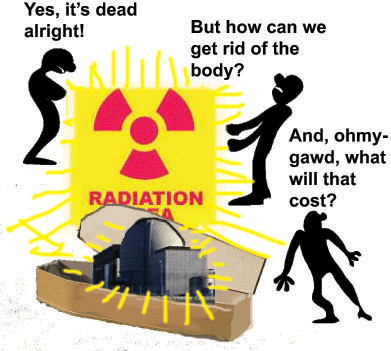 A bad bank for nuclear, as public assumes risk for closure costs http://reneweconomy.com.au/2014/a-bad-bank-for-nuclear-as-public-assumes-risk-for-closure-costs-39365 By Craig Morris on 16 May 2014 Energy Transition Over the weekend, there were reports of talks about the creation of a “bad bank” for German nuclear plants, which are to be shut down successively by the end of 2022.
Critics charge that the proposal is yet another attempt to privatize profits and nationalize losses. But Craig Morris has a bit more understanding for the firms’ position. At the end of February, the German hard coal sector made a proposal that revealed the sector’s actual situation: a bad bank. We continue to hear many reports about coal making a comeback in Germany, but in reality the uptick in 2013 will prove to be short-lived; coal power is already dramatically down in Q1 2014. And going forwards, hard coal in particular will be squeezed out even during the nuclear phaseout.
Now, the firms that run coal and nuclear plants think the idea might be useful to them during the nuclear phaseout. A quick glance at the idea is enough to make your hair stand on end, and the comments on German news websites (such as here – in German) are filled with outrage:
- The provisions set aside for the dismantling of the nuclear plants would be transferred to a state-owned foundation (the bad bank), which would then use the money for the phaseout.
- The government – meaning “the public” – would then run the risks, specifically if the costs exceed the provisions.
- In return, the power firms would drop their lawsuits against the German government with the ICSID (International Centre for Settlement and Disputes) settlements court in DC. Sweden’s Vattenfall has a minority holding in the Brokdorf nuclear plant in Germany along with Eon and is suing the German government in DC.
- Surprisingly, while Eon and EnBW (Vattenfall is apparently not involved in the negotiations for a bad bank) would be able to hand over their provisions, RWE would reportedly need a capital increase – has the firm spent its nuclear provisions on something else?
The case of Vattenfall is especially interesting. In the fall of 2010, the German government reneged on the original nuclear phaseout agreement of 2002 and extended the service lives of nuclear plants by 8 to 14 years, depending on the plant. In return, the government imposed a tax on the nuclear fuel rods to be consumed – allegedly to prevent windfall profits. But after Fukushima – only a few months later – those power plant extensions were revoked, but the tax remained.
In all likelihood, the four utilities agreed that the foreigner – Vattenfall, the one with the smallest nuclear assets – would “test the waters” and see whether a court case against the nuclear tax could be won. Last month, a German court ruled that the nuclear tax was illegal, so the current negotiations may be taking place against that backdrop.
There are, however, different readings of who wants what now. German economics daily Handelsblatt writes in its newsletter on Monday that “the government in Berlin wants to have the roughly 35 billion euros in nuclear provisions from Eon, RWE, EnBW, and Vattenfall,” the four utilities that run nuclear plants and Germany. This report in English at the Financial Times also makes it sound like the German government has plans of its own.
Technically, of course, the public already runs the risks. If anything goes wrong, the liability of these firms is limited. And while this limited liability has often been decried as unfair, we should keep in mind that the power firms themselves – from the US to Germany – never wanted to build nuclear plants. The nuclear power sector was originally an attempt to make the production of nuclear weapons more palatable to the public. The power sector wanted nothing to do with the technology, which they did not understand and did not trust. Once the government had limited their liability, they essentially began building the kind of power plants they understood but merely boiled the water with nuclear fuel rods instead of coal. Some 50 years ago, RWE in particular felt that nuclear would conflict with its fleet of coal plants. The result is hundreds of nuclear plants of crappy design, with numerous design options having barely been investigated.
The German government thus forced these companies into nuclear decades ago and now it is forcing them out. All of this is unfair to these firms. It’s also unfair to the German public, which never asked for nuclear power but has to pay for the entire mess. Whatever the outcome, perhaps the main argument against nuclear is that it’s hard to do it fairly.
Why Small Modular Nuclear Reactors are not viable, and no cure for climate change
WHY SMALL MODULAR REACTORS ARE PART OF THE PROBLEM, First, the viability of SMRs is dependent on the very economic processes that have eluded the industry in the past. The ability of the small modular reactor technology to reverse the cost trajectory of the industry is subject to considerable doubt. The empirical analysis of learning processes in the “Great Bandwagon Market” discussed in Section I and the failure of regulatory streamlining, advanced design and standardization in the “nuclear renaissance” certainly question the ability of the new technology to produce such a dramatic turnaround. As a result, even under the best of circumstances, the SMR technology will need massive subsidies in the early stages to get off the ground and take a significant amount of time to achieve the modest economic goal set for it.
Second, even if these economic processes work as hoped, nuclear power will still be more costly than many alternatives. Over the past two decades wind and solar have been experiencing the cost reducing processes of innovation, learning and economies of scale that nuclear advocate hoped would benefit the “Renaissance” technology and claim will affect the small modular technology. Nuclear cost curves are so far behind the other technologies that they will never catch up, even if the small modular technology performs as hoped.
Third, the extreme relaxation of safety margins and other changes in safety oversight is likely to receive a very skeptical response from policymakers. This is just the latest skirmish in a 50 year battle over safety. The push to deploy large numbers of reactors quickly with a new safety regime recalls the mistake of the early “Great Bandwagon Market.”
Fourth, the type of massive effort that would be necessary to drive nuclear costs down over the next couple of decades would be an extremely large bet on a highly risky technology that would foreclose alternatives that are much more attractive at present. Even if the technology could be deployed at scale at the currently projected costs, without undermining safety, it would be an unnecessarily expensive solution to the problem that would waste a great deal of time and resources, given past experience.
Finally, giving nuclear power a central role in climate change policy would not only drain away resources from the more promising alternatives, it would undermine the effort to create the physical and institutional infrastructure needed to support the emerging electricity systems based on renewables, distributed generation and intensive system and demand management.
The paper concludes that the prudent approach to resource acquisition is to build the institutional and physical infrastructure that achieves the maximum contribution from the more attractive resources available in the near and mid-term. With a clear path of more attractive resources, we do not have to engage in the hundred year debate today, although there is growing evidence that prospects for high penetration renewable scenarios for the long terms are quite good. The available and emerging alternatives can certainly carry the effort to meet the demand for electricity with low carbon resources a long way down the road, certainly long enough that the terrain of technologies available may be much broader before we have to settle for inferior options like nuclear power…
“Tactical” nuclear weapons useless and dangerous
Nothing tactical about nuclear weapons Express Tribune, By Zahir Kazmi May 17, 2014 The term ‘tactical nuclear weapon’ is a Cold War relic not applicable to the subcontinent. There is nothing tactical about these weapons, as their use would have strategic fallouts. Their ideal purpose should be to deter adversaries from contemplating actions that can lead to crises, conflicts and wars. For nuclear-armed states, the key would then be to exercise self-deterrence and avoid triggering conflicts.
A potential nuclear war between India and Pakistan would be a chain of unfortunate events, possibly triggered by another spectacular terrorist attack in India by Pakistan-based quasi-state extremists. India would trade the ‘Gandhian restraint’ for a dance of destruction to punish Pakistan without activating a nuclear response.
In times of defence, Pakistan’s hand would be forced to defeat advancing Indian forces either by conventional forces or by using low-yield nuclear weapons. India threatens a massive retaliation against limited nuclear use, discounting assured Pakistani quid pro quo. There will be no winners in a nuclear war.
Escalating a crisis on the grave assumption that Pakistan would be involved in a future terrorist attack is a commitment trap. The rational choice of investigating such an event with Pakistani help would be an easy option. Fighting terrorism in all its forms is essential. Having a military-to-military joint intelligence sharing mechanism in times of peace would be another ideal worth considering. Pakistan had made such an offer after the Mumbai incident.
Likewise, relying on a massive nuclear retaliation threat in hopes to deter Pakistani response to limited war strategy is a naive assumption at best.
The two risky extremes seem impervious to the certainty that there is no way both sides would be able to guarantee either to dominate or control a crisis from escalating. ……http://tribune.com.pk/story/709277/nothing-tactical-about-nuclear-weapons/
1 This Month
Chernobyl: The Lost Tapes – A good documentary on Chernobyl on SBS available On Demand for the next 3 weeks– https://www.sbs.com.au/ondemand/tv-program/chernobyl-the-lost-tapes/2352741955560

of the week–London Campaign for Nuclear Disarmament

Tell the Ukrainian Government to Drop Prosecution of Peace Activist Yurii Sheliazhenko
To see nuclear-related stories in greater depth and intensity – go to https://nuclearinformation.wordpress.com
-
Archives
- April 2026 (126)
- March 2026 (251)
- February 2026 (268)
- January 2026 (308)
- December 2025 (358)
- November 2025 (359)
- October 2025 (376)
- September 2025 (257)
- August 2025 (319)
- July 2025 (230)
- June 2025 (348)
- May 2025 (261)
-
Categories
- 1
- 1 NUCLEAR ISSUES
- business and costs
- climate change
- culture and arts
- ENERGY
- environment
- health
- history
- indigenous issues
- Legal
- marketing of nuclear
- media
- opposition to nuclear
- PERSONAL STORIES
- politics
- politics international
- Religion and ethics
- safety
- secrets,lies and civil liberties
- spinbuster
- technology
- Uranium
- wastes
- weapons and war
- Women
- 2 WORLD
- ACTION
- AFRICA
- Atrocities
- AUSTRALIA
- Christina's notes
- Christina's themes
- culture and arts
- Events
- Fuk 2022
- Fuk 2023
- Fukushima 2017
- Fukushima 2018
- fukushima 2019
- Fukushima 2020
- Fukushima 2021
- general
- global warming
- Humour (God we need it)
- Nuclear
- RARE EARTHS
- Reference
- resources – print
- Resources -audiovicual
- Weekly Newsletter
- World
- World Nuclear
- YouTube
-
RSS
Entries RSS
Comments RSS
 nuclear-news