HUman Rights Watch lets activists and victims down!
Published on 16 May 2014
Abby Martin speaks to Keane Bhatt, journalist and activist about a recent open letter he and many prominent figures signed calling for the non-profit organization Human Rights Watch to close its revolving door with the U.S. government.
https://nacla.org/blogs/keanebhatt
http://www.globalresearch.ca/the-hypocrisy-of-human-rights-watch/5367940
Over more than a decade, the rise of the left in Latin American governance has led to remarkable advances in poverty alleviation, regional integration, and a reassertion of sovereignty and independence. The United States has been antagonistic toward the new left governments, and has concurrently pursued a bellicose foreign policy, in many cases blithely dismissive of international law.
So why has Human Rights Watch (HRW)—despite proclaiming itself “one of the world’s leading independent organizations” on human rights—so consistently paralleled U.S. positions and policies? This affinity for the U.S. government agenda is not limited to Latin America. In the summer of 2013, for example, when the prospect of a unilateral U.S. missile strike on Syria—a clear violation of the UN Charter—loomed large, HRW’s executive director Kenneth Roth speculated as to whether a simply “symbolic” bombing would be sufficient. “If Obama decides to strike Syria, will he settle for symbolism or do something that will help protect civilians?” he asked on Twitter. Executive director of MIT’s Center for International Studies John Tirman swiftly denounced the tweet as “possibly the most ignorant and irresponsible statement ever by a major human-rights advocate.”1
HRW’s accommodation to U.S. policy has also extended to renditions—the illegal practice of kidnapping and transporting suspects around the planet to be interrogated and often tortured in allied countries. In early 2009, when it was reported that the newly elected Obama administration was leaving this program intact, HRW’s then Washington advocacy director Tom Malinowski argued that “under limited circumstances, there is a legitimate place” for renditions, and encouraged patience: “they want to design a system that doesn’t result in people being sent to foreign dungeons to be tortured,” he said, “but designing that system is going to take some time.”2
Similar consideration was not extended to de-facto U.S. enemy Venezuela, when, in 2012, HRW’s Americas director José Miguel Vivanco and global advocacy director Peggy Hicks wrote a letter to President Hugo Chávez arguing that his country was unfit to serve on the UN’s Human Rights Council. Councilmembers must uphold the highest standards in the promotion and protection of human rights, they maintained, but unfortunately, “Venezuela currently falls far short of acceptable standards.”3 Given HRW’s silence regarding U.S. membership in the same council, one wonders precisely what HRW’s acceptable standards are.
One underlying factor for HRW’s general conformity with U.S. policy was clarified on July 8, 2013, when Roth took to Twitter to congratulate his colleague Malinowski on his nomination to be Assistant Secretary of State for Democracy, Human Rights and Labor (DRL). Malinowski was poised to further human rights as a senior-level foreign-policy official for an administration that convenes weekly “Terror Tuesday” meetings. In these meetings, Obama and his staffers deliberate the meting out of extrajudicial drone assassinations around the planet, reportedly working from a secret “kill list” that has included several U.S. citizens and a 17-year-old girl.4
Malinowski’s entry into government was actually a re-entry. Prior to HRW, he had served as a speechwriter for Secretary of State Madeline Albright and for the White House’s National Security Council. He was also once a special assistant to President Bill Clinton—all of which he proudly listed in his HRW biography. During his Senate confirmation hearing on September 24, Malinowski promised to “deepen the bipartisan consensus for America’s defense of liberty around the world,” and assured the Foreign Relations Committee that no matter where the U.S. debate on Syria led, “the mere fact that we are having it marks our nation as exceptional.”5
Power Lines, Fallout and Childhood Leukemia
http://www.counterpunch.org/2014/05/09/power-lines-fallout-and-childhood-leukemia/
by CHRIS BUSBY
Weekend Edition May 9-11, 2014
The risk of leukemia for children living near power lines closely tracks levels of radiation from nuclear bomb test fallout, writes Chris Busby. The obvious explanation the ‘experts’ have chosen to ignore: the electro-magnetic fields increase radiation exposure.
The Childhood Cancer Research Group (CCRG) has recently published the results of a study of child leukemia near high voltage powerlines.
The conclusions have been widely reported as proving that there is no excess risk, as in Medical News Today:
“No childhood leukemia risk from power lines – Children who spend their early years living near overhead power lines are not at greater risk of developing childhood leukemia, according to researchers at the University of Oxford in the UK, who report their findings in the British Journal of Cancer.”
However it is a tortured interpretation of what the results really showed. What they found answers one of the most important questions in the area of childhood cancer, and one that I have been involved in for 20 years.
Enter the nuclear establishment’s wet blanket
The CCRG, based in Oxford, was set up originally in the 70s by Dr Gerald Draper. Draper began his career working for the late Dr Alice Stewart, whose ground-breaking research and data identified radiation as one cause of the increasing rates of the then largely new disease, childhood leukemia.
Alice told me she didn’t trust him. He quickly left her to set up the CCRG, an operation largely to parallel her own acquisition of childhood cancer data, but (mysteriously) much better funded.
The CCRG are essentially part of the environmental risk fire brigade funded by the government. Any suggestion that there is a problem (with radiation near nuclear sites, with high voltage powerlines, mobile phones, etc) is ‘independently’ investigated by CCRG – and the public are reassured.
It was CCRG that examined child cancer near nuclear sites and (through questionable methodology) recently gave an ‘all clear’. In my own studies of child leukemia in the UK (e.g., the Irish Sea, Aldermaston/ Harwell, Chepstow, Dumfries) Draper has popped up to have a go at me, and to play down any suggestion of links with radiation.
In 2005, however, CCRG went off at a tangent. Draper and colleagues carried out a study of childhood leukemia near high voltage powerlines.
This is an issue which has been an area of controversy since the 1970s when Wertheimer and Leeper first reported an association between low frequency (wiring) electromagnetic (EM) fields and childhood cancer. [4]
It’s a highly controversial area which has now generated enormous amount of research and which has spilled into the mobile phone-and-cancer arguments.
Identified – an excess of child leukemia near power lines
The Draper 2005 study or ‘CCRG study’ was a case-control study of a large number of children living in England and Wales diagnosed with cancer and leukemia living near high voltage power lines.
Results demonstrated a modest but statistically significant excess of child leukemia 0-14 in those living less than 600m away. For those children within 200m the relative risk RR was 1.64. That means that there was a 64% greater chance of developing childhood leukemia if the child lived less than 200m from a high voltage power line.
The study covered 1962-95 and involved 9,700 children with leukemia and the same number of controls. The powerlines examined were the 400 and 275kV lines. This result was, of course, rather embarrassing for the government and particularly the electricity supply industry.
Various committees were set up, including one, SAGE which, since I had carried out some research in this area (funded by Children with Leukemia CWL) I was invited to join when it began in 2004. I agreed, but the government found out, and I was suddenly dis-invited.
Burying the evidence
Clearly, something had to be done. Draper retired from CCRG and a new study was funded by the charity Children with Cancer – the same outfit as CWL with a name change.
The senior researcher was Kathryn Bunch (as in bunch of flowers or bunch of crooks) and it is the result of this extension of the earlier Draper et al 2005 study that turned up a most amazing and important result.
And having made they extraordinary and important discovery, they wrote it off in a remarkable scientific misinterpretation of the findings. This finding is the subject of this article.
The Bunch study increased the number of children with leukemia to 16,620 by extending the period to from 1962 to 2008, and adding Scotland to England and Wales. The authors found that over the whole period and for all the children, the effect declined over time from a relative risk of 4.5 in the 60s to 0.71 in the 2000s.
They conclude that “a risk declining over time” cannot arise from any physical effect of the powerlines and is “more likely to be a result of changing populations of those living near powerlines.”
This conclusion is absurd. We are to believe that the explanation of this extraordinary finding is that the types of people that chose to live near high voltage powerlines changed from leukemia sensitive individuals in the 1960s to leukemia resistant individuals today.
Can I have heard right? What do the journalists who report these conclusions think? Do they think at all?
From 1960s to present, a declining risk – but why?
There are two initial results which are key. The first is that the original effect found by Draper et al 2005 [3] is actually found at a greater level in the results from Bunch et al for the period from 1962 to 1999. The Relative Risks in the 0-200m region are given in Table 1 below for the periods used.
Thus the initial observation of a link is supported by the more recent study.
| Period | Leukemia RelativeRisk 0-200m | Cases0-200m | Controls0-200m | Total Numberof cases |
| 1962-1969 | 4.5 | 14 | 4 | 1107 |
| 1970-1979 | 2.46 | 40 | 22 | 3519 |
| 1980-1989 | 1.54 | 52 | 36 | 3578 |
| 1990-2000 | 0.99 | 67 | 64 | 4325 |
| 2000-2008 | 0.71 | 48 | 59* | 3999 |
Table 1. Results Relative Risk (by regression) for childhood leukemia 0-14 Bunch et al 2014. All data including 132kV lines. * = adjusted for higher control numbers.
What is quite clear is that up to 1990 there were 106 case and 62 controls within 200m, which is a crude population weighted Relative Risk of 2.33. The figure may be compared with the curiously lower Draper figure of 1.6.
Taking all the data to 2000 the RR = 1.86. Also statistically significant as is the result for the entire period to 2008 (1.58). However, the second (and most important) finding is that the reduction of the risk over time is remarkable and is statistically significant.
Wildfires threaten San Onofre nuclear power plant
 Fires sweep southern California and prompt partial evacuation of San Onofre nuclear power plant news.com.au 15 May 14 FIREFIGHTERS are scrambling to control multiple blazes in southern California on the second day of a sweltering heatwave.
 San Diego County officials say there are nine wildfires burning in the region covering more than 36 square kilometres.
At a press conference today, fire and emergency officials said the greatest concern is now in the city of San Marcos north of San Diego, where a new blaze broke out in the late afternoon and some 21,000 evacuation notices have been sent to residents……One fire prompted the partial evacuation of the San Onofre nuclear power plant, theLos Angeles Times is reporting……..
The blazes, which also closed a major north-south highway, come amid record temperatures in the western US state, where the annual wildfire season typically starts much later in the year………http://www.news.com.au/world/fires-sweep-southern-california-and-prompt-partial-evacuation-of-san-onofre-nuclear-power-pant/story-fndir2ev-1226918410622
New nuclear reactor plans for Ontario stopped by Federal Court ruling

 Ontario nuclear reactor plans go back to drawing board http://metronews.ca/news/canada/1035484/reactor-plans-go-back-to-drawing-board/TORONTO – A Federal Court ruling has thrown out the preliminary approvals for a series of new nuclear power reactors in Ontario.
Ruling in a case brought by environmental groups, Justice James Russell says the environmental assessment for the proposed expansion of the Darlington nuclear plant fell short.
Russell says the assessment should have examined the environmental effects of radioactive fuel waste, a Fukushima-type accident and hazardous emissions. As a result of the decision, the whole project is stalled until a panel can redo the assessment.
Ontario Power Generation’s plan to expand Darlington has been in the works since 2006 and would have seen up to four new reactors built.
Environmentalists welcomed the ruling.“This is a win for Canadians’ right to meaningfully participate in environmental reviews and understand the risks of nuclear power,” said Theresa McClenaghan, executive director of the Canadian Environmental Law Association. The group was part of the suit, along with Lake Ontario Waterkeeper, Northwatch and Greenpeace.
“This is a common sense ruling,” said Shawn-Patrick Stensil of Greenpeace. “It boggles the mind that the federal authorities approved new reactors without first considering the environmental effects of radioactive waste and reactor accidents.”
The Ontario government decided last October to suspend its reactor plans. But the ruling means that the project cannot be revived without more assessment.
“The Federal Court has confirmed that federal authorities must do more than simply kick the tires before approving new nuclear reactors,” said lawyer Justin Duncan.“Fully assessing radioactive waste, major accidents, and hazardous emissions is essential to protecting the health of Ontarians.”
As weapons companies make money, depleted uranium destroys lives
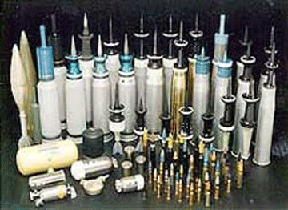 Uranium Weapons Still Making Money, Wreaking Havoc http://www.counterpunch.org/2014/05/15/uranium-weapons-still-making-money-wreaking-havoc/ by JOHN LAFORGE The US Army has awarded General Dynamics a $12 million contract to deconstruct and dispose of 78,000 depleted uranium anti-tank shells. The Pentagon’s May 6 announcement calls for “demilitarization” of the aging shells, as newer depleted uranium rounds are added to the US arsenal.
In the perpetually profitable business of war production, General Dynamics originally produced and sold some of the 120-millimeter anti-tank rounds to the Army. One of the richest weapons builders on earth, General Dynamics has 95,000 employees and sells its wares in 40 countries on six continents.
The International Coalition to Ban Uranium Weapons in Manchester, England, reports the armor-piercing shells to be disassembled are thought to be the large 105-millimeter and 120-millimeter anti-tank rounds. Depleted uranium, or DU, weapons are made of extremely dense uranium-238. More than 700,000 tons of DU has been left as waste in the US alone from the production of nuclear weapons and nuclear reactor fuel rods. The urankum-238 is left when fissionable uranium-235 is separated for H-bombs and reactor fuel. DU is only ‘depleted’ of this U-235. It is still a radioactive and toxic heavy metal. A tax and ecological liability, DU is given away free to weapons builders.
The Pentagon is replacing older DU shells in spite of international appeals for a moratorium on their use. The military is set to buy 2,500 large anti-tank rounds just this year at a cost of $30 million or over $10,000 each from Alliant Tech Systems, formerly of Minneapolis.
In 1991, during its 40-day, 1,000-sorties-per-day bombardment, between 300 and 800 tons of DU was blasted into Iraq by US forces. Another estimated 170 tons were used in the 2003 bombing and annexation. Toxic, radioactive contamination left from the use of these weapons (the DU burns and turns to dusty aerosol on impact) has been linked to the skyrocketing incidence of birth abnormalities in southern Iraq and to the Gulf War Syndrome among tens of thousands of US combat veterans.
After the US/NATO bombardment of Kosovo in 1999, our DU weapons were discovered to be spiked with plutonium and other isotopes. This news created a political uproar in Europe and led to the admission by the US Energy Department that “the entire US stock of depleted uranium was contaminated” with plutonium, americium, neptunium and technetium. United Nations investigators in Kosovo found sites hit with DU to be poisoned with all four isotopes. The Nation magazine reported that about 150,000 tons uranium-238 was dirtied with plutonium-239 and neptunium-237 and that “some apparently found its way to the Persian Gulf and Balkans battlefields.” (Robert Alvarez, “DU at Home,” The Nation, April 9, 2001, p. 24)
European papers shouting “Plutonium!” in headlines saw US and NATO officials rushing to microphones to claim with straight faces that their shells contained “mere traces of plutonium, not enough to cause harm,” and that the highly radioactive materials “were not relevant to soldiers’ health because of their minute quantities.” But plutonium is 200,000 times more radioactive than U-238 and ingesting less than 27 micrograms of plutonium-239 a millionth of an ounce — will cause lung cancer.
(One indication of just how poisonous these weapons are is that in 30 years of resisting nuclear weapons and the war system, the only ‘not guilty of trespass’ verdict I ever won from a jury followed a protest at Alliant Tech over its DU program. The jury agreed with four of us that since poison weapons are banned by the Geneva and Hague Conventions our action was an attempt at crime prevention.)
Long-term disposal plans for the uranium from 78,000 shells were not outlined by the Army. Uranium in the shells is often alloyed with titanium or molybdenum, and if these metals are not recycled, they could become part of our vast stockpile of DU, requiring indefinite storage as intermediate-level radioactive waste. Other parts of the munitions are currently disposed of as low-level rad’ waste in spite of the plutonium content.
Melting shells of the sea butterflies – a sign of global warming endangering oceans
 You Know the Ocean’s in Trouble When Your Shell Starts Melting http://www.enn.com/wildlife/article/47393 Things are getting really dicey for a little ocean creature called a pteropod. Better known as the “sea butterfly,” this delicate little sea snail is serving as an unfortunate bellwether of the deteriorating state of our oceans. Why? Conditions in the Antarctic ocean and along the West Coast of the U.S. have become so unnaturally acidic that the shells of sea butterflies are literally dissolving away.
“We did not expect to see pteropods being affected to this extent in our coastal region for several decades,” said Dr. William Peterson, an oceanographer at National Oceanic and Atmospheric Administration (NOAA)’s Northwest Fisheries Science Center, in a NOAA press release.
Damage that’s “several decades” early is a big alarm bell. We’d better pay close attention before it’s too late.
 What We’re Doing to Our Oceans
The chemistry of the world’s oceans is changing, thanks to the carbon dioxide humans continue to spew into our atmosphere. Oceans absorb between one quarter to one third of that carbon dioxide. Over time, it has turned the ocean from a slightly alkaline state to a bit more acidic.
According to some estimates, the ocean’s pH level 150 years ago was about 8.2. It’s now about 8.1. It may seem to be an infinitesimal shift, but it’s worse than it sounds. The more acidic the ocean gets, the harder it is for marine life like oysters, clams and corals to form calcium carbonite skeletons and shells.
In the case of pteropods, the increased acidity of the ocean is actually eating away at their shells.
“The first thing that happens is the dissolution of their shell,” NOAA’s Dr. Nina Bednarsek told PBS. “Dissolution can be mild, [to] very severe. Once you have it dissolving on the outside, you have to put so much more energy into the shell in order to maintain it. The energy that you would otherwise use for other important physiological maintenance you are putting in the shell maintenance.”
Researchers working off the coast of Oregon, Washington and California in 2011 discovered that over half of the sea butterflies they found onshore were victims of “severe dissolution damage.” Offshore, about 24 percent were damaged.
If we don’t change our ways, by 2050, researchers estimate that coastal waters will be 70 percent more acidic than they were in the pre-industrial era.
Continue reading at ENN affiliate, Care2.
Huge and worrying task of cleaning up Zion Nuclear Plant
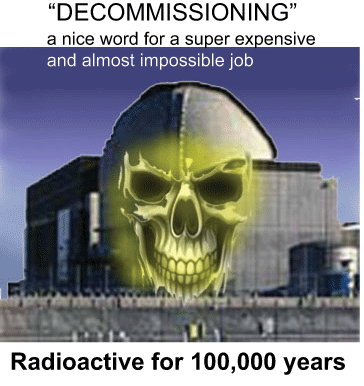
 Decommissioning Of Zion Nuclear Plant Raises Safety Concerns ZION, Ill. (CBS) 15 May 14. — It’s the largest closing of a nuclear plant in the United States, and it’s right in our backyard. The most critical and dangerous part of the process at Zion is underway right now with the transfer of used nuclear fuel. CBS 2’s Jim Williams is the only local TV reporter allowed inside to see firsthand what’s going on and to get answers to concerns about safety in this original report. For us, it was a first: an interview right next to a worker holding a radiation detector………….
The plant stopped operating 16 years ago, but what was left behind is so toxic robots were brought in.
“You don’t want men in there using hand tools and torches,” said Sauger.
By train and truck, they’re shipping the less hazardous material to Texas, Tennessee and Utah where it will be buried.
Dan Pryor is the project manager. He described the less hazardous material as “filters, rags, mops; things that might have been in contact with radiated material and might be contaminated.”
But spent nuclear fuel that had been in this cooling pool is being placed in steel cylinders called casks and then encased in concrete. Dave Kraft of the Nuclear Energy Information Service said, “We call this the nuclear bowling alley,” because all 65 casks will end up together above ground next to the old plant.
Kraft fears they could be a prime target for terrorists in a plane.
“If you have a huge fire from a burning airliner for example, It’s going to affect everything around,” said Kraft.
Kraft and Paul Kakuris, of the Dunesland Preservation Society worry the casks could break open, releasing radiation across the Chicago area and poisoning the Lake.
“We are at risk here. This is the water supply for 20 million people,” said Kakuris………Today, the casks are surrounded by high fences and razor wire. Heavily armed security guards are everywhere there. Still, it’s not enough to satisfy the critics.
“You only get one chance to be wrong,” said Kraft.
Another safety concern is how will those steel and concrete casks hold up over time before a permanent storage site is created? The nuclear regulatory commission expects them to be replaced in 100 years. But, environmentalists fear those casks may wind up sitting there next to Lake Michigan for much longer than that. http://chicago.cbslocal.com/2014/05/14/decommissioning-of-zion-nuclear-plant-raises-safety-concerns/
Nigeria to get nuclear power plant. Is this a GOOD idea?
Nigeria to get $6bn nuclear plant in 2022 – commission PUNCH, MAY 15, 2014 BY OLUSOLA FABIYI The Nigeria Atomic Energy Commission has revealed that the country will get a nuclear plant in 2022 at a cost of $6b dollars.
The Director, Human Resources of the commission, Professor Simon Mallam, who stated this on Thursday when he appeared before the national conference committee on Energy, also urged the Federal government to explore and develop all sources of energy available in the country…..Mallam further advised that although the country wasted a little time in the nuclear arena, it would still be able to deliver nuclear power by 2022 if the enabling environment and support could be given….http://www.punchng.com/news/nigeria-to-get-6bn-nuclear-plant-in-2022-commission/
US Catholic bishops and Iranian ayatollahs discuss nuclear weapons
 US bishops and Iranian ayatollahs hold talks on nuclear arms http://www.catholicherald.co.uk/news/2014/05/15/us-bishops-and-iranian-ayatollahs-hold-talks-on-nuclear-arms/ By PATRICIA ZAPOR on Thursday, 15 May 2014 It has been revealed that a small group of US Catholic bishops have met with Iranian ayatollahs to discuss nuclear weapons and the role of faith leaders in influencing political moves on the issue of Iran’s nuclear programme. Quietly, a small group of U.S. Catholic bishops and Iranian ayatollahs began in March what they intend to be an ongoing dialogue on nuclear weapons and the role of faith leaders in influencing political moves on the issue of Iran’s nuclear program. Continue reading
Low dose radiation’s harmful effects on fruit flies – implications for the human species
“These results may have broader implications beyond the model organism. In particular, they may indicate an increased risk of pathological response to radiation in humans carrying hypomorphic mutations of these genes in their genome (note that both genes are highly evolutionarily conserved). Such individuals may be more vulnerable than the bulk of the population to even low levels of radiation
 Researchers reveal the secret of radiation vulnerability Medical EXpress, 15 May 14, The scientists – Boris Kuzin, Ekaterina Nikitina, Roman Cherezov, Julia Vorontsova, Mikhail Slezinger, Olga Zatsepina, Olga Simonova, Grigori Enikolopov and Elena Savvateeva-Popova – studied Drosophila flies, in whose genome weak mutations of two different genes were combined. They concluded that these mutations synergistically strengthen their mutual phenotypic expression. In other words, the aggregate effect of these mutations is much greater than that which can be produced by one of them individually.
The mutant flies bred by the scientists have a number of significant peculiarities. The experiments have shown that even low doses of X-ray irradiation (not exceeding 10 R) can cause serious defects in those flies’ legs.
In contrast, in the flies with normal (unchanged) genome such defects could not be caused even by doses of irradiation hundreds of times higher. What is more, the combination of the two mutations worsened the long-term memory impairment, earlier observed in the flies with only one of the mutations. Continue reading
Uranium stock prices plunge along with disastrous uranium market
CHART: Uranium stocks vs spot price – something’s gotta give #auspolhttp://tinyurl.com/n25brbj Frik Els | May 15, 2014
The prospect of a Japanese nuclear reactor restart. The end of the Russia-US megatons to megawatts program last August, eliminating a huge source of supply. China’s accelerated plan to approve six to eight plants a year through 2020; part of its war on pollution. The possibility of a rethink in Germany about phasing out nuclear (coal is the only viable alternative and Putin’s gas is becoming dearer).As the stars aligned for a pickup in global uranium demand so did investors for uranium stocks.
But the rapid run-up in uranium shares – especially developers – didn’t turn out to be a leading indicator.
The spot price continued to slide going below $30 a pound to levels last seen in 2005. That dragged the long term price, where most uranium business is conducted, down to $45, a six year low.
Uranium stocks have now come down to earth as this chart from Haywood Securities shows.
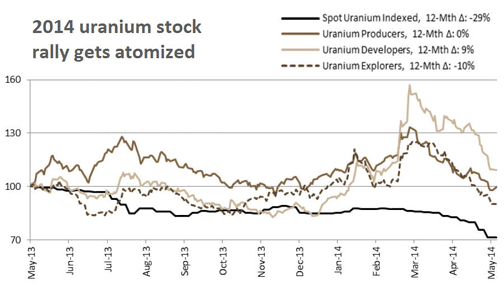
The independent investment dealer with $5 billion under management says now that the spot price appears to have found something of a floor, the sell-off may begin to slow down.
But the Vancouver-based firm cautions that the shares of producers and developers “remain at or above their indexed price point of 12 months ago, when spot uranium was $40.70 U3O8, a 40% premium to current spot”.
There may be more pain ahead
Pay cut for US nuclear weapons managers? – Heaven forfend!
 Nuclear Weapons Complex Reform Could Mean Pay Cut For Contractors Government Executive, By Douglas P. Guarino Global Security Newswire 15 May 14 The for-profit companies that run the U.S. nuclear weapons complex might have a pay cut in their future, though by how much and exactly when is still unclear.For decades the complex — which includes the national laboratories and other facilities responsible for developing and maintaining the nation’s atomic arsenal — operated on a non-profit basis. Taxpayer dollars sunk into it went directly toward scientific work related to weapons development and nonproliferation efforts.
Since the early 2000s, however, the sites have been run by for-profit, limited liability companies. A portion of the annual budget for each facility is set aside as an “incentive fee.” The better the job a contractor does managing a facility’s work in a given year, the larger the percentage of the total available incentive fee the company gets to take home.
Lately these contracts have been under increased scrutiny due to repeated cost overruns, delays and security failures across the nuclear weapons complex. In one of the most dramatic examples, an 82-year-old nun and two other peace activists in 2012 were able to infiltrate the Y-12 National Security Complex in Oak Ridge, Tenn., where bomb-grade uranium is stored.
Associate Deputy Energy Secretary Bruce Held has been questioning whether what he describes as “large fees” currently paid to manage the weapons sites are the best way to motivate all players involved.
- Performance at the national labs might actually improve, the former CIA officer says, if less money went toward the fees meant to motivate the management companies that run the sites, and if more funds went directly to the scientific work that the facilities conduct…..One significant change that appears to be in the works is an effort to make the maximum fee potentially available to the contractor smaller, and to have much of that fee be based on a fixed amount…….
- “But when you’re doing manufacturing and managing huge programs — [those are] not things that universities are very good at.”So that means you have to get the corporate world involved, and when you bring the corporate world in, they have shareholders they have to accommodate,” http://www.govexec.com/contracting/2014/05/nuclear-weapons-complex-reform-could-mean-pay-cut-contractors/84475/?oref=river
US nuclear companies keen to work on Fukushima clean-up
Kennedy vows U.S. help to Japan for Fukushima nuclear clean-up Planet Ark 5-May-14 Country: JAPAN Author: Yoko Kubota U.S. Ambassador to Japan Caroline Kennedy pledged U.S. support for the clean-up at Japan’s tsunami-wrecked Fukushima Daiichi nuclear power plant on Wednesday after her first visit to the site……..
Contaminated water accumulates at a rate of 400 tonnes a day at the plant as groundwater flows into the destroyed basements of the reactor buildings and mixes with highly radioactive water used to cool melted fuel.
Row upon row of huge blue and gray tanks that store contaminated water are lined up while pink, white and purple azalea bushes are in full bloom nearby. Overgrown plants curl onto the streets while pipes snake across the site where numerous cranes still stand.
About 1,200 to 1,300 tanks storing about 450,000 tonnes of contaminated water are on site and over the next two years Tepco wants to set up enough tanks to store 800,000 tonnes of water, said Kenichiro Matsui, a spokesman for the utility.
Up to 5,000 workers are on site each day, according to the Tepco spokesman, Matsui, up from about 4,000 a year ago. In future, that number is likely to increase to about 6,000, he said.
 Overseas companies including U.S. ones are eager to get in on the clear-up work and the decommissioning of the six reactors at the wrecked plant but most contracts have gone to Japanese companies……..
It’s good that she’s here because the situation at the plant needs to be reported worldwide,” said one man who now works as a driver for plant workers after hitting his annual radiation exposure limit in his former job at the site.http://planetark.org/enviro-news/item/71554
Long standing issues complicate nuclear negotiations with Iran
 The phantom at the Iran nuclear talks: weaponisation, Guardian, Julian Borger 15 May 14, How far should Iran go to resolve concerns over past weapons research to reach a comprehensive deal? ………. there is another issue waiting in the wings – the past. The general western intelligence consensus is that Iran had an organised weaponisation programme exploring how to build a warhead up to 2003, and that if research continued it was in a more dispersed manner………
even if Iran started working on weapons in the wake of the Iran-Iraq war (in which it saw the West as backing Saddam’s use of chemical weapons against Iran) but was now prepared to give up any such aspirations, it might still refuse to contemplate a confession. It would be a huge embarrassment in view of the Supreme Leader’s fatwa against nuclear weapons. Tehran could also see pressure for such a confession as a trick designed to justify a military attack. The question then for the West is whether to allow those fears stand in the way of deal that would constraint Iran’s future programme.
The mood music being put out by diplomats in Vienna suggests that the issue will not be a deal breaker for now. One solution, set out in a detailled report produced by the International Crisis Group, is for the problem to be kicked down the road. A comprehensive deal clinched in the next few months would commit Iran to resolving the issue satisfactorily with the IAEA. It would not let Iran off the hook but neither would it jeopardise non-proliferation gains that could be achievable now. http://www.theguardian.com/world/julian-borger-global-security-blog/2014/may/15/iran-nuclear-talks-weapons
1 This Month


Tell the Ukrainian Government to Drop Prosecution of Peace Activist Yurii Sheliazhenko

Petition to revoke the licensing of the Near Surface Nuclear Disposal Facility (NSDF) at Chalk River. https://www.ourcommons.ca/petitions/en/Petition/Details?Petition=e-7247


of the week – STOP SMALL MODULAR REACTORS IN CANADA
To see nuclear-related stories in greater depth and intensity – go to https://nuclearinformation.wordpress.com
-
Archives
- March 2026 (212)
- February 2026 (268)
- January 2026 (308)
- December 2025 (358)
- November 2025 (359)
- October 2025 (376)
- September 2025 (258)
- August 2025 (319)
- July 2025 (230)
- June 2025 (348)
- May 2025 (261)
- April 2025 (305)
-
Categories
- 1
- 1 NUCLEAR ISSUES
- business and costs
- climate change
- culture and arts
- ENERGY
- environment
- health
- history
- indigenous issues
- Legal
- marketing of nuclear
- media
- opposition to nuclear
- PERSONAL STORIES
- politics
- politics international
- Religion and ethics
- safety
- secrets,lies and civil liberties
- spinbuster
- technology
- Uranium
- wastes
- weapons and war
- Women
- 2 WORLD
- ACTION
- AFRICA
- Atrocities
- AUSTRALIA
- Christina's notes
- Christina's themes
- culture and arts
- Events
- Fuk 2022
- Fuk 2023
- Fukushima 2017
- Fukushima 2018
- fukushima 2019
- Fukushima 2020
- Fukushima 2021
- general
- global warming
- Humour (God we need it)
- Nuclear
- RARE EARTHS
- Reference
- resources – print
- Resources -audiovicual
- Weekly Newsletter
- World
- World Nuclear
- YouTube
-
RSS
Entries RSS
Comments RSS
 nuclear-news