Failing nuclear industry launches lobbying campaign
 Nuclear lobbying campaign aims to boost industry’s fortunes, philly.com Andrew Maykuth, Inquirer Staff Writer 6 May 14 Last year’s closure of the Kewaunee Power Station in Wisconsin sent shock waves though the American nuclear industry, not because the reactor suffered an accident but because it could not withstand something more potent – market forces.
So two months ago, the industry launched a lobbying campaign called Nuclear Matters, whose aim is to create a greater appreciation of atomic power’s role as a reliable source of carbon-free electricity.
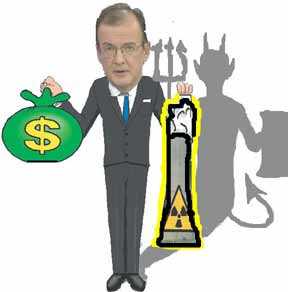
“I think most Americans aren’t sensitive to the fact that nuclear energy is going through challenging times,” Evan Bayh, a former Democratic senator from Indiana, told a roundtable discussion Monday at the Constitution Center sponsored by the Greater Philadelphia Chamber of Commerce.
Bayh and former Sen. Judd Gregg, a Republican from New Hampshire, were enlisted as the bipartisan co-chairmen of Nuclear Matters, whose purpose is to start a dialogue that will lead to improvements in the nuclear business climate
Nuclear power accounts for 19 percent of the nation’s electricity generation, but the industry is challenged by a slow-growth market in which electricity prices are depressed by cheap energy from the shale-gas boom and a flood of tax-subsidized wind power……..
The campaign bills itself as “a cross-section of individuals, organizations and businesses.” Monday’s session was attended by U.S. Sen. Pat Toomey (R., Pa.), utility officials, labor and business leaders, and nuclear-power academics from Pennsylvania State University and the University of Pittsburgh……..
The campaign already has attracted opposition from anti-nuclear activists. The Nuclear Information and Resource Service has denounced Nuclear Matters as an industry “front group.”
Exelon Corp., the nation’s largest nuclear fleet operator and owner of Peco Energy Co., wrote the initial check to fund the campaign.
Exelon declined to disclose the amount of its funding, but Christopher Crane, the company’s chief executive, and in an interview last week that Exelon was “very supportive” of the effort………
Bayh downplayed the effect of the 2011 Fukushima nuclear accident in Japan as undermining public confidence, citing strong support in areas surrounding reactors.
“You look at polling, scientific polling, and for most people, safety is not a concern,” he said.
But McGowan, the Malvern manufacturer, cautioned the industry about becoming too comfortable with polls. He said his sense is that there is an underlying apprehension with safety that needs to be addressed. http://www.philly.com/philly/business/20140506_Nuclear_lobbying_campaign_aims_to_boost_the_industry_s_flagging_business_fortunes.html#cOmXlecVcosu5OUs.99
Radiation pollution of Great Lakes – is that really OK?
 Canadian ‘Experts’ Comfy with Radioactive Pollution of Great Lakes http://www.counterpunch.org/2014/05/02/canadian-experts-comfy-with-radioactive-pollution-of-great-lakes/ by JOHN LAFORGE
No matter how cynical you become, it’s never enough to keep up.” — Lily Tomlin
 Ontario Power Generation (OPG) — which owns or leases 20 nuclear reactors across Ontario — would save loads of cash by not having to contain, monitor and repackage leaky above-ground radioactive waste storage casks. Last Sept., I testified in Ontario against the company’s plan to deeply bury some of this waste next to Lake Huron.
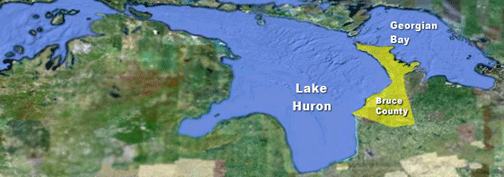
OPG officially plans to let its waste canisters leak their contents, 680 meters underground, risking long-term contamination of the Great Lakes — a source of drinking water for 40 million people including 24 million US residents.
The Bruce reactor complex — the world’s biggest with 8 reactors — is on Huron’s Bruce Peninsula and is the storage site for radioactive waste (other than fuel rods) from all of OPG’s 20 reactors. Digging its dump right next door would save the firm money — and put the hazard out of sight, out of mind.
OPG’s public statements make clear that it intends to poison the public’s water. First, the near-lake dump would be dug into deep caverns of porous limestone. The underground holes are to “become the container” OPG testified last fall, because its canisters are projected to be rotted-through by the waste in 5 years. On April 13 the Canadian government was shocked to learn that OPG grossly understated the severe radioactivity of its waste material, some of which, like cesium, is 1,000 times more radioactive than OPG had officially claimed.
Second, OPG’s callous poisoning plan was broadcast in a December 2008 handout. Radioactive contamination of the drinking water would not be a problem, OPG says, because “The dose is predicted to be negligible initially and will continue to decay over time.”
The ‘expert’ group’s report says it’s possible that as much as 1,000 cubic meters a year of water contaminated with radiation might leach from the dump, but calls such pollution “highly improbable.” (Emphasis on “predicted” and “improbably” here: The US government’s 650-meter-deep Waste Isolation Pilot Project in New Mexico was predicted to contain radiation for 10,000 years. It failed badly on Feb. 14, after only 15.)
OPG’s pamphlet goes further in answer to its own question, “Will the [dump] contaminate the water?” The company claims, “…even if the entire waste volume were to be dissolved into Lake Huron, the corresponding drinking water dose would be a factor of 100 below the regulatory criteria initially, and decreasing with time.”
This fatuous assertion made me ask in my testimony: “Why would the government spend $1 billion on a dump when it is safe to throw all the radioactive waste in the water?” Now, what I thought of then as a rhetorical outburst has become “expert” opinion.
‘Experts’ Unworried About Drinking Industrial Radiation
On March 25, the “Report of the Independent Expert Group” was presented issued to the waste review panel. The experts are Maurice Dusseault, Tom Isaacs, William Leiss and Greg Paoli. They concluded that the “immense” waters of the Great Lakes would dilute any radiation-bearing plumes leaching from the site.
Dusseault advises governments and teaches short courses at the Univ. of Waterloo on oil production, petroleum geomechanics, waste disposal and sand control.
Paoli founded Risk Sciences International and the company’s web site notes his position on Expert and Advisory Committees of Canada’s National Roundtable on the Environment and the Economy.
Isaacs, with degrees in engineering and applied physics, works at the plutonium-spewing Lawrence Livermore National Lab, studying “challenges to the effective management of the worldwide expansion of nuclear energy.” Of course, hiding radioactive waste from public scrutiny is one of his industry’s biggest challenges.
Leiss has degrees in history, accounting and philosophy, and has taught sociology, eco-research, risk communications and health risk assessment at several Canadian universities.
So what level of expertise do the experts bring? None of them have any background in water quality, limnology, radio-biology, medicine, health physics or even radiology, hazardous nuclides, health physics, or radiation risk. As plumes of Fukushima radiation spreading into the Pacific continue to show, the poisons spread from the source and can contaminate entire oceans. Fish large and small, and other organisms, bio-accumulate the cesium, strontium (which persist for 300 years), and cobalt (persisting for 57), etc. in the plumes. The isotopes also bio-concentrate in the food chain as albacore tuna studies repeated in April.
Canada’s expert group’s opinion on how radioactive waste might spread and be diluted in Great Lakes drinking water is inane and meaningless; its cubic meter estimates and risk assessments nothing but fairy tales. You could call the report a rhetorical outburst.
John LaForge works for Nukewatch, edits its Quarterly, and lives at the Plowshares Land Trust out of Luck, Wisconsin.
A Clear and Present Danger – new US report on Climate Change
 Climate change is clear and present danger, says landmark US report National Climate Assessment, to be launched at White House on Tuesday, says effects of climate change are now being felt Suzanne Goldenberg US environment correspondent theguardian.com , Monday 5 May 2014 On Sunday the UN secretary-general, Ban Ki-moon, said the world needed to try harder to combat climate change. At a meeting of UN member states in Abu Dhabi before a climate change summit in New York on 23 September, Ban said: “I am asking them to announce bold commitments and actions that will catalyse the transformative change we need. If we do not take urgent action, all our plans for increased global prosperity and security will be undone.”
- Gary Yohe, an economist at Wesleyan University and vice-chair of the NCA advisory committee, said the US report would be unequivocal that the effects of climate change were occurring in real-time and were evident in every region of the country.
- “One major take-home message is that just about every place in the country has observed that the climate has changed,” he told the Guardian. “It is here and happening, and we are not cherrypicking or fearmongering.”
- The draft report notes that average temperature in the US has increased by about 1.5F (0.8C) since 1895, with more than 80% of that rise since 1980. The last decade was the hottest on record in the US.
- Temperatures are projected to rise another 2F over the next few decades, the report says. In northern latitudes such as Alaska, temperatures are rising even faster.
- “There is no question our climate is changing,” said Don Wuebbles, a climate scientist at the University of Illinois and a lead author of the assessment. “It is changing at a factor of 10 times more than naturally.”
- Record-breaking heat – even at night – is expected to produce more drought and fuel larger and more frequent wildfires in the south-west, the report says. The north-east, midwest and Great Plains states will see an increase in heavy downpours and a greater risk of flooding.
- “Parts of the country are getting wetter, parts are getting drier. All areas are getting hotter,” said Virginia Burkett, chief scientist for global change at the US Geological Survey. “The changes are not the same everywhere.”……..
The assessments are the American equivalent of the UN’s Intergovernmental Panel on Climate Change (IPCC) reports. This year’s report for the first time looks at what America has done to fight climate change or protect people from its consequences in the future.
Under an act of Congress the reports were supposed to be produced every four years, but no report was produced during George W Bush’s presidency.http://www.theguardian.com/environment/2014/may/04/climate-change-present-us-national-assessment
USA urging Australia to take climate change seriously
US urges closer ties on climate change http://www.heraldsun.com.au/news/breaking-news/us-urges-closer-ties-on-climate-change/story-fni0xqi4-1226906292654 NICK PERRY MAY 05, 2014 UNITED States ambassador John Berry has urged Australia to work closely with its ally in Washington on climate change, pointing to the major economic opportunities available in tackling the global challenge.
The US is one of the world’s largest polluters, but has made significant progress reducing its emissions since climate change was made a top-priority issue by the Obama administration.
Data in April showed the US had slashed greenhouse gas emissions 10 per cent below 2005 levels, meaning it’s more than halfway to achieving its target of a 17 per cent reduction by 2020.
Ambassador Berry said the US had managed to cut pollution while maintaining economic growth, defying the argument that achieving green outcomes was too expensive and hard on business.
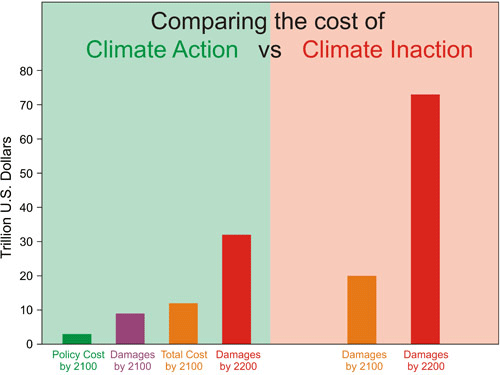
The US would lead by example and be challenging world leaders to do their part by adopting “aggressive” pollution goals of their own.
“The issue is serious, it deserves everyone’s attention,” Ambassador Berry told a climate summit attended by Environment Minister Greg Hunt on Monday. “We know you will continue to work with us – both bilaterally and in multilateral organisations – on the tremendous challenges climate change presents in the region.”
The federal government has promised to reduce emissions by five per cent of 2000 levels by 2020, but will review this target in 2015 as world leaders prepare to hammer out a new binding climate deal.
The US has forged agreements with other major polluters like India and China in the lead up to the 2015 summit, and wants to see climate change on the G20 agenda in Brisbane in November.
Ambassador Berry said the US should work closer with Australia to chase the huge economic benefits posed by the growth of renewable energy. “It’s not only good environmental policy, it’s also good business,” he said.
China’s nuclear reactors endanger Taiwan, but “national leaders” will be safe

 China nuclear plants a threat to Taiwan: NSB chief By Joseph Yeh, The China Post May 6, 2014, TAIPEI, Taiwan — Taiwan is at risk of nuclear disasters and radioactive incidents as more than a dozen nuclear power plants are located along coastal areas of the Chinese mainland, National Security Bureau (NSB, 國安局) head Tsai De-sheng (蔡得勝) said yesterday……As the island of Taiwan is located close to the Chinese mainland, the NSB head said Taiwan is at high risk of nuclear disasters and radioactive incidents if an incident similar to Japan’s Fukushima incident in 2011 occurs on the other side of the Taiwan Strait……

 Once a nuclear disaster or radioactive incident occurs, Tsai said, the NSB will escort national leaders and senior Cabinet members to a safe house as soon as possible. An annual drill has focused on having national heads evacuate in case of emergency, he added.
Tsai made the comments in response to lawmakers’ questions on the government’s nuclear disaster response measures during the Legislature’s National Defense and Foreign Affairs Committee meeting yesterday.
Speaking during the same session, Defense Minister Yen Ming (嚴明) said the military will immediately relocate important military facilities and installations once a nuclear accident happens.http://www.chinapost.com.tw/taiwan/national/national-news/2014/05/06/407029/China-nuclear.htm
The coming demise of coal and nuclear power
Coming Coal & Nuclear Power Plant Retirements, & What That Means, Clean technica 5 May 14 (Good Graphs) “……..Some of the challenges faced by coal-fired and nuclear generators, and the implications for electricity markets if the plants are retired in significant numbers, are analyzed in this discussion………In 2012 and 2013, operators of five nuclear power reactors representing 4.2 GW of capacity announced plans to retire the reactors by 2015. Four of the reactors—San Onofre 2 and 3, Kewaunee, and Crystal River—already have ended nuclear power production, and the fifth, Vermont Yankee, is expected to end generation by the end of 2014 [1]. In addition, the Oyster Creek plant is expected to conclude operation in 2019 [2]. These are the first retirements of U.S. nuclear power plants since Millstone Unit 1 was retired in 1998. Retirements often are the result of unique circumstances, but some owners of nuclear power plants have voiced concerns about the profitability of their units, sparking discussion of possible additional nuclear retirements [3]. In order to evaluate the impacts of potential retirements beyond those in the Reference case, AEO2014 includes several alternative cases with economic assumptions that make it less likely that existing coal and nuclear power plants will be used for generation.
Factors that lead to power plant retirements
Power plant owners generally make the decision to retire plants when their expected costs exceed their expected revenues over the future life of the plants [4]. Costs incurred by power plants can include large capital projects, such as installation of flue gas desulfurization (FGD) systems or scrubbers on coal plants, increased operating costs, or higher fuel costs. Revenues are received from energy sales or capacity payments in wholesale electricity markets in regions of the country with competitive wholesale markets, or from cost-recovery mechanisms in regions with vertically integrated utilities subject to rate regulations [5].
Recent trends in the electric power industry have resulted in both declining revenues and increased operating costs for coal plants…….
When faced with declining profitability, plant owners may choose to retire their units rather than make additional investments to keep them operating. In the AEO2014 Reference case, all coal-fired plants are required to have either a scrubber or a dry sorbent injection (DSI) system combined with a fabric filter in order to continue operating in 2016 [8] and later years. As of the end of 2012, 64% of the U.S. fleet of coal-fired generators was compliant with this requirement. The remaining plant owners are in the process of deciding whether to retrofit or retire their plants [9]………
Conclusions
Accelerated retirements of coal-fired and nuclear electricity generation capacity would cause natural gas and renewables to gain an increased share in the nation’s electricity generation mix. Natural gas is most often the lowest-cost option for replacement capacity, while renewable generation grows, spurred by the increased economic competitiveness of solar and wind technologies toward the end of the projection period. The rising use of natural gas in the electric power sector results in price increases for both natural gas and electricity in all sectors relative to the Reference case http://cleantechnica.com/2014/05/05/power-plant/#S7icgLuw3MM0xsAf.99
Experts critcise White House for planning cuts to nuclear security
Issue Experts, Activists Decry U.S. ‘Major Retreat’ on Nuclear Security http://www.nationaljournal.com/global-security-newswire/issue-experts-activists-decry-u-s-major-retreat-on-nuclear-security-20140505A GROUP OF 100 FORMER OFFICIALS, PEACE ADVOCATES AND ISSUE EXPERTS CRITICIZED THE WHITE HOUSE FOR PLANNING TO CUT NUCLEAR SECURITY FUNDING NEXT YEAR.Colorado passes Bill to protect groundwater from uranium mining’s radiation pollution
House advances uranium groundwater protection bill By Joe Hanel Denver Herald staff writer 5 May 14, DENVER – New regulations on uranium processing passed the state House on Monday, despite a plea from Rep. Don Coram, R-Montrose, that they would destroy hope in the mining towns in his district.
Senate Bill 192 is intended to address an environmental disaster caused by the Cotter uranium mill in Cañon City, where radioactive waste poisoned a neighborhood’s groundwater for years.
It passed 43-22 Monday morning.
“We want to make sure there is not another Cotter mill. We want to make sure groundwater is not polluted by uranium processing,” said one of the sponsors, Rep. K.C. Becker, D-Boulder. The bill sets minimum standards for groundwater cleanups before a company can be let off the hook. It also requires uranium and thorium mines to get a radioactive materials license from the state health department if they use a new process that involves injecting water into the mine’s rock formations……..
Rep. Jared Wright, R-Fruita, said new mining technologies often pollute, despite promises to be safe and clean……..“This bill is about protecting our citizens, those we are all here today to serve,” Wright said.
If Energy Fuels reverses course and decides to build the new mill, SB 192’s groundwater cleanup requirements would apply to it, as well as to Cotter’s Cañon City mill.
2013 – On the Day of Hiroshima and Nagasaki 広島・長崎の日にて – Mari Takenouchi reports with Updated information to 2014
As if showing off some efforts, Prime Minister Abe said that he would tackle more on the issue of certifying A-bomb disease victims. But how many years have been passed since the drop of A-bombs? Many of the sufferers have passed away and now the government has started to work on it more while ignoring the health issues of children after Fukushima accident.
In October 2002, the former ambassador to Switzerland, Mr. Mitsuhei Murata asked Mr. Abe in person, “please relocate children in contaminated areas,” Mr. Abe just ignored his plea. In other words, the government of Japan is not really serious about helping out radiation exposed people, Hibakusha.
Updated information from the UN can be found here https://nuclear-news.net/2014/05/04/japans-government-still-in-denial-on-the-human-rights-of-its-children-living-in-the-radioactive-contaminated-zones-hidden-onhcr-report-march-11th-2014/
Links to the last data showing a confirmed 33 thyroid cancers on links at the bottom of this article (Click “more” if you are seeing this on the home page)

8 August 2013 RePost
「広島は本当にダメなのよ」
“Hiroshima is really hopeless.”
かつて、反原発で一人で動いていた広島の女性活動家(故人)の言葉です。どういう意味か。広島は、過去に起きた核兵器の残忍性や核兵器反対は声高に言うが、原発反対は絶対言わないどころか、原発反対運動を邪魔しているというのです。
This is a word by a late female Japanese activist who was working alone in Hiroshima. What does this mean? It means that Hiroshima appeals on the cruelty and abolition of nuclear weapons, but never touches upon abolition of nuclear power, and furthermore, the Hiroshima movement is actually hindering the anti-nuclear power movement in Japan.
私も本当にそう思います。私が99年に初めて反原発になった時、原発の問題は被曝の問題だからと、被団協に訪れたところ、「被爆者の中に、原発で働いている人がいるから、原発には反対できません。」と言われ、腰を抜かすほど驚いたのを覚えています。
I totally agreed with her. When I became anti-nuclear power supporter for the first time in 1999, I visited the Japan Conference of A-bomb and H-bomb Sufferers Organizations thinking that basics of nuclear power issue is the radiation exposure issue. However, I was told, “Our organization cannot oppose to nuclear power since there are actually A-bomb sufferers who have been working at nuclear power plants.” I was speechless.

その直後、日本では、JCOという核燃料工場にて、初めて2人の急性被曝死を出した原 子力事故が起きました。翌年、このJCO事故の関連で、私はある海外の環境団体のリーダーを広島にお連れした際、広島市長との面会の通訳として同行したの ですが、なんとその当時の広島の秋葉市長は面会の終わりに、「この面会の記事を反原発新聞なんかに載せないでよ」と言われて行かれたのを覚えています。心 底失望しました。
Soon after that, Japan had the its first nuclear accident which had 2 acute radiation symptom deaths at JCO nuclear fuel conversion plant. The following year, I visited Hiroshima as an interpreter for a global environmental organization’s leader to meet the Hiroshima Mayor. At the end of the meeting, the Hiroshima Mayor Mr. Akiba told us, “Never put our photo on a newspaper such as an Anti-Nuclear Power Paper.” I was completely disappointed.
そして今年の5月終わりに、福島の子供たちの間に27人もの甲状腺がんが発見されまし た。(データはこのページの末尾参照)ところが、これについてものを申す、被爆者関連団体、また環境団体、市民団体がほぼ皆無なのに、私は打ちひしがれて います。それ以前に、のう胞や結節の割合が多いという時には騒がれていたのに、決定的な甲状腺がんの発症のニュースが出たら、皆、貝のように沈黙している のです。
At the end of May this year (2013), 27 child thyroid cancer cases were found among Fukushima children. (You can see the data at the bottom of this page on the link) However, there have been almost no A-bomb sufferers organizations or anti-nuclear power organizations reporting on this most important issue. Again I am totally discouraged. Prior to this, the high rate of cysts and nodules were found, which became quite a big issue among citizens’ organizations, but amazingly when this critical news of thyroid cancer emerged, almost every organization became silent.
8月6日、被爆者の代表たち7人が安倍首相に面会しましたが、彼らの主張は「原発再稼働反対」のみで「福島の子供の27人もの甲状腺がん」については一言も言いませんでした。
On August 6th (2013), 7 representatives of A-bomb sufferers met Prime Minster Abe, and they appealed for suspension of restarting nuclear power plants but they never touched upon 27 thyroid cancer children in Fukushima.
これはいったいどういうことなのでしょうか。
What is really going on?
From the World To Fukushima: You are not forgotten 世界から福島へ:「忘れていません」
Published on 5 May 2014
Messages to the mothers and children living in Fukushima from people all over the world who watched the documentary film ‘A2-B-C’.
‘A2-B-C’ WEBSITE
English: http://www.a2documentary.com/
日本語: http://www.a2-b-c.com/
Trailer: http://youtu.be/ZD9yGONdEUY
予告編: http://youtu.be/6xLwVc-V1RU
Messages from ‘A2-B-C’ World Premier in Germany:
http://youtu.be/BBT1bM01qtE
1 This Month



Tell the Ukrainian Government to Drop Prosecution of Peace Activist Yurii Sheliazhenko

Petition to revoke the licensing of the Near Surface Nuclear Disposal Facility (NSDF) at Chalk River. https://www.ourcommons.ca/petitions/en/Petition/Details?Petition=e-7247


of the week – STOP SMALL MODULAR REACTORS IN CANADA
To see nuclear-related stories in greater depth and intensity – go to https://nuclearinformation.wordpress.com
-
Archives
- March 2026 (212)
- February 2026 (268)
- January 2026 (308)
- December 2025 (358)
- November 2025 (359)
- October 2025 (376)
- September 2025 (258)
- August 2025 (319)
- July 2025 (230)
- June 2025 (348)
- May 2025 (261)
- April 2025 (305)
-
Categories
- 1
- 1 NUCLEAR ISSUES
- business and costs
- climate change
- culture and arts
- ENERGY
- environment
- health
- history
- indigenous issues
- Legal
- marketing of nuclear
- media
- opposition to nuclear
- PERSONAL STORIES
- politics
- politics international
- Religion and ethics
- safety
- secrets,lies and civil liberties
- spinbuster
- technology
- Uranium
- wastes
- weapons and war
- Women
- 2 WORLD
- ACTION
- AFRICA
- Atrocities
- AUSTRALIA
- Christina's notes
- Christina's themes
- culture and arts
- Events
- Fuk 2022
- Fuk 2023
- Fukushima 2017
- Fukushima 2018
- fukushima 2019
- Fukushima 2020
- Fukushima 2021
- general
- global warming
- Humour (God we need it)
- Nuclear
- RARE EARTHS
- Reference
- resources – print
- Resources -audiovicual
- Weekly Newsletter
- World
- World Nuclear
- YouTube
-
RSS
Entries RSS
Comments RSS
 nuclear-news
