Rebutting the nuclear spruiker, James Conca
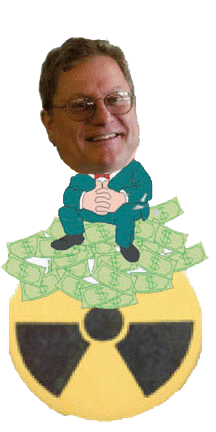
A Rebuttal to the January 11, 2013 Article by James Conca, “Like We’ve Been Saying — Radiation is Not A Big Deal,” Posted on Forbes Website fukushimavoice-eng.blogspot.com.au/2013/02/a-rebuttal-to-january-11-2013-article.html
In particular, it appears to refer to the section (f) of paragraph 25 on page 10, as below, to declare that “the United Nations is to adopt advice on radiation that clarifies what can be said about its health effects on individuals and large populations.”
“(f) In general, increases in the incidence of health effects in populations cannot be attributed reliably to chronic exposure to radiation at levels that are typical of the global average background levels of radiation. This is because of the uncertainties associated with the assessment of risks at low doses, the current absence of radiation-specific biomarkers for health effects and the insufficient statistical power of epidemiological studies. Therefore, the Scientific Committee does not recommend multiplying very low doses by large numbers of individuals to estimate numbers of radiation-induced health effects within a population exposed to incremental doses at levels equivalent to or lower than natural background levels;”
However, the UNSCEAR report merely states that it “does not recommend,” which isn’t the same as declaring it will regulate what “can be said.” The unidentified author of the post seems to be inferring that the UNSCEAR controls who says what about the radiation effects.
Conca, in the Forbes article, takes it one step further, by placing the statement below the “official” UNSCEAR logo: “The United Nations Scientific Committee on the Effects of Atomic Radiation (UNSCEAR) has finally admitted that we can’t use the LNT (linear no-threshold dose) hypothesis to predict cancer from low doses of radiation. Now the Japanese people can start eating their own food again and stop being as afraid. Source: United Nations.” This juxtaposition of his opinion next to the UNSCEAR logo could easily make readers misconstrue that the statement is the official statement by the UNSCEAR.
As for Conca’s claim that radiation doses less than 10 rem (0.1 Sv) are “no big deal” and that
“the linear no-threshold dose hypothesis does not apply to doses less than 10 rem (0.1 Sv), which is the region encompassing background levels around the world,” it simply is a mystery how he seems to have reached such a conclusion, seemingly straight out of thin air.
First, nowhere in the UNSCEAR document he links to, “UN document A/67/46,” does it mention 10 rem (0.1 Sv) as “no big deal” or applying to “the region encompassing background levels around the world.” However, the paragraph 25(f) excerpted above does refer to “chronic exposure to radiation at levels that are typical of the global average background levels of radiation.” Is it possible that he took a liberal interpretation of “the global average background levels of radiation” to mean the highest background levels in rare locations, HBRAs, such as Ramsar, Iran?
According to paragraph 92 on page 111 of UNSCEAR 2000 Annex B: Exposures from natural radiation sources, “worldwide annual exposures to natural radiation sources would generally be expected to be in the range 1-10 mSv, with 2.4 mSv being the present estimate of the central value.”
http://www.unscear.org/unscear/publications/2000_1.html
Secondly, radiation doses less than 10 rem (0.1 Sv or 100 mSv) are not a “no big deal” situation as claimed by Conca. The 2012 meta-analysis by evolutionary biologists Anders Moller (France) and Timothy Mousseau (United States), “The effects of natural variation in background radioactivity on humans, animals and other organisms,” found evidence of significant effects of natural variation in background radiation on mutation rates, DNA damage/repair, immunology and disease including cancer.
http://onlinelibrary.wiley.com/doi/10.1111/j.1469-185X.2012.00249.x/pdf
Radiation effects from exposures well below 10 rem (0.1 Sv or 100 mSv), including background radiation, medical exposure, leukemias in Chernobyl clean-up workers as well as leukemias near nuclear power stations, are discussed by the British radiation biologist, Ian Fairlie.
http://www.ianfairlie.org/news/recent-evidence-on-the-risks-of-very-low-level-radiation/
http://www.ianfairlie.org/news/a-100-msv-threshold-for-radiation-effects/
Thirdly, it is untrue that the LNT hypothesis does not apply to doses below 10 rem (0.1 Sv or 100 mSv). Fairlie discusses very large studies with statistically significant results at very low doses, even down to background levels, showing the linear shape of the dose response relationship down to low doses.
http://www.ianfairlie.org/news/the-linear-no-threshold-theory-of-radiation-risks/
Contrary to Conca’s claim that Japan cut the accepted global limit of 1,000 Bq/kg cesium level in half hoping it would have a calming influence on public’s radiation fear, Japan actually already had guidelines established to be used in case of emergency. So the initial regulatory limit of 500 Bq/kg of cesium was not a compromise by the Japanese government for the purpose of “easing” the public fear. It has now been lowered to 100 Bq/kg. The U.S. regulatory limit is outrageously high at 1,200 Bq/kg. This means any radiation tests conducted on Japan imports in the United States immediately after the accident were practically useless, even though the result might have been below the derived intervention level (DIL) of 1,200 Bq/kg.
http://www.fda.gov/newsevents/publichealthfocus/ucm247403.htm
Besides, the current regulatory limit for milk Conca mentioned in his article is not even accurate in that it is not 200 Bq/kg, but 50 Bq/kg.
The statement, “Accepted global limits on radioactivity levels in foods is 1,000 Bq/kg (1,200 Bq/kg in the U.S.),” is a little misleading in terms of who “accepts” these numbers. These high numbers are apparently set by those interested in protecting and promoting advancement of nuclear energy and imposed upon people who don’t really even know what the numbers mean. On the other hand, those whose interests lie in protecting physical well-being and lives of people, apparently have other perspectives, such as not accepting these limits of 1,000 and 1,200 Bq/kg.
The primary fact is that there is no dose of radiation that is recognized to be harmless, as excerpted from the report, “Calculated Fatalities from Radiation.”
“Setting official maximum levels of radionuclides to be tolerated in food is supposed to protect the population from danger. But, in contrast to chemical toxins, there is no threshold below which radioactivity is harmless. Thus there is also no dose of radiation, no matter how small, that is harmless, benign or unobjectionable. The authority (government or international organization) that recommends or sets standards, or maximum permissible value limits, basically decides on how many fatalities or cases of illness will be acceptable in a given situation.”
foodwatch.de/foodwatch/content/e10/e42688/e44884/e44993/CalculatedFatalitiesfromRadiation_Reportfoodwatch-IPPNW2011-09-20_ger.pdf
In fact, foodwatch, an European consumer rights group, and International Physicians for the Prevention of Nuclear War (IPPNW) Germany called for lowering of the permissible limits of radioactive cesium to 8 Bq/kg for baby food and 16 Bq/kg for all other foods, based on the maximum annual effective radiation dose of 0.3 mSv, which is the maximum exposure limit set out in Germany’s radiation protection legislation for normal operations in nuclear power plants.
http://www.ippnw-europe.org/?expand=681&cHash=02aa1d26e8
Based on Conca’s statements in the comment section of his article, he seems to think a “little bit of cesium ingested” is harmless as it is excreted from the body. But is it really harmless? Does radioactive cesium simply get distributed to mostly muscles, as generally recognized, and eventually excreted without doing any harm?
An exiled Belarusian anatomical pathologist Bandazhevsky, now living in Ukraine, showed that radioactive cesium accumulated in various organs in the body, other than skeletal muscles. He claimed that radioactive cesium affected multiple organ systems, especially cardiac muscles, causing arrhythmia and sudden cardiac deaths.
In the study published on January 23, 2013, “Artificial Radionuclides in Abandoned Cattle in the Evacuation Zone of the Fukushima Daiichi Nuclear Power Plant,” a team of Japanese researchers showed how cesium accumulated in various organs of cows.
http://www.plosone.org/article/info%3Adoi%2F10.1371%2Fjournal.pone.0054312
We have no way of knowing if the accumulated cesium would have eventually caused cancer in these cows, or if they were physically ill before euthanized according to the government order to kill animals left behind in the evacuation zone. However, it is a little hard to imagine the accumulated radioactive cesium causing no harm in delicate cells and tissues of these organs, such as heart, kidney, liver, lungs, bladder, thyroid, etc.
Conca states that as UNSCEAR found no observable health effects from the Fukushima nuclear accident, the Japanese people can start eating their own food again and moving back into areas only lightly contaminated with radiation levels that are similar to background in many areas of the world.
According to paragraph 8 on page 4 of the UNSCEAR report, “UN document A/67/46,” sources of data for the Committee’s evaluation included the Japanese government, United Nations Member States, and other organizations such as the Comprehensive Nuclear-Test-Ban Treaty Organization, the Food and Agriculture Organization of the United Nations (FAO), the International Atomic Energy Agency (IAEA), the World Health Organization (WHO) and World Meteorological Organization (WMO). They also used information and analyses published in peer-reviewed scientific journals as well as measurements uploaded by the public on crowdsourcing websites.
As the UNSCEAR only considers cancer and heritable effects important in establishing radiation risk estimates for low dose exposures, it is not surprising that they concluded that
“No health effects have been attributed to radiation exposure observed among workers or children or any other members of the population.” in paragraph 9(a). At 22 months after the accident, it is considered too soon for radiation-induced cancer to develop, and Japanese government and Fukushima Prefecture do not seem to be actively conducting epidemiological studies in showing heritable effects such as congenital deformities.
However, in reality, there are unofficial accounts of birth defects such as anencephaly and leukemia, not only in Fukushima Prefecture but also in Tokyo and the Kanto region surrounding Tokyo. In addition, a variety of symptoms such as nosebleeds, rash, fatigue, and spread as well as recurrence of infections have been reported in Tokyo and the Kanto region, in addition to increased incidence of abnormal EKG in school children in some areas. Reports of thyroid disorders, such as Hashimoto’s disease and subacute thyroiditis are heard more frequently. Leukopenia has been reported in children in Tokyo and the Kanto region.
TEPCO workers and external contractors involved in the on-site clean-up activities are not reported to have any health effects, but there are no studies or data published to back up that claim. In other words, we have no objective evidence that no health effects have occurred to those workers. There have been at least 5 workers who have died since the accident, with the last reported death being from August 2012, and in some cases their causes of death were not revealed by TEPCO, citing privacy protection. Other than these five, two other TEPCO employees were found dead in the reactor 4 turbine building.
It is not clear where Conca derived information in the following clause, “Radiation played no role in the coincidental deaths of six Fukushima workers in the time since the accident, who died from accidents, e.g. being crushed by debris or being swept out to sea.” Insinuating, without any concrete evidence, that six workers died from accidents is absurd – are there videotapes or eye witness reports to corroborate his claim? Does he honestly know what “really” happened in Japan after the earthquake and tsunami?
The first worker to die was a 60-year-old man who died of “heart attack” on his second day of work. He was one of many “seasonal nuclear power plant workers” who would go to various nuclear power plants on demand. These workers might not know what their cumulative radiation exposure doses are. Sudden cardiac deaths are often called “heart attacks.” In view of this, this man’s “heart attack” could be the result of long-term exposure.
A worker in his 40’s died of acute leukemia in mid-August, 2011, after working at Fukushima Dai-ichi NPP for one week in the beginning of August. His exposure dose was supposedly 0.5 mSv, and TEPCO denied any relationship between his leukemia and radiation. It was not known if he might have had any other occupational radiation exposure prior to his work at Fukushima Dai-ichi, but TEPCO had no intention of investigating his death any further.
Another worker whose circumstance of death has been publicized, was a 57-year-old man who was found unconscious as he was resting after not feeling well on August 22, 2012. He was dead on arrival at the hospital. After working at Fukushima Dai-ichi for one year, his cumulative dose was 25 mSv.
Paragraph 9(e) mentions thyroid monitoring, which was conducted on 1,083 children (544 boys and 539 girls) in Iitate village, Kawamata town and Iwaki-city in late March, 2011, showing no individual exceeding a screening level of 0.2 μSv/h that was derived from a thyroid dose of 100 mSv.
The following is excerpted from the proceedings of the United Nations Sixty-seventh General Assembly Fourth Committee, which was held on November 13, 2012.
http://www.un.org/News/Press/docs/2012/gaspd523.doc.htm
“Maximum dose reported was ‘35 mSv,’ which , he said, was reassuring, because that was significantly lower than what had been observed after the Chernobyl incident. ‘That good news must be underlined,’ asserted the representative of Argentina.”
This thyroid screening was done on March 26-27, 2011 in Iwaki-city, on March 28-30, 2011 in Kawamata town, and on March 29-30, 2011 in Iitate village. In Iitate village, the background radiation level was so high, over 10 μSv/h in some cases, and they had to scurry around to find almost a cubby-hole like area in a city hall with a background level of 0.2 μSv/h, where 300 children were screened. For the whole group including Iitate village children, 55% was 0 μSv/h and 26% was 0.01 μSv/h, and 99% was under 0.04 μSv/h. The highest was 0.1 μSv/h. Under such high background conditions, can accurate measurements verifiably be conducted?
Nevertheless, the most recently published results of the thyroid ultrasound examination, conducted as part of the Fukushima Prefecture Health Management Survey, shows 38,327 (39.9%) of 95,954 children with abnormalities. There are about 360,000 children in Fukushima Prefecture, and the initial round of the ultrasound examination is still ongoing.
www.fmu.ac.jp/radiationhealth/results/media/9-2_Thyroid.pdf
Although Conca wrote in the Forbes article, “UNSCEAR also found no observable health effects from last year’s nuclear accident in Fukushima. No effects,” truth might be far from it.
With due respect, the studies by WHO and Tokyo University which Conca refers to, apparently excerpted from his favorite source, the World Nuclear News post, might not reflect accurate information, although exactly which studies he is referring to is unclear. If it is WHO’s “Preliminary Dose Estimation from the nuclear accident after the 2011 Great East Japan Earthquake and Tsunami” that he is referring to, it was most likely based on official information from the Japanese government. http://www.who.int/ionizing_radiation/pub_meet/fukushima_dose_assessment/en/index.html
The Japanese government did issue an evacuation order for the 20-km zone, but the actual evacuation process was chaotic, and in some cases people went in the direction of the radioactive plume as the government failed to disclose information from the System for Prediction of Environment Emergency Dose Information (SPEEDI). Some evacuees simply went to other parts of Fukushima Prefecture, which also received radioactive plume. It is not so cut-and-clean “evacuating Fukushima Prefecture quickly” type of business. Stable iodine was not administered to people other than one municipality, Miharu town, whose mayor bravely decided to administer it to the town residents against the advice of Fukushima Prefecture. Such details are often not included in the official documentation and not readily available to those seeking information from overseas.
Actually, it is not just Fukushima Prefecture that received a significant amount of radiation contamination. The path of the plume went north and east initially, but then it turned south and covered a wide area including Tokyo and the surrounding Kanto region.
This is a recently broadcast simulation of iodine 131 using newly discovered data from a monitoring post located 5 km west of Fukushima Dai-ichi NPP. Tokyo received a radioactive plume, especially highly concentrated between 9am and 12pm on March 15, 2011.
In regards to the Tokyo University studies, Conca could be referring to “Internal Radiation Exposure After the Fukushima Nuclear Power Plant Disaster,” which reports “low exposure levels.” http://jama.jamanetwork.com/article.aspx?articleid=1346169
http://www.nikkei.com/article/DGXZZO50651160W3A110C1000000/It is indeed curious that both Forbes and Nikkei Newspaper are “financial” publications. It appears that those whose interests are “finances” want to minimize health effects of radiation or radioactive contamination so that they can push their “peaceful” use of nuclear power, and they seem blind to the basic human rights of being able to breathe clean air and eat clean food.
He certainly seems excited about his specialty area of nuclear waste disposal, and at least Conca is correct in pointing out that decontamination effort that is passing for clean-up so far has been a huge waste of money by just moving dirt and leaves around. However, does he even know that some disaster debris with some degree of radioactive contamination is being transported all over Japan, at a great expense, to be incinerated? He probably doesn’t know, as he seems to spend very little time conducting research verifying facts prior to writing his articles.
Are the Japanese people being punished for some unspoken reason by having lower radiation levels in food? Is it really criminal to continue applying LNT dose effects for doses less than 100 mSv?
He is certainly entitled to having his own opinions, no matter how ”prevaricating” it sounds. (Conca himself used the word “prevaricating” in his article, stating that UNSCEAR needs to stop procrastinating and “prevaricating.”) However, observing the way he rants about “less than 100 mSv being nothing,” the infamous “Mr. 100 mSv” Shunichi Yamashita of Fukushima Medical University might have a newfound friend. And what is really criminal is to make Japanese people eat food contaminated with radiation no matter how little the contamination is, regardless of the “accepted global limits.”
3 Comments »
Leave a reply to Chris Murray Cancel reply
-
Archives
- May 2026 (72)
- April 2026 (356)
- March 2026 (251)
- February 2026 (268)
- January 2026 (308)
- December 2025 (358)
- November 2025 (359)
- October 2025 (376)
- September 2025 (257)
- August 2025 (319)
- July 2025 (230)
- June 2025 (348)
-
Categories
- 1
- 1 NUCLEAR ISSUES
- business and costs
- climate change
- culture and arts
- ENERGY
- environment
- health
- history
- indigenous issues
- Legal
- marketing of nuclear
- media
- opposition to nuclear
- PERSONAL STORIES
- politics
- politics international
- Religion and ethics
- safety
- secrets,lies and civil liberties
- spinbuster
- technology
- Uranium
- wastes
- weapons and war
- Women
- 2 WORLD
- ACTION
- AFRICA
- Atrocities
- AUSTRALIA
- Christina's notes
- Christina's themes
- culture and arts
- Events
- Fuk 2022
- Fuk 2023
- Fukushima 2017
- Fukushima 2018
- fukushima 2019
- Fukushima 2020
- Fukushima 2021
- general
- global warming
- Humour (God we need it)
- Nuclear
- RARE EARTHS
- Reference
- resources – print
- Resources -audiovicual
- Weekly Newsletter
- World
- World Nuclear
- YouTube
-
RSS
Entries RSS
Comments RSS
 nuclear-news
I don’t have time to do a detailed review of Conca’s articles (congrats on yours), but below is a review of Mark Lynas’s similarly-themed book. “Nuclear 2.0”. Some of the info/references may be of use, especially re the 100mSv threshold myth.
All the best,
Chris Murray.
Mark Lynas, in “Nuclear 2.0”, commits the same errors he ascribes to the anti-nuclear movement, except that where anti-nuclear activists allegedly exaggerate, Mark Lynas relentlessly minimises.
Lynas quotes UNSCEAR and others in an effort at scientific respectability, but the quotes are often selective and misleading. For example, re Chernobyl, UNSCEAR is correctly quoted as offering reassurance to individuals that the personal risks are low, but there is no mention whatever that UNSCEAR also clearly states “Although the numbers of cancers projected to be induced by radiation exposure from the accident are very small relative to the baseline cancer risk, THEY COULD POTENTIALLY BE SUBSTANTIAL IN ABSOLUTE TERMS” (my emphasis – even a “very small” increase of say, 0.5%, in baseline risk would cause, say, 10,000 extra cancers in a 10 million population, assuming normal cancer mortality of 20% of all deaths). This, from the very agency – UNSCEAR – that Lynas is using to establish credibility, is surely worth at least a mention, especially from someone claiming scientific objectivity. Nor is there any mention that earlier World Health Organisation reports put the eventual excess cancer death toll among the cleanup workers at 4,000, and in the most affected areas of Russia, Ukraine and Belarus alone at a further 5,000. And the harm is unlikely to stop there.
Similarly, Lynas mentions UNSCEAR’s recent warning that collective dose should not be used to estimate future cancer deaths at Fukushima, without mentioning that the International Commission on Radiological Protection (ICRP), the WHO, and many other scientifically reputable government agencies, have previously all used collective dose to estimate cancer deaths, or that ICRP and UNSCEAR are not saying NO risks/deaths, they are warning of UNCERTAINTY at very low doses. They even admit that this uncertainty could be in either direction – that lower dose radiation could, over part of the graph, be proportionately MORE damaging than higher doses ie supralinearity. This is completely ignored by Lynas. Re hormesis or a low dose threshold, the ICRP and many others have carefully examined the evidence, and have firmly rejected them in favour of LNT. The LNT “debate” is bogus. At every turn of the debate, Lynas presents the view that makes nuclear look best. UNSCEAR’s warnings of uncertainties re the MAGNITUDE of the risks, NOT their existence, has been elevated by Lynas into a complete dismissal of the risks, flying in the face of established radiological science. This magical thinking, designed to make inconvenient (for the nuclear industry) cancer risks disappear, may be a suitable approach for a propagandist, but one can hardly simultaneously wrap oneself in the science flag.
Re a mythical 100mSV limit, Lynas, in the teeth of the growing evidence, fights a rearguard action to cast doubt everywhere except on the pro-nuclear position. However, as far back as 2001, the ICRP, in “Radiation and Your Patient: A Guide for Medical Practitioners” advised doctors that “The higher dose diagnostic medical procedures (such a CT scan of the abdomen or pelvis) yield an effective dose of about 10 mSv. If there were a large population in which every person had 1 such scan, the theoretical lifetime risk of radiation induced fatal cancer would be about 1 in 2,000 (0.05%).”
So why is the evidence sufficient for patients exposed to 10 mSV (NB 10 mSV, not the 100 mSv claimed by Mark Lynas as some kind of threshold) to be warned of a 1 in 2,000 risk of fatal cancer, but not sufficient to clearly warn “a large population”, exposed to similar radiation levels from a nuclear disaster, of similar risks? Instead the risks are usually buried in specious technobabble about “insignificant” increases in the baseline cancer rate and misleading claims that “no health effects will be detected”, while admitting quietly that thousands or tens of thousands may actually die. Why are the risks from 10mSv enough to warn doctors and patients, but, according – sometimes – to UNSCEAR and the ICRP, not enough to even estimate, not even roughly estimate, overall cancer deaths from Chernobyl and Fukushima? Could it be that such clear, direct estimates give embarrassingly large – to the nuclear industry – estimates of 20,000 – 40,000 fatal Chernobyl cancers and 1,000 – 3,000 fatal cancers from Fukushima? Could this just possibly have some bearing? (There has recently been a spate of disgraceful articles by young, gullible ex-Greens claiming that the Chernobyl death toll is “only” about 50. How would those article have read if they were shouting “Hey! We got it all wrong about nuclear power! The dangers have been wildly exaggerated by those irrational, alarmist, anti-science eco-loons! Did you know that Chernobyl’s final death toll from cancer will be a mere 20,000 – 40,000???”)
Lastly, Lynas gets his sums badly wrong. In a bungled attempt to discredit LNT, he quotes figures from Preston et al (2004) “Effect of recent changes in atomic bomb survivor dosimetry on cancer mortality risk estimates”, Table 3. He claims “……those receiving doses below 100 mSv had no observable increase in risk at all. Out of the 68,467 people in the below 100 mSv category, 7,657 died of cancer before 2000, out of an expected number of cancer deaths totalling 7,655. The difference* is too tiny to have any statistical meaning. This latter conclusion is critically important. No convincing evidence has ever been obtained, despite many hundreds of studies, showing a statistically significant correlation between cancer incidence and radiation exposures of less than 100 mSv. ” (* Difference is 2).
There are actually other widely accepted studies showing excess cancer risk at doses well below 100mSv, from Alice Stewart’s work, from studies of radiation workers, from CT scans, even from background radiation studies, but forget about them. Just look up Table 3 yourself (You’ll have to register – free – at the Radiation Research Society web journal). It shows cancer deaths roughly as predicted by LNT in various dose bands from 2,000 mSv down. It does show only 2* fitted excess cancer deaths in a lower category, but it’s in the below 5 mSv (FIVE mSv, not 100 mSv) category, and it shows fitted excess cancer deaths in the 5-100 mSv category to be 44. These 44 sub-100mSv deaths have simply disappeared in Lynas’s account. It’s easy to draw “critically important” conclusions when you lose statistics that don’t suit. But don’t get caught.
Mark Lynas is one of a number of naive people (George Monbiot, Michael Shellenberger, even Jim Hansen) trying to discredit LNT, and insulting the anti-nuclear movement as being ignorant, irrational and unscientific. There is a deluge of scientific evidence, some of it going back decades, supporting LNT. The evidence is increasing all the time that lower and lower doses have an effect consistent with LNT predictions. In contrast, the evidence for a threshold, never mind hormesis, is speculative, largely confined to laboratories, generally contradicted by real-world epidemiology, and has been considered and firmly rejected by the ICRP, BEIR etc.
Lynas and co. might like to consider the following from “The radiobiology/radiation protection interface in Healthcare” (Martin et al, 2009), published by the Journal of Radiological Protection and available at the Institute of Physics website.
“The 21st L H Gray conference gathered leading experts in radiobiology, radiation epidemiology, radiation effect modelling, and the application of radiation in medicine to provide an overview of the subject………
Epidemiological evidence from the Japanese A-bomb survivors provides strong evidence that there is a linear relationship between the excess risk of cancer and organ dose that extends from about 50 mSv up to 2.5 Sv, and results from pooled data for multiple epidemiological studies indicate that risks extend down to doses of 20 mSv. Thus linear extrapolation of the A-bomb dose-effect data provides an appropriate basis for radiological protection standards at the present time…..
The Japanese A-bomb survivor group provides data for a population with a wide range of ages who received relatively high doses primarily from external radiation……. The results have proved that there is a linear relationship between cancer risk and organ dose between about 100 mSv and 2.5 Sv (Hall 2009). If data from A-bomb survivors who received doses between 5 and 125 mSv are grouped together and the excess risk plotted against a mean dose, the data give a definite excess relative risk for cancer mortality and a value which agrees with the LNT extrapolation of the A-bomb survivor data for a mean dose of about 40 mSv (Brenner et al 2003)………
Another area of study which is relevant when considering carcinogenic effects at low doses is the induction of childhood leukaemia in children radiographed in utero with doses of 10-20 mSv (Stewart et al 1956, Knox et al 1987). These studies provide further evidence that effects do occur at doses down to 10 or 20 mSv…….
.
Data from the UK, USA and Canada have been combined to give results for 95 000 radiation workers who received a mean individual cumulative dose of 40 mSv (Cardis et al 1995) and data from 15 countries pooled to give 400 000 workers with a mean cumulative dose of 19.4 mSv (Cardis et al 2005b). Results from both studies indicate an excess relative risk of leukaemia that is statistically significant………..
Comparative studies on groups exposed to different levels of natural background radiation do not have the statistical power to detect effects on cancer incidence, because of the small numbers receiving higher doses (BEIR 2006, Hendry et al 2009). Based on current risk estimates a population of 10 million would be required in order to prove whether there was a high incidence of solid cancer in an area where the population was exposed to 10 mSv yr−1, whereas the populations that have been studied comprise less than 100 000 individuals. Populations that have higher doses from radon exposure provide the best indicator of a link between cancer and dose at lower dose levels. Results of a European project, which combined data from a number of individual case control studies in member states, show a clear increase in the risk of lung cancer among residents of homes with an enhanced concentration of radon (above 150 Bq m−3)……
…the LNT dose-effect model is the most appropriate one to adopt to describe the risks of cancer and provides a workable practical framework for the operation of protection………….”
In an earlier article, Lynas thanked “…..Professor Wade Allison for his help on the research”. Allison is a physicist, with no scientific expertise in radiobiology, who wants to increase the statutory radiation protection limits by a factor of 1000. It is worth considering what the normally understated and polite Dr. Keith Baverstock, who led the Radiation Protection Programme at the World Health Organisation’s Regional Office for Europe from 1991 to 2003, thinks of Allison’s theories…….
“Back to Allison and his brand of pantomime biology: he is not a misguided crank, he understands the scientific process, he is surrounded with colleagues in Oxford he could consult and in two years he has not heeded the warnings of, I am sure, many experts that he is simply wrong. I don’t believe he is deliberately peddling untruths either. So what is his problem? One can only conclude that he is deluded. It seems that one can become so obsessed with an idea that any challenge to it is somehow expelled from consciousness. I believe on this issue Allison is a menace to society and I am not alone in that; he was, I understand, told as much by a senior radiobiologist at a scientific meeting in London last month: he still filed his evidence to the HoC S&T Committee though on 22 December and whether he realises it or not he is attempting to mislead them when he claims the scientific high ground and dismisses genuine scientific opinion as politics. He should either withdraw his book or re-title it ‘Radiation and Unreason’ and ask for it to be displayed in bookshops and libraries under ‘fiction’.”
Mark Lynas’s dreadful book should join it.
For anyone interested in a more scientific approach to the crucial low level radiation debate, Dr. Ian Fairlie’s site is the best I’ve found so far (Dr. Fairlie, like Dr. Baverstock, is a professional in radiobiology).
Chris Murray.
Posted in reply to James Conca on 17th May 2014 at http://www.forbes.com/sites/jamesconca/2012/06/10/energys-deathprint-a-price-always-paid/
Nope, strictly speaking UNSCEAR, citing uncertainty (which applies both ways – supralinearity is also a possibility across part of the dose range), refused ala Pontius Pilate, to give any estimates at all, although they did warn that the numbers of fatal cancers “could be substantial”. The 4,000/9,000 came from Chernobyl Forum (UNSCEAR was a member) and WHO publications which for some reason ignored doses outside the most heavily contaminated regions. LNT and collective dose point to casualties of 50,000 from cancer alone, and can hardly be considered “small”. So UNSCEAR and ExternE and the RREF and the ICRP and the WHO and all the radiological organisations across the world are indulging in “speculation”? And you see THE TRUTH? And AGW predictions (which I accept) are based on… uh oh….model numbers. See my other posts at http://www.forbes.com/sites/jamesconca/2013/01/11/like-weve-been-saying-radiation-is-not-a-big-deal/#comment-5193 for more detail.
All the best,
Chris Murray
Reply to James Conca May 17th 2014 at http://www.forbes.com/sites/jamesconca/2013/01/11/like-weve-been-saying-radiation-is-not-a-big-deal/#comment-5193
You seem to have moved your threshold from 100 mSv to “about” 50 mSv. Re the atomic bomb survivor data, to my knowledge, they do not provide evidence, never mind proof, of any threshold, quite the reverse. You seem to be conflating your imagined absence of evidence with evidence of absence. The difficulties in categorically PROVING effects at low or very low doses, and UNSCEAR’s warnings about uncertainties re the MAGNITUDE (not the existence) of risks at low doses, are not excuses to dismiss risks altogether. Maybe you could reread the references above?
To recap, the scientific radiobiological establishment generally accepts PROVEN linear effects down to 100mSv, and sufficient evidence down to 10mSv for even the generally pro-nuclear UNSCEAR (quoted previously by you with approval) to state in 2010 that “Risk estimates vary with age, with younger people being generally more sensitive: studies of in utero radiation exposures show that the foetus is particularly sensitive, with elevated risk being detected at exposures of 10 mGy and above.” (10mGy is equivalent to 10mSv).
The evidence is sufficient for even the equally pro-nuclear International Commission on Radiological Protection to state that “The higher dose diagnostic medical procedures (such a CT scan of the abdomen or pelvis) yield an effective dose of about 10 mSv. If there were a large population in which every person had 1 such scan, the theoretical lifetime risk of radiation induced fatal cancer would be about 1 in 2,000 (0.05%). (Radiation and your Patient: A guide for Medical Practitioners).
If the evidence is strong enough to warn doctors of a one in 2,000 risk at 10mSv, it’s good enough to warn the population of similar risks from broadly similar doses from Chernobyl and Fukushima. How big a deal is, say, a one in 2,000 risk of fatal cancer? That’s up to every individual to decide. It’s certainly not up to me or James Conca to decide.
I’m not saying that “all radiation is deadly”, or even that 10 mSv or 100 is deadly. Tiny doses involve only tiny risks, and it would be unwise to fret about a 1 in a million risk. But tiny individual risks are of genuine concern to society when large numbers of people are exposed. Analogies with aspirin or jumping from 1 foot versus jumping from 100 foot are specious, as is whataboutery re other health hazards. There is NO KNOWN THRESHOLD. BEIR, ICRP, WHO, UNSCEAR, and every reputable radiological protection agency in the world accept this. Those who disagree are entitled to their opinions, and who knows, may even be right (and the moon may turn out to be made of cheese), but they are not entitled to parade their opinions as established scientific fact.
This is not rocket science. If the nuclear bomb survivor data now PROVE linear effects from 2,500 mSv down through 2,000 mSv, through 1,500 mSv, 1,000 mSv, 500 mSV, 400, 300, 200, and 100 mSv, and provide evidence of linear effects down to about 40 mSv, and this is supported by other large studies showing generally linear effects down to 10mSv, it is not some kind of mass delusion or anti-nuclear hysteria, or oil industry propaganda, or hippy conspiracy, as you would have it, to warn people of this, and to postulate that the linear slope may continue. And that is the majority scientific opinion.
The case for nuclear doesn’t look quite so good if good science prevails and people, instead of shouting “Hey! Chernobyl only killed 50 people!” (or even 4,000 – 9,000 people) are honest and admit that Chernobyl may kill 50,000 from cancer alone (ExternE, one of your approved sources, estimate 10,000 – 50,000), and stop the “lesser of two evils/two wrongs make a right” silliness (The even larger casualties from coal, can, according to Brian Wang – another of your approved sources – be reduced by 99% through retrofitting scrubbers).
Best wishes,
Chris Murray.