Desperate publicity manipulations by the nuclear industry
 You know the nuclear industry is desperate when… Michael Mariotte April 1, 2014 You know the nuclear power industry is getting desperate when it solicits its CEOs to start piling on ghost-written op-eds in publications chosen for their reach to key audiences. And you know the industry is really desperate when it brings out big guns like a couple of paid-for former U.S. Senators to support nuclear power in The Hill newspaper, which, as its name implies, is aimed at current legislators. And you know the industry is super desperate when it pulls out none other than Rudy Giuliani, who continues stuffing his wallet with nuclear-powered green.
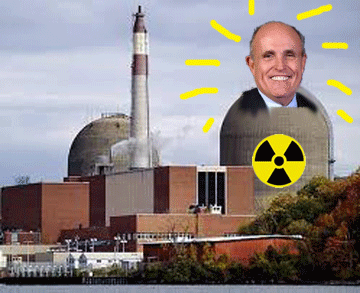
And when it rolls out all three on the same day? That’s when you know that the nuclear industry knows what not enough clean energy activists have yet understood: the nuclear power industry is in real trouble; it’s sensing its near-imminent demise; and like the dinosaur snarling and wagging its tail on its way to extinction, it’s in a dire, and ultimately likely to be unsuccessful, scramble for its very existence.
Yesterday, March 31, the nuclear industry’s march to oblivion was on full display. Two of the op-eds it placed were remarkably similar, so much so that they probably came from the same pen. And their points are so easy to knock down that one wonders if the Nuclear Energy Institute’s public relations A-Team already has jumped ship. Seriously, if these are the best arguments the industry can offer, they’re in bigger trouble than even I thought.
First up is Mike Renchek, the CEO of Areva, who is trying to convince Providence Journal readers that “nuclear energy is crucial to New England.”The crux of his argument seems to be that nuclear reactors kept providing power during the “polar vortex” this winter. Well, so did solar and wind plants, and energy efficiency worked pretty well too we hear. What didn’t work so well was natural gas, which went up in price and down in supply. But gas, although it is typically much cheaper than nuclear and in New England especially has been undercutting the region’s reactors in price, isn’t exactly an ideal provider of electricity, especially in the nuclear-free, carbon-free energy system we’re working to build. Gas is, at this exact moment in time, a genuine competitor to nuclear, but nuclear’s real future problem isn’t gas, it’s renewables and efficiency. And Renchek’s reactors can’t compete with those anymore either and will be even less able to do so as this decade rolls on.
Former Senators Evan Bayh of Indiana and Judd Gregg of New Hampshire are the figureheads of a new industry-sponsored group called Nuclear Matters, which was created to try to prevent the shutdown of more existing reactors. Creation of such a group is itself a sign of the industry’s desperation–who knew a technology that is so self-evidently advantageous (at least in the minds of the industry itself, if for no one else) would need a new organization not to promote industry growth but to try to postpone its inevitable stumble into oblivion?…….
The nuclear industry’s sense of desperation is palpable. Activists need to understand what the industry obviously knows: it’s in serious trouble. This is our time to really join together, ramp up our efforts, and kick more of these reactors over the edge; they’re already teetering. They’re dangerous, they can’t provide cost-effective electricity, they don’t have a solution to their radioactive waste and they exist now only because they were built decades ago and the utilities want to milk them for everything they can before they surrender to the inevitable and have to begin spending huge sums of money again–but this time it won’t be to build new reactors, it will be to decommission their dinosaurs. http://tinyurl.com/n3b9myt
Waste Isolation Pilot Plant so radioactive that crews had to retreat
 AP: Crews retreat after nuclear material found at WIPP — Officials: Correct to turn back, contamination was increasing — Robots brought to site for radiation levels too high for humans — ‘Significant amount of information’ will be revealed to public in next few days (VIDEOS) http://enenews.com/ap-crews-retreat-after-nuclear-material-found-at-wipp-officials-correct-to-turn-back-contamination-increased-the-further-they-went-robots-brought-to-site-in-case-radiation-levels-too-high-for?utm_source=feedburner&utm_medium=email&utm_campaign=Feed%3A+ENENews+%28Energy+News%29
AP, Apr. 17, 2014: Crews on their fourth trip into the mine on Wednesday made it into the only active waste storage area and found contamination, [Tammy Reynolds, U.S. Dept. of Energy’s deputy recovery manager] said. The deeper they went into the area, the more widespread the contamination, she said. But the crews had to retreat before identifying the possible source because they had been underground for five hours in protective gear that retains heat and the batteries on their respiratory equipment were running low. […] The next step is for crews, and possibly robots, to go back down to see if they can identify what caused the leak.
Tammy Reynolds, deputy WIPP recovery manager: “The more they went into panel seven, the more (the contamination) became more widespread […] They made the correct decision to turn back […] Everyone was safely returned to the surface.”
John Heaton, former state representative and chairman of the Carlsbad Mayor’s Nuclear Taskforce, WIPP Town Hall, Apr. 17, 2014 (at 7:00 in): I think that next week might a very busy week in that I think that there will be progress to report in terms as to what might have been the cause and also Phase 1 of the accident investigation report. […] I believe — I hate to speculate on this — but there will be a significant amount of information that will come out next week. So I think it will be a very important meeting and I think we need to have adequate time for people to be able to ask questions.
Reynolds, WIPP Town Hall, Apr. 17, 2014 (at 23:00 in): One of the other things we’ve been working on is the contingency plan […] They’ve been working to have robots prepared that in the event that the conditions in the underground don’t allow us to be able to get to the waste space or other parts of the mine later on in recovery activities because of the level of contamination, as a contingency we’re looking at the use of robots. And so there’s a couple of robot operators, they’ve already been to the WIPP site, they’ve received all of the training they would need to go into the underground […] they’ve completed that. And today they brought the robots out to the site and they did a demonstration for us […] so that if we can’t go and visibly put our eyes on certain pieces of the mine, the robot can do that for us and feed us back that information.
Washington State and DOE squabble over disatrous radioactive waste problem at Hanford
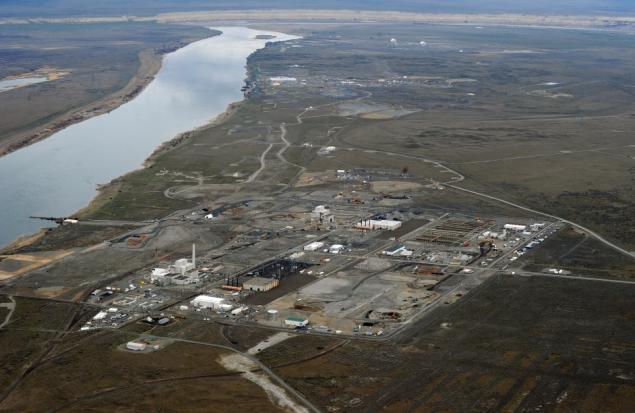 State, feds reject each other’s Hanford proposals http://www.kansascity.com/2014/04/18/4968158/ap-newsbreak-state-rejects-hanford.html April 18 BY NICHOLAS K. GERANIOS SPOKANE, Wash. — The state of Washington and the U.S. Department of Energy on Friday each rejected the other’s proposal to amend a federal court agreement governing cleanup of the Hanford Nuclear Reservation, the nation’s most polluted nuclear weapons production site. The state sent a letter to federal lawyers saying the Energy Department’s March 31 proposal that would have eliminated many deadlines for Hanford cleanup “is not acceptable to Washington.”
The Department of Energy, meanwhile, said a state proposal also issued March 31 that would have left many deadlines in place was unrealistic.
The state proposal does not “adequately account for the realities of technical issues resolution, project management requirements and budget constraints,” the Energy Department said in a news release.
While the state warned that it might consider legal action, the Energy Department said it wanted to keep negotiating the issues. Hanford for decades made plutonium for nuclear weapons, and now is engaged in cleaning up the nation’s largest volume of radioactive wastes. The site is near Richland. Continue reading
Rio Tinto’s AGM faced with facts on radiological impact of Rossing uranium mine
 Radiological Impact of Rössing Uranium Mine – Namibia http://www.facing-finance.org/en/2014/04/radiological-impact-of-rossing-uranium-mine-namibia/ April 17th, 2014 by jdub / facing finance
At the Annual General Meeting of Rio Tinto in London, 15 May  2014, two recent reports about the impact of the uranium mine Rössing near Arandis, Namibia, on the environment and health were presented to the shareholders.
In cooperation with Earthlife Namibia, the French organizationCRIIRAD (Commission de Recherhe et d’Information Independantes sur la Radioactivite) analyzed the radiation of soil, water and sediments samples taken near Rössing´s mine caused by the tailing dams and waste rock dumps. Results show elevated levels of heavy metals and uranium in the samples up to more than 2000 times higher than WHO recommendations.
In their study, Earthlife Namibia surveyed the health status of current and former workers of the mine. Many of them complained of health problems, among them respiratory problems and illnesses due to the constant exposure to radon gas and dust.
CRIIRAD and Earthlife Namibia demand more independent research on radiation at the Rössing mine, a broad independent examination of the health status of workers and access to monitoring data for experts, as well as workers´ unrestricted access to their own medical reports.
Read CRIIRAD´s report here
Read Earthlife Namibia´s report here
Vital to carry through with diplomacy between Iran and the West

 Why we must give Iran nuclear deal a chance, Global Public SquareBy Tyler Cullis and Jamal Abdi, Special to CNN 18 April 14 Editor’s note: Tyler Cullis is a policy associate at the National Iranian American Council. Jamal Abdi is policy director at NIAC. The views expressed are the authors’ own.
The United States could be on the verge of securing a historic agreement over Iran’s nuclear program, one that verifiably limits it and opens the door to further cooperation between the two countries. Yet with a diplomatic victory on the horizon, the rhetoric of those who have long opposed any diplomatic resolution is reaching dizzying heights of disingenuousness.
During a recent Senate hearing, Senate Foreign Relations Committee Chairman Robert Menendez (D-NJ) hit out at reports that negotiations with Iran may produce a deal that “only” extends Iran’s nuclear breakout timeline to 6 to 12 months.
“I don’t think we did everything that we’ve done to only get a six to twelve month lead time,” Menendez lamented as he grilled Secretary of State John Kerry over the progress of the talks………
The Israeli government appears to believe that threatening possible military strikes on Iran’s nuclear facilities is the solution. But here’s the kicker: some estimates suggest that an Israeli strike on Iran would delay Iran’s breakout timeline by…six to twelve months – the same as the negotiated approach. The problem, of course, is that unlike a diplomatic solution, which would trade sanctions relief for verifiable limits on Iran’s nuclear program, an Israeli (or U.S.) military strike would have the opposite effect, and could prompt Iran to kick out inspectors and make a dash for a nuclear deterrent.
All this suggests an understanding of the potential timelines under these scenarios points to one conclusion – the White House is taking the best approach, one that extends the breakout timeline and has the best potential for securing an intrusive inspections regime to ensure Iranian compliance.
Opponents of diplomacy would do well to reflect on the reality that as the United States has tried to leverage sanctions against Iran, Tehran has responded by ramping up the production of centrifuges. As a result, the U.S. has long been in need of a new direction in its policy toward Iran.
Tentatively, but unmistakably, the Obama Administration has pursued a new approach – one that has brought us the first freeze on Iran’s nuclear program in a decade and which reports suggests have led to significant concessions on Iran’s Arak reactor.
If such a deal is not good enough for some in Congress or Israel’s government, then they must be prepared to speak up and offer viable alternatives. In the meantime, they should avoid undermining one of the most promising prospects for limiting Iran’s nuclear program in years. http://globalpublicsquare.blogs.cnn.com/2014/04/18/why-we-must-give-iran-nuclear-deal-a-chance/
Time to reveal the truth on Israel’s theft of nuclear weapons fuel from USA
 Nearly 50 years have passed since the events in question. It is time to level with the public. At this point it is up to the president himself to decide whether to declassify completely the NUMEC documents, all of which are over 30 years old. He should do so. We know that is asking a lot given the president’s sensitivity about anything involving Israel, and especially anything relating to Israeli nuclear weapons. But none of his political concerns outweigh his responsibility to tell the US public the historical truth it deserves to know.
 Did Israel steal bomb-grade uranium from the United States? Bulletin of Atomic Scientists Victor GilinskyRoger J. Mattson 17 April 14 Last month the Interagency Security Classification Appeals Panel (ISCAP), the nation’s highest classification authority, released a number of top-level government memoranda that shed additional light on the so-called NUMEC affair, “the story that won’t go away—the possibility that in the 1960s, Israel stole bomb-grade uranium from a US nuclear fuel-processing plant.”
The evidence available for our 2010 Bulletin article persuaded us that Israel did steal uranium from the Apollo, Pennsylvania, plant of the Nuclear Materials and Equipment Corporation (NUMEC). We urged the US government to declassify CIA and FBI documents to settle the matter. In releasing the current batch—the release being largely due to the persistent appeals of researcher Grant Smith—the government has been careful to excise from all the released documents the CIA’s reasons for fingering Israel.
Despite this, the documents are significantly revealing. Continue reading
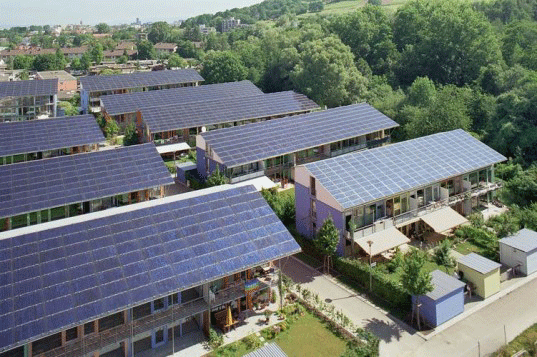
A city that produces 4 times more energy than it consumes – solar Sonnenschiff
Sonnenschiff: Solar City Produces 4X the Energy it Consumes http://inhabitat.com/sonnenschiff-solar-city-produces-4x-the-energy-it-needs/ by Andrew Michler, 07/27/11 Sonnenschiff solar city in Freiburg, Germany is very much net positive. The self-sustaining city accomplishes this feat through smart solar design and lots and lots of photovoltaic panels pointed in the right direction. It seems like a simple strategy — but designers often incorporate solar installations as an afterthought, or worse, as a label. Designed by Rolf Disch, the Sonnenschiff (Solar Ship) and Solarsiedlung (Solar Village) emphasize power production from the start by smartly incorporating a series of large rooftop solar arrays that double as sun shades. The buildings are also built to Passivhaus standards, which allows the project to produce four times the amount of energy it consumes!
U.S. Republican Senator Rand Paul said: Nuclear Iran is Not a Threat to Israel
Rand Paul: Nuclear Iran Not a Threat to U.S., Israel, Washington Free Beacon, Endorsed Bilderberg conspiracy theories before winning Senate seat BY: Alana Goodman April 18, 2014
Sen. Rand Paul (R., Ky.) denied that a nuclear Iran would pose a national security threat to the United States or Israel in a 2007 radio interview with talk show host and conspiracy theorist Alex Jones.
“Even our own intelligence community consensus opinion now is that they’re not a threat. Like my dad [Rep. Ron Paul] says, [the Iranians] don’t have an Air Force, they don’t have a Navy,” said Paul, according to a recording of the interview. “You know, it’s ridiculous to think they’re a threat to our national security.”
“It’s not even that viable to say they’re a national threat to Israel,” Paul added. “Most people say Israel has 100 nuclear weapons, you know.”
The future senator, who was working on his father’s presidential campaign at the time, also came out against military action, saying Republicans “all want to invade Iran next.”
“I tell people in speeches, I say, you know we’re against the Iraq War, we have been from the beginning,” said Paul. “But you know we’re also against the Iran war—you know the one that hasn’t started yet.”……….. http://freebeacon.com/politics/rand-paul-nuclear-iran-not-a-threat-to-u-s-israel/
Renewable energy – Ukraine’s road to energy independence
 Renewables seen as Ukraine’s road to energy independence from Russia http://rt.com/business/ukraine-seeks-renewable-energy-396/ April 18, 2014 As a way of becoming less reliant on Russian conventional energy Ukraine is talking to US investors who want to put money into alternative energy like wind and solar.
“Russia’s aggression towards Ukraine indeed brought energy security concerns to the fore,” as Bloomberg quotes Olexander Motsyk, Ukraine’s ambassador to the US said at a renewable-energy conference in Washington on Thursday. “I strongly believe the time has come for US investors to discover Ukraine, especially its energy.”
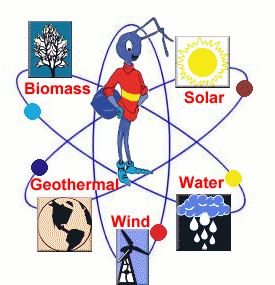
To get away from Russian natural gas as the primary source for heat and electric power, Ukraine seeks wants to invest in biomass heat plants, wind and solar power.
US and European officials have been trying to find ways to help Ukraine limit its dependence, including the possibility of US approval to export liquefied natural gas.
Vadym Glamazdin, the managing director of the Energy Industry Research Center (EIRC) suggests heating in Ukraine accounts for about 40 percent of all gas imported from Russia. This could be replaced with renewable energy within three to five years.
According to his words by 2030, renewables could account for about 15 percent of Ukraine’s electricity supply, currently it is only 2 percent.
The EIRC research shows that the most likely and adoptable form of renewable energy for Ukraine are biomass and biogas, as the nation’s network of electric-power lines and substations can’t easily adjust to the addition of significant amounts of wind and solar energy.
“The resources are there,” now the major challenge is to attract investment, Todd Foley, a senior vice president for policy and government relations at the American Council on Renewable Energy said.
One biomass plant could replace 24,000 natural gas boilers EIRC officials said.
Navajo art against uranium mining
Uranium mining should not be permitted.Daily Times, VENAYA YAZZIE, 17 April 14 “……..For the People’s Choice show I created an art piece specifically on the topic of uranium mining on the Navajo reservation, or as my people refer to the land of our ancestors – Dinétah. My Navajo tribe has endured many atrocities and triumphs since our forced exodus and return from Fort Sumner, in 1868. Yet, I believe the most terrible has been the disastrous effects of uranium mining on ancestral Navajo lands.
My painting which is titled ée’t’só: Roaming Monsters in Dinétah and Sodizin as Our Weapon, concerns the history of uranium mining in the 20th century, which shows that from 1944 to 1986 about four million tons of uranium ore was extracted throughout the reservation. Today, the Navajo reservation is riddled with 521 abandoned uranium mines, in the state of New Mexico alone there are 450. The disheartening fact is that most of these abandoned mines on the Navajo reservation have been declared contaminated sites and are no longer habitable. This fact alone is the reality that human rights to clean air, water and a healthy environment have been taken away. My hope is that this knowledge will not only bring awareness to the community, but also to the world that uranium mining should not be permitted……”
A sort of a comeback for renewable energy loan guarantees in USA
Loan Guarantees for U.S. Renewables Making a Comeback, National Geographc by Pete Danko on April 17, 2014 Federal loan guarantees for renewable energy, which spurred the development of massive projects like the recently completed Ivanpah Solar Electric Generating System in California – and roiled the 2012 elections – are emerging from hibernation.
More than two years after closing the last such loan guarantee, the U.S. Department of Energyannounced on Wednesday that it intends to make up to $4 billion available “for innovative renewable energy and energy efficiency projects located in the U.S. that avoid, reduce, or sequester greenhouse gases.”
The announcement sets the stage for the DOE to offer support for projects that incorporate one or more of five broad technology types [PDF]:
- “advanced grid integration and storage,” a key need in getting more intermittent renewable energy on the grid;
- “drop-in biofuels,” which could directly replace conventional fossil fuels in cars, planes and ships and function within the current distribution system;
- “waste-to-energy,” where waste gases and discarded materials are used in commercial-scale energy production;
- “enhancement of existing facilities,” such as adding power-production to existing dams that don’t have it;
- and “efficiency improvements,” a catchall that could range from residential building improvements to the recovery of energy from curtailed renewable energy systems……….
“The Loan Program Office portfolio is strong,” Reicher said. “You have a piece of this as a taxpayer, and it’s doing quite well.”
The portfolio is heavy with solar – the DOE notes that it backed the first five 100-megawatt-plus photovoltaic plants to go online in the United States – but will move into new realms now. That’s good news for companies like Wisconsin-based Virent, a developer of advanced biofuels technology……http://energyblog.nationalgeographic.com/2014/04/17/loan-guarantees-for-u-s-renewables-making-a-comeback/
The week in nuclear news

Christina Macpherson’s websites & blogs
Climate change in the news, following the IPCC report . The nuclear front group The Breakthrough Institute fraudulently pitches that report as a pro nuclear document
Economics.
Germany’s renewable energy output lowers European electricity prices
Some top nuclear executives are selling their stock. Commercial nuclear power shrinking, while plenty of uranium will last. Bavaria shuts down uneconomic nuclear plant. Czech Republic cancels nuclear power expansion
But there’s a bright side to nuclear economics , as nuclear companies get together to organise the global lucrative business of shutting down nuclear reactors.
Japan Harrassment of Mari Takenouchi a freelance Japanese journalist, who writes about radiation and Fukushima’s children – has escalated. A very worrying tip of the iceberg of silencing independent opinion about nuclear power and Fukushima.
Decision to restart nuclear reactors may backfire politically and economically on the Abe government. Much opposition from public and influential community leaders Government duplicity in radiation readings
UK. David Cameron acknowledges damage to offspring of nuclear test veterans. UK defence heavies bullying Scotland which wants to get rid of nuclear weapons base.
South Africa – boosting renewable energy
Radiation exposure leads to one cancer, and to another one, later on
 Link between radiation exposure and first and second cancers exposed by researchers http://www.naturalnews.com/044750_radiation_exposure_cancer_tumors.html, April 17, 2014 by: David Gutierre (NaturalNews) Large-scale population studies of survivors of the nuclear attacks on Hiroshima and Nagasaki have confirmed that radiation exposure can lead to multiple cancers that manifest separately over the course of years or decades — a finding with implications not just in cases of nuclear accidents or attacks but also for radiation-based cancer treatments.
The landmark study was conducted by researchers from the Fred Hutchinson Cancer Research Center, the Radiation Effects Research Foundation in Hiroshima and Nagasaki, and the National Cancer Institute, and published in the journal Cancer Research in September 2010. It found that the risk of developing a second cancer from radiation exposure was nearly identical to the risk of developing a first.
“Our findings suggest that cancer survivors with a history of radiation exposure should continue to be carefully monitored for second cancers,” said researcher Christopher I. Li, MD, PhD.
Certain organs more vulnerable
Radiation causes cancer when it damages the DNA of a cell but does not kill that cell outright. If the cell is unable to repair itself, it will continue to produce other mutated cells every time it divides. Eventually, this cluster of mutated cells may progress into clinical cancer.
Although the link between radiation and cancer is undisputed, researchers have been unsure to what degree a single radiation exposure can produce more than one cancer. To answer this question, researchers analyzed data from the Life Span Study of Hiroshima and Nagasaki survivors who had been followed from 1950 through 2002. Out of 10,031 people who survived a primary cancer, 1,088 eventually developed another form of cancer unrelated to the first (a “second primary cancer”).
“We found that radiation exposure increased the risks of first and second cancers to a similar degree,” Li said. “People exposed to radiation who developed cancer also had a high risk of developing a second cancer, and the risk was similar for both solid tumors and leukemias in both men and women, regardless of age at exposure or duration between first and second primary cancers.”
The most common first and second cancers to develop as a result of radiation were of the stomach, lungs, liver and female breast. Primary cancer survivors were also particularly prone to cancers of the colon, thyroid, bladder and blood. All these organs are known to be especially sensitive to radiation.
The study’s findings have obvious implications for the long-term care of people exposed to large amounts of radiation, whether through workplace exposure or through a nuclear accident such as at the Fukushima power plant in Japan.
“We greatly appreciate having the opportunity to conduct this unique research with our Japanese colleagues who, through innumerable publications, have truly transformed the tragedy of the atomic bombings to fundamental scientific advancements that have impacted radiation protection standards and policies worldwide,” Li said.
Implications for medicine
But the findings also have major implications for modern medicine, which is responsible for nearly half of all total radiation exposure experienced by the U.S. population, and well over half of the non-natural exposure experienced by most regular citizens.
“If irradiated at a young age, the lifetime risk is much higher than for those irradiated when older, and the risk is higher for females,” Lawrence said.
Radioactive trash from fracking is just booming
Radioactive Waste Booms With Fracking as New Rules Mulled, Bloomberg, By Alex Nussbaum Apr 16, 2014 Oilfields are spinning off thousands of tons of low-level radioactive trash as the U.S. drilling boom leads to a surge in illegal dumping and states debate how much landfills can safely take.
State regulators are caught between environmental and public health groups demanding more regulation and the industry, which says it’s already taking proper precautions. As scientists debate the impact of small amounts of radiation on cancer risks, the U.S. Environmental Protection Agency says there’s not enough evidence to say what level is safe.
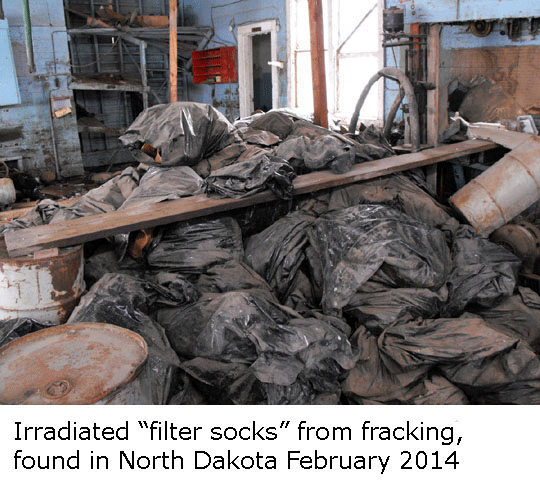
Left to police the waste, state governments are increasing their scrutiny of well operators. Pennsylvania and West Virginia are revising limits for acceptable radiation levels and strengthening disposal rules. North Dakota’s doing the same, after finding piles of garbage bags filled with radioactive debris in an abandoned building this year. “We have many more wells, producing at an accelerating rate, and for each of them there’s a higher volume of waste,” said Avner Vengosh, a professor of geochemistry at Duke University in Durham,North Carolina, who’s studied the issue. Without proper handling, “we are actually building up a legacy of radioactivity in hundreds of points where people have had leaks or spills around the country.”
Source: North Dakota Dept of Health via Bloomberg
On Feb. 28, North Dakota officials found hundreds of irradiated “filter socks” — used…Read More
The waste is a byproduct of the drilling renaissance that has brought U.S. oil and natural gas production to its highest levels in three decades — while also unlocking naturally occurring radium from rock formations far underground…….
Radium Contamination
The issue is shale rock, the dense formations found to hold immense reserves of gas and oil. Shale often contains higher levels of radium — a chemical element used in industrial X-ray diagnostics and cancer treatments — than traditional oil fields, Vengosh said.
Freeing gas and oil is a water-intensive process called hydraulic fracturing, or fracking, in which drill bits cut thousands of feet through shale fields to make way for high-pressure water streams that pulverize the rock. The process displaces radium-tinged subterranean water that comes up through the wells, where it can taint soil and surface equipment. Radiation levels can build up in sludges at the bottom of tanks, pipeline scale and other material that comes in extended contact with wastewater.
Buried Waste
Some states allow the contaminated material to be buried at the drill site. Some is hauled away, with varying requirements for tracking the waste. Some ends up in roadside ditches, garbage dumpsters or is taken to landfills in violation of local rules, said Scott Radig, director of the North Dakota Health Department’s Division of Waste Management.
In that state’s Bakken oilfields, “it’s a wink-and-a-nod situation,” said Darrell Dorgan, a spokesman for the North Dakota Energy Industry Waste Coalition, a group lobbying for stricter rules. “There’s hundreds of thousands of square miles in northwestern North Dakota and a lot of it is isolated. Nobody’s looking at where all of it is going.”…….http://www.bloomberg.com/news/2014-04-15/radioactive-waste-booms-with-oil-as-new-rules-mulled.html
$Millions spent on Uranium Processing Facility (UPF) “just gone”
 Irresponsible spending on nuclear weapons infrastructure http://thehill.com/blogs/congress-blog/economy-budget/203685-irresponsible-spending-on-nuclear-weapons-infrastructure By Eric Tamerlani 17 April 14 Hundreds of millions of tax dollars have been wasted on U.S. nuclear weapons infrastructure—again. The National Nuclear Security Administration (NNSA) wasted about $600 million on the design of the Uranium Processing Facility (UPF) in Oak Ridge, Tennessee.
The waste was confirmed by Bruce Held, NNSA administrator. In an April 8 House Armed Services Strategic Forces Subcommittee hearing chaired by Rep. Mike Rogers (R-Ala.), Held said that half of the $1.2 billion spent on designing the UPF is “just gone.”
Responsible for maintaining the nuclear weapons arsenal and laboratories that support the arsenal, NNSA is a federal civilian contracting agency that oversees major construction contracts. A major contract is defined by the Government Accountability Office (GAO) as having a value over $750 million.
NNSA’s major contracts are on GAO’s “High Risk List,” susceptible to fraud, waste, abuse and mismanagement. When it comes to big construction jobs, NNSA seems to have more money than sense. To their credit, NNSA has improved on managing projects less than $750 million; several smaller projects were completed on time and on budget. Unfortunately, the UPF is among the latest examples of NNSA’s failure to responsibly manage large contracts.
Half the money spent on designing the facility is gone with nothing to show for it. The start of UPF’s construction has been delayed by at least 10 years. According to Held, the facility may not be finished until 2038—“well after most people who are today working at Oak Ridge would be long retired.” Each representative and senator on the Appropriations Energy and Water subcommittees should wonder how a federal agency with several major contracts could let one project slip so perilously out of control. When mismanagement leads to exorbitant waste and abuse of the taxpayer, it is time to take a closer look. Rep. Rogers was right: it is awful.
Nuclear weapons facilities have operated on an assumption that government objectives are better met by the skill and expertise of private industry. Facilities would be owned by the government, and industry would be contracted to operate the facilities. That relationship has worked in some other functions of the Energy Department, particularly the Office of Science, but the model seems to have failed the UPF project.
The management and operating contractor for the UPF was Babcock and Wilcox Technical Services Y-12 (B&W), which has since been replaced on the project. NNSA would oversee B&W as the private contractor carried out the majority of the work to design and build the UPF. B&W was free to achieve the NNSA’s performance goals as they saw fit, which is in line with the thinking that government defers to the expertise of industry.
In the process, B&W subcontracted UPF’s design to four other companies and then failed to consolidate or supervise the subcontractors’ work. This led to an untenable design which was scrapped and over half a billion tax dollars were paid to a handful of companies for nothing the government could use. More rigorous performance standards for contractors have since been put in place. However, more can be done. A peer review process could be used at NNSA. Private engineers and managers from other contractors across the nuclear weapons complex could critique each other’s plans, under NNSA direction, before embarking on large construction projects. This would provide assessment of projects from companies that work for NNSA but are not working on the project being considered.
Additionally Congress could place the U.S. Army Corps of Engineers in charge of supervising all major NNSA construction projects until NNSA has a better track record with the GAO. The Corps has helped other parts of the government with fledgling construction responsibilities and they could teach the NNSA a thing or two.
The Friends Committee on National Legislation opposes all nuclear weapons and the facilities that support their modernization. However, you don’t have to be a Quaker or pacifist to realize the millions our government throws down the drain on the UPF and other mismanaged projects at NNSA is poor public policy.
Demanding accountability from federal contractors, requiring independent performance evaluation from across the complex, and supplementing industry expertise with the Army Corps of Engineers protects taxpayers from waste and abuse and certifies the NNSA can be effective at overseeing large projects that it delegates to industry.
Tamerlani is the program assistant for Nuclear Disarmament at the Friends Committee on National Legislation.
1 This Month
26 April – Chernobyl: Inside the Meltdown airs on National Geographic on Sunday 26th April from 4pm

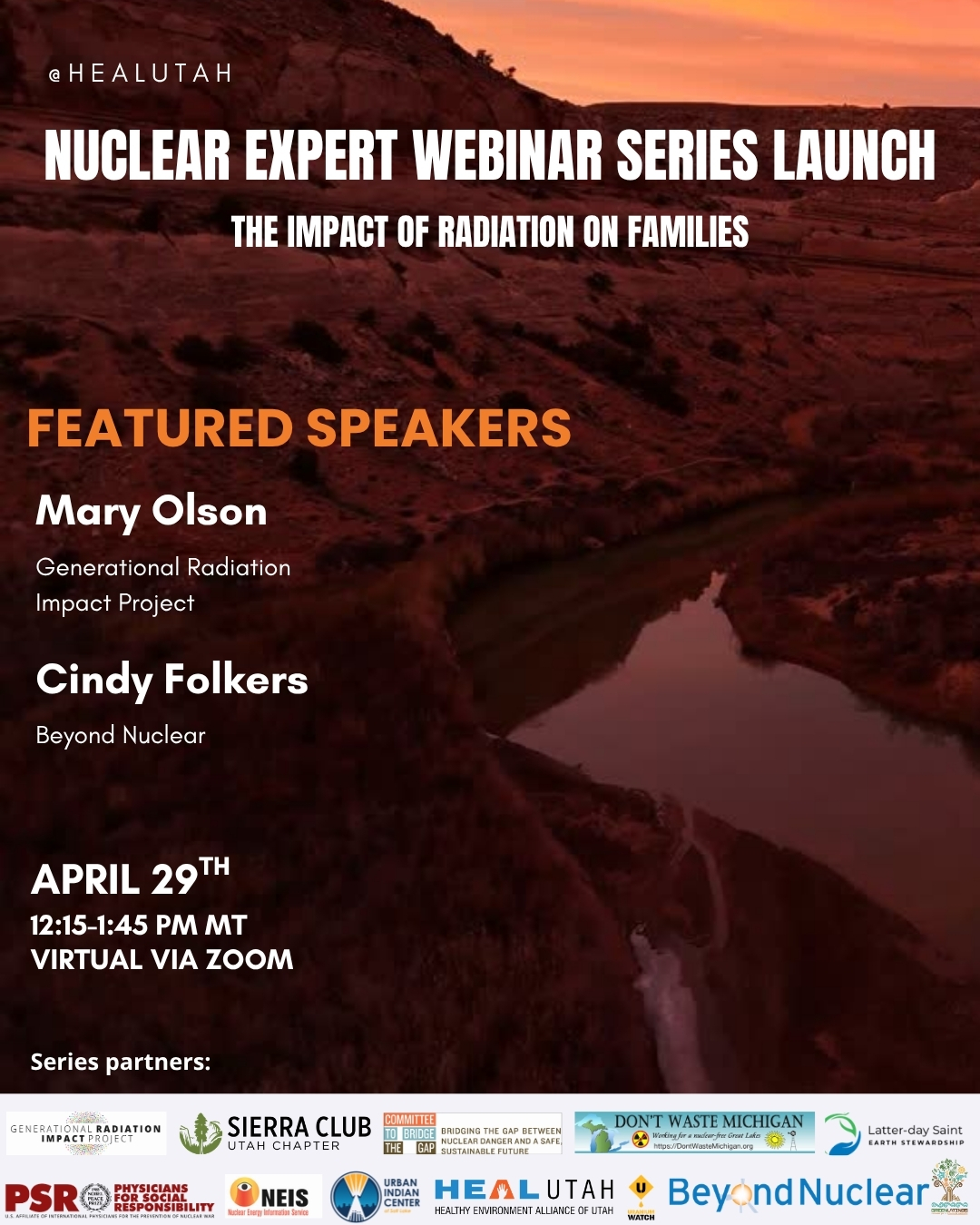
29 April – Nuclear Expert Webinar #1 – Radiation Impacts on Families with Mary Olson and Cindy Folkers
- 12:15 PM MT – 1:45 PM MT
- Location: Virtual – REGISTER TODAY

4 May -West Suburban Peace Coalition to discuss Iran war at May Educational Forum
Monday, May 4, 7:00 – 8:00 PM Central Standard Time
Title: : How Trump’s Narrative Tries to Shape the Reality of the War on Iran.
Contact Walt Zlotow, zlotow@hotmail.com 630 442 3045 for further information
14 May – online event From Bombs to Data Centres: the Face of Nuclear Colonialism

Pine Ridge Uranium is the real threat, not Tehran- Tell Burgum: Stop the Extraction.
Chernobyl: The Lost Tapes – A good documentary on Chernobyl on SBS available On Demand for the next 3 weeks– https://www.sbs.com.au/ondemand/tv-program/chernobyl-the-lost-tapes/2352741955560
To see nuclear-related stories in greater depth and intensity – go to https://nuclearinformation.wordpress.com
-
Archives
- April 2026 (288)
- March 2026 (251)
- February 2026 (268)
- January 2026 (308)
- December 2025 (358)
- November 2025 (359)
- October 2025 (376)
- September 2025 (257)
- August 2025 (319)
- July 2025 (230)
- June 2025 (348)
- May 2025 (261)
-
Categories
- 1
- 1 NUCLEAR ISSUES
- business and costs
- climate change
- culture and arts
- ENERGY
- environment
- health
- history
- indigenous issues
- Legal
- marketing of nuclear
- media
- opposition to nuclear
- PERSONAL STORIES
- politics
- politics international
- Religion and ethics
- safety
- secrets,lies and civil liberties
- spinbuster
- technology
- Uranium
- wastes
- weapons and war
- Women
- 2 WORLD
- ACTION
- AFRICA
- Atrocities
- AUSTRALIA
- Christina's notes
- Christina's themes
- culture and arts
- Events
- Fuk 2022
- Fuk 2023
- Fukushima 2017
- Fukushima 2018
- fukushima 2019
- Fukushima 2020
- Fukushima 2021
- general
- global warming
- Humour (God we need it)
- Nuclear
- RARE EARTHS
- Reference
- resources – print
- Resources -audiovicual
- Weekly Newsletter
- World
- World Nuclear
- YouTube
-
RSS
Entries RSS
Comments RSS
 nuclear-news