UV radiation an important component of climate change
UV-radiation data to help ecological research, Eureka Alert 22April 14 Many research projects study the effects of temperature and precipitation on the global distribution of plant and animal species. However, an important component of climate research, the UV-B radiation, is often neglected. The landscape ecologists from UFZ in collaboration with their colleagues from the Universities in Olomouc (Czechia), Halle and Lüneburg have processed UV-B data from the U.S. NASA space agency in such a way that they can be used to study the influence of UV-B radiation on organisms. Continue reading
Nuclear power plants operating license fees to go up
Indian Point nuclear licenses to cost more lohud.com Michael Risinit April 22, 2014 The Nuclear Regulatory Commission collects most of the money in its budget from the nation’s nuclear plants, including Indian Point. our first driver’s license at 16 will cost you $80. A resident hunting license? $22. A license to operate a nuclear reactor? Millions.
While most of your tax dollars go toward the agencies and departments involved with healthcare, defense and the national debt, the Nuclear Regulatory Commission gets most of its money from the industry it oversees. By law, the NRC must recover about 90 percent of its budget from license charges, spokesman Neil Sheehan said.
This year the fee is going up by $938,000. That means Entergy, the owner of Indian Point nuclear power plant, and the country’s other nuclear power companies must pony up $5,328,000 for each running reactor. That money will go back into the U.S. Treasury’s general fund………http://www.lohud.com/story/news/local/indian-point/2014/04/22/nuclear-plant-licenses-costly-indian-point-owner/8004159/
Computer based tool to solve problems in burial of nuclear wastes
Nuclear waste heads into the virtual realm Physics World, Apr 16, 2014 A new computer-based tool designed to help find the best sites for nuclear-waste repositories and to win public confidence in them has been developed by researchers in Germany. The €3m VIRTUS virtual underground laboratory will allow scientists to explore the behaviour of highly radioactive materials inside specific rock formations, with the aim of making it cheaper to develop and build repositories. Critics, however, argue that the new software will do little to improve safety and might disrupt real laboratory studies of nuclear waste.
Underground disposal
Many scientists believe that the best way to dispose of spent nuclear fuel and other long-lived radioactive materials is to bury them hundreds of metres underground, with Sweden and Finland having both selected sites for national waste repositories next to existing nuclear power stations. France also plans to open its own facility in 2025, and, like Sweden, has built a major underground lab to test the geology and technologies to be used at the site.
However, there are severe technical and societal problems associated with repositories, not least that the waste they contain will remain harmful for hundreds of thousands of years. The development of a national repository in Germany, for example, has been mired in controversy. A formal site-selection process has still to be set up, even though exploratory work at the Gorleben salt mine in the north of the country began as far back as the 1970s. The nearby Asse mine, meanwhile, was set up in the 1960s as a research facility but was decommissioned in 1997 after a brine leak threatened to flood the complex and cause it to collapse.
Developed by the Fraunhofer Institute for Factory Operation and Automation (IFF) in Magdeburg, together with Germany’s nuclear-safety organization (GRS), the Federal Institute for Geosciences and Natural Resources and the waste-repository company DBE Technology, VIRTUS will attempt to partially address this issue. The software enables detailed models of specific rock formations or mine structures to be created and then fed into a simulation to calculate how a repository would evolve physically and chemically over time. The results of these calculations can then be visualized graphically, and it is planned that members of the public will in future be able to see those graphics inside a 360° projection system…….http://physicsworld.com/cws/article/news/2014/apr/16/nuclear-waste-heads-into-the-virtual-realm
Renewable energy in Pacific Islands – promoted by New Zealand and European Union
New Zealand, EU push ahead with renewable energy initiatives in Pacific http://www.shanghaidaily.com/article/article_xinhua.aspx?id=213961 Apr 22,2014 WELLINGTON, (Xinhua) — A joint New Zealand-European Union (EU) mission will tour four Pacific island countries this week to assess progress on renewable energy projects, New Zealand Foreign Affairs Minister Murray McCully announced Tuesday.
The tour follows up on the Pacific Energy Summit in New Zealand in March last year and the launch of the European Union-New Zealand Energy Access Partnership to fund renewable energy projects in the region. The summit’s aim was to move Pacific nations closer to achieving 50 percent of their electricity from renewable means and 635 million NZ dollars (545.02 million U.S. dollars) was secured for Pacific energy projects.
“This mission is an opportunity to see the progress being made on renewable energy initiatives in Samoa, Tuvalu, Kiribati, and the Cook Islands, and to meet with the Pacific governments and organizations to discuss opportunities for further cooperation,” McCully said in a statement. “Representatives from the World Bank, the Asian Development Bank and the International Renewable Energy Agency are also joining the mission to gain further insight into the potential for sustainable energy across the Pacific,” he said.
“Renewable energy is a strong focus of our support to developing countries and we are committed to working with partners like the European Union to deliver clean, safe and reliable energy projects.”
European Commissioner Andris Piebalgs, who will accompany McCully on the mission, said the EU projects included solar panels installed to renewable provide electricity in Apia, extending the availability of reliable electricity with solar panels for Tuvalu’ s outer islands, and agreeing with the Asian Development Bank to construct six photovoltaic power plants in the Cook Islands.
In Kiribati, Piebalgs would also launch a barge that would protect Tarawa’s beaches from silt build-up and open a laboratory dedicated to monitoring and responding to environmental diseases.
Both projects were necessary to mitigate the effects of climate change in Kiribati, Piebalgs said in a statement.
New technology brings renewable energy’s challenge to the old power systems
Renewables changing the nature of power Crikey, GUY RUNDLE | APR 22, 2014 New technology has dramatically increased the possibilities of renewable energy. But the material revolution challenges those who want to preserve the existing relations of production, consumption and energy.
Halfway through April this year, scientists at Harvard and MIT announced something extraordinary: they had found a way to create solar cells that can store accumulated energy from sunlight, and then — with no more than a burst of afew photons, release that energy....(registered readers only) http://www.crikey.com.au/2014/04/22/rundle-renewables-changing-the-nature-of-power-and-manufacturing/?wpmp_switcher=mobile
The rise and rise of solar power: the fall and fall of nuclear
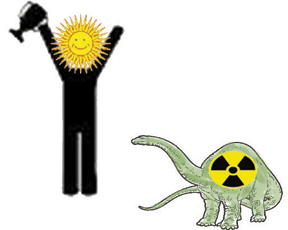 As nuclear power dies, solar rises By Denis Hayes and Scott Denman April 22, 2014 (CNN) – At long last, this Earth Day we celebrate the true dawn of the Solar Age. That sunrise is hastened, here and abroad, by the slow demise of the once-touted “too-cheap-to-meter” Atomic Age of nuclear power.
As utilities find nuclear power less and less cost effective, new solar photovoltaic installations in the United States are springing up. New solar installations in 2013 reached a record 4.2 gigawatts, bringing the total to 10. On average, one gigawatt of solar photovoltaics powers 164,000 U.S. homes. That means power for 1.6 million homes.
Worldwide, in 2013, solar power installations grew by 38 gigawatts, from 96 to 134. According to the World Nuclear Industry Status Report 2013, in the preceding year, 45 gigawatts of wind and 32 gigawatts of solar power were installed worldwide, compared with a net addition of just 1.2 gigawatts of nuclear.
Hastening this energy revolution is the nuclear industry’s Achilles heel: an aging, dangerous reactor fleet that is increasingly uncompetitive and new reactor designs that are too expensive to build.
Last year, utilities permanently shuttered five more reactors, lowering the number of operating units in the United States to fewer than 100 for the first time in two decades. Utility owners canceled at least nine planned upgrades of existing reactors, deeming the investments no longer economically justifiable.
Additionally, nine planned new nuclear reactors were axed in 2013, an indication of how rapidly things have changed. Just five years ago, utilities applied for licenses to construct at least 27 new reactors. By the close of 2013, only four of those reactor projects were still alive……. http://edition.cnn.com/2014/04/22/opinion/hayes-denman-solar-power/
Corporate investment in renewable energy is the goal for Business Renewables Resource Center
 Getting Fortune 500 To Invest Much More In Renewable Energy (VIDEO) Clean Technic a 23 April 14 Last week, RMI’s program to significantly scale the commitment by Fortune 500 companies to source renewable energy was chosen as one of six winners at the Bloomberg New Energy Finance Summit’s Finance for Resilience (“FiRe”) event. FiRe is designed to identify the best proposals to spur increased investment in renewables and scale them as quickly as possible.
RMI’s plan is to create a Business Renewables Resource Center that will help to double clean energy cash flows by 2019 by increasing clean energy procurement by large commercial and industrial companies. While the Center will initially focus on the U.S. market, the capability will effectively travel within these large corporations to other countries…. http://cleantechnica.com/2014/04/22/fortune-500-double-source-renewable-energy/#2QK86PoTqu7xtXtb.99
Those outside Fukushima receive no help with health monitoring although contamination has spread far beyond the prefectural border 福島県外の被曝健康調査は全て自助努力となっており、国は必要性を認めていない。
This is a badly translated version of the article that was posted to Face book by https://www.facebook.com/kodomo.zenkokunet/posts/811383438890181?notif_t=notify_me
from this article in Japanese
http://www.tokyo-np.co.jp/s/article/2014042290071034.html
Dated ; 2014年4月22日 07時10分
The original article in Japanese has been posted below for our Japanese speakers to disseminate fully…
Here is the rough translation in English by arclight2011part2
Extract
[…]
Concerning the TEPCO nuclear power plant nuclear disaster, the health testing in the Fukushima prefecture, this is not reproduced in other areas where high levels of radiation have been found. There are not funds made available to these other contaminated areas.
Last September a co-operative was formed and an ultrasound device was purchased for some 3 million Yen to voluntarily check in Ibaraki and Chiba prefectures supported by 3 volunteer doctors.
To support this effort a charge of 1,000 Yen is charged to individuals who undergo the tests. The testing was inundated by requests and 816 people had been examined by March 2014
A high dose of radioactivity area at the same level as Fukushima is had. I am going to inspect the fund in future in the other main prefecture including Tochigi.
In the metropolitan area, I observe 0.40 0.30 an mcSv/h ( 0.23 mcSv/h is the decontamination target of the country) even after space radiation dose comes in districts such as Yorii, Nasumachi, Tochigi or Nasu-Shiobara-shi Sekiya in this year.
The self-governing body supports the expense that inhabitants are examined on an original budget at hospitals.
In Nasumachi, inTochigi, the total amount supports examination of thyroid gland costs for children 18 years or younger. Tsukuba-shi or Joso City supports a 3,000 yen cost in the upper limit in Ibaraki prefecture. Matsudo-shi begins the furtherance of the same amount soon, for the first time in Chiba prefecture.
As for all the inhabitants who were younger than 18 years old, it received an examination of thyroid gland at the time of a nuclear plant accident at no cost in Fukushima by the assistance of the govenment. In the other areas with no assistance, it is forced to a self fund through private enterprise and a NGO`s.
The Government didn’t specify health investigation enforcement outside of Fukushima in a basic policy of the child / victim support method in a cabinet decision last October.
An opinion said [you should carry testing out out of the prefecture] was sent, but the government didn’t accept that opinion as there isn’t the possibility that increase is accepted because of the health advice concerning radiation by the report of the World Health Organization (WHO) of last February 2014.
I demanded it, but the governement doesn’t accept the opinion, so that nine mayors of Chiba guarantee Fukushima and the health care of the residents such as pregnant women who had a child since last October.
Shoji Sawada / the Masaru Nagoya honorary professor points it out with [the country may be afraid that inspection costs could become enormous]. [there is the person who shows a problem with a very small amount of radiation.] It is the abandonment of the responsibility of the government and the present conditions that a self-governing body (NGO) and the volunteers that a nuclear plant accident is cannot fully test for prooblems.
The seminar that it obeyed a basic policy to leave slight possibility for examination with public funds out of Fukushima, and was installed in Ministry of the Environment……
I reexamine the ideal method of the health care and give a conclusion by the end of 2014….. snip ends
[…]
Full article in Japanese – 日本語記事全文
東京電力福島第一原発事故を受け、福島県以外の地域で、住民団体が被ばく検査を自主的に実施したり、自治体が支援したりする動きが広がっている。背 景には、首都圏などでも局所的に空間放射線量が高い地域があるのに、福島県のように国費で被ばく検査する制度がないので自助努力せざるを得ないという、苦 渋の現実がある。 (大野暢子(まさこ)、写真も)
首都圏の母親や常総生協(茨城県守谷市)が、昨年九月「関東子ども健康調査支援基金」を設立。三百万円を出し合ってエコー検査機を購入し、茨城、千葉両県の公民館などで毎月、子どもの甲状腺検査を続けている。医師三人がボランティアで活動を支える。
受検者から千円のカンパをもらうが、「郊外の会場でも、定員がすぐに埋まってしまう」と荻(おぎ)三枝子共同代表(60)。三月までに計八百十六人が受検した。
1 This Month

of the week – Shut Down Drone Warfare!


Tell the Ukrainian Government to Drop Prosecution of Peace Activist Yurii Sheliazhenko

Petition to revoke the licensing of the Near Surface Nuclear Disposal Facility (NSDF) at Chalk River. https://www.ourcommons.ca/petitions/en/Petition/Details?Petition=e-7247
To see nuclear-related stories in greater depth and intensity – go to https://nuclearinformation.wordpress.com
-
Archives
- April 2026 (57)
- March 2026 (251)
- February 2026 (268)
- January 2026 (308)
- December 2025 (358)
- November 2025 (359)
- October 2025 (376)
- September 2025 (257)
- August 2025 (319)
- July 2025 (230)
- June 2025 (348)
- May 2025 (261)
-
Categories
- 1
- 1 NUCLEAR ISSUES
- business and costs
- climate change
- culture and arts
- ENERGY
- environment
- health
- history
- indigenous issues
- Legal
- marketing of nuclear
- media
- opposition to nuclear
- PERSONAL STORIES
- politics
- politics international
- Religion and ethics
- safety
- secrets,lies and civil liberties
- spinbuster
- technology
- Uranium
- wastes
- weapons and war
- Women
- 2 WORLD
- ACTION
- AFRICA
- Atrocities
- AUSTRALIA
- Christina's notes
- Christina's themes
- culture and arts
- Events
- Fuk 2022
- Fuk 2023
- Fukushima 2017
- Fukushima 2018
- fukushima 2019
- Fukushima 2020
- Fukushima 2021
- general
- global warming
- Humour (God we need it)
- Nuclear
- RARE EARTHS
- Reference
- resources – print
- Resources -audiovicual
- Weekly Newsletter
- World
- World Nuclear
- YouTube
-
RSS
Entries RSS
Comments RSS
 nuclear-news