The week in nuclear news

Christina Macpherson’s websites & blogs
Climate change in the news, following the IPCC report . The nuclear front group The Breakthrough Institute fraudulently pitches that report as a pro nuclear document
Economics.
Germany’s renewable energy output lowers European electricity prices
Some top nuclear executives are selling their stock. Commercial nuclear power shrinking, while plenty of uranium will last. Bavaria shuts down uneconomic nuclear plant. Czech Republic cancels nuclear power expansion
But there’s a bright side to nuclear economics , as nuclear companies get together to organise the global lucrative business of shutting down nuclear reactors.
Japan Harrassment of Mari Takenouchi a freelance Japanese journalist, who writes about radiation and Fukushima’s children – has escalated. A very worrying tip of the iceberg of silencing independent opinion about nuclear power and Fukushima.
Decision to restart nuclear reactors may backfire politically and economically on the Abe government. Much opposition from public and influential community leaders Government duplicity in radiation readings
UK. David Cameron acknowledges damage to offspring of nuclear test veterans. UK defence heavies bullying Scotland which wants to get rid of nuclear weapons base.
South Africa – boosting renewable energy
Radiation exposure leads to one cancer, and to another one, later on
 Link between radiation exposure and first and second cancers exposed by researchers http://www.naturalnews.com/044750_radiation_exposure_cancer_tumors.html, April 17, 2014 by: David Gutierre (NaturalNews) Large-scale population studies of survivors of the nuclear attacks on Hiroshima and Nagasaki have confirmed that radiation exposure can lead to multiple cancers that manifest separately over the course of years or decades — a finding with implications not just in cases of nuclear accidents or attacks but also for radiation-based cancer treatments.
The landmark study was conducted by researchers from the Fred Hutchinson Cancer Research Center, the Radiation Effects Research Foundation in Hiroshima and Nagasaki, and the National Cancer Institute, and published in the journal Cancer Research in September 2010. It found that the risk of developing a second cancer from radiation exposure was nearly identical to the risk of developing a first.
“Our findings suggest that cancer survivors with a history of radiation exposure should continue to be carefully monitored for second cancers,” said researcher Christopher I. Li, MD, PhD.
Certain organs more vulnerable
Radiation causes cancer when it damages the DNA of a cell but does not kill that cell outright. If the cell is unable to repair itself, it will continue to produce other mutated cells every time it divides. Eventually, this cluster of mutated cells may progress into clinical cancer.
Although the link between radiation and cancer is undisputed, researchers have been unsure to what degree a single radiation exposure can produce more than one cancer. To answer this question, researchers analyzed data from the Life Span Study of Hiroshima and Nagasaki survivors who had been followed from 1950 through 2002. Out of 10,031 people who survived a primary cancer, 1,088 eventually developed another form of cancer unrelated to the first (a “second primary cancer”).
“We found that radiation exposure increased the risks of first and second cancers to a similar degree,” Li said. “People exposed to radiation who developed cancer also had a high risk of developing a second cancer, and the risk was similar for both solid tumors and leukemias in both men and women, regardless of age at exposure or duration between first and second primary cancers.”
The most common first and second cancers to develop as a result of radiation were of the stomach, lungs, liver and female breast. Primary cancer survivors were also particularly prone to cancers of the colon, thyroid, bladder and blood. All these organs are known to be especially sensitive to radiation.
The study’s findings have obvious implications for the long-term care of people exposed to large amounts of radiation, whether through workplace exposure or through a nuclear accident such as at the Fukushima power plant in Japan.
“We greatly appreciate having the opportunity to conduct this unique research with our Japanese colleagues who, through innumerable publications, have truly transformed the tragedy of the atomic bombings to fundamental scientific advancements that have impacted radiation protection standards and policies worldwide,” Li said.
Implications for medicine
But the findings also have major implications for modern medicine, which is responsible for nearly half of all total radiation exposure experienced by the U.S. population, and well over half of the non-natural exposure experienced by most regular citizens.
“If irradiated at a young age, the lifetime risk is much higher than for those irradiated when older, and the risk is higher for females,” Lawrence said.
Radioactive trash from fracking is just booming
Radioactive Waste Booms With Fracking as New Rules Mulled, Bloomberg, By Alex Nussbaum Apr 16, 2014 Oilfields are spinning off thousands of tons of low-level radioactive trash as the U.S. drilling boom leads to a surge in illegal dumping and states debate how much landfills can safely take.
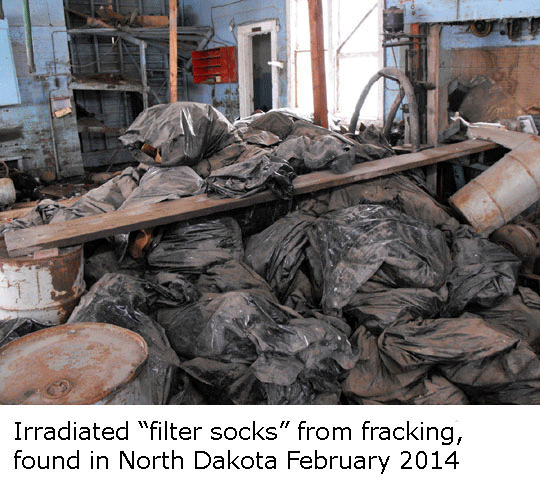
State regulators are caught between environmental and public health groups demanding more regulation and the industry, which says it’s already taking proper precautions. As scientists debate the impact of small amounts of radiation on cancer risks, the U.S. Environmental Protection Agency says there’s not enough evidence to say what level is safe.
Left to police the waste, state governments are increasing their scrutiny of well operators. Pennsylvania and West Virginia are revising limits for acceptable radiation levels and strengthening disposal rules. North Dakota’s doing the same, after finding piles of garbage bags filled with radioactive debris in an abandoned building this year. “We have many more wells, producing at an accelerating rate, and for each of them there’s a higher volume of waste,” said Avner Vengosh, a professor of geochemistry at Duke University in Durham,North Carolina, who’s studied the issue. Without proper handling, “we are actually building up a legacy of radioactivity in hundreds of points where people have had leaks or spills around the country.”
Source: North Dakota Dept of Health via Bloomberg
On Feb. 28, North Dakota officials found hundreds of irradiated “filter socks” — used…Read More
The waste is a byproduct of the drilling renaissance that has brought U.S. oil and natural gas production to its highest levels in three decades — while also unlocking naturally occurring radium from rock formations far underground…….
Radium Contamination
The issue is shale rock, the dense formations found to hold immense reserves of gas and oil. Shale often contains higher levels of radium — a chemical element used in industrial X-ray diagnostics and cancer treatments — than traditional oil fields, Vengosh said.
Freeing gas and oil is a water-intensive process called hydraulic fracturing, or fracking, in which drill bits cut thousands of feet through shale fields to make way for high-pressure water streams that pulverize the rock. The process displaces radium-tinged subterranean water that comes up through the wells, where it can taint soil and surface equipment. Radiation levels can build up in sludges at the bottom of tanks, pipeline scale and other material that comes in extended contact with wastewater.
Buried Waste
Some states allow the contaminated material to be buried at the drill site. Some is hauled away, with varying requirements for tracking the waste. Some ends up in roadside ditches, garbage dumpsters or is taken to landfills in violation of local rules, said Scott Radig, director of the North Dakota Health Department’s Division of Waste Management.
In that state’s Bakken oilfields, “it’s a wink-and-a-nod situation,” said Darrell Dorgan, a spokesman for the North Dakota Energy Industry Waste Coalition, a group lobbying for stricter rules. “There’s hundreds of thousands of square miles in northwestern North Dakota and a lot of it is isolated. Nobody’s looking at where all of it is going.”…….http://www.bloomberg.com/news/2014-04-15/radioactive-waste-booms-with-oil-as-new-rules-mulled.html
$Millions spent on Uranium Processing Facility (UPF) “just gone”
 Irresponsible spending on nuclear weapons infrastructure http://thehill.com/blogs/congress-blog/economy-budget/203685-irresponsible-spending-on-nuclear-weapons-infrastructure By Eric Tamerlani 17 April 14 Hundreds of millions of tax dollars have been wasted on U.S. nuclear weapons infrastructure—again. The National Nuclear Security Administration (NNSA) wasted about $600 million on the design of the Uranium Processing Facility (UPF) in Oak Ridge, Tennessee.
The waste was confirmed by Bruce Held, NNSA administrator. In an April 8 House Armed Services Strategic Forces Subcommittee hearing chaired by Rep. Mike Rogers (R-Ala.), Held said that half of the $1.2 billion spent on designing the UPF is “just gone.”
Responsible for maintaining the nuclear weapons arsenal and laboratories that support the arsenal, NNSA is a federal civilian contracting agency that oversees major construction contracts. A major contract is defined by the Government Accountability Office (GAO) as having a value over $750 million.
NNSA’s major contracts are on GAO’s “High Risk List,” susceptible to fraud, waste, abuse and mismanagement. When it comes to big construction jobs, NNSA seems to have more money than sense. To their credit, NNSA has improved on managing projects less than $750 million; several smaller projects were completed on time and on budget. Unfortunately, the UPF is among the latest examples of NNSA’s failure to responsibly manage large contracts.
Half the money spent on designing the facility is gone with nothing to show for it. The start of UPF’s construction has been delayed by at least 10 years. According to Held, the facility may not be finished until 2038—“well after most people who are today working at Oak Ridge would be long retired.” Each representative and senator on the Appropriations Energy and Water subcommittees should wonder how a federal agency with several major contracts could let one project slip so perilously out of control. When mismanagement leads to exorbitant waste and abuse of the taxpayer, it is time to take a closer look. Rep. Rogers was right: it is awful.
Nuclear weapons facilities have operated on an assumption that government objectives are better met by the skill and expertise of private industry. Facilities would be owned by the government, and industry would be contracted to operate the facilities. That relationship has worked in some other functions of the Energy Department, particularly the Office of Science, but the model seems to have failed the UPF project.
The management and operating contractor for the UPF was Babcock and Wilcox Technical Services Y-12 (B&W), which has since been replaced on the project. NNSA would oversee B&W as the private contractor carried out the majority of the work to design and build the UPF. B&W was free to achieve the NNSA’s performance goals as they saw fit, which is in line with the thinking that government defers to the expertise of industry.
In the process, B&W subcontracted UPF’s design to four other companies and then failed to consolidate or supervise the subcontractors’ work. This led to an untenable design which was scrapped and over half a billion tax dollars were paid to a handful of companies for nothing the government could use. More rigorous performance standards for contractors have since been put in place. However, more can be done. A peer review process could be used at NNSA. Private engineers and managers from other contractors across the nuclear weapons complex could critique each other’s plans, under NNSA direction, before embarking on large construction projects. This would provide assessment of projects from companies that work for NNSA but are not working on the project being considered.
Additionally Congress could place the U.S. Army Corps of Engineers in charge of supervising all major NNSA construction projects until NNSA has a better track record with the GAO. The Corps has helped other parts of the government with fledgling construction responsibilities and they could teach the NNSA a thing or two.
The Friends Committee on National Legislation opposes all nuclear weapons and the facilities that support their modernization. However, you don’t have to be a Quaker or pacifist to realize the millions our government throws down the drain on the UPF and other mismanaged projects at NNSA is poor public policy.
Demanding accountability from federal contractors, requiring independent performance evaluation from across the complex, and supplementing industry expertise with the Army Corps of Engineers protects taxpayers from waste and abuse and certifies the NNSA can be effective at overseeing large projects that it delegates to industry.
Tamerlani is the program assistant for Nuclear Disarmament at the Friends Committee on National Legislation.
Secret deals trapping Turkey into buying Japanese nuclear technology
 Why would the Western authorities allow a country like Turkey to have nuclear plants?
Because it can trap such a nation under secret deals of the colluding powers, expanding and stabilizing their profit-oriented status quo guaranteed by the magic words “national security”
Japanese Nuclear Plants For Sale http://www.opednews.com/articles/Japanese-Nuclear-Plants-Fo-by-Hiroyuki-Hamada-Fukushima-Meltdown_Government-Industry-Collusion_Government-Transparency_National-Security-140417-354.html?show=votes
By Hiroyuki Hamada 17 April 14 I don’t understand why people are not talking about this but here it goes. Japan has been working hard to export nuclear plants. That’s odd, right? After what happened in Fukushima? I mean who would want it? And if you want it, would you get it from Japan?
Here is an interesting fact. Japan has accumulated at least 4000 nuclear warheads’ worth of plutonium, and in fact, it used to export plutonium to England where it was used to make nuclear weapons (1). And that is actually an enormous feat for a nation with a peace constitution that bans wars as a means of conflict resolution, and for a nation with multiple regulations guarding against exporting weapons, which of course stipulate anything nuclear as a big no. What I’m trying to say is that Japan has been very very dishonest about its nuclear policies. The numbers and the facts, which have become available after the accident, state that the nuclear energy has not been as efficient as what has been claimed, while the safety measures and potential risks have not been the primary concerns. In fact some of us now believe that the primary reason why Japan acquired nuclear energy at the first place was to acquire bomb- making capability, along with the lucrative deals guaranteed by the western nuclear authorities (2).
Last year, one of the Japanese parliament members demanded detailed info regarding the export of the nuclear plant to Vietnam. Many of us were stunned to see the disclosed papers completely filled with black rectangles, the contents were pretty much all censored due to national-security concerns (3).
Now, why would anyone want a nuclear plant from Japan? Continue reading
IAEA says Iran has made drastic cuts in its stock of highly enriched uranium
 Iran slashes nuclear stock, says UN http://www.skynews.com.au/world/article.aspx?id=968784 April 18, 2014 Iran has cut its stock of highly-enriched uranium by 75 per cent, a new report by the UN’s nuclear watchdog has revealed.
The monthly update by the International Atomic Energy Agency (IAEA) showed Tehran remained in compliance with a November interim deal made with world powers, drawn up as part of efforts to find a lasting solution to Iran’s controversial nuclear drive.
Under the agreement, Iran pledged to ‘dilute’ half of its highly-enriched uranium by mid-April, with the rest to be converted by mid-July.
The IAEA report also said that progress on a plant in Tehran that will be used for the conversion of low-enriched uranium had been delayed, but that Iran had said this will not prevent it from fulfilling its part of the deal by the July 20 deadline.
Diplomats who saw the document told AFP everything was in order.
The international community was ‘keeping an eye’ on progress at the conversion plant in Tehran, one of the diplomats added.
Under the November deal, Iran agreed to freeze parts of its nuclear activities, including limiting enrichment. Enriching uranium can be part of a peaceful atomic drive but can also produce weapons-grade material for a bomb.
Tehran has consistently said its nuclear program is for civilian purposes only, while the West believes it has a military dimension.
Iran and six world powers – the US, Russia, China, Britain, France and Germany — will next meet on May 13 in a bid to draw up a lasting accord and end the decade-old standoff over Iran’s nuclear program.
2014 A leap ahead for renewable energy businesses?
 Clean energy: Is a boom coming in 2014?, Christian Science Monitor, 16 April 14 Clean energy is off to a strong start in 2014, with global investment rising as prices for wind and solar power continue to drop. Renewables still hold a small share of total energy mixes, but clean-energy growth is picking up momentum.
By David J. Unger, Staff writer / April 16, 2014 he first quarter of 2014 may ease any worries about clean energy’s future. After two years of annual declines, investments in clean energy worldwide jumped 9 percent year-over-year in the first quarter of 2014, according to data released Wednesday by Bloomberg New Energy Finance (BNEF), a London-based energy analysis firm. Solar power led the way with a 23 percent increase, more than offsetting a 16 percent decline in wind power. All told, investors spent $47.7 billion on renewables and energy efficiency in the first three months of this year.
Global investment in renewable energy is up, technology costs continue to drop precipitously, and markets are expanding into emerging economies in Asia, the Middle East, and Africa. The industry still has a long way to go, and many say a shift to cleaner energy is happening too slowly to offset the downsides of carbon-heavy fuels. Even so, the broad, global outlook for renewables is bright, and deployment of the technology verges on rapid acceleration.
It is too early to say definitively that 2013 was the low point for clean energy investment worldwide and that 2014 will show a rebound, but the first-quarter numbers are encouraging,” Michael Liebreich, chairman of the advisory board for Bloomberg New Energy Finance, said in a statement Wednesday.
The bulk of the gains came in the form of small-scale solar installations, like residential rooftop solar panels. It suggests that falling prices and new financing options are quickly eroding the barriers to entry that long discouraged consumers from home solar. The cost of a rooftop solar array has dropped from nearly $7 per watt in 2008 to $4 or less in 2013, according to an April report by McKinsey & Company, a global consulting firm.
Clean-energy growth isn’t limited to the world’s developed economies. Brazil saw the biggest investment gain, jumping 211 percent year-over-year to $1.3 billion in the first quarter of 2014, according to BNEF. Investment grew 82 percent to $2.4 billion in the Middle East and Africa.
“In Q1, we saw two of the top four asset finance deals happening in Indonesia and Kenya,” Mr. Liebreich said in a statement……..http://www.csmonitor.com/Environment/Energy-Voices/2014/0416/Clean-energy-Is-a-boom-coming-in-2014
UK’s surviving atomic test veterans cautiously welcome David Cameron’s statement
Thorpe St Andrew nuclear test veteran speaks of defect fears, after PM gives  hope to families, Norwich Evening News 24, 17 April 14
“………Veterans say they were made ill as a result of being exposed to radiation during the tests, and have been battling for recognition and compensation for years.
Mr Freeman, a father-of-three and grandfather-of-eight, said his ninth grandchild was expected next month, but added: “I’ve got grandchildren who suffer from deafness and one was born with one kidney. With another grandchild due, we are all worried that everything is going to be OK, as you can never tell.”
Nuclear test campaigners say Mr Cameron’s pledge is the closest they have been to formal recognition of the suffering caused by the South Pacific explosions. The meeting between Mr Cameron and Tory MP John Baron last week was the first time the veterans had their case put forward to any prime minister.
Mr Baron, patron of the British Nuclear Test Veterans’ Association, told the PM descendants had 10 times the normal rate of birth defects, their wives had elevated rates of miscarriage, and no other veterans’ group had suffered harm which spread down the generations. France, the US, Australia, New Zealand, Russia, China and even the Isle of Man recognise and compensate test veterans. The MoD has always insisted no harm befell the men.
Are you a veteran of nuclear testing living in the Norwich area? Email reporter David Bale at david.bale2@archant.co.uk http://www.eveningnews24.co.uk/news/thorpe_st_andrew_nuclear_test_veteran_speaks_of_defect_fears_after_pm_gives_hope_to_families_1_3562535
Obama does what he can to promoter solar energy
Obama to challenge private companies to boost solar power use WP, By Juliet Eilperin and Katie Zezima, April 16 E-mail the writers
President Obama will challenge companies Thursday to expand their use of solar power, part of his ongoing effort to leverage the power of his office to achieve goals that have been stymied by Congress. The new initiative comes as the White House is hosting a Solar Summit aimed at highlighting successful efforts on the local level to speed the deployment of solar energy…….
“Now is the time for solar,” said Anya Schoolman, executive director of theCommunity Power Network, a Washington-based nonprofit group that helps communities build renewable energy projects. She will be honored at the summit Thursday.
“The costs are affordable, in reach of middle America and above. We know how to do it now, we know how to scale it, and we kind of just need people to let it go and encourage it,” she said.
In an effort to make it easier for state, local and tribal governments to expand their solar portfolios, the Energy Department is launching a $15 million-dollar “Solar Market Pathways” program………
States are starting novel ways to help commercial tenants access solar energy. In Connecticut, the state set up a green bank with taxpayer dollars. When a building owner wants to access capital for solar projects, the state puts a tax lien on the building and gives the owner a loan that must be paid back over 20 years, said Jessica Bailey of theConnecticut Clean Energy Finance and Investment Authority.…
Rhone Resch, president and chief executive of the Solar Energy Industries Association, a trade group, said solar is no longer an “afterthought” in the renewable energy conversation, accounting for nearly 30 percent of new electric in 2013.
“Without question, the Obama administration has been the most solar-friendly ever,” Resch said. http://www.washingtonpost.com/national/health-science/obama-to-challenge-private-companies-to-boost-solar-power-use/2014/04/16/76bd2b20-c5a3-11e3-bf7a-be01a9b69cf1_story.html
A promising new storage system for distributed solar energy
 Breakthrough could help solve solar power’s biggest problem: Power generation at night Extreme Tech, By Joel Hruska on April 16, 2014
One of the most fundamental barriers to the widespread adoption of renewable energy has been the inconvenient truth of planetary rotation. Solar power has advanced enormously over the past few decades but panel efficiency and solar concentration plants are of limited assistance when Apollo is busy elsewhere on the Earth. Now, researchers think they’ve found a partial solution to that problem by combining the known properties of one substance with everyone’s favorite technological advance: carbon nanotubes……….
What’s needed is a simple method of converting energy gathered during the day into a resource that can be tapped at night — and Timothy Kucharski, a post-doc at MIT and Harvard, thinks his team has found it.
Of photoswitches and nanotubes
Kucharski’s work is based on the well-known properties of azobenzenes. These are molecules, dubbed photoswitches, that have one particular molecular configuration by default but, when struck by certain frequencies of ultraviolet light, assume a new configuration, as shown below. (diagrams) ……..
The goal would be to create a short-term thermal battery that could be used to power a stove or other heat sources during the night after charging all day. A gravity system would be simple, with few moving parts. The long-term goal is to create a system that could be used to provide thermal power for entire buildings and to further increase efficiency.
While it’s not a full-scale solar battery, discoveries like this could make solar power far more useful in developing nations, which still rely primarily on wood or peat for cooking fuel. http://www.extremetech.com/electronics/180697-breakthrough-could-help-solve-solars-biggest-problem
-
Archives
- February 2026 (240)
- January 2026 (308)
- December 2025 (358)
- November 2025 (359)
- October 2025 (376)
- September 2025 (258)
- August 2025 (319)
- July 2025 (230)
- June 2025 (348)
- May 2025 (261)
- April 2025 (305)
- March 2025 (319)
-
Categories
- 1
- 1 NUCLEAR ISSUES
- business and costs
- climate change
- culture and arts
- ENERGY
- environment
- health
- history
- indigenous issues
- Legal
- marketing of nuclear
- media
- opposition to nuclear
- PERSONAL STORIES
- politics
- politics international
- Religion and ethics
- safety
- secrets,lies and civil liberties
- spinbuster
- technology
- Uranium
- wastes
- weapons and war
- Women
- 2 WORLD
- ACTION
- AFRICA
- Atrocities
- AUSTRALIA
- Christina's notes
- Christina's themes
- culture and arts
- Events
- Fuk 2022
- Fuk 2023
- Fukushima 2017
- Fukushima 2018
- fukushima 2019
- Fukushima 2020
- Fukushima 2021
- general
- global warming
- Humour (God we need it)
- Nuclear
- RARE EARTHS
- Reference
- resources – print
- Resources -audiovicual
- Weekly Newsletter
- World
- World Nuclear
- YouTube
-
RSS
Entries RSS
Comments RSS
 nuclear-news