Why are Entergy executives selling their stock? – Rats leaving a sinking ship?
http://safeenergy.org/2014/04/15/why-are-entergy-execs-selling/
April 15, 2014
By Tim Judson.
Over the last few months, there has been a bit of a selling spree of Entergy stock. But this sell-off isn’t coming from just anybody: these sales are by some of the corporation’s top executives. Between December and early April, five Entergy execs sold off large portions of stock they hold in their employer. On December 3, 2013, Entergy CEO Leo Denault sold more than half of his Entergy stock (55.7%, or 33,949 shares valued at $2,103,480). On February 20, the Chief Financial Officer, Andrew Marsh, sold 20.7% of his stock (2,808 shares valued at $181,902). On February 27, Senior Vice President for Federal Government, Regulatory, and Policy Affairs Kimberly Despeaux sold 20.8% of her stock (3,024 shares valued at $193,113). And most recently, on April 9, Chief Accounting Officer Alyson Mount sold 45.9% of her stock (4,929 shares valued at $347,495). Also, on December 16 and October 16, Senior VP of Human Resources and Chief Diversity Officer Donald Vinci twice sold more than 16% of his Entergy holdings.
There was nothing illegal about any of this, they are all above-board transactions properly reported to the Securities and Exchange Commission and covered in the investment press. But if the three people who know most about Entergy’s finances (the CEO, CFO and CAO) and the person in charge of the company’s government and regulatory affairs—which are central to the company’s economic future (see below)—don’t feel that Entergy stock is a better long-term investment, you have to wonder whether there’s some big news on the horizon.
We have posted a lot recently about economic troubles in the nuclear garden, and the industry’s gambit to rescue itself from financial collapse (see here and here, for instance). The two largest players in this are Exelon and Entergy, the #1 and #2 nuclear operators in the country. As Wall Street has become aware of the serious problems facing the nuclear energy business over the last year, Entergy and Exelon have increasingly been named among the riskiest investments among major energy companies. In terms of gross numbers, Exelon has the greatest exposure to the economic crisis facing “merchant” nuclear reactors – that is, those operating in deregulated energy markets, where power plants sell electricity on a wholesale market rather than as part of a utility company with ratepayers. All of Exelon’s 22 reactors operate in deregulated markets, and more than 25% of them have been listed as at risk of closure.
But in some ways, Entergy may be even more at risk than Exelon, If insiders voting with their portfolios is any indication. After all, no one is reporting on Exelon executives selling stock like their counterparts at Entergy. Entergy currently owns 11 reactors, six of which are part of the corporation’s merchant power division, Entergy Wholesale Commodities (EWC); five are part of Entergy’s utility business in Arkansas, Louisiana, and Mississippi. Nearly all of the merchant reactors face some imminent threat of closure—that is, all but Vermont Yankee, which Entergy already has announced will close in 2014.

Among the others, FitzPatrick (NY) and Pilgrim (MA) have been singled out by industry analysts as two of the most economically troubled plants. Palisades (MI) is only profitable now because of a sweetheart contract with the reactor’s former owner, but has a growing list of major maintenance issues, including an embrittled reactor vessel. Indian Point’s two reactors near New York City are Entergy’s only currently profitable merchant nuclear “assets,” but are still considered vulnerable to closure due to major public and political opposition and legal challenges to their relicensing. That means within the next couple years, literally every reactor and the entirety of Entergy’s merchant power division could go belly-up.
That has investor analysts concerned. Of the thirteen investment firms “following” Entergy’s stock, two recommend investors sell their Entergy stock, eight are “neutral,” five firms have downgraded Entergy in the last year,* and only one has “upgraded” their rating. So that’s reason enough to be worried if you own Entergy stock. Entergy has had other problems recently, not least of which is the failure of a major deal to sell off the company’s electricity transmission infrastructure in the south, rejected by Mississippi regulators.
1,500 Children likely to develop heart problems on a yearly basis- Effects of the Fukushima nuclear disaster
This is a defect in the heart of children caused by radiation from Chernobyl, and it causes physical holes in the heart of the child, along with a host of other issues.

Image and quote source; http://www.chernobyl-international.com/programmes/medical-programmes-projects/cardiac-mission
Op Ed Arlight2011part2
Posted to nuclear-news.net
15th April 2012
In an attempt to work out the possible figures of children that will be born annually in Japan with birth defects, I have used the figures below to make an estimation of the likely impact. Based on figures from Chernobyl from Yablakov (2010) of 8, 300, 000 against a similar area in Fukushima Prefecture and the NW Myiagi prefecture (ACRO France) with a population living in contaminated areas of under 2, 500, 000. The figures seem to point to 1,500 children a year are likely to be born in future years with birth defects.
There is obviously some dispute as to the figures and areas of contamination. Also, the contamination in the mountains is likely to hit cities like Koriyama that are downhill of this unknown and untested for contamination. there are also some small issues with the population statistics though they seem about right to me.
Japan has no free health services and I would recommend that people not conceive in such a a place and subject their unborn Fetus to the high levels of Gamma radiation. Thanks to local initiatives food contamination is presently being contained mainly but as time goes on, like in Belarus etc, testing becomes lax. So evacuation is a good idea for young people wanting to raise a family. The issue of contaminated food is an international one that needs independent analysis to ascertain the depths of the problem and the IAEA and WHO are not up to the job because they have a nuclear bias. The quotes and links follow for you to decide if I am right or not;
From Chernobyl Children International
Today in Belarus, over 7000 children await treatment for cardiac conditions that would be practically routine matters in the United States or Europe. The country’s health services are already stretched to the breaking point, and the waiting list grows by an estimated 800 to 1000 children every year.
[..]
Since its establishment, Chernobyl Children’s Project International has built and maintained a fleet of over 140 ambulances in Belarus and Western Russian
http://www.chernobyl-international.org/programs.html
Quote from the Irish Independent newspaper – April 2014
“The €3m spent so far on establishing and maintaining the program has been raised entirely in Ireland by CCI donors and volunteer fund raising activities.
[..]
For the past 10 years, the program has been treating a significant portion of the 6,000 Ukrainian children born with genetic heart diseases every year. Many of these conditions, known as the ‘Chernobyl heart’, have been linked to the radiation leaks from the Chernobyl nuclear plant accident in 1986.”
[..]
Quotes from Chernobyl Children International CEO Adi Roche 2014

Wiki Information
According to reports from Soviet scientists, 28,000 square kilometers (km ², or 10,800 square miles, mi²) were contaminated by caesium-137 to levels greater than 185 kBq per square meter. Roughly 830,000 people lived in this area. About 10,500 km ² (4,000 mi²) were contaminated by caesium-137 to levels greater than 555 kBq/m². Of this total, roughly 7,000 km² (2,700 mi²) lie in Belarus, 2,000 km² (800 mi²) in the Russian Federation and 1,500 km² (580 mi²) in Ukraine. About 250,000 people lived in this area. These reported data were corroborated by the International Chernobyl Project.[13]
http://en.wikipedia.org/wiki/Effects_of_the_Chernobyl_disaster
Ratical website information
Arclight moves to Ireland and gives you a nuclear news update from Limerick
Some links for you to check out
Activists in Japan are under attack.. Legal Bar Association enjoys that!! GRRRRR!!
https://nuclear-news.net/2014/04/14/lawyer-yabe-ms-shimoya-and-friends-target-mari-takenouchi-in-a-disgusting-campaign-of-hate-and-sexual-abuse-with-no-comment-from-the-ethos-child-killers/
Deformities in Fukushima
Radiation cover up in Japan
Personal account from Tokyo, of government’s duplicity in radiation readings
Prime minister Cameron gets PR advice from WPP corporation (Tony Blair offers more advice on “Image Perception”?)
David Cameron acknowledges damage to nuclear test veterans and their offspring
IPCC wnats renewables not nuclear as advertised by corporate media
UK urged to triple or quadruple renewable energy, after IPCC
A nuclear future for us all?
Dwindling group of Hiroshima survivors bear witness to the nuclear horror
Ukraine “revolutionaries” need to talk as children are going to die
Kiev crisis halts Chernobyl charity’s €3m surgery plan – Children at risk!
Sellafield kills the Sea and everything
Japanese government’s double dealing on radiation data
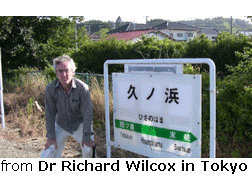 Japan’s Radioactive Potemkin Village: The Government’s Double-Dealing Data, rense.com. By Richard Wilcox, PhD, 4-12-14 I stand to be corrected but what I recently witnessed first hand and face to face in the city of Nihonmatsu can be interpreted as nothing other than scientific fraud and blatant misrepresentation of the facts on the part of the Japanese government regarding gamma radiation levels, leading to the early deaths of tens of thousands of residents . I visited a large nuclear refugee camp in a beautiful location near Nihonmatsu, a modest sized city just outside the evacuation zone of the Fukushima Nuclear Power Plant No. 1 (FNPP#1) disaster site . Continue reading
Just off Fukushima coast – earthquake magnitude 4.9
Quake hits just off Fukushima plant, felt along 500 kilometer stretch of Japan coast — Seismic intensity of 4 on scale up to 7 — Camera shakes for about 1 minute (VIDEO) http://enenews.com/quake-hits-just-off-fukushima-plant-felt-along-500-kilometers-of-japan-coast-camera-shakes-for-about-1-minute-video?utm_source=feedburner&utm_medium=email&utm_campaign=Feed%3A+ENENews+%28Energy+News%29
Japan Meteorological Agency, Apr. 13, 2014:
Time: 18:16 JST
Date: Apr. 13, 2014
Depth: 60 km
Location: Fukushima-ken Oki
Coordinates: 37.3N 141.2E
Magnitude: 4.9
Seismic Intensity: 4 out of 7
[Centered 30 km east of Fukushima Daiichi]Watch video of the quake here (at 8:00 in, 2x speed)
Deformities in Fukushima plants and insects
 Fairewinds Video: ‘Anomalies’ in plants and animals documented by Fukushima residents, some severely deformed — Scientists: Genetic mutations observed in Fukushima include trees with peculiar distortions, insect abnormalities, tumors in birds, more (PHOTO) http://enenews.com/fairewinds-video-anomalies-in-plants-and-animals-documented-by-fukushima-residents-some-severely-deformed-scientists-genetic-mutations-observed-in-fukushima-include-trees-with-peculiar-disto?utm_source=feedburner&utm_medium=email&utm_campaign=Feed%3A+ENENews+%28Energy+News%29
Fairewinds Energy Education, Apr. 10, 2014 — Chiho Kaneko, member of the Board of Directors of Fairewinds originally from Iwate, Japan (at 11:15 in): It’s not just people who are sicker. I met a home gardener who lives in Kawamata, Fukushima, 30-miles from Fukushima Daiichi. She grows luffas, whose fruit is often dried to make bath sponges. Last year, with some trepidation, she used the seeds saved from the year before. She found flower buds directly growing out of the fruit. Some of her pole beans were abnormally gigantic. Near Fukushima city, another person saw a frog so severely deformed that, at first, it was difficult to tell that it was a frog, save for its hopping. These are true events described by people I met who took notes and photographs of these environmental anomalies.
Asian Perspective Vol. 37, No. 4, Anders Pape Møller and Timothy A. Mousseau, Oct.-Dec. 2013: A careful observer [who visits Chernobyl or Fukushima] will quickly become aware of the peculiar distortions of tree growth, numerous abnormalities in insects, and tumors and cataracts in birds, all caused by genetic mutations induced by exposure to the radiation […] radiation causes damage to DNA molecules (leading to mutations if not repaired) […] We have known for more than eighty years that low-dose radiation has cytotoxic effects and causes mutations. […] we looked at 373 effect sizes from forty-six different studies […] they showed a statistically significant negative effect of radiation […] on mutation, physiology, immunology, and disease. As one would expect, effects were stronger on plants, which are stuck in one place, than on animals that can move around […] As the first scientists in both Chernobyl and Fukushima, we have performed [fifteen] published tests, of organisms ranging from plants and insects to birds and mammals in Chernobyl, that support the hypothesis that low-dose radiation disrupts development, and all fifteen studies show a higher degree of asymmetry in the more contaminated plots. […] we have assembled effect sizes from all published studies of mutation rates from Chernobyl, in total 151 estimates of mutations in forty-five studies of thirty-three species ranging from bacteria and plants to insects, birds, and mammals, including humans [The] findings are robust in showing a general, strong overall mean effect size of radiation on mutation rates. […] Mutations accumulate with time and across generations, so we may only be seeing the first stages of the negative public health consequences […] for humans.
SMR & Thorium proponents desperately promoting their failed plans to Australia

Christina Macpherson’s websites & blogs
While the BHP-funded Grattan Institute and a number of other “authoritative” bodies tout Small Modular Nuclear Reactors (SMRs) – powered by Thorium, for Australia, the bottom is falling out of the SMR project. The big firms involved are pulling out. Westinghouse already has. Babcock and Wilcox will be next.
Lobbyists like the USA’s nuclear front group, the Breakthrough Institute, have worked successfully on Australia’s pro nukers to flog off these (so far non-existent) SMRs to Australia. Note that they leave out the word “nuclear”, knowing that this word gives their project a bad smell.
However, – forget the associated bad smells of terrorism targets, proliferation dangers, waste problems that go with these nasty little nuclear reactors.
The biggy is economics. They just don’t stack up economically. (It’s such bad taste to mention this – but reneweable energy does stack up economically. And when you’re talking about small decentralised power sources – well – solar and wind are obviously the go.)
Small Modular Nuclear Reactors (SMRs) uneconomic: Babcock and Wilcox pulling out?
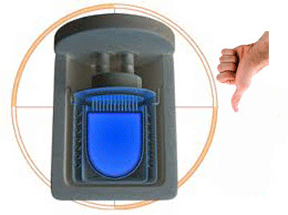 B&W scales back its small nuclear reactor project, Charlotte Observer, By Bruce Hendersony, Apr. 14, 2014 Charlotte-based Babcock & Wilcox said Monday it will scale back its mPower small modular nuclear reactor program after being unable to attract needed investors or contracts. The president of its mPower subsidiary, Christofer Mowry, left the company as of Sunday, B&W said in a securities filing. Mowry was terminated “without cause,” the filing said. William Fox III will replace him.
Announced in 2009, small modular reactor technology had been the company’s largest research and development project……Babcock & Wilcox announced an “accelerated” search for additional investors in the program last November.
But the project struggled to find additional investors or construction contracts that would bring in enough revenue to continue its development, B&W said Monday……..mPower recorded an $87 million operating loss in 2013, B&W said in a March proxy statement. http://www.charlotteobserver.com/2014/04/14/4841485/bw-scales-back-its-small-nuclear.html
Personal account from Tokyo, of government’s duplicity in radiation readings
Japan’s Radioactive Potemkin Village: The Government’s Double-Dealing Data, rense.com. By Richard Wilcox, PhD, 4-12-14 “…….Can You Trust The Government?
According to the Japanese government official website, the Nuclear Regulation Authority , gamma radiation in Tokyo is just 0.034 microsieverts per hour (mcr sv pr hr) . This reading is taken 22 meters above the ground, in Shinjuku, a main hub of urban Tokyo. As luck would have it, I live not far from there and took a reading out my window several stories up in my apartment building and it regularly reads 0.13 mcr sv pr hr. According to the government chart, an estimated reading of 0.061 mcr sv pr hr is given for one meter above ground level. I measured one meter above ground where I live and the reading was 0.12 mcr sv pr hr.
What accounts for the noticeable discrepancy? Could it be the equipment or the location of measurement? The government chart gives an average reading for the ENTIRE CITY OF TOKYO, of 0.061, as if that is remotely accurate. I believe the government and authorities use two main tactics:
1. The place measurement monitoring devices high above the ground where it won’t read the worst radiation which naturally settles on the ground or in ditches;
2. They scrub and decontaminate the area in the immediate vicinity of the monitoring device in order to create a lower reading.
It could also be that tampering with the way devices are calibrated in order to get lower readings, or manipulating published data could occur, but I have no personal proof of these speculations.
Much of the problem with radiation science promoted by the nuclear establishment and their minions is that they limit the factors involved in their methodology and avoid the precautionary principle when drawing conclusions. In other words: don’t worry, be happy (even if your mitochondrial DNA is being damaged).
After the Fukushima accident I personally measured my kid’s school grounds. My readings were consistently higher what was reported by the school who simply measured above the ground in order to avoid the worst radiation.
When I was in the midwest in the US in March, I took outdoor readings above and on the ground that measured between 0.08 to 0.13 mcr sv pr hr. We now live in a manmade radioactively contaminated world due to above ground nuclear tests, nuclear power plant emissions, and nuclear accidents, in addition to natural background radiation from the sun or soil.
What I have witnessed first hand in Nihonmatsu is scientific fraud and misrepresentation of the facts. This is verified by my own dosimeter readings, and by the testimony of both Mr. Honda, the head of the temporary housing facility, and the experienced construction and decontamination worker who I talked with…..”
* Richard Wilcox is a Tokyo-based teacher and writer who holds a Ph.D. in environmental studies and is a regular contributor to the world’s leading website exposing the Fukushima nuclear disaster, Rense.com. He is also a contributor to Activist Post. His radio interviews and articles are archived at http://wilcoxrb99.wordpress.com and he can be reached by email for radio or internet podcast interviews to discuss the Fukushima crisis at wilcoxrb2013@gmail.com. http://www.rense.com/general96/jpsradioctv.html
Fukushima considered world’s worst nuclear accident
National Geographic: Fukushima considered world’s worst nuclear accident — Physician: Fukushima remains a “global health concern” — Kaku: “It’s so bad, they don’t even have a picture of melted core… the agony is unending” (VIDEO)
Asian Perspective Vol. 37, No. 4, Tilman A. Ruff, physician and Associate Professor in the Nossal Institute for Global Health at University of Melbourne, Oct.-Dec. 2013: A Public Health Perspective on the Fukushima Nuclear Disaster — The Fukushima nuclear disaster is far from over and remains a global health concern. While evacuations, sheltering, reducing intake of contaminated food, and other measures reduced radiation exposures, both the immediate and longer-term public health responses to the disaster leave major room for improvement. Commercially and institutionally, vested interests have undermined public health and safety. […]
National Geographic, Apr. 14, 2014: The meltdown at the Chernobyl power plant in 1986 made front-page news and, until Japan’s Fukushima disaster of 2011, was considered the world’s worst nuclear accident. […] Early estimates by the Associated Press (Dec. 16, 2000) were that the health of 3.4 million of Ukraine’s 50 million people was negatively affected, including 1.26 million children […]
Michio Kaku,Mar. 18, 2014 (at 1:18:00 in): The agony of 3 simultaneous meltdowns in Northern Japan […] The accident is not over at all. A small earthquake will send the accident starting all over again. You will realize that the reactor is so radioactive workers cannot even get in for more than just a few minutes at a time. […] The next thing they want to do is insert cameras into the water to see where the melting is. It’s so bad, they don’t even have a picture of the melted core. We know it’s 100 percent melted. […] The agony is unending. […] Japan said we will go nuclear because we have no oil or coal, but there is a price you have to pay — that is, you sell your soul to the devil.
69% of Japanese want nuclear power to be phased out
 Japan’s Profound Ambivalence Over Nuclear Energy , TIME, Per Liljas, 14 April 14 Prime Minister Shinzo Abe has unveiled a pro-nuclear blueprint for the country’s energy future around the three-year mark of the disaster at Fukushima, a move that most Japanese appear to disagree with, even those who returned to Fukushima to rebuild their lives ……On a national level, too, there is a lack of consensus. Produce from Fukushima, even from villages
  unconnected to the disaster, does not inspire confidence among consumers despite official O.K.s. And nobody can agree on the future of Japan’s nuclear-energy sector…….“They want to restart the reactors because of money, but it’s irresponsible, Japan is too unsafe to have nuclear power,” says activist Kaori Echigo, before taking to a podium in front of the parliament building in Tokyo and leading a crowd in the chanting of anti-nuclear slogans. The crowd at these gatherings, which have been held weekly since the disaster, has dwindled to a few hundred. But the last time a reactor was restarted, in 2012, thousands came onto the streets—as they are likely to do again if Abe goes ahead with his plan.
A poll by the Tokyo Shimbun newspaper last month found that 69% of respondents wanted nuclear power to be phased out. That number could rise even higher if Japan makes it through another summer without blackouts…….Spread out through the village are fields covered with black plastic bags, each one filled with contaminated topsoil that has been collected from the surroundings. Watanabe says she feels life is coming back to Tamura when she sees children in the streets, but then remembers that they are only allowed half an hour’s outdoor playtime per day because of radiation fears.
“I don’t want my grandchildren to grow up here,” she says. “I don’t know which health problems they may get.” Even that old saw about marrying somebody from Tamura means nothing now. “I want my grandchildren to get married” Watanabe adds, “and I don’t know which suitors would ever come here.” http://time.com/59096/fukushima-nuclear-daiichi-japan-tamura/
Likely political and economic damage to Abe’s government as result of pro nuclear decision
 Tokyo’s decision on nuclear power plants ‘may backfire’
It could cost PM Abe politically and set back his economic policies: analysts Business Times BY ANTHONY ROWLEY, 14 April 14, IN TOKYO JAPANESE Prime Minister Shinzo Abe has entered a high-stakes gamble with the decision announced last Friday to restore nuclear power to the nation’s menu of electricity generation sources in the wake of the Fukushima nuclear meltdown three years ago.
The controversial decision goes against the non-nuclear policy adopted by the Democratic Party of Japan government before Mr Abe’s Liberal Democratic Party returned to power at the end of 2012 and could backfire in a number of ways, analysts say.
With polls showing a significant proportion of Japanese remaining opposed to the restart of the nation’s 50 or so nuclear reactors that have been idled since the Fukushima disaster, the political price of restoring nuclear power could be high for Mr Abe, some claim.
At the same time, there could be economic consequences such as setting back the policy being pursued by the Bank of Japan (BOJ) under pressure from Mr Abe to replace deflation with annual inflation of 2 per cent. So far much of the progress towards this target has been driven by “imported inflation” in fuel costs…..(subscribers only) http://www.businesstimes.com.sg/premium/world/tokyos-decision-nuclear-power-plants-may-backfire-20140414
Tatsuya Murakami, influential ex-mayor leads community opposition to Japan’s nuclear power push
 Ex-mayor of nation’s nuclear birthplace comes out swinging against atomic power Japan Times, BY KEIJI HIRANO, 13 April 14, KYODO THE FORMER MAYOR OF A VILLAGE THAT HAD A PIONEERING ROLE IN THE NATION’S NUCLEAR DEVELOPMENT EXPRESSED HIS OPPOSITION SUNDAY TO THE COUNTRY CONTINUING TO LOOK TO NUCLEAR POWER AS AN ENERGY SOURCE.
“It has been said that a local community can enjoy benefits by hosting a nuclear power plant, but it is just an illusion,” Tatsuya Murakami, who served as mayor of Tokaimura, Ibaraki Prefecture, for 16 years until his retirement last September, told a public gathering in Tokyo.
Around one-third of the village’s general account budget was from nuclear facilities located there while he was mayor, “but the ‘nuclear money’ has made our industrial structure disproportionately depend on nuclear-related businesses,” he said. “As a result, we have failed to cultivate other businesses.”
The village’s shipment of manufactured goods stands at only ¥30 billion, compared with that of Myoko, Niigata Prefecture, with a population almost the same as Tokaimura’s, at ¥140 billion, according to Murakami.
“The nuclear operators are just like lords of the community, and people seek cozy ties with them. To criticize the lords is taboo,” Murakami said as he talked about the situation in the village where nation’s first research reactor achieved criticality in 1957.
His comments came after the government of Prime Minister Shinzo Abe decided Friday on a national energy policy that supports the use of nuclear power now and in the future, retracting a nuclear phaseout goal introduced by the previous Democratic Party of Japan-led government in the wake of the 2011 Fukushima nuclear disaster.
Murakami has served as a co-representative of the Mayors for a Nuclear Free Japan, which comprises around 90 former and incumbent mayors supporting the nuclear phaseout policy. Incumbent mayors include those of major cities, such as Sapporo, Aomori and Nagoya………
Six months after retiring, Murakami now gives lectures several times a month around the nation to encourage people to raise their voices against nuclear power.
“I had been thinking about how to reconstruct our village in the wake of the nation’s first criticality accident in 1999,” which killed two workers at a nuclear fuel processor and exposed hundreds of residents to radiation, he said. “We were thrust into notoriety — Tokaimura was contaminated with radiation and the villagers were not being chosen as marital partners.
“I believe now that a local municipality should break away from the old mindset focusing only on economic development,” he said. “Rather, we need to create a sustainable society, taking good care of the environment as well as ourselves.”http://www.japantimes.co.jp/news/2014/04/13/national/ex-mayor-of-nations-nuclear-birthplace-comes-out-swinging-against-atomic-power/
USA bumping up its weapons exports to Asian region
 World Cuts Back Military Spending, But Not Asia, Inter Press Service Analysis by John Feffer WASHINGTON, Apr 14 2014 (IPS) – For the second year in a row, the world is spending a little less on the military. Asia, however, has failed to get the memo. The region is spending more at a time when many others are spending less.
Last year, Asia saw a 3.6 percent increase in military spending, according to figures just released by the Stockholm International Peace Research Institute. The region — which includes East Asia, South Asia, Central Asia and Oceania — posted topping off a 62 percent increase over the last decade. In 2012, for the first time Asia outpaced Europe in its military spending. That year, the world’s top five importers of armaments all came from Asia: India, China, Pakistan, South Korea, and (incredibly) the city-state of Singapore.
China is responsible for the lion’s share of the increases in East Asia, having increased its spending by 170 percent over the last decade. It has also announced a 12.2 percent increase for 2014.
But China is not the only driver of regional military spending. South Asia – specifically the confrontation between India and Pakistan – is responsible for a large chunk of the military spending in the region. Rival territorial claims over tiny islands – and the vast resources that lie beneath and around them — in both Northeast and Southeast Asia are pushing the claimants to boost their maritime capabilities.
Even Japan, which has traditionally kept its military spending to under one percent of GDP, is getting into the act. Tokyo has promised of a 2.8 percent increase in 2014-15.
The United States, a Pacific power whose military spending is not included in the Asia figures, has also played an important role in driving up the expenditures in the region. The Barack Obama administration’s “Pacific pivot” is designed to reboot the U.S. security presence in this strategically critical part of the world………
The modest reduction in Pentagon spending will not necessarily lead to a corresponding decline in exports. In fact, the opposite is likely to be true, as was the case during the last Pentagon slowdown in the 1990s. The Obama administration has pushed through a streamlining of the licensing process in order to facilitate an increase in military exports – in part to compensate U.S. arms manufacturers for a decline in orders from the Pentagon…..
Asia and Oceania represent the primary target for U.S. military exports, absorbing nearly half of all shipments. Of that number, East Asia represents approximately one-quarter (South Asia accounts for nearly half).
The biggest-ticket item is the F-35 fighter jet, which Washington has already sold to Japan, South Korea, and Australia. Long-range missile defence systems have been sold to Japan, South Korea, and Taiwan. Overall between 2009 and 2013, Australia and South Korea have been the top U.S. clients. With its projected increase in military spending, Japan will also likely rise much higher on the list.
The more advanced weaponry U.S. allies purchase, the more they are locked into future acquisitions. The United States emphasises “interoperability” among its allies. Not only are purchasers dependent on the United States for spare parts and upgrades, but they must consider the overall system of command and control (which is now C5I — Command, Control, Communications, Computers, Combat systems and Intelligence).
Although a French fighter jet or a Russian naval vessel might be a cheaper option in a competitive bid, the purchasing country must also consider how the item integrates with the rest of its hardware and software……
The continued increase in military spending by countries in East Asia and the massive influx of arms into the region are both symptoms and drivers of conflict. Until and unless the region restrains its appetite for military upgrades, the risk of clashes and even all-out war will remain high.
In such an increasingly volatile environment, regional security agreements – on North Korea’s nuclear programme, the several territorial disputes, or new technological threats like cyberwarfare – will be even more difficult to achieve.
Most importantly, because of these budget priorities, the region will have fewer resources and less political will to address other pressing threats, such as climate change, which cannot be defeated with fighter jets or the latest generation of battle ship. http://www.ipsnews.net/2014/04/world-cuts-back-military-spending-asia/
India will keep is ‘no first use’ nuclear weapons policy
 No-first-use nuclear policy to stay: Rajnath Kumar Uttam, Hindustan Times 13 Apil 14, The BJP will leave unchanged India’s stand not to be the first side to use nuclear weapons in a conflict, the party said Sunday, ending speculation about one of the defining principles of New Delhi’s foreign policy. The no-first-use policy for nuclear weapons was a well thought out stand of the NDA government led by Atal Behari Vajpayee. We don’t intend to reverse it,” BJP chief Rajnath Singh told HT.
Party leaders say the policy has not only boosted India’s standing in the international community but also gives a certain amount of leverage in foreign-policy matters.
1 This Month

of the week – Shut Down Drone Warfare!


Tell the Ukrainian Government to Drop Prosecution of Peace Activist Yurii Sheliazhenko

Petition to revoke the licensing of the Near Surface Nuclear Disposal Facility (NSDF) at Chalk River. https://www.ourcommons.ca/petitions/en/Petition/Details?Petition=e-7247
To see nuclear-related stories in greater depth and intensity – go to https://nuclearinformation.wordpress.com
-
Archives
- April 2026 (68)
- March 2026 (251)
- February 2026 (268)
- January 2026 (308)
- December 2025 (358)
- November 2025 (359)
- October 2025 (376)
- September 2025 (257)
- August 2025 (319)
- July 2025 (230)
- June 2025 (348)
- May 2025 (261)
-
Categories
- 1
- 1 NUCLEAR ISSUES
- business and costs
- climate change
- culture and arts
- ENERGY
- environment
- health
- history
- indigenous issues
- Legal
- marketing of nuclear
- media
- opposition to nuclear
- PERSONAL STORIES
- politics
- politics international
- Religion and ethics
- safety
- secrets,lies and civil liberties
- spinbuster
- technology
- Uranium
- wastes
- weapons and war
- Women
- 2 WORLD
- ACTION
- AFRICA
- Atrocities
- AUSTRALIA
- Christina's notes
- Christina's themes
- culture and arts
- Events
- Fuk 2022
- Fuk 2023
- Fukushima 2017
- Fukushima 2018
- fukushima 2019
- Fukushima 2020
- Fukushima 2021
- general
- global warming
- Humour (God we need it)
- Nuclear
- RARE EARTHS
- Reference
- resources – print
- Resources -audiovicual
- Weekly Newsletter
- World
- World Nuclear
- YouTube
-
RSS
Entries RSS
Comments RSS
 nuclear-news