Today’s energy system is simply unsustainable
Arvizu: Why the current energy system is unsustainable REneweconomy By Giles Parkinson on 4 April 2014
The first point is on cost, as renewables become a cheaper option than coal or gas; the other is on environmental impacts, as the world finally absorbs the impact of dirty coal generation; and the third is the arrival of new disruptive (and mostly renewable) technologies, such as rooftop solar and storage. But the most stunning piece of evidence is this: the industry spends only 0.3 per cent of its phenomenal revenues (in the trillions of dollars) on R&D. And even that money is spent by new players looking to bring new technologies to the market.
In an interview with RenewEconomy on the sidelines of the 2XEP energy efficiency conference in Sydney this week, Arvizu says he knows of no other incumbent industry that has spent so little on securing its future and on innovation, and was relying so much on the models of the past.
“The energy sector has the highest level of conservatism and the lowest level of risk taking,” Arvizu says. Change, via disruptive technologies such as solar and storage and other renewables, along with smart devices, is now upon it. But it will be fighting hard to resist change.
“We need to change the business model. We need new infrastructure, and brick by brick we will dismantle the old system and make a new one,” he says……….
“The future is much more promising than a lot of people expect,” Arvizu says, adding that even he is surprised at the pace of technological change and cost reduction.
He dismisses the protests of people who say that renewables are too expensive – in particular those like Bjorn Lomborg who insist that more research should take place (ironic given the industry’s low R&D commitment so far). “That’s just kicking the can down the road,” Arvizu says.
“If we are just talking about incremental changes to the existing system, we will never fully utilise the potential.”
It is, he says, a scary prospect for the incumbent utilities, who have enjoyed decades – nearly a century – of uninterrupted growth and extraordinary market power. And they are protected by layers and layers or regulation.
“We created this monster,” Arvizu says. “You often hear the words, ‘let the market decide’, but this is such a disingenuous argument in such a highly regulated market.
“The classic supply and demand equations do not work …. because what we’ve allowed the incumbents to create a set of highly regulated markets where they have tremendous market share, and there has been an alliance between public policy markets and incumbents, where reliable power supply has been exchanged for a high return on investment.
“But now we have other options in the market place, and in order to break into that market, they need to mature and they need an ecosystem around them.”
The key to change, he says, will come in power for the consumers, and the key to that will come in storage.
“If we had storage that was cost effective – you would very quickly be able to encourage the utilities to get on to the program. Once you have got the opportunity to say, I don’t need your electrons any more, that is when consumers will have the (market) power.”………
he notes, it is important that the new model be integrated with the old, in other words, the best of distributed generation must be merged with the best bits of the old centralized model.
This will be difficult, considering the regulatory hurdles, but it is important. And in the same way he dismissed the idea of “energy independence” for a country (focusing more on energy security), he’s also not sure why individuals would want to do the same.
“I don’t think we need to go to 100 per cent renewables, although I think we can,” he says. “And I don’t know why you would want to pay to be autonomous (off grid). The extra cost that it entails … to be isolated as an act of bravado is absurd, it is an interconnected world.” http://reneweconomy.com.au/2014/arvizu-why-the-current-energy-system-is-unsustainable-76176
Utah’s renewable energy hat trick
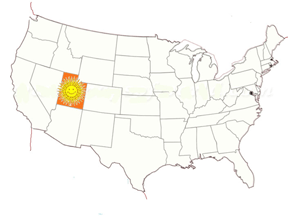 Utah embraces trio of renewable energy firsts By Amy Joi O’Donoghue, Deseret News, April 4 2014 SALT LAKE CITY — Utah turned a page in the renewable energy handbook this week, embracing a triad of “firsts” that is positioning the state for a future with fewer carbon emissions.
On Thursday, state officials joined Salt Lake County Mayor Ben McAdams and the Utah Clean Air Partnership to unveil the state’s first electric fast-charging station for public use along the Wasatch Front.
The direct current charging station has a 480-volt rate that is able to charge in 10 to 40 minutes and is a key step along the way to boosting the infrastructure for electric vehicle owners, McAdams said.
Earlier in the week, Scatec Solar announced plans to start construction later this year on an 80-megawatt solar plant in Iron County — a first in that area. When complete, it will deliver power to PacifiCorp and be the state’s largest commercial solar field.
And Wednesday, Utah Clean Energy was picked by the U.S. Department of Energy and the National Renewable Energy Laboratory to operate one of six new regional wind energy resource centers in the nation.
In the case of the local nonprofit advocacy organization, it will operate the Four Corners Wind Resource Center, guiding a consortium of industry, government and other groups to promote development of wind energy resources against a best-practices backdrop.
The hat trick in renewable energy signals a new momentum for some. “This says to me that market forces are moving forward,” said Samantha Mary Julian, director of theUtah Office of Energy Development. “We have been seeing one activity after the other. It is really cool and exciting. Utah is starting to take hold of renewable energy efficiencies and clean transportation.”…… http://www.deseretnews.com/article/865600250/Utah-embraces-trio-of-renewable-energy-firsts.html
Norway’s wealth fund, and renewable energy
 Norway wealth fund to ramp up renewable energy investments,
* Government says fund should invest more in renewable energy
* Says sum should rise to between $5-8.3 billion
* Critics say ramp-up is inadequate
* Plans to get rid of fund’s independent ethics council
* Government may struggle to win consensus on ethics reforms (Adds reactions)
By Camilla Knudsen and Gwladys Fouche
Fri Apr 4, 2014 OSLO, April 4 (Reuters) – Norway’s $860 billion oil fund should scale up its investments in renewable energy and weigh the risk to future returns posed by climate change, the financeministry said on Friday, a shift green groups said was insufficient. Continue reading
Trade forecast for USA Renewable Energy sector
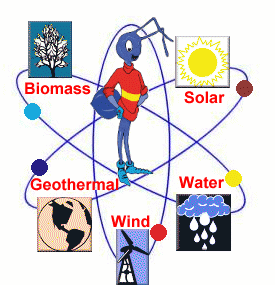 ACORE Releases Renewable Energy in America Outlook domestic fuel, April 4, 2014 by Joanna Schroeder The American Council On Renewable Energy (ACORE) has released The Outlook for Renewable Energy in America: 2014, jointly authored by U.S. renewable energy trade associations from the power, thermal, and fuel sectors. The Outlook assesses the renewable energy marketplace and forecasts the future of each renewable energy technology sector, from the perspectives of each of the associations, and provides a list of policy recommendations by the respective associations that would encourage continued industry growth.
“ACORE applauds the unity of the renewable industry community and this united front as reflected in The Outlook for Renewable Energy in America: 2014,” said ACORE President and CEO, Michael Brower. “The report demonstrates the many public and private sector opportunities that exist at the national, regional and local levels for continued industry advancement and investment; however, they are not one-size-fit-all solutions for every renewable technology.”
Bower noted that the articles in the report detail specific market drivers for the biofuel, biomass, geothermal, hydropower, solar, waste and energy sectors………….The Outlook for Renewable Energy in America: 2014 shows the potential of America’s renewable energy economy to extend beyond one fuel choice or pipeline, to provide the country with an unparalleled opportunity to reinvigorate the U.S. economy while protecting our environment. http://domesticfuel.com/2014/04/04/acore-releases-renewable-energy-in-america-outlook/
Barefoot power solar powering up remote villages
 Impact corner: innovative solutions in the renewable energy sector http://www.theguardian.com/sustainable-business/impact-corner-innovative-solutions-renewable-energy-sector Affordable, reliable renewable energy is still a luxury in many parts of the world. Barefoot Power and Hybrid Social Solutions tackle the challenges Tomohiro Nagasaki Guardian Professional, Friday 4 April 2014 Access to safe and affordable sources of energy still remains a luxury for 1.5 billion people in the world. Both product innovation and distribution innovation are challenges in ensuring off-grid access to clean, safe and affordable energy.
BCtA member Barefoot Power addresses this problem by offering solar lighting products which are simple to use and come with a complete set of solar panels, batteries, wires, and (in most products) phone charging adapters. Barefoot’s products are designed at their headquarters in Australia, and manufactured and assembled in China. In order to maintain high quality standards, the company works closely with factories to oversee the quality control process. Barefoot’s lighting products are expected to bring durable and efficient lighting systems to 10 million people by 2015.
In doing business with base of the pyramid populations, having the right strategy for product distribution is often the key to successfully reaching customers. Hybrid Social Solutions, based in the Philippines, specialises in last-mile distribution of solar appliances in the country’s rural communities. The company takes an innovative approach of combining product distribution with the provision of financing, training on the use of solar appliances, and technical support to end-users to ensure their sustainable use of solar products. The company is able to offer such a holistic solution to the end-users through its partnerships with community-based NGOs, cooperatives, and microfinance institutions for providing financing, capacity building, and maintenance support services.
Tomohiro Nagasaki provides impact measurement as a consultant for the Business Call to Action.
Launched at the United Nations, the Business Call to Action (BCtA) is a global alliance hosted by the United Nations Development ProgrammeHeadquarters in New York. Follow: @BCtAInitiative
Copy on this page is provided by Business Call to Action, supporter of the role of business in development hub
Legal action against Utah uranium mill
 Environmental group sues uranium mill operator,http://www.heraldextra.com/news/local/environmental-group-sues-uranium-mill-operator/article_2293f9e6-bc40-11e3-8d5a-0019bb2963f4.html Annie Knox – Associated Press SALT LAKE CITY 4 April 14 — An environmental group is suing the operator of a southern Utah uranium mill, alleging it has hiked pollution levels in neighboring communities.
Grand Canyon Trust filed the suit in Utah federal District Court Wednesday against Energy Fuels Resources over operations at its San Juan County White Mesa Mill.
The group says the mill’s radon emissions in 2012 and 2013 surpassed federal standards and alleges the company ran more waste pits during that time than federal regulations allowed.
Trust attorney Anne Mariah Tapp says emissions from the nation’s last operating conventional uranium mill pose serious health risks.
Energy Fuels has announced plans to in summer halt processing ore from regional mines, including ones near the Grand Canyon, and possibly restart next year.
It did not immediately return phone messages Friday afternoon.
Argentina says that Falkland Islands are a NATO nuclear base
Falklands a NATO nuclear base: Argentina SMH, April 3, 2014 Buenos Aires: Argentine President Cristina Kirchner has claimed that the Falkland Islands serve as a nuclear base for the NATO alliance in the South Atlantic.
Are the Bees Really Dying Out? The Strange Disappearance of the Bees – One Japanese Farmer’s Experience
[Arclight note] Evidence of mutation in bees when given 30 Gray dose. This experiment was done in Japan to stop the bees stinging! But it shows radiation effects on Bees when hit with a dose slightly less than cancer treatment patients get. I would also point out that bee death in the USA and France occurred first. Both countries have many nuclear reactors and regular emissions of radionuclides. Of course it looks like big pharma has had an impact as well but the odd story of this farmer losing the queens leaving the hive in distress is interesting. Here is the link to the Bee experiment:
http://lib.icimod.org/record/22885/files/c_attachment_201_2621.pdf
Monday, March 26, 2012
http://modernmarketingjapan.blogspot.co.uk/2012/03/are-bees-really-dying-out-strange.html
Yesterday I wrote about going to pick strawberries at a farm in Isehara about one hour out from Tokyo.
While I was there, I was anxious to ask the farmer about the story going on concerning the dying out of the bees that we so often read about.I became interested in the bees and honey story because my wife and son have allergies this time of year and one well reviewed natural remedy for allergies is locally produced honey. The rationale for using honey to treat allergies is that bees process the same pollen that causes the allergies in making the honey. So, by eating the honey, one can build up a resistance to the pollen – somewhat like immunizations use dead viruses to create. (Also add loads of vitamin C and vitamin D3!) It seems to work well for my wife and son.

My wife’s uncle is a farmer in Isehara and he grows rice and tangerines. Since he has tangerines, he also produces honey from bee hives he keeps and sells it as “Tangerine honey.” It does have a different tangerine flavor (or so people tell me. I can’t tell the difference!)

Over these last few years, there is much talk about the bees disappearing and or dying off. In the photos above, you can see two large jars of locally produced honey. The jar on the left sold for ¥2,000 (about $24.18 USD) two years ago. My wife and son just discovered the wonderful relief that honey gives to serious allergy sufferers and they went through (actually my wife) went through a jar that was 1/2 that size in three years. Now we are back to buy a new jar of locally produced honey and the jar on the right, when you can get them, sell for ¥5,500 yen (about $66.50 USD) today. So the price has gone up a lot… I am told that the price increase is due to problems with the bees.Well, we’ve all heard that the bees are dying off, right? Well, according to my wife’s uncle and another farmer, Mr. Tsuzuki (farms strawberries and rice) the bees are not dying off per se. They are, are you sitting down? (cue Twilight Zone music) “disappearing.”
I wasn’t sure what they meant and asked for clarification. I asked Mr. Tsuzuki at his farm,
“Did you find and dead bees around the hives or lots of dead bees in the fields?”
“No,” came the answer. He continued,
“It wasn’t the bees dying as such. They would fly away and disappear.”
Fly away and disappear!!?? Wait! What?

That’s right. According to these farmers the bees weren’t dying off, they were disappearing. This is a quote, “The queen bee would fly away from the hive and then they wouldn’t come back. I think, perhaps, they flew around above the hive for so long that the birds would come and eat them.”
Now, before you panic and think that this could be the end of civilization, Mr. Tsuzuki told me that he knows all about the bees dying off in America – everyone does. But he said that while they had a similar problem in Japan for a few years, the local farmers switched back to fertilizers, insecticides and herbicides that they were using before the problem started and now the bees are coming back. He said that they’ve had no problems this year at all.

Vanunu’s Family Affair and US-Israeli Reality-Check: Nukes and ‘Peace Talks’

BEYOND NUCLEAR: Mordechai Vanunu’s FREEDOM of SPEECH Trial and My Life as a Muckraker: 2005-2010
By Eileen Fleming
Exclusive to The Arab Daily News
The world must be prevented by all available means from hearing, from the lips of a credible witness, that the Americans are full partners in Israel’s nuclear arms program, while pretending to be the world’s sheriff for the prevention of nuclear proliferation
Secretary of State John Kerry said Friday the U.S. is questioning its role in the Israeli-Palestine peace talks, noting it was “reality-check time” for negotiators from both parties.
In the past week, Israel cancelled the planned release of a group of Palestinian prisoners and Palestine applied to the United Nations to join 15 international conventions and treaties.
Kerry said that the U.S.’s role in the peace process is not “open-ended,” the AP reports, and that the U.S. will “evaluate very carefully exactly where this is and where it might possibly be able to go.”
Kerry is heading back to D.C. today after working in Europe and the Middle East “to bolster peace in the region.” 
The Way ends this article:
The news regarding Jonathon Pollard’s connection to extending the “peace talks” thus furthering pieces of Palestine being ‘wiped off the map’ prompted, Mordechai Vanunu’s US adoptive parents, Nick and Mary Eoloff to email me that they, “Will be writing to our Zionist reps in the senate and house to ask that they free Mordechai and allow him to join his new family in Minnesota. Perhaps, you could ask your constituency to write or contact Kerry to ask the Israelis to free Mordechai.”
The Eoloff’s learned about Vanunu in a 1995 edition of The Progressive.
In a 2003 interview the Eoloff’s explained how they came to be Vanunu’s new family

I read his story, and I thought it was out of the Dark Ages. I mean, to keep someone in this day of age in a six-foot by nine-foot cell. It’s unreal.
He’s been in isolation longer than any person in the western world. Just the brutality of that is very moving.
He told us, ‘You can’t imagine what it’s like to see grass after ten years.’
The Eoloffs began writing to Vanunu and joined the US Campaign to free Vanunu united by their mutual anti-nuclear views.
Mary noted the obvious; “Here we have this beautiful world [and] the idea of destroying it in an afternoon is insane.”
1 This Month

of the week – Shut Down Drone Warfare!


Tell the Ukrainian Government to Drop Prosecution of Peace Activist Yurii Sheliazhenko

Petition to revoke the licensing of the Near Surface Nuclear Disposal Facility (NSDF) at Chalk River. https://www.ourcommons.ca/petitions/en/Petition/Details?Petition=e-7247
To see nuclear-related stories in greater depth and intensity – go to https://nuclearinformation.wordpress.com
-
Archives
- April 2026 (103)
- March 2026 (251)
- February 2026 (268)
- January 2026 (308)
- December 2025 (358)
- November 2025 (359)
- October 2025 (376)
- September 2025 (257)
- August 2025 (319)
- July 2025 (230)
- June 2025 (348)
- May 2025 (261)
-
Categories
- 1
- 1 NUCLEAR ISSUES
- business and costs
- climate change
- culture and arts
- ENERGY
- environment
- health
- history
- indigenous issues
- Legal
- marketing of nuclear
- media
- opposition to nuclear
- PERSONAL STORIES
- politics
- politics international
- Religion and ethics
- safety
- secrets,lies and civil liberties
- spinbuster
- technology
- Uranium
- wastes
- weapons and war
- Women
- 2 WORLD
- ACTION
- AFRICA
- Atrocities
- AUSTRALIA
- Christina's notes
- Christina's themes
- culture and arts
- Events
- Fuk 2022
- Fuk 2023
- Fukushima 2017
- Fukushima 2018
- fukushima 2019
- Fukushima 2020
- Fukushima 2021
- general
- global warming
- Humour (God we need it)
- Nuclear
- RARE EARTHS
- Reference
- resources – print
- Resources -audiovicual
- Weekly Newsletter
- World
- World Nuclear
- YouTube
-
RSS
Entries RSS
Comments RSS
 nuclear-news