Are the Bees Really Dying Out? The Strange Disappearance of the Bees – One Japanese Farmer’s Experience
[Arclight note] Evidence of mutation in bees when given 30 Gray dose. This experiment was done in Japan to stop the bees stinging! But it shows radiation effects on Bees when hit with a dose slightly less than cancer treatment patients get. I would also point out that bee death in the USA and France occurred first. Both countries have many nuclear reactors and regular emissions of radionuclides. Of course it looks like big pharma has had an impact as well but the odd story of this farmer losing the queens leaving the hive in distress is interesting. Here is the link to the Bee experiment:
http://lib.icimod.org/record/22885/files/c_attachment_201_2621.pdf
Monday, March 26, 2012
http://modernmarketingjapan.blogspot.co.uk/2012/03/are-bees-really-dying-out-strange.html
Yesterday I wrote about going to pick strawberries at a farm in Isehara about one hour out from Tokyo.
While I was there, I was anxious to ask the farmer about the story going on concerning the dying out of the bees that we so often read about.I became interested in the bees and honey story because my wife and son have allergies this time of year and one well reviewed natural remedy for allergies is locally produced honey. The rationale for using honey to treat allergies is that bees process the same pollen that causes the allergies in making the honey. So, by eating the honey, one can build up a resistance to the pollen – somewhat like immunizations use dead viruses to create. (Also add loads of vitamin C and vitamin D3!) It seems to work well for my wife and son.
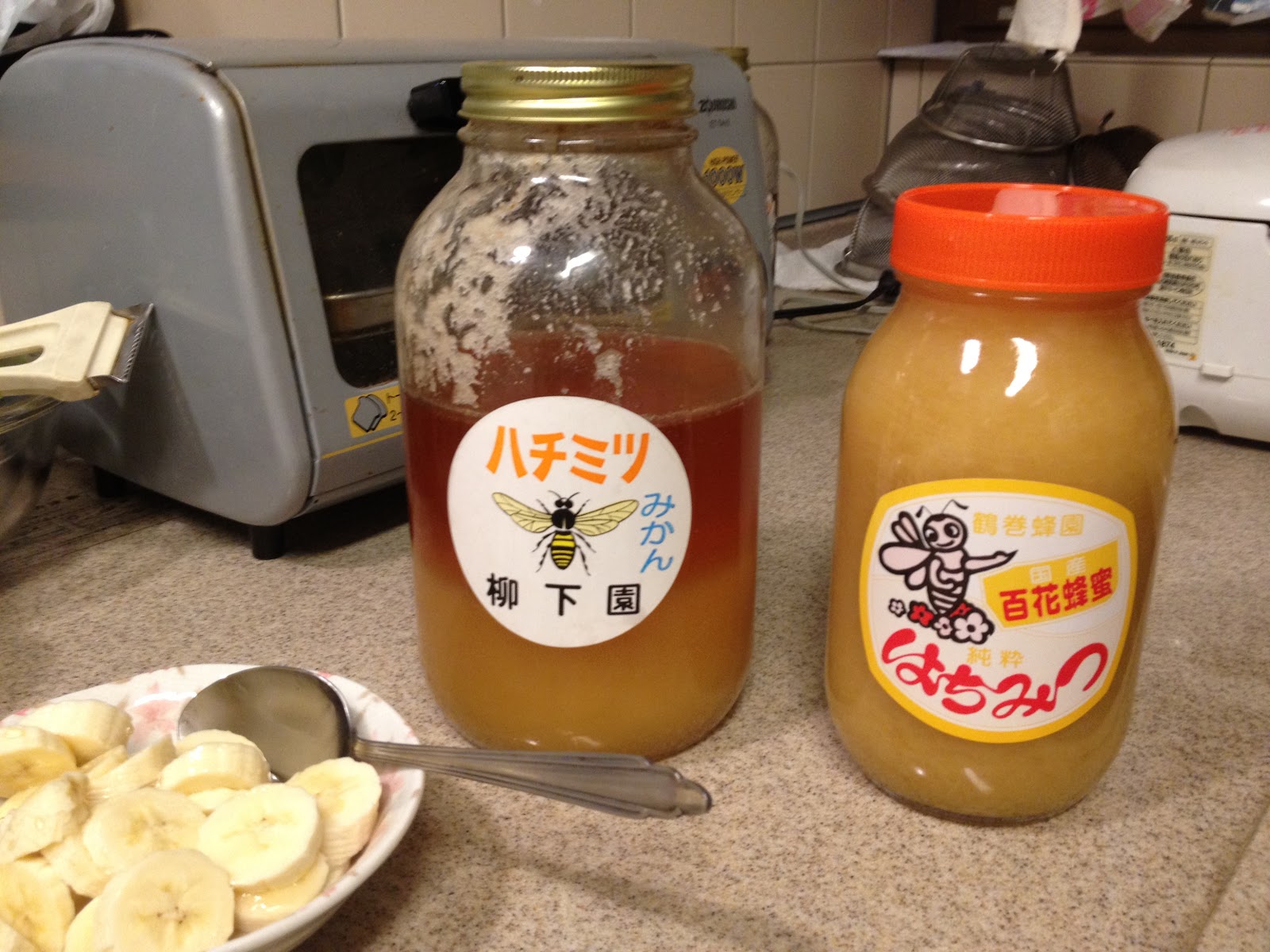
My wife’s uncle is a farmer in Isehara and he grows rice and tangerines. Since he has tangerines, he also produces honey from bee hives he keeps and sells it as “Tangerine honey.” It does have a different tangerine flavor (or so people tell me. I can’t tell the difference!)

Over these last few years, there is much talk about the bees disappearing and or dying off. In the photos above, you can see two large jars of locally produced honey. The jar on the left sold for ¥2,000 (about $24.18 USD) two years ago. My wife and son just discovered the wonderful relief that honey gives to serious allergy sufferers and they went through (actually my wife) went through a jar that was 1/2 that size in three years. Now we are back to buy a new jar of locally produced honey and the jar on the right, when you can get them, sell for ¥5,500 yen (about $66.50 USD) today. So the price has gone up a lot… I am told that the price increase is due to problems with the bees.Well, we’ve all heard that the bees are dying off, right? Well, according to my wife’s uncle and another farmer, Mr. Tsuzuki (farms strawberries and rice) the bees are not dying off per se. They are, are you sitting down? (cue Twilight Zone music) “disappearing.”
I wasn’t sure what they meant and asked for clarification. I asked Mr. Tsuzuki at his farm,
“Did you find and dead bees around the hives or lots of dead bees in the fields?”
“No,” came the answer. He continued,
“It wasn’t the bees dying as such. They would fly away and disappear.”
Fly away and disappear!!?? Wait! What?

That’s right. According to these farmers the bees weren’t dying off, they were disappearing. This is a quote, “The queen bee would fly away from the hive and then they wouldn’t come back. I think, perhaps, they flew around above the hive for so long that the birds would come and eat them.”
Now, before you panic and think that this could be the end of civilization, Mr. Tsuzuki told me that he knows all about the bees dying off in America – everyone does. But he said that while they had a similar problem in Japan for a few years, the local farmers switched back to fertilizers, insecticides and herbicides that they were using before the problem started and now the bees are coming back. He said that they’ve had no problems this year at all.

I felt very insecure, not about my paintings
or research but about the way I was treated: a single
person against hundreds of scientists who had the ‘truth’
on their side and who considered themselves to be the
only ones entitled to carry out official research. Cornelia Hesse-Honegger
Insects left disfigured by nuclear radiation
15:00 24 April 2008 by Michael Marshall
“..No one wants to live too close to a source of artificial radiation, not even insects. Cornelia Hesse-Honegger has spent 20 years travelling around the world, mostly in Europe, capturing and studying over 16,000 insects, many living in the vicinity of nuclear power stations, or other artificial sources of radiation. Her conclusion, not surprisingly, is that exposure to radiation increases the chances of deformity.
She made particularly detailed studies of the regions worst hit by the Chernobyl radioactive cloud: the south of Sweden and the Ticino canton in Switzerland. Drawing on her skills as a scientific illustrator, she made to-scale watercolour paintings of many of her specimens, illustrating deformities such as misshapen wings and stunted feelers…”
http://www.newscientist.com/article/dn13760-insects-left-disfigured-by-nuclear-radiation.html
and here are some pictures of mutations from Cornelia Hesse Honegger!!
“..On The Simpsons, the effects of nuclear contamination are conspicuous and comedic. In nature, though, they’re often subtle — and sometimes strangely beautiful. Scientific illustrator Cornelia Hesse-Honegger details these minute mutations in the so-called true bugs she collects near nuclear facilities and areas of chemical contamination. True bugs don’t travel far, and they “suck the liquid from the plants they live on,” she says. “So if the plant is contaminated, they take a lot of radioactivity into their bodies.”
Conventional wisdom holds that nuclear power stations don’t leak enough radiation to create malformed organisms. But in some locations, Hesse-Honegger discovered mutations — curtailed feelers, misshapen legs, asymmetrical wings — in as many as 30 percent of the bugs she gathered. That’s 10 times the overall rate of about 3 percent for insects found in the wild. “For me, the mutated bugs were like prototypes of a future nature,” she says. A selection of Hesse-Honegger’s work will be shown this fall in Berlin….”
1992
According to a statement from the French parliament in 2007 the unexplained die-off of bees in France dates from 1992.
[Gentlemen, the unexplained die-off of bees…has been with us since 1992. Why then have we waited 15 years to set up a commission of inquiry?]Cited in “Pesticides. Révélations sur un scandale français” by Nicolino etVeillerette
http://www.liberterre.fr/gaiasophia/agriculture/pollinisateurs/requiem01.html
“…Janette Sherman:
One of the scientists whose photograph is on the cover of the book is Tim Mousseau from the University of South Carolina. [6] He’s led over 25 groups of scientists to the Chernobyl area. They have studied insects and birds and animals and owls and all kinds of different animals as to what is going on.
He said [during] one of the trips he made, that he suddenly realized there were no bees. There was no fruit falling on the ground. And he realized there was no fruit falling on the ground because there were no bees that had pollenated the trees. So he is predicting, and this may indeed happen, that there could indeed be a complete loss of species around Chernobyl as a result of these isotopes that are still decaying that could wipe out entire species.
After all it is a major bird transport area, a migration area. And we don’t know what’s happening when the birds come through, ….”
http://www.ratical.org/radiation/Chernobyl/C1Mcasualties.html
Reduced abundance of insects and spiders linked to radiation at Chernobyl 20 years after the accident
Anders Pape Møller and Timothy A. Mousseau
http://rsbl.royalsocietypublishing.org/content/5/3/356.full
this link says that honey bees are an excellent gauge of pollution even radiation
http://www.apimondia.com/apiacta/articles/2003/porrini.pdf
No comments yet.
1 This Month
10 March A LIVE WEBINAR THE REAL EFFECTS OF NUCLEAR POWER
What the Industry Isn’t Telling Us
1:00 PM Mountain, 2 pm Central, 3 pm Eastern. Live on the Keepers of the Water Facebook page



18 March Webinar @ 1 PM EST: An Assessment of SMR Projects: The Case of Canada
register for the zoom:
https://us02web.zoom.us/webinar/register/WN_o8BIIOUvQ2ONJR1nta65DQ#/registration


of the week – STOP SMALL MODULAR REACTORS IN CANADA
To see nuclear-related stories in greater depth and intensity – go to https://nuclearinformation.wordpress.com
-
Archives
- March 2026 (99)
- February 2026 (268)
- January 2026 (308)
- December 2025 (358)
- November 2025 (359)
- October 2025 (376)
- September 2025 (258)
- August 2025 (319)
- July 2025 (230)
- June 2025 (348)
- May 2025 (261)
- April 2025 (305)
-
Categories
- 1
- 1 NUCLEAR ISSUES
- business and costs
- climate change
- culture and arts
- ENERGY
- environment
- health
- history
- indigenous issues
- Legal
- marketing of nuclear
- media
- opposition to nuclear
- PERSONAL STORIES
- politics
- politics international
- Religion and ethics
- safety
- secrets,lies and civil liberties
- spinbuster
- technology
- Uranium
- wastes
- weapons and war
- Women
- 2 WORLD
- ACTION
- AFRICA
- Atrocities
- AUSTRALIA
- Christina's notes
- Christina's themes
- culture and arts
- Events
- Fuk 2022
- Fuk 2023
- Fukushima 2017
- Fukushima 2018
- fukushima 2019
- Fukushima 2020
- Fukushima 2021
- general
- global warming
- Humour (God we need it)
- Nuclear
- RARE EARTHS
- Reference
- resources – print
- Resources -audiovicual
- Weekly Newsletter
- World
- World Nuclear
- YouTube
-
RSS
Entries RSS
Comments RSS
 nuclear-news
Leave a comment