TAKE ACTION ! to stop the Hinkley Point nuclear plant
 The EU consultation on state aid for the proposed new nuclear power plant, Hinkley Point C. Quick copy and paste submission. It happens 3 April 14

.. http://dandelionithappens-dendelion.blogspot.co.uk/2014/04/the-eu-consultation-on-state-aid-for.html
E-mail: stateaidgreffe@ec.europa.eu
Japan’s government not measuring the worst of Fukushima radiation

 TV: Gov’t not measuring worst of Fukushima radiation — Over 100 Million gallons of radioactive water bleeding into ocean from plant — We’re beginning to see radiation in west coast water — Very concerned about eating fish from Pacific (VIDEO) http://enenews.com/tv-govt-not-measuring-worst-of-fukushima-radiation-over-100-million-gallons-of-radioactive-water-bleeding-into-ocean-from-plant-were-beginning-to-see-radiation-in-west-coast-water-very-c
Interview with Fairewinds’ Chief Engineer Arnie Gundersen on Al Jazeera, Mar. 27, 2014:
You run the risk of destroying the fabric of a country — it happened at Chernobyl and it’s happening right now in Japan. […] The nuclear plant on the Japanese side of the Pacific is bleeding radiation into the Pacific every day. About 400 tons of radioactive water every day for over 1,000 days now [105,668,000 gallons], has been pouring in to the Pacific. […] We are beginning to see low levels of radiation in the water […] Until our government, whether it’s states or national government, tell me what’s in the fish, I remain very concerned about eating the fish that are coming from the Pacific.Watch the broadcast here
Now 21 workers radioactively contaminated at New Mexico nuclear waste site
 TESTS SHOW RADIATION CONTAMINATION ON FOUR MORE WORKERS AT NEW MEXICO
  SITE http://www.nextgov.com/health/2014/04/tests-show-radiation-contamination-four-more-workers-new-mexico-site/81709/?oref=ng-HPriverThe U.S. Energy Department on Monday said testing had revealed trace levels of contamination in four additional workers at a nuclear waste site in New Mexico.
The announcement brings to 21 the total number of Waste Isolation Pilot Plant, or “WIPP,” personnel who were exposed to small amounts of radiation following a February leak of some radioactive elements from the subterranean nuclear-materials dump, the Associated Pressreports.
The department intended to dispatch a team of eight specialists on Tuesday into the underground portion of the nuclear facility to start establishing outposts that would enable a probe into exactly what led to the leak.
The WIPP facility has not accepted any new atomic waste since the discovery of the radiation leak. This has caused some U.S. nuclear-weapons sites to turn to temporary options for storing their waste.
Radiation readings kept secret, as Japan encourages Fukushima evacuees to return
 J-GOV WITHHOLDS RADIATION READINGS FROM 3 FUKUSHIMA SITES
Fukushima Update MARCH 28, 2014 via Mainichi.jp / March 25, 2014 /A Cabinet Office team has delayed the release of radiation measurements from three Fukushima Prefecture municipalities, and plans to release them later with lower, recalculated results, the Mainichi learned on March 24.
The three municipalities are currently covered by evacuation orders imposed after the March 2011 Fukushima No. 1 nuclear plant meltdowns — evacuation orders the government plans to lift in the near future. According to one source, the original measurements were higher than expected, prompting the Cabinet Office team — set up to support victims of the nuclear disaster — to hold the results back over worries they would discourage residents from returning.
The Mainichi has acquired documents drawn up in November last year detailing the radiation measurements and intended for release. The documents, however, were never made public. According to this and other sources, the measurements were taken in September last year in the city of Tamura’s Miyakoji district, the village of Kawauchi and the village of Iitate by the Japan Atomic Energy Agency (JAEA) and the National Institute of Radiological Sciences (NIRS), using new dosimeters………http://fukushimaupdate.com/j-gov-withholds-radiation-readings-from-3-fukushima-sites/
Is this a target for terrorists? Oh no, it’s just a nuclear waste ship
 Nuclear waste ship in Tasman sea http://www.stuff.co.nz/national/9896660/Nuclear-waste-ship-in-Tasman-sea TIM DONOGHUE 2 April 14 The nuclear waste carrier Pacific Grebe is currently making its way through the northern mid-Tasman sea bound for Japan with canisters of high level reprocessed nuclear waste from Britain on board.
The 6,840 tonne British registered ship, owned by Warrington, UK based Pacific Nuclear Transport, sailed from Barrow-in-Furness, north of Liverpool, bound for Japan on 14 February 2014
The Japan Times reported in January, 2014 that 28 canisters of high-level radioactive waste, produced through the reprocessing of spent Japanese nuclear fuel in Britain, would be transported to the Aomori Prefecture on board Pacific Grebe.
The 28 canisters of vitrified radioactive waste included 14 for Kansai Electric Power Co and seven each for Chubu Electric Power Co. and Chugoku Electric Power Co.
The paper also reported in January that the shipment was the third involving vitrified radioactive waste to be brought to Japan from Britain.
Japan has received 104 canisters of such waste from Britain and plans to receive around 800 more. The 104 canisters have been stored at a facility in the village of Rokkasho, The Japan Times reported.
Japanese tax-payers called upon to financially support nuclear industry
 Another Japan nuclear operator turns to government for aid BY TAIGA URANAKA AND JAMES TOPHAM TOKYO Wed Apr 2, 2014 (Reuters) – Japan’s Kyushu Electric Power Co (9508.T) has become the second nuclear generator to seek state support this week as reactors across the country remain idled and industry losses mount three years after the Fukushima nuclear disaster.
Kyushu Electric, a regional monopoly that supplies power in southern Japan, said on Wednesday it was in talks with state-owned Development Bank of Japan for financial backing. On Tuesday, a source said Hokkaido Electric Power Co (9509.T), which supplies Japan’s northernmost island, had asked the same bank for financial assistance…….
We are in consultations with the Development Bank of Japan about receiving capital support, but since nothing has been decided I am unable to comment further,” said Kyushu spokesman Yuki Hirano.
Kyushu Electric is asking the bank to buy 100 billion yen of preferred stock in the company, a source said. The lender is considering the request, which was reported earlier by the Nikkei business newspaper.
If both Kyushu Electric and Hokkaido Electric get the aid, they would join the stricken Fukushima plant’s operator, Tokyo Electric Power Co (Tepco) (9501.T), in receiving government bailouts. Other nuclear operators may be forced to turn to the government, the Nikkei said on Tuesday.
In 2012, the government took a controlling stake in Tepco. The company still relies on constant taxpayer handouts to pay compensation to those affected by the nuclear disaster, which forced 160,000 people from their homes……..
Shares in Kyushu Electric were down 4.6 percent in mid-morning trade, after falling as much as 6.5 percent, versus a 1.1 percent rise in the benchmark Nikkei 225 .N225.
Kyushu Electric has estimated a net loss of 125 billion yen for the year ended March 31……
Prime Minister Shinzo Abe is moving to revive nuclear power as a core part of Japan’s energy mix, but many of those idled reactors will never be restarted.http://in.reuters.com/article/2014/04/02/japan-nuclear-kyushu-idINDEEA3100Z20140402
Radiation levels still up, but some Fukushima residents to go home
Fukushima residents cleared to return home (CNN) By Euan McKirdy, CNN April 1, 2014 — Hundreds of residents of an area contaminated by a catastrophic reactor meltdown at a nuclear plant in northeastern Japan have been allowed to return home three years after the disaster.
An evacuation order, declared in the aftermath of a devastating tsunami that crippled the Fukushima-Daiichi nuclear plant in March, 2011, was lifted at midnight on Monday from the Miyakoji district of Tamura city in Fukushima Prefecture.
Residents of the town, who have been in limbo ever since, are now free to re-inhabit their homes following decontamination work in the area……..
Radiation worries
However, concerns remain about background radiation levels and uncertainty surrounding the safety of the area, especially given past concerns about the reporting of radiation levels in the area by Fukushima’s operator, Tokyo Electric Power Company (TEPCO). Last month, Miyakoji residents were told at a community meeting that radiation contamination levels had lowered sufficiently to enable their return to the area — though some voiced concern over existing radiation levels despite decontamination efforts around some communities…….
Areas are declared suitable for habitation if residents are exposed to a maximum of 20 millisieverts of radiation per year. Officials have said they would like to get radiation exposure down to one millisievert a year……http://edition.cnn.com/2014/04/01/world/asia/fukushima-miyakoji-return/
Climate deniers use legalistic bullying to shut down a journal article
 The journal that gave in to climate deniers’ intimidation The Conversation, Elaine McKewon, Research Associate, Australian Centre for Independent Journalism at University of Technology, Sydney 1 April 14,
In February 2013, the journal Frontiers in Psychology published a peer-reviewed paper which found that people who reject climate science are more likely to believe in conspiracy theories. Predictably enough, those people didn’t like it.The paper, which I helped to peer-review, is called “Recursive fury: Conspiracist ideation in the blogosphere in response to research on conspiracist ideation”. In it, cognitive scientist Stephan Lewandowsky and his colleagues survey and analyse the outcry generated on climate skeptic blogs to their earlier work on climate denial.
The earlier study had also linked climate denial with conspiracist thinking. And so by reacting with yet more conspiracy theorising, the bloggers rather proved the researchers’ point.
Yet soon after Recursive Fury was published, threats of litigation started to roll in, and the journal took the paper down (it survives on the website of the University of Western Australia, where Lewandowsky carried out the study).
A lengthy investigation ensued, which eventually found the paper to be scientifically and ethically sound. Yet on March 21 this year, Frontiers retracted the paper because of the legal threats.
The episode offers some of the clearest evidence yet that threats of libel lawsuits have a chilling effect on scientific research………
the journal’s management and editors were clearly intimidated by climate deniers who threatened to sue. So Frontiers bowed to their demands, retracted the paper, damaged its own reputation, and ultimately gave a free kick to aggressive climate deniers.
I would have expected a scientific journal to have more backbone, certainly when it comes to the crucially important issue of academic freedom. http://theconversation.com/the-journal-that-gave-in-to-climate-deniers-intimidation-25085
Carbon tax works to reduce greenhouse emissions and benefit economy
 How British Columbia Enacted the Most Effective Carbon Tax in North America, the Atlantic Cities, CHRIS MOONEY, 26 MARCH 14, Suppose that you live in Vancouver and you drive a car to work.
  Naturally, you have to get gas regularly. When you stop at the pump, you may see a notice like the one below, explaining that part of the price you’re paying
is, in effect, due to the cost of carbon. That’s because in 2008, the government of British Columbia decided to impose a tax on greenhouse gas emissionsfrom fossil fuels, enacting what has been called ”the most significant carbon tax in the Western Hemisphere by far.”
- A carbon tax is just what it sounds like: The BC government levies a fee, currently 30 Canadian dollars, for every metric ton of carbon dioxide equivalent emissions resulting from the burning of various fuels, including gasoline, diesel, natural gas, and, of course, coal. That amount is then included in the price you pay at the pump—for gasoline, it’s 6.67 cents per liter (about 25 cents per gallon)—or on your home heating bill, or wherever else the tax applies. (Canadian dollars are currently worth about 89 American cents).
-
If the goal was to reduce global warming pollution, then the BC carbon tax totally works. Since its passage, gasoline use in British Columbia has plummeted, declining seven times as much as might be expected from an equivalent rise in the market price of gas, according to arecent study by two researchers at the University of Ottawa. That’s apparently because the tax hasn’t just had an economic effect: It has also helped change the culture of energy use in BC. “I think it really increased the awareness about climate change and the need for carbon reduction, just because it was a daily, weekly thing that you saw,” says Merran Smith, the head of Clean Energy Canada. “It made climate action real to people.”
It also saved many of them a lot of money. Sure, the tax may cost you if you drive your car a great deal, or if you have high home gas heating costs. But it also gives you the opportunity to save a lot of money if you change your habits, for instance by driving less or buying a more fuel-efficient vehicle. That’s because the tax is designed to be “revenue neutral”—the money it raises goes right back to citizens in the form of tax breaks. Overall, the tax has brought in some $5 billion in revenue so far, and more than $3 billion has then been returned in the form of business tax cuts, along with over $1 billion in personal tax breaks, and nearly $1 billion inlow-income tax credits (to protect those for whom rising fuel costs could mean the greatest economic hardship). According to the BC Ministry of Finance, for individuals who earn up to $122,000, income tax rates in the province are now Canada’s lowest.
So what’s the downside? Well, there really isn’t one for most British Columbians, unless they drive their gas-guzzling cars a lot. (But then, the whole point of taxing carbon is to use market forces to discourage such behavior.) The far bigger downside is for Canadians in other provinces who lack such a sensible policy—and especially for Americans. In the United States, the idea of doing anything about global warming is currently anathema, even though addressing the problem in the way that British Columbia has done would help the environment and could also put money back in many people’s pockets. Such is the depth of our dysfunction; but by looking closely at British Columbia, at least we can see that it doesn’t have to be that way……….
- The tax has actually become quite popular. “Polls have shown anywhere from 55 to 65 percent support for the tax,” says Stewart Elgie, director of the University of Ottawa’s Institute of the Environment. “And it would be hard to find any tax that the majority of people say they like, but the majority of people say they like this tax.”It certainly doesn’t hurt that the tax, well, worked. That’s clear on at least three fronts: Major reductions in fuel usage in BC, a corresponding decline in greenhouse gas emissions, and the lack of a negative impact on the BC economy……..
- The bottom line, then, is that BC’s experience provides an exclamation point at the end of the long list of reasons to like a carbon tax. Perhaps the leading one, in the end, is that it’s a far simpler policy option than a cap and trade scheme, and is, as Harvard economist and Bush administration Council of Economic Advisers chair N. Gregory Mankiw has put it, “more effective and less invasive” than the sort of regulatory approaches that the government tends to implement.Indeed, economists tend to adore carbon taxes. When the IGM forum asked a group of 51 prominent economists whether a carbon tax would be “a less expensive way to reduce carbon dioxide emissions than would be a collection of policies such as ‘corporate average fuel economy’ requirements for automobiles,” assent was extremely high: 90 percent either agreed or strongly agreed. Yale economist Christopher Udry commented, “This is as clear as economics gets; provides incentives to find minimally costly ways to reduce emissions.”
“Totally basic economics!” added Stanford’s Robert Hall.
Since 2012, British Columbia has not raised the carbon tax further. Instead, the government agreed to freeze the rate as it is for five years. And no wonder: BC is now far ahead of most of its neighbors, and most of North America, in taking action to curtail global warming………
- In the meantime, BC can boast of the crown jewel of North American climate policy. “BC now has the lowest fuel use in Canada, the lowest tax rates in Canada, and a pretty healthy economy,” says the University of Ottawa’s Stewart Elgie. “It works.”http://www.theatlanticcities.com/jobs-and-economy/2014/03/how-british-columbia-enacted-most-effective-carbon-tax-north-america/8732/
Renewed anxiety over Barnsworth nuclear waste plume
Controversy remains over Barnsworth Nuclear Plume Barnwell, SC (WLTX) – A plume of a low level radioactive substance is traveling through the ground and has bubbled up in a creek in Barnwell, about an hour and a half from Columbia.
The plume has been there for some time, but new concern over how nuclear waste at a disposal site nearby has sparked debate and a court battle………
The 235 acre site has accepted low level nuclear waste for the past 43 years.
For the past 20 years, Energy Solutions and DHEC have monitored the plume of radioactive Tritium. The nuclear byproduct has traveled through groundwater and reached Mary’s Branch Creek near the disposal site.
“You have to keep in mind that low level does not mean low risk,” said Susan Corbett, Chairwoman of the South Carolina Sierra Club.
Court documents from a claim filed by the Sierra Club say nuclear waste was sometimes transported in paper and cardboard to the site years ago……..http://www.wltx.com/story/news/local/2014/03/31/tritium-plume-barnwell-site/7050761/
Another USA nuclear power plant of dubious safety
Waterford 3 nuclear plant in St. Charles Parish faces extra safety oversight By Littice Bacon-Blood, NOLA.com | The Times-Picayune The Waterford 3 nuclear power plant in St. Charles Parish will receive additional oversight from the Nuclear Regulatory Commission because it failed to ensure that an exhaust fan designed to cool diesel generators in an emergency would work. The NRC on Monday issued what it called a “white” finding, meaning the infraction ranks as a low to moderate safety risk.
The NRC evaluates regulatory performance at commercial nuclear power plants with a color-coded process that classifies findings as green, white, yellow or red, in order of increasing safety significance. While the Entergy plant, located inKillona, has taken corrective action, the finding still will result in increased inspections and regulatory oversight, the NRC reports.
Read the NRC Waterford 3 report……..
http://www.nola.com/business/index.ssf/2014/04/waterford_3_nuclear_plant_in_s.html
Deep Borehole Disposal of Spent Fuel: International Developments and Implications for NE Asia
NAPSNet Special Report
Recommended Citation
Neil Chapman, “Deep Borehole Disposal of Spent Fuel: International Developments and Implications for NE Asia”, NAPSNet Special Reports, March 24, 2014, http://nautilus.org/napsnet/napsnet-special-reports/deep-borehole-disposal-of-spent-fuel-international-developments-and-implications-for-ne-asia/
by Neil A. Chapman
25 March 2014
This Special Report was originally published as a Working Paper 2013-12 by the Center for Energy, Governance and Security at Hanyang University, Seoul.
I. INTRODUCTION
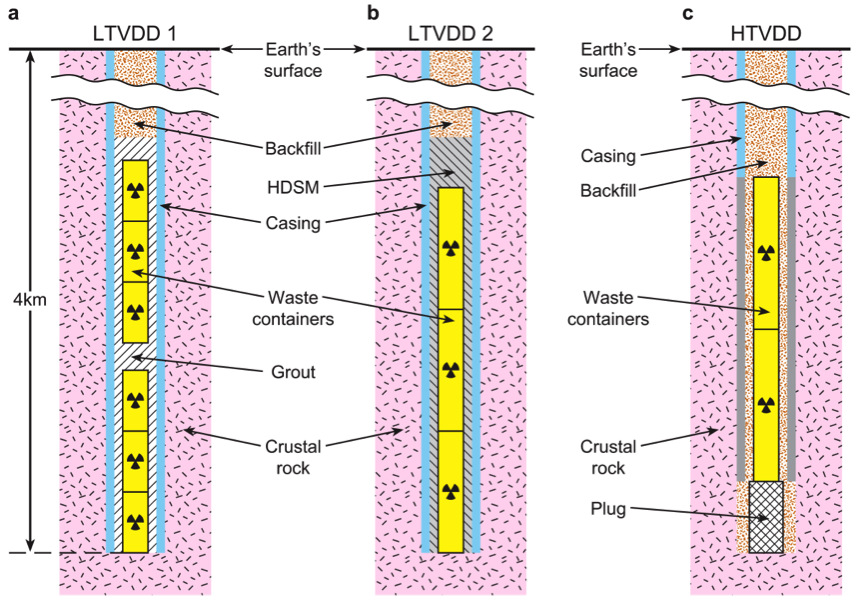
Deep borehole disposal (DBD) has been discussed as a possible means of disposing of spent fuel (SF) from nuclear power reactors in some East Asian countries, to support a prospective nuclear weapons free zone in the region, and to help to avoid security and sustainability dilemmas associated with the management of rapidly growing quantities of SF. This Working Paper examines the status of the DBD concept and discusses some of the implications for SF strategy in East Asia, with special emphasis on NE Asian countries.
The concept of deep borehole disposal (DBD) of spent fuel, high-level nuclear wastes (HLW, generated during the reprocessing of spent fuel to extract plutonium and uranium) and other radioactive wastes has been discussed actively for many decades. The US Nuclear Waste Technical Review Board identified DBD as a “technically viable type of geologic disposal”. In fact, it is a significant variant of ‘conventional’ geological disposal in deep underground repositories, which are mined facilities that can be accessed by shafts and tunnels during operation, and which have extensive underground cavern and tunnel excavations. Nevertheless, DBD retains many conceptual similarities with conventional repositories in terms of the way in which long-term containment and isolation of radioactivity are provided.
Scheduled Re-Entry at New Mexico Nuclear Waste Plant Delayed
April 1, 2014
(CARLSBAD, N.M.) — Workers were unable to re-enter the Waste Isolation Pilot Plant in Carlsbad on Tuesday as scheduled due to an equipment delay.
The radiation monitors that the personnel entering the plant are expected to wear were not received in time to enter the plant’s mines on Tuesday. The re-entry would have been the first since the plant was shut down following a February radiation leak.
Eight workers had been expected to establish a safe base of operations, conduct radiation surveys and check for airborne contamination.
The plant had been in operation for 15 years and allows for the permanent disposal of nuclear waste in salt mines over 2,000 feet below the earth’s surface. In February, prior to the initial radiation leak, the plant had suffered a vehicle fire in the underground mines.
Copyright 2014 ABC News Radio
Japan may only be able to restart one-third of its nuclear reactors

“Given the current unwillingness of the government to have stronger support for nuclear power they have to be prepared for the future replacement,” said Tatsujiro Suzuki, a vice chairman of the Japan Atomic Energy Commision, who is stepping down on Monday. https://nuclear-news.net/2014/03/31/japan-to-add-11000-mw-of-fossil-fuels-thinking-about-renewables-for-2050-maybe/
http://newsonjapan.com/html/newsdesk/article/107102.php
Three years after the Fukushima disaster prompted the closure of all Japan’s nuclear reactors, Prime Minister Shinzo Abe is moving to revive nuclear power as a core part of the energy mix, but many of those idled reactors will never come back online.
The above link will take you to the Japanese Media Center website that was abandoned in 2012. However I happen to know that the Japanese Science Media Center is still operating and giving the media some good climate change advice. – 🙂

Image source ; http://www.sciencemediacentre.org/blog/
LONG LIVE FIONNA FOX!!
The climate change queen
Arclight
New US/Russia nuclear warhead numbers released.
Department of State released some new data pertaining to New START aggregate numbers.
http://www.state.gov/t/avc/rls/224236.htm
Compared to previous declarations, there was a slight reduction of US numbers and a slight rise of Russian ones, mostly attributable to launch platforms (missiles, bombers and submarines) being shifted in and out of refurbishment.
Some chronological data for context:


h/t http://www.militaryphotos.net/forums/showthread.php?236892
1 This Month

of the week – Shut Down Drone Warfare!


Tell the Ukrainian Government to Drop Prosecution of Peace Activist Yurii Sheliazhenko

Petition to revoke the licensing of the Near Surface Nuclear Disposal Facility (NSDF) at Chalk River. https://www.ourcommons.ca/petitions/en/Petition/Details?Petition=e-7247
To see nuclear-related stories in greater depth and intensity – go to https://nuclearinformation.wordpress.com
-
Archives
- April 2026 (57)
- March 2026 (251)
- February 2026 (268)
- January 2026 (308)
- December 2025 (358)
- November 2025 (359)
- October 2025 (376)
- September 2025 (257)
- August 2025 (319)
- July 2025 (230)
- June 2025 (348)
- May 2025 (261)
-
Categories
- 1
- 1 NUCLEAR ISSUES
- business and costs
- climate change
- culture and arts
- ENERGY
- environment
- health
- history
- indigenous issues
- Legal
- marketing of nuclear
- media
- opposition to nuclear
- PERSONAL STORIES
- politics
- politics international
- Religion and ethics
- safety
- secrets,lies and civil liberties
- spinbuster
- technology
- Uranium
- wastes
- weapons and war
- Women
- 2 WORLD
- ACTION
- AFRICA
- Atrocities
- AUSTRALIA
- Christina's notes
- Christina's themes
- culture and arts
- Events
- Fuk 2022
- Fuk 2023
- Fukushima 2017
- Fukushima 2018
- fukushima 2019
- Fukushima 2020
- Fukushima 2021
- general
- global warming
- Humour (God we need it)
- Nuclear
- RARE EARTHS
- Reference
- resources – print
- Resources -audiovicual
- Weekly Newsletter
- World
- World Nuclear
- YouTube
-
RSS
Entries RSS
Comments RSS
 nuclear-news