Aircraft threaten nuclear power plants and other industrial plants – Global dimming effects over the Atlantic due to contrails increasing severe rainfall – 2
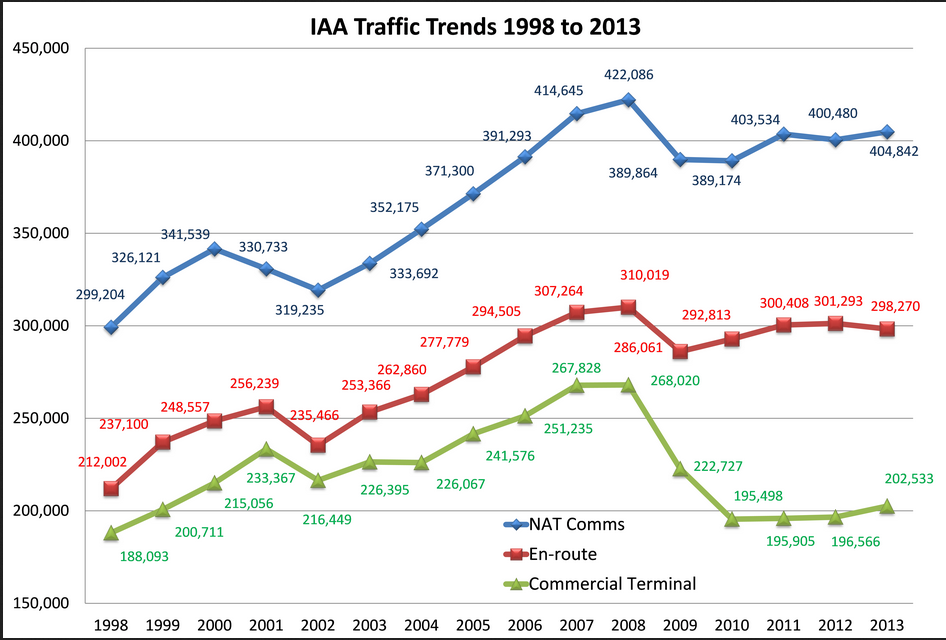
NATS is the UK’s leading provider of air traffic control services. Each year we handle 2.2 million flights and 220 million passengers in UK airspace.
http://www.nats.aero/about-us/what-we-do/our-control-centres/
OpEd
Arclight2011
20 February 2014
This post attempts to answer the question of what mechanism is causing the large amounts of record breaking levels of rainfall in Norway and the UK over recent years. Whilst global warming is an obvious answer as clouds hold more water if the atmosphere is warmer but the facts remain that increased flights across the Atlantic and increased particulates from various sources are responsible for this.
This dimming effect has repercussion concerning reports that use data that expects no quick changes to the earths climate (ref MET Office UK). In planning large projects such as nuclear power plants, waste/fuel processing work and storage sites, I have noticed that they refer to the incorrect information on the MET Office site and do not include the obvious recent data showing record breaking severe weather.
Of course this localised dimming effect causes the clouds to empty quicker in Europe and has reported to be causing droughts in Iran for instance.
Severe rainfall also can flood deep nuclear waste repositories as well as undermine buildings.
David Cameron on Sky TV yesterday did not say that climate change was definite and a done deal in answer to why is the flooding so severe. David Cameron decided to concentrate on the here and now and not worry about the future (even with more storms heading towards the UK).
So as part of my research i will place the links and info that is helping to inform me.. I think many flights are not reported (rendition and military but bear in mind that most flights to the wars from the USA to the middle east fly either to Ireland or across the top of Scotland).
Below are some links concerning localised global dimming in the context of global warming.
Extreme Weather in parts of the world (Updated 14 February 2014)
Parts of the world have witnessed a series of extreme weather conditions in the first six weeks of 2014, continuing a pattern that was set in December 2013.
Much of the United States of America has experienced cold waves and major winter storms, whilst California remains gripped by drought.The United Kingdom has seen its wettest December-January period on record, with severe, widespread and prolonged flooding. A combination of strong winds, storms and high tides caused damage and flooding in other coastal areas of Europe. There has been unusually heavy snowfall in the southern Alps.
Monthly mean temperatures were extremely high from eastern Mongolia to eastern China. In the Southern hemisphere, Australia, Argentina and Brazil experienced extended heatwaves.
Throughout this period, national meteorological and hydrological services provided forecasts and regularly-updated warnings.
http://www.wmo.int/pages/mediacentre/news/index_en.html
Tuesday, 8 January 2013: 9:15 AM
Relating the climate impact of trans-Atlantic flights to typical north Atlantic weather patterns
Room 17A (Austin Convention Center)
Emma A. Irvine, Univ. of Reading, Reading, Berkshire, United Kingdom; and K. P. Shine and B. J. Hoskins
Video of talk here that discusses the connection between contrails and the jet stream and high pressure ridges as well as the connection between dimming (cloud cover) and rain.
https://ams.confex.com/ams/93Annual/flvgateway.cgi/id/23305?recordingid=23305
Martin Wild
ETH Zurich, Institute for Atmospheric and Climate Science, Zurich, Switzerland
Coherent periods and regions with prevailing declines (“dimming”) and inclines (“brightening”) in surface solar radiation have been detected in the worldwide observational networks, often in accord with anthropogenic air pollution patterns
http://journals.ametsoc.org/doi/abs/10.1175/BAMS-D-11-00074.1
By Kharunya Paramaguru
Oct. 30, 2013
A new report on extreme-weather events by the Norwegian Meteorological Institute and the European national science academies suggests that “some of the extreme weather phenomena associated with climate change are increasing in frequency and intensity within Europe.” They also say that
“human activity has been the cause of more profound and rapid change”
for the earth’s climate.
Using computer modeling, the authors have found a “consensus” on “the likely future pattern of extreme weather events in Europe.” This includes more frequent and intense heat waves, as well as a reduction of rainfall and average temperatures for southern Europe.
For northern Europe, the authors say that “high intensity and extreme precipitation are expected to become more frequent……
Read more: Europe Hit by Powerful Storm: More Extreme Weather Is Likely in Future | TIME.com http://science.time.com/2013/10/30/bad-news-for-storm-battered-europe-theres-more-extreme-weather-on-the-horizon/#ixzz2tsKnjFg2
2011: world’s 10th warmest year, warmest year with La Niña on record, second-lowest Arctic sea ice extent
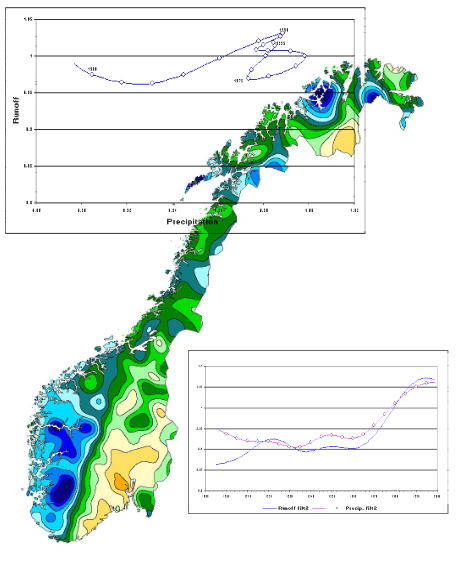
“Norway also had its wettest summer on record, and record summer rainfalls also occurred in many parts of Denmark and northeast Germany. “
http://www.wmo.int/pages/mediacentre/press_releases/gcs_2011_en.html
Past and future variations in climate and runoff in Norway
A comforting AUSTRALIAN view about climate change

Christina Macpherson’s websites & blogs
I’ve been humming Reg Livermore’s song all this morning ” I’m in the Dance Band on the Titanic” Now why is that? Oh, It’s ever since I learned of Prime Minister Tony Abbott’ response to the IPCC’s report on Climate Change – Tony’s got no worries. ““Australia is a land of drought and flooding rains, always has been and always will be”.
Is that not dandy? And here were we stressing unnecessarily about yesterday’s The  report by the Intergovernmental Panel on Climate Change. Those panic merchants say that climate change is already upon us, and will get worse. Especially here in Australia! Rubbish! (Excuse me while I yell to someone – ”for god’s sake someone turn on the air-conditioning, it’s boiling hot here”)
Anyway – not to worry, because it’s the poor and disadvantaged in Australia, who will be hit most. (Not US – will we?)
And, another thought. There’s that enthusiastic push in Australia for the nuclear industry , including the claim that nuclear power will solve the climate change problem. (That in itself is a bit of a problem for them, with a government that doesn’t believe in climate change).
But no doubt Tony Abbott will change his mind about climate change, as soon as BHP and Rio tell him to.
Nuclear industry for Australia? Sure, sez I, why just stuff up our country partially with coal and gas, when we can stuff it up completely with nuclear?
However, nuclear will have zilch impact on climate change, for many reasons. but here’s a couple:
- The time lapse until the 11,000 necessary nuclear plants are operating, will be many decades – by which time global warming will have run away with no hope of mitigation.
- The entire nuclear fuel cycle – uranium mining to reactor and waste burial – gives out heaps of carbon emissions. (The nuclear lobby just doesn’t count the dirty bits at the beginning and at the end.
INTERNATIONAL
Oh dear – in my patriotic delight that we in Australia are exempt from worrying about Climate and Nuclear, – I have left little space for those countries that are NOT Australia.
Well – the IPCC says that they are all going to cop Climate Change, too. (See youtube video) And odd people like Barack Obama, David Cameron, Xi Jinping, and all the European leaders believe it. Well, we in Oz never did trust foreigners, did we?
USA are going to spend over 1 $trillion making and minding their nuclear weapons until 2015
 UK is paying private companies 7 billion pounds to clean up old nuclear reactors.
Japan has a shocker of a nuclear energy plan so full of dangers that it is a (bad) April Fools Day joke.
Sorry – I gotta go and get some ice. Summer in Australia is supposed to end in February? Oh well….
Climate Change is now upon us, and it’s going to get worse
 Panel’s Warning on Climate Risk: Worst Is Yet to Come NYT, By JUSTIN GILLISMARCH 30, 2014 YOKOHAMA, Japan — Climate change is already having sweeping effects on every continent and throughout the world’s oceans, scientists reported Monday, and they warned that the problem is likely to grow substantially worse unless greenhouse emissions are brought under control.
The report by the Intergovernmental Panel on Climate Change, a United Nations group that periodically summarizes climate science, concluded that ice caps are melting, sea ice in the Arctic is collapsing, water supplies are coming under stress, heat waves and heavy rains are intensifying, coral reefs are dying, and fish and many other creatures are migrating toward the poles or in some cases going extinct.
The oceans are rising at a pace that threatens coastal communities and are becoming more acidic as they absorb some of the carbon dioxide given off by cars and power plants, which is killing some creatures or stunting their growth, the report found.
Organic matter frozen in Arctic soils since before civilization began is now melting, allowing it to decay into greenhouse gases that will cause further warming, the scientists said.
And the worst is yet to come, the scientists said in the second of three reports that are expected to carry considerable weight next year as
nations try to agree on a new global climate treaty. In particular, the report emphasized that the world’s food supply is at considerable risk — a threat that could have serious consequences for the poorest nations.
“Nobody on this planet is going to be untouched by the impacts of climate change,” Rajendra K. Pachauri, chairman of the intergovernmental panel, said at a news conference here on Monday…….. Timothy Gore, an analyst for Oxfam, the anti-hunger charity that sent observers to the proceedings, praised the new report for painting a clear picture. But he warned that without greater efforts to limit global warming and to adapt to the changes that have become inevitable, “the goal we have in Oxfam of ensuring that every person has enough food to eat could be lost forever.” http://www.nytimes.com/2014/03/31/science/earth/panels-warning-on-climate-risk-worst-is-yet-to-come.html?hp&_r=0
Japan’s Basic Energy Plan – a (bad) April Fools Day joke
Is the joke still on Fukushima this April Fools’? MAR 31, 2014 What’s wrong with this picture? Japan Times, Eric Johnson, Japan’s new Basic Energy Plan sees nuclear power as an important base load energy source. But whatever “base load” means politically, the public is lulled — fooled — into a sense that, despite Fukushima, nuclear will remain a logistically viable long-term option.
Yet the realities of Japan’s nuclear power industry show keeping nuclear are l ikely to be far more problematic — and expensive — than the pro-nuclear lobby wants to admit. Here are the most obvious hurdles.
First, as of 2013, of the remaining 48 reactors, three were more than 40 years and 13 were over 30 years old. The reactors were supposed to be decommissioned after 40 years but can now apply for a maximum two-decade extension.
Want to keep those reactors, with their increased risk of technical problems and thus lower efficiency rates, running until they’re 60? Even if they meet new safety standards, local governments hosting the reactors are sure to demand funding for pork-barrel projects in exchange for agreeing to any extension. Guess whose tax money will be used to ensure a continued flow of “cheap” nuclear power. Hint: look in the mirror.
 Even if restarted reactors run at pre-3/11 levels, estimates are their spent fuel pools will be overflowing like public toilets sooner rather than later. A Tokyo Shimbun calculation shows 33 reactors could see their pools full within six years. Government figures estimate the pools will be full within three to 16 years, with most filled to the brim within eight years.
What happens then? Tokyo is now pushing local governments to build interim storage facilities for the fuel before it’s sent to Rokkasho, Aomori Prefecture, for reprocessing. But despite promises of even more tax money for their coffers, no local government wants to host such a facility.
Finally, Japan’s population, about 127 million, will shrink to 107 million by 2040 while the working population, i.e. the large volume of electricity users, will decline by 30 percent. Furthermore, 21 percent of all Japanese will be 75 years or older, also by 2040. Who is going to need how much electricity?
So, the “nuclear will be an important base load” argument assumes: 1. Older plants can be run until they are 60 years without major problems and at a lower cost than other sources; 2. Within the next, say, 16 years, new storage facilities for spent fuel will be built somewhere; and 3. By 2040, a country with 16 percent less people than in 2010 and one-fifth the population over 75 will not use less energy than today.
What’s wrong with this picture?…….http://www.japantimes.co.jp/community/2014/03/31/issues/is-the-joke-still-on-fukushima-this-april-fools/
UK awards lucrative nuclear clean-up job to Babcock and Fluor
 Babcock wins UK nuclear clean-up deal, Guardian UK, British engineering contractors and US group Fluor given £7bn contract covering sites such as Hinkley, Sizewell and Dungeness Britain has awarded a 14-year, £7bn contract to manage the decommissioning of its nuclear sites to engineering contractors Babcock and US group Fluor. The deal covers some of Britain’s oldest nuclear power sites, including Hinkley, Sizewell and Dungeness, and is one of the largest contracts the country has put out to tender.,,,,,,,,
Aside from EnergySolutions and Bechtel, Babcock beat two other consortiums: Serco, Areva and CH2M Hill; and Amec, Atkins and Rolls-Royce in a two-year-long bidding process.
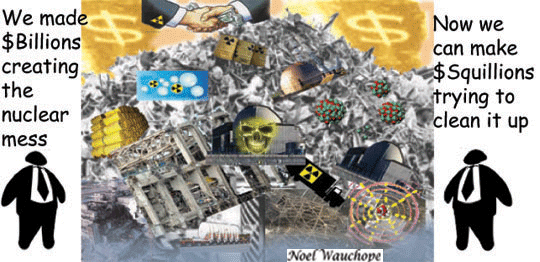
Cavendish Fluor, the joint venture between Babcock-owned subsidiary Cavendish Nuclear and Fluor, will be formally awarded the contract – pending legal approval – on 1 September , after a ten-day mandatory standstill and a five-month transition period.
“Cavendish Fluor Partnership bring a successful track record and extensive nuclear experience that will bring enormous benefits to the decommissioning and clean-up programme,” NDA chief executive John Clarke said………http://www.theguardian.com/business/2014/mar/31/babcock-uk-nuclear-clean-up-contract
Nuclear weapons, nuclear safety – the $trillion USA cost
 Money for Food or for Nuclear Bombs?OpEdNews Op Eds 3/31/2014 By Madelyn Hoffman We live in strange times, indeed. In the past few months, the U.S. Congress has failed to extend unemployment benefits for 1.3 million people and has passed legislation that will cut $8.6 billion in food stamps over the next 10 years, affecting 850,000 households in 1/3 of the states. Money for Food or for Nuclear Bombs?OpEdNews Op Eds 3/31/2014 By Madelyn Hoffman We live in strange times, indeed. In the past few months, the U.S. Congress has failed to extend unemployment benefits for 1.3 million people and has passed legislation that will cut $8.6 billion in food stamps over the next 10 years, affecting 850,000 households in 1/3 of the states.
At the same time, the 2015 budget shows a 7% increase in spending on nuclear weapons, from $18.6 billion to $19.4 billion — almost $1 billion. While the overall amount allocated for nuclear weapons is greater than last year, the funds dedicated to nuclear nonproliferation programs — programs to reduce the numbers of available warheads or securing so-called “loose nukes” was cut, making more dollars available to either build new nuclear weapons hardware or spend billions to modernize old ones, such as the B-61 bomb……… costs added together total $1.0095 trillion for 2015! Here are two ways to reduce this. Two nearly identical bills in the U.S. Congress today target nuclear weapons spending to save money. Senator Markey, D-Mass, introduced the “Smarter Approach to Nuclear Expenditures (SANE)” Act and Rep. Blumenauer, D-Ore, introduced the “Reduce Expenditures in Nuclear Infrastructure Now (REIN-IN)” Act. According toEric Tamerlani’s article “Reining in Nuke Spending the Smart Way” in the March 12th Roll Call, these bills will save taxpayers $100 billion on nuclear weapons over 10 years. The bills would reduce the number of new nuclear submarines, cap tactical nuke modernization and scrap the F-35’s nuclear mission. In late April, pro-disarmament activists from around the world will gather at the United Nations to prepare nuclear disarmament proposals to present at the 2015 Nuclear Nonproliferation Treaty (NPT) Review Conference. Sharon Dolev, Director of the Israeli Disarmament Movement, will participate. She will also speak on “Cooling the Hot Spot: A Nuclear Weapons Free Middle East” at NJPA’s April 27th Annual Dinner at the Regency House in Pompton Plains. Her talk will address what a nuclear weapons free Middle East means for Israel, the region, and the world, as well as obstacles within Israel to attaining that important goal. For more information and to make reservations, visit www.njpeaceaction.org. Cooling off tensions in the Middle East and preventing another war will release funds for programs that address community needs. This is not only timely, but essential, for genuine security in our nation and the world. http://www.opednews.com/articles/Money-for-Food-or-for-Nucl-by-Madelyn-Hoffman-Budget_Diplomacy_Food-Stamps_Food-Stamps-140331-42.html |
Iran’s Bushehr nuclear plant an earthquake-prone timebomb
 Olivier Guitta: Iran’s other nuclear timebomb http://fullcomment.nationalpost.com/2014/03/31/olivier-guitta-irans-other-nuclear-timebomb/ Olivier Guitta, National Post | March 31, 2014 While the international community has been focusing on a potential Israeli strike against Iranian nuclear facilities, another much larger issue looms, and should be tackled very urgently. But interestingly, except for a few concerned neighbours in the Gulf, nobody is really looking at the possible implications of a potential earthquake in Bushehr, where Iran’s oldest and main nuclear plant is located.
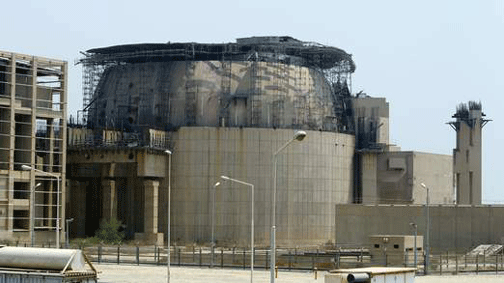
Bushehr, a city of over a million people in southeast Iran, sits in one of the most active seismic regions in the world, at the intersection of three tectonic plates. Building a nuclear plant in this area should have been a no-no, but construction started in 1975 with the help of Germany. It was stopped in 1979, right before the Revolution that unseated the Shah. It was resumed in 1996 with Russian assistance. The project took over 15 years to complete because of the very difficult technical issues of merging German and Russian technology. After Russia provided necessary nuclear fuel, the plant went operational in July 2013.
The safety issues concerning the plant are numerous: It is built with a 40-year-old design that has shown its limitations; the emergency coolant system is also 30 years old; it is running on two different technologies; according to the International Atomic Energy Agency, the staff is not properly trained to face any kind of accident. In February, 2011, a broken water pump caused small metallic pieces to infiltrate the reactor cooling system, forcing the unloading of the fuel rods.
1 This Month


18 March Webinar @ 1 PM EST: An Assessment of SMR Projects: The Case of Canada
register for the zoom:
https://us02web.zoom.us/webinar/register/WN_o8BIIOUvQ2ONJR1nta65DQ#/registration


of the week – STOP SMALL MODULAR REACTORS IN CANADA
To see nuclear-related stories in greater depth and intensity – go to https://nuclearinformation.wordpress.com
-
Archives
- March 2026 (140)
- February 2026 (268)
- January 2026 (308)
- December 2025 (358)
- November 2025 (359)
- October 2025 (376)
- September 2025 (258)
- August 2025 (319)
- July 2025 (230)
- June 2025 (348)
- May 2025 (261)
- April 2025 (305)
-
Categories
- 1
- 1 NUCLEAR ISSUES
- business and costs
- climate change
- culture and arts
- ENERGY
- environment
- health
- history
- indigenous issues
- Legal
- marketing of nuclear
- media
- opposition to nuclear
- PERSONAL STORIES
- politics
- politics international
- Religion and ethics
- safety
- secrets,lies and civil liberties
- spinbuster
- technology
- Uranium
- wastes
- weapons and war
- Women
- 2 WORLD
- ACTION
- AFRICA
- Atrocities
- AUSTRALIA
- Christina's notes
- Christina's themes
- culture and arts
- Events
- Fuk 2022
- Fuk 2023
- Fukushima 2017
- Fukushima 2018
- fukushima 2019
- Fukushima 2020
- Fukushima 2021
- general
- global warming
- Humour (God we need it)
- Nuclear
- RARE EARTHS
- Reference
- resources – print
- Resources -audiovicual
- Weekly Newsletter
- World
- World Nuclear
- YouTube
-
RSS
Entries RSS
Comments RSS
 nuclear-news