Ireland to trade wind energy from West Cork to back up French nuclear power failures/closures/shutdowns/accidents etc
BY CATHERINE KETCH
22 March 2014
AN interconnector between the south coast of Ireland and the north-west coast of France will facilitate the exchange of West Cork’s wind-generated energy for France’s nuclear power.
The two national transmission system operators – EirGrid and RTE, its French counterpart – signed a memorandum of understanding last summer to commission further preliminary studies on the feasibility of building a 600km submarine electricity interconnector between the two countries. The capacity of the new interconnector would be 700MW or the equivalent of power for 450,000 households and the project, if it went ahead, would in place by 2025.
The operators conducted studies in early 2013, which indicated that the project could be beneficial to electricity customers in both countries EirGrid has said. The benefits, according to EirGrid, would be increased security of supply, downward price pressure on electricity prices through competition and the potential to export renewable energy.

The spokesperson on the French side cited benefit from the varying wind resources of Ireland and the Continent as well as improving the electricity supply in the north-west part of France.
EirGrid carried out an economic feasibility report in 2009 highlighting the diversity between the two systems and the dominance of nuclear energy in France.
Further feasibility study is ongoing. The identification of feasible routes and landfall locations is expected to be completed early this year. Stage two for which a first round of tenders has been invited will involve a marine survey.
Last year EirGrid completed construction on the 500MW submarine East-West Interconnector between England and Wales.
Cork County Council’s draft development plan allows for the possible trebling of wind farms in West Cork and it is estimated that the region currently produces one fifth of the country’s wind energy.
MDMK for closure of Kudankulam nuclear power plant
Updated: March 23, 2014
S. Vijay Kumar
BJP will emerge as the single largest party, says Vaiko
Marumalarchi Dravida Munnetra Kazhagam will take steps to close down the Kudankulam Nuclear Power Project in Tirunelveli district. In its election manifesto, released by party general secretary Vaiko here on Saturday, the party also promised to make the State free from nuclear power plants.
Mr. Vaiko said the Bharatiya Janata Party would emerge as the single largest party and be in a position to form the next government and its candidate Narendra Modi would become the Prime Minister even without the support of the 40 MPs in Tamil Nadu and Puducherry.
Endorsing a ‘Modi wave’ across the country, he appealed to voters to support the National Democratic Alliance in the State as the Congress-led United Progressive Alliance had betrayed Tamils on various issues. “I appeal to the voters to support the BJP-led alliance if they want to save the State from corruption and liquor…we will erase the tears of the Eelam Tamils and protect the Tamil Nadu fishermen,” he said.
Mr. Vaiko demanded that 50 per cent of the tax collected from States be returned through the Planning Commission. His party would strive for achieving State autonomy which would only reinforce Centre-State relations and federalism.
Tymoshenko says Ukraine could refuse of Russian gas and nuclear fuel
March 22, 2014, 4:52 p.m. | Ukraine — by Interfax-Ukraine
Batkivschyna Party leader Yulia Tymoshenko has said that Ukraine could refuse of the Russian gas and nuclear fuel.
Rosenergoatom: Crimea to develop traditional energy production, not nuclear generation
In his opinion, Crimea should focus on developing alternative energy generation using the power of wind and sun. “This was done in Soviet times too, and one of the first solar power stations was operated in Crimea,”
http://en.itar-tass.com/russia/724928
MOSCOW, March 22, /ITAR-TASS/. Crimea needs to develop traditional energy production, not build a nuclear power plant, Pavel Ipatov, Deputy Director-General of the Rosenergoatom Company, told ITAR-TASS on Saturday, March 22.
“There are no ready projects for building nuclear power plants there and it would be premature to speak about that now. I would even say pointless,” he said.
Ipatov recalled that in Soviet times there had been a project to build two 1,000 MW nuclear units in Crimea. The first unit was almost 90 percent finished and things went so far that even nuclear fuel was brought in so that the reactor could start operating at in the early 1990s. “However, now this site is in such condition that it cannot be restored. We have gone far ahead from the technologies that existed in the 1960s when the station was designed… and sometimes it is much more economically justified to build a new project than restore an old one,” Ipatov said.
“The approaches and solutions used in modern projects are more progressive in terms of security and cost efficiency. Therefore there should be a very serious argument in order to consider building a nuclear power plant in Crimea today,” he said.
In his opinion, Crimea should focus on developing alternative energy generation using the power of wind and sun. “This was done in Soviet times too, and one of the first solar power stations was operated in Crimea,” he said and observed at the same time that the cost of such generation would be dozens of times higher than that of traditional forms, which makes “their commercial construction unlikely”.
Ipatov believes that traditional power plants will most likely be built instead. “We will see by the end of this year what kind of decisions will be made to improve power supply in Crimea,” he added.
Pressure mounting over £16bn nuclear site for Hinkley Point
Ms Walley, who is the Labour MP for Stoke-on-Trent North, said in the letter, seen by The Independent, that “the Government was wrong to insist that Hinkley Point was not being subsidised”. She has pointed Mr Almunia to a critical committee report published in December to convince him that Hinkley Point should not go ahead under its current financing arrangement

22 March 2014
The Government’s divisive plans for a new £16bn civil nuclear plant at Hinkley Point in Somerset have been dealt a double blow by the United Nations and a powerful group of MPs.
A UN environmental committee has warned that there is “profound suspicion” that the UK failed to properly consult neighbouring countries, including Norway and Spain, over the possible environmental impact that Hinkley Point C could have on them.
In a letter to the Department for Communities and Local Government, Vesna Kolar Planinsic, who chairs the UN’s implementation committee on the Convention on Environmental Impact Assessment in a Transboundary Context, said that the UK’s only consultation efforts amounted to “informal exchanges” with Ireland and Austria. The department has been ordered to send a delegation to face the committee in December.
Separately, Joan Walley, who chairs Parliament’s Environmental Audit Committee, has written to the European Competition Commissioner, Joaquin Almunia, to help an EU investigation into state aid for the two new reactors at Hinkley Point. This inquiry is considered the last big obstacle preventing the construction of a power station expected to meet around 7 per cent (enough to supply nearly 5 million homes) of the country’s energy needs from 2023.
The French energy giant EDF could only be persuaded to build the plant if a minimum price was guaranteed for the electricity generated from Hinkley C, thereby ensuring a return for shareholders worried about the enormous upfront construction costs. This minimum, known as the “strike price”, would be covered through increases in consumer bills.
Cape Cod Activists ‘Guilty’ for Plymouth Nuclear Plant Protest – Use of ‘Necessity Defense’ Denied
https://www.commondreams.org/headline/2014/03/22-0
Published on Saturday, March 22, 2014 by Common Dreams
Three years after Fukushima, and approximately one year after their acts of civil resistance, 12 Massachusetts residents were found guilty Friday in Plymouth (MA) District Court for illegally entering the grounds of the Pilgrim Nuclear Power Plant located on the Cape Cod coast.
The activists admitted to entering the Plymouth facility, but using the ‘necessity defense,’ declared they were innocent of “trespassing” because they were trying to prevent a greater and imminent public danger from occuring.
Diana Turco, co-founder of Cape Downwinders, Cape Cod residents who want the nuclear plant permanently shut down, was one of the 12 defendants.
“There are cancers caused by the nuclear power plant. There is no assurance of public safety in the evacuation plans. Those are huge issues,” Turco said. “The verdict doesn’t matter; the truth got out.”
The judge ruled the standards for the necessity defense were not met.
The 12 defendants were found guilty and each was sentenced to a day in jail, or time served.
Those defendants are: Bill Maurer, Diane Turco, Doug Long, Femke Rosenbaum, Janet Azarovitz, Joyce Johnson, Margaret Rice Moir, Mike Risch, Paul Rifkin, Sarah Thacher, and Susan Carpenter.
WBUR radio in Boston reports:
New Mexico nuclear site – Withdrawal of temporary permit allowing two new disposal vaults
http://news.yahoo.com/mexico-cancels-permit-expand-leaky-nuclear-waste-034936192–finance.html
By Laura Zuckerman
22 March 2014
(Reuters) – New Mexico on Friday withdrew a temporary permit allowing two new disposal vaults at a U.S. government nuclear waste dump grappling with a release of radiation in February, state regulators said.
Seventeen workers at the Carlsbad-area “waste isolation pilot project” (WIPP) were exposed to radiation after an accidental leak last month from the site which stores waste from U.S. nuclear labs and weapons production facilities.
State regulators were withdrawing the draft expansion permit to identify safety issues that may need to be addressed in the aftermath of that accident, New Mexico Environment Secretary Ryan Flynn told a news conference on Friday afternoon.
“We need to proceed with caution (and) assess any additional risks posed to either workers or the public,” Flynn said.
The draft permit would have allowed disposal of machinery, clothing and other items tainted with radioisotopes, like plutonium in two additional storage vaults and it granted changes to the way chambers filled to capacity are sealed.
No workers were underground at the U.S. Energy Department’s site when air sensors half a mile below the surface triggered an alarm, indicating unsafe levels of radioactive particles.
35 workers training to re-enter underground mine at troubled nuclear-waste dump
http://www.startribune.com/nation/251720411.html
- Article by: Associated Press
- Updated: March 22, 2014
CARLSBAD, N.M. — Employees at the federal government’s troubled nuclear waste dump in southeastern New Mexico are preparing to enter the facility’s underground mine for the first time since a radiation leak contaminated workers last month.
The U.S. Department of Energy announced Saturday that 35 workers have undergone training simulations at a Potash mine before re-entry next week into the Waste Isolation Pilot Plant (WIPP).
Employees went through a two-hour underground session using protective gear and air-breathing units, officials said.
Workers spent this week training for various scenarios that could occur in the mine.
According to the Department of Energy, the plan is for workers to set up an operating camp near a salt-handling shaft and then check for a secondary exit in the shaft that controls air flow. After that, they will focus on finding the source of the radiation release.
Japan’s shame: no solution in sight to Fukushima’s radioactive pollution
the current setup is untenable — particularly since so little is understood about how to deal with the melted-down reactors, or how long it will take to end the radiation threat. It is long past time that the government take direct control of the disaster site.
Fukushima’s Shameful Cleanup http://www.nytimes.com/2014/03/22/opinion/fukushimas-shameful-cleanup.html?hp&rref=opinion&_r=0 By THE EDITORIAL BOARD MARCH 21 A pattern of shirking responsibility permeates the decommissioning work at the damaged Fukushima Daiichi nuclear power plant. An increasing proportion of the 3,000 contract laborers at Fukushima are poorly trained, with little technical expertise or knowledge of radiation. They earn about $150 a day, less than what a regular construction job pays. Few are given insurance coverage. Many are destitute, recruited by ruthless labor brokers, some with ties to the mob. And the laborers are tossed out once they are exposed to the legal radiation limit. Critics point to the poor quality of the laborers for the series of large leaks of contaminated water. Continue reading
Nuclear industry thinks Ukraine crisis is great; “We might sell some nukes to Europe”
Nuclear industry hopes Ukraine crisis to boost business in Europe By Michel Rose PARIS, March 21 (Reuters) – Western players in the nuclear industry are hoping the conflict between Ukraine and Russia could help push countries in Eastern Europe that rely on Russian gas to turn to atomic energy…….
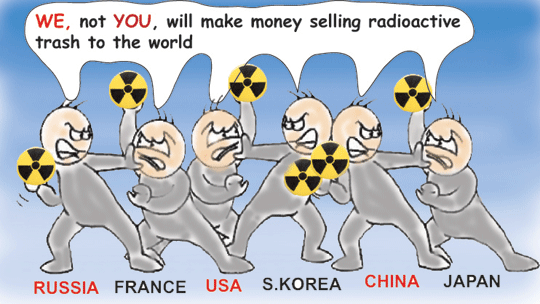
The nuclear industry, whose prospects were hit by the Fukushima disaster in Japan in 2011, has been keen to promote its advantages as a domestically produced source of clean energy by comparison with imported gas and polluting coal-fired plants.
“I think it is wise for eastern Europe to be evaluating nuclear, because it forces them to be less dependent on external forces, external politics,” Donald Hoffman, president of the American Nuclear Society (ANS), told Reuters on the sidelines of the SFEN nuclear industry conference in Paris.
Delegates from the French nuclear industry are also keen to export reactors to central European countries such as Poland and the Czech Republic.
“It (nuclear power) can bring rethinking in terms of energy independence,” said Christophe Behar, director of the French nuclear research centre CEA’s nuclear energy division……..”The first Ukrainian alert had played a role in energy policy decisions in Britain, for example,” said Philippe Knoche, chief operating officer at French nuclear reactor builder Areva.
Britain went on to award a 19 billion euro ($26.4 billion) contract last year to build the first new nuclear plant in Europe since Fukushima to a consortium made of EDF, Areva and Chinese state-owned companies CGN and CNNC……..
NO SHORT-TERM BOOST But other players were more sceptical on the prospects for nuclear energy in Eastern Europe as a response to the Ukrainian crisis. “The gas issue is very short-term, I don’t see how the nuclear industry could help,” said Jean Van Vyve, nuclear assets and projects manager at Belgium’s Electrabel, owned by GDF Suez.These countries’ existing heating infrastructure, mainly based on oil and gas and not on electrical devices, reduces the attractiveness of nuclear energy, he added.
Danes Burket, from Czech utility CEZ, did not expect a major boost for nuclear energy either. “I am not optimistic on that,” he said, partly because the EU energy strategy focuses more on supporting renewables than nuclear energy…… http://www.reuters.com/article/2014/03/21/nuclear-ukraine-idUSL6N0MH4VT20140321
Dr Helen Caldicott debunks rumour of death threats in Japan
 dunrenard
herve.courtois@yahoo.com
86.192.255.80 22 March 14, That was debunked today by Doctor Helen Mary Caldicott herself. No one threatened her in Japan, during an interview there she was asked if she had ever been threatened before. She answered that in the past she had been threatened several times in the USA.
In Japan: death threats as Dr Helen Caldicott spoke on the dangers of nuclearpower
 KPFA: Dr. Helen Caldicott threatened with death while in Japan for speaking about nuclear power — Students being charged with disturbing the peace for handing out flyers (AUDIO) http://enenews.com/kpfa-dr-helen-caldicott-threatened-death-japan-speaking-about-nuclear-power-students-charged-disturbing-peace-handing-flyers-audio?utm_source=feedburner&utm_medium=email&utm_campaign=Feed%3A+ENENews+%28Energy+News%29
KPFA Flashpoints, Mar. 10, 2014
Steve Zeltzer, reporting from Japan: We went to Osaka […] we were told there’s continuing repression. Activists here are being threatened, including Professor Shimoji who was arrested for handing out leaflets. The government is trying to suppress opposition to nuclear power by passing the secrecy law which just passed the parliament and also by intimidating antinuclear activists and saying they have to keep quiet. […] We also learned from Dr. Helen Caldicott that she was threatened. She spoke at a meeting in Kyoto on the 8th and it was reported at the meeting that she had been threatened by right-wingers with death for speaking out about the dangers of nuclear power. (correction – Dr Caldicott referred to previous incidents in USA, not Japan)
Can the Nuclear Security Summit actually do anything about the urgent danger of plutonium?
Harvard’s Bunn said the absence of top Russian leaders at the event will be noticed, if only because Russia and the United States together control the bulk of the world’s nuclear explosive materials.
Bunn, an expert on physical security, said that the summits have focused too much on short-term fixes rather than on building more robust systems to prevent nuclear terror. In a report, Bunn and his colleagues call for the establishment of a database of nuclear terror-related incidents to demonstrate that the threat is urgent.
 Move Over, Uranium, Now It’s Time for Plutonium Can the Nuclear Security Summit actually move beyond stopgap measures and vague promises? FP BY DOUGLAS BIRCH MARCH 21, 2014 proposal by Western countries to limit holdings of a key nuclear explosive, which appears in a draft communique for the Nuclear Security Summit beginning on March 24, is concise and modest.
- But its uncertain fate symbolizes the uphill battle Washington faces in moving the biennial summits beyond what critics depict as stopgap measures, small ambitions, and vague promises to tighten security for the world’s stockpile of nuclear explosives.
A January draft of the communique to be released at the March 24-25 summit in the Netherlands — convened at President Obama’s initiative — for the first time includes a suggestion that nations try to restrain their stocks of plutonium, the fuel for the bomb that devastated Nagasaki in August 1945. Continue reading

Fukushima molten nuclear fuel cores causing “Risk of re-criticallity”
Japanese TV: Fukushima fuel cores have ‘molten-through’ containment vessels — Location of molten fuels is unknown — “Risk of re-criticallity” from filling vessels with water http://enenews.com/japanese-tv-fukushima-fuel-cores-have-molten-through-containment-vessels-location-of-molten-fuels-is-unknown-risk-of-re-criticallity-from-filling-vessels-with-water?utm_source=feedburner&utm_medium=email&utm_campaign=Feed%3A+ENENews+%28Energy+News%29
Email update from Genn Saji, former Secretariat of Japan’s Nuclear Safety Commission, Mar. 10, 2014 (emphasis added):
On February 26, NHK released (Japanese only) a news on their overall view on un-dissolved nub parts of the Fukushima Daiichi nuclear accident. The identified issues are categorized in the following four topics;
De-fueling of “molten” core debris should start six years from now in the earliest — The core-meltdown has occurred in 1F1 through 1F3, resulting in penetration of the molten high temperature nuclear fuels through the RPV (Reactor Pressure Vessel) and leached at the bottom of the PCV (Primary Containment Vessel) in the Fukushima Daiichi accident. According to TEPCO’s schedule, the de-fueling should start in 2020 in the earliest. The overall decommissioning should be completed in a time span of 30-40 years.
Exact damage location of PCVs have not been identified — In attempting the above task, there is an urgent issue waiting for early solution. First of all, the exact damage locations of the PCVs where the fuel have molten-through has not been identified yet. TEPCO plans to fill the PCVs with water to shield against radiation […]
The molten fuels have not been characterized — Next issue is whereabout and characteristics of the molten fuels are not know. Without resolving these issues, it is not possible to establish the necessary approaches for de-fueling. In addition, there exists a risk of re-criticallity upon filling the PCV with water. The contaminated water is hindering human access for inspection with high radiation field and hazardous radioactive species. The Japanese Government and TEPCO are rushing for R&D of robots as well as theoretical predictions trying to grasp accurate status of nuclear fuels.
Searching for way out of contaminated water issues — Fundamental solutions are waited for the contaminated water issues which are generated through cooling of nuclear fuels. The contaminated water accumulated at the basements of buildings through leakage from PCVs. Its volume continue increasing, and a part of the water was found leaked unnoticed last year. […] leak path has not been identified […]
I believe NHK failed to identify two of the most important and serious issues among the consequences of Fukushima nuclear accident […] [one] issue is the root case of hydrogen explosion. NHK simply followed TEPCO’s scenario of zirconium-steam reaction. […]
(More to come about Saji’s view on the root cause of the explosions)
Fears and no secure answer to Japan’s nuclear waste

they should not make any more of the stuff

| Video: Japan nuclear waste disposal raises fears http://www.aljazeera.com/video/asia-pacific/2014/03/japan-nuclear-waste-disposal-raises-fears-201432145945421435.html |
| The government’s plan to find an underground disposal site has raised concerns over long-term safety. Japan’s government has encountered oppostion to find an underground disposal site for nuclear waste.
As Japan prepares to begin nuclear power generation again – after safety reviews carried out in the wake of the Fukushima disaster – there is increased focus on the long-term problem of nuclear waste. The government plans to find an underground disposal site but campaigners say Japan is not a safe place to bury highly radioactive materials. Al Jazeera’s Harry Fawcett reports from Horonobe, Japan. |
-
Archives
- February 2026 (228)
- January 2026 (308)
- December 2025 (358)
- November 2025 (359)
- October 2025 (376)
- September 2025 (258)
- August 2025 (319)
- July 2025 (230)
- June 2025 (348)
- May 2025 (261)
- April 2025 (305)
- March 2025 (319)
-
Categories
- 1
- 1 NUCLEAR ISSUES
- business and costs
- climate change
- culture and arts
- ENERGY
- environment
- health
- history
- indigenous issues
- Legal
- marketing of nuclear
- media
- opposition to nuclear
- PERSONAL STORIES
- politics
- politics international
- Religion and ethics
- safety
- secrets,lies and civil liberties
- spinbuster
- technology
- Uranium
- wastes
- weapons and war
- Women
- 2 WORLD
- ACTION
- AFRICA
- Atrocities
- AUSTRALIA
- Christina's notes
- Christina's themes
- culture and arts
- Events
- Fuk 2022
- Fuk 2023
- Fukushima 2017
- Fukushima 2018
- fukushima 2019
- Fukushima 2020
- Fukushima 2021
- general
- global warming
- Humour (God we need it)
- Nuclear
- RARE EARTHS
- Reference
- resources – print
- Resources -audiovicual
- Weekly Newsletter
- World
- World Nuclear
- YouTube
-
RSS
Entries RSS
Comments RSS
 nuclear-news