The JGov Dept of Truth strikes again….
More ☢ Funny Business (Sic) from the Japanese Gov’t.
U.S. Nuclear Fort Knox Compromised: “Multiple System Failures” and “Troubling Ineptitude”
Mac Slavo
March 24th, 2014
SHTFplan.com
Across the United States there exist numerous facilities at which nuclear fuel is manufactured and stored, including highly enriched uranium (HEU). According to experts, even someone with rudimentary skills could utilize this HEU fuel to create a nuclear weapon capable of leveling a major U.S. city.
You would think that after the destruction of the world trade center, thousands of deaths and hundreds of billions of dollars spent that the Department of Homeland Security would have made securing these facilities a top priority.
But you’d be wrong.
A new report from Harvard University underscores just how ripe with security holes and ineptitude these facilities really are. So much so that recently an 82 year-old nun and two of her cohorts compromised one of these locations with tools as simple as a pair of bolt cutters and a couple of hammers. What’s more is that the facility cited in the report is one that nuclear security experts refer to as the “Fort Knox of Highly Enriched Uranium” – the Y-12 Oak Ridge, Tennessee National Security Complex.
In the early morning hours of July 28, 2012, an 82 year-old nun and two other protesters broke into the Y-12 nuclear weapons production facility—sometimes referred to as the Fort Knox of HEU—in Oak Ridge, Tennessee. Equipped with hammers, paint, blood, and a pair of bolt cutters, they cut through four fences—three of them with intrusion detectors—setting off alarms, and traversed a 600-meter semi-wooded area until they arrived at the wall of a building housing hundreds of tons of HEU, enough for thousands of nuclear weapons. They painted blood on the walls, sang songs, and pounded on the building with their hammers, before finally being accosted by a single guard. Fortunately, they were not terrorists armed with explosives and did not mean any harm (and the building has specially designed walls that would be very difficult for terrorists to penetrate, along with extensive interior protections). But later investigations revealed a security culture failure of epic proportions, not only in the intrusion but also in the response.
How could this happen? The subsequent investigation of the incident by the Department of Energy (DOE) Inspector General revealed “multiple system failures on several levels” and “troubling displays of ineptitude” in Y-12’s security practices. For example, it turned out the site had a new intrusion detection system, which was setting off ten times as many false alarms as usual. Normally, the guard at the central alarm station could check if an alarm was caused by a real intruder using cameras along the fence—but the cameras had been broken for months. They had not been put on the priority list to be fixed, on the assumption that guards could always check out the alarms; but it appears that with so many false alarms, the guards had grown weary of investigating. For whatever reason, even a series of alarms on a path leading directly to the HEU building was not enough to prompt the guard at the central alarm station to take more serious action. The heavily armed guards inside the facility heard the hammering and thought it might be construction they had not been told about, even though it was before dawn, and did not bother to check.
In short, there was a profound breakdown in security culture—among those who tolerated an intrusion system setting off ten times as many false alarms as usual, among those who did not bother to fix the cameras, among the guards who did not react to the alarms or the hammering, and eventually in the armed response to the intrusion.
Perhaps even more troubling, prior to the intrusion, officials at DOE headquarters thought of Y-12 as one of their most secure sites, and had no idea such a serious erosion of security practices had occurred. Tom D’Agostino, then-administrator of the National Nuclear Security Administration (NNSA), warned that “this incident raises important questions about the security of Category I materials [those requiring the highest level of security] throughout the DOE complex.”
Full Report: Advancing Nuclear Security: Evaluating Progress and Setting New Goals (PDF)
The Department of Homeland Security insists that it is a necessary component of the national security apparatus.
They’ve certainly found time to weave a massive surveillance web across this country to record the digital interactions of every single American. They’ve highlighted the existence of serious threats emerging from domestic lone wolves who engage in activities such as making cash purchases, storing emergency supplies, or purchasing bulk ammunition. And these days everyone from a guy producing his own silver coins to kids making gun gestures with their fingers is accused of engaging in terrorist activity.
But when it comes to weapons of mass destruction it seems like no one in government really cares.
This report, yet again, brings to question the purpose of all the added security measures being forced upon the American people.
If national security is such a top priority of DHS and other agencies, then why is it that our Southern border remains so porous that individuals from countries like Iran and Afghanistan, some of them with possible ties to mid-east terrorist organisations, have been nabbed over the last several years trying to make their way into the United States?
How is it that critical utility infrastructure components like water reservoirs and electrical sub stations remain susceptible to even basic attacks?
And how, in a world where terrorism and improvised weapons are the typical method of attack, can supposedly highly secured nuclear facilities be broken into by a nun with bolt cutters?
An objective observer would have to conclude that protecting the United States from terrorists of the al-Queda Jihadi influence is not at all what these initiatives are all about.
Seriously, is anyone at DHS or the rest of our federal agencies paying attention to the real threats to our national security?
Jonathan Schell dies at 70; author and anti-nuclear activist
For four decades, Jonathan Schell covered war and politics as a reporter and columnist for The New Yorker, Newsday and The Nation.
http://www.latimes.com/obituaries/la-me-jonathan-schell-20140327,0,2301879.story#ixzz2x8Pdsl5t
March 26, 2014, 8:01 p.m.
Jonathan Schell, the author, journalist and activist who wrote passionately and cogently about war and politics for more than 40 years, condemning conflicts from Vietnam to Iraq and galvanizing the anti-nuclear movement with his horrifyingly detailed bestseller, “The Fate of the Earth,” died Tuesday at his home in New York City. He was 70.
The cause was cancer, according to Schell’s companion, Irena Gross.
With unrelenting rage and idealism, Schell focused on the consequences of violence in essays and books that conveyed a hatred of war rooted in part in his firsthand observations of American military operations in Vietnam.
He was only 24 when he published his first book, “The Village of Ben Suc” (1967), a graphic account of the American assault on a small village northeast of Saigon in 1967. Schell, then a graduate student returning from studies in Japan, wangled a press pass and swooped into the hamlet with the first wave of U.S. military helicopters, then chronicled its obliteration in quiet but forceful prose.
“It was a remarkable piece of reporting and writing, particularly for one so young and so modestly experienced,” New Yorker editor David Remnick wrote in a tribute Wednesday that described Schell as “an invaluable voice” of moral conscience.
As gentle in person as he was impassioned on paper, Schell was a reporter and columnist for such publications as The New Yorker, Newsday and most recently The Nation.
Among his books, “The Fate of the Earth” (1982) was his mostly widely praised. Originally published as a four-part series in the New Yorker, it opened with a detailed description of how atom bombs are made and the annihilation they would cause before proceeding to analyze the problems with deterrence theory and discourse on humanity’s obligation to future generations. It appeared at an especially tense moment of the Cold War, with public sentiment for a nuclear weapons freeze growing.
New Zealand – Are our muttonbirds radioactive? but no tests for Strontium 90
“We will need to go through a number of approval processes and engage in consultation with local people before anything can happen as there are sensitive issues to consider before work can begin.”
“Our study is complementary to that earlier work but tests feathers instead of the birds themselves,” Dr Krofcheck said.
http://www.odt.co.nz/news/national/296744/are-our-muttonbirds-radioactive
Thu, 27 Mar 2014
– By Jamie Morton of the NZ Herald
Scientists are to check whether New Zealand muttonbirds that spend the winter off the coast of Japan have been exposed to radiation from the damaged Fukushima nuclear power plant.
In a new pilot study, University of Auckland scientists will investigate whether radioactive cesium has entered the New Zealand ecosystem or food chain via the birds.
The wrecked plant and its trapped contents have loomed over Japan since floodwaters from the March 2011 tsunami knocked out the plant’s back-up generators that were supposed to keep cooling its nuclear fuel.
The over-heating sparked meltdowns in three reactors and forced 150,000 to flee, and tens of thousands have been unable to return home to areas contaminated by radiation.
In the study, researchers will test the birds’ feathers for gamma rays that indicate the presence of the radioactive isotope cesium-134.
Feathers will be collected from prime muttonbird sites in the South Island, particularly Stewart Island.
New Zealand sooty shearwaters or titi migrate annually, spending the summer mating and raising their chicks in New Zealand before over-wintering off the coast of Japan.
Dr David Krofcheck, of the university’s department of physics, said the research was “very much about taking a precautionary approach”as there was no evidence to indicate that the birds had been vectors of radioactivity.
“But detection of gamma rays would tell us whether the birds spend sufficient time near Fukushima to accumulate cesium-134 from nuclear fission,” he said.
“Obviously the issue would then become whether that radioactivity is being absorbed into local ecosystems or the food chain.”
Pacific Bluefin tuna caught off the west coast of the United States showed only a minute trace of cesium-134 from Fukushima, 100 times less than normal radioactive elements found in fish.
The sooty shearwater was of cultural and economic value to Maori, who sustainably harvested the nearly fledged chicks during the annual muttonbird season.
The season runs from April to May and was restricted to Maori and their whanau who use the birds for food, oil and feather down.
Dr Krofcheck said consultation with Maori, the Rakiura Titi Islands Administering Body, about the research would begin as soon as possible.
“We will need to go through a number of approval processes and engage in consultation with local people before anything can happen as there are sensitive issues to consider before work can begin.”
The research is being done in collaboration with the Department of Zoology, University of Otago.
Previous tests on muttonbird exposure to radiation from Fukushima found no evidence of cesium being passed from parents to chicks.
“Our study is complementary to that earlier work but tests feathers instead of the birds themselves,” Dr Krofcheck said.
“Obviously what we are hoping to find in this latest research is that cesium levels in muttonbirds do not exceed exposure levels you would expect from natural sources.”
– By Jamie Morton of the NZ Herald
TED’s Pro-Nuclear Bias – Dennis Riches
Thirty-six talks are tagged “energy” and among these only a few are primarily about nuclear energy while a few others cover it as a sub-topic. This is a reflection of the TED’s bias, but also of those searching for the best way to respond to global warming. Some of them are pro-nuclear, while others believe either that nuclear is so irrelevant that it’s not worth discussing, or they just want to make it a one-front war against the fossil fuel industry. The bias in the TED talks is also a reflection of society’s lack of concern about nuclear energy. Nuclear energy and nuclear weapons are no longer novelties that strike fear in our hearts, even though the risks haven’t changed at all.
http://nf2045.blogspot.jp/2014/03/teds-pro-nuclear-bias.html
TED talks gone nuclear: how neoliberal proselytizing goes hand in hand with the promotion of nuclear energy
The TED talks became popular about ten years ago once broadband video had become widely available. At first, the videos seemed like a valuable educational resource and a compelling alternative in a post-literate world to reading magazine articles. Few people would read, or even find, a report about the eradication of smallpox, but many more would find and listen to a twenty-minute personal narrative by the man who led the UN program which successfully eradicated smallpox. What’s not to like here? But over time I noticed that more and more of the talks ended with the speaker saying something to the live audience like “go out and change the world,” and it was clear that the message was directed at the wealthy, important people in attendance, not at the masses watching the recordings. It had become clear that TED reflected a particular belief system about how to improve the world, and that the conference had a missionary purpose which left people watching at home as mere spectators. Critical voices started to grumble about a vaguely sensed banality that arises from the missionary aura of the event. For a while, no one was quite able to define the problem, and it was difficult to find fault with a forum that presented so many interesting speakers and was apparently devoted to changing the world for the better. It wasn’t until 2012 that critical reviews seemed to be getting close to articulating what is wrong with TED. Martin Robbins wrote in “The Trouble with TED Talks” in New Statesman in September, 2012. He noted that the TED slogan “ideas worth spreading” indicates that TED is essentially concerned with proselytizing. A significant flaw in the structure of TED is that participation in the conference is accessible only to people who can pay thousands of dollars to attend for a few days. Robbins asks, “What better crowd could there be than social elites who’ve invested thousands of dollars for the opportunity to bask in the warm glow of someone else’s intellectual aura?” For Robbins, the major flaw is that ideas worth spreading are never challenged or peer reviewed. There is no question period after the talks, no debate, no transparency about the way speakers are selected. He concludes:
TED Talks are designed to make people feel good about themselves; to flatter them and make them feel clever and knowledgeable; to give them the impression that they’re part of an elite group making the world a better place. People join for much the same reason they join societies like Mensa: it gives them a chance to label themselves part of an intellectual elite. That intelligence is optional, and you need to be rich and well-connected to get into the conferences and the exclusive fringe parties and events that accompany them, simply adds to the irresistible allure. TED’s slogan shouldn’t be ‘Ideas worth spreading’, it should be: ‘Ego worth paying for’.
In December 2013, Benjamin Bratton wrote “We Need to Talk about TED” for The Guardian. He stated his opinion that “TED actually stands for: middlebrow megachurch infotainment.” He noted an implicit requirement that talks be based on “epiphany and personal testimony” in order to be considered worthy. He asked, “What is it that the TED audience hopes to get from this? A vicarious insight, a fleeting moment of wonder, an inkling that maybe it’s all going to work out after all? A spiritual buzz?” Bratton noted that TED management demanded that its various satellite conference organizers (TEDx events) refrain from featuring speakers whose topics include the paranormal, the conspiratorial and new agey. The goal was to have TEDx present talks that are imaginative yet grounded in reality. Bratton gives TED some credit for trying to maintain its reliability, but he noted:
“the corollaries of placebo science and placebo medicine are placebo politics and placebo innovation. On this point, TED has a long way to go… If we really want transformation, we have to slog through the hard stuff (history, economics, philosophy, art, ambiguities, contradictions). Bracketing it off to the side to focus just on technology, or just on innovation, actually prevents transformation… Keep calm and carry on “innovating” … is that the real message of TED? To me that’s not inspirational, it’s cynical. In the US the rightwing has certain media channels that allow it to bracket reality… other constituencies have TED.
In spite of what TED claims in its response to such criticisms, I think there is nonetheless an ideological bias in the TED conference, and this is incompatible with the objective of conducting an open search for innovative solutions to global problems. The problem can be understood by asking what is absent as opposed to what is present. Because it was established by and for technology millionaires, content has been consciously or unconsciously selected to reflect their world view. Prominent intellectuals, such as Noam Chomsky and Ralph Nader, for example, have never appeared on the TED stage. In TEDworld, solutions come in the form of small-scale initiatives by selected innovators that can be scaled up, if they receive support from wealthy donors during networking sessions at the conference. Someone who has developed an inexpensive water filter might get private funding to launch a large-scale deployment in an African country, but this is as far as problem-solving goes. The TED stage does not welcome discussion of the big questions about resource exploitation and the geopolitical goals of Western powers that perpetuate numerous African conflicts. No one on the TED stage talks about solving complex social problems through government policy, taxes on the wealthy, or electoral reform. Many TED speakers beseech the TED audience to take action because they see government and private enterprise as incapable of doing the right thing. Bill Gates said in his talk about his charitable foundation, “Governments don’t naturally pick these things [philanthropic initiatives] in the right way. The private sector doesn’t naturally put its resources into these things. So it’s going to take brilliant people like you… [special people in the TED audience]” Somehow, this depressing lack of faith in democratic institutions and traditions isn’t seen as detracting from the optimism and inspiration of the event. An excellent example of ideological filtering can be seen in the way TED has set the parameters of its discussion of nuclear energy. In the list below, I briefly comment on the few talks that have mentioned nuclear energy, and what emerges from this review is a bias that promotes nuclear energy as a solution to global warming yet avoids all mention of its historical failures, the health and environmental hazards, and the intractable problem of waste disposal. There is a long list of qualified and respectable nuclear scientists who lost their funding when they began to report findings unfavorable to national energy policy goals, but they have continued to do good research with funds they raise privately. These people have never been invited to the TED stage because it seems they have been categorized among those who do “placebo science,” science which is “not grounded in reality.” Other people who will never be invited are representatives of ethnic groups such as the Navajo, Dene and Marshallese who have been victimized by nuclear weapons testing and uranium mining. What follows is a brief summary and critique of the short list of TED talks that are concerned with nuclear energy.
1. Debate: Does the world need nuclear energy? (2010) This is perhaps the only instance of a TED talk presented as a multi-faceted discussion in which ideas are challenged by the debaters, the moderator and members of the audience. However, the debate parameters are stacked in favor of nuclear energy. The “No” answer is framed as needing to prove that renewable energy could provide enough baseload energy to replace both carbon and nuclear sources. The speaker, Mark Jacobson, is a specialist in atmospheric research and renewable energy, so he isn’t the best person to speak of the negative aspects of nuclear energy. The “anti-nuclear” argument is allotted little opportunity to discuss environmental impacts, health impacts, proliferation risks, the risk of catastrophic failures (this was one year before Fuskushima) and the questionable values of a society that leaves the nuclear waste legacy to future generations. Nonetheless, Jacobson manages to cover some of these topics while spending most of his time explaining the potential of renewables. The pro-nuclear argument is presented by the famous apostate of traditional environmentalism, Stewart Brand.
“Nuclear is pricing itself out of the market” – Citigroup
Coal, it says, is basically priced out of the market. Environmental regulations means that the LCOE for new coal is around 15.6c/kWh, and it notes that coal only accounts for 2 per cent of the generation projects under development.
On nuclear, Citi says cost over-runs at the Vogtle plant under construction in Georgia – now slated to cost $15 billion, way above expectations – mean that nuclear is pricing itself out of the market. Citi puts its LCOE at 11c/kWh), which it said is relatively expensive, vs combined cycle gas plants and solar and wind. And it notes that while financing costs are inexpensive in the current monetary environment, this situation will not last.
“Financing cost are likely to rise which would hurt the LCOE attractiveness of a high construction cost generating source like nuclear,” Citi says. “As a result, we do not expect nuclear to effectively compete on economic merits. Despite this LCOE dynamic, there is merit to increasing fuel diversity and supporting lower carbon generation. “
http://reneweconomy.com.au/2014/citigroup-says-the-age-of-renewables-has-begun-69852
By Giles Parkinson on 27 March 2014
Investment banking giant Citigroup has hailed the start of the “age of renewables” in the United States, the world’s biggest electricity market, saying that solar and wind energy are getting competitive with natural gas peaking and baseload plants – even in the US where gas prices are said to be low.
In a major new analysis released this week, Citi says the big decision makers within the US power industry are focused on securing low cost power, fuel diversity and stable cash flows, and this is drawing them increasingly to the “economics” of solar and wind, and how they compare with other technologies.
Much of the mainstream media – in the US and abroad – has been swallowing the fossil fuel Kool-Aid and hailing the arrival of cheap gas, through the fracking boom, as a new energy “revolution”, as if this would be a permanent state of affairs. But as we wrote last week, solar costs continue to fall even as gas prices double.
Citi’s report echoes that conclusion. Gas prices, it notes, are rising and becoming more volatile. This has made wind and solar and other renewable energy sources more attractive because they are not sensitive to fuel price volatility.
Citi says solar is already becoming more attractive than gas-fired peaking plants, both from a cost and fuel diversity perspective. And in baseload generation, wind, biomass, geothermal, and hydro are becoming more economically attractive than baseload gas.
It notes that nuclear and coal are structurally disadvantaged because both technologies are viewed as uncompetitive on cost. Environmental regulations are making coal even pricier, and the ageing nuclear fleet in the US is facing plant shutdowns due to the challenging economics.
“We predict that solar, wind, and biomass to continue to gain market share from coal and nuclear into the future,” the Citi analysts write.
Citi says the key metric in comparing power sources will be the levellised cost of energy (LCOE). “As solar, wind, biomass, and other power sources gain market share from coal, nukes, and gas, the LCOE metric increasingly becomes important to the new build power generation decision making,” it says.
(Citi defines LCOE as the average cost of producing a unit of electricity over the lifetime of the generating source. It takes into account the amount produced by the source, the costs that went into establishing the source over its lifetime, including the original capital expenditure, ongoing maintenance costs, the cost of fuel and any carbon costs. It also includes financing costs and ensuring that the project generates a reasonable internal rate of return (IRR) for the equity providers).
Here is the key graph on the current state of play, baseload generation and their renewable competitors to the left, and peaking gas and solar to the right.
On baseload, all renewables except marine beat coal and nuclear. Combined cycle gas just hangs on.
As for peaking plant, it depends on the gas prices, but these are rising and in some regions it is now back above its pre-GFC and fracking boom levels. The move to export LNG will likely cause a further increase in prices.
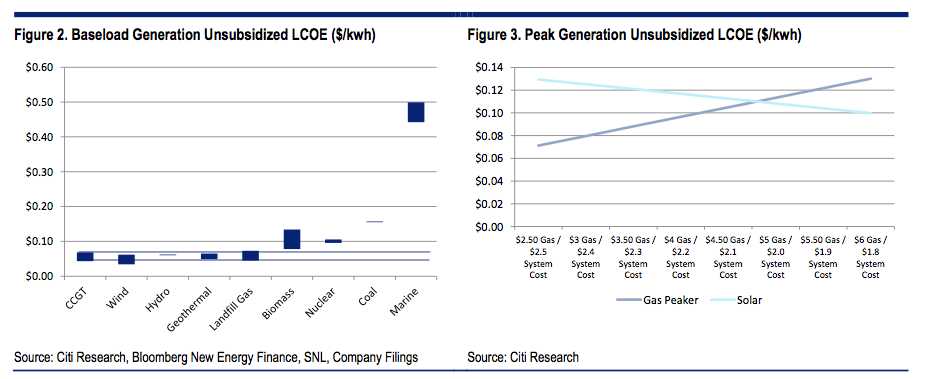
And here (below) is more on those gas prices. As can be seen, natural gas prices have nearly doubled in the past two years, and these have a direct correlation to the price of gas-fired electricity.

At a natural gas price of $US4.00/mmbtu, the LCOE of a gas peaker is $US0.10/kwh and a CCGT (combined cycle or baseload plant) is $US0.06/kwh. If Citi’s commodities team’s long-term gas price forecast of $5.50 is used, the implied LCOE is $0.12/kwh for natural gas peaker or $0.07/kwh for a CCGT plant.
“These numbers,” Citi says, “set the bar for alternative energy.
“Given the large expected increase in demand for gas, offset by production gains, gas prices are expected to rise over the long term. As a result, the bar for renewables and other fuel sources to cross continues to rise, thus making it easier for alternatives to gain market share.”
(Australia take note: its gas prices are already double the US price, which is why gas generation is being pushed out of the market. Coal, however, is recovering because the Australian government does not set strict emissions standards).
11 workers at Hanford nuclear waste facility hospitalised with ?radiation-caused illness
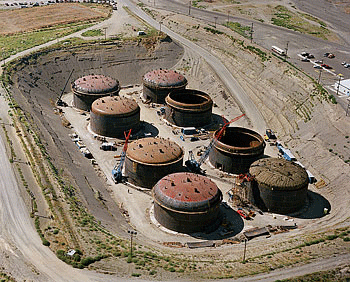 TV: 11 workers at U.S. nuclear site transported to medical facilities — Suffering nose bleeds, chest pains, coughing up blood — Multiple locations evacuated — Persistent symptoms “extremely unusual” — Workers: “The place is falling apart… serious problems out there” (VIDEO) http://enenews.com/tv-11-workers-at-u-s-nuclear-site-transported-to-medical-facilities-suffering-nose-bleeds-chest-pains-coughing-up-blood-multiple-locations-evacuated-persistant- KING 5 News Susannah Frame, Mar. 25, 2014: Hanford sources tell the KING 5 Investigators that at least 11 people have gotten sick in the last six days after breathing in toxic fumes while working near underground tanks holding hazardous nuclear waste. […] The first two workers to fall ill in the last week breathed in fumes that “tasted like copper” on Wednesday, March 19. […] both are still suffering effects of breathing in the vapors: headache, chest pain, difficulty breathing, nose bleeds and sore throats. One employee has coughed up blood. Sources who work in this area of Hanford tell KING […] this is “extremely unusual” to have symptoms persist this long. The next batch of employees to get sick breathed in fumes today, Tuesday, March 25. Four WRPS employees breathed in vapors at 9:00 am and were immediately transported to a medical facility […] the tank farm, identified as AY-AZ farm was evacuated […] Immediately afterward two employees from what’s known as the industrial hygiene department of WRPS [Washington River Protection Solutions], who monitor chemical exposures, were sent out to investigate and they too, had reactions to the fumes and were transported to the onsite medical facility. […] Sources tell KING 5 that three additional employees got sick from ingesting fumes later on Tuesday. TheseWRPS employees were working in a different portion of the tank farm […] about 8 to 10 miles from the AY-AZ farm. That location was also deemed a Vapor Control Zone and was evacuated. Sources say two were transported to the hospital by ambulance and one was transported to the HPMC.
Residents encouraged to return to Fukushima areas where radiation is high: data is withheld
nside Source: Gov’t officials are withholding Fukushima radiation data — Levels much higher than 
 Iexpected — Releasing numbers would “have a huge impact” — Over 2,000 millisieverts per year where residents are being encouraged to return http://enenews.com/inside-source-govt-officials-are-withholding-fukushima-radiation-data-levels-much-higher-than-expected-releasing-numbers-would-have-a-huge-impact-over-2000-millisieverts-per-year-wher?utm_source=feedburner&utm_medium=email&utm_campaign=Feed%3A+ENENews+%28Energy+News%29
Mainichi,Mar. 25, 2014: A Cabinet Office team has delayed the release of radiation measurements from three Fukushima Prefecture municipalities, and plans to release them later with lower, recalculated results, the Mainichi learned on March 24. […] According to one source, the original measurements were higher than expected, prompting the Cabinet Office team […] to hold the results back over worries they would discourage residents from returning. The Mainichi has acquired documents drawn up in November last year detailing the radiation measurements and intended for release. The documents, however, were never made public. According to this and other sources, the measurements were taken in September last year in the city of Tamura’s Miyakoji district, the village of Kawauchi and the village of Iitate […] According to an inside source, the Cabinet Office team had noticed that measurements taken with older dosimeters distributed by Fukushima Prefecture municipalities to residents showed radiation measurements much lower than those recorded by aerial surveys. The Cabinet Office team had planned to release the latest measurements […] putting special emphasis on how low the figures were. The new results, however, were significantly higher than expected, with the largest gap coming in Kawauchi. There, the Cabinet Office team had predicted radiation doses of 1-2 millisieverts per day, but the data showed doses at between 2.6 and 6.6 millisieverts. Cabinet Office team members apparently said that the numbers would “have a huge impact” […] and release of the results was put off. At the request of the Cabinet Office team, the JAEA and NIRS then recalculated the results by ditching the assumption that people would be outside eight hours a day […] Under these new assumptions, a farmer was now expected to spend around six hours a day outdoors.
Atsuo Tamura, official on the Cabinet Office team: “We did not hold the results back because they were too high. We did so because it was necessary to look into whether the assumptions for residents’ lifestyle patterns matched reality.”
Shinzo Kimura, associate professor of radiation and hygiene at Dokkyo Medical University: “The assumption of eight hours a day outside, 16 hours inside is commonly used, and it is strange to change it. I can’t see it as anything but them fiddling with the numbers to make them come out as they wanted.”
Mexico worried about the risks from USA’s radiation leak from New Mexico nuclear waste facility
Health & Environment
U.S. radiation leak concerns Mexicans
Juárez officials expected to meet with U.S. representatives on March 26 or 27 to discuss ongoing issues from February 14 incident
by Kent Paterson, Frontera NorteSur // March 25, 2014 Serious problems at a U.S. Department of Energy (DOE) nuclear waste dump in southeastern New Mexico have caught the eyes of the press and government officials in Ciudad Juarez, Mexico……Since February 14, additional radiation releases connected to the original one have been reported, even as more workers are still awaiting test results for possible radiation exposure during the first event. ……
Opened in 1999 after years of protests and litigation by environmentalists, WIPP is carved out of underground salt beds where low-level, or transuranic waste, from Cold War nuclear weapons programs is shipped for permanent burial. Transported from different sites across the United States, the disposed items contaminated with plutonium and other radioactive elements include clothing, tools, rags, soil and other materials, according to the DOE.
By 2011, WIPP had handled 10,000 shipments of transuranic waste. A private contractor, Nuclear Waste Partnership, operates the underground repository for the federal government…….
public doubts about the gravity of the February 14 incident persist due to incomplete contaminant data reporting, the slowness in getting all the potentially exposed workers tested and informed, spotty or contradictory statements by regulatory officials, and uncertainties over the origin of the radiation leak and how far an area it has impacted……
In mid-March, Farok Sharif was sacked as head of Nuclear Waste Partnership and Bob McQuinn named the new company president and WIPP project manager.
Mexican whistle-blower Bernardo Salas Mar, a former employee of the Laguna Verde nuclear power plant in Veracruz, said important bits of information need to be confirmed about theWIPP radiation release like the wind patterns at the time of the incident and the possible geographic scope of the spread of contaminants.
“The answer to these questions will lend knowledge to the damage that could have been caused,” Salas said. “After (radiation) ingestion or incorporation into the human organism, 10 or 15 years or more pass before the appearance of some kind of cancer.”
If plutonium and americium were indeed released into the larger environment, “the surrounding population should take precautions in order to avoid exposure to these contaminants,” he added…..
Back in the 1990s, Ciudad Juarez and U.S. environmentalists from the Rio Bravo Ecological Alliance took a stand against WIPPbased partly on concerns that the underground storage facility would eventually contaminate the Pecos River Basin and the Rio Grande.
February’s events have refocused public attention on not only the safety of current operations at WIPP, but plans to expand and streamline the depository’s storage capacity and even accept high-level waste from commercial operations …….
On February 28, representatives of 30 New Mexico citizen groups wrote to Flynn requesting that the Martinez administration cabinet official take precisely the action he did three weeks later.
“Once the radiation leak investigation and recovery occur, we would urge NMED to re-evaluate the draft permit in light of what is learned and make needed changes to protect public health and the environment before issuing a new draft permit for public review and comment,” the groups urged.
Signing on to the letter, among others, were representatives of Citizens for Alternatives to Radioactive Dumping, Laguna and Acoma Coalition for Safe Environment, New Mexico Environmental Law Center, Southwest Research and Information Center, Post-1971 Uranium Workers Committee, Albuquerque Mennonite Church, Concerned Citizens of Wagon Mound and Mora County, and Alliance for Environmental Strategies.
Dr. Mariana Chew, environmental engineer and longtime environmental activist in the Paso del Norte region, contended that a cross-border, information-credibility gap existed with regards to WIPP……Albuquerque and Santa Fe community meetings are sponsored by the Concerned Citizens for Nuclear Safety, Southwest Research and Information Center, Citizens for Alternatives to Radio Dumping and Nuclear Watch New Mexico.
“The same thing always happens. It happened with Asarco (ex-El Paso smelter) and other environmental disasters that weren’t made known to the public,” Chew was quoted in the daily Norte. “Given the history, this radiation shouldn’t be taken lightly. Whenever something happens, that’s when you hear about it.”
Additional Sources:…….http://newspapertree.com/articles/2014/03/25/us-radiation-leak-concerns-mexicans
Propaganda for Thorium nuclear reactors is no more than a distraction from the real plight of the entire nuclear industry
All in all, it rather looks like the nuclear industry, failing terribly to provide a reliable and affordable energy source, is trying to divert our attention from its scandals and incompetence to a distant, rosy dream. Not bad PR but not  much else.
The mythologies of thorium and uranium http://funologist.org/2014/03/26/the-mythologies-of-thorium-and-uranium by Jan Beránek – March 24, 2014 Thorium and uranium represent the heaviest naturally occurring elements on Earth. Both were named after ancient gods: Uranus was the principal Greek god of the sky while Thor was the Norse (and broadly Germanic) god of a thunder.
There’s a modern mythology surrounding thorium and uranium too, such as the currently very popular suggestion that thorium can replace uranium and deliver much better (safer, cheaper, fuel abundant) nuclear energy.
Well, we’ve heard all these things from advocates of nuclear energy before, haven’t we? Weren’t we told in the 50’s, 60’s, 70’s, 80’s, 90’s and even until recently that all these miracles would actually be delivered by uranium fueled reactors? Yeah, something obviously went wrong because none of those dreams actually came true, despite half a century’s worth of effort and hundreds of billions in subsidies poured into the nuclear industry.
What are the chances that replacing the Greek god with a Germanic one will help? Would Thor take his powerful hammer and nail it all down? Not likely.
Thorium technology is in principal based on nuclear fission and therefore keeps fission’s inherent problems. While it partially addresses some of the downsides of current commercial reactors based on uranium (plutonium) fuel, such as limited reserves of uranium and unwanted production of plutonium and transuranic isotopes, it still has significant issues related to fuel mining and fabrication, reactor safety, production of dangerous waste, and the hazards of the proliferation of nuclear weapons.
Let’s look more closely at some of the hopeful claims around thorium.
Safer reactors? The risks inherent in nuclear reactors are due to the massive concentrations of radioactive materials and the huge amount of heat they produce (which is actually needed to generate electricity). No matter if the fuel is based on uranium or thorium, if it’s solid or liquid, this characteristic alone will inevitably continue to be the Achilles heel of any nuclear reactor. As you can read in the Union of Concerned Scientists’ briefing on this issue, the truth is that the U.S. Department of Energy concluded in 2009 after a review that “the choice between uranium-based fuel and thorium-based fuel is seen basically as one of preference, with no fundamental difference in addressing the nuclear power issues [of waste management, proliferation risk, safety, security, economics, and sustainability].”
Less nuclear waste? It’s obvious that fission applied to different nuclear fuel results in a different composition of radioactive waste. But it’s still radioactive waste and whether the waste produced by thorium reactors is less problematic (because there’s no plutonium in it) remains a question. Spent thorium fuel still contains long-lived isotopes such as proactinium-231 (with a half-life 32,000 years which is even longer than plutonium Pu-239) which implies the need for long term management in timescales comparable to typical high level waste from uranium reactors. Not surprisingly, a chart published in Nuclear Engineering International magazine in November 2009 shows that the radiotoxicity of spent thorium fuel is actually higher than uranium spent fuel over the long term, ie after first 10,000 years:
No proliferation? Yes, thorium can’t itself be used to build nuclear weapons but it can’t be used directly as a nuclear fuel either. In fact, it has to be first converted into the fissile uranium isotope, U-233. That’s an isotope that is suitable for nuclear weapons. The US successfully detonated a nuclear bomb containing U-233 in 1955.
Even the UK Department of Energy and Climate Change commissioned a report which concluded in 2012 that the claims by thorium proponents who say that the radioactive chemical element makes it impossible to build a bomb from nuclear waste, leaves less hazardous waste than uranium reactors, and that it runs more efficiently, are “overstated”.
Thorium reactors exist only in blueprints and early experiments, which means there could be other issues not yet detected that would complicate their large scale implementation. In any case, this also means that it would take much longer than a decade before thorium reactors would potentially become available for a larger commercial deployment.
Recent studies, like the one published by the Norwegian thorium commission, while being supportive of the concept, also conclude that there are many uncertainties and problems related to it. It notes that Norwegian thorium reserves are of limited economic attractiveness compared to other sources; that accelerator-based reactors will be viable in the distant future at best; that thorium reactors would create nuclear waste problems; and that any of this will require massive international research.
Related to this is thorium’s unknown economic performance. Experts suggest that one of the key reasons why thorium reactors are not being developed is that they cannot compete economically with uranium fuel-based reactors, due to more complicated fuel fabrication and processing. And current pressurized water reactors are already uncompetitive. With investment costs of current reactor technology easily reaching 8,000 USD/kW of installed capacity, it is difficult to imagine that thorium reactors would be developed and built in foreseeable future.
All in all, it rather looks like the nuclear industry, failing terribly to provide a reliable and affordable energy source, is trying to divert our attention from its scandals and incompetence to a distant, rosy dream. Not bad PR but not much else.
While we are once again told to dream about a bright nuclear future, modern renewable energy technologies are already cheaper and upscaled well beyond nuclear: in 2013, while only 4,000 MW was globally installed in four single reactors, installations of wind and solar combined reached 80,000 MW. Those newly added capacities of wind and solar alone will generate, on an annual basis, as much electricity as twenty large reactors.
Let’s not get distracted. Let’s not waste even more time, money and brainpower on trying to make the impossible: a nuclear energy source that would actually really work. The future is renewable, and that’s where we need to go as quickly as possible.
The life of a Fukushima nuclear clean-up worker, shown in Manga art
Former Fukushima worker depicts life inside crippled nuclear plant in manga http://japandailypress.com/former-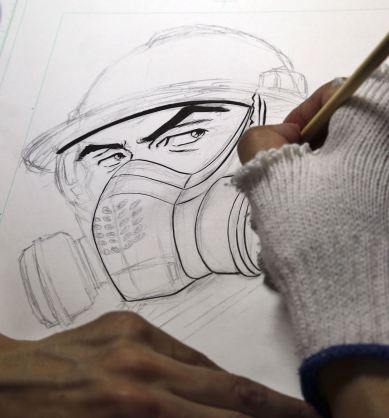 fukushima-worker-depicts-life-inside-crippled-nuclear-plant-in-manga-2646389/We’re used to having superheroes, athletes, samurai, chefs, and even taxmen, depicted in mangaseries, but would you be interested in reading about the “adventures” of nuclear plant workers? Well, if it depicts life at the crippledFukushima Daiichi nuclear plant, then maybe there is enough of an audience for this unique kind of story.
He then decided to write and draw the story of what he and the other workers experienced everyday. His first episode was published in the weekly manga magazine Morning, and even won a newcomer award for the 49-year-old artist. He is expected to release the next few episodes as a book next month, and his publisher Kodansha Ltd. is planning on turning it into a series. However, Tatsuta emphasizes that his story is not meant to take any side in the ongoing debate about the need for nuclear power vs the safety of the public. He also doesn’t mean to glorify nuclear plant workers, but said they deserve to earn more than what they’re getting, around $80-$200 a day, given the hazardous nature of their job. Tokyo Electric Power Co (TEPCO), the operator of the nuclear plant, refused to make any statement about the book, but spokesman Koichiro Shiraki said, “It’s just a manga.”
Read the entire first chapter of 1F, for free, translated into English on the series’ Facebook page (first 4 pages shown below in the original article.).
Obama stresses the importance of nuclear terrorism risk to New York and other cities
Obama says he’s more worried about the possibility of ‘nuclear weapon going off in Manhattan’ than  Russian threat
The President says the Russians ‘don’t pose the No. 1 national security threat to the United States,’ despite the Kremlin’s land grab of Crimea.
New Yorkers got a chilling wake up call Tuesday about just how badly terrorists want to strike the city.
The warning came straight from the top: President Obama.
During a news conference in Europe, Obama said he’s far more worried about the possibility of a nuclear weapon exploding in New York City than he is about the threat posed by Russia following its invasion of Ukraine.
“Russia is a regional power that is threatening some of its immediate neighbors, not out of strength, but out of weakness,” Obama said in The Hague, Netherlands.
“Russia’s actions are a problem. They don’t pose the No. 1 national security threat to the United States,” the President added……..
Anti-terrorism officials have long considered the detonation of a nuclear device in a major U.S. city the nation’s worst-case terror scenario.
Since 2007, the Department of Homeland Security has poured more than $118 million into the NYPD-led Securing the Cities nuclear detection program.The program pays for sensors — some stationary, some so small they are worn by first responders — that can detect unusual radiation as far as 150 miles from midtown Manhattan.
The sensors target both Hiroshima-style nuclear devices as well as “dirty” bombs — which use traditional explosives to spread radioactive material………http://www.nydailynews.com/news/politics/obama-warns-russia-ukraine-advance-article-1.1734113
Slowly, some progress on Nuclear Security
 Measured Progress on Nuclear Security

NYT, By THE EDITORIAL BOARDMARCH 25, 2014 Although the summit meeting was overshadowed by the crisis in Ukraine, 53 international leaders in The Hague this week made important progress on securing nuclear materials around the world and keeping them out of the hands of terrorist groups like Al Qaeda. There is still a long way to go to address the challenges of a world awash in nuclear materials and weapons, but many countries are taking constructive action……..At this week’s summit meeting, only 35 of the 53countries agreed to enact into their laws internationalguidelines on nuclear security like criminalizing unauthorized acts involving nuclear materials. What is needed are binding international legal standards, applicable to all, and a treaty to ban the production of fissile material altogether.http://www.nytimes.com/2014/03/26/opinion/measured-progress-on-nuclear-security.html?_r=0
India launches long range missile from underwater
INDIA TEST FIRES LONG RANGE N-MISSILE, Greater Kashmir, New Delhi, Mar 25: India has successfully test-fired a nuclear-capable ballistic missile launched from an underwater platform with a range of over 2,000 kms.
The missile, which can be launched from submarines, was test-fired yesterday in the Bay of Bengal and all parameters were met, Defence Ministry sources said.
This is the longest range missile in the underwater category to have been developed by India. With this development, India has developed the capability of launching long-range nuclear-capable missile from surface, air and underwater…….
Community speak ups forcibly to Panel on decommissioning of San Onofre nuclear plant
San Onofre panel hears from community Orange County Register 25 Mar 14,A Community  Engagement Panel tasked with helping guide Southern California Edison’s dismantling of the shuttered San Onofre Nuclear Generating Station got an earful from the public Tuesday night and raised questions of its own.
Most of the two dozen speakers who addressed the panel during a three-hour meeting at the San Clemente Community Center were activists urging the members to stress safety over efforts to save money……..
Edison appointed the panel to provide a public sounding board during what could be a 20-year decommissioning. Everyone agreed that safe storage of nuclear waste is the challenge, as the federal government hasn’t fulfilled a decades-old promise to provide permanent storage in a remote location.
“I’m concerned it will never be moved,” said San Diego County Supervisor Bill Horn, a panel member questioning how safe long-term on-site storage would be, particularly with I-5 and Southern California’s rail line close by.
“You, in my minds, are the guardians of the future of Southern California,” activist Marni Magda from Laguna Beach told the panel. Jenifer Massey of San Clemente and others suggested not waiting for the federal government and appealing instead to California to solve its own dilemma by establishing a remote site within the state……..
Palmisano described a process for decommissioning to nearly 200 people gathered at the Community Center.
“This is a huge engineering project,” said David Victor, chairman of the panel. “It seems to be as difficult to dismantle a plant as it is to build one in the first place.”
Victor said there will be some aspects where the panel can provide valuable input while other aspects will be constrained by the regulatory process – the U.S. Nuclear Regulatory Commission and California Public Utilities Commission.
Victor said the next meeting will be sometime in May at a site to be announced.http://www.ocregister.com/articles/panel-606987-san-community.html
-
Archives
- February 2026 (228)
- January 2026 (308)
- December 2025 (358)
- November 2025 (359)
- October 2025 (376)
- September 2025 (258)
- August 2025 (319)
- July 2025 (230)
- June 2025 (348)
- May 2025 (261)
- April 2025 (305)
- March 2025 (319)
-
Categories
- 1
- 1 NUCLEAR ISSUES
- business and costs
- climate change
- culture and arts
- ENERGY
- environment
- health
- history
- indigenous issues
- Legal
- marketing of nuclear
- media
- opposition to nuclear
- PERSONAL STORIES
- politics
- politics international
- Religion and ethics
- safety
- secrets,lies and civil liberties
- spinbuster
- technology
- Uranium
- wastes
- weapons and war
- Women
- 2 WORLD
- ACTION
- AFRICA
- Atrocities
- AUSTRALIA
- Christina's notes
- Christina's themes
- culture and arts
- Events
- Fuk 2022
- Fuk 2023
- Fukushima 2017
- Fukushima 2018
- fukushima 2019
- Fukushima 2020
- Fukushima 2021
- general
- global warming
- Humour (God we need it)
- Nuclear
- RARE EARTHS
- Reference
- resources – print
- Resources -audiovicual
- Weekly Newsletter
- World
- World Nuclear
- YouTube
-
RSS
Entries RSS
Comments RSS
 nuclear-news